
Life, 1922-12-14 · page 16 of 36
Life — December 14, 1922 — page 16: what you’re looking at
What you’re looking at
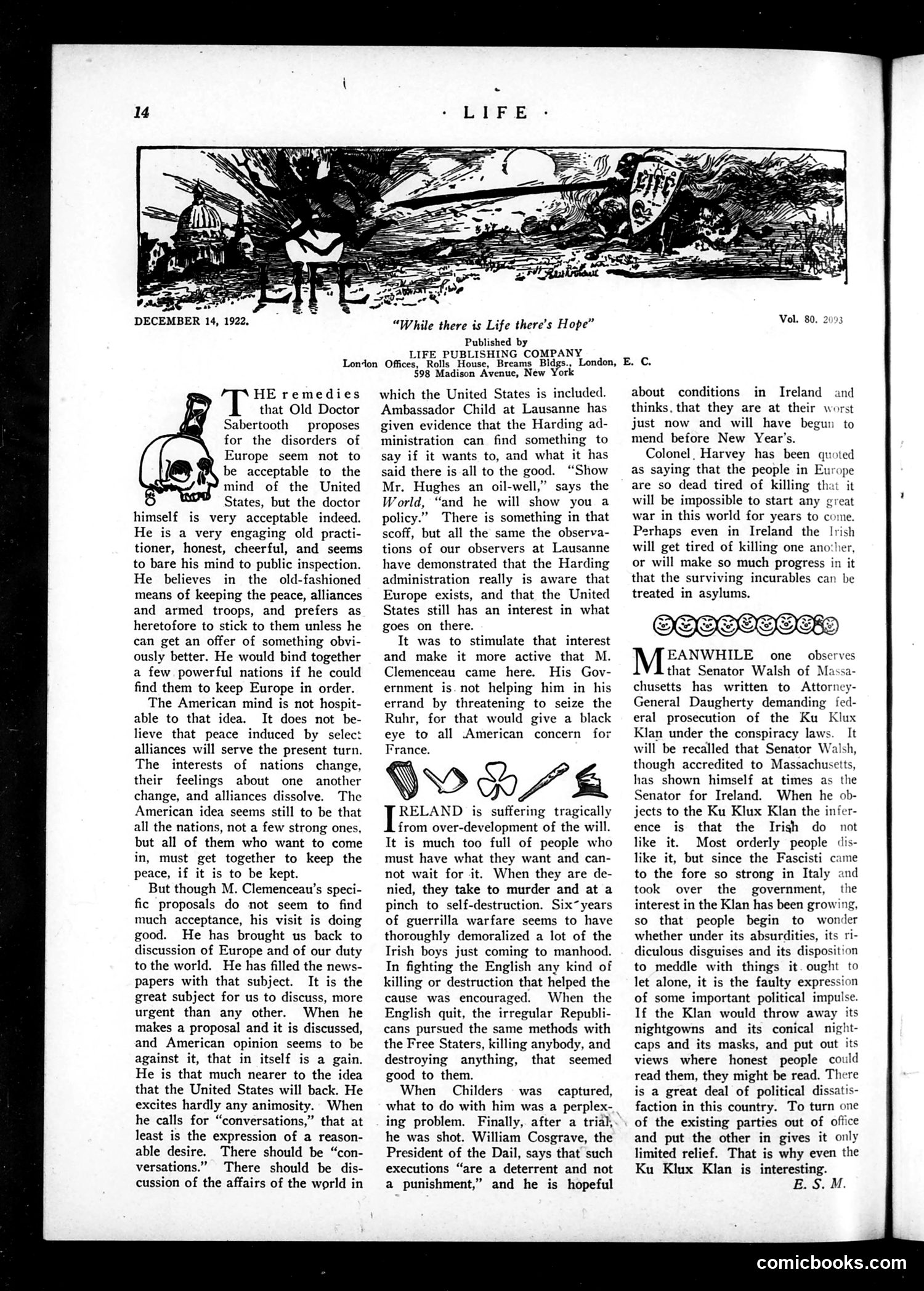
The page contains two editorial pieces discussing international affairs rather than a political cartoon. The main article critiques Old Doctor Sabertooth (likely a metaphorical figure representing European militarism or imperial powers) for proposing to cure Europe's disorders. The author argues this approach is unacceptable to American sensibilities, which favor peace through alliances rather than armed conflict. The second article addresses Ireland's suffering and turmoil, criticizing both English colonial methods and Irish republican violence. It also comments on Senator Walsh of Massachusetts advocating for prosecution of the Ku Klux Klan, noting the irony that Irish people—themselves victims of persecution—should be cautious about supporting such organizations. The pieces reflect 1920s American isolationism and domestic civil rights concerns.
📄 Transcribed text from this page (OCR, searchable)
Machine-transcribed from the original scan — historical spelling and the odd misread are preserved.
Ben ihe ae “While there is Life there’s Hope” Published by LIFE PUBLISHING COMPANY Lon‘on Offices, Rolls House, Breams Bldgs., London, E. C. HE remedies that Old Doctor Sabertooth proposes for the disorders of Europe seem not to be acceptable to the mind of the United States, but the doctor himself is very acceptable indeed. He is a very engaging old practi- tioner, honest, cheerful, and seems to bare his mind to public inspection. He believes in the old-fashioned means of keeping the peace, alliances and armed troops, and prefers as heretofore to stick to them unless he can get an offer of something obvi- ously better. He would bind together a few powerful nations if he could find them to keep Europe in order. The American mind is not hospit- able to that idea. It does not be- lieve that peace induced by select alliances will serve the present turn. The interests of nations change, their feelings about one another change, and alliances dissolve. The American idea seems still to be that all the nations, not a few strong ones, but all of them who want to come in, must get together to keep the peace, if it is to be kept. But though M. Clemenceau’s speci- fic proposals do not seem to find much acceptance, his visit is doing good. He has brought us back to discussion of Europe and of our duty to the world. He has filled the news- papers with that subject. It is the great subject for us to discuss, more urgent than any other. When he makes a proposal and it is discussed, and American opinion seems to be against it, that in itself is a gain. He is that much nearer to the idea that the United States will back. He excites hardly any animosity. When he calls for “conversations,” that at least is the expression of a reason- able desire. There should be “con- versations.” There should be dis- cussion of the affairs of the world in 598 Madison Avenue, New York which the United States is included. Ambassador Child at Lausanne has given evidence that the Harding ad- ministration can find something to say if it wants to, and what it has said there is all to the good. “Show Mr. Hughes an oil-well,” says the World, “and he will show you a policy.” There is something in that scoff, but all the same the observa- tions of our observers at Lausanne have demonstrated that the Harding administration really is aware that Europe exists, and that the United States still has an interest in what goes on there. It was to stimulate that interest and make it more active that M. Clemenceau came here. His Gov- ernment is. not helping him in his errand by threatening to seize the Ruhr, for that would give a black eye to all American concern for France. VY HA & RELAND is suffering tragically from over-development of the will. It is much too full of people who must have what they want and can- not wait for it. When they are de- nied, they take to murder and at a pinch to self-destruction. Six~years of guerrilla warfare seems to have thoroughly demoralized a lot of the Irish boys just coming to manhood. In fighting the English any kind of killing or destruction that helped the cause was encouraged. When the English quit, the irregular Republi- cans pursued the same methods with the Free Staters, killing anybody, and destroying anything, that seemed good to them. When Childers was captured, what to do with him was a perplex- ing problem. Finally, after a trial, he was shot. William Cosgrave, the President of the Dail, says that such executions “are a deterrent and not a punishment,” and he is hopeful about conditions in Ireland and thinks, that they are at their worst just now and will have begun to mend before New Year's. Colonel, Harvey has been quoted as saying that the people in Europe are so dead tired of killing that it will be impossible to start any great war in this world for years to come. Perhaps even in Ireland the Irish will get tired of killing one ano:her, or will make so much progress in it that the surviving incurables can be treated in asylums. CECeSeoe EANWHILE one _ observes that Senator Walsh of Mz chusetts has written to Attorney- General Daugherty demanding fed- eral prosecution of the Ku Klux Klan under the conspiracy laws. It will be recalled that Senator Walsh, though accredited to Massachusetts, has shown himself at times as the Senator for Ireland. When he ob- jects to the Ku Klux Klan the infer- ence is that the Irish do not like it. Most orderly people like it, but since the Fascisti came to the fore so strong in Italy and took over the government, the interest in the Klan has been growing, so that people begin to wonder whether under its absurdities, its ri- diculous disguises and its disposition to meddle with things it. ought to let alone, it is the faulty expression of some important political impulse. If the Klan would throw away its nightgowns and its conical night- caps and its masks, and put out its views where honest people could read them, they might be read. There is a great deal of political dissatis- faction in this country. To turn one of the existing parties out of office and put the other in gives it only limited relief. That is why even the Ku Klux Klan is interesting. E. S. M. Si dis- comicbooks.com