
Life, 1922-12-14 · page 26 of 36
Life — December 14, 1922 — page 26: what you’re looking at
What you’re looking at
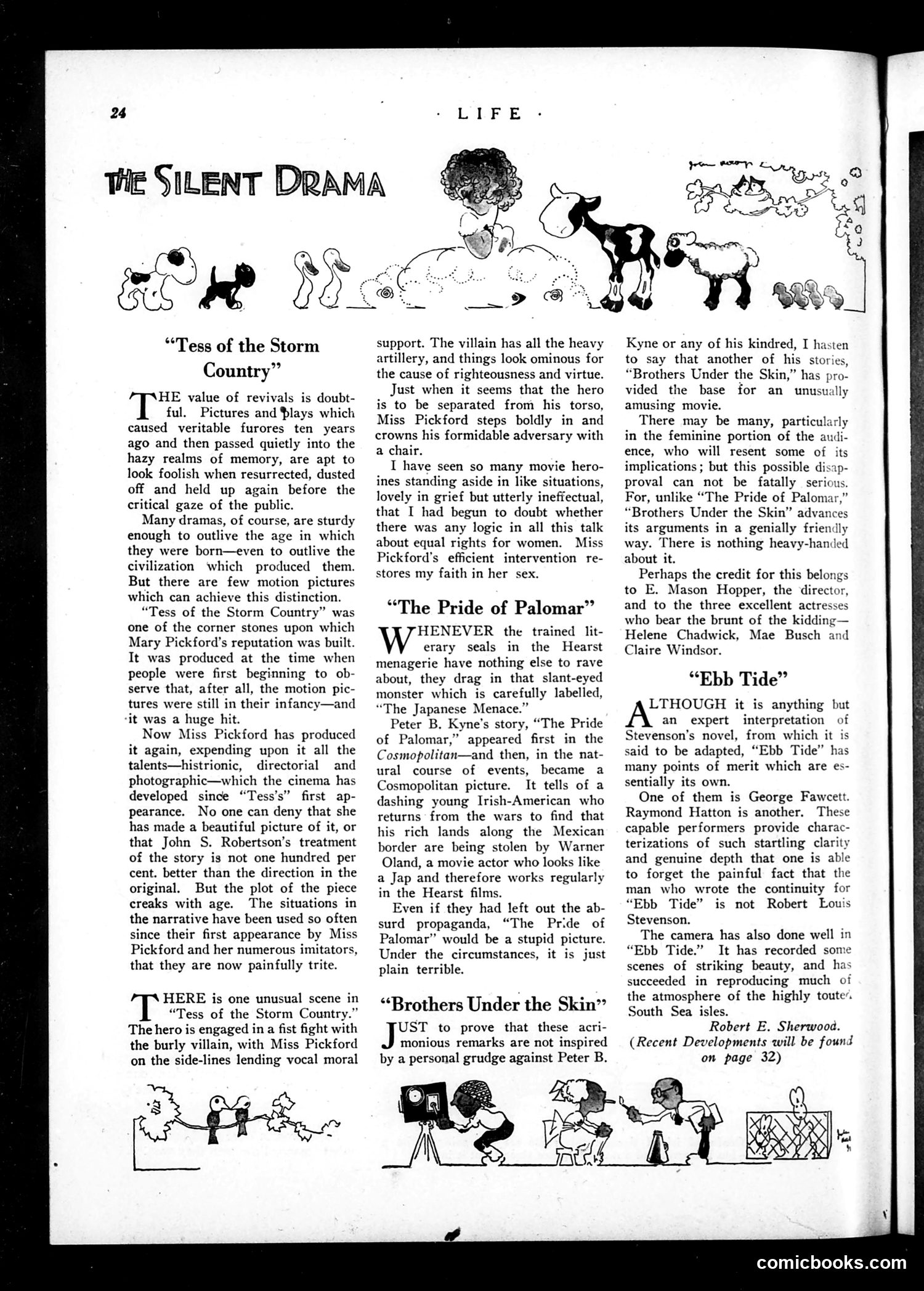
This page reviews three contemporary silent films, critiquing both their artistic merit and social messaging. **"Tess of the Storm Country"**: A Mary Pickford remake. The reviewer praises the updated production values but notes the plot feels dated from overuse. He surprisingly commends Pickford for having her character *actively intervene* in a fight scene—physically attacking the villain with a chair rather than standing passively by. He sarcastically suggests this restores his "faith" in women's equality, implying that most movie heroines were depicted as helpless. **"The Pride of Palomar"**: The reviewer harshly dismisses this as propaganda-laden drivel. It features Warner Oland (appearing "Japanese") as a villain stealing lands from an Irish-American hero. The critic mocks *Hearst menagerie* publications for constantly invoking "The Japanese Menace"—a contemporary xenophobic trope—to sell stories. **"Brothers Under the Skin"**: Also by Kyne, but the reviewer finds it genuinely amusing and good-natured, though it may offend some audience members with its implications about race or class. The page satirizes how films weaponize propaganda while praising those offering entertainment without malice.
📄 Transcribed text from this page (OCR, searchable)
Machine-transcribed from the original scan — historical spelling and the odd misread are preserved.
Tie SILENT DRAMA ne He “Tess of the Storm Country” HE value of revivals is doubt- ful. Pictures and lays which caused veritable furores ten years ago and then passed quietly into the hazy realms of memory, are apt to look foolish when resurrected, dusted off and held up again before the critical gaze of the public. Many dramas, of course, are sturdy enough to outlive the age in which they were born—even to outlive the civilization which produced them. But there are few motion pictures which can achieve this distinction. “Tess of the Storm Country” was one of the corner stones upon which Mary Pickford’s reputation was built. It was produced at the time when people were first beginning to ob- serve that, after all, the motion pic- tures were still in their infancy—and ‘it was a huge hit. Now Miss Pickford has produced it again, expending upon it all the talents—histrionic, directorial and photographic—which the cinema has developed since “Tess’s” first ap- pearance. No one can deny that she has made a beautiful picture of it, or that John S. Robertson’s treatment of the story is not one hundred per cent. better than the direction in the original. But the plot of the piece creaks with age. The situations in the narrative have been used so often since their first appearance by Miss Pickford and her numerous imitators, that they are now painfully trite. HERE is one unusual scene in “Tess of the Storm Country.” The hero is engaged in a fist fight with the burly villain, with Miss Pickford on the side-lines lending vocal moral ‘8 support. The villain has all the heavy artillery, and things look ominous for the cause of righteousness and virtue. Just when it seems that the hero is to be separated from his torso, Miss Pickford steps boldly in and crowns his formidable adversary with a chair. I have seen so many movie hero- ines standing aside in like situations, lovely in grief but utterly ineffectual, that I had begun to doubt whether there was any logic in all this talk about equal rights for women. Miss Pickford’s efficient intervention re- stores my faith in her sex. “The Pride of Palomar” HENEVER the trained lit- erary seals in the Hearst menagerie have nothing else to rave about, they drag in that slant-eyed monster which is carefully labelled, “The Japanese Menace.” Peter B, Kyne’s story, “The Pride of Palomar,” appeared first in the Cosmopolitan—and then, in the nat- ural course of events, became a Cosmopolitan picture. It tells of a dashing young Irish-American who returns from the wars to find that his rich lands along the Mexican border are being stolen by Warner Oland, a movie actor who looks like a Jap and therefore works regularly in the Hearst films. Even if they had left out the ab- surd propaganda, “The Pride of Palomar” would be a stupid picture. Under the circumstances, it is just plain terrible. “Brothers Under the Skin” UST to prove that these acri- monious remarks are not inspired by a personal grudge against Peter B. xa “4 AWW Kyne or any of his kindred, I hasten to say that another of his stories, “Brothers Under the Skin,” has pro- vided the base for an unusually amusing movie. . There may be many, particu! in the feminine portion of the audi- ence, who will resent some of its implications ; but this possible disap- proval can not be fatally serious. For, unlike “The Pride of Palomar,” “Brothers Under the Skin” advances its arguments in a genially friendly way. There is nothing heavy-handed about it. Perhaps the credit for this belongs to E. Mason Hopper, the director, and to the three excellent actresses who bear the brunt of the kidding— Helene Chadwick, Mae Busch and Claire Windsor. “Ebb Tide” ALTHOUGH it is anything but an expert interpretation of Stevenson's novel, from which it is said to be adapted, “Ebb Tide” has many points of merit which are es- sentially its own. One of them is George Fawcett. Raymond Hatton is another. These capable performers provide charac- terizations of such startling clarity and genuine depth that one is able to forget the painful fact that the man who wrote the continuity for “Ebb Tide” is not Robert Louis Stevenson. The camera has also done well in “Ebb Tide.” It has recorded some scenes of striking beauty, and has succeeded in reproducing much of the atmosphere of the highly toute. South Sea isles. Robert E. Sherwood. (Recent Developments will be found on page 32) comicbooks.com