
Life, 1922-12-14 · page 24 of 36
Life — December 14, 1922 — page 24: what you’re looking at
What you’re looking at
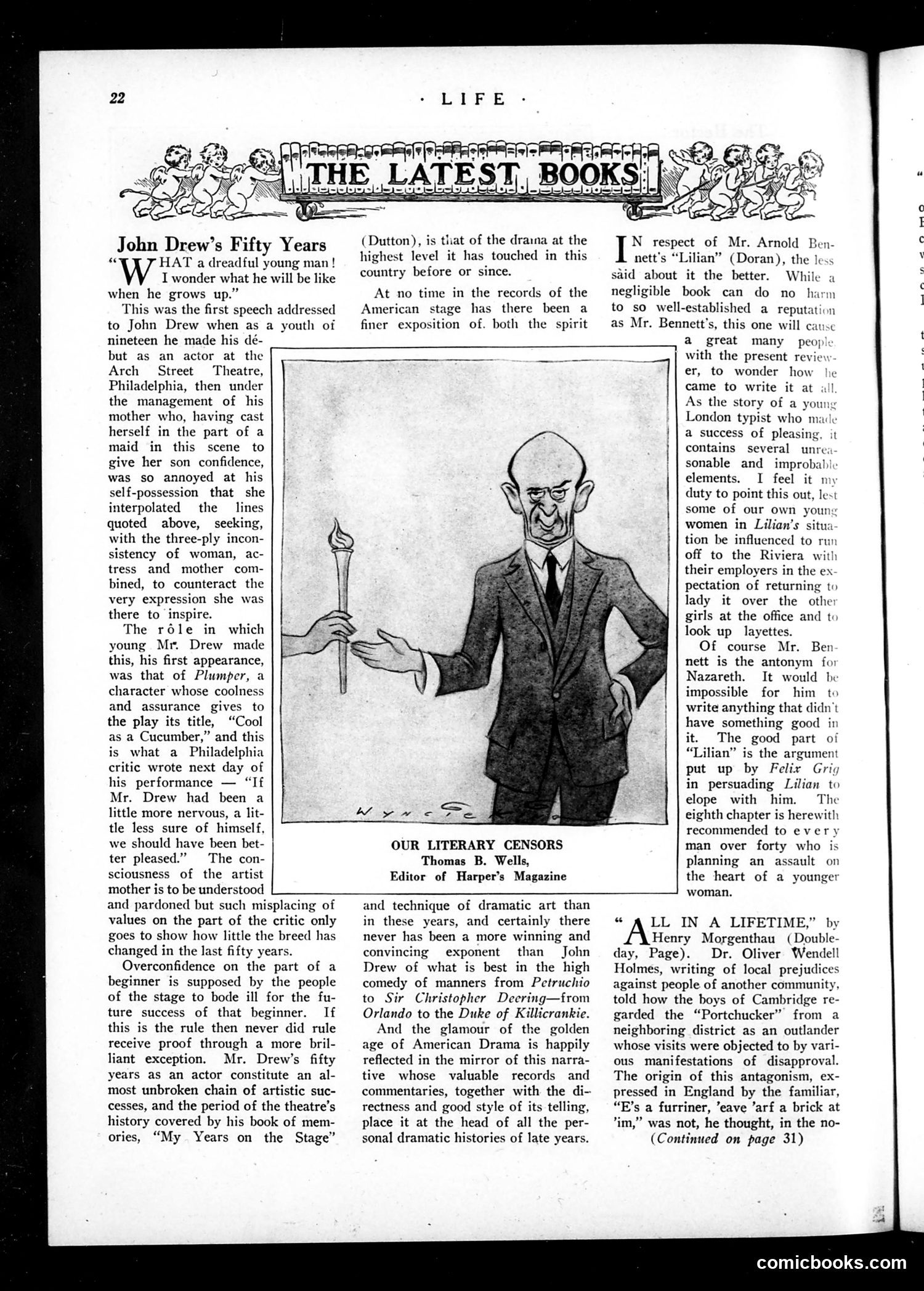
The cartoon depicts Thomas B. Wells, editor of Harper's Magazine, portrayed as a stern censor wielding what appears to be a censorious implement. The accompanying article reviews Arnold Bennett's novel "Lilian," criticizing it for potentially corrupting young women by depicting a typist who runs away with her employer to the Riviera, then returns to lord it over her coworkers. Wells objects to the book's "unreasonable and improbable elements" as dangerous moral influence. The satire targets Wells's self-appointed role as moral gatekeeper—ironically, he praises Bennett's writing quality while warning against its corrupting influence on female readers. The piece exemplifies early 20th-century literary censorship attitudes, where magazine editors positioned themselves as protectors of public morality, particularly regarding women's behavior and aspirations.
📄 Transcribed text from this page (OCR, searchable)
Machine-transcribed from the original scan — historical spelling and the odd misread are preserved.
John Drew’s Fifty Years HAT a dreadful young man! I wonder what he will be like when he grows up.” This was the first speech addressed to John Drew when as a youth of nineteen he made his dé- “ (Dutton), is that of the draina at the highest level it has touched in this country before or since. At no time in the records of the American stage has there been a finer exposition of. both the spirit N respect of Mr. Arnold Ben- nett's “Lilian” (Doran), the | said about it the better. While a negligible book can do no harm to so well-established a reputation as Mr. Bennett's, this one will cause but as an actor at the Arch Street Theatre, J Philadelphia, then under the management of his mother who, having cast herself in the part of a maid in this scene to give her son confidence, was so annoyed at his self-possession that she interpolated the lines quoted above, seeking, with the three-ply incon- sistency of woman, ac- tress and mother com- bined, to counteract the very expression she was there to inspire. The role in which young Mr. Drew made this, his first appearance, was that of Plumper, a character whose coolness and assurance gives to the play its title, “Cool as a Cucumber,” and this is what a Philadelphia critic wrote next day of his performance — “If Mr. Drew had been a little more nervous, a lit- tle less sure of himself, we should have been bet- ter pleased.” The con- sciousness of the artist mother is to be understood OUR LITERARY CENSORS Thomas B. Wells, Editor of Harper’s Magazine = a great many pe __ with the present review- | er, to wonder how he came to write it at «ll As the story of a you London typist who m: a success of pleasing contains several unrea- sonable and improbal)| elements. I feel it my duty to point this out, lest some of our own young women in Lilian’s situa tion be influenced to run off to the Riviera with their employers in the ex pectation of returning to lady it over the othe: girls at the office and to look up layettes. Of course Mr. Ben nett is the antonym for Nazareth. It would hx impossible for him to write anything that didn’t have something good in it. The good part of “Lilian” is the argument put up by Felix Grig in persuading Lilian to elope with him. The eighth chapter is herewith recommended to every man over forty who is planning an assault on the heart of a younger and pardoned but such misplacing of values on the part of the critic only goes to show how little the breed has changed in the last fifty years. Overconfidence on the part of a beginner is supposed by the people of the stage to bode ill for the fu- ture success of that beginner. If this is the rule then never did rule receive proof through a more bril- liant exception. Mr. Drew’s fifty years as an actor constitute an al- most unbroken chain of artistic suc- cesses, and the period of the theatre’s history covered by his book of mem- ories, “My Years on the Stage” and technique of dramatic art than in these years, and certainly there never has been a more winning and convincing exponent than John Drew of what is best in the high comedy of manners from Petruchio to Sir Christopher Deering—from Orlando to the Duke of Killicrankie. And the glamour of the golden age of American Drama is happily reflected in the mirror of this narra- tive whose valuable records and commentaries, together with the di- rectness and good style of its telling, place it at the head of all the per- sonal dramatic histories of late years. woman. = LL IN A LIFETIME,” by Henry Morgenthau (Double- day, Page). Dr. Oliver Wendell Holmes, writing of local prejudices against people of another community, told how the boys of Cambridge re- garded the “Portchucker” from a neighboring district as an outlander whose visits were objected to by vari- ous manifestations of disapproval. The origin of this antagonism, ex- pressed in England by the familiar, “E’s a furriner, ’eave ’arf a brick at ’im,” was not, he thought, in the no- (Continued on page 31) comicbooks.com \