
Life, 1922-12-14 · page 20 of 36
Life — December 14, 1922 — page 20: what you’re looking at
What you’re looking at
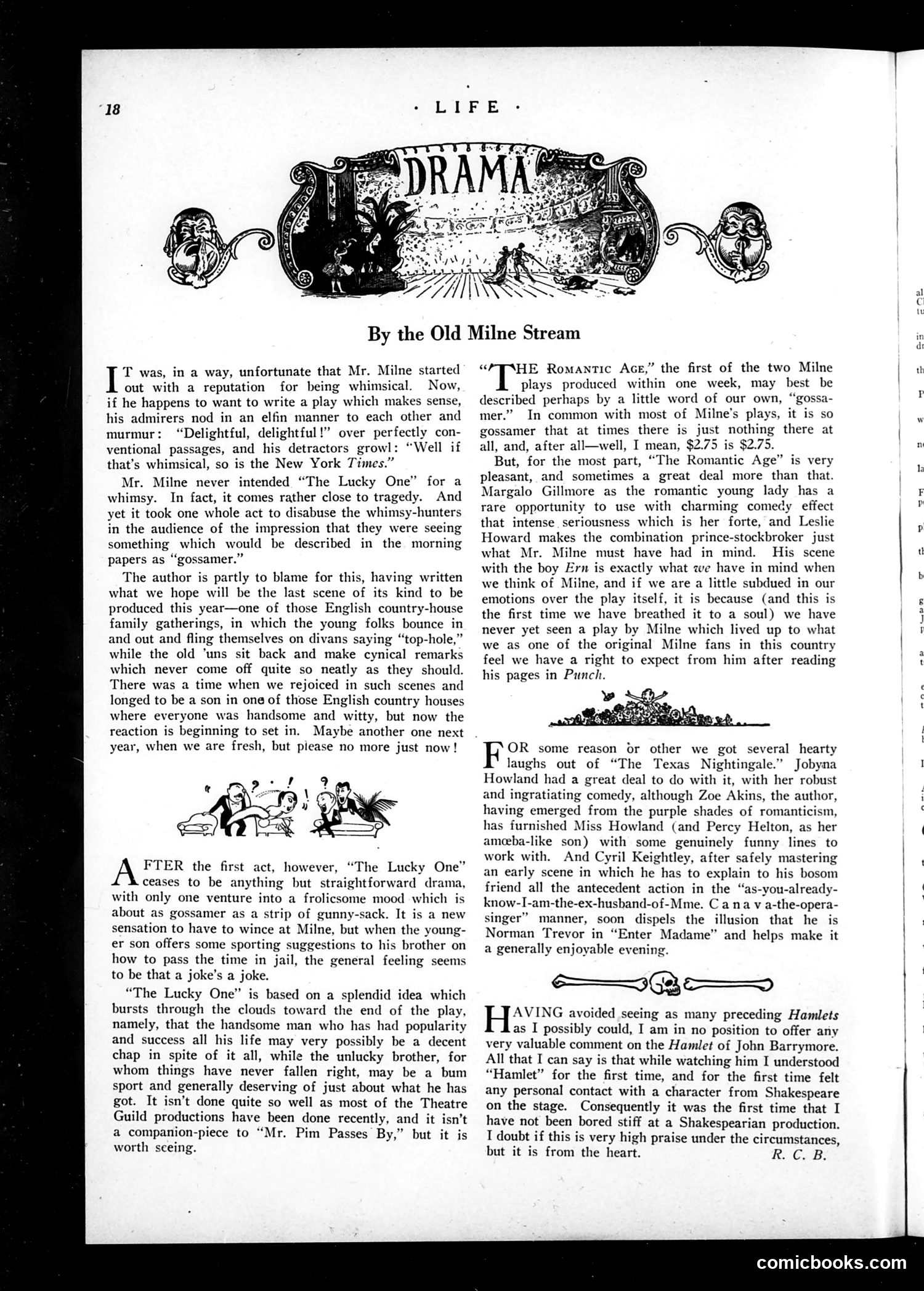
This page reviews three theatrical productions by A.A. Milne, the British playwright and author. The critic discusses Milne's reputation for whimsical writing and how audiences struggle to take his serious dramatic work seriously. The main critique concerns "The Lucky One," which the reviewer argues is a straightforward drama undermined by Milne's reputation—audiences expecting whimsy keep searching for it even when it isn't there. The critic finds the play's central idea compelling (that popularity doesn't guarantee decency of character) but the execution merely adequate for a Theatre Guild production. "The Romantic Age" receives gentler treatment as pleasant but insubstantial—the reviewer coins "gossamer" to describe its ethereal emptiness, noting it costs $2.75 regardless. Actors Margalo Gillmore and Leslie Howard are praised for their performances. The page also briefly mentions "The Texas Nightingale," crediting actress Jobyna Howland for generating laughs.
📄 Transcribed text from this page (OCR, searchable)
Machine-transcribed from the original scan — historical spelling and the odd misread are preserved.
T was, in a way, unfortunate that Mr. Milne started out with a reputation for being whimsical. Now, if he happens to want to write a play which makes sense, his admirers nod in an elfin manner to each other and murmur: “Delightful, delightful!” over perfectly con- ventional passages, and his detractors growl: “Well if that’s whimsical, so is the New York Times.” Mr. Milne never intended “The Lucky One” for a whimsy. In fact, it comes rather close to tragedy. And yet it took one whole act to disabuse the whimsy-hunters in the audience of the impression that they were seeing something which would be described in the morning papers as “gossamer.” The author is partly to blame for this, having written what we hope will be the last scene of its kind to be produced this year—one of those English country-house family gatherings, in which the young folks bounce in and out and fling themselves on divans saying “top-hole,” while the old ‘uns sit back and make cynical remarks which never come off quite so neatly as they should. There was a time when we rejoiced in such scenes and longed to be a son in one of those English country houses where everyone was handsome and witty, but now the reaction is beginning to set in. Maybe another one next year, when we are fresh, but piease no more just now! FTER the first act, however, “The Lucky One” ceases to be anything but straightforward drama, with only one venture into a frolicsome mood which is about as gossamer as a strip of gunny-sack. It is a new sensation to have to wince at Milne, but when the young- er son offers some sporting suggestions to his brother on how to pass the time in jail, the general feeling seems to be that a joke’s a joke. “The Lucky One” is based on a splendid idea which bursts through the clouds toward the end of the play, namely, that the handsome man who has had popularity and success all his life may very possibly be a decent chap in spite of it all, while the unlucky brother, for whom things have never fallen right, may be a bum sport and generally deserving of just about what he has got. It isn’t done quite so well as most of the Theatre Guild productions have been done recently, and it isn’t a companion-piece to “Mr. Pim Passes By,” but it is worth seeing. By the Old Milne Stream - HE Romantic AGE,” the first of the two Milne plays produced within one week, may best be described perhaps by a little word of our own, “gossa- mer.” In common with most of Milne’s plays, it is so gossamer that at times there is just nothing there at all, and, after all—well, I mean, $2.75 is $2.75. But, for the most part, “The Romantic Age” is very pleasant, and sometimes a great deal more than that. Margalo Gillmore as the romantic young lady has a rare opportunity to use with charming comedy effect that intense seriousness which is her forte, and Leslie Howard makes the combination prince-stockbroker just what Mr. Milne must have had in mind. His scene with the boy Ern is exactly what we have in mind when we think of Milne, and if we are a little subdued in our emotions over the play itself, it is because (and this is the first time we have breathed it to a soul) we have never yet seen a play by Milne which lived up to what we as one of the original Milne fans in this country feel we have a right to expect from him after reading his pages in Punch. OR some reason or other we got several hearty laughs out of “The Texas Nightingale.” Jobyna Howland had a great deal to do with it, with her robust and ingratiating comedy, although Zoe Akins, the author, having emerged from the purple shades of romanticism, has furnished Miss Howland (and Percy Helton, as her ameeba-like son) with some genuinely funny lines to work with. And Cyril Keightley, after safely mastering an early scene in which he has to explain to his bosom friend all the antecedent action in the “as-you-already- know-I-am-the-ex-husband-of-Mme. C a na v a-the-opera- singer” manner, soon dispels the illusion that he is Norman Trevor in “Enter Madame” and helps make it a generally enjoyable evening. 363, Hees avoided seeing as many preceding Hamlets as I possibly could, I am in no position to offer any very valuable comment on the Hamlet of John Barrymore. All that I can say is that while watching him I understood “Hamlet” for the first time, and for the first time felt any personal contact with a character from Shakespeare on the stage. Consequently it was the first time that I have not been bored stiff at a Shakespearian production. I doubt if this is very high praise under the circumstances, but it is from the heart. R. C. B: comicbooks.com