
Life, 1922-12-14 · page 15 of 36
Life — December 14, 1922 — page 15: what you’re looking at
What you’re looking at
This page contains a satirical cartoon and accompanying story about childhood materialism and parental disappointment. The cartoon depicts a theater lobby scene where a young boy (Oswald) is being scolded by an agitated manager for whistling loudly—a violation of public decorum. The accompanying story reveals the satirical point: Oswald's father gave him experiences (theater tickets) rather than material gifts for Christmas, hoping to teach him appreciation. However, the boy's behavior demonstrates the lesson backfired—he's already ungrateful and disruptive despite receiving what the father considered a generous, educational present. The satire targets early-20th-century anxieties about modern children's ingratitude and materialism, suggesting that even "improving" gifts cannot combat contemporary youth's unruly nature.
📄 Transcribed text from this page (OCR, searchable)
Machine-transcribed from the original scan — historical spelling and the odd misread are preserved.
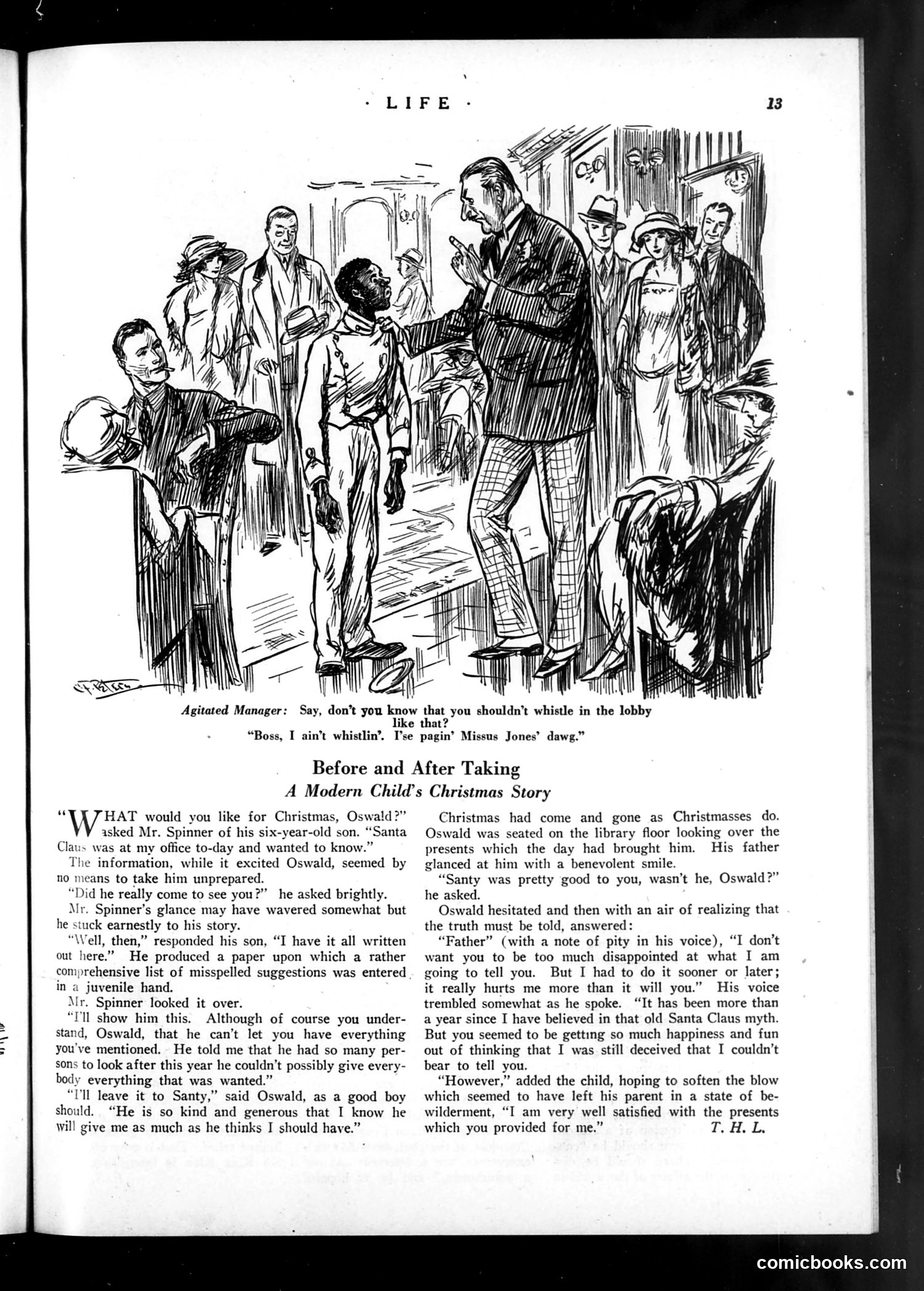
4) Agitated Manager: Say, don’t you know that you shouldn't whistle in the lobby like that? “Boss, I ain’t whistlin’. I’se pagin’ Missus Jones’ dawg.” Before and After Taking A Modern Child’s Christmas Story my HAT would you like for Christmas, Oswald?” asked Mr. Spinner of his six-year-old son. “Santa ‘laus was at my office to-day and wanted to know.” information, while it excited Oswald, seemed by no means to take him unprepared. “Did he really come to see you?” he asked brightly. Mr. Spinner’s glance may have wavered somewhat but he stuck earnestly to his story. “Well, then,” responded his son, “I have it all written out here.” He produced a paper upon which a rather comprehensive list of misspelled suggestions was entered in a juvenile hand. r. Spinner looked it over. “T'll show him this. Although of course you under- stand, Oswald, that he can’t let you have everything you've mentioned. He told me that he had so many per- sons to look after this year he couldn’t possibly give every- body everything that was wanted.” “T'll leave it to Santy,” said Oswald, as a good boy should. “He is so kind and generous that I know he will give me as much as he thinks I should have.” Christmas had come and gone as Christmasses do. Oswald was seated on the library floor looking over the presents which the day had brought him. His father glanced at him with a benevolent smile. “Santy was pretty good to you, wasn’t he, Oswald he asked. Oswald hesitated and then with an air of realizing that the truth must be told, answered: “Father” (with a note of pity in his voice), “I don’t want you to be too much disappointed at what I am going to tell you. But I had to do it sooner or later; it really hurts me more than it will you.” His voice trembled somewhat as he spoke. “It has been more than a year since I have believed in that old Santa Claus myth. But you seemed to be getting so much happiness and fun out of thinking that I was still deceived that I couldn’t bear to tell you. “However,” added the child, hoping to soften the blow which seemed to have left his parent in a state of be- wilderment, “I am very well satisfied with the presents which you provided for me.” T. H. L. oa comicbooks.com