
Life, 1922-12-14 · page 4 of 36
Life — December 14, 1922 — page 4: what you’re looking at
What you’re looking at
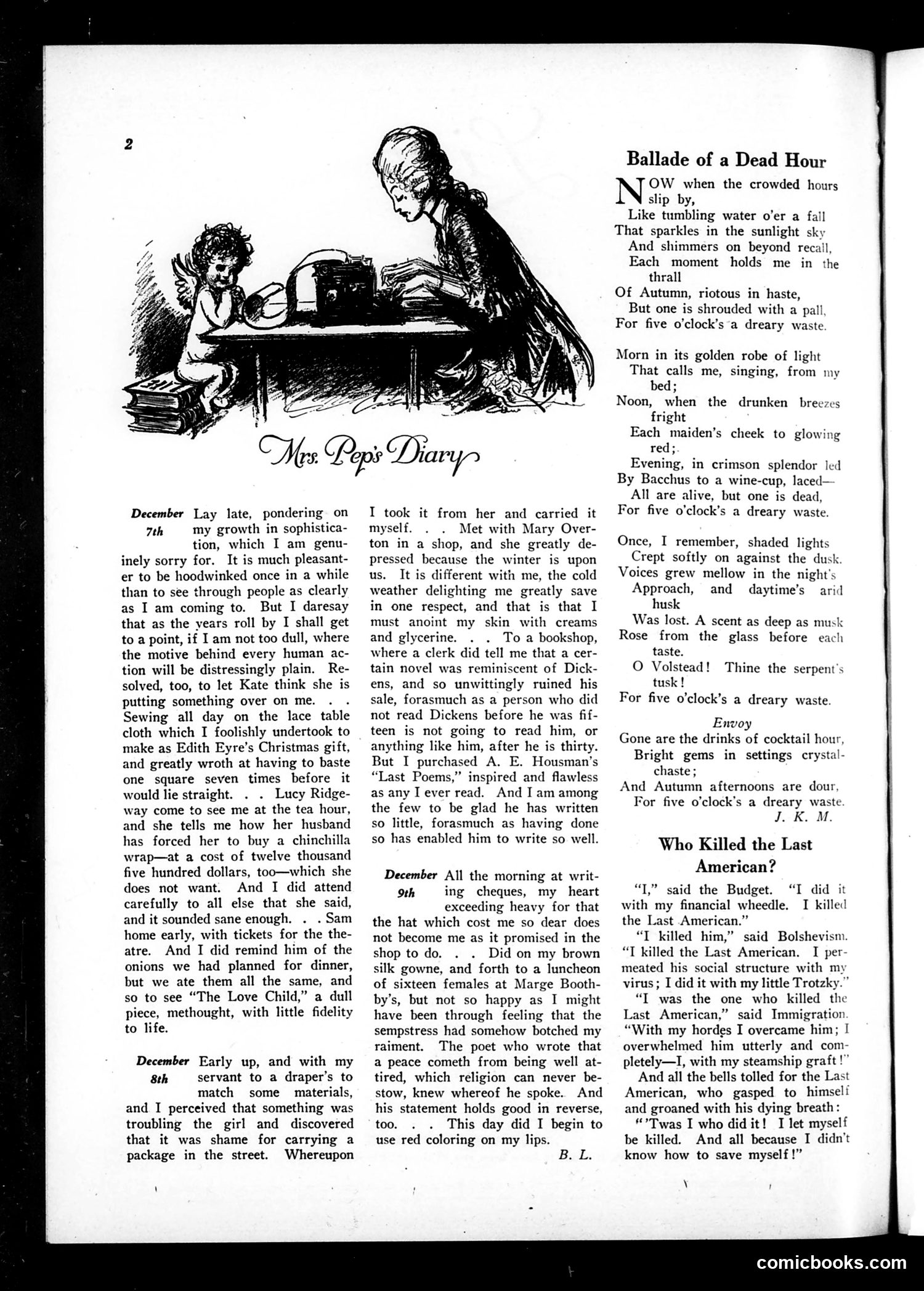
This page contains three distinct literary pieces rather than political cartoons: 1. **"Mrs. Peps Diary"** (with accompanying illustration): A domestic humor column describing a woman's December activities—shopping, attending theater, and social obligations. The tone is gently satirical about upper-middle-class women's busy social schedules. 2. **"Ballade of a Dead Hour"** (poem): A melancholic verse about the five o'clock hour, personified as a "dreary waste" in autumn. It reflects fin-de-siècle aesthetic sensibilities popular in early 20th-century literary magazines. 3. **"Who Killed the Last American?"**: A satirical piece where various figures (Budget, Bolshevism, Immigration, etc.) humorously claim responsibility for killing "the Last American," each representing contemporary social anxieties about American identity and modernization. The page reflects Life's role as a literary and social satire publication rather than purely visual humor.
📄 Transcribed text from this page (OCR, searchable)
Machine-transcribed from the original scan — historical spelling and the odd misread are preserved.
t December Lay late, pondering on 7th my growth in sophistica- tion, which I am genu- inely sorry for. It is much pleasant- er to be hoodwinked once in a while than to see through people as clearly as I am coming to. But I daresay that as the years roll by I shall get to a point, if I am not too dull, where the motive behind every human ac- tion will be distressingly plain. Re- solved, too, to let Kate think she is putting something over on me. 5 Sewing all day on the lace table cloth which I foolishly undertook to make as Edith Eyre’s Christmas gift, and greatly wroth at having to baste one square seven times before it would lie straight. Lucy Ridge- way come to see me at the tea hour, and she tells me how her husband has forced her to buy a chinchilla wrap—at a cost of twelve thousand five hundred dollars, too—which she does not want. And I did attend carefully to all else that she said, and it sounded sane enough. . Sam home early, with tickets for the the- atre. And I did remind him of the onions we had planned for dinner, but we ate them all the same, and so to see “The Love Child,” a dull piece, methought, with little fidelity to life. December Early up, and with my 8th servant to a draper’s to match some materials, and I perceived that something was troubling the girl and discovered that it was shame for carrying a package in the street. Whereupon I took it from her and carried it myself. Met with Mary Over- ton in a shop, and she greatly de- pressed because the winter is upon us. It is different with me, the cold weather delighting me greatly save in one respect, and that is that I must anoint my skin with creams and glycerine. To a bookshop, where a clerk did tell me that a cer- tain novel was reminiscent of Dick- ens, and so unwittingly ruined his sale, forasmuch as a person who did not read Dickens before he was fif- teen is not going to read him, or anything like him, after he is thirty. But I purchased A. E. Housman’s “Last Poems,” inspired and flawless as any I ever read. And I am among the few to be glad he has written so little, forasmuch as having done so has enabled him to write so well. December All the morning at writ- 9th ing cheques, my heart exceeding heavy for that the hat which cost me so dear does not become me as it promised in the shop to do. Did on my brown silk gowne, and forth to a luncheon of sixteen females at Marge Booth- by’s, but not so happy as I might have been through feeling that the sempstress had somehow botched my raiment. The poet who wrote that a peace cometh from being well at- tired, which religion can never be- stow, knew whereof he spoke. And his statement holds good in reverse, too. . . This day did I begin to use red coloring on my lips. Ballade of a Dead Hour OW when the crowded hours slip by, Like tumbling water o’er a fall That sparkles in the sunlight sky And shimmers on beyond recail, Each moment holds me in the thrall Of Autumn, riotous in haste, But one is shrouded with a pall, For five o’clock’s a dreary waste Morn in its golden robe of light That calls me, singing, from my bed; Noon, when the drunken breezes fright Each maiden’s cheek to glowing red; Evening, in crimson splendor led By Bacchus to a wine-cup, laced— All are alive, but one is dead, For five o’clock’s a dreary waste. Once, I remember, shaded lights Crept softly on against the dusk. Voices grew mellow in the night's Approach, and daytime’s arid husk Was lost. A scent as deep as musk Rose from the glass before each taste. O Volstead! tusk! For five o’clock’s a dreary waste Thine the serpent’s Envoy Gone are the drinks of cocktail hour, Bright gems in settings crystal- chaste ; And Autumn afternoons are dour, For five o’clock’s a dreary waste J. K. M. Who Killed the Last American? “T,” said the Budget. “I with my financial wheedle. the Last American.” “T killed him,” said Bolshevism. “T killed the Last American. I per- meated his social structure with my virus ; I did it with my little Trotzky.” “I was the one who killed the Last American,” said Immigration “With my hordes I overcame him; | overwhelmed him utterly and com- pletely—I, with my steamship graft!” And all the bells tolled for the Last American, who gasped to himseli and groaned with his dying breath: “Twas I who did it! I let myself be killed. And all because I didn’t know how to save myself!” did it I killed \ ' comicbooks.com