
A complete issue · 34 pages · 1922
Life — February 23, 1922
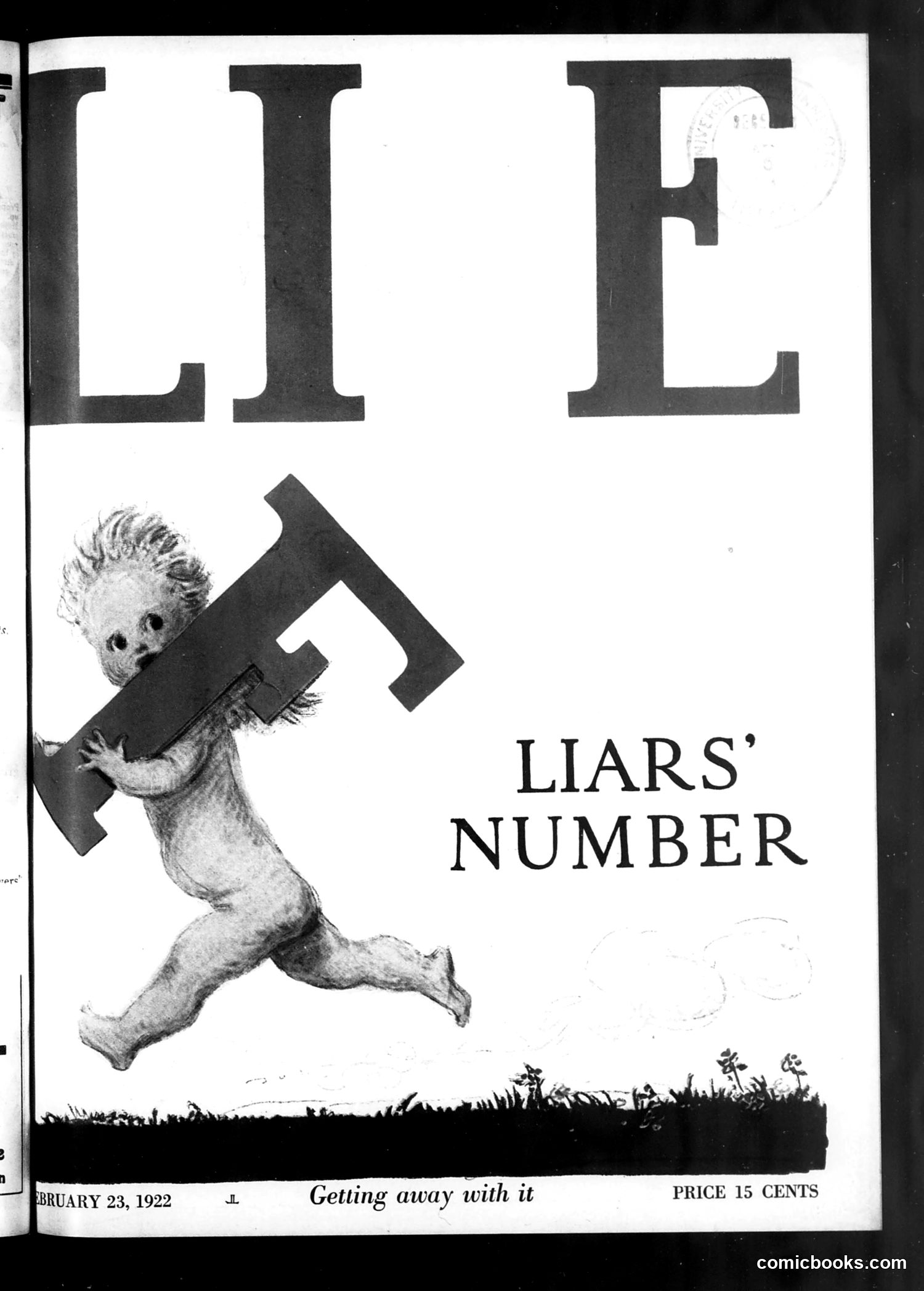
This is the cover of *Life* magazine's "Liars' Number" issue. The central image depicts a cherubic, mischievous child figure carrying an oversized swastika symbol while running away—the subtitle reads "Getting away with it." The satire targets dishonesty and deception in public discourse circa 1922. The swastika here likely references post-WWI propaganda or false claims circulating in that era, rather than Nazi symbolism (the swastika predates its later appropriation). The child "getting away with" carrying this symbol suggests how falsehoods spread unchecked through society, with innocent or mischievous intent disguising more sinister underlying issues. The cover humorously critiques widespread public deception and misinformation of the period.
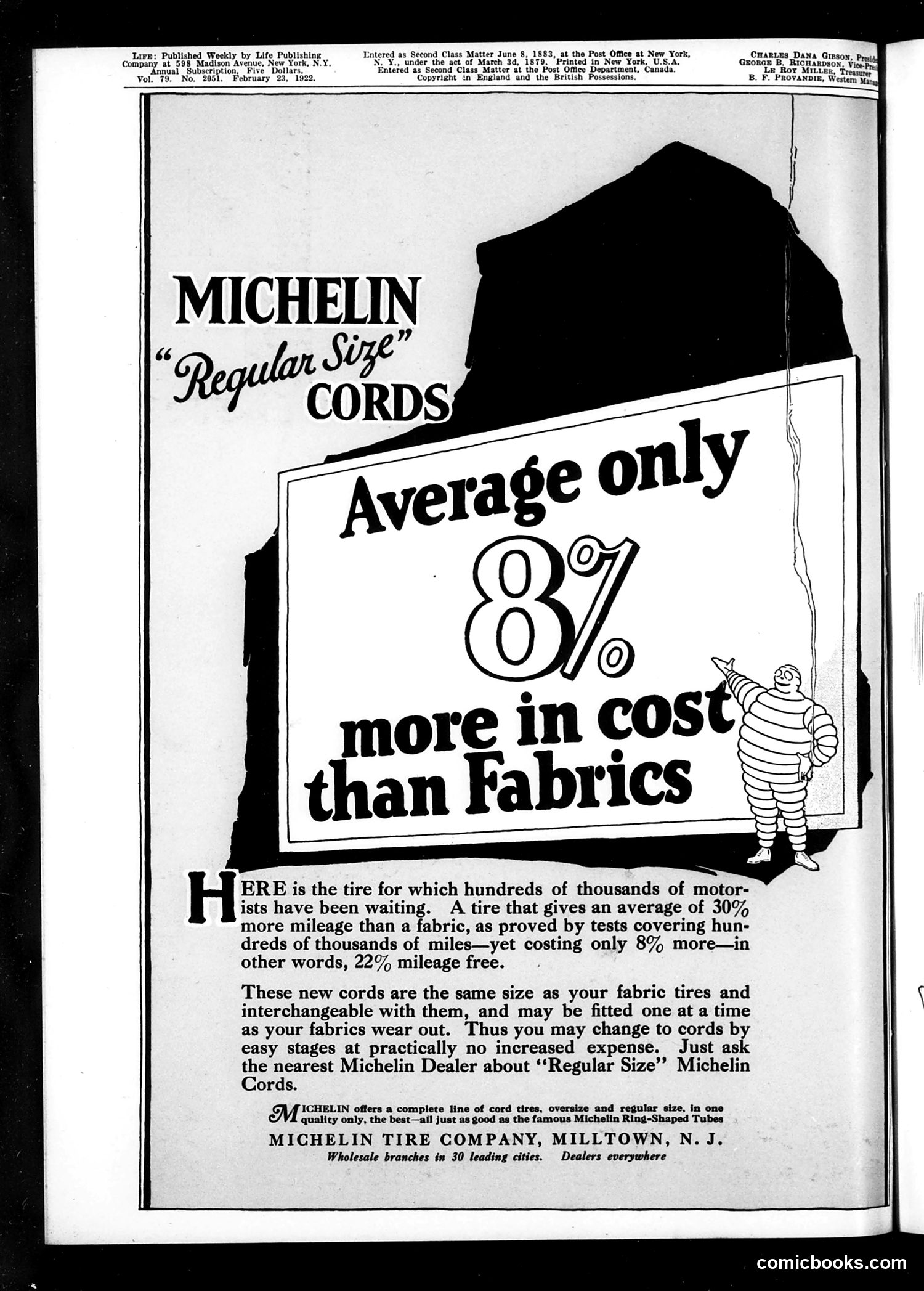
This is a **Michelin tire advertisement**, not political satire or comics content. It appeared in *Life* magazine and promotes Michelin "Regular Size" cord tires. The ad's central claim: these cord tires cost only 8% more than fabric tires but deliver 30% greater mileage—effectively providing 22% "mileage free." The Michelin Man (Bibendum, the mascot shown on the right) endorses the product. The advertisement emphasizes that cord tires are interchangeable with existing fabric tires, allowing gradual conversion "at practically no increased expense." The ad targets motorists seeking better value and durability. This is straightforward commercial messaging rather than satire or political commentary—typical early automotive advertising using brand mascots and performance comparisons to drive consumer interest.
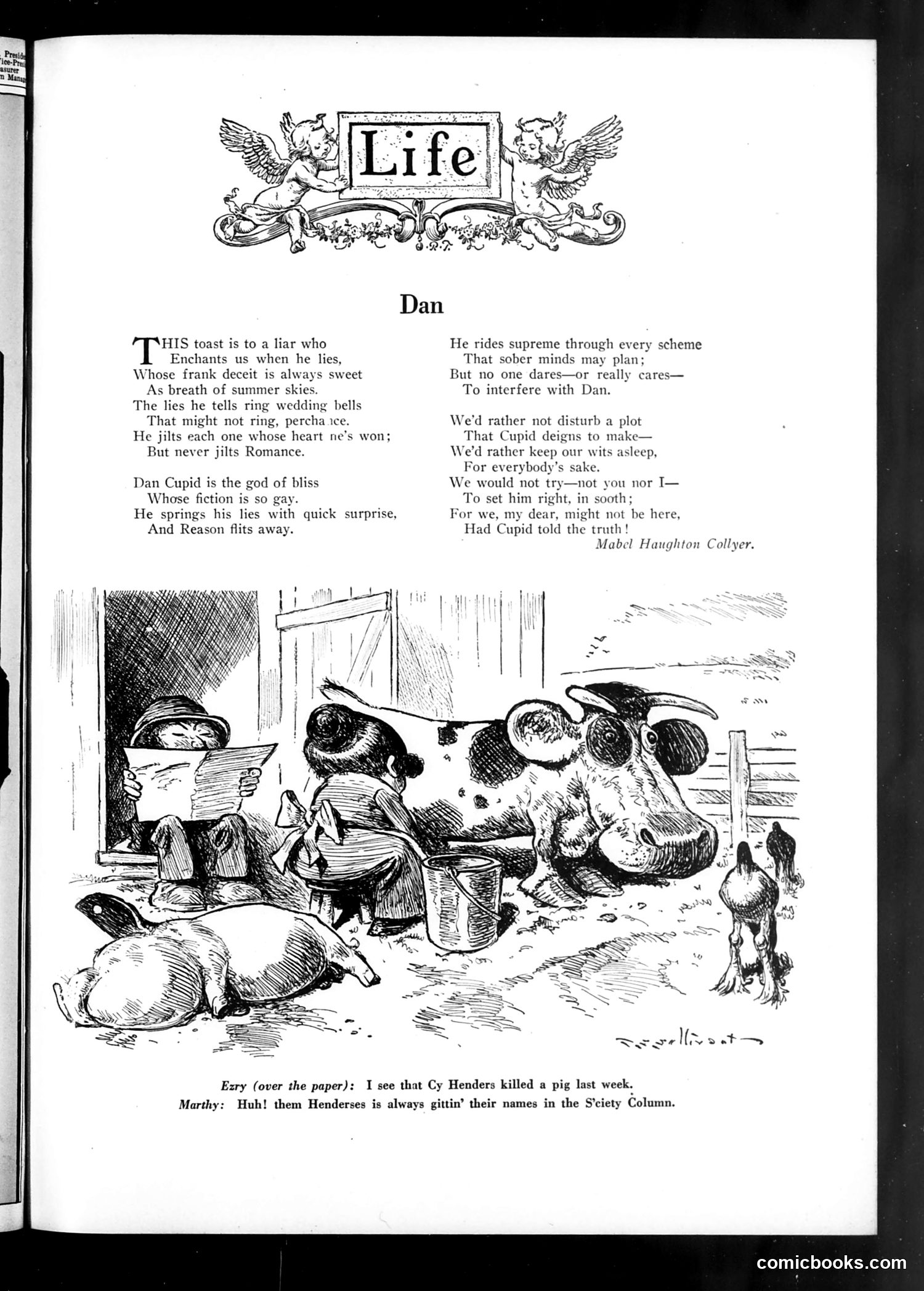
This page satirizes a habitual liar named "Dan" through a poem by Mabel Haughton Colyer. The verse describes Dan as someone whose deceptions are constant and charming—he lies about romance, his romantic exploits, and his schemes, yet no one confronts him because no one wants to disrupt his fabrications. The accompanying illustration depicts a rural farm scene where two men (labeled Eery and Marthy) read a newspaper. Their dialogue reveals the satirical point: they're discussing Cy Henders killing a pig, noting that the Henders family always appears in the society column—a joke about small-town vanity and how rural families seek social prominence through newspaper mentions, no matter how trivial the news. The cartoon mocks rural social pretension.
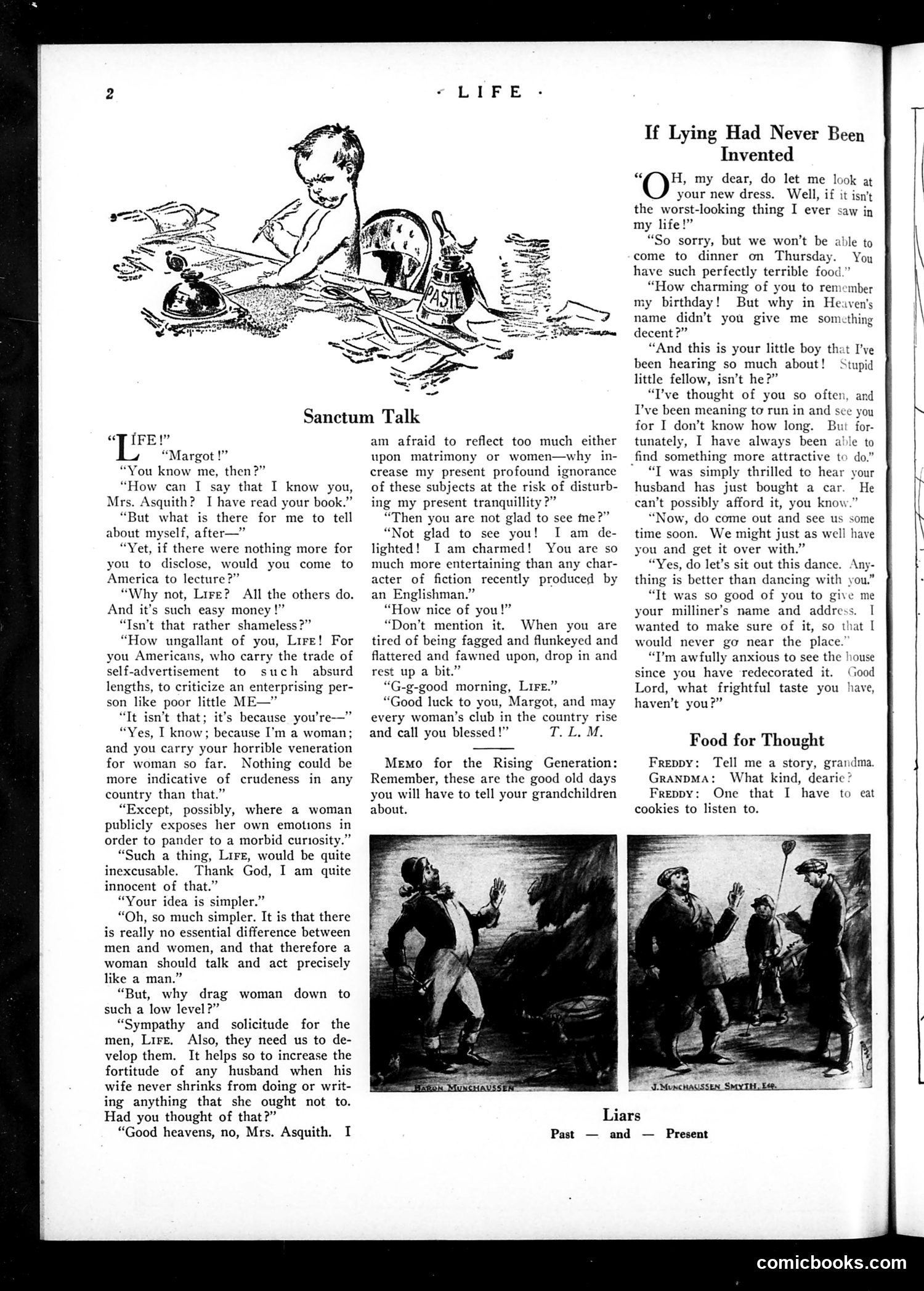
**"Sanctum Talk"** is a satirical dialogue between "Life" (the magazine personified) and "Margot," a society woman. The exchange mocks upper-class female behavior: Margot seeks Life's approval for her social standing while Life critiques women's tendency toward self-advertisement and emotional public disclosure. **"If Lying Had Never Been Invented"** presents domestic dialogue satirizing marriage and gender relations—a husband buying a car they can't afford, a wife's jealousy about another woman's name. The satire suggests married couples rely on dishonesty to maintain harmony. **"Food for Thought"** and **"Liars Past and Present"** (with illustrations) appear to be additional short humor pieces typical of Life's satirical format, targeting social hypocrisy and family dynamics of the early 20th century.
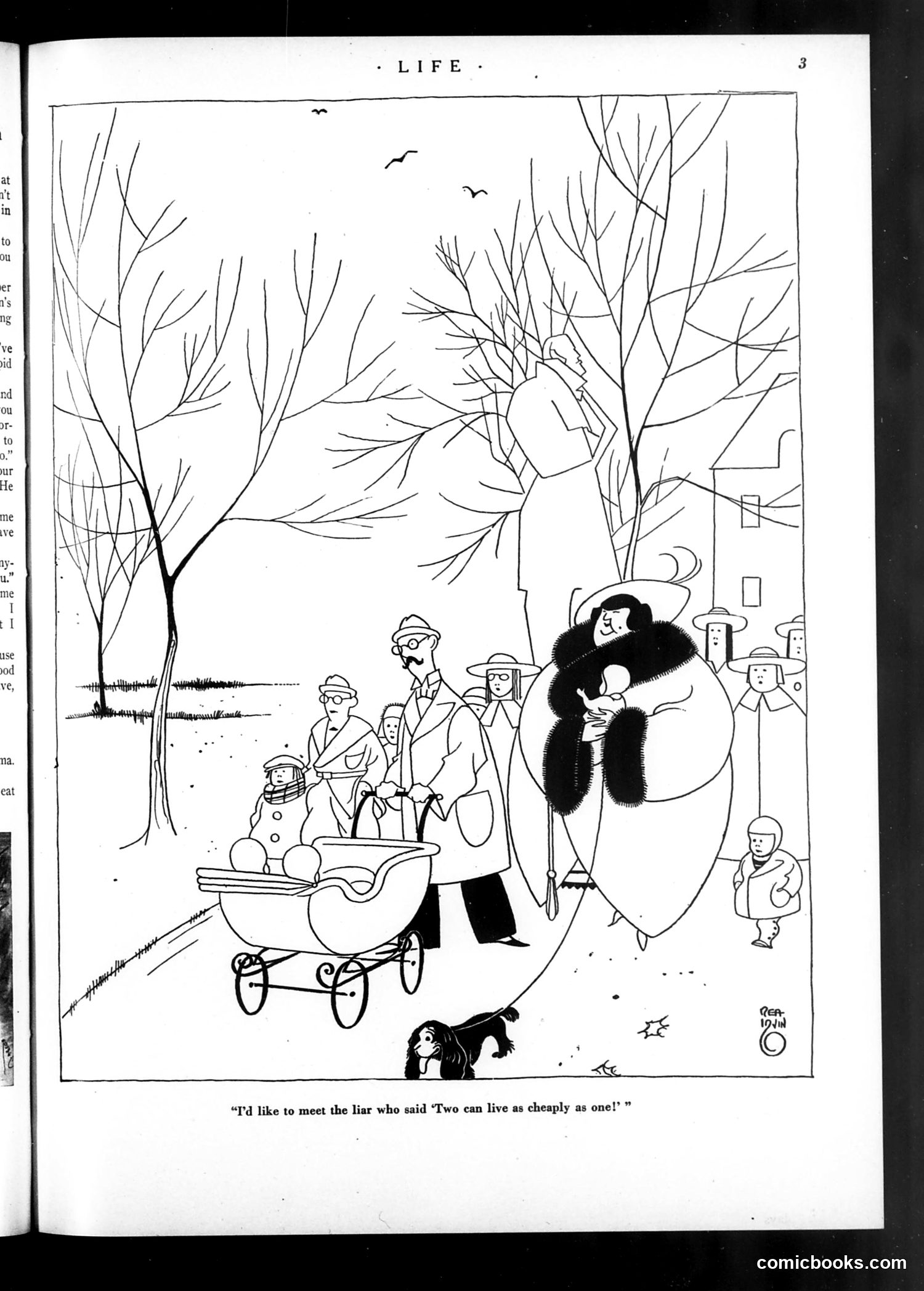
This is a satirical cartoon from *Life* magazine mocking the economic argument that "two can live as cheaply as one." The scene shows a well-dressed woman with a large fur coat holding a baby carriage, surrounded by men in suits and hats—likely representing her husband and associates. A small dog is visible in the foreground. The joke targets the common saying used to justify marriage or cohabitation on financial grounds. The cartoon suggests this claim is false, depicting an affluent lifestyle with expensive clothing and accessories that contradicts the notion of economical living. The woman's lavish fur coat and the formal entourage emphasize conspicuous consumption, implying that married couples (particularly wives) actually spend considerably *more* money, not less. This reflects early 20th-century satire about marriage economics and female spending habits.
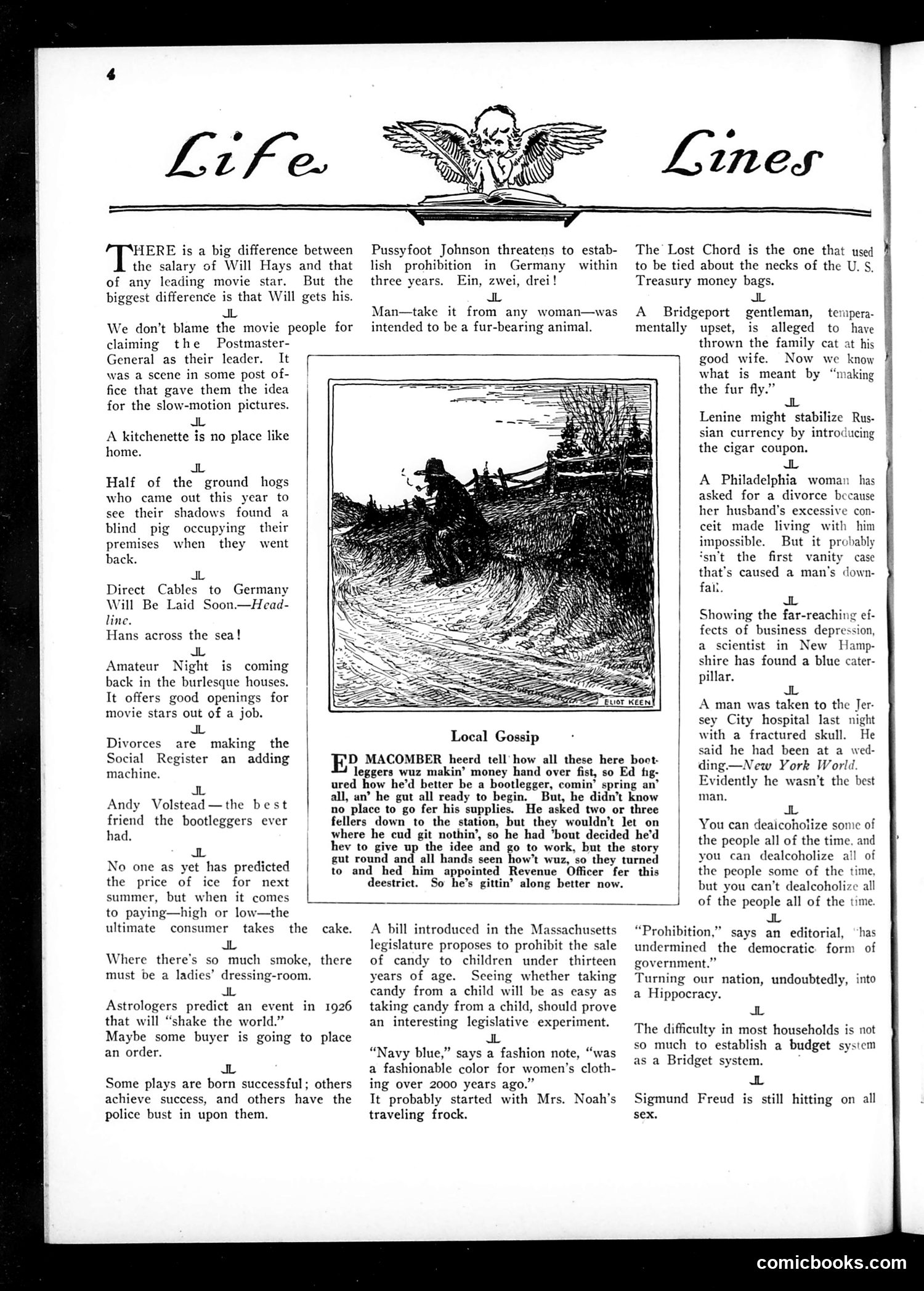
The main illustration depicts a figure in dark clothing struggling in turbulent water—likely representing someone caught in dangerous circumstances. Without clearer identification, the specific subject is unclear, though the dramatic composition suggests a contemporary incident or metaphorical struggle. The "Local Gossip" section contains brief satirical items about early 1920s American life: bootleggers during Prohibition, fashion trends ("Navy blue"), and social commentary on divorce, budgets, and psychoanalysis (Freud's popularity). The scattered remarks mock various aspects of American society—from entertainment industry salaries to legislative proposals about candy sales to children. The overall tone is characteristic of Life magazine's role as a witty social observer critiquing 1920s trends and institutions.
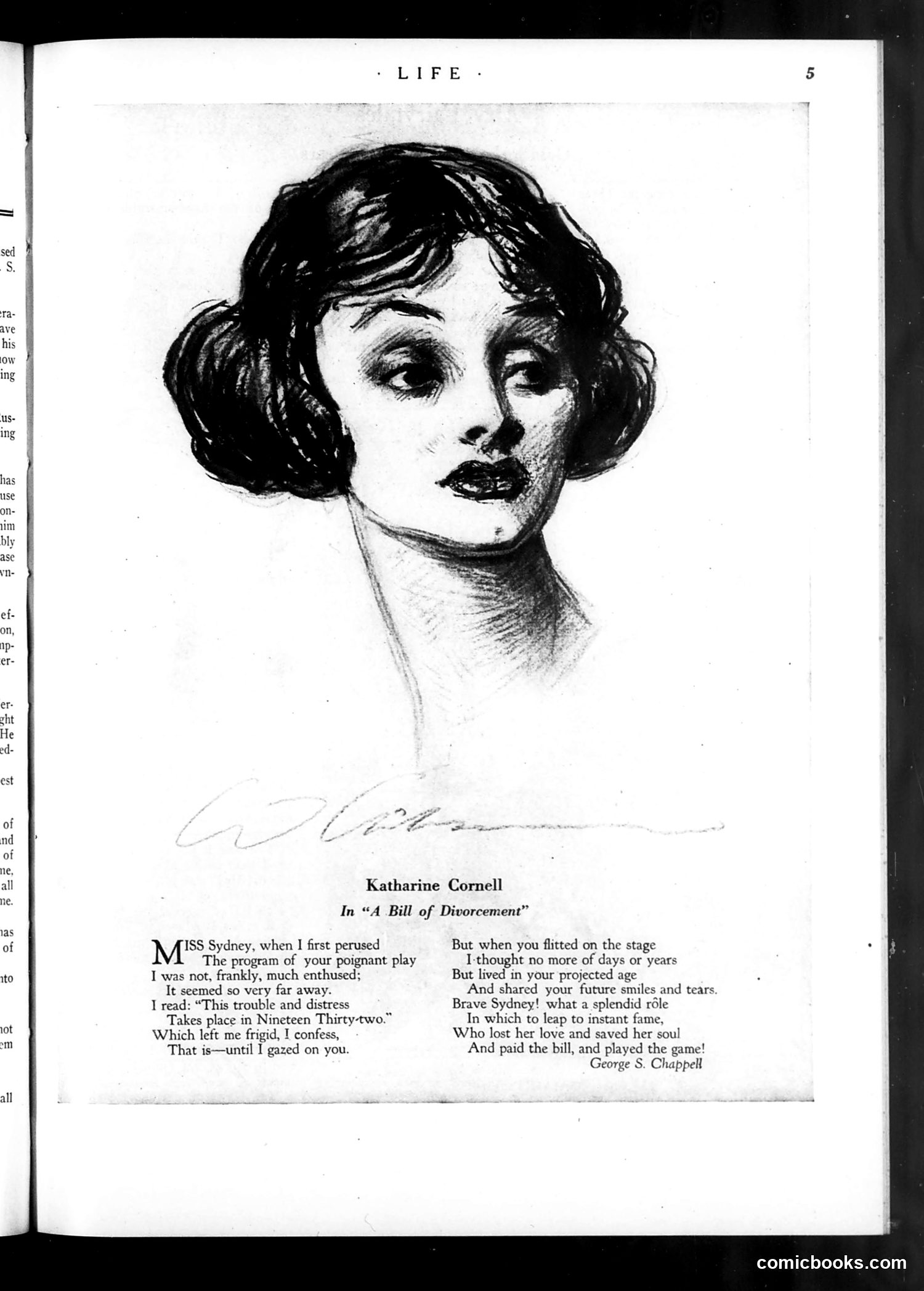
This page features a portrait of **Katharine Cornell**, a prominent stage actress, accompanying a poem titled "In 'A Bill of Divorcement.'" The poem, credited to George S. Chappell, appears to be a tribute to Cornell's performance in that theatrical production. The verses reference her stage debut ("when you flitted on the stage") and praise her acting ability, particularly her portrayal of a character who "lost her love and saved her soul / And paid the bill, and played the game!" This is not political satire but rather **theatrical criticism/promotion** — a common Life magazine feature celebrating notable performers of the era. The sketch-style portrait and accompanying verse represent early 20th-century entertainment journalism, highlighting Cornell's growing fame and her acclaimed role in this drama about divorce and personal sacrifice.
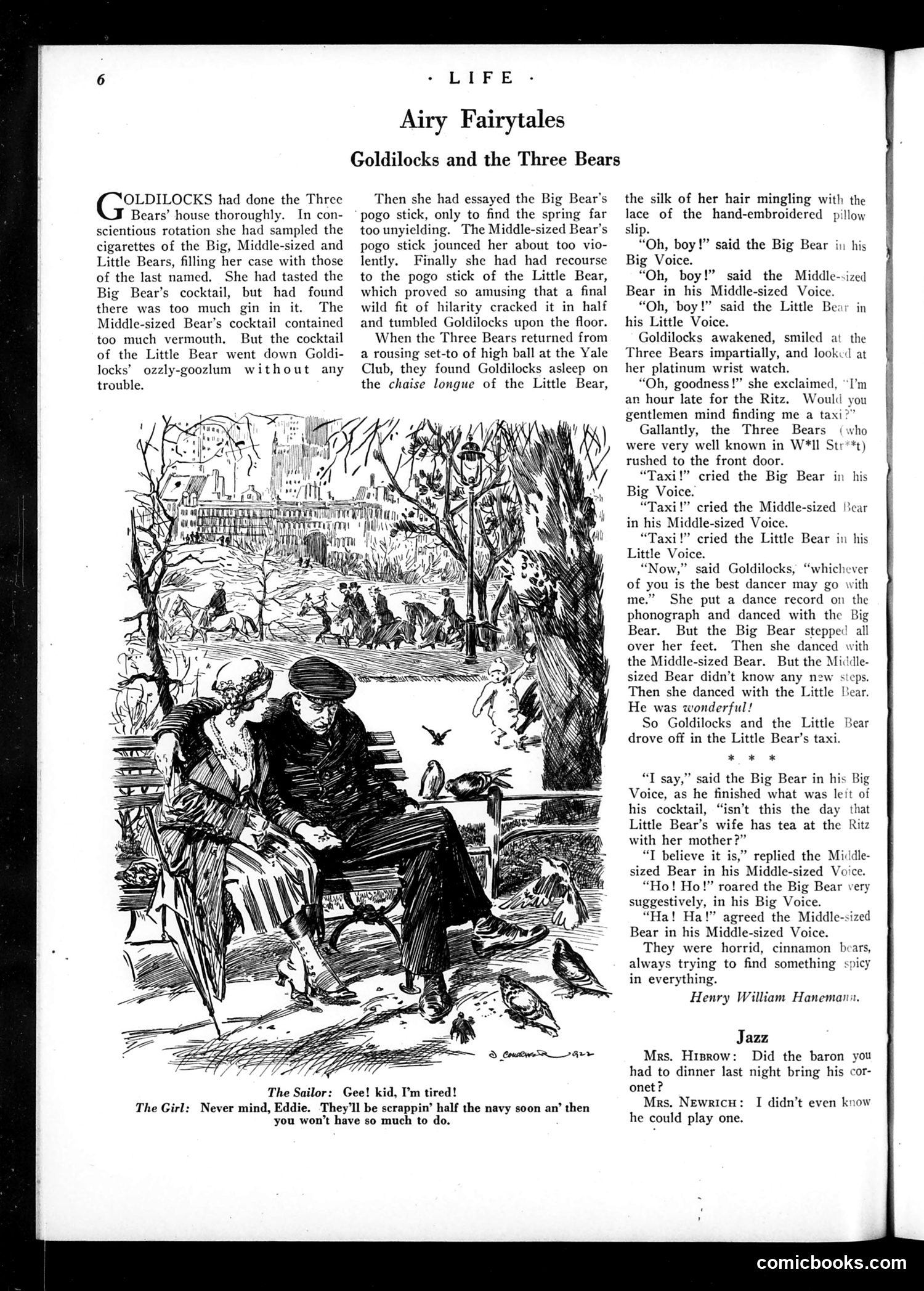
This page presents a modern, satirical retelling of the classic fairy tale. The illustration shows Goldilocks as a fashionable young woman in 1920s dress, lounging in what appears to be an urban park setting with three well-dressed bears. The satire updates the innocent children's story into Jazz Age humor: Goldilocks samples the bears' cocktails with "scientific rotation," stays up late at the Ritz nightclub, dances with the bears, and leaves via taxi—suggesting scandalous behavior and loose morals typical of "flapper" culture. The bears' resigned observations ("always trying to find something spicy in everything") mock both the rebellious younger generation and their own bourgeois concerns. The bottom dialogue between a sailor and girl provides additional period commentary on changing social conventions.
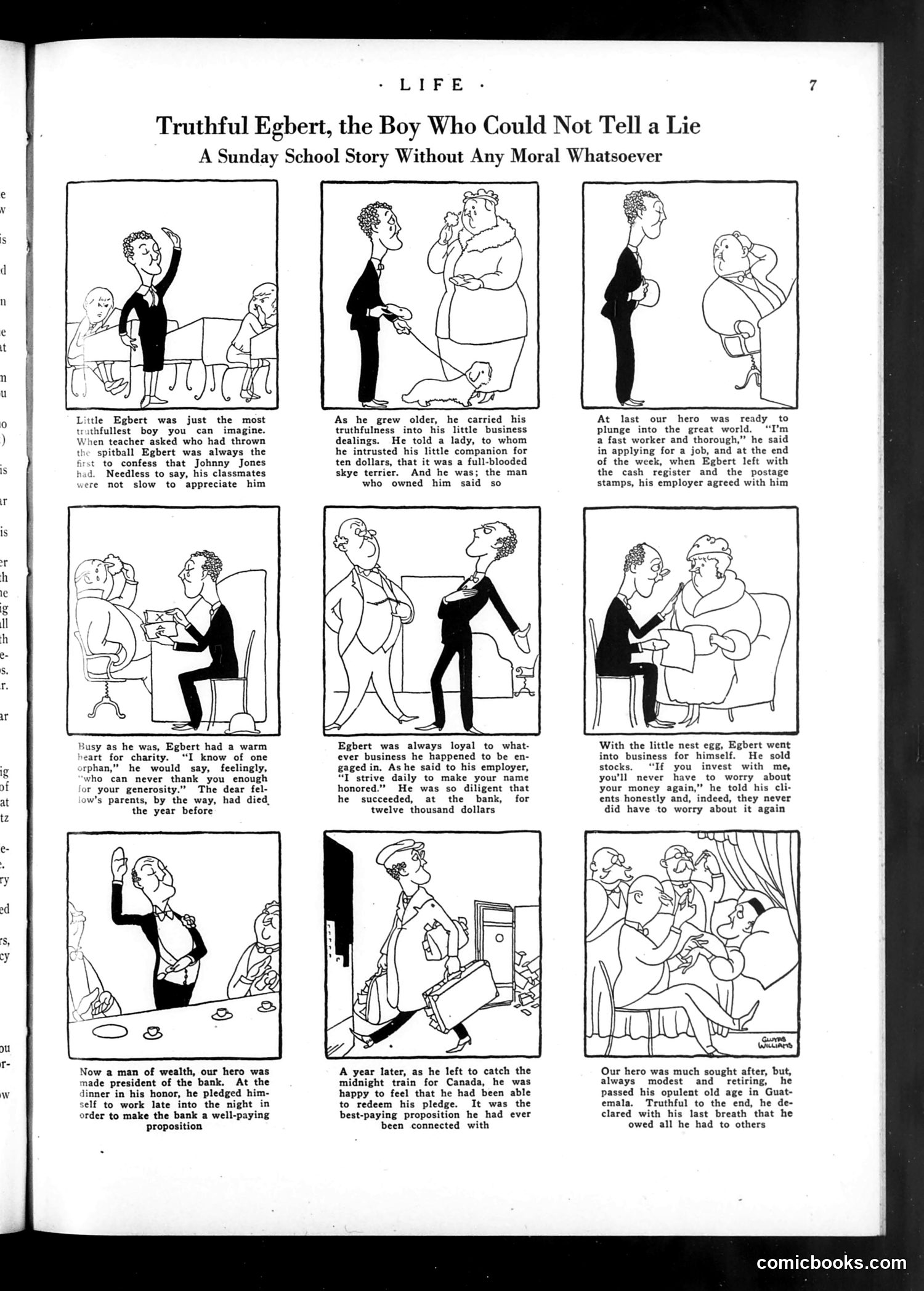
This is a satirical Sunday school-style moral tale that deliberately *subverts* the genre by offering "no moral whatsoever." The story follows Egbert, an impossibly honest boy whose truthfulness paradoxically leads to business success and wealth. The satire targets Victorian moral tales and American capitalism simultaneously. Egbert's rigid honesty—refusing to lie even when advantageous—somehow makes him rich and admired. The joke is that actual business success in the Gilded Age typically required dishonesty and manipulation, yet this cartoon suggests truthfulness brings fortune anyway, mocking both the naive moralism of Sunday school stories and the hypocrisy of wealthy businessmen who claimed virtue while engaging in dubious practices. The subtitle's admission of "no moral whatsoever" is the punchline itself.
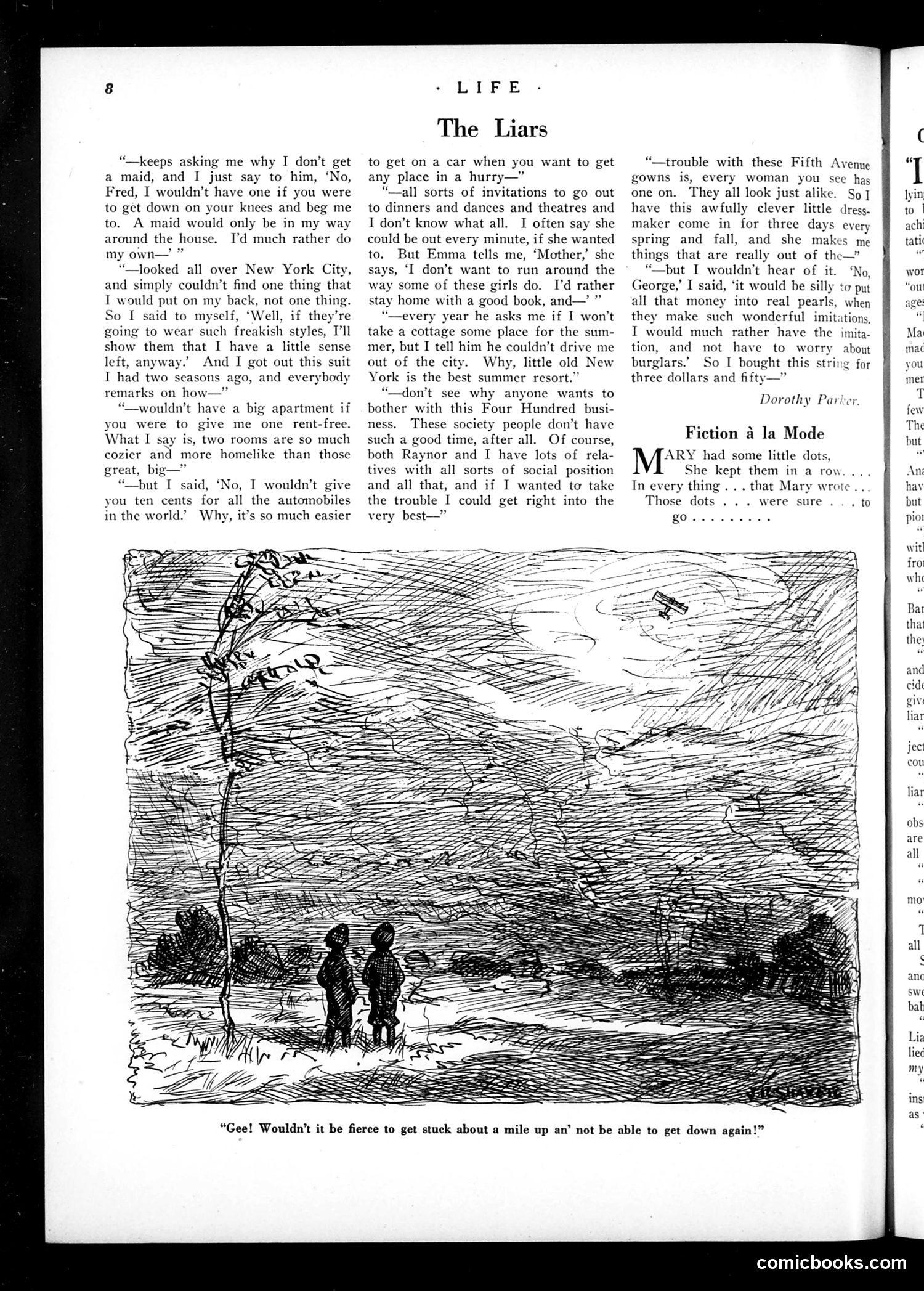
This page from *Life* magazine contains two satirical pieces about social pretense among wealthy New Yorkers. **"The Liars"** (left column) mocks the excuses wealthy people make to avoid responsibilities—claiming inability to find maids, refusing to hire drivers, inventing social obligations. The narrator exposes these as transparent lies masking unwillingness to spend money or effort. **"Fiction à la Mode"** (right) begins a story about Mary's dots/dashes, appearing to parody overwrought literary writing. **The cartoon** below depicts two children observing a stuck horse/cart, with one saying they'd be "stuck about a mile up" and unable to get down—seemingly illustrating how poor planning or pretense can trap people in bad situations, connecting to the broader theme of self-deception among the upper classes.
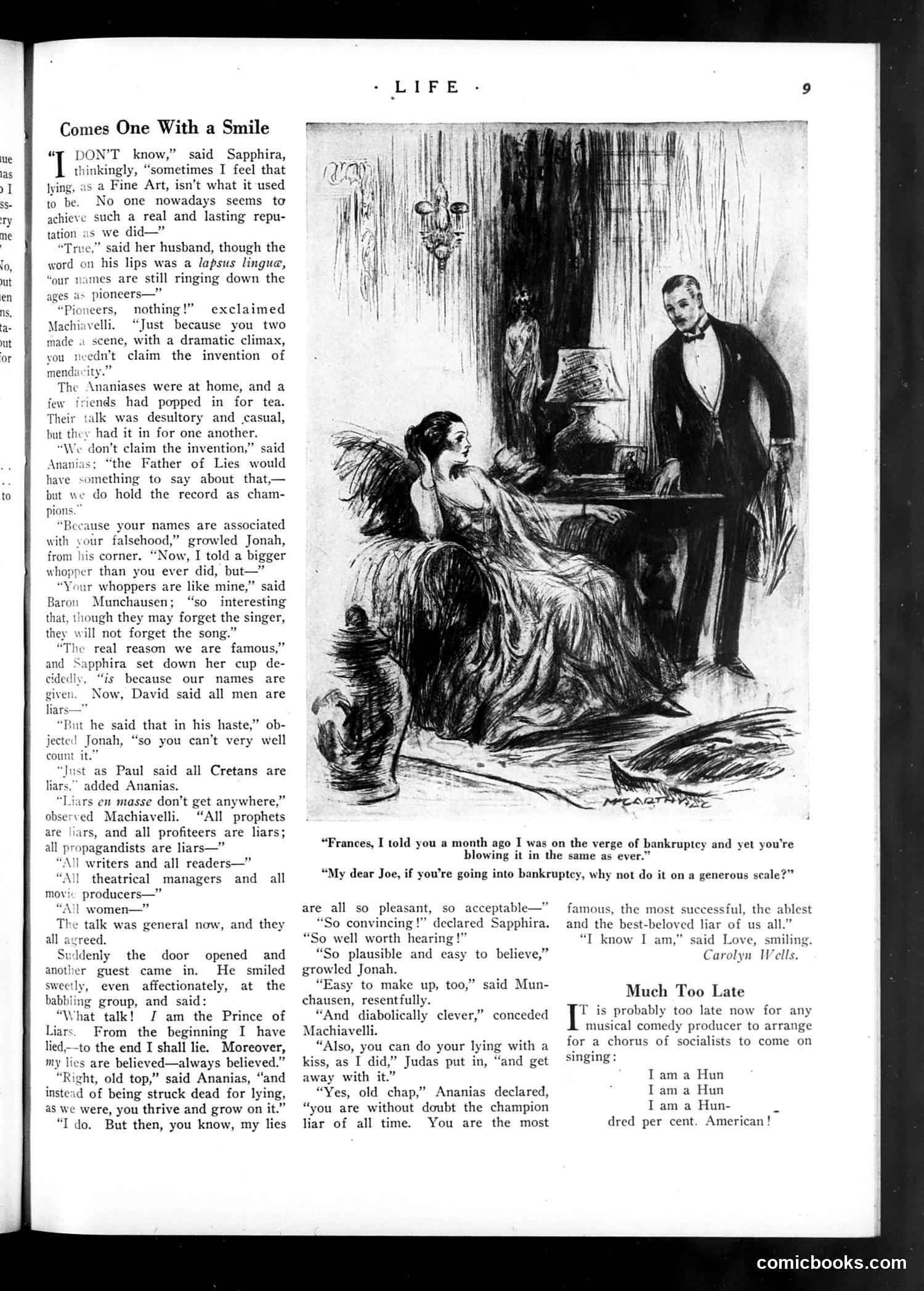
This page satirizes bohemian artistic circles and their moral pretensions. The dialogue mocks famous artists and performers who publicly claim high principles while privately behaving hypocritically—lying about their work, finances, and personal conduct. The cartoon illustration shows what appears to be a social gathering where characters discuss the "lies" endemic to creative professions. References include "the Father of Lies" (Satan), comparisons to Munchausen and Baron Munchausen (famous liars), and jabs at "theatrical managers," "movie producers," "prophets," and "propagandists." The satire's core joke: these bohemian figures pride themselves on being honest and artistic while being serial liars—yet they're celebrated anyway. The final section "Much Too Late" mocks socialist causes as inherently unconvincing ("plausible and easy to believe").
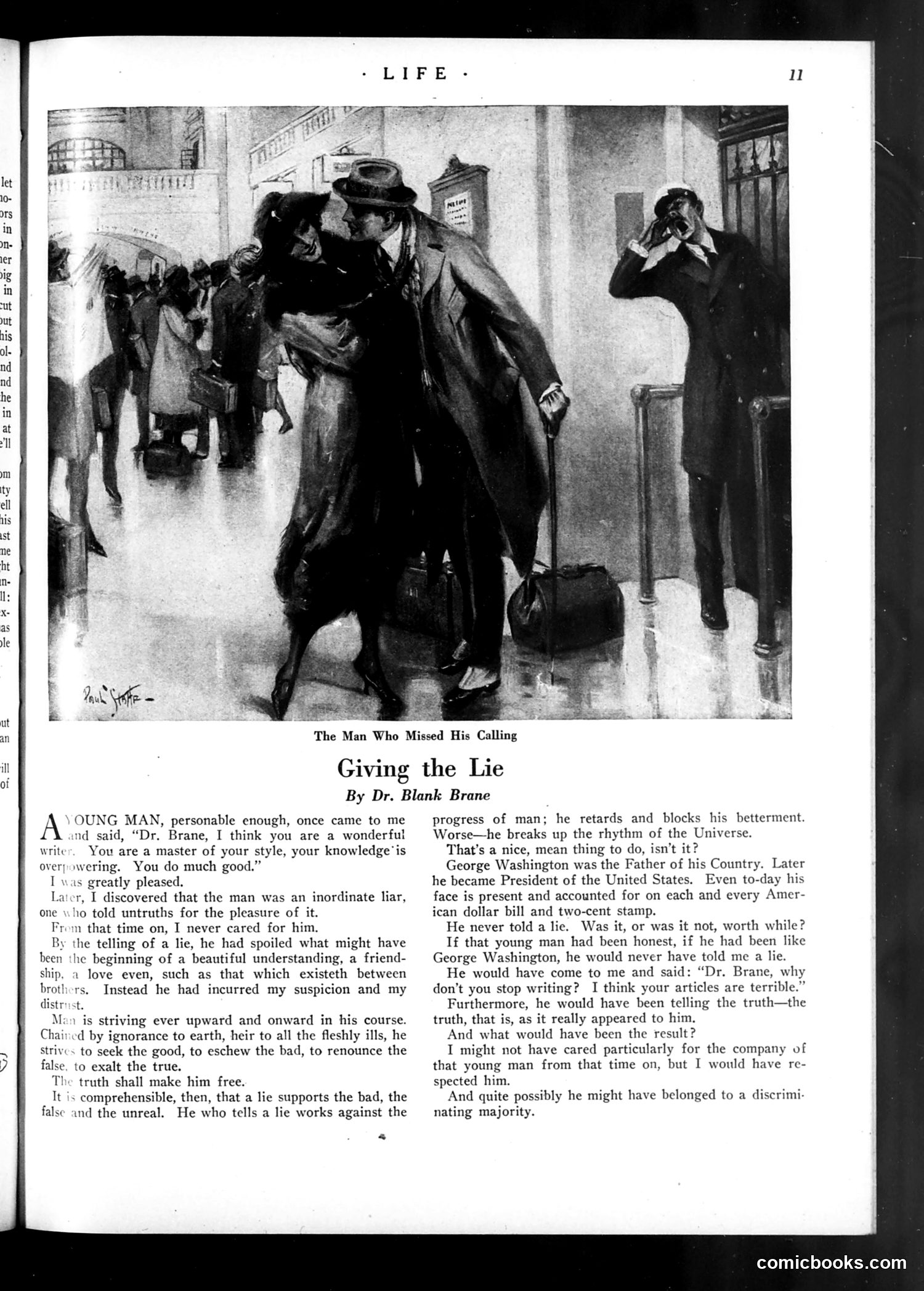
This satirical article critiques a young man who lied to the author, claiming mastery in writing and knowledge. The illustration depicts the confrontation—a man in a hat and overcoat gestures while speaking to a woman in what appears to be a public building or station, with other figures observing in the background. The piece uses George Washington as a moral exemplar, noting he "never told a lie" and became president precisely because of his honesty. Brune argues that lying undermines character and social advancement. The satire targets the young man's dishonesty as a character flaw that ultimately damages his prospects, despite any short-term advantage deception might offer. The cartoon illustrates the embarrassing social consequences of being caught in falsehood.
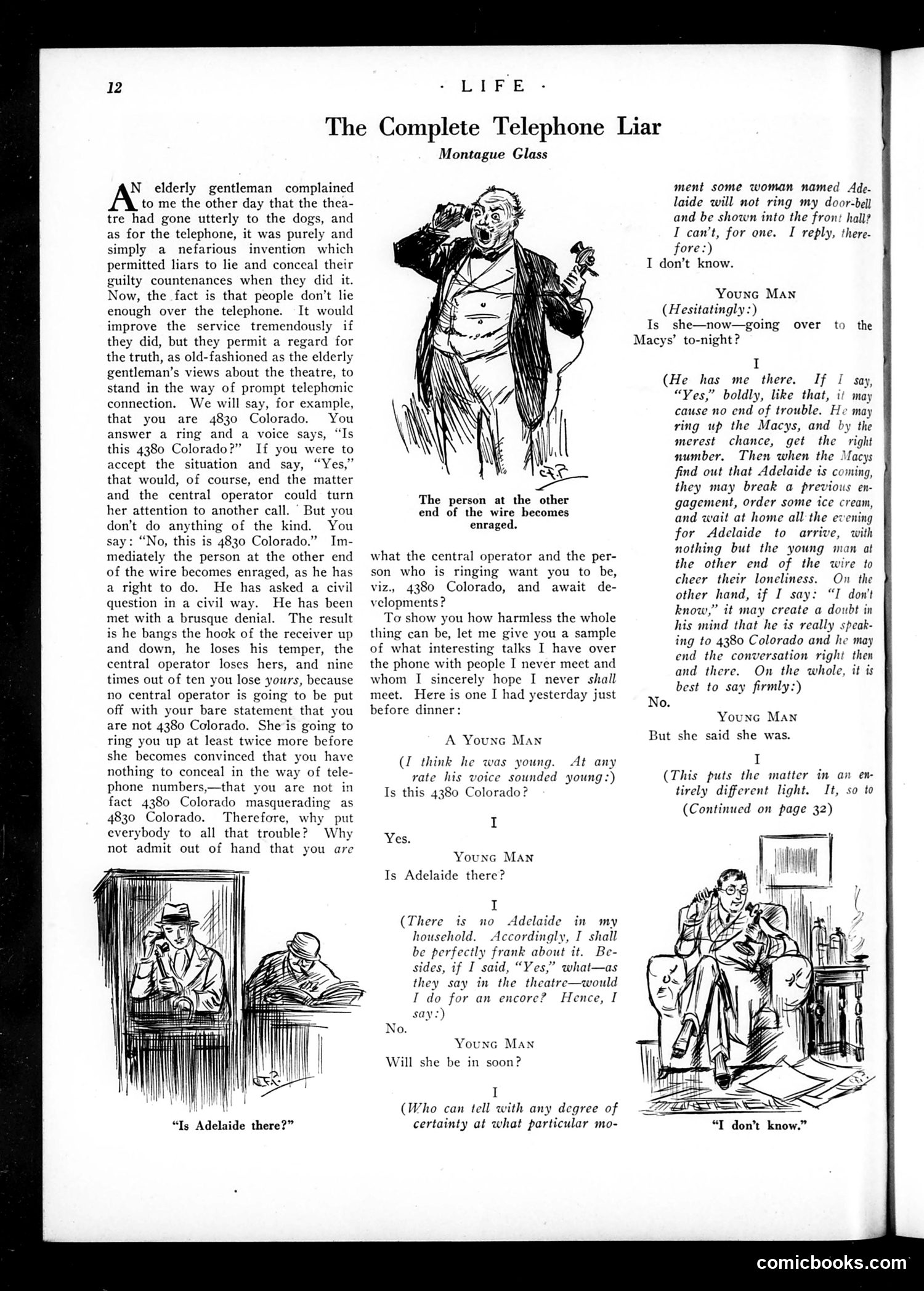
This satirical piece mocks the telephone's unreliability for honest communication. An elderly gentleman complains that telephones enable people to lie with impunity—the central operator and caller can easily deny what was said, unlike face-to-face conversation. The humor centers on a practical problem: when a young man calls asking for "Adelaide," the operator claims she doesn't know if Adelaide is available. This creates comic confusion and frustration. The piece illustrates how the telephone's distance between parties encourages deception—neither party can be definitively proven wrong about what was said or promised. It's satirizing early telephone culture's social awkwardness and the technology's capacity to facilitate dishonesty when no witnesses are present.
This page from *Life* magazine shows a dark, atmospheric image titled "Burning the Midnight Oil." The image depicts what appears to be a solitary figure or light source in near-total darkness, creating a dramatic contrast. The phrase "burning the midnight oil" is an idiom meaning to work late into the night. Without additional context or visible text explaining the cartoon's specific satirical intent, this appears to be either an illustration accompanying a story about overwork, industrialization, or labor conditions—common *Life* magazine concerns. The stark imagery suggests commentary on the hardships of excessive labor or the isolation of nighttime work. The specific political or social reference remains unclear from the image alone.
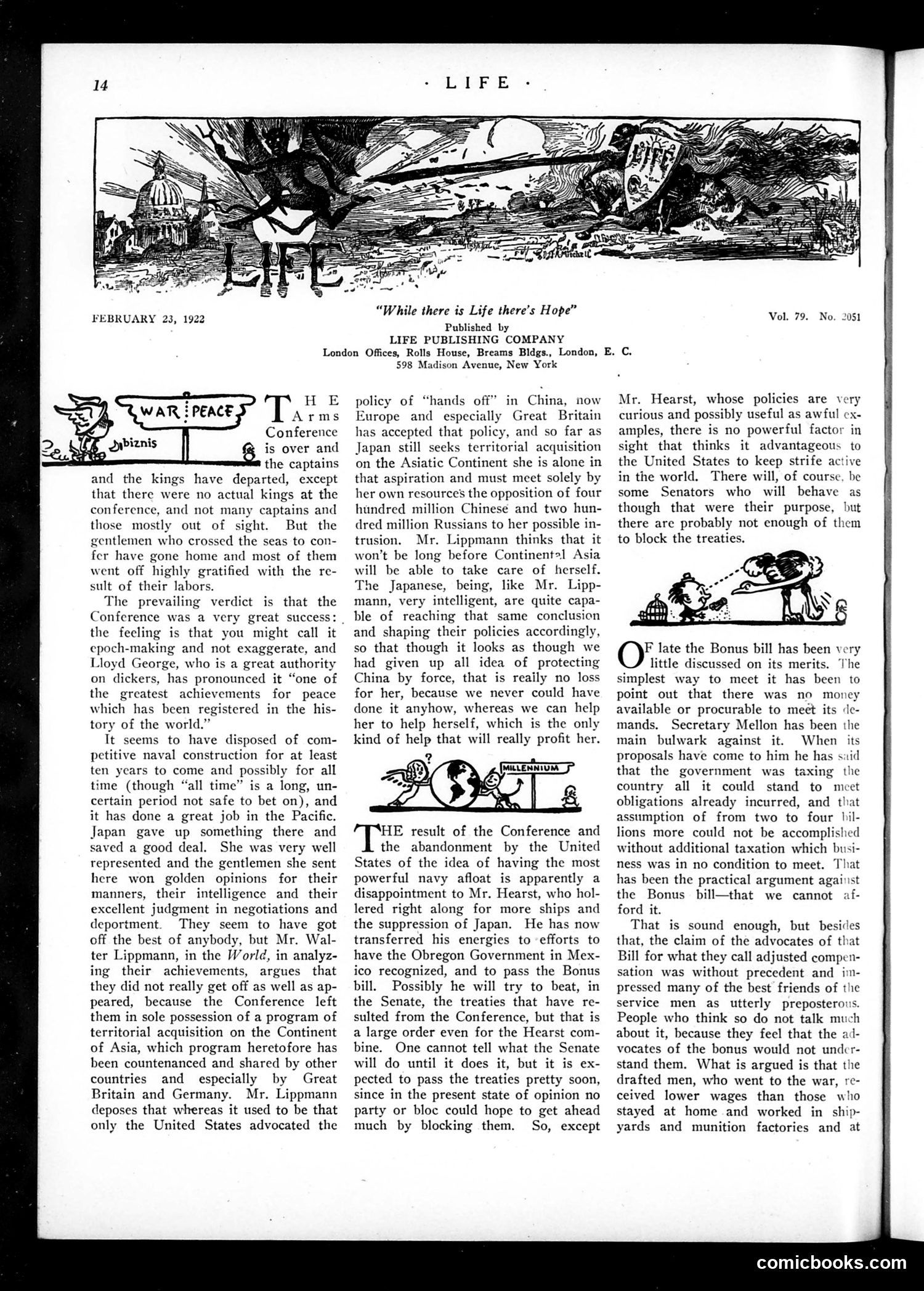
The page contains two editorial sections addressing post-WWI policy debates. The left column discusses the Washington Conference's outcomes regarding naval construction and Japan's territorial ambitions in China. The right column debates the "Bonus bill" for war veterans. The small **cartoons** appear to use allegorical figures—likely representing nations or policy positions—engaged in negotiation or conflict, though specific identities aren't entirely clear from the reproductions. The underlying satire critiques how political negotiations often produce compromises that satisfy no one: the Conference supposedly ended competitive naval construction but disappointed those wanting stronger action against Japan, while the Bonus bill debate pits veterans' interests against fiscal concerns and Senate obstruction.
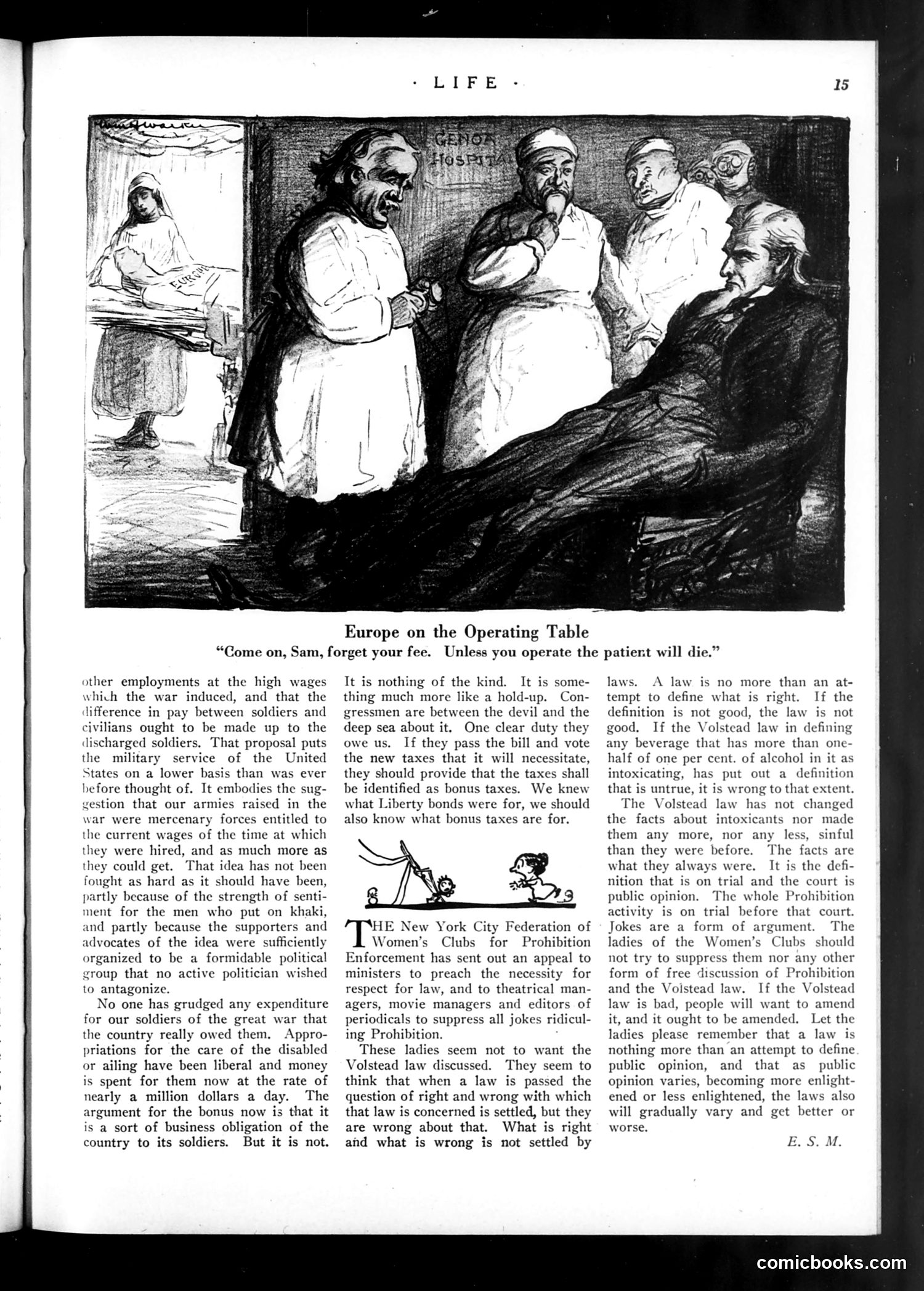
This political cartoon satirizes post-World War I peace negotiations. "Europe" appears as a patient on an operating table, with medical figures (likely representing Allied leaders or peacemakers) gathered around. The caption—"Come on, Sam, forget your fee. Unless you operate the patient will die"—suggests that Europe's survival depends on successful surgical intervention, but the doctors are haggling over payment rather than focusing on the critical work ahead. The cartoon critiques the self-interested negotiations of Allied powers during the Treaty of Versailles period, implying that political leaders prioritized financial gain over genuinely healing Europe's war-devastated condition. The satire mocks the apparent indifference of decision-makers to the continent's desperate post-war plight.
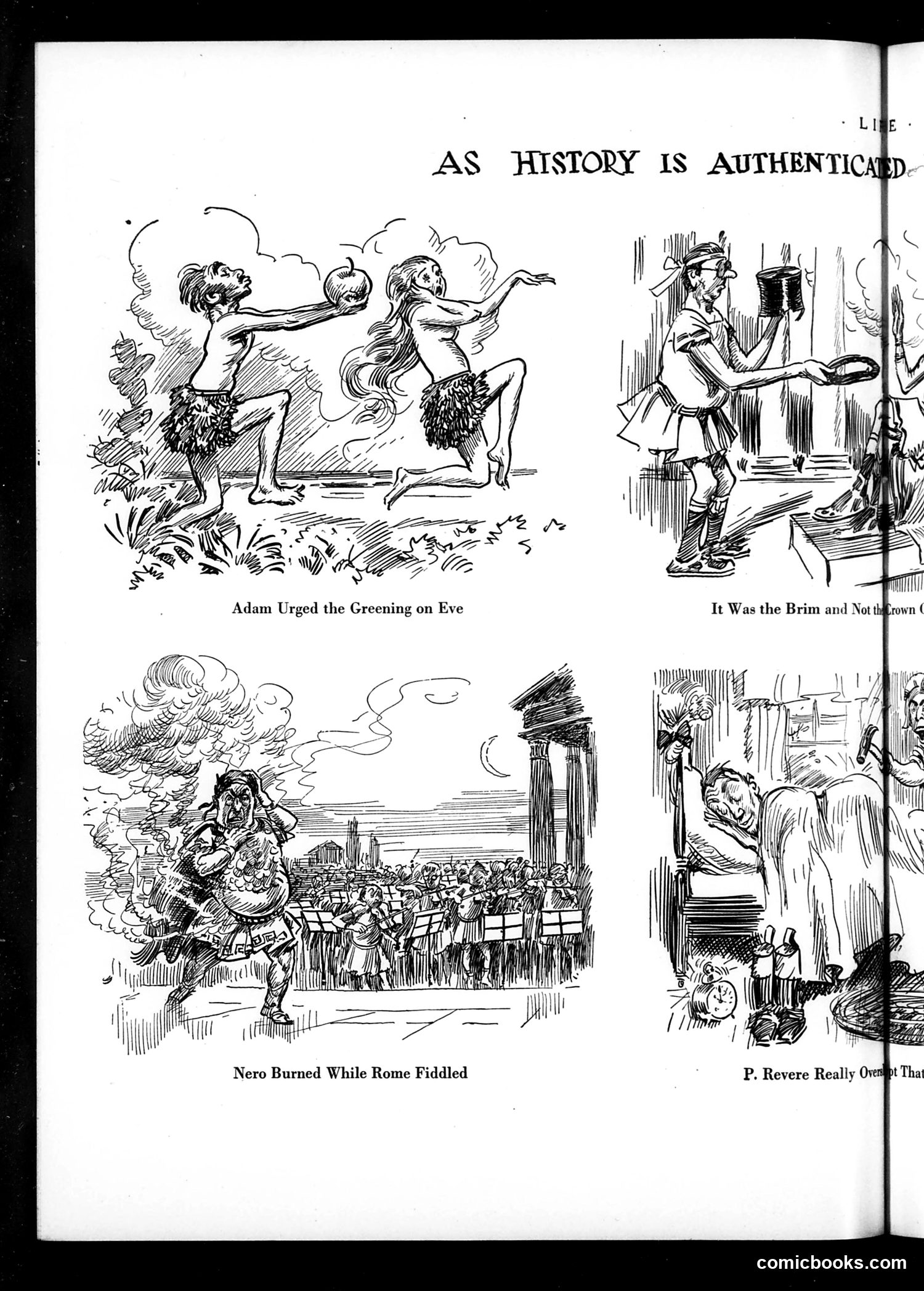
This page presents four comedic retellings of famous historical events with humorous twists: 1. **"Adam Urged the Greening on Eve"**: Shows Adam and Eve in the Garden of Eden, with the caption suggesting Adam encouraged Eve's environmental consciousness rather than the biblical temptation narrative. 2. **"Nero Burned While Rome Fiddled"**: Depicts the Roman emperor Nero during Rome's destruction, playing on the famous (historically inaccurate) legend that he fiddled while the city burned. 3. **"It Was the Brim and Not the Crown"**: Appears to reference a historical moment, though the full caption is cut off. 4. **"P. Revere Really Overdid That"**: References Paul Revere's famous midnight ride, likely satirizing the exaggeration of his historical importance. The page's title, "As History Is Authenticated," ironically suggests these cartoons represent "verified" history while actually presenting comedic reinterpretations and debunkings of popular historical myths and legends.
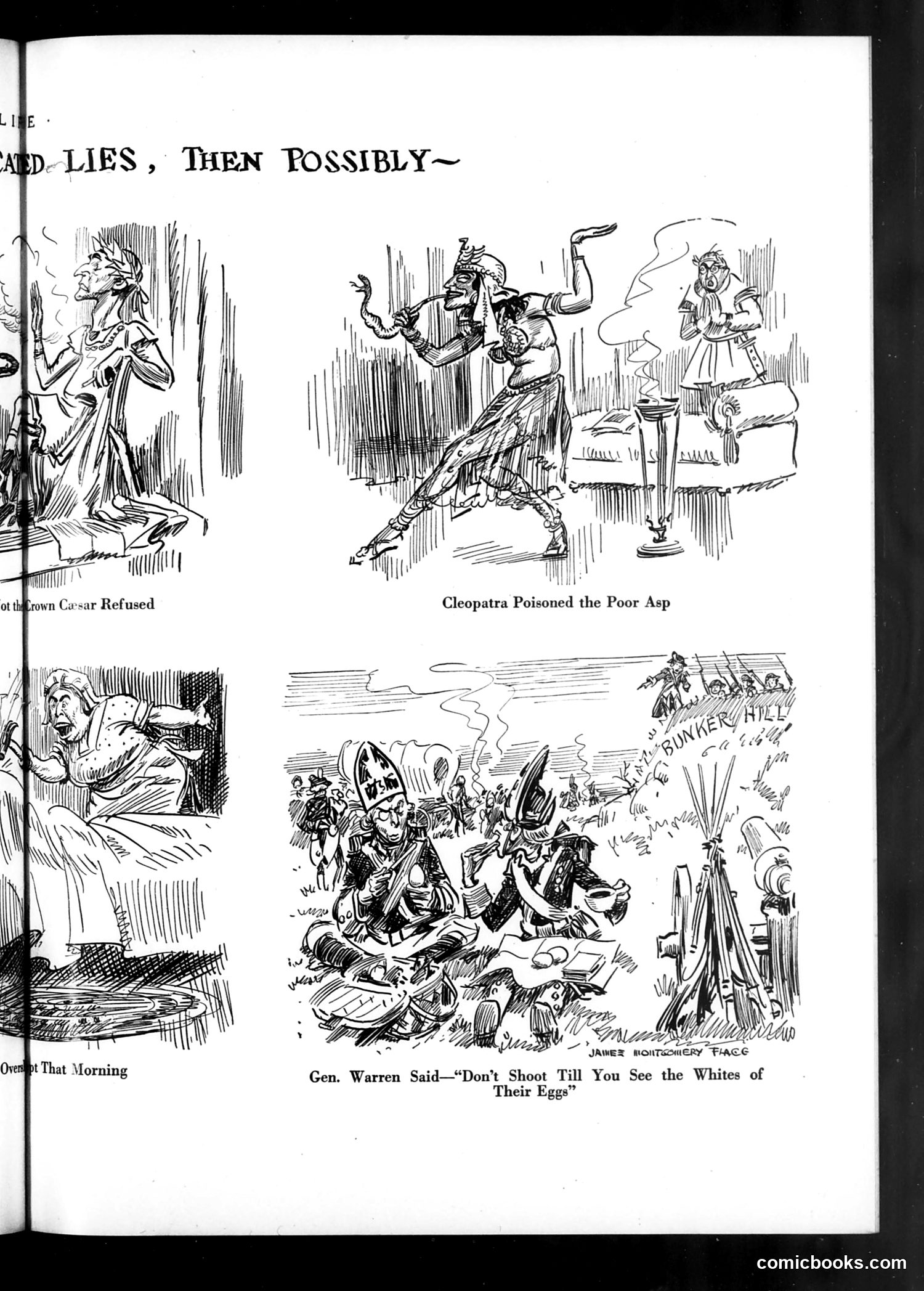
This page from *Life* magazine contains historical satirical cartoons mocking historical figures and events. The visible captions reference: 1. **"Cleopatra Poisoned the Poor Asp"** — likely a pun on classical history, treating the asp as a sympathetic victim 2. **General Warren's quote** — "Don't Shoot Till You See the Whites of Their Eggs" appears to parody the famous Revolutionary War order "Don't fire till you see the whites of their eyes," absurdly substituting "eggs," creating comic wordplay 3. **"Overt That Morning"** — caption for another illustration (unclear reference without full context) The cartoons employ exaggerated caricature drawing styles typical of early 20th-century satirical magazines, using historical and military references as vehicles for humor. The specific historical events or figures being mocked require additional context to fully explain.
This page critiques the Russian theatrical revue "Chauve-Souris" (Bat), which was performing in New York. The author, Robert C. Benchley, satirizes both the show and its pretentious American admirers. **The Satire:** Benchley argues the revue, while technically excellent and beautifully executed, relies entirely on tired, conventional acts—porcelain clock dancers, wooden soldiers, old-fashioned parlor sketches—the sort of entertainment Americans have endured since the Rutherford B. Hayes era. His central point: the same material performed by American actors would be dismissed as uncreative hack work, yet audiences treat it as profound art simply because it's Russian and presented with sophisticated aesthetics ("ultra-modern greens and lavenders"). **The Joke:** This attacks the cultural snobbery of "high-class" New York audiences who automatically revere foreign performers while dismissing domestic talent—a commentary on American inferiority complex toward European culture in the 1920s. The small illustrations show simplified stage figures, reinforcing the mechanical, unoriginal nature of the acts.
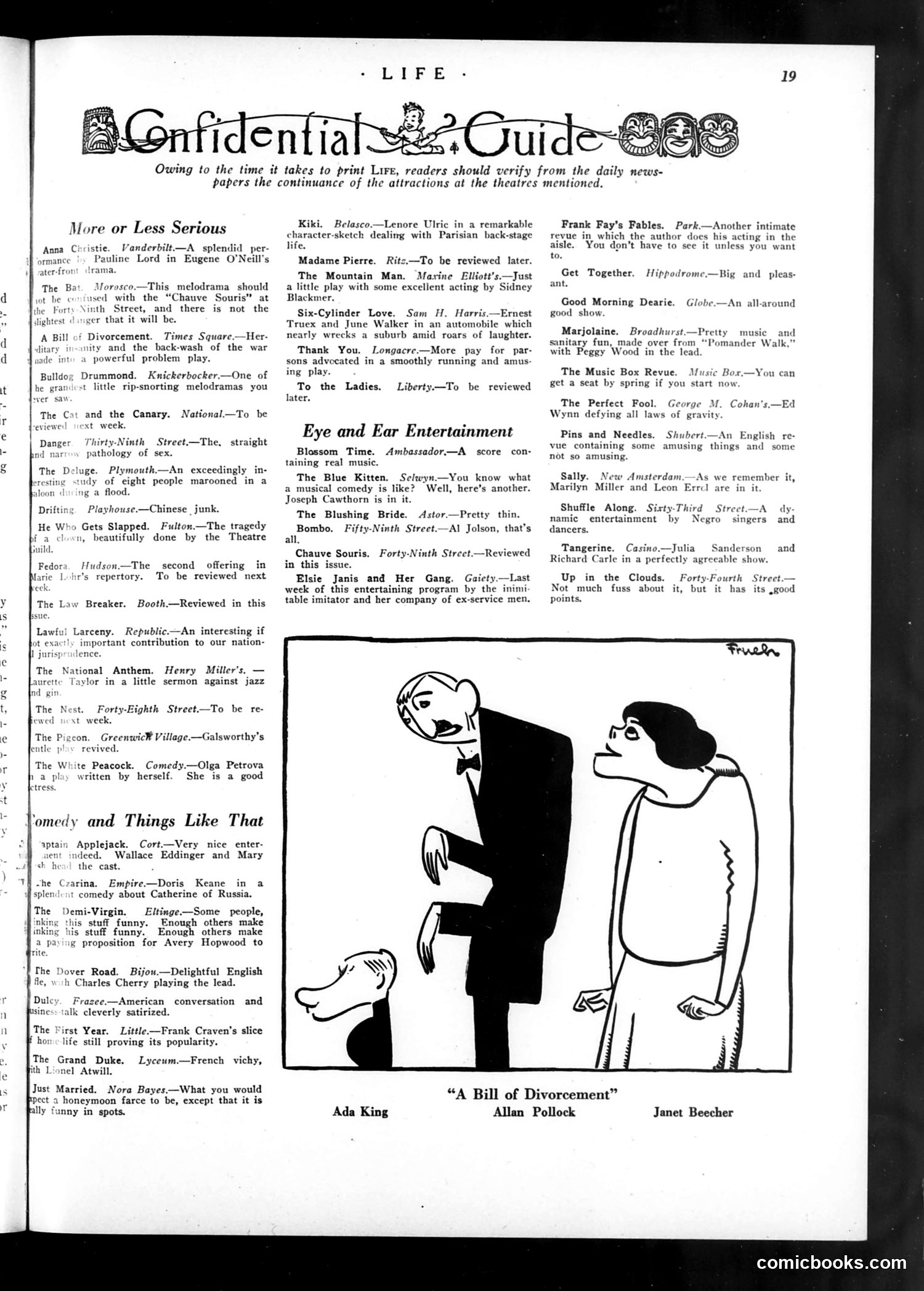
This cartoon illustrates the title play reviewed on the page—a serious drama about the aftermath of World War I and inherited mental illness. The image shows two figures in an emotionally fraught moment: a man holding up a theatrical mask (suggesting performance, artifice, or hidden identity) while a woman looks away in distress. The cartoon captures the play's central tension: the conflict between appearance and reality, duty and desire. The mask likely represents either the man's attempt to conceal his condition or the societal pretense that must be maintained around such uncomfortable topics as hereditary insanity and divorce—subjects the review identifies as the play's "powerful problem." The cartoonist (signed "Frueh") uses this simple, expressive imagery to convey the psychological and emotional complexity that makes this a "problem play" rather than light entertainment, distinguishing it from the comedies and musical reviews listed on the same page.
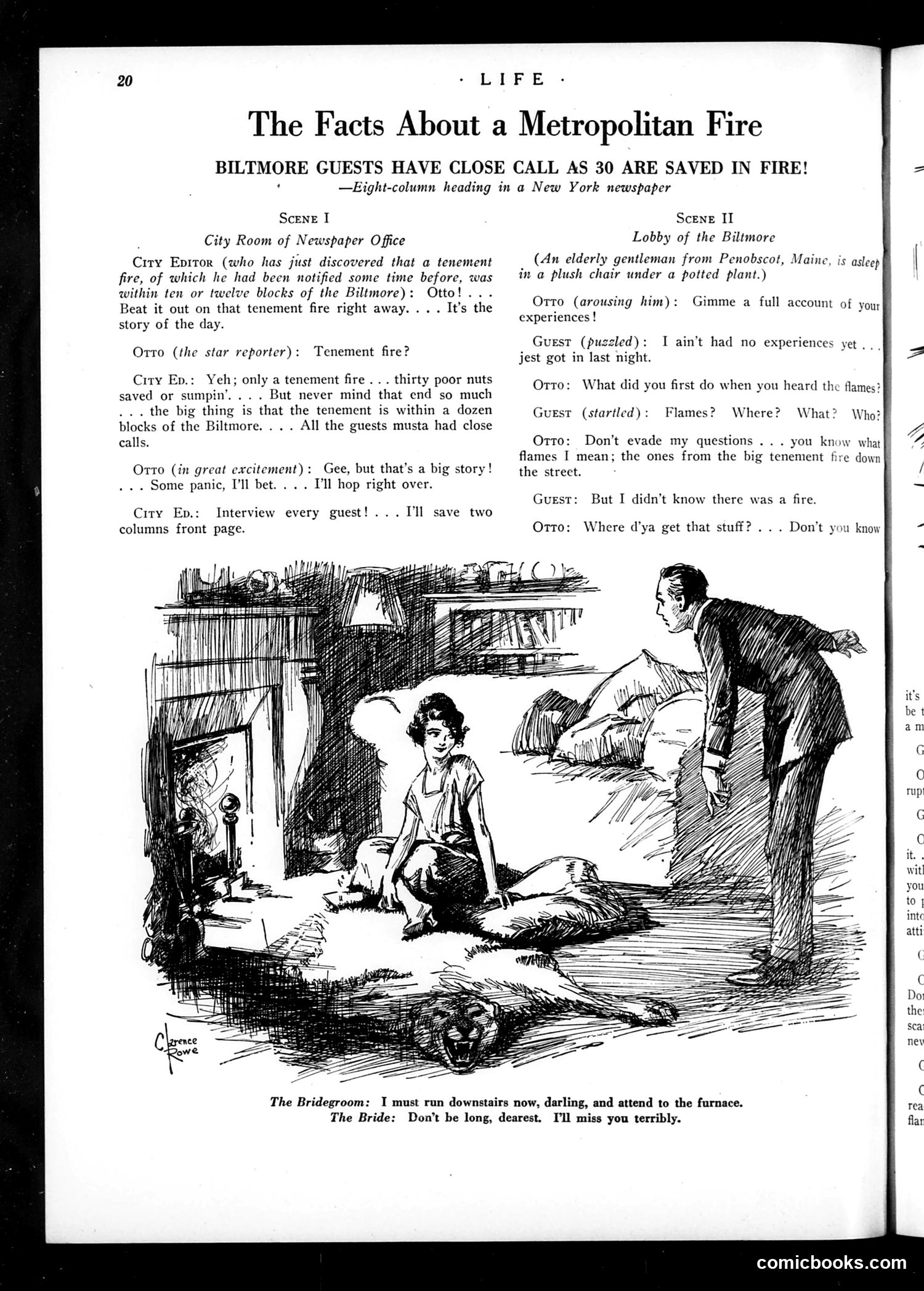
This two-scene satire mocks sensationalist newspaper journalism and class bias in news coverage. **The Setup:** A tenement fire kills 30 poor residents, but the newspaper's City Editor dismisses it as routine ("thirty poor nuts saved") until learning the fire occurred near the Biltmore Hotel, where wealthy guests stay. Suddenly it becomes front-page news—not because of the deaths, but because of proximity to the rich. **The Punch:** Reporter Otto interviews hotel guests seeking dramatic "fire experiences," but they slept through the entire incident. A guest from Maine didn't even know a fire happened. The scene reveals the absurdity: the newspaper manufactures a sensational story ("Biltmore guests have close call") from nothing, while the actual tragedy—poor people dying—barely merited mention. **The Point:** Life satirizes how 1920s newspapers prioritized wealthy readers' interests over genuine human tragedy, fabricating drama around the rich while ignoring deaths among the poor. The bridegroom's mundane dialogue underscores the fakery of the manufactured crisis.
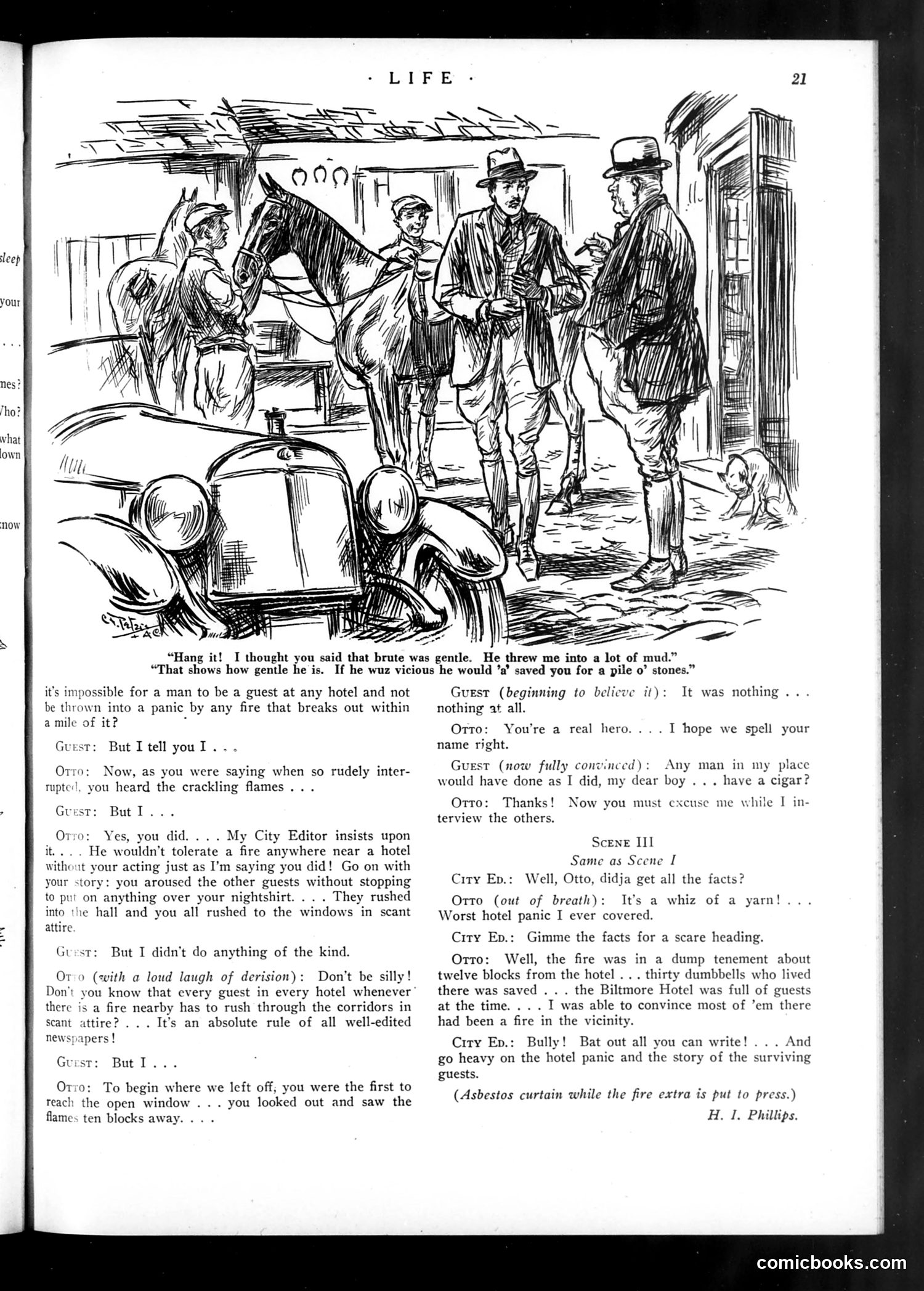
This cartoon by H. I. Phillips satirizes sensationalist newspaper reporting. Otto, a city reporter, interviews a hotel guest about a nearby tenement fire. Otto systematically *fabricates* details—pressuring the guest to confirm false claims about panicked guests fleeing in nightclothes, heroic window rescues, and dramatic flames visible blocks away. The confused guest eventually accepts these invented "facts" as his own memory. The joke exposes how newspapers (particularly the "City Editor") manufacture exciting stories for circulation, coaching witnesses into confirming false narratives. The final scene shows Otto's editor demanding sensational headlines about hotel panic, despite the actual fire occurring in a poor tenement with no hotel involvement. The satire criticizes "yellow journalism"—the practice of exaggerating or fabricating stories for dramatic effect and sales, a common criticism of American newspapers in the early 20th century.
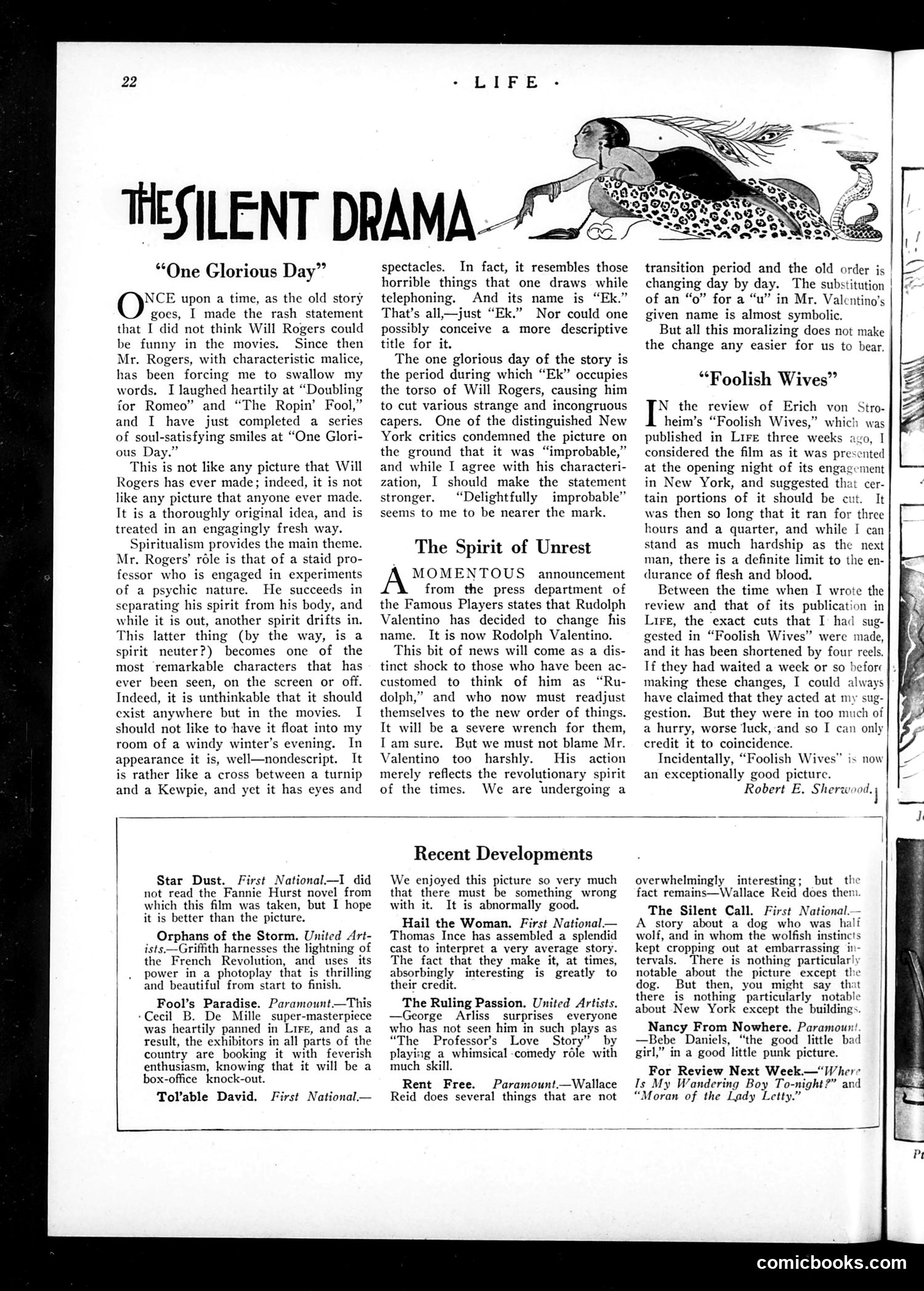
This page reviews three silent films, using satire to comment on Hollywood's absurdities and vanities circa early 1920s. **"One Glorious Day"** reviews a Will Rogers comedy about spiritualism where Rogers's character's body is possessed by a spirit creature called "Ek"—described mockingly as resembling something doodled while on the telephone. The satire mocks the film's implausibility while admitting Rogers makes it entertainingly absurd. **"The Spirit of Unrest"** sarcastically covers Rudolph Valentino's name change from "Rudolph" to "Rodolph." The critic playfully equates this minor spelling shift with revolutionary social upheaval, suggesting Hollywood's self-importance inflates trivial celebrity decisions into cosmic significance. **"Foolish Wives"** review complains the film ran three hours and twenty minutes. The satire lies in the critic's rueful admission that after suggesting cuts, the studio made them anyway—but too quickly for him to claim credit. Overall, the page gently ridicules Hollywood's pretensions, stars' vanities, and the medium's bizarre creative choices while remaining affectionate toward cinema itself.
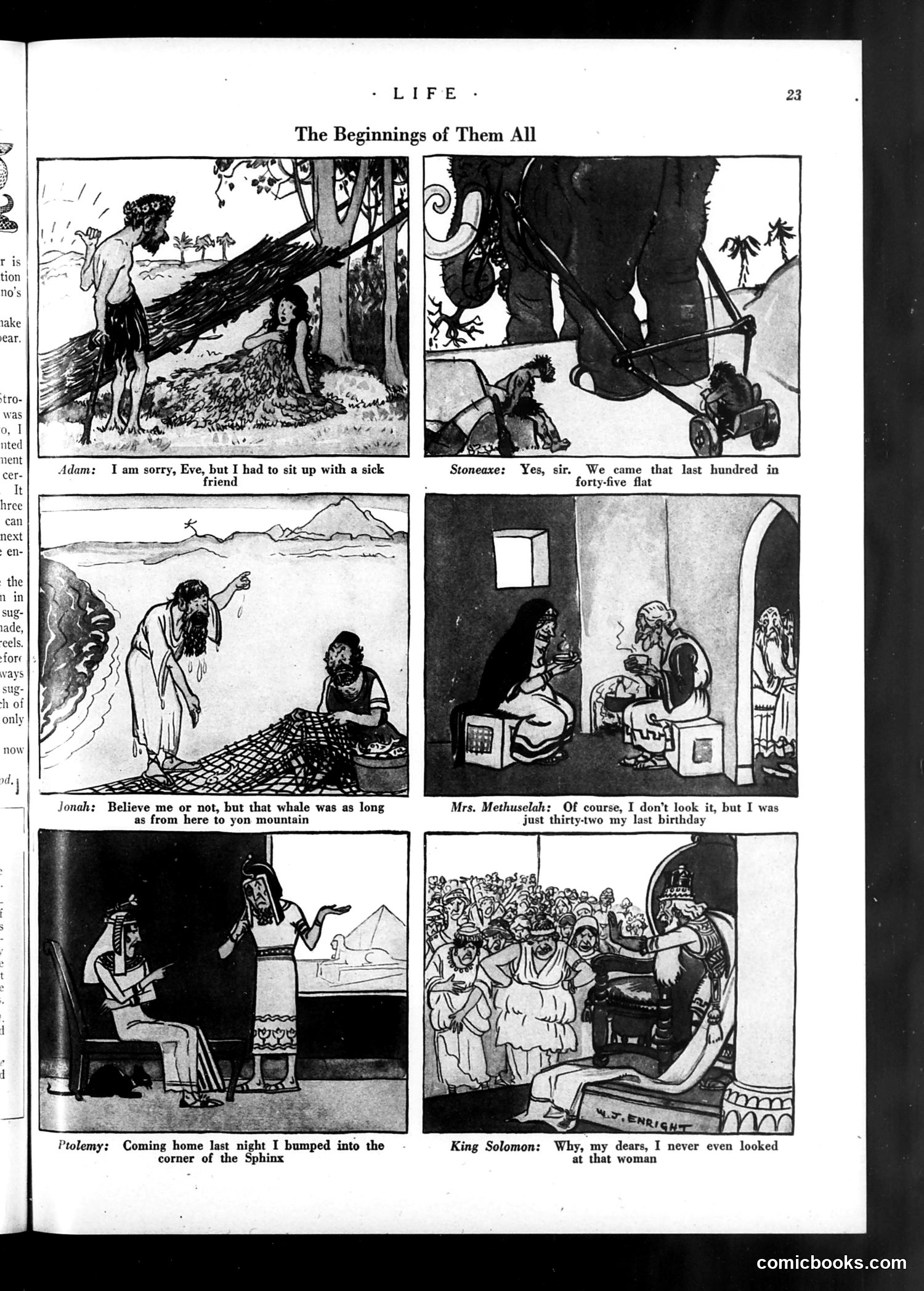
This page presents six comic panels featuring biblical and historical figures making excuses or boasting about implausible achievements—a satire on how legends grow through exaggeration. **The jokes:** - **Adam** apologizes to Eve for neglecting her (domestic complaint set in Eden) - **Stoneaxe** brags about speed records in a primitive setting - **Jonah** exaggerates the whale's size (a classic tall tale) - **Mrs. Methuselah** claims youth despite extreme age (referencing the biblical figure who lived 969 years) - **Ptolemy** casually mentions bumping into the Sphinx (anachronistic/impossible) - **King Solomon** boasts about ignoring women despite his legendary many wives The satire mocks how historical and religious narratives become inflated through retelling, and how people across time universally make excuses or embellish stories. The humor relies on readers recognizing these famous figures and their associated legends.
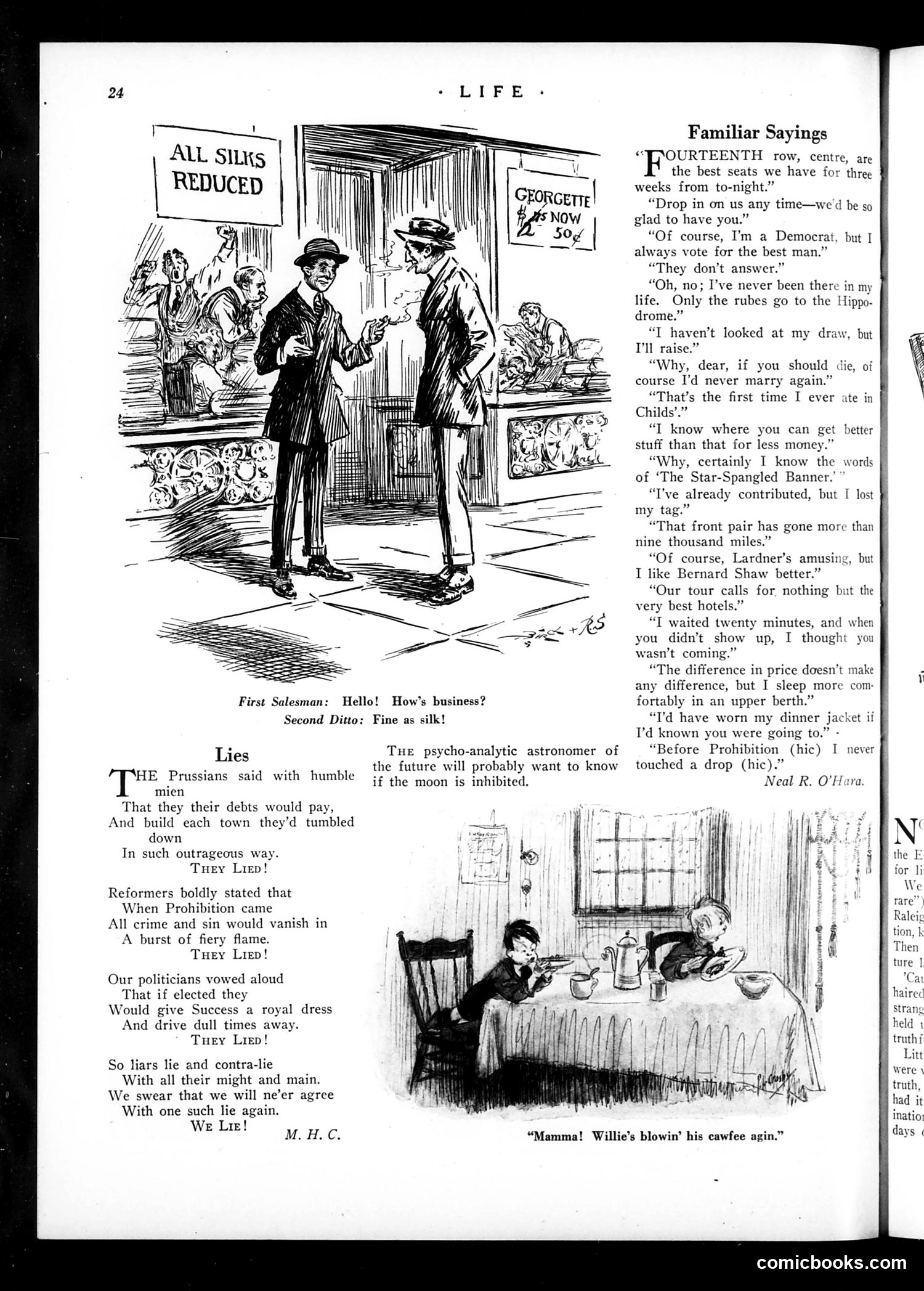
**Top Cartoon:** A silk merchant tells a colleague "Fine as silk!" when asked about business, while an "All Silks Reduced" sign hangs behind him. This is a visual pun—he's literally fine because he's surrounded by silk, though the reduced prices suggest struggling sales. **"Lies" Poem:** A satirical verse by M.H.C. cataloging broken promises from different groups: Prussians (post-WWI reparations), Prohibition reformers (crime wouldn't vanish), and politicians (economic prosperity). Each stanza ends "They Lied!" The final verses express weary cynicism about widespread falsehoods in public discourse. **"Familiar Sayings" Column:** Lists common social lies people tell—false invitations ("drop in anytime"), exaggerated claims ("I know the words to the Star-Spangled Banner"), and contradictions (claiming sobriety before Prohibition while hiccupping). These mock hypocritical everyday dishonesty. **Bottom Cartoon:** A child blowing on hot coffee while mother says "Willie's blowin' his cawfee again"—a domestic scene with dialect humor. The page's theme: American society operates on widespread, accepted deception at every level.
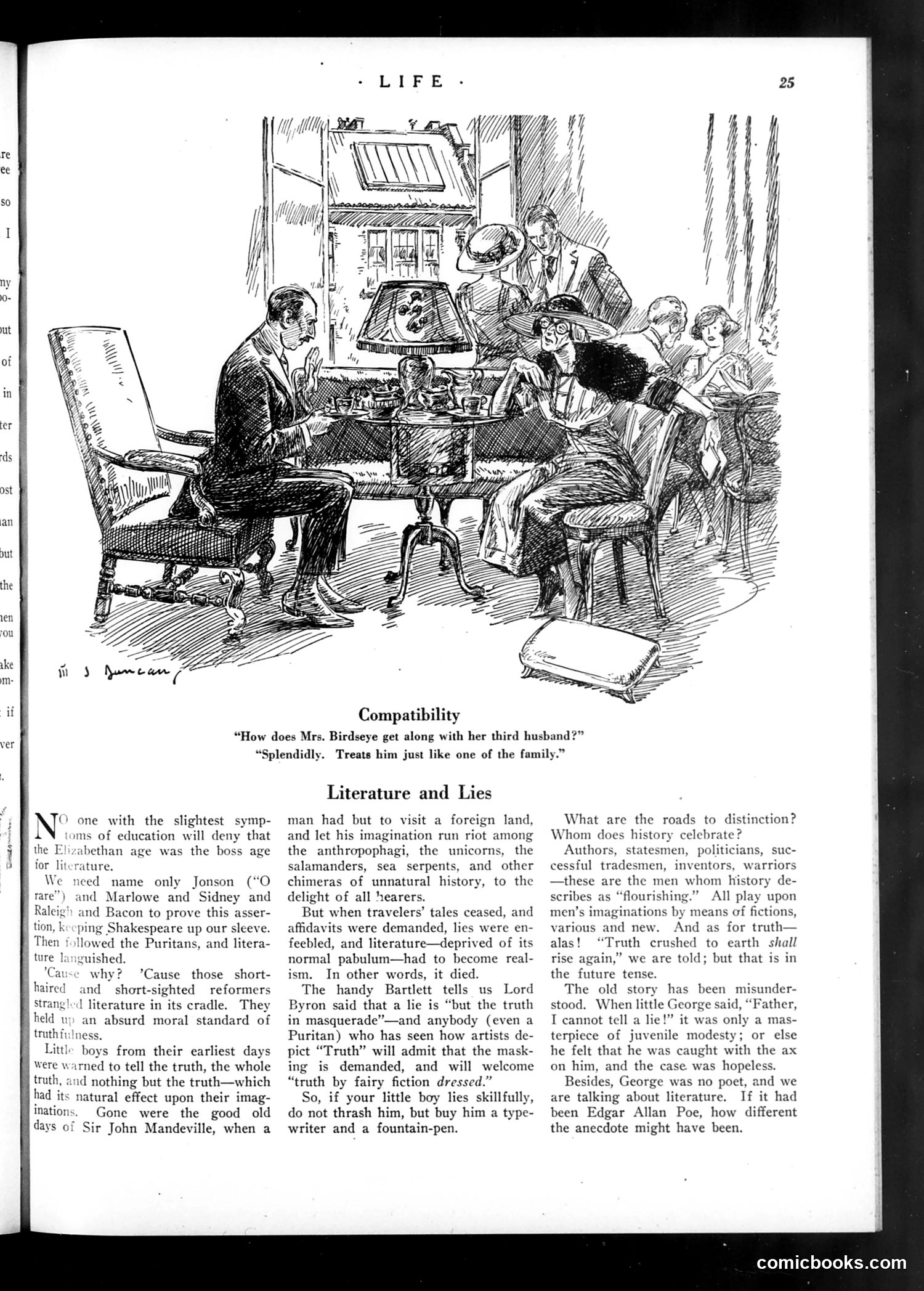
The cartoon depicts a domestic scene captioned "Compatibility," joking that Mrs. Birdseye gets along splendidly with her third husband by treating him "just like one of the family"—implying he's simply another in a series of disposable spouses, unremarkable enough to blend in. The accompanying essay, "Literature and Lies," argues that Puritan moral standards demanding children tell "the whole truth" damaged English literature by suppressing imaginative embellishment. The author contrasts this with earlier writers like John Mandeville, who freely invented fantastical tales. He claims "truth by fairy fiction dressed" (Byron's phrase) is superior to bare realism, and sardonically suggests parents should buy lying sons typewriters to become writers rather than punish them—since history celebrates those who skillfully reshape facts (politicians, generals, authors). The George Washington cherry-tree anecdote is dismissed as likely fabrication anyway. The satire targets Puritan prudishness and celebrates artistic license over literal truthfulness.
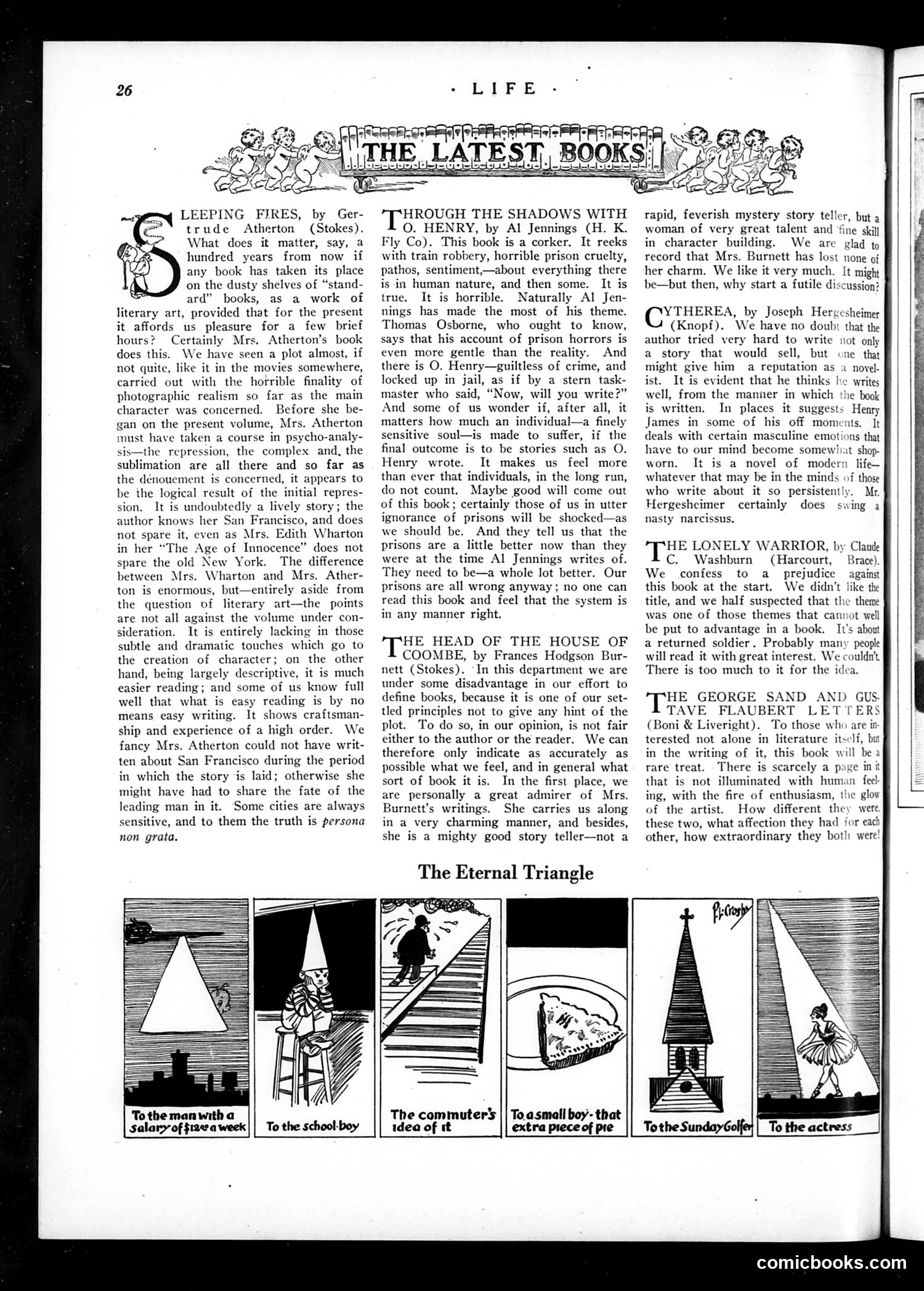
This is a humorous visual essay on a timeless social concept—the "eternal triangle" of romantic rivalry. Each panel depicts a different version of this three-person love scenario using simple geometric triangles as visual metaphors: The six scenes show the triangle's relevance across social classes: a working man earning modest wages, a schoolboy, a commuter, a boy receiving extra food, a churchgoer, and an actress. The joke is that romantic entanglement—typically involving two men and one woman (or vice versa)—affects everyone equally, regardless of social status or circumstance. The cartoon satirizes how this fundamental human drama recurs universally. By reducing each scenario to stark black-and-white imagery with minimal captions, the artist emphasizes that jealousy, love, and conflict are democratically distributed across society—from the poor to the wealthy, the young to the religious.
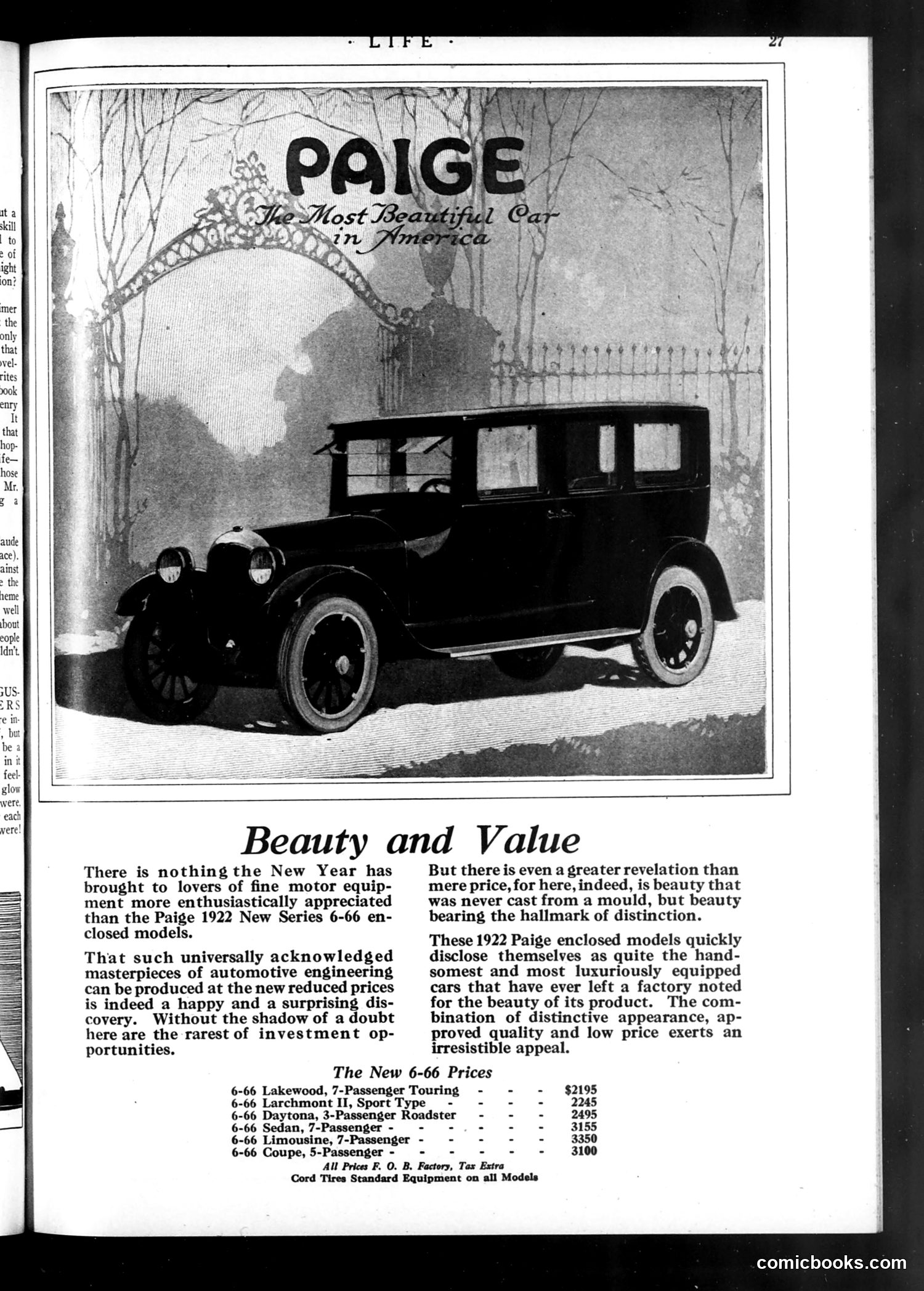
This page is primarily **automobile advertising**, not political satire. It promotes the Paige 1922 New Series 6-66 enclosed models as "The Most Beautiful Car in America." The advertisement uses romantic imagery—a silhouetted car beneath an ornate archway in a tree-lined landscape—to associate the vehicle with elegance and luxury. The text emphasizes that these cars combine "beauty," "quality," and affordability at "reduced prices," marketing them as smart investments for the new year. There is no cartoon or satirical content here. The page reflects early 1920s automotive advertising strategy: appealing to aspirational consumers by positioning a mid-range vehicle as offering luxury comparable to more expensive models. The "beauty" claim is marketing language, not commentary.
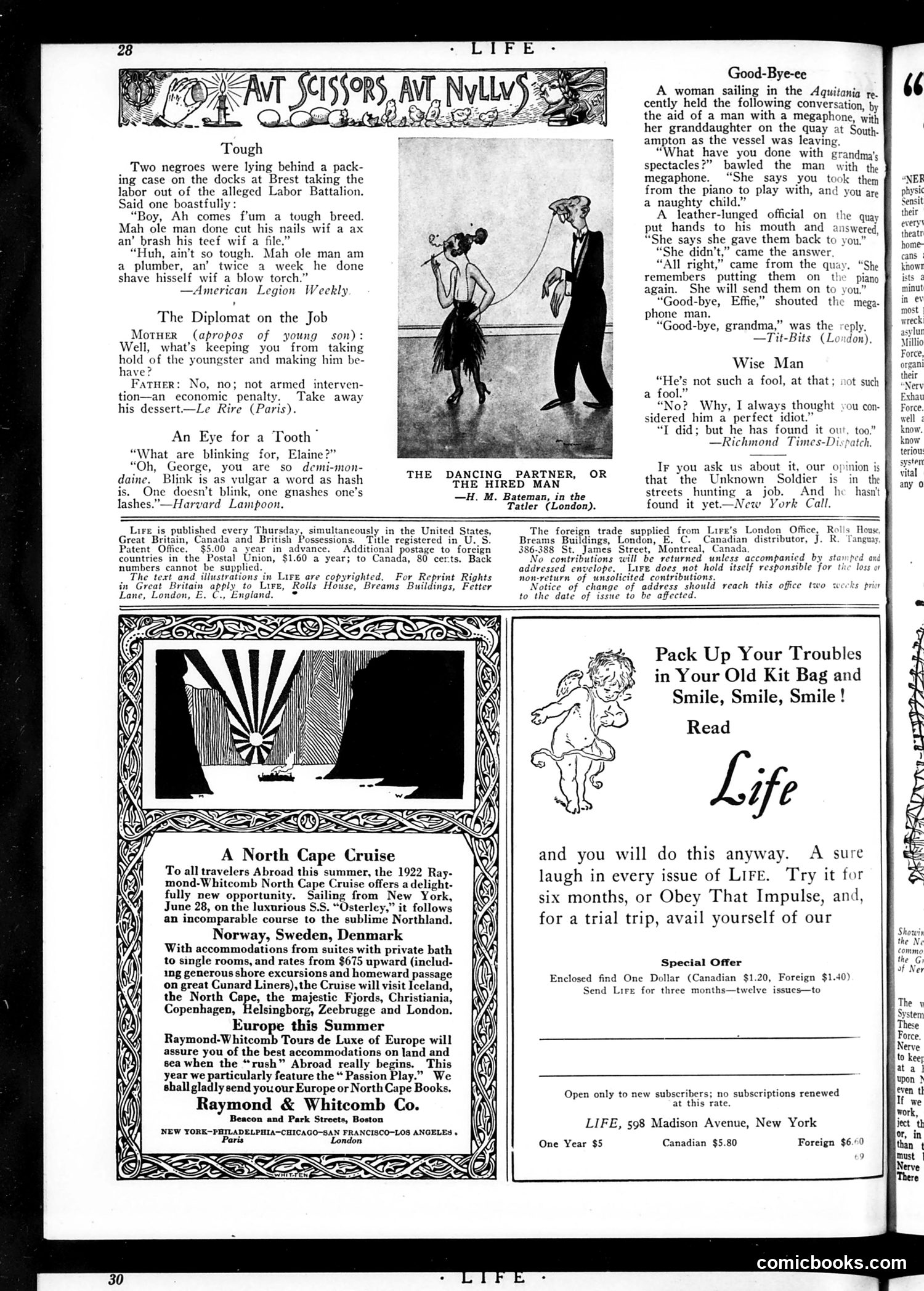
This page collects brief humorous anecdotes and cartoons typical of Life's satirical format: **"Tough"** mocks African American dialect humor (common but offensive by modern standards), presenting boastful claims about hardness—one man's father used an ax as a nail clipper; the other's used a blowtorch to shave. **"The Diplomat on the Job"** satirizes modern parenting by suggesting economic sanctions (removing dessert) rather than physical discipline—reflecting post-WWI debates about "soft" child-rearing. **"An Eye for a Tooth"** jokes about affected, pretentious speech—mocking a woman who avoids the word "blink" as vulgar, insisting on "gnashing one's lashes" instead. **"Good-Bye-ee"** humorously depicts a ship-departure conversation using megaphones, playing on communication mishaps across distance. **"Wise Man"** presents a brief paradox about foolishness. **The cartoon** (credited to H.M. Bateman) depicts "The Dancing Partner, or The Hired Man"—likely showing awkward dancing, though details are unclear. The page is primarily **advertising** (travel, magazine subscriptions) with scattered humor content.
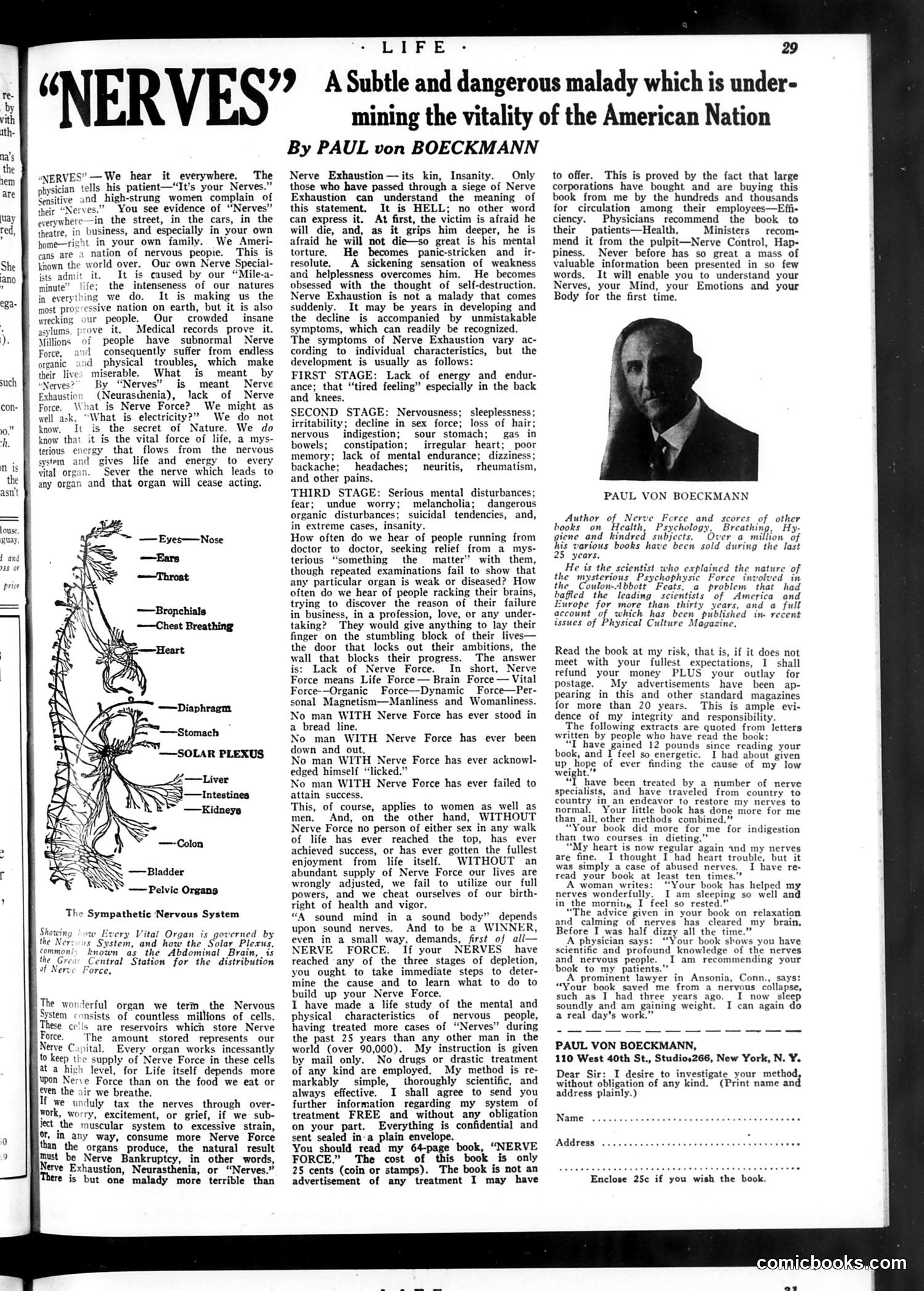
This is **not a cartoon or satire**, but rather a pseudo-medical advertisement disguised as educational journalism. The page promotes Paul von Boeckmann's book on "Nerve Force"—a quack remedy marketed during the early 20th century when "nerves" was a catch-all diagnosis for stress, anxiety, and various ailments. The anatomical diagram of the nervous system lends false scientific credibility. The text exploits genuine concerns about American industrial-era stress ("mile-a-minute life") to sell a dubious cure. The three "stages" of "Nerve Exhaustion" are vaguely-defined symptoms designed to convince readers they're sick. The testimonials and aggressive sales pitch ("Read the book at my risk") are classic direct-mail marketing tactics. This exemplifies how *Life* magazine—despite its satirical reputation—carried advertisements for fraudulent health products, exploiting readers' real anxieties about modern life with pseudoscientific jargon and manufactured expertise.
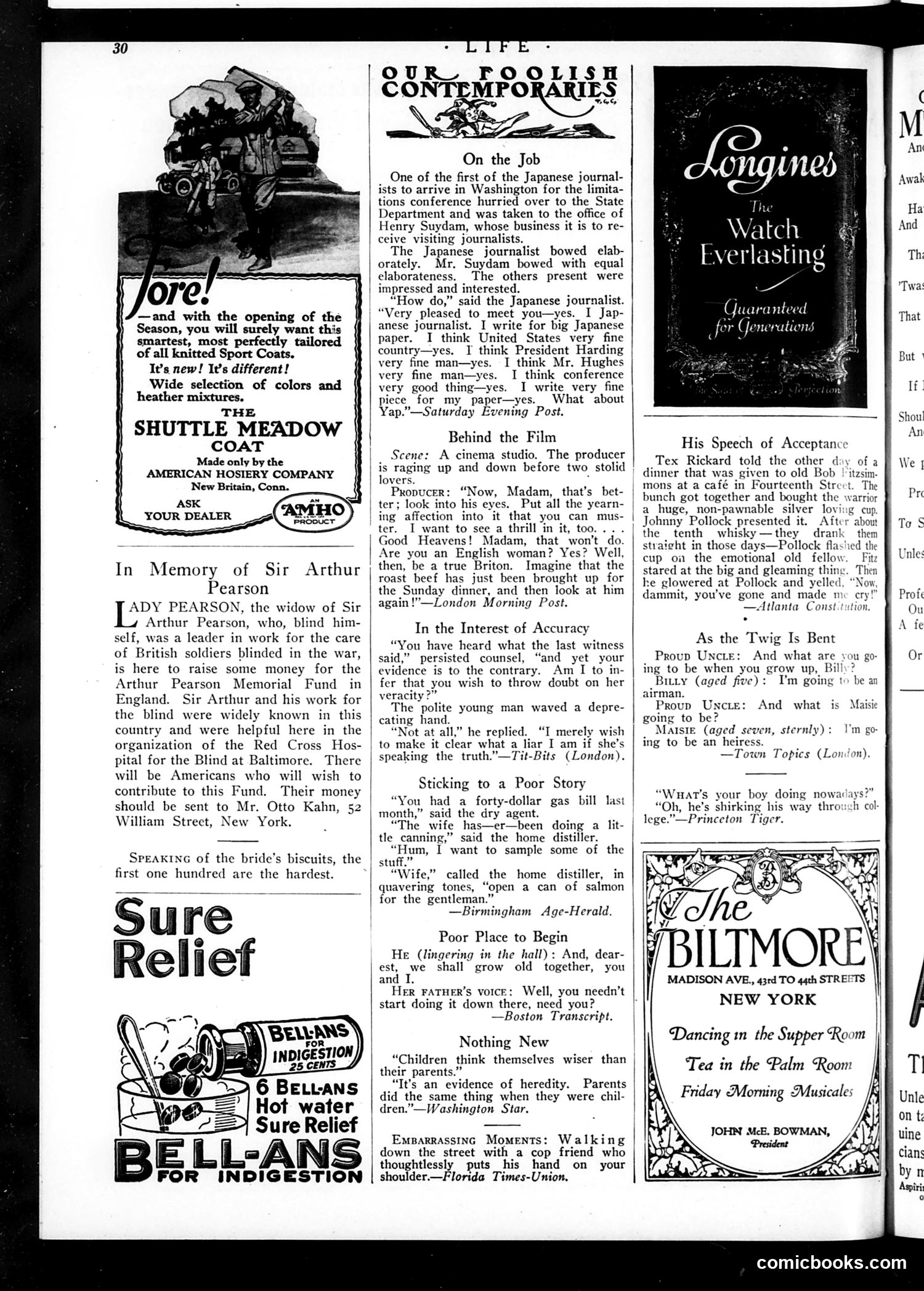
This page contains several satirical humor pieces and advertisements typical of Life magazine's format. **"On the Job"** mocks a Japanese journalist at the Washington Naval Conference (likely 1921-22), stereotyping his speech with exaggerated broken English and obsequiousness. The humor derives from his repetitive affirmations and sudden pivot to asking about "Yap" (a disputed Pacific island). **"Behind the Film"** satirizes silent film acting, where a producer instructs an actress to imagine roast beef to generate emotion—mocking the artificial methods actors used to convey feeling without dialogue. **"In the Interest of Accuracy"** presents a courtroom quip where a witness admits he's simply a liar, turning a legal cross-examination into wordplay. The remaining pieces are brief comedic anecdotes about marriage, Prohibition-era home distilling, and heredity. The page also includes a memorial notice for Sir Arthur Pearson, a blind British philanthropist, and period advertisements for clothing and digestive remedies (Bell-Ans for indigestion).
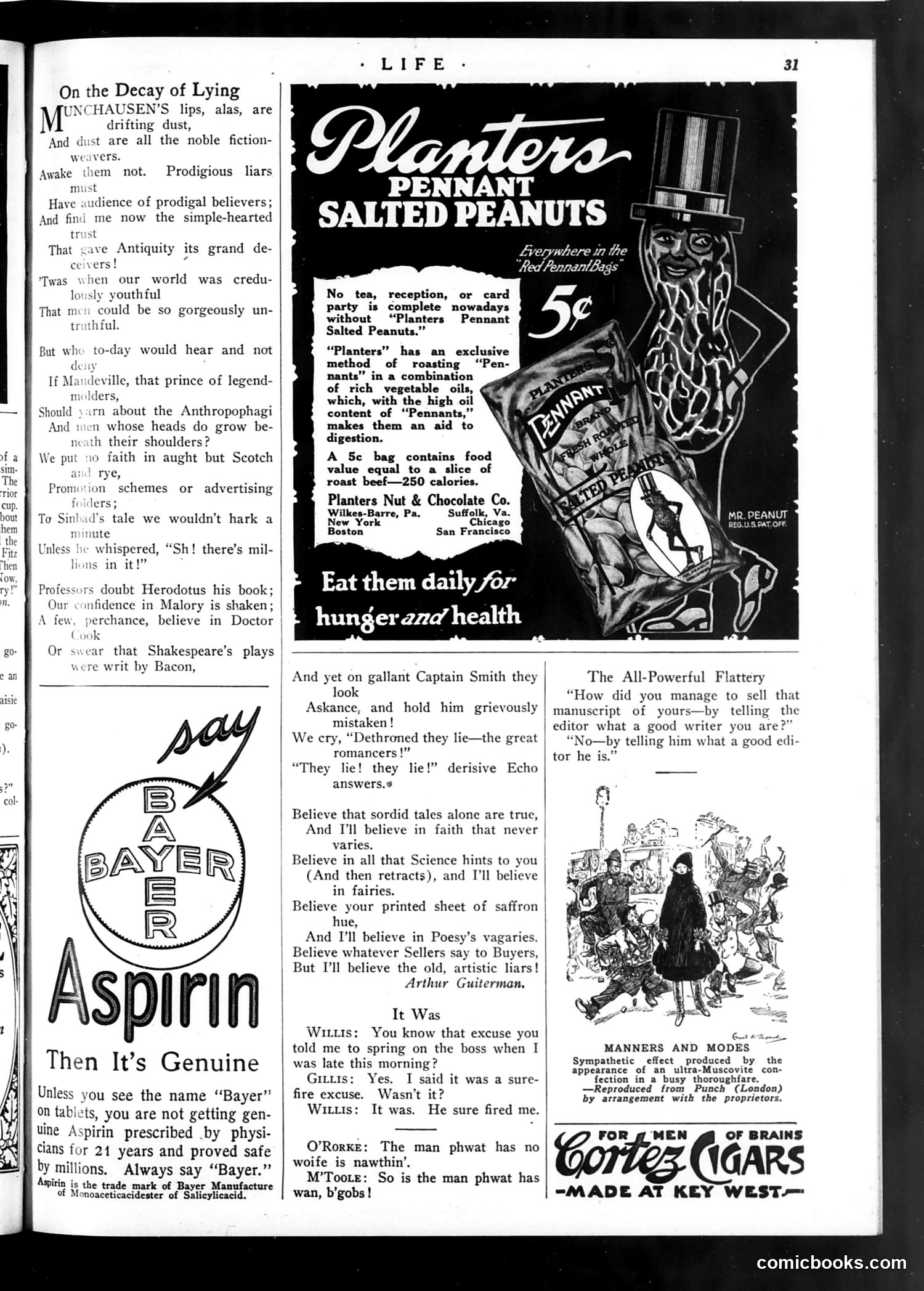
This page mixes literary satire with period advertising. The main text is Arthur Guiterman's poem "On the Decay of Lying," which laments that modern people no longer believe grand fictional tales—only in mundane things like "Scotch and rye" and advertising schemes. Guiterman argues we've lost faith in the old storytellers and romantic liars of antiquity. The advertisements reflect the commercial culture Guiterman critiques: Bayer Aspirin emphasizes brand-name trust, Planters Peanuts uses a mascot (Mr. Peanut) to sell snacks as health food, and Corlez Cigars target businessmen. The page includes brief humorous dialogues exploiting ethnic stereotypes (Irish accents in "It Was") and wordplay about flattery—typical of Life's lighter content. The overall irony: Guiterman mourns lost belief in fiction while surrounded by ads designed to manipulate consumer belief through marketing narratives.
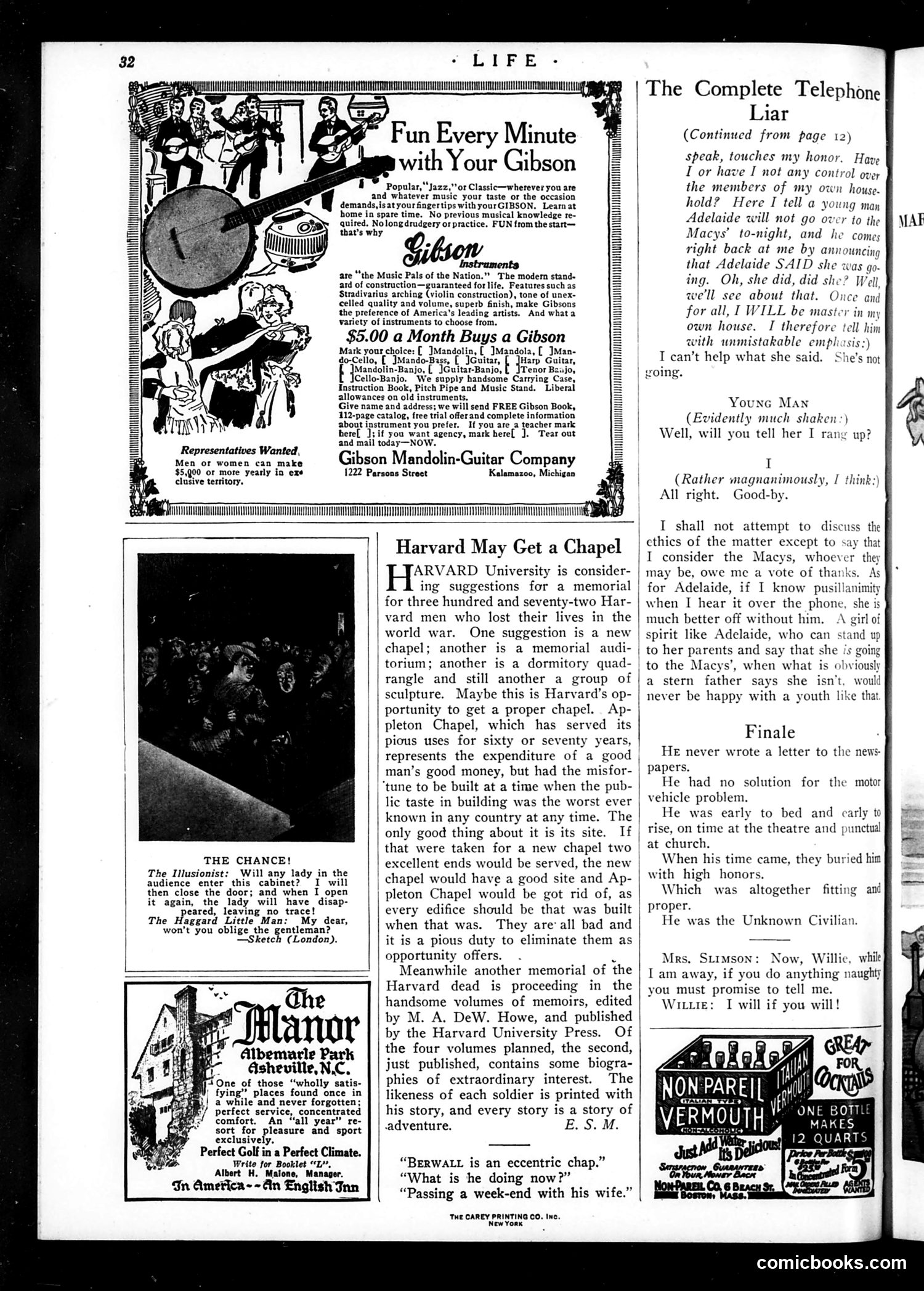
This page is primarily **advertising and light humor**, not political satire. The main content includes: 1. **Gibson Musical Instruments ad** (top): A straightforward product advertisement for mail-order musical instruments, emphasizing easy home learning with no prior knowledge required. Features various mandolins, guitars, and banjos at $5/month. 2. **"The Complete Telephone Liar" (right column)**: A humorous domestic sketch where a young man contradicts his fiancée Adelaide's statement to her parents that she won't visit the Macys' store. The joke plays on male-female relationship dynamics and the social awkwardness of public disagreement. 3. **"The Chance!" cartoon (lower left)**: A magic trick setup where a magician asks for a volunteer from the audience; a husband immediately offers his wife, implying he'd like her to disappear—a common marital humor trope of the era. 4. **Other minor ads** (Manor hotel, Vermouth): Standard period advertising. The page reflects 1920s social humor focused on gender relations and everyday domestic situations rather than political commentary.