
Life, 1922-02-23 · page 9 of 34
Life — February 23, 1922 — page 9: what you’re looking at
What you’re looking at
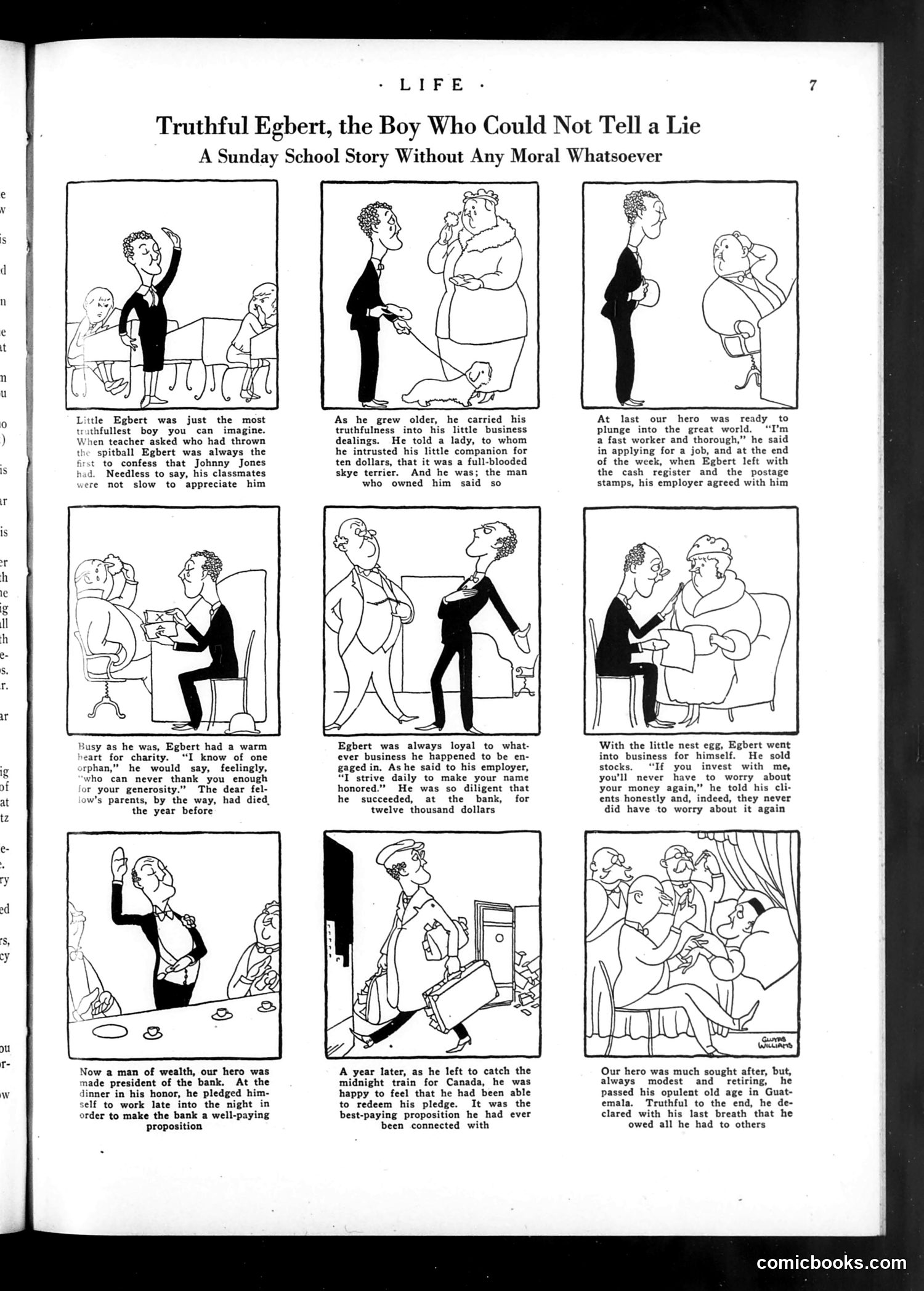
This is a satirical Sunday school-style moral tale that deliberately *subverts* the genre by offering "no moral whatsoever." The story follows Egbert, an impossibly honest boy whose truthfulness paradoxically leads to business success and wealth. The satire targets Victorian moral tales and American capitalism simultaneously. Egbert's rigid honesty—refusing to lie even when advantageous—somehow makes him rich and admired. The joke is that actual business success in the Gilded Age typically required dishonesty and manipulation, yet this cartoon suggests truthfulness brings fortune anyway, mocking both the naive moralism of Sunday school stories and the hypocrisy of wealthy businessmen who claimed virtue while engaging in dubious practices. The subtitle's admission of "no moral whatsoever" is the punchline itself.
📄 Transcribed text from this page (OCR, searchable)
Machine-transcribed from the original scan — historical spelling and the odd misread are preserved.
Little Egbert was just the most trathfullest boy you can imagine. When teacher asked who had thrown the spitball Egbert was always the first to confess that Johnny Jones had. Needless to say, his classmates were not slow to appreciate him Busy as he was, Egbert had a warm eart for charity. “I know of one rphan,” he would say, feelingly, who can never thank you enough ot your generosity.” The dear fel- ow’s parents, by the way, had died, the year before Now a man of wealth, our hero was made president of the bank. At the dinner in his honor, he pledged him- self to work late into the night in order to make the bank a well-paying proposition * LIFE - Truthful Egbert, the Boy Who Could Not Tell a Lie A Sunday School Story Without Any Moral Whatsoever As he grew older, he carried his truthfulness into his little business dealings. He told a lady, to whom he intrusted his little companion for ten dollars, that it was a full-blooded skye terrier. And he was; the man who owned him said so Egbert was always loyal to what- ever business he happened to be en- gaged in. Ashe said to his employer, “I strive daily to make your name honored.” He was so diligent that he succeeded, at the bank, for twelve thousand dollars A year later, as he left to catch the midnight train for Canada, he was happy to feel that he had been able to redeem his pledge. It was the best-paying proposition he had ever been connected with At last our hero was ready to plunge into the great world. “I’m a fast worker and thorough,” he said in applying for a job, and at the end of the week, when Egbert left with the cash register and the postage stamps, his employer agreed with him With the little nest egg, Egbert went into business for himself. He sold stocks. ‘If you invest with me, you'll never have to worry about your moncy again,” he told his cli- ents honestly and, indeed, they never did have to worry about it again Our hero was much sought after, but, always modest and retiring, he passed his opulent old age in Guat- emala. Truthful to the end, he de- clared with his last breath that he owed all he had to others comicbooks.com