
Life, 1922-02-23 · page 14 of 34
Life — February 23, 1922 — page 14: what you’re looking at
What you’re looking at
This satirical piece mocks the telephone's unreliability for honest communication. An elderly gentleman complains that telephones enable people to lie with impunity—the central operator and caller can easily deny what was said, unlike face-to-face conversation. The humor centers on a practical problem: when a young man calls asking for "Adelaide," the operator claims she doesn't know if Adelaide is available. This creates comic confusion and frustration. The piece illustrates how the telephone's distance between parties encourages deception—neither party can be definitively proven wrong about what was said or promised. It's satirizing early telephone culture's social awkwardness and the technology's capacity to facilitate dishonesty when no witnesses are present.
📄 Transcribed text from this page (OCR, searchable)
Machine-transcribed from the original scan — historical spelling and the odd misread are preserved.
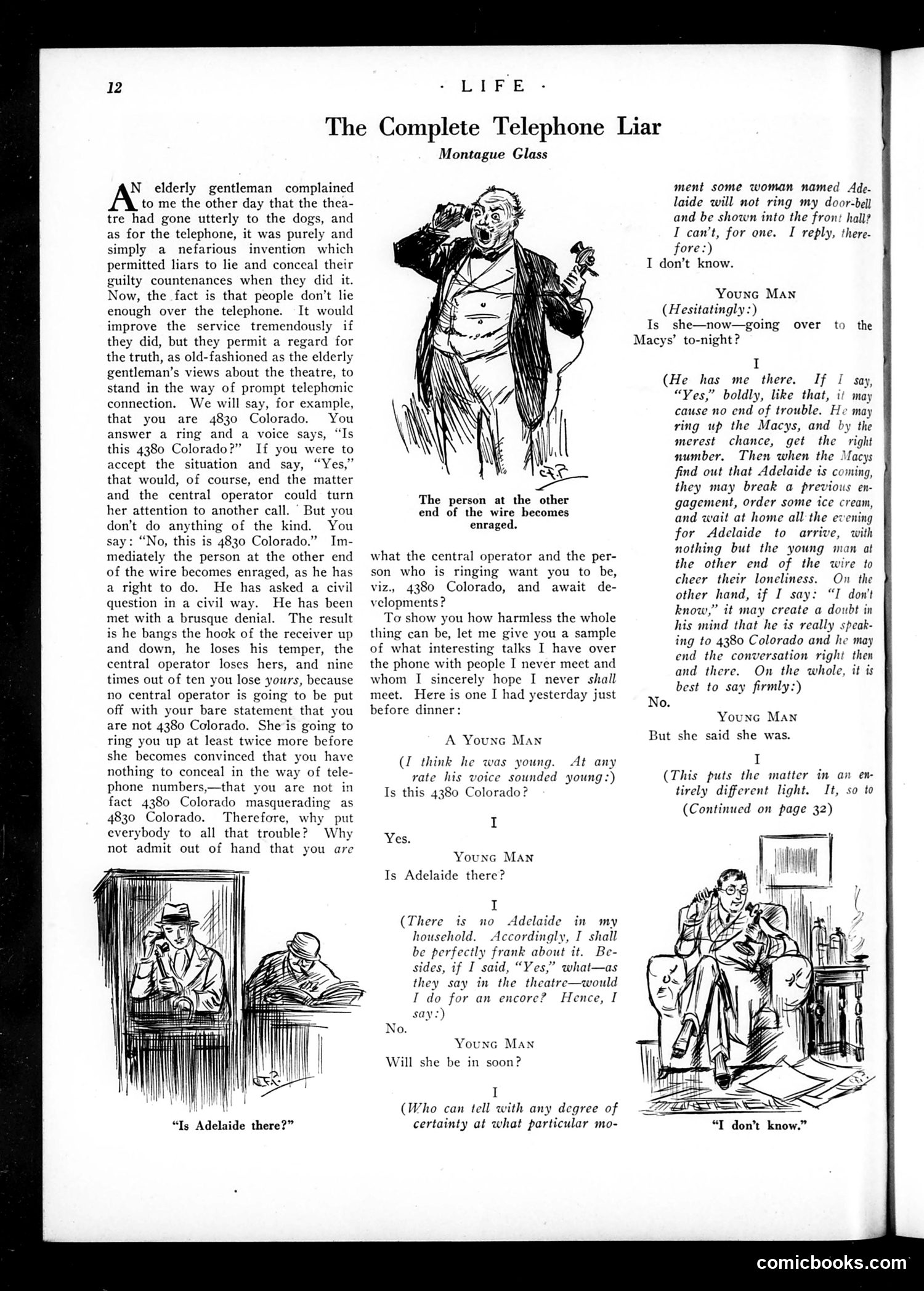
LP E The Complete Telephone Montague Glass N elderly gentleman complained A to me the other day that the thea- tre had gone utterly to the dogs, and as for the telephone, it was purely and simply a nefarious invention which permitted liars to lie and conceal their guilty countenances when they did it. Now, the fact is that people don’t lie enough over the telephone. It would improve the service tremendously if they did, but they permit a regard for the truth, as old-fashioned as the elderly gentleman’s views about the theatre, to stand in the way of prompt telephonic connection. We will say, for example, that you are 4830 Colorado. You answer a ring and a voice says, “Is this 4380 Colorado?” If you were to accept the situation and say, “Yes,” that would, of course, end the matter and the central operator could turn her attention to another call. ‘But you don’t do anything of the kind. You say: “No, this is 4830 Colorado.” Im- mediately the person at the other end of the wire becomes enraged, as he has a right to do. He has asked a civil question in a civil way. He has been met with a brusque denial. The result is he bangs the hook of the receiver up and down, he loses his temper, the central operator loses hers, and nine times out of ten you lose yours, because no central operator is going to be put off with your bare statement that you are not 4380 Colorado. She is going to ring you up at least twice more before she becomes convinced that you have nothing to conceal in the way of tele- phone numbers,—that you are not in fact 4380 Colorado masquerading as 4830 Colorado. Therefore, why put everybody to all that trouble? Why not admit out of hand that you are | \ } “Is Adelaide there?” The person at the other end of the wire becomes enraged. what the central operator and the per- son who is ringing want you to be, viz., 4380 Colorado, and await de- velopments? To show you how harmless the whole thing can be, let me give you a sample of what interesting talks I have over the phone with people I never meet and whom I sincerely hope I never shall meet. Here is one I had yesterday just before dinner: A Younc Man (I think he was young. At any rate his voice sounded young:) Is this 4380 Colorado? I Yes. Younc Man Is Adelaide there? I (There is no Adelaide in my household. Accordingly, I shall be perfectly frank about it. Be- sides, if I said, “Yes,” what—as they say in the theatre—would I do for an encore? Hence, I say:) No. Younc Man Will she be in soon? I (Who can tell with any degree of certainty at what particular mo- ment some woman named Ade- laide will not ring my door-bell and be shown into the front hall? I can’t, for one. I reply, there- fore:) I don’t know. Younc Man (Hesitatingl. Is she—now—going over to the Macys’ to-night? I (He has me there. If I say, “Yes,” boldly, like that, ii may cause no end of trouble. He may ring up the Macys, and by the merest chance, get the right number. Then when the Macys find out that Adelaide is coming, they may break a previous en- gagement, order some ice cream, and wait at home all the evening for Adelaide to arrive, with nothing but the young man at the other end of the wire to cheer their loneliness. On the other hand, if I say: “I don't know,” it may create a doubt in his mind that he is really speak- ing to 4380 Colorado and he may end the conversation right then and there. On the whole, it is best to say firmly:) No. Younc Man But she said she was. I (This puts the matter in an en- tirely different light. It, so to (Continued on page 32) “I don’t know.” comicbooks.com