
Life, 1922-02-23 · page 17 of 34
Life — February 23, 1922 — page 17: what you’re looking at
What you’re looking at
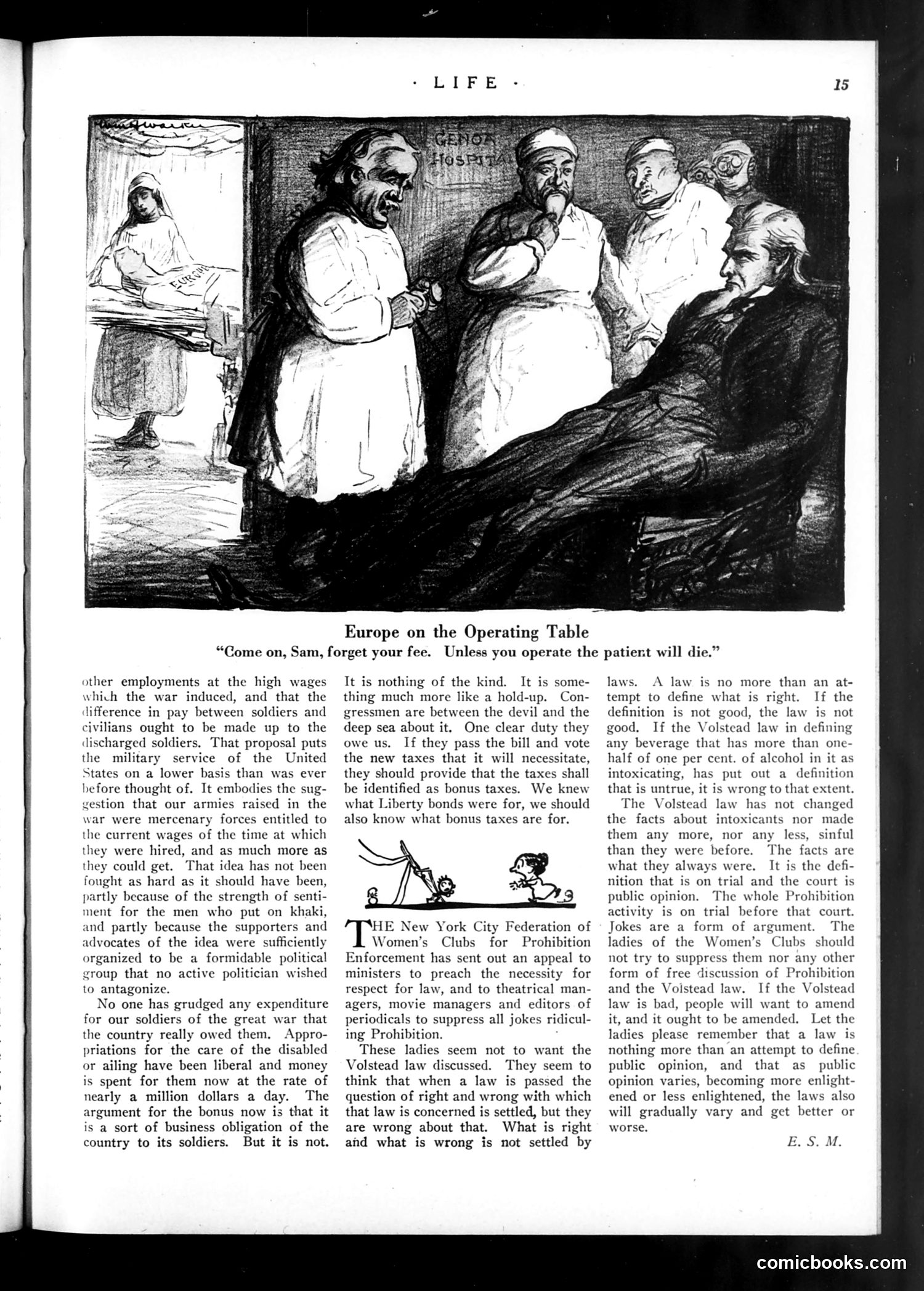
This political cartoon satirizes post-World War I peace negotiations. "Europe" appears as a patient on an operating table, with medical figures (likely representing Allied leaders or peacemakers) gathered around. The caption—"Come on, Sam, forget your fee. Unless you operate the patient will die"—suggests that Europe's survival depends on successful surgical intervention, but the doctors are haggling over payment rather than focusing on the critical work ahead. The cartoon critiques the self-interested negotiations of Allied powers during the Treaty of Versailles period, implying that political leaders prioritized financial gain over genuinely healing Europe's war-devastated condition. The satire mocks the apparent indifference of decision-makers to the continent's desperate post-war plight.
📄 Transcribed text from this page (OCR, searchable)
Machine-transcribed from the original scan — historical spelling and the odd misread are preserved.
Europe on the Operating Table “Come on, Sam, forget your fee. Unless you operate the patient will die.” other employments at the high wages which the war induced, and that the lifference in pay between soldiers and civilians ought to be made up to the discharged soldiers, That proposal puts the military service of the United States on a lower basis than was ever before thought of. It embodies the sug- gestion that our armies raised in the war were mercenary forces entitled to the current wages of the time at which they were hired, and as much more as they could get. That idea has not been fought as hard as it should have been, partly because of the strength of senti ment for the men who put on khaki, and partly because the supporters and advocates of the idea were sufficiently organized to be a formidable political group that no active politician wished to antagonize. No one has grudged any expenditure for our soldiers of the great war that the country really owed them. Appro- priations for the care of the disabled or ailing have been liberal and money is spent for them now at the rate of nearly a million dollars a day. The argument for the bonus now is that it is a sort of business obligation of the country to its soldiers. But it is not. It is nothing of the kind. It is some- thing much more like a hold-up. Con- gressmen are between the devil and the deep sea about it. One clear duty they owe us. If they pass the bill and vote the new taxes that it will necessitate, they should provide that the taxes shall be identified as bonus taxes. We knew what Liberty bonds were for, we should also know what bonus taxes are for. «) ‘HE New York City Federation of Women’s Clubs for Prohibition Enforcement has sent out an appeal to ministers to preach the necessity for respect for law, and to theatrical man- agers, movie managers and editors of periodicals to suppress all jokes ridicul- ing Prohibition. These ladies seem not to want the Volstead law discussed. They seem to think that when a law is passed the question of right and wrong with which that law is concerned is settled, but they are wrong about that. What is right and what is wrong is not settled by A law is no more than an at- tempt to define what is right. If the definition is not good, the law is not good. If the Volstead law in defining any beverage that has more than one- half of one per cent. of alcohol in i intoxicating, has put out a defi that is untrue, it is wrong to that extent. The Volstead law has not changed the facts about intoxicants nor made them any more, nor any less, sinful than they were before. The facts are what they always were. It is the defi- nition that is on trial and the court is public opinion. The whole Prohibition activity is on trial before that court. Jokes are a form of argument. The ladies of the Women’s Clubs should not try to suppress them nor any other form of free discussion of Prohibition and the Voistead law. If the Volstead law is bad, people will want to amend it, and it ought to be amended. Let the ladies please remember that a law is nothing more than an attempt to define public opinion, and that as _ public opinion varies, becoming more enlight- ened or less enlightened, the laws also will gradually vary and get better or worse, laws. E. S. M. comicbooks.com