
Life, 1922-02-23 · page 13 of 34
Life — February 23, 1922 — page 13: what you’re looking at
What you’re looking at
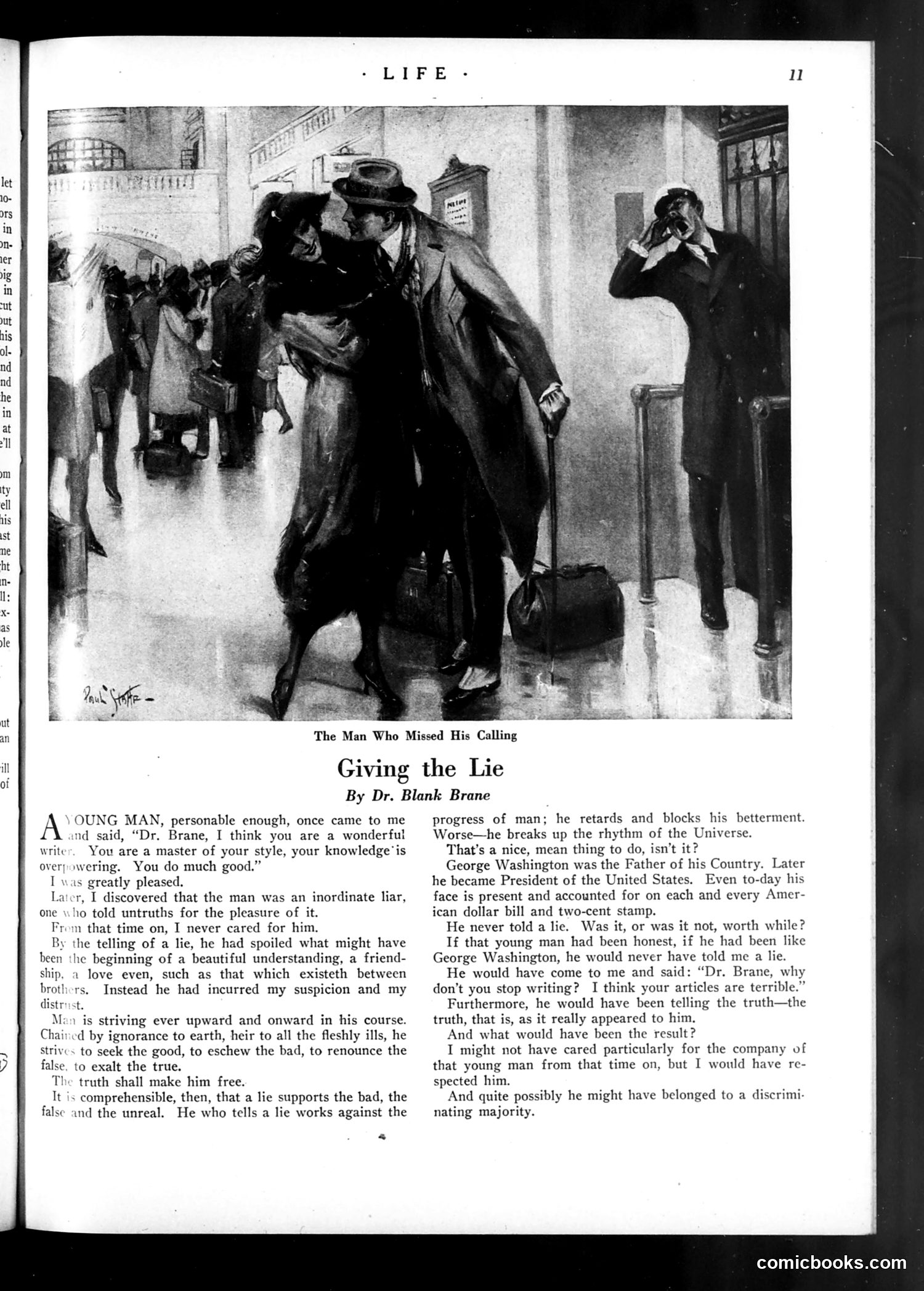
This satirical article critiques a young man who lied to the author, claiming mastery in writing and knowledge. The illustration depicts the confrontation—a man in a hat and overcoat gestures while speaking to a woman in what appears to be a public building or station, with other figures observing in the background. The piece uses George Washington as a moral exemplar, noting he "never told a lie" and became president precisely because of his honesty. Brune argues that lying undermines character and social advancement. The satire targets the young man's dishonesty as a character flaw that ultimately damages his prospects, despite any short-term advantage deception might offer. The cartoon illustrates the embarrassing social consequences of being caught in falsehood.
📄 Transcribed text from this page (OCR, searchable)
Machine-transcribed from the original scan — historical spelling and the odd misread are preserved.
write The Man Who Missed His Calling Giving the Lie By Dr. Blank Brane OUNG MAN, personable enough, once came to me nd said, “Dr. Brane, I think you are a wonderful You are a master of your style, your knowledge ‘is powering. You do much good.” is greatly pleased. r, I discovered that the man was an inordinate liar, ho told untruths for the pleasure of it. n that time on, I never cared for him. the telling of a lie, he had spoiled what might have he beginning of a beautiful understanding, a friend- 1 love even, such as that which existeth between rs. Instead he had incurred my suspicion and my ) is striving ever upward and onward in his course. d by ignorance to earth, heir to all the fleshly ills, he to seek the good, to eschew the bad, to renounce the >. to exalt the true. false truth shall make him free. s comprehensible, then, that a lie supports the bad, the and the unreal. He who tells a lie works against the « progress of man; he retards and blocks his betterment. Worse—he breaks up the rhythm of the Universe. That's a nice, mean thing to do, isn’t it? George Washington was the Father of his Country. Later he became President of the United States. Even to-day his face is present and accounted for on each and every Amer- ican dollar bill and two-cent stamp. He never told a lie. Was it, or was it not, worth while? If that young man had been honest, if he had been like George Washington, he would never have told me a lie. He would have come to me and said: “Dr. Brane, why don’t you stop writing? I think your articles are terrible.” Furthermore, he would have been telling the truth—the truth, that is, as it really appeared to him. And what would have been the result? I might not have cared particularly for the company of that young man from that time on, but I would have re- spected him. And quite possibly he might have belonged to a discrimi- nating majority. comicbooks.com