
Life, 1922-02-23 · page 27 of 34
Life — February 23, 1922 — page 27: what you’re looking at
What you’re looking at
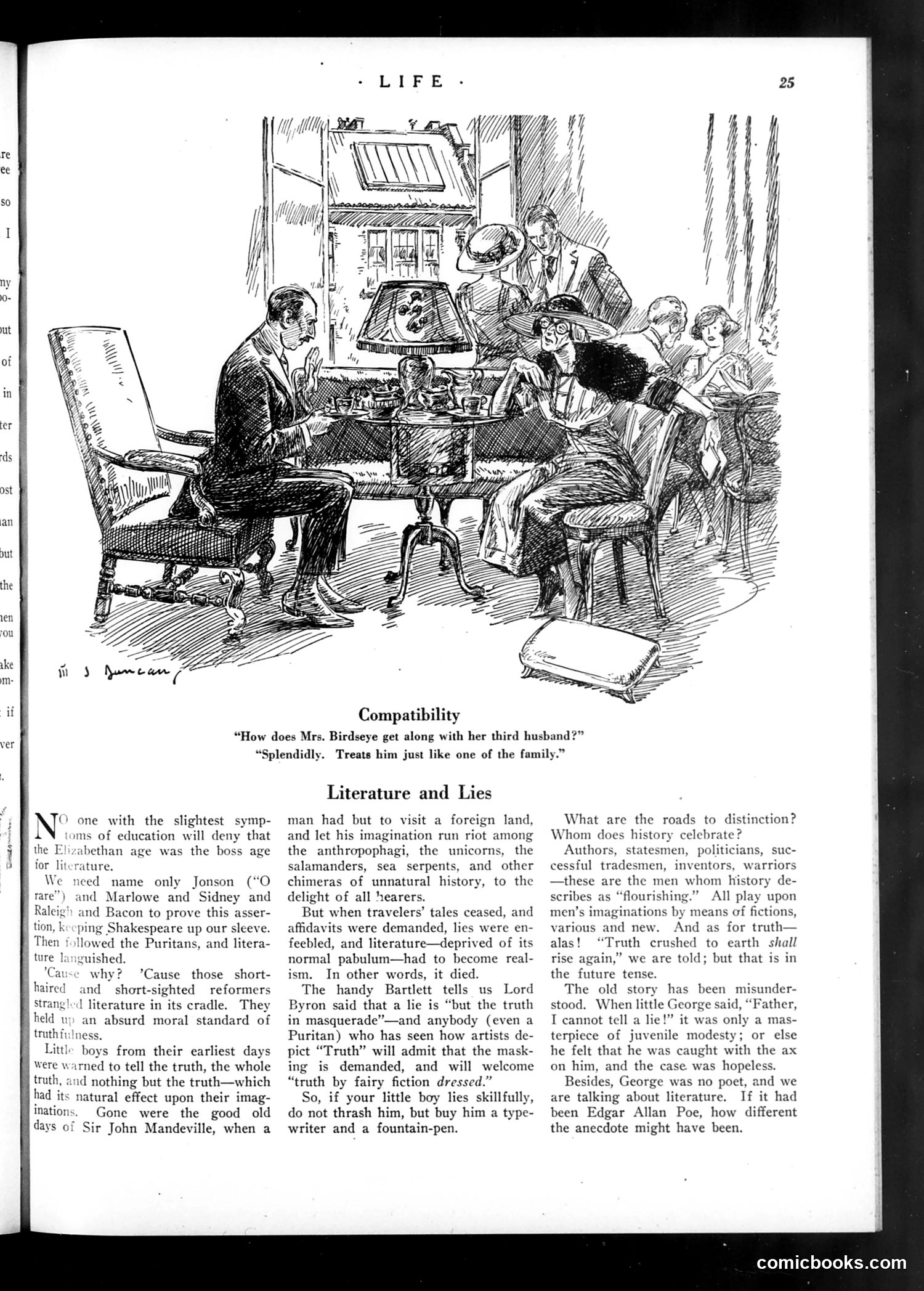
The cartoon depicts a domestic scene captioned "Compatibility," joking that Mrs. Birdseye gets along splendidly with her third husband by treating him "just like one of the family"—implying he's simply another in a series of disposable spouses, unremarkable enough to blend in. The accompanying essay, "Literature and Lies," argues that Puritan moral standards demanding children tell "the whole truth" damaged English literature by suppressing imaginative embellishment. The author contrasts this with earlier writers like John Mandeville, who freely invented fantastical tales. He claims "truth by fairy fiction dressed" (Byron's phrase) is superior to bare realism, and sardonically suggests parents should buy lying sons typewriters to become writers rather than punish them—since history celebrates those who skillfully reshape facts (politicians, generals, authors). The George Washington cherry-tree anecdote is dismissed as likely fabrication anyway. The satire targets Puritan prudishness and celebrates artistic license over literal truthfulness.
📄 Transcribed text from this page (OCR, searchable)
Machine-transcribed from the original scan — historical spelling and the odd misread are preserved.
Compatibility “How does Mrs. Birdseye get along with her third husband?” “Splendidly. Treats him just like one of the family.” rN one with the slightest symp- | toms of education will deny that abethan age was the boss age for literature. We need name only Jonson y the E (“O nd Marlowe and Sidney and and Bacon to prove this asser- ping Shakespeare up our sleeve. llowed the Puritans, and litera- guished. pCa why? ’Cause those short- haired and short-sighted reformers }) Strangled literature in its cradle. They held up an absurd moral standard of rare”) » Ralei tion, k p Then { ture Is Little boys from their earliest days }) Were warned to tell the truth, the whole ) truth, and nothing but the truth—which i had its natural effect upon their imag- inations. Gone were the good old days of Sir John Mandeville, when a Literature and Lies man had but to visit a foreign land, and let his imagination run riot among the anthropophagi, the unicorns, the salamanders, sea serpents, and other chimeras of unnatural history, to the delight of all hearers. But when travelers’ tales ceased, and affidavits were demanded, lies were en- feebled, and literature—deprived of its normal pabulum—had to become real- ism. In other words, it died. The handy Bartlett tells us Lord Byron said that a lie is “but the truth in masquerade”—and anybody (even a Puritan) who has seen how artists de- pict “Truth” will admit that the mask- ing is demanded, and will welcome “truth by fairy fiction dressed.” So, if your little boy lies skillfully, do not thrash him, but buy him a type- writer and a fountain-pen. What are the roads to distinction? Whom does history celebrate? Authors, statesmen, politicians, suc- cessful tradesmen, inventors, warriors —these are the men whom history de- scribe! ‘flourishing.” All play upon men’s imaginations by means of fictions, various and new. And as for truth— alas! “Truth crushed to earth shall rise again,” we are told; but that is in the future tense. The old story has been misunder- stood. When little George said, “Father, I cannot tell a lie!” it was only a mas- terpiece of juvenile mod ; or else he felt that he was caught with the ax on him, and the case was hopeless. Besides, George was no poet, and we are talking about literature. If it had been Edgar Allan Poe, how different the anecdote might have been. comicbooks.com