
Life, 1922-02-23 · page 16 of 34
Life — February 23, 1922 — page 16: what you’re looking at
What you’re looking at
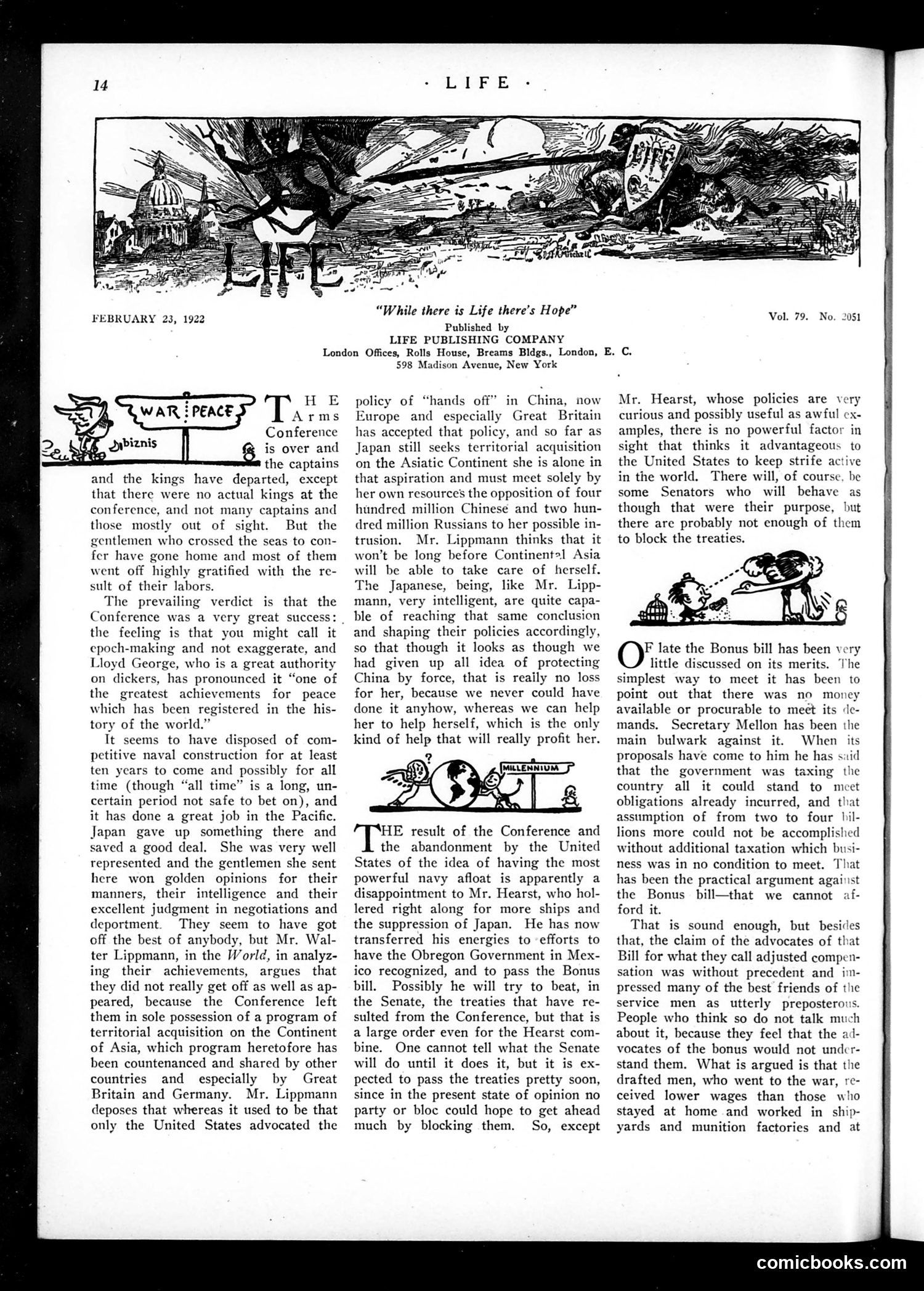
The page contains two editorial sections addressing post-WWI policy debates. The left column discusses the Washington Conference's outcomes regarding naval construction and Japan's territorial ambitions in China. The right column debates the "Bonus bill" for war veterans. The small **cartoons** appear to use allegorical figures—likely representing nations or policy positions—engaged in negotiation or conflict, though specific identities aren't entirely clear from the reproductions. The underlying satire critiques how political negotiations often produce compromises that satisfy no one: the Conference supposedly ended competitive naval construction but disappointed those wanting stronger action against Japan, while the Bonus bill debate pits veterans' interests against fiscal concerns and Senate obstruction.
📄 Transcribed text from this page (OCR, searchable)
Machine-transcribed from the original scan — historical spelling and the odd misread are preserved.
FEBRUARY 23, 1922 “While there is Life there's Hope” Published by LIFE PUBLISHING COMPANY Vol. 79. No. 2051 London Offices, Rolls House, Breams Bldgs., London, E. C. T HE Arms Conference is over and the captains and the kings have departed, except that there were no actual kings at the conference, and not many captains and those mostly out of sight. But the gentlemen who crossed the seas to con- fer have gone home and most of them went off highly gratified with the re- sult of their labors. The prevailing verdict is that the Conference was a very great success: the feeling is that you might call it epoch-making and not exaggerate, and Lloyd George, who is a great authority on dickers, has pronounced it “one of the greatest achievements for peace which has been registered in the his- tory of the world.” It seems to have disposed of com- petitive naval construction for at least ten years to come and possibly for all time (though “all time” is a long, un- certain period not safe to bet on), and it has done a great job in the Pacific. Japan gave up something there and saved a good deal. She was very well represented and the gentlemen she sent here won golden opinions for their manners, their intelligence and their excellent judgment in negotiations and deportment. They seem to have got off the best of anybody, but Mr. Wal- ter Lippmann, in the World, in analyz- ing their achievements, argues that they did not really get off as well as ap- peared, because the Conference left them in sole possession of a program of territorial acquisition on the Continent of Asia, which program heretofore has been countenanced and shared by other countries and especially by Great Britain and Germany. Mr. Lippmann deposes that whereas it used to be that only the United States advocated the 598 Madison Avenue, New York policy of “hands off” in China, now Europe and especially Great Britain has accepted that policy, and so far as Japan still seeks territorial acquisition on the Asiatic Continent she is alone in that aspiration and must meet solely by her own resources the opposition of four hundred million Chinese and two hun- dred million Russians to her possible in- trusion. Mr. Lippmann thinks that it won’t be long before Continental Asia will be able to take care of herself. The Japanese, being, like Mr. Lipp- mann, very intelligent, are quite capa- ble of reaching that same conclusion and shaping their policies accordingly, so that though it looks as though we had given up all idea of protecting China by force, that is reaily no loss for her, because we never could have done it anyhow, whereas we can help her to help herself, which is the only kind of help that will really profit her. ‘HE result of the Conference and the abandonment by the United States of the idea of having the most powerful navy afloat is apparently a disappointment to Mr. Hearst, who hol- lered right along for more ships and the suppression of Japan. He has now transferred his energies to efforts to have the Obregon Government in Mex- ico recognized, and to pass the Bonus bill. Possibly he will try to beat, in the Senate, the treaties that have re- sulted from the Conference, but that is a large order even for the Hearst com- bine. One cannot tell what the Senate will do until it does it, but it is ex- pected to pass the treaties pretty soon, since in the present state of opinion no party or bloc could hope to get ahead much by blocking them. So, except Mr. Hearst, whose policies are very curious and possibly useful as awful ex- amples, there is no powerful factor in sight that thinks it advantageous to the United States to keep strife active in the world. There will, of course, be some Senators who will behave as though that were their purpose, but there are probably not enough of them to block the treaties. F late the Bonus bill has been very little discussed on its merits. The simplest way to meet it has been to point out that there was no money available or procurable to meet its le- mands. Secretary Mellon has been the main bulwark against it. When its proposals have come to him he has siid that the government was taxing the country all it could stand to meet obligations already incurred, and that assumption of from two to four Dbil- lions more could not be accomplished without additional taxation which busi- ness was in no condition to meet. That has been the practical argument against the Bonus bill—that we cannot af- ford it. That is sound enough, but besices that, the claim of the advocates of that Bill for what they call adjusted compen- sation was without precedent and im- pressed many of the best friends of the service men as utterly preposterous. People who think so do not talk much about it, because they feel that the ad- vocates of the bonus would not under- stand them. What is argued is that the drafted men, who went to the war, re- ceived lower wages than those who stayed at home and worked in ship- yards and munition factories and at comicbooks.com