
Life, 1922-02-23 · page 24 of 34
Life — February 23, 1922 — page 24: what you’re looking at
What you’re looking at
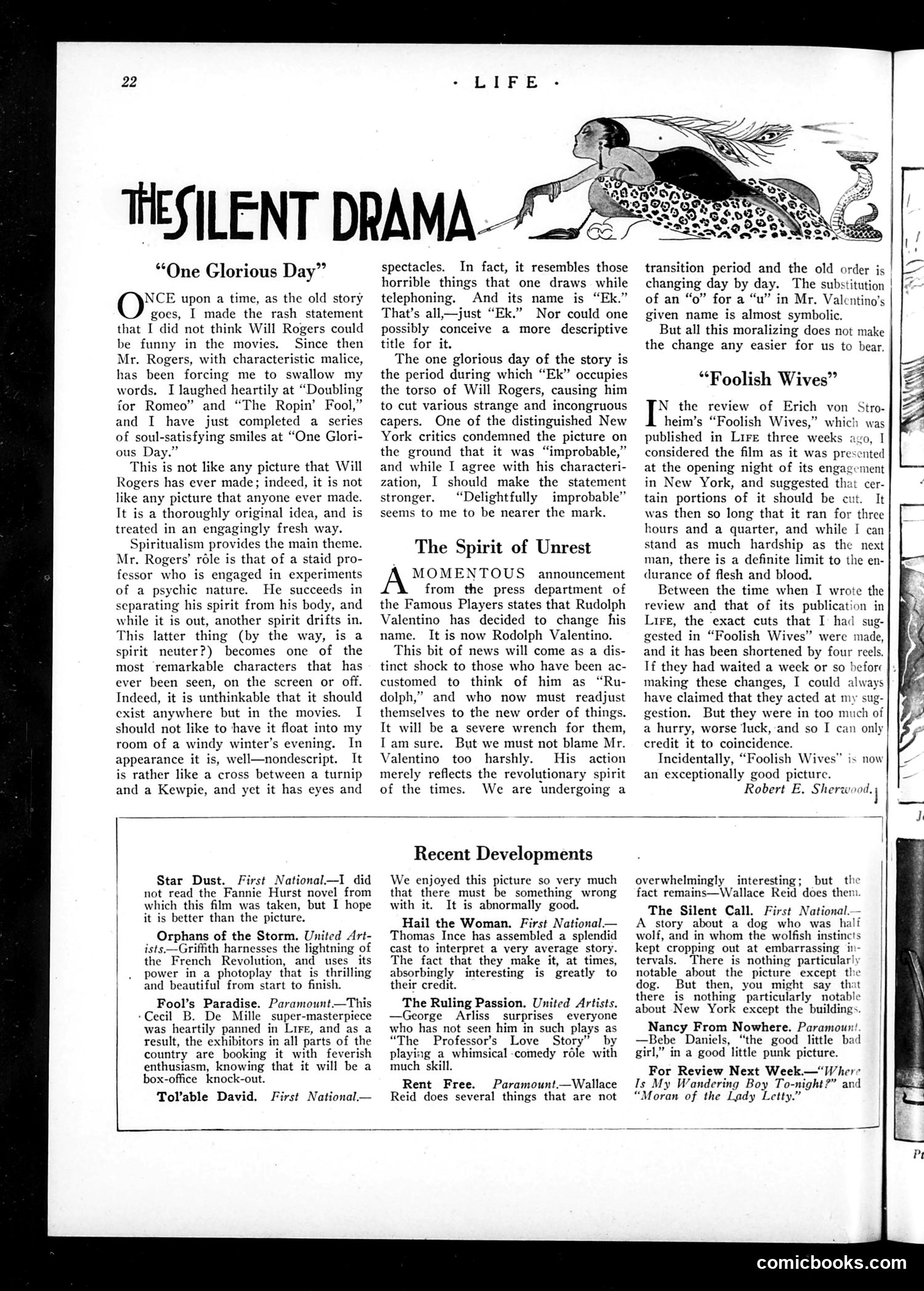
This page reviews three silent films, using satire to comment on Hollywood's absurdities and vanities circa early 1920s. **"One Glorious Day"** reviews a Will Rogers comedy about spiritualism where Rogers's character's body is possessed by a spirit creature called "Ek"—described mockingly as resembling something doodled while on the telephone. The satire mocks the film's implausibility while admitting Rogers makes it entertainingly absurd. **"The Spirit of Unrest"** sarcastically covers Rudolph Valentino's name change from "Rudolph" to "Rodolph." The critic playfully equates this minor spelling shift with revolutionary social upheaval, suggesting Hollywood's self-importance inflates trivial celebrity decisions into cosmic significance. **"Foolish Wives"** review complains the film ran three hours and twenty minutes. The satire lies in the critic's rueful admission that after suggesting cuts, the studio made them anyway—but too quickly for him to claim credit. Overall, the page gently ridicules Hollywood's pretensions, stars' vanities, and the medium's bizarre creative choices while remaining affectionate toward cinema itself.
📄 Transcribed text from this page (OCR, searchable)
Machine-transcribed from the original scan — historical spelling and the odd misread are preserved.
“One Glorious Day” NCE upon a time, as the old story goes, I made the rash statement that I did not think Will Rogers could be funny in the movies. Since then Mr. Rogers, with characteristic malice, has been forcing me to swallow my words. I laughed heartily at “Doubling for Romeo” and “The Ropin’ Fool,” and I have just completed a series of soul-satisfying smiles at “One Glori- ous Day.” This is not like any picture that Will Rogers has ever made; indeed, it is not like any picture that anyone ever made. It is a thoroughly original idea, and is treated in an engagingly fresh way. Spiritualism provides the main theme. Mr. Rogers’ role is that of a staid pro- fessor who is engaged in experiments of a psychic nature. He succeeds in separating his spirit from his body, and while it is out, another spirit drifts in. This latter thing (by the way, is a spirit neuter?) becomes one of the most remarkable characters that has ever been seen, on the screen or off. Indeed, it is unthinkable that it should exist anywhere but in the movies. I should not like to have it float into my room of a windy winter’s evening. In appearance it is, well—nondescript. It is rather like a cross between a turnip and a Kewpie, and yet it has eyes and spectacles. In fact, it resembles those horrible things that one draws while telephoning. And its name is “Ek.” That’s all,—just “Ek.” Nor could one possibly conceive a more descriptive title for it. The one glorious day of the story is the period during which “Ek” occupies the torso of Will Rogers, causing him to cut various strange and incongruous capers. One of the distinguished New York critics condemned the picture on the ground that it was “improbable,” and while I agree with his characteri- zation, I should make the statement stronger. “Delightfully improbable” seems to me to be nearer the mark. The Spirit of Unrest MOMENTOUS announcement from the press department of the Famous Players states that Rudolph Valentino has decided to change his name. It is now Rodolph Valentino. This bit of news will come as a dis- tinct shock to those who have been ac- customed to think of him as “Ru- dolph,” and who now must readjust themselves to the new order of things. It will be a severe wrench for them, I am sure. But we must not blame Mr. Valentino too harshly. His action merely reflects the revolutionary spirit of the times. We are undergoing a transition period and the old order is changing day by day. The substitution of an “o” for a “u” in Mr. Valentino's given name is almost symbolic. But all this moralizing does not make the change any easier for us to bear. “Foolish Wives” N the review of Erich von Stro- heim’s “Foolish Wives,” which was published in Lire three weeks ; 1 considered the film as it was presented at the opening night of its engagement in New York, and suggested that cer- tain portions of it should be cut. It was then so long that it ran for three hours and a quarter, and while I can stand as much hardship as the next man, there is a definite limit to the en- durance of flesh and blood. Between the time when I wrote the review and that of its publication in Lire, the exact cuts that I had sug- gested in “Foolish Wives” were made, and it has been shortened by four reels. If they had waited a week or so before making these changes, I could always have claimed that they acted at my sug- gestion. But they were in too much of a hurry, worse luck, and so I can only! credit it to coincidence. Incidentally, “Foolish Wives” is now an exceptionally good picture. Robert E. Sherw rode) Star Dust. First National—I did not read the Fannie Hurst novel from which this film was taken, but I hope it is better than the picture. Orphans of the Storm. United Art- ists.—Griffith harnesses the lightning of the French Revolution, and uses_ its power in a photoplay that is thrilling and beautiful from start to finish. Fool’s Paradise. Paramount—This ‘Cecil B. De Mille super-masterpiece was heartily panned in Lire, and as a result, the exhibitors in all parts of the country are booking it with feverish enthusiasm, knowing that it will be a box-office knock-out. Tol’able David. First National— Recent Developments We enjoyed this picture so very much that there must be something wrong with it. It is abnormally good. Hail the Woman. First National — Thomas Ince has assembled a splendid cast to interpret a very average story. The fact that they make it, at times, absorbingly interesting is greatly to their credit. The Ruling Passion. United Artists. —George Arliss surprises everyone who has not seen him in such plays as “The Professor’s Love Story” by playing a whimsical comedy réle with much skill. Rent Free. Paramount.—Wallace Reid does several things that are not overwhelmingly interesting; but the fact remains—Wallace Reid does them The Silent Call. First National. A story about a dog who was wolf, and in whom the wolfish instincts kept cropping out at embarrassing in- tervals. There is nothing particularly notable about the picture except the dog. But then, you might say that there is nothing particularly notable about New York except the buildings Nancy From Nowhere. Paramoun! —Bebe Daniels, “the good little bad girl,” in a good little punk picture. For Review Next Week.—“Where Is My Wandering Boy To-night?” and “Moran of the Lady Letty.” comicbooks.com