
Life, 1922-02-23 · page 20 of 34
Life — February 23, 1922 — page 20: what you’re looking at
What you’re looking at
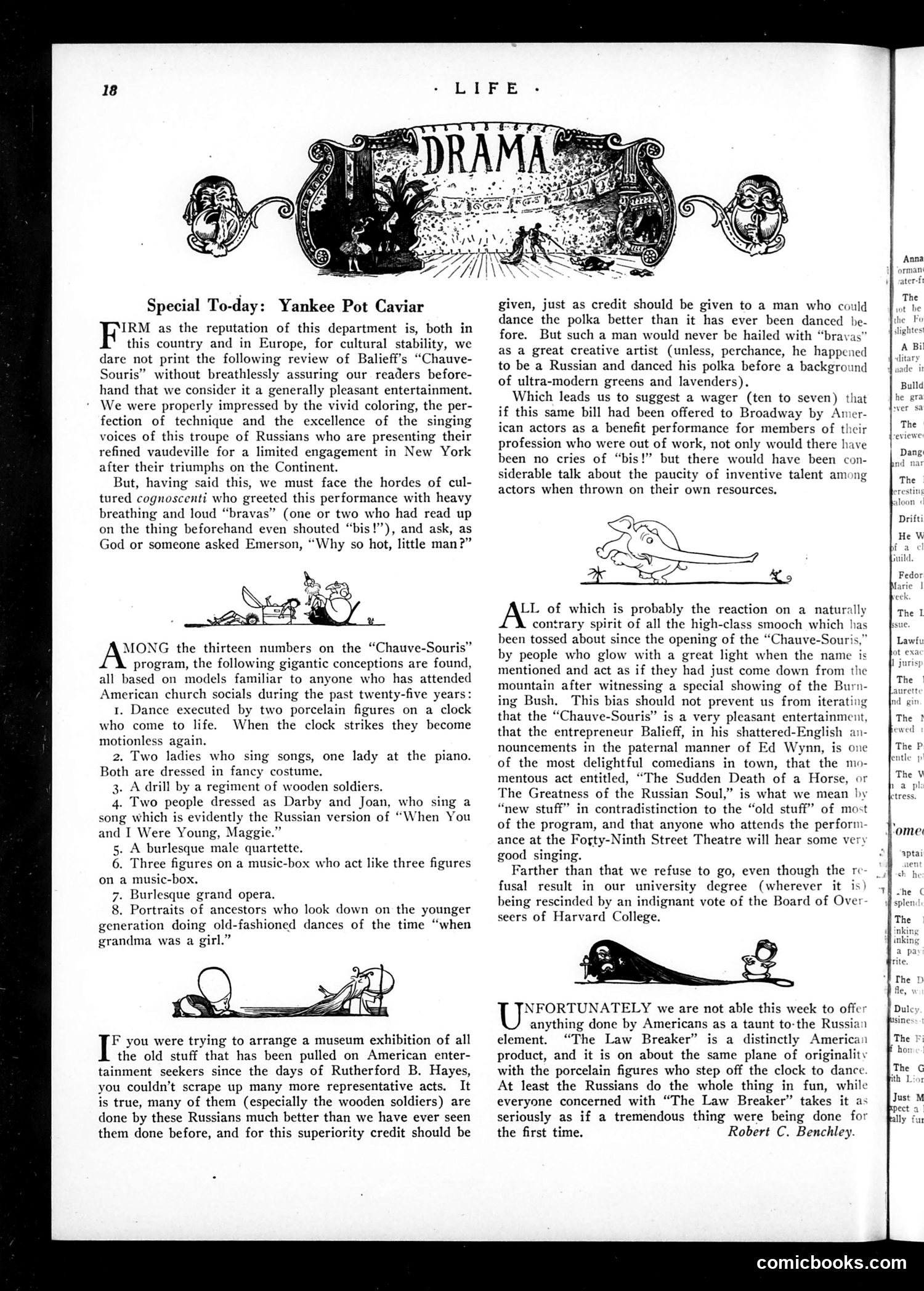
This page critiques the Russian theatrical revue "Chauve-Souris" (Bat), which was performing in New York. The author, Robert C. Benchley, satirizes both the show and its pretentious American admirers. **The Satire:** Benchley argues the revue, while technically excellent and beautifully executed, relies entirely on tired, conventional acts—porcelain clock dancers, wooden soldiers, old-fashioned parlor sketches—the sort of entertainment Americans have endured since the Rutherford B. Hayes era. His central point: the same material performed by American actors would be dismissed as uncreative hack work, yet audiences treat it as profound art simply because it's Russian and presented with sophisticated aesthetics ("ultra-modern greens and lavenders"). **The Joke:** This attacks the cultural snobbery of "high-class" New York audiences who automatically revere foreign performers while dismissing domestic talent—a commentary on American inferiority complex toward European culture in the 1920s. The small illustrations show simplified stage figures, reinforcing the mechanical, unoriginal nature of the acts.
📄 Transcribed text from this page (OCR, searchable)
Machine-transcribed from the original scan — historical spelling and the odd misread are preserved.
ZA Special To-day: Yankee Pot Caviar IRM as the reputation of this department is, both in this country and in Europe, for cultural stability, we dare not print the following review of Balieff’s “Chauve- Souris” without breathlessly assuring our readers before- hand that we consider it a generally pleasant entertainment. We were properly impressed by the vivid coloring, the per- fection of technique and the excellence of the singing voices of this troupe of Russians who are presenting their refined vaudeville for a limited engagement in New York after their triumphs on the Continent. But, having said this, we must face the hordes of cul- tured cognoscenti who greeted this performance with heavy breathing and loud “bravas” (one or two who had read up on the thing beforehand even shouted “bis!”), and ask, as God or someone asked Emerson, “Why so hot, little man?” ONG the thirteen numbers on the “Chauve-Souris” program, the following gigantic conceptions are found, all based on models familiar to anyone who has attended American church socials during the past twenty-five years: 1. Dance executed by two porcelain figures on a clock who come to life. When the clock strikes they become motionless again. 2. Two ladies who sing songs, one lady at the piano. Both are dressed in fancy costume. 3. A drill by a regiment of wooden soldiers. 4. Two people dressed as Darby and Joan, who sing a song which is evidently the Russian version of “When You and I Were Young, Maggie.” 5. A burlesque male quartette. 6. Three figures on a music-box who act like three figures on a music-box. 7. Burlesque grand opera. 8. Portraits of ancestors who look down on the younger generation doing old-fashioned dances of the time “when grandma was a girl.” F you were trying to arrange a museum exhibition of all the old stuff that has been pulled on American enter- tainment seekers since the days of Rutherford B. Hayes, you couldn’t scrape up many more representative acts. It is true, many of them (especially the wooden soldiers) are done by these Russians much better than we have ever seen them done before, and for this superiority credit should be given, just as credit should be given to a man who could dance the polka better than it has ever been danced be- fore. But such a man would never be hailed with “brayas” as a great creative artist (unless, perchance, he happened to be a Russian and danced his polka before a background of ultra-modern greens and lavenders). Which leads us to suggest a wager (ten to seven) that if this same bill had been offered to Broadway by Amer- ican actors as a benefit performance for members of their profession who were out of work, not only would there have been no cries of “bis!” but there would have been con- siderable talk about the paucity of inventive talent among actors when thrown on their own resources, LL of which is probably the reaction on a naturally contrary spirit of all the high-class smooch which has been tossed about since the opening of the “Chauve-Souris,” by people who glow with a great light when the name is mentioned and act as if they had just come down from the mountain after witnessing a special showing of the Bu ing Bush. This bias should not prevent us from iterating that the “Chauve-Souris” is a very pleasant entertainment, that the entrepreneur Balieff, in his shattered-English an- nouncements in the paternal manner of Ed Wynn, is one of the most delightful comedians in town, that the mo- mentous act entitled, “The Sudden Death of a Horse, or The Greatness of the Russian Soul,” is what we mean by “new stuff” in contradistinction to the “old stuff’ of most of the program, and that anyone who attends the perform- ance at the Fosty-Ninth Street Theatre will hear some very good singing. Farther than that we refuse to go, even though the rc fusal result in our university degree (wherever it is) being rescinded by an indignant vote of the Board of Over seers of Harvard College. NFORTUNATELY we are not able this week to offer anything done by Americans as a taunt to-the Russian element. “The Law Breaker” is a distinctly American product, and it is on about the same plane of originality with the porcelain figures who step off the clock to dance At least the Russians do the whole thing in fun, while everyone concerned with “The Law Breaker” takes it as seriously as if a tremendous thing were being done for the first time. Robert C. Benchley. comicbooks.com