
Life, 1922-02-23 · page 28 of 34
Life — February 23, 1922 — page 28: what you’re looking at
What you’re looking at
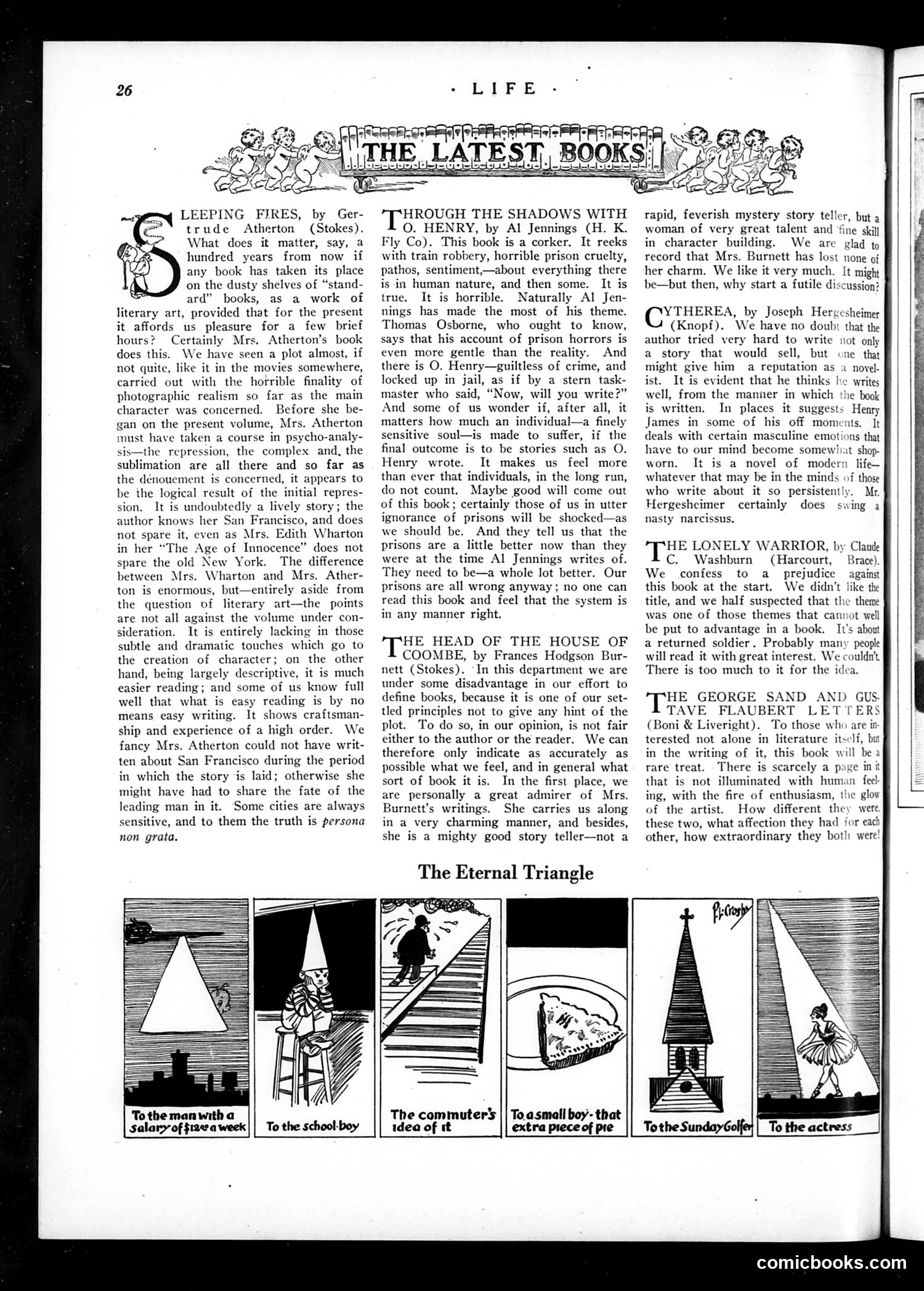
This is a humorous visual essay on a timeless social concept—the "eternal triangle" of romantic rivalry. Each panel depicts a different version of this three-person love scenario using simple geometric triangles as visual metaphors: The six scenes show the triangle's relevance across social classes: a working man earning modest wages, a schoolboy, a commuter, a boy receiving extra food, a churchgoer, and an actress. The joke is that romantic entanglement—typically involving two men and one woman (or vice versa)—affects everyone equally, regardless of social status or circumstance. The cartoon satirizes how this fundamental human drama recurs universally. By reducing each scenario to stark black-and-white imagery with minimal captions, the artist emphasizes that jealousy, love, and conflict are democratically distributed across society—from the poor to the wealthy, the young to the religious.
📄 Transcribed text from this page (OCR, searchable)
Machine-transcribed from the original scan — historical spelling and the odd misread are preserved.
LEEPING FIRES, by Ger- trude Atherton (Stokes). What does it matter, say, a hundred years from now if any book has taken its place on the dusty shelves of “stand- ard” books, as a work of literary art, provided that for the present it affords us pleasure for a few brief hours? Certainly Mrs. Atherton’s book does this. We have seen a plot almost, if not quite, like it in the movies somewhere, carried out with the horrible finality of photographic realism so far as the main character was concerned. Before she be- gan on the present volume, Mrs. Atherton must have taken a course in psycho-analy- sis—the repression, the complex and, the sublimation are all there and so far as the dénouement is concerned, it appears to be the logical result of the initial repres- sion. It is undoubtedly a lively story; the author knows her San Francisco, and does not spare it, even as Mrs. Edith Wharton in her “The Age of Innocence” does not spare the old New York. The difference between Mrs. Wharton and Mrs. Ather- ton is enormous, but—entirely aside from the question of literary art—the points are not all against the volume under con- sideration. It is entirely lacking in those subtle and dramatic touches which go to the creation of character; on the other hand, being largely descriptive, it is much easier reading; and some of us know full well that what is easy reading is by no means easy writing. It shows craftsman- ship and experience of a high order. We fancy Mrs. Atherton could not have writ- ten about San Francisco during the period in which the story is laid; otherwise she might have had to share the fate of the leading man in it. Some cities are always sensitive, and to them the truth is persona non grata, Tothe manwitha Salary of $12eaweek|| To the school-boy HROUGH THE SHADOWS WITH O. HENRY, by Al Jennings (H. K. Fly Co). This book is a corker. It reeks with train robbery, horrible prison cruelty, pathos, sentiment,—about everything there is in human nature, and then some. It is true. It is horrible. Naturally Al Jen- nings has made the most of his theme. Thomas Osborne, who ought to know, says that his account of prison horrors is even more gentle than the reality. And there is O. Hen guiltless of crime, and locked up in jail, as if by a stern task- master who said, “Now, will you write?” And some of us wonder if, after all, it matters how much an individual—a finely sensitive soul—is made to suffer, if the final outcome is to be stories such as O. Henry wrote. It makes us feel more than ever that individuals, in the long run, do not count. Maybe good will come out of this book; certainly those of us in utter ignorance of prisons will be shocked—as we should be. And they tell us that the prisons are a little better now than they were at the time Al Jennings writes of. They need to be—a whole lot better. Our prisons are all wrong anyway; no one can read this book and feel that the system is in any manner right. THe HEAD OF THE HOUSE OF COOMBE, by Frances Hodgson Bur- nett (Stokes). ‘In this department we are under some disadvantage in our effort to define books, because it is one of our set- tled principles not to give any hint of the plot. To do so, in our opinion, is not fair either to the author or the reader. We can therefore only indicate as accurately as possible what we feel, and in general what sort of book it is. In the first place, we are personally a great admirer of Mrs. Burnett's writings. She carries us along in a very charming manner, and besides, she is a mighty good story teller—not a The Eternal Triangle To.asmall boy- that extra piece of pie The commuter’s idea of it rapid, feverish mystery story teller, but a woman of very great talent and ‘tine skill in character building. We are glad to record that Mrs. Burnett has lost none of her charm. We like it very much. It might be—but then, why start a futile discussion? 'YTHEREA, by Joseph Hergesheimer (Knopf). We have no doubt that the author tried very hard to write not only a story that would sell, but one that might give him a reputation as a novel- st. It is evident that he thinks he writes well, from the manner in which the book is written. In places it suggests Henry James in some of his off moments. It deals with certain masculine emotions that have to our mind become some worn. It is a novel of mode whatever that may be in the minds of those who write about it so persistently. Mr. Hergesheimer certainly does swing a nasty narcissus, HE LONELY WARRIOR, by Claude C. Washburn (Harcourt, Brace), We confess to a_ prejudice against this book at the start. We didn’t like the title, and we half suspected that the theme was one of those themes that cannot well be put to advantage in a book. It’s about a returned soldier. Probably many people will read it with great interest. We couldn't There is too much to it for the idea. HE GEORGE SAND TAVE FLAUBERT LET (Boni & Liveright). To those who are terested not alone in literature itself, but in the writing of it, this book will be rare treat. There is scarcely a page init that is not illuminated with human feel ing, with the fire of enthusiasm, the glow of the artist. How different they were these two, what affection they had for each other, how extraordinary they both were! To the actress cata comicbooks.com