
A complete issue · 58 pages · 1921
Life — December 1, 1921
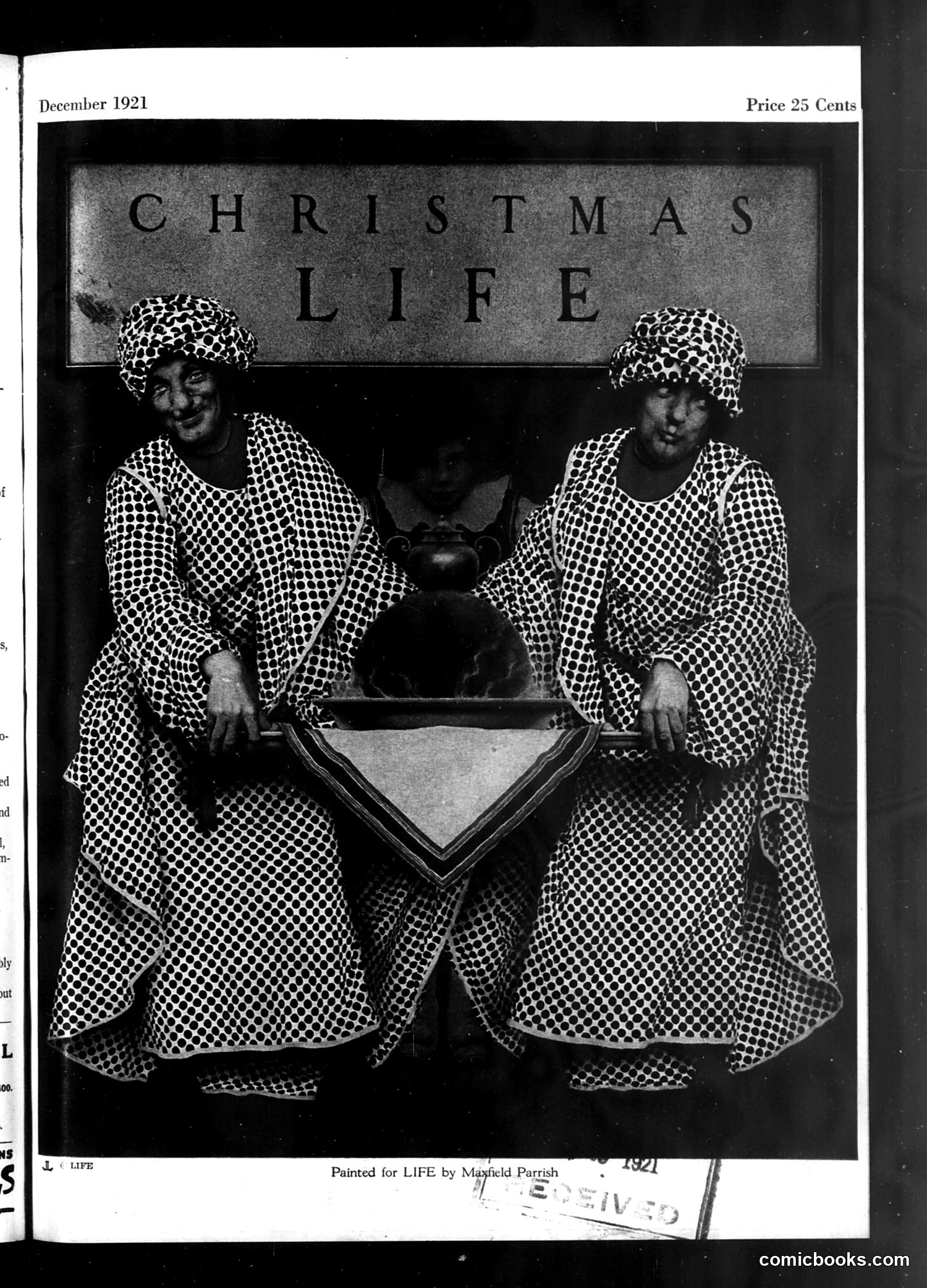
This is the cover of *Life* magazine's Christmas issue from December 1921, priced at 25 cents. The image shows two women in matching patterned dresses and cloche hats flanking a black cat, all posed around what appears to be a gift or present. The artwork is credited to Maxfield Parrish, a prominent illustrator of the era. The satire likely plays on 1920s holiday consumption and gift-giving culture, with the fashionably dressed women embodying the modern "flapper" aesthetic of the Jazz Age. The black cat may reference superstitions or simply add festive whimsy. The composition emphasizes commercial holiday excess wrapped in contemporary style—a gentle jab at seasonal materialism and fashion consciousness among well-to-do Americans.
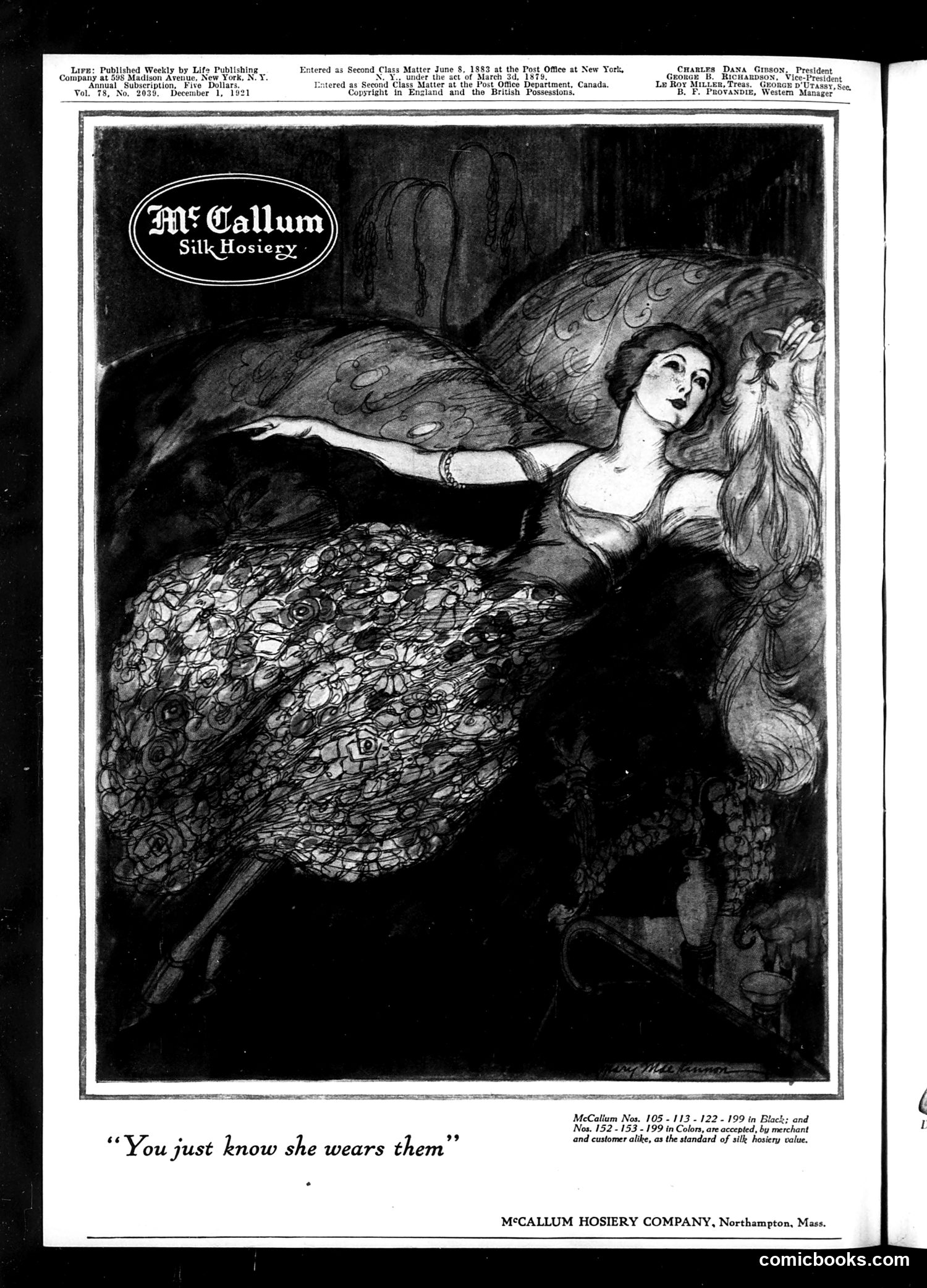
This is a **McCallum Silk Hosiery Company advertisement**, not political satire. The page promotes silk stockings through an illustration showing a woman reclining on ornate bedding with decorative pillows. The tagline "You just know she wears them" uses suggestive imagery typical of 1920s advertising—the woman's relaxed, intimate pose implies luxury and desirability. The implication is that quality silk hosiery signals sophistication and attractiveness to observers. The elaborate Art Deco-style illustration emphasizes the beauty of the fabric itself through detailed pattern work. This represents early 20th-century advertising's use of aspirational lifestyle imagery to market consumer goods to women, associating a product with glamour and allure rather than practical function alone.
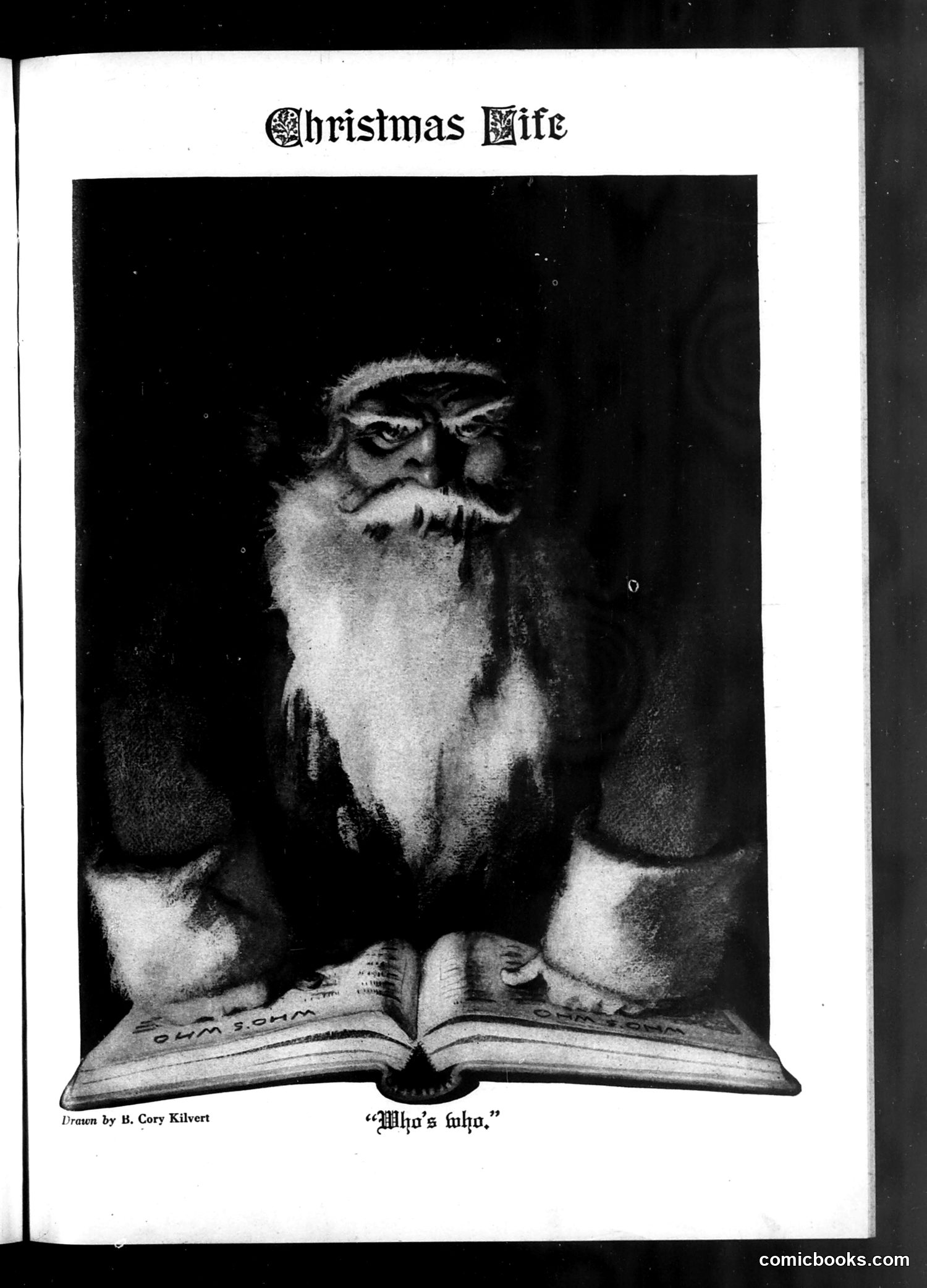
This satirical illustration depicts Santa Claus as an elderly, bearded figure reading from an open book labeled "Ohm's Schm" (likely a reference to Ohm's Law, a physics principle). The drawing, credited to B. Cory Kilvert, appears to be a joke about Santa's knowledge or authority. The title "Who's Who" suggests the cartoon is identifying or characterizing Santa in some way—possibly mocking his supposed omniscience or wisdom. The physics textbook reference is unclear without additional context, but likely references contemporary scientific or educational concerns from early-to-mid 20th century Life magazine. The image plays on the familiar Christmas trope of Santa knowing "who's naughty or nice," here reframed through an intellectual or technical lens.
This is not a cartoon page but rather an editorial essay by E.S. Martin titled "Christmas, 1921." The text addresses post-WWI America's role as a world leader and moral example. Martin argues that the United States, composed of diverse immigrant populations living together peacefully, should use its influence to help restore international order after the war's devastation. He criticizes Europe's continued antagonisms and appeals to American idealism and confidence to lead global recovery. The essay concludes with a call to action: Americans should gather their sympathies and powers to steer the world "back on the rails" toward hope. It's essentially a patriotic plea for American moral leadership during the uncertain post-war period.
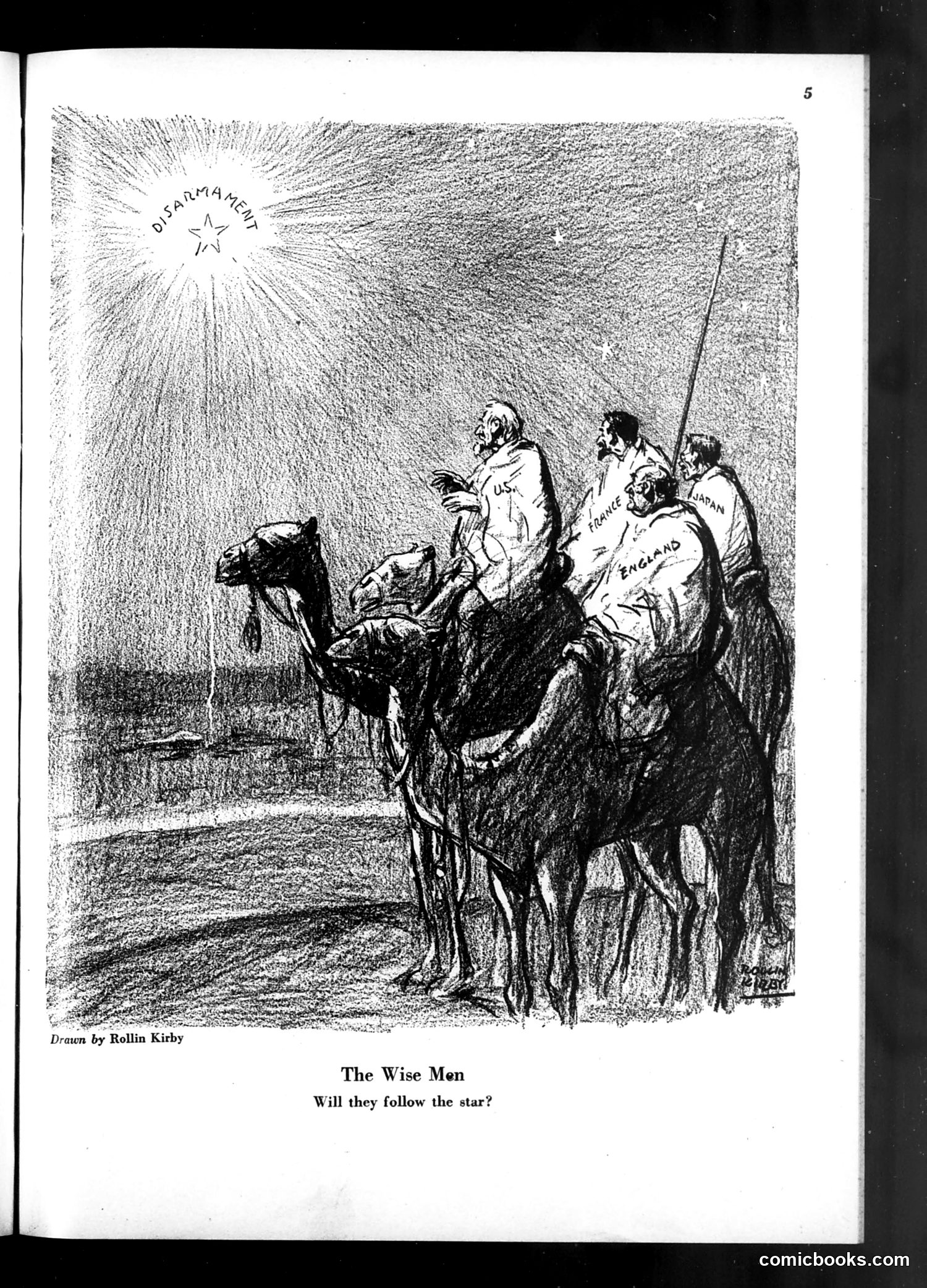
This political cartoon by Rollin Kirby depicts three figures on camels following a bright star labeled "DISARMAMENT." The figures' clothing is labeled with country names: "USA," "FRANCE," "ENGLAND," and what appears to be "JAPAN." The cartoon satirizes international disarmament negotiations, likely from the 1920s-1930s era when such conferences were frequent. The title "The Wise Men / Will they follow the star?" references the biblical Magi following the Star of Bethlehem, but questions whether these major world powers will actually commit to disarmament as their "guiding light." The satire suggests skepticism about whether nations will genuinely pursue peace through arms reduction, treating the disarmament goal as an idealistic but potentially unreachable aspiration.
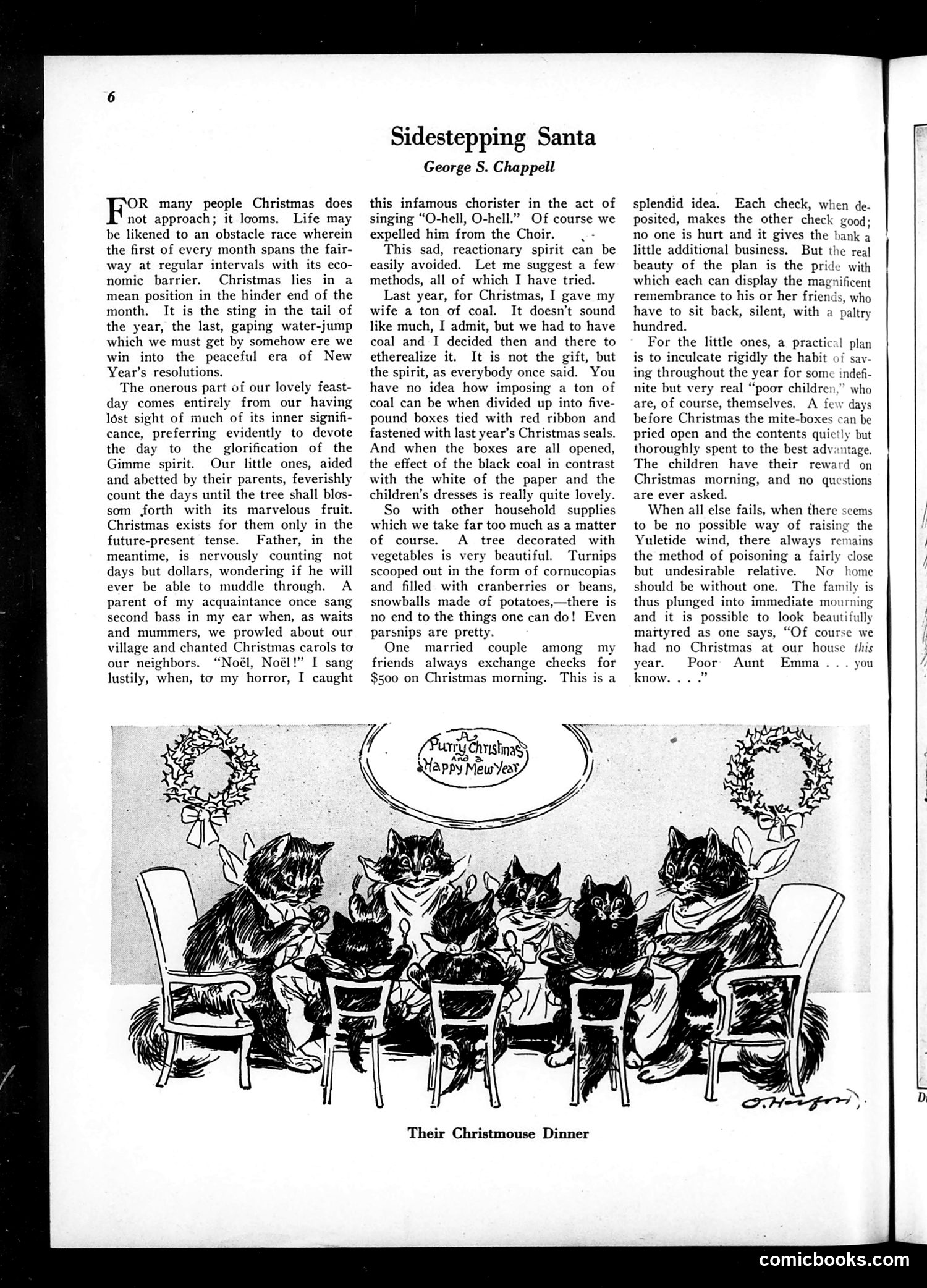
This is a humorous essay by George S. Chappell about managing Christmas expenses during economically challenging times. The author describes practical alternatives to expensive gifts: giving coal (divided into smaller boxes with ribbons), decorating with household items like vegetables, and exchanging small checks instead of presents. The accompanying illustration shows cats dining together at a formal table with wreaths and a "Merry Christmas & Happy New Year" banner—a whimsical visual pun on "their Christmouse dinner" (mice/mouse being cats' natural prey). The overall satirical point targets the commercialization of Christmas and suggests that meaningful celebrations don't require expensive purchases—a commentary relevant to readers facing financial constraints, likely during an economic downturn in the early 20th century.
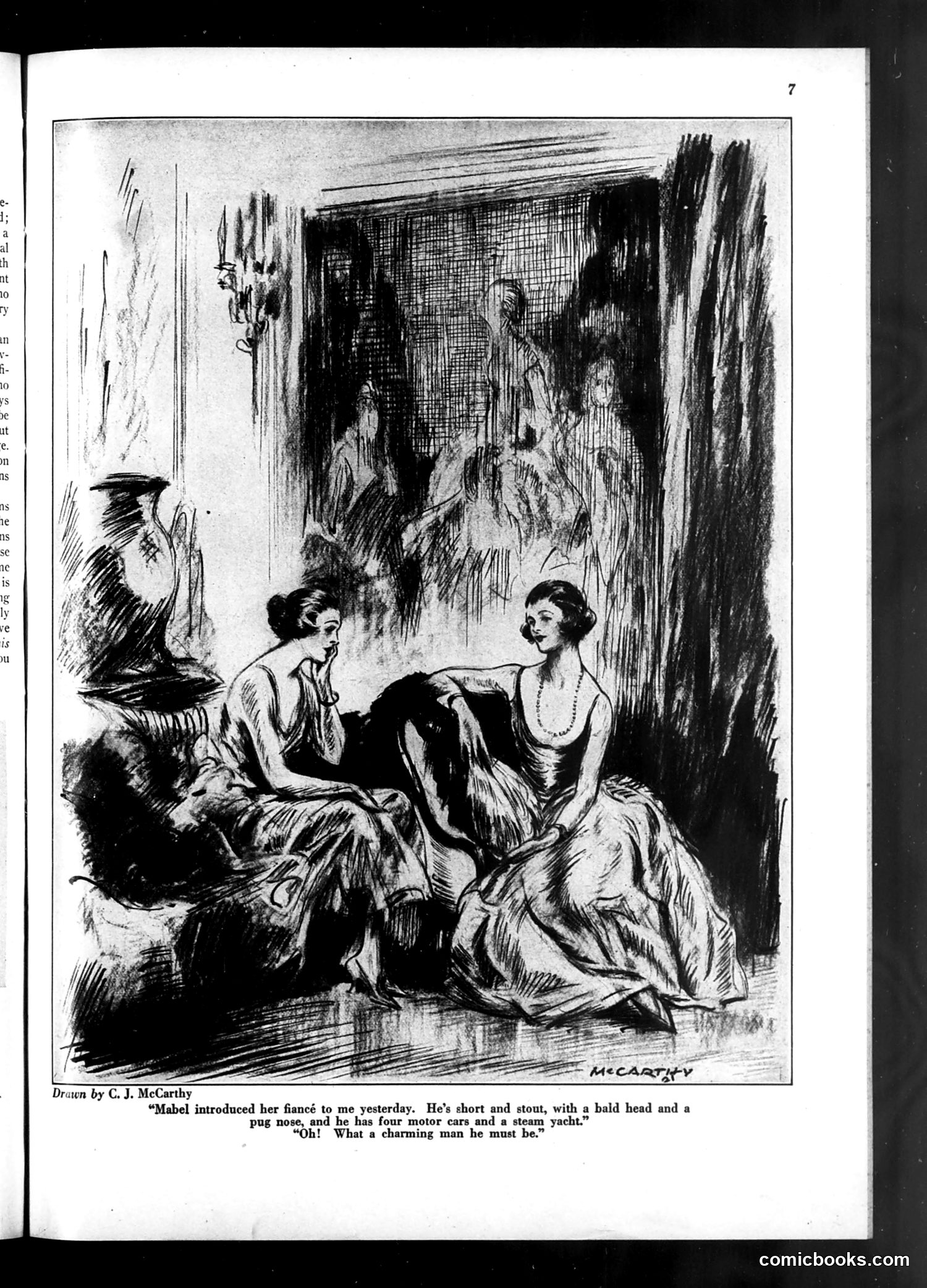
This is a single-panel drawing by C.J. McCarthy depicting two women in conversation. One woman is describing her fiancé to the other, using ironic praise: he's "short and stout, with a bald head and a pug nose, and he has four motor cars and a steam yacht." The satire targets **materialistic courtship and marriage**, where a woman overlooks a man's physical unattractiveness because of his wealth. Her final comment—"Oh! What a charming man he must be"—is delivered with obvious sarcasm, as the listener recognizes that the woman is primarily attracted to his possessions rather than his character or appearance. This reflects early 20th-century anxieties about wealth-based social climbing and superficial matchmaking among the leisure classes.
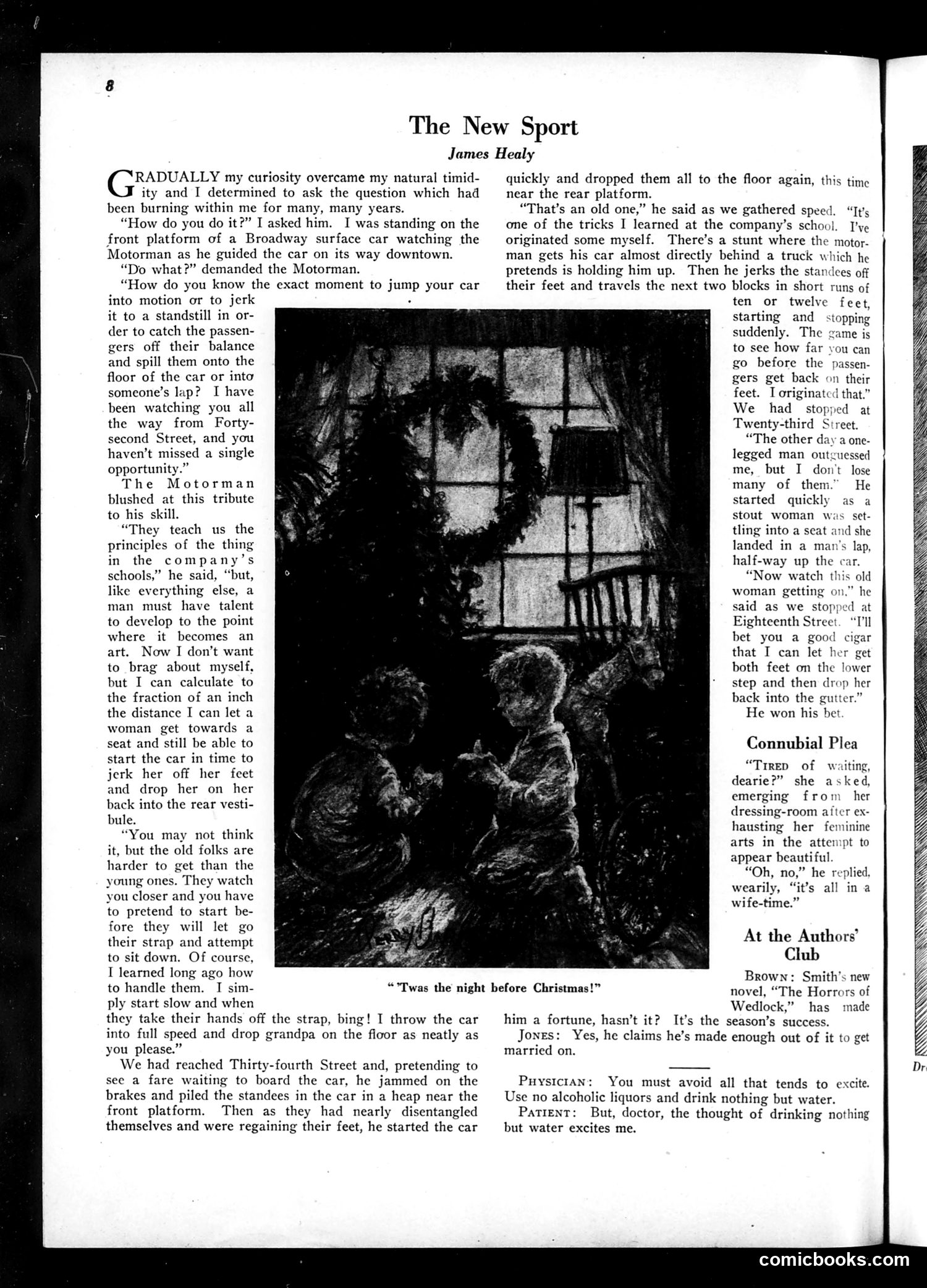
This page contains "The New Sport" by James Healy, a short story about motormen (streetcar operators) and a dangerous game they play: jerking the streetcar suddenly to throw standing passengers off balance onto the floor or into each other's laps. The accompanying photograph shows what appears to be the interior of a crowded streetcar with passengers. The story describes this as a learned "skill" taught at the company's training school—calculating precisely how much acceleration will dislodge riders without causing them to fall completely. The narrator notes older passengers are harder targets than younger ones, as they hold tighter to straps. The humor derives from presenting this reckless, dangerous prank as a legitimate competitive "sport" among operators, satirizing both workplace hazing and the cavalier disregard for passenger safety in early 20th-century public transit.
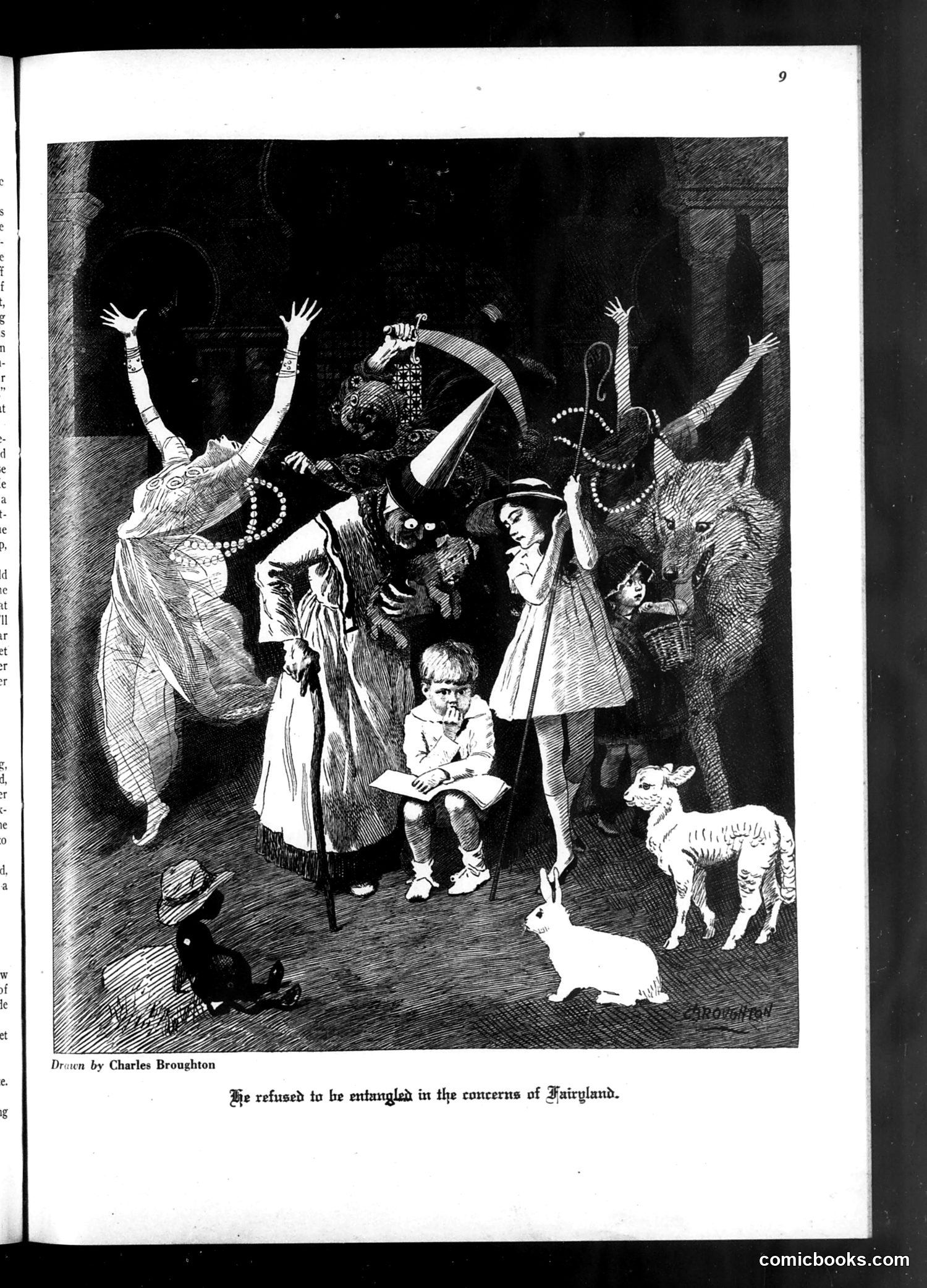
This illustration by Charles Broughton depicts a child surrounded by costumed fantasy figures with raised arms in celebratory poses. The caption reads: "He refused to be entangled in the concerns of Fairyland." The satire appears to comment on childhood innocence or resistance to fantastical distraction. The child sits calmly reading while elaborate masked and costumed characters—some wearing pearls and ornate dress—gesture excitedly around him, seemingly trying to engage his attention or involve him in their "concerns." The cartoon likely critiques either: parental attempts to shield children from frivolous entertainment, a child's refusal to be distracted by superficial spectacle, or possibly a political allegory about avoiding involvement in elaborate but ultimately meaningless affairs (though the specific historical reference remains unclear without additional context from Life magazine's publication date).
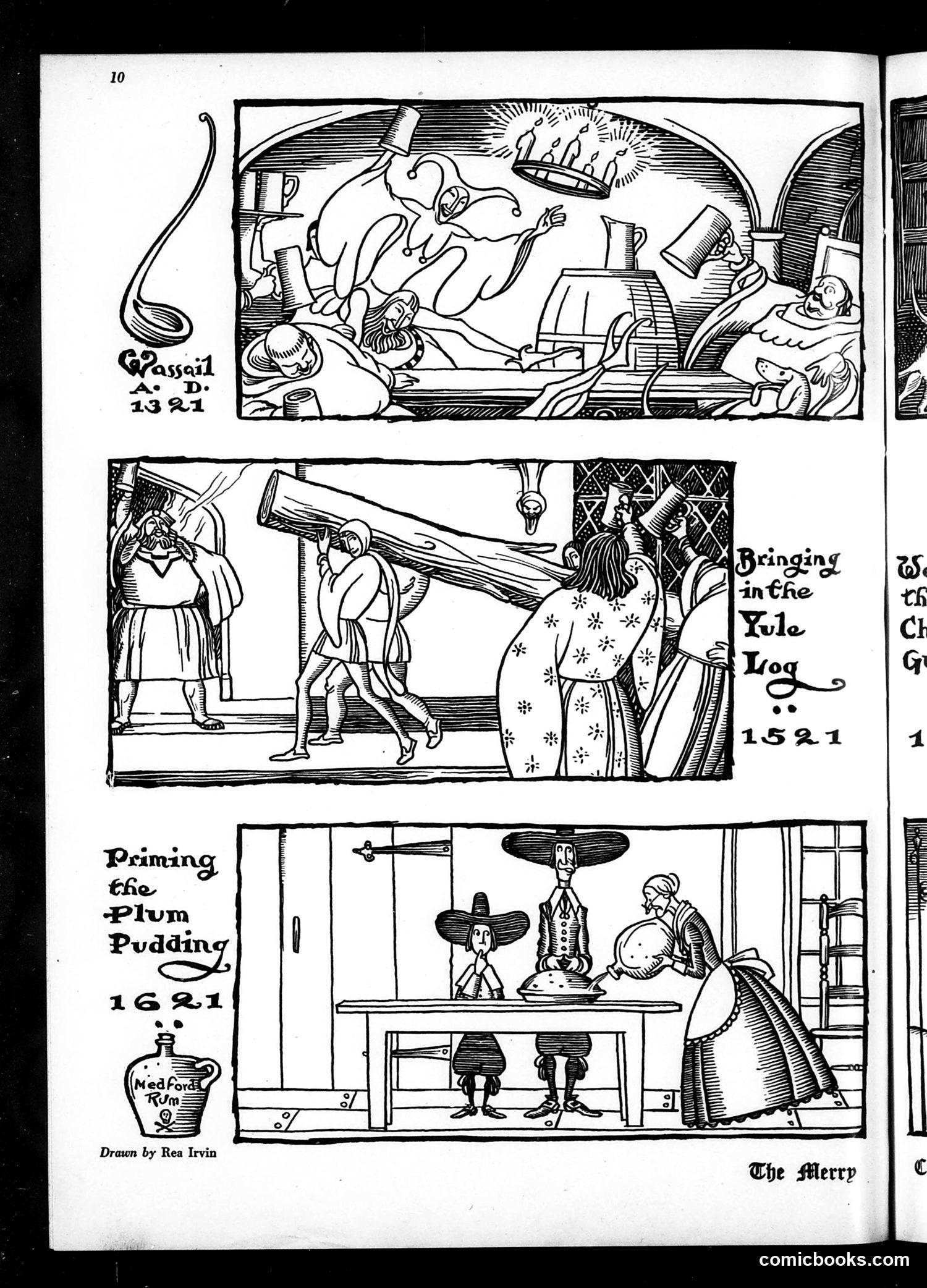
This page presents three satirical scenes depicting Christmas customs, drawn by Rea Irwin. The top panel shows chaos in what appears to be a kitchen or dining area during holiday preparations—figures are colliding with flying objects and general mayhem, labeled "Gossamer 1321" (unclear reference). The middle panel, "Bringing in the Yule Log" (1521), depicts the traditional practice of bringing a large decorated log indoors for Christmas festivities. The bottom panel, "Priming the Plum Pudding" (1621), shows the old custom of preparing plum pudding, a central Christmas dish. A figure appears to be adding spirits ("Med Fordd Rum" visible) to the pudding mixture. These cartoons satirize holiday traditions through exaggerated domestic scenes, playing on the chaos and rituals of early 20th-century Christmas celebrations.
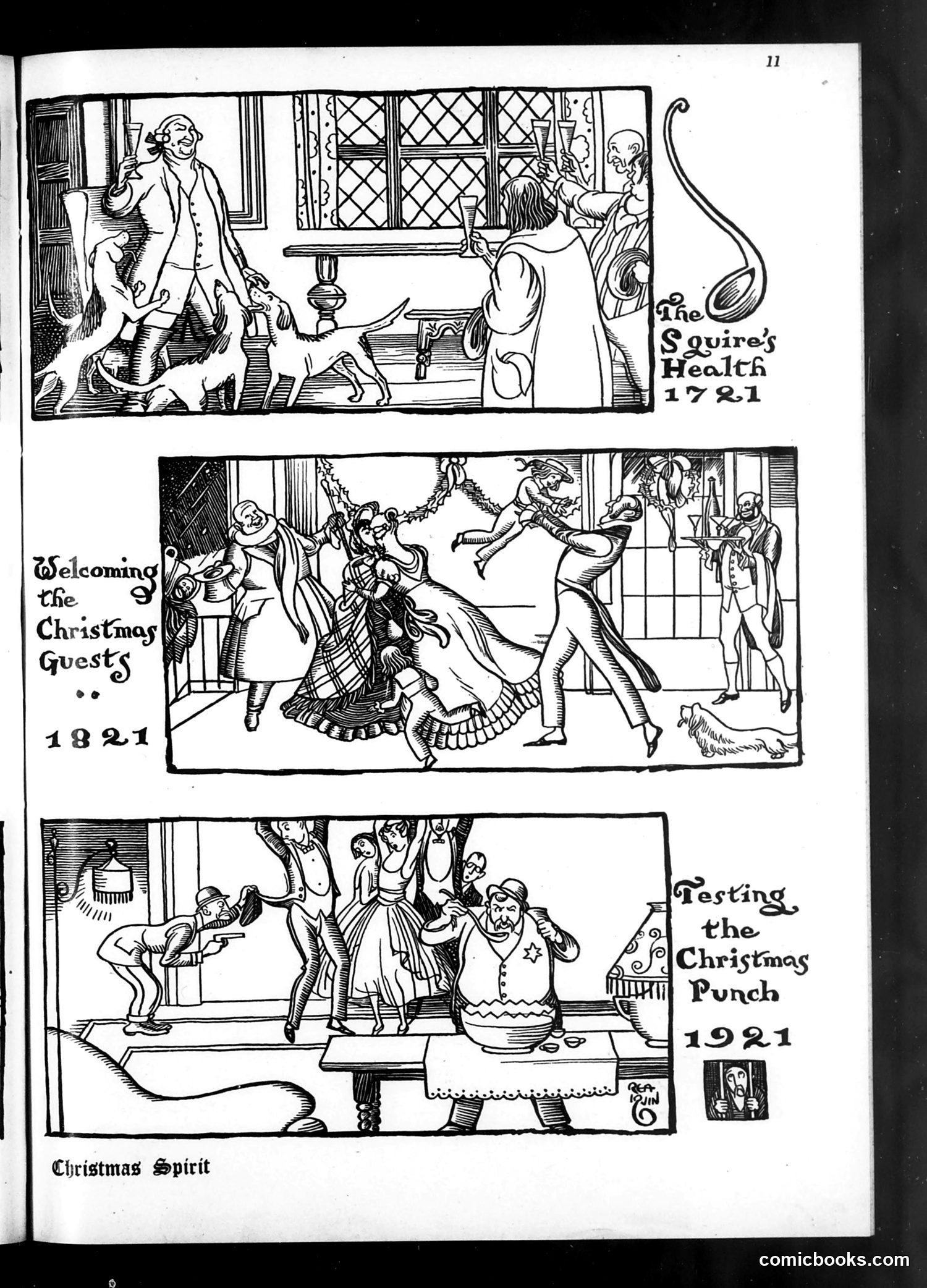
This page presents three satirical vignettes about Christmas 1921, all titled "Christmas Spirit." The cartoons depict: 1. **"The Squire's Health"** — A wealthy gentleman with dogs, apparently concerned about health matters 2. **"Welcoming the Christmas Guests"** — A boisterous indoor celebration with people dancing and socializing energetically 3. **"Testing the Christmas Punch"** — Figures gathered around a large bowl, sampling holiday beverages The satire likely comments on 1920s upper-class Christmas traditions and behaviors. The punch-testing scene may reference Prohibition (enacted 1920), making the testing of homemade alcohol a pointed joke about well-to-do Americans flouting the law during the holiday season. The overall tone suggests ironic commentary on affluent society's Christmas customs.
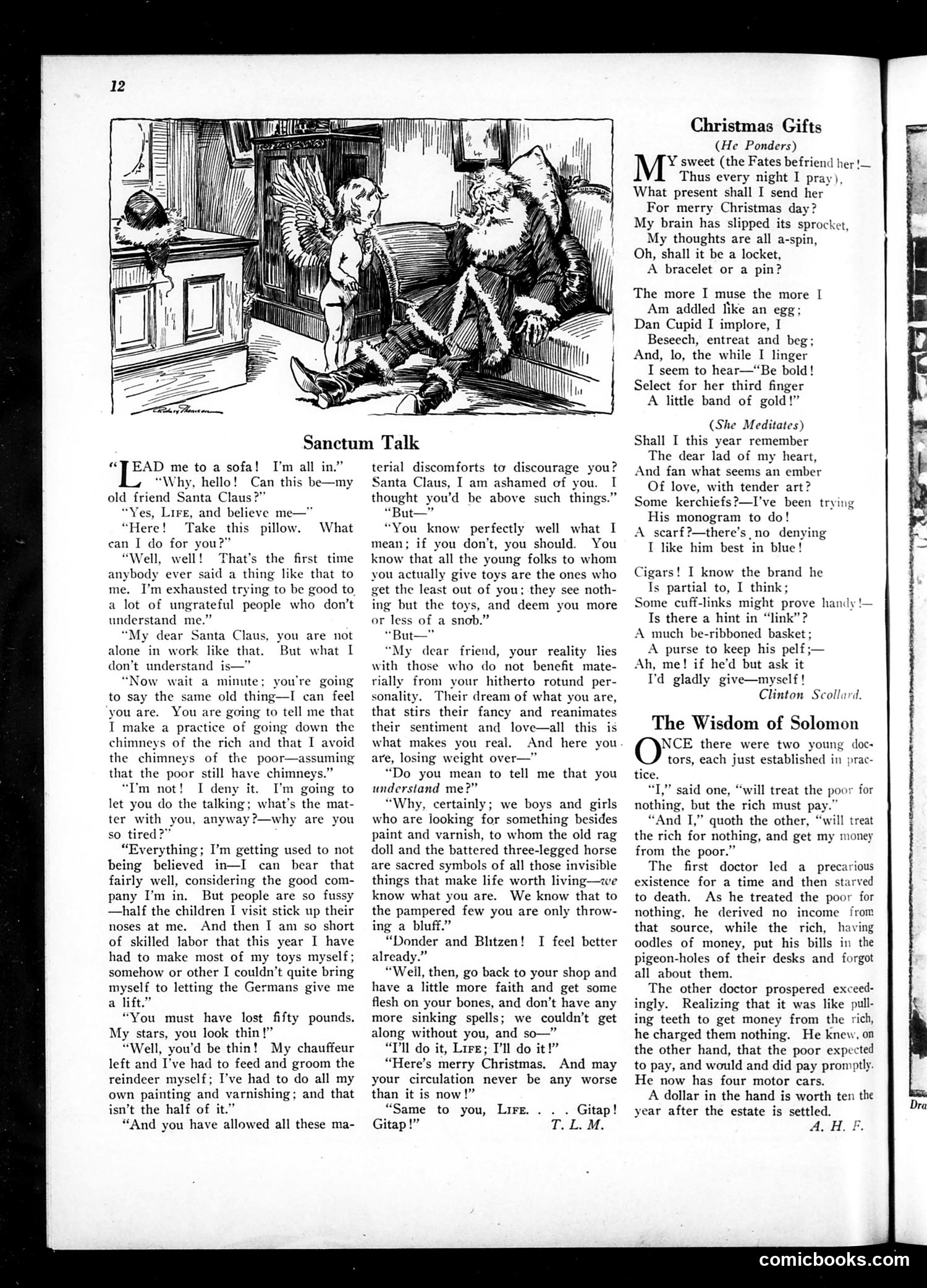
The page contains three distinct pieces: 1. **"Christmas Gifts" (top)**: A sketch showing Santa Claus with a child, accompanied by verses about gift-giving anxieties—the speaker worries over selecting the perfect present. 2. **"Sanctum Talk" (middle)**: A dialogue between "Life" (the magazine's personified voice) and Santa Claus, where Life complains about Christmas commercialism and materialism. Santa defends gift-giving as meaningful, arguing that toys symbolize "invisible things that make life worth living." Life remains cynical about consumerism. 3. **"The Wisdom of Solomon" (bottom right)**: A parable contrasting two doctors—one who treats the poor for nothing while remaining poor himself, and another who exploits wealthy patients, becoming rich. The moral critiques class inequality and greed. The page satirizes Christmas commercialism while offering social commentary on poverty and wealth disparity.
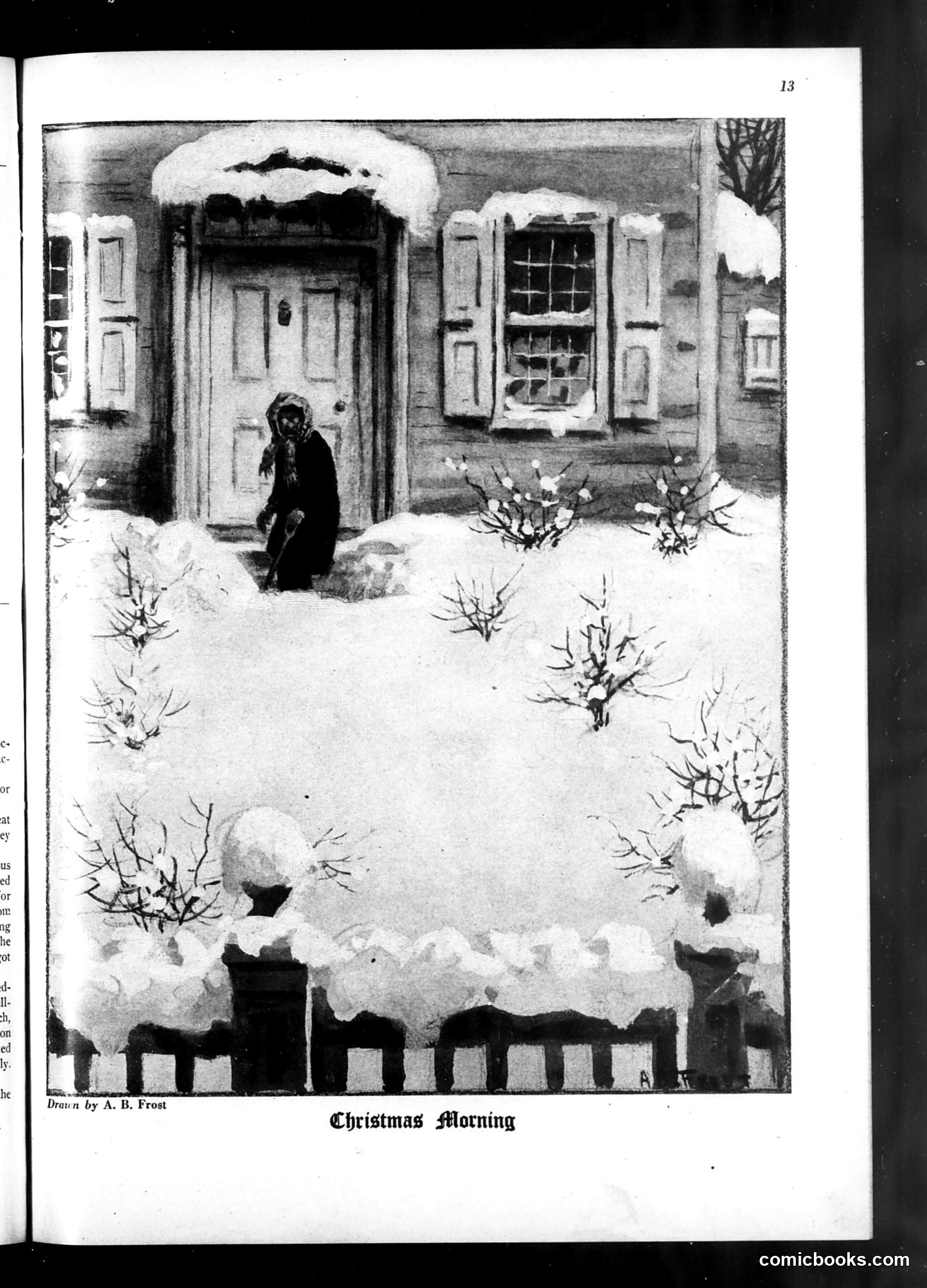
This is a winter domestic scene rather than political satire. The illustration shows a snowy Christmas morning outside a modest house, with a solitary figure in dark clothing standing near the entrance. Bare shrubs poke through the snow in the yard, and snow accumulates on the roof and fence. The drawing appears sentimental or possibly melancholic rather than satirical—depicting a quiet, cold Christmas morning with minimal holiday cheer visible. The lone figure and stark landscape create an understated mood. Without additional context from the magazine's surrounding text or other pages, the specific social commentary or joke (if any) remains unclear. It may simply be an illustrated story or seasonal sketch rather than political commentary.
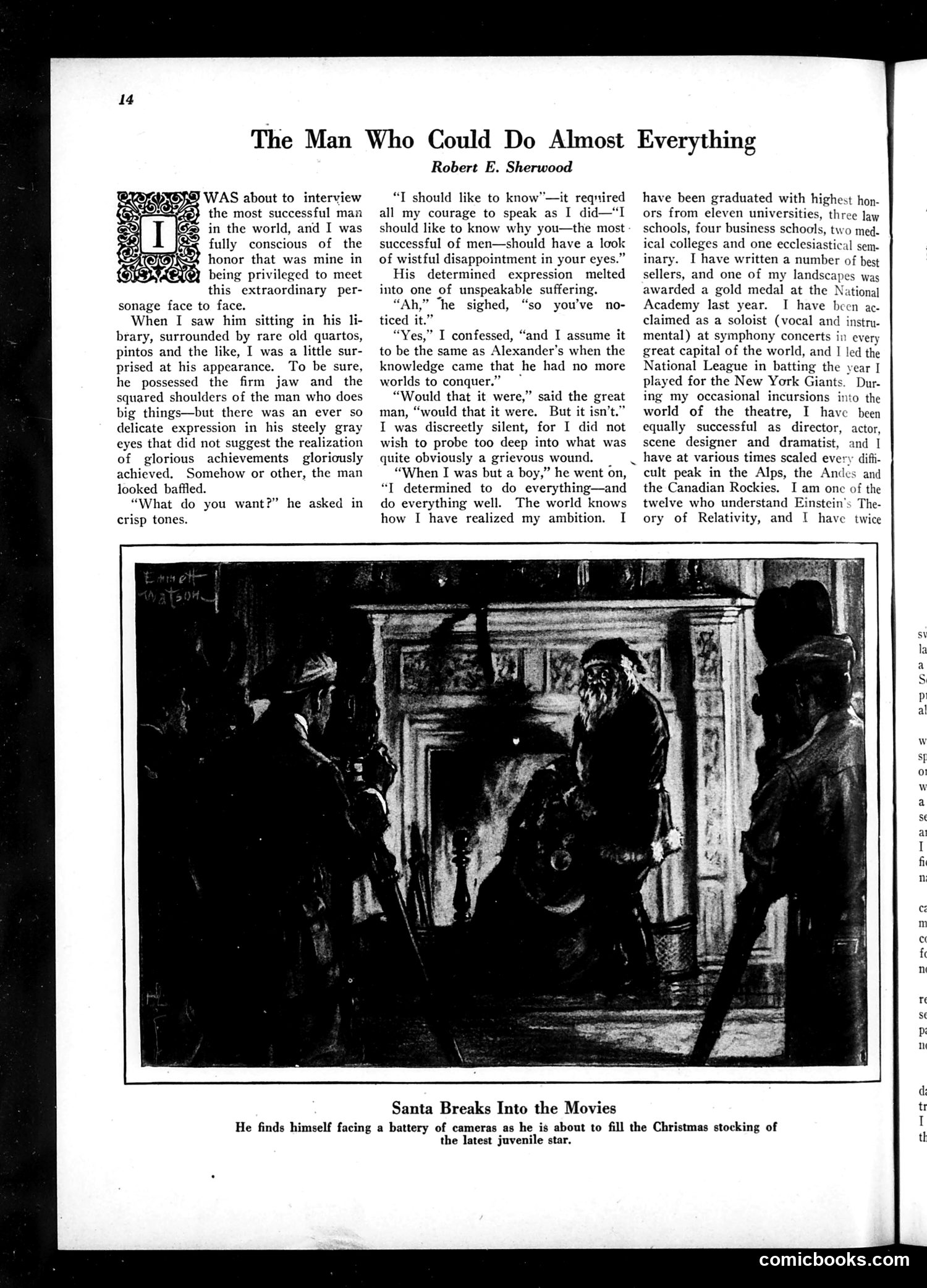
This is a satirical article by Robert E. Sherwood about an unnamed but clearly accomplished person. The subject is being interviewed and becomes visibly uncomfortable when asked what he wants—his expression melting "into one of unspeakable suffering." The joke centers on a man who has achieved almost everything: graduated with honors, attended prestigious schools, written award-winning plays, performed as a soloist, directed films and theater, and scaled mountains. Yet this relentless achievement has left him empty and purposeless. He admits he determined as a boy to "do everything—and do everything well" but never questioned *why*. The photograph shows what appears to be a Santa Claus figure surrounded by movie cameras, illustrating how even holiday tradition gets commodified into entertainment and performance—fitting the theme that constant achievement and activity may be hollow.
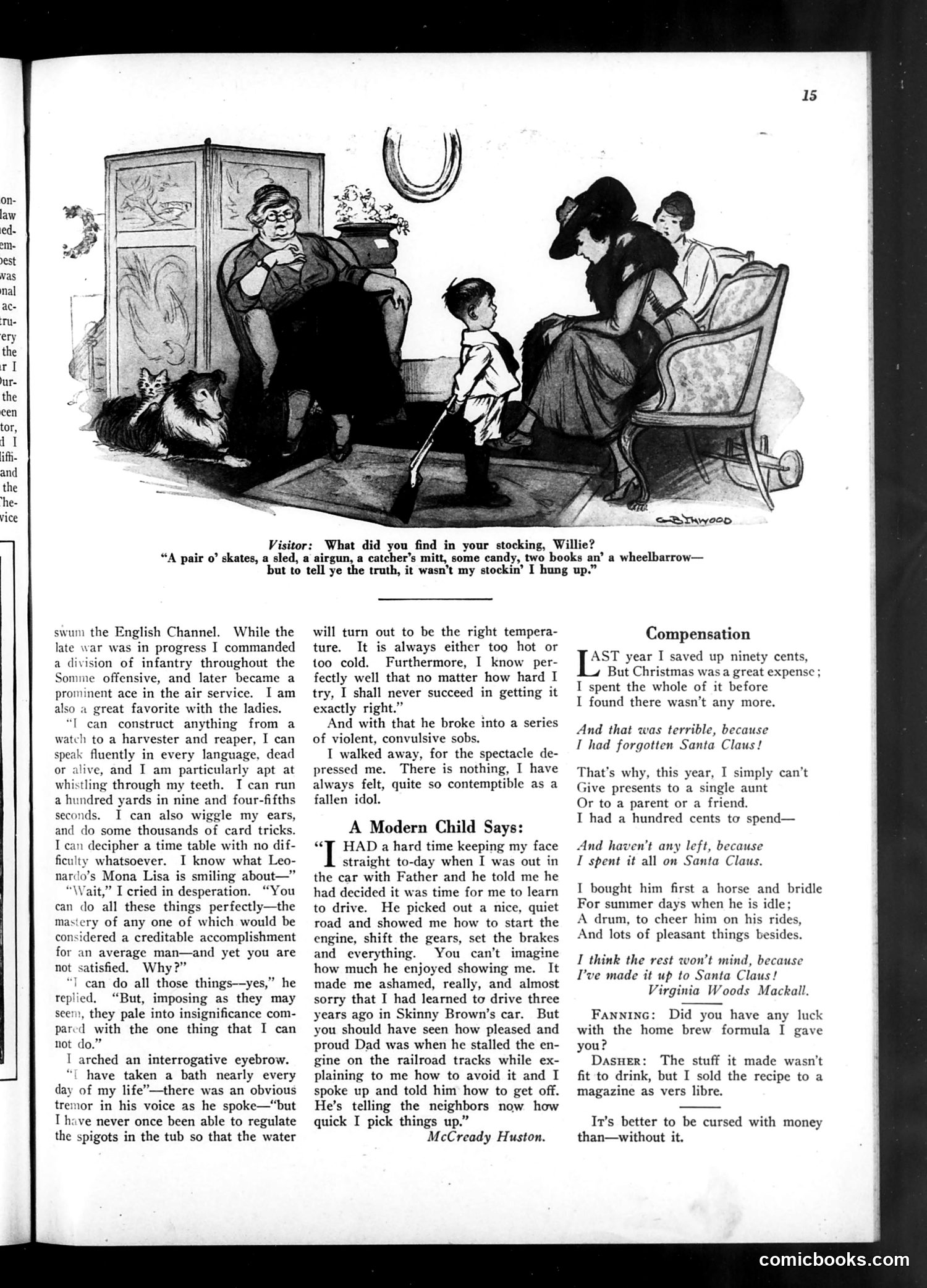
The top cartoon shows a domestic scene where a young boy ("Willie") describes his Christmas stocking contents to visitors. The humor relies on the contrast between what parents *expect* children to find in stockings (skates, sleds, toys, candy) versus what Willie actually received—practical items like books and a wheelbarrow. The joke satirizes either parental miserliness or the tension between children's desires and adult pragmatism. Below are three literary pieces: a prose anecdote about military service, a poem titled "Compensation" about saving money for Christmas, and "A Modern Child Says"—a humorous monologue where a child boasts about learning to drive, establishing himself as precocious and somewhat insufferable. The page represents early 20th-century domestic humor focused on childhood, consumerism, and generational attitudes.
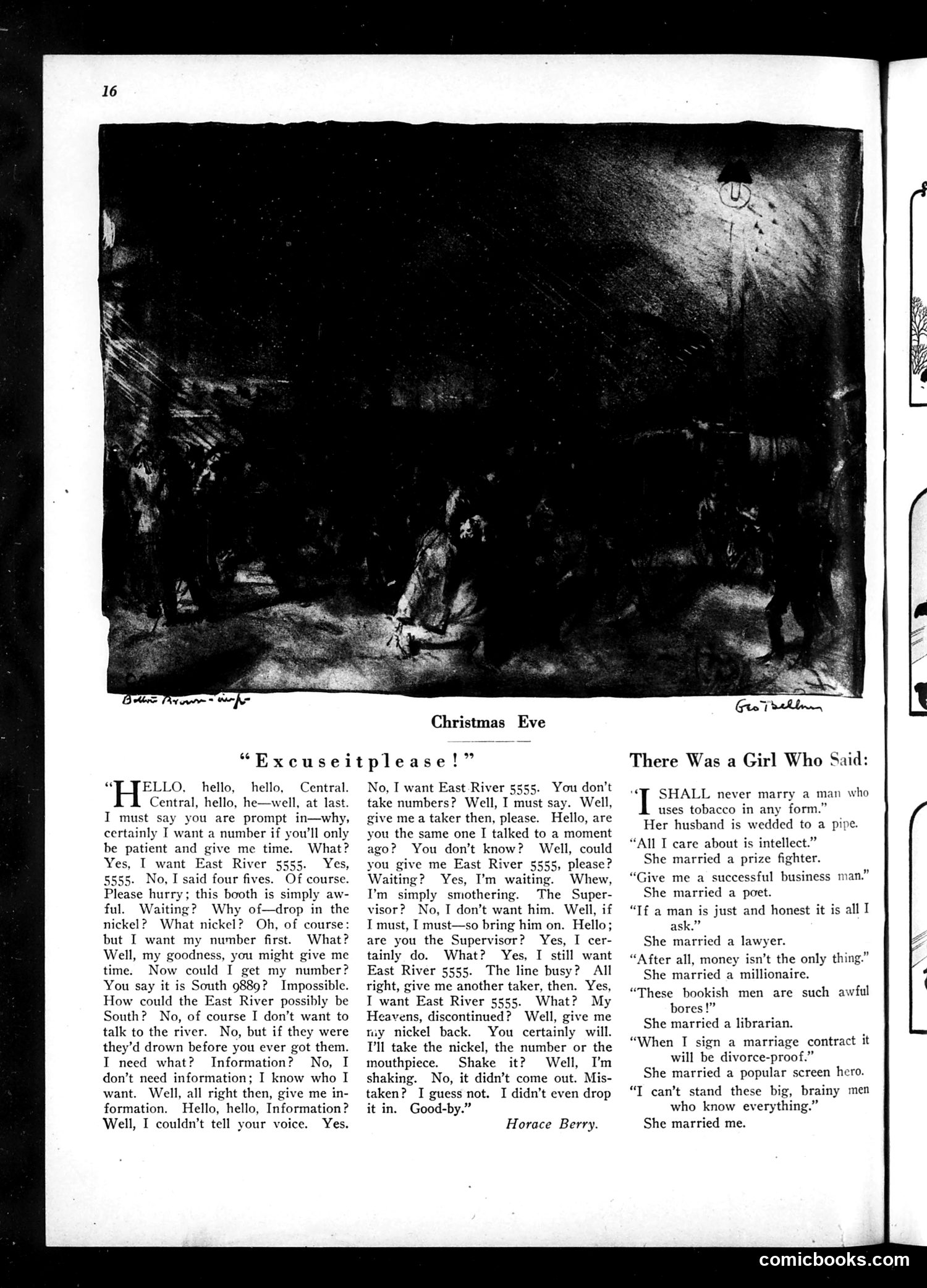
This page contains two satirical pieces for Christmas Eve. **"Excuseiplease!"** depicts a comedic phone conversation where a caller frantically tries to reach someone at "East River 5555," repeatedly interrupting an operator. The humor lies in the caller's impatience and increasingly absurd demands—asking for multiple "takers" (apparently bribes), shaking the mouthpiece, and generally behaving badly. The satire mocks rude telephone etiquette and the caller's presumptuous entitlement. **"There Was a Girl Who Said"** presents a series of brief anecdotes about women who married men despite stated principles—a businesswoman marrying a poet, a lawyer marrying a millionaire, etc. The final punchline, "She married me," suggests male wishful thinking about women abandoning their stated values. It satirizes both women's inconsistency and male self-delusion about romantic prospects. Both pieces use humor to critique social behavior and gender relations of the era.
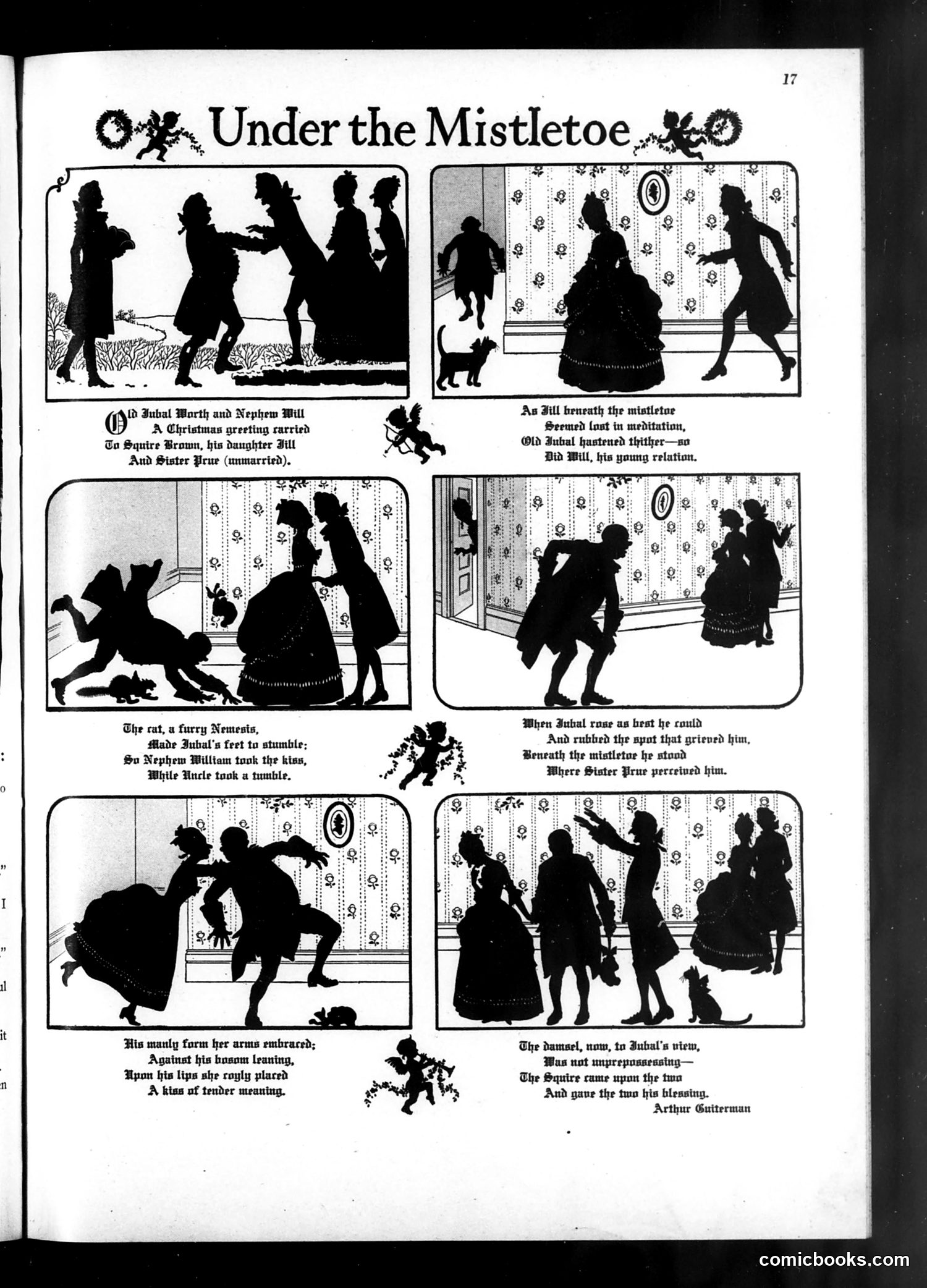
This is a humorous Christmas narrative poem illustrated with silhouettes, depicting romantic mishaps at a holiday gathering. The story involves Jubal Worth visiting Squire Brown's house with his nephew William. The plot involves mistletoe-triggered chaos: William kisses Jill (the squire's daughter) after a cat trips Jubal. Jubal attempts to kiss Dill but gets knocked down by young Will instead. When Jubal recovers and stands beneath the mistletoe, he encounters Sister Prue (an unmarried woman), and the Squire witnesses and blesses their union. The satire plays on Victorian courtship customs—specifically the mistletoe tradition where a man under it could kiss a woman. The humor derives from slapstick mishaps disrupting romantic intentions, and the ironic "happy ending" where an awkward older man accidentally wins approval to court an unmarried woman through comedic circumstance rather than intentional romance. The poem is credited to Arthur Guiterman, a popular American humorist of the early 20th century.
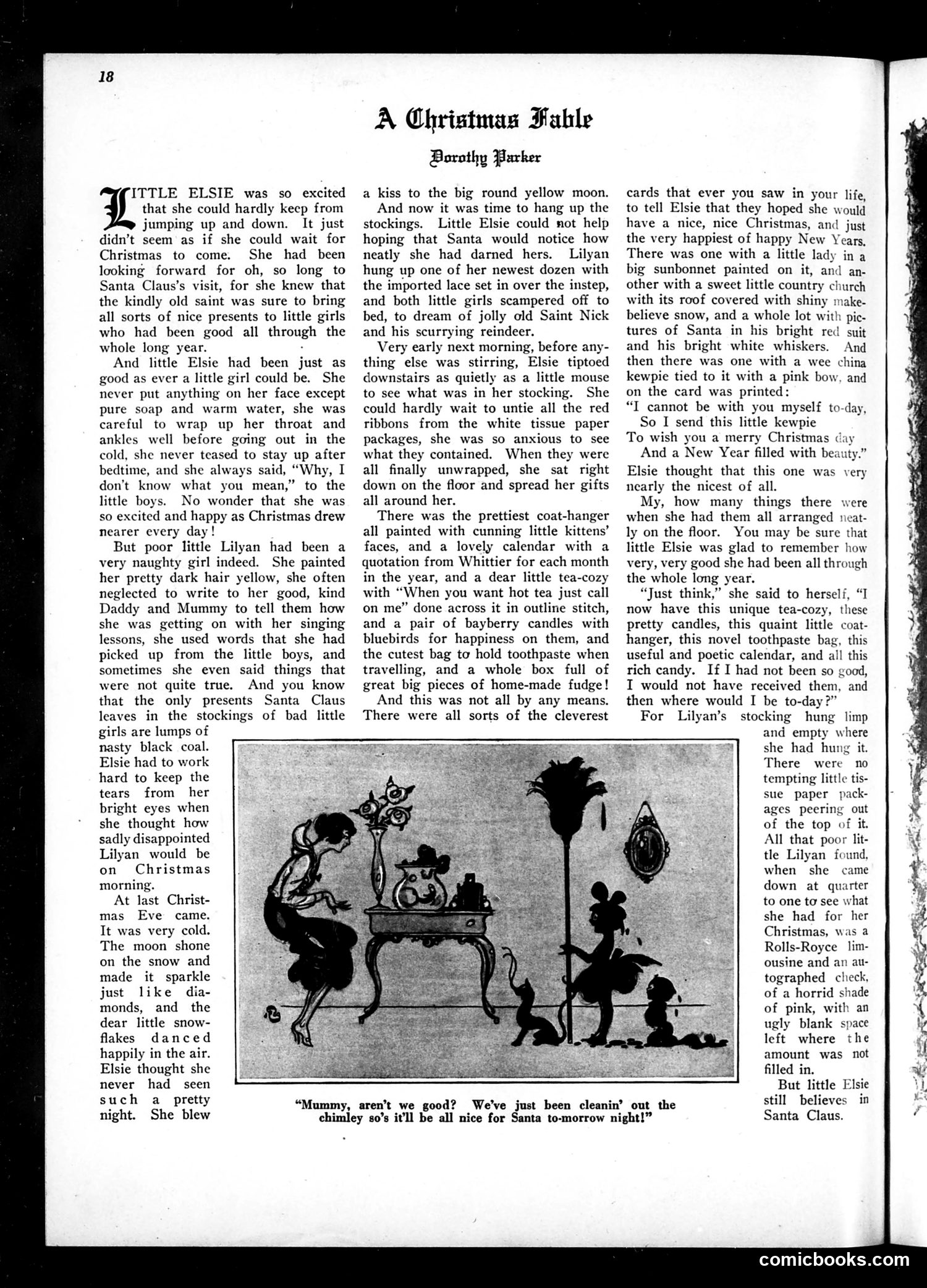
This is a satirical children's story that mocks sentimental Victorian morality tales. Parker contrasts two girls: virtuous little Elsie (who is boringly "good"—uses only soap and water, wraps her throat) versus naughty Lilyan (who dyes her hair, neglects letters, uses crude language). The satire lies in the setup's predictability: readers expect Lilyan to receive coal while Elsie gets rewards. The accompanying illustration shows children cheerfully cleaning the chimney, captioned with their claim of being "good" for Santa—but the children's mischievous appearance suggests Parker's ironic commentary. Parker uses this fable format to gently mock the rigid, joyless "goodness" demanded of girls and the arbitrary moral judgments of adults. The story subverts expectations of what Christmas morality tales typically teach, questioning whether such rigid virtue is actually desirable or realistic for children.
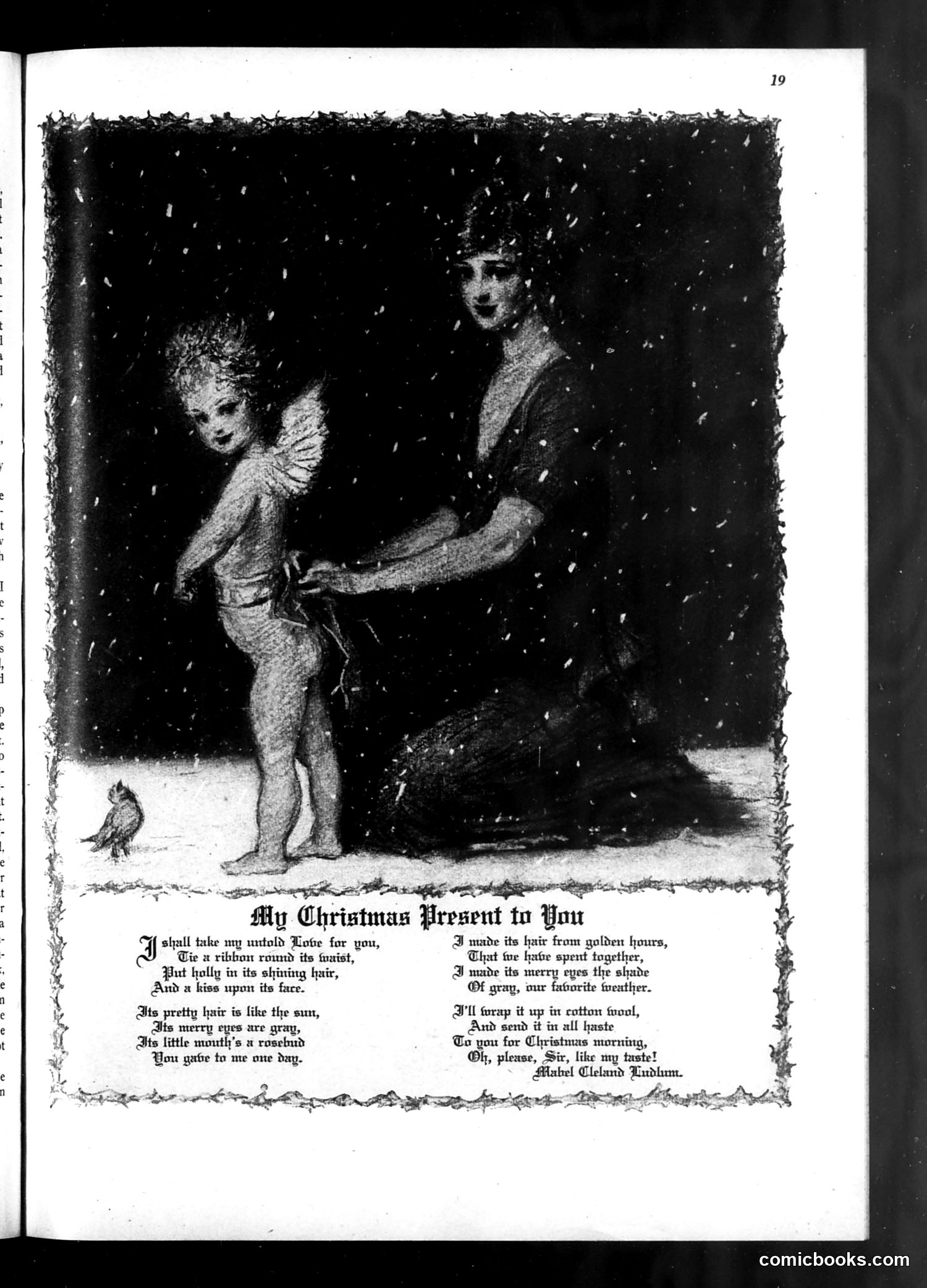
This is a sentimental Christmas poem by Mabel Cleland Lumbum, illustrated with a scene of a woman presenting a cherub or baby to a man. The "present" is metaphorical—the poem describes giving an idealized child to a beloved figure, created from shared memories ("hair from golden hours," "merry eyes the shade / Of gray, our favorite weather"). The illustration depicts this romantic/domestic fantasy: the woman holds the angelic child while gesturing toward the man, suggesting conjugal affection and the promise of offspring or family. The poem reads as a sentimental love letter wrapped in Christmas imagery. This represents early 20th-century *Life* magazine content: genteel, romantic humor aimed at middle-class readers. The satirical edge is subtle—likely poking gentle fun at sentimental Christmas traditions and idealized domesticity, rather than making sharp political commentary. The piece prioritizes romantic sentimentality over satire.
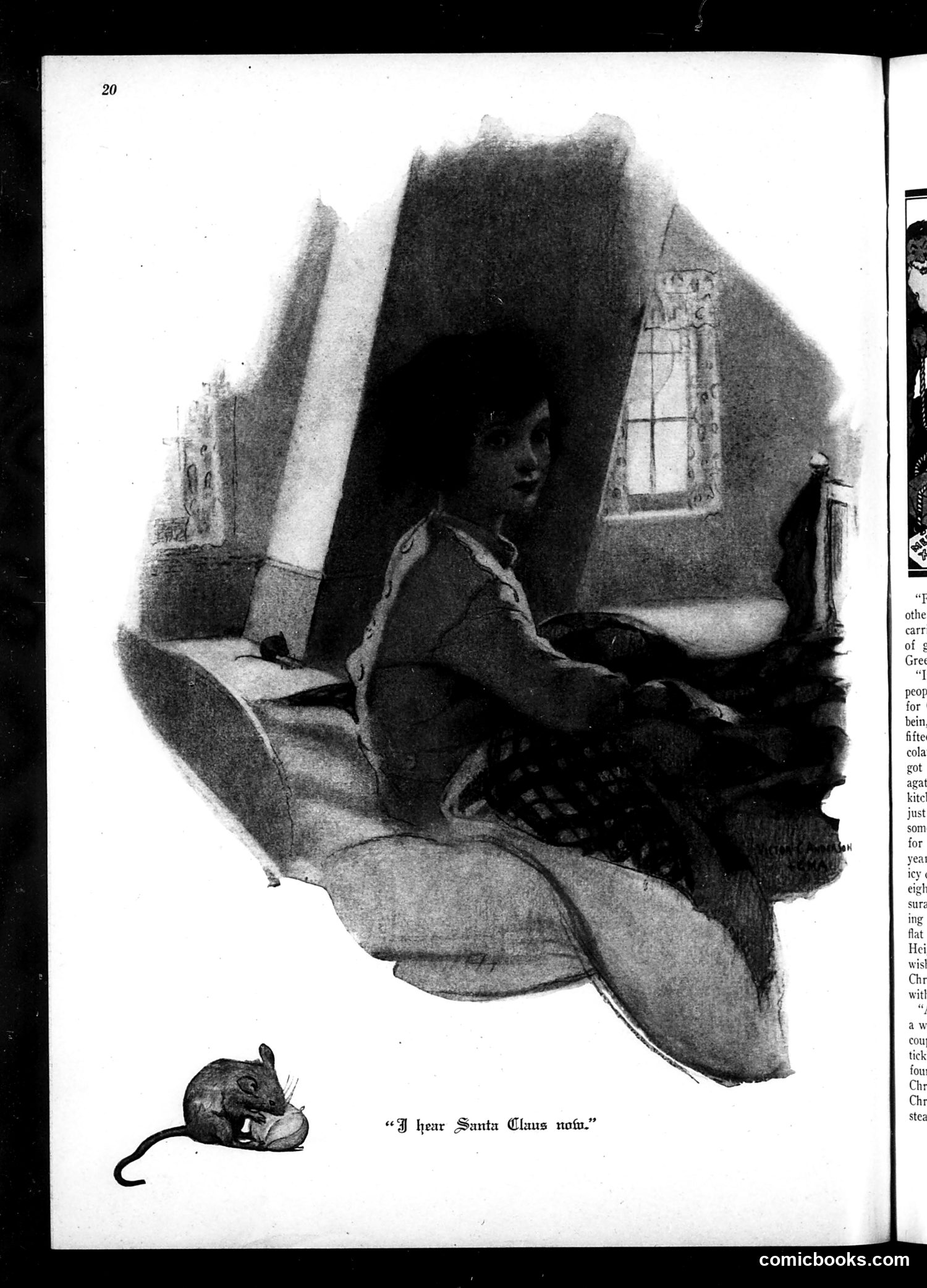
This illustration shows a child listening intently in what appears to be an attic or upper room with a slanted roof and window. A mouse in the lower left corner provides comic commentary. The caption reads "I hear Santa Claus now." The satire plays on childhood wonder and parental deception around Christmas. The child is supposedly hearing Santa Claus arriving, but the mouse's presence suggests a mundane reality: the "sounds" are likely just mice or household noises in the attic—not magical visitors. This gently mocks both the innocence of children who believe in Santa and perhaps the elaborate fictions parents construct. The humor derives from the gap between the child's magical interpretation and the actual, prosaic reality, with the mouse serving as visual irony about what's *actually* in the attic.
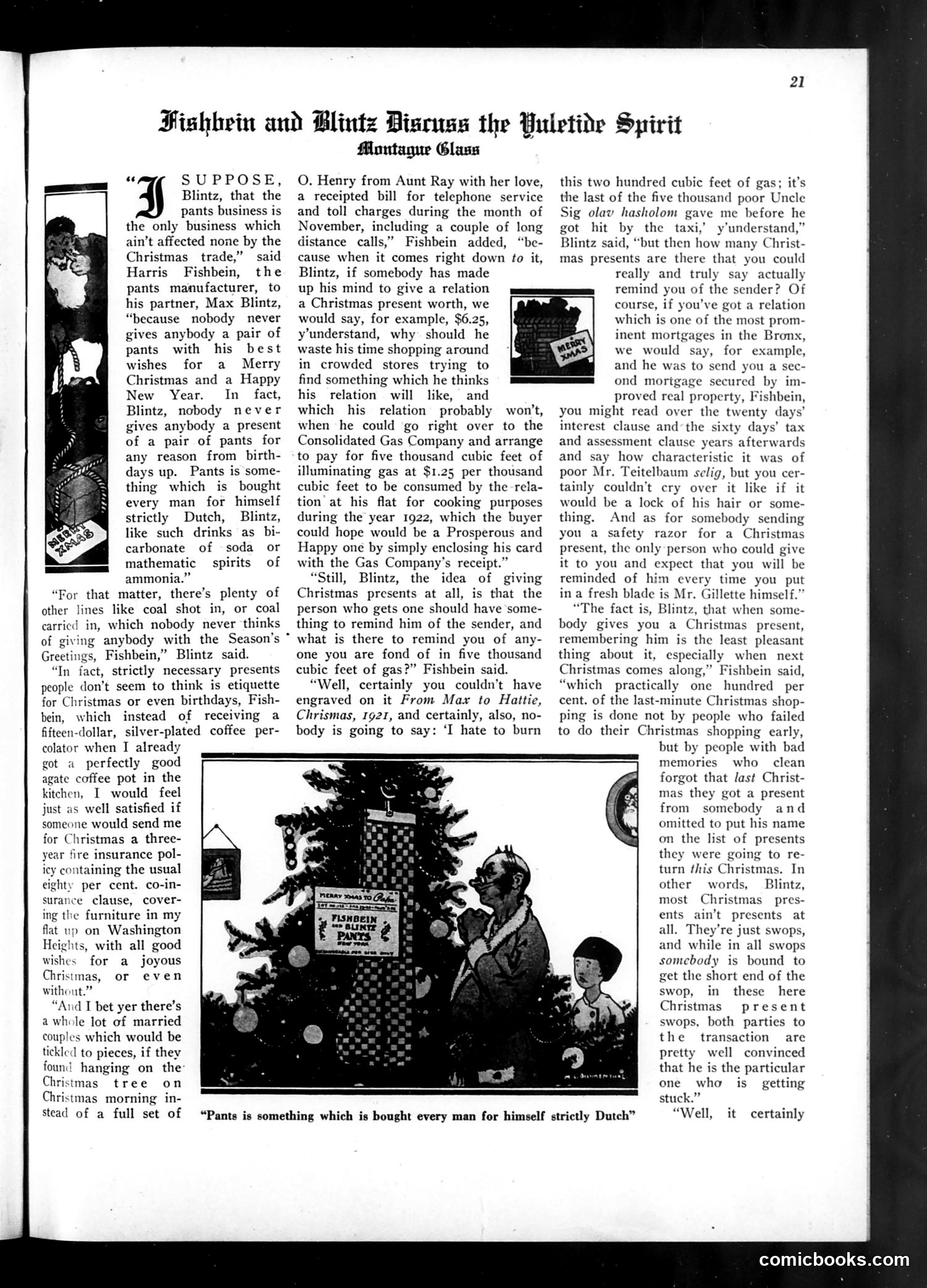
This is a satirical dialogue between two Yiddish-American businessmen—Harris Fishbein (pants manufacturer) and Max Blintz (his partner)—debating the absurdity of Christmas gift-giving conventions. **The Satire:** Fishbein argues that practical necessities (pants, coal, utilities) make terrible gifts because no one buys these *for* others as presents. Blintz sarcastically extends this logic to propose genuinely impractical "gifts": a three-year fire insurance policy, a phone bill receipt, and crucially, a gas company bill for five thousand cubic feet of illuminating gas—presented as a sentimental Christmas present. **The Point:** The humor mocks both excessive Christmas commercialism and the greeting-card sentimentality surrounding gift-giving. By proposing utterly ridiculous "gifts" (utility bills, insurance policies), the characters expose how arbitrary and wasteful conventional present-buying is. The joke lands hardest with the gas bill "gift"—completely useless yet technically "thoughtful." **Context:** This reflects 1920s Jewish-American immigrant humor, using vernacular speech ("olav hasholom," "y'understand") and the characters' outsider perspective to critique mainstream American consumer culture.
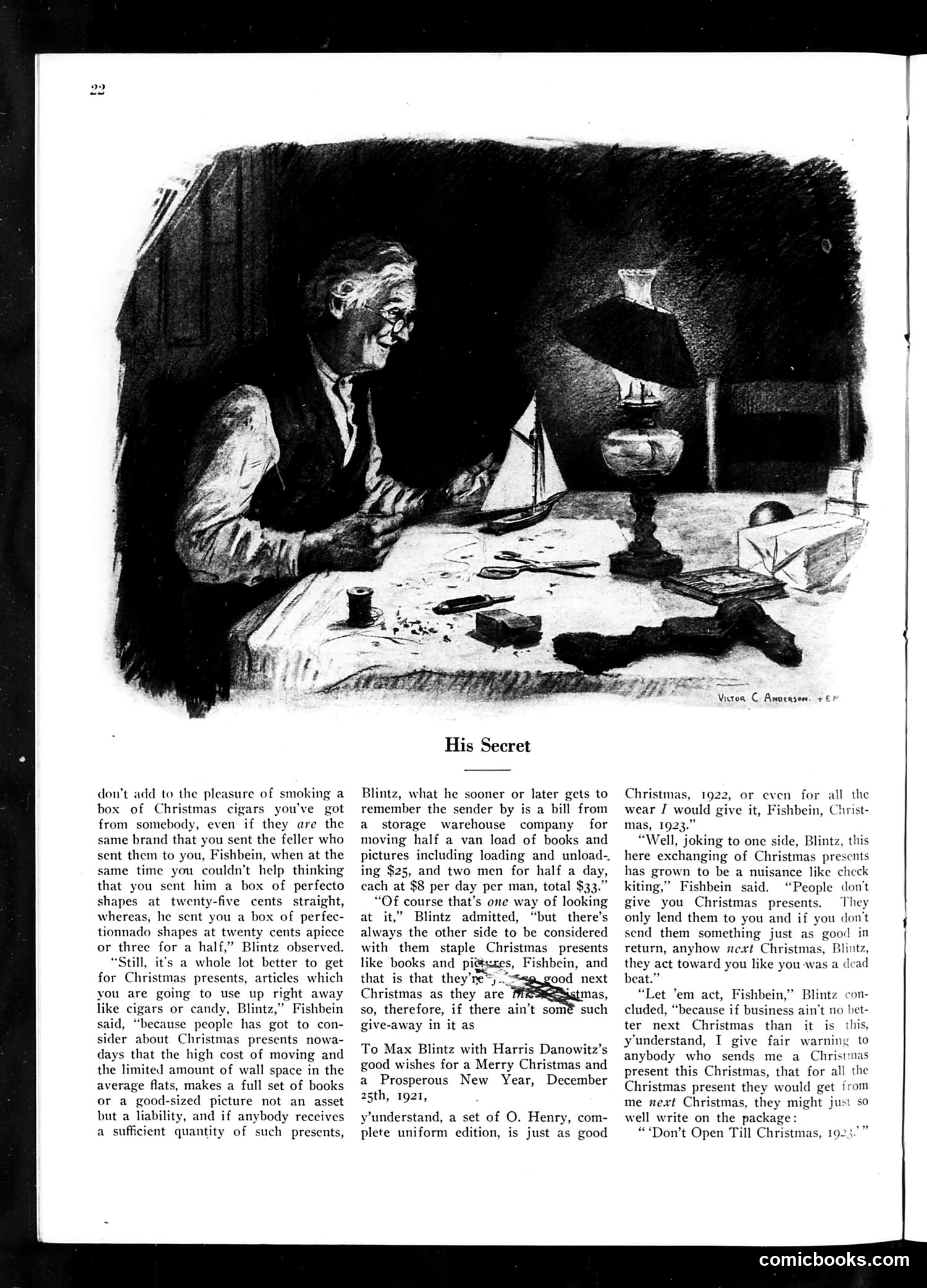
This is a satirical dialogue between two working-class characters, Blintz and Fishbein, discussing the burden of Christmas gift-giving etiquette during economically tight times (post-WWI recession). **The Joke:** The men debate whether to give practical consumables (cigars, candy) or lasting gifts (books, pictures). Fishbein points out that lasting gifts become financial *liabilities*—storage warehouse fees ($33 mentioned) eat up savings. Blintz cynically concludes the whole exchange has become a coercive obligation rather than genuine giving. **The Satire:** The cartoon mocks how Christmas gifting, supposedly about goodwill, has devolved into a transactional burden where people "lend" gifts expecting equal-value returns, or risk being treated "like a dead beat." **The Context:** December 1921 was economically difficult; the cartoon reflects real anxiety about affording holiday customs. The working-class dialect and characters suggest Life was satirizing middle and lower-middle-class anxieties about maintaining social appearances despite financial strain.
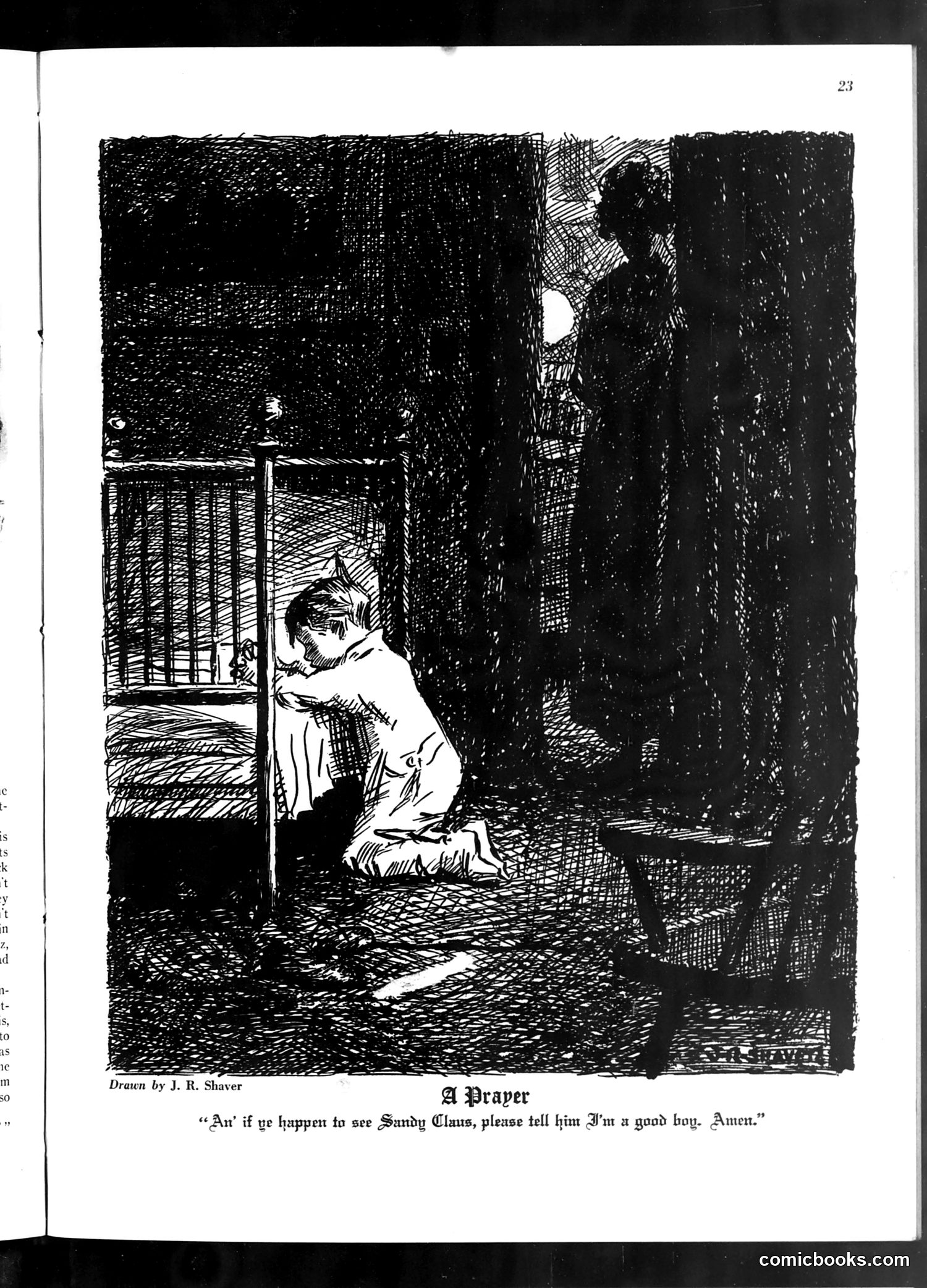
This is a sentimental illustration titled "A Prayer," drawn by J.R. Shaver. It depicts a young child kneeling in prayer in what appears to be a sparse, dimly-lit room or cellar, with a barred window visible in the background. The caption reads: "An' if ye happen to see Sandy Claus, please tell him I'n a good boy. Amen." The piece satirizes childhood innocence and poverty. The child's misspelling of "Santa Claus" as "Sandy Claus" and modest request—merely to be acknowledged as "good"—contrasts with the bleak living conditions suggested by the sparse setting. The drawing critiques socioeconomic inequality by highlighting how poor children's hopes remain humble and earnest despite their material deprivation, evoking sympathy rather than humor in this particular illustration.
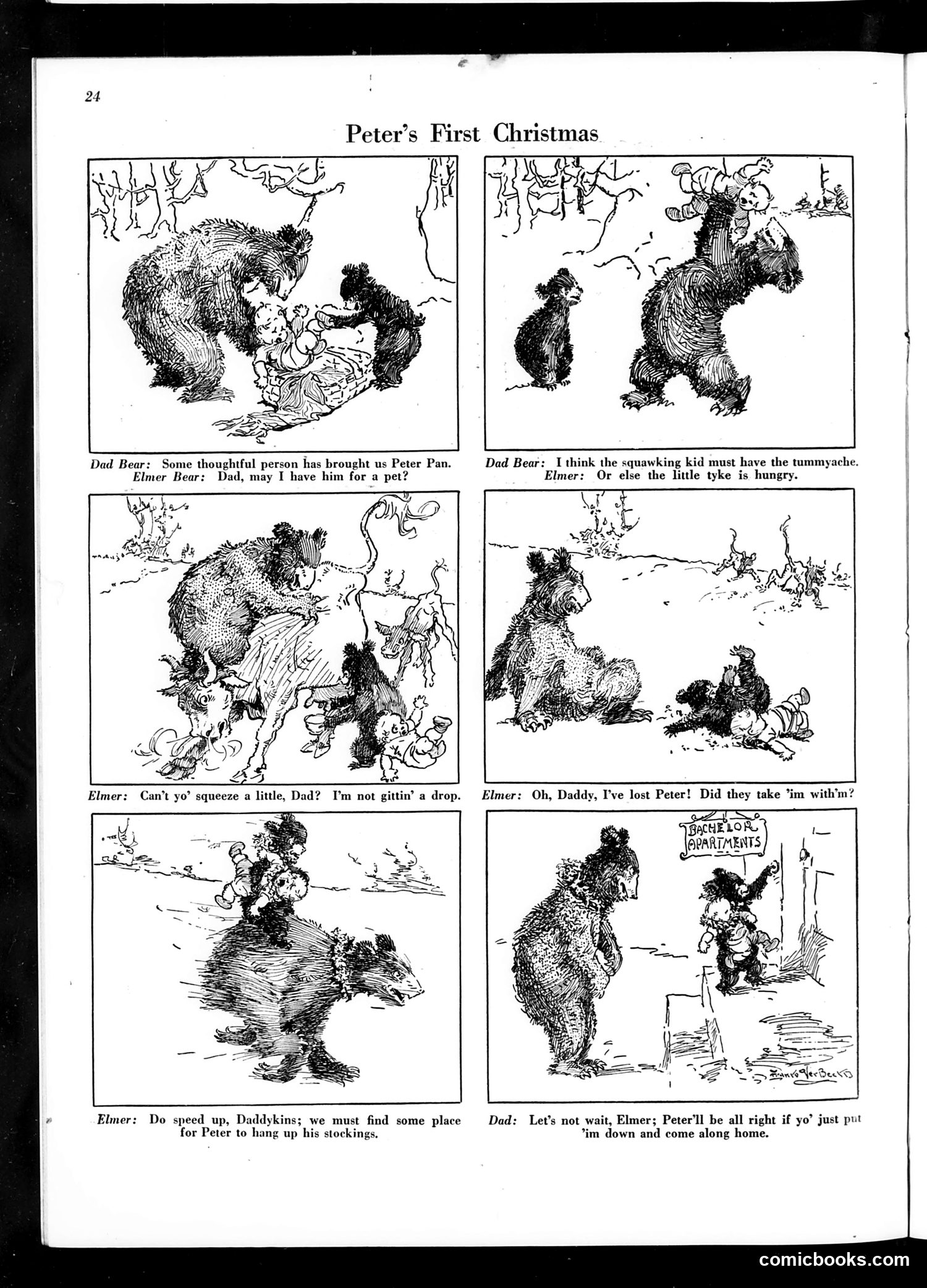
This is a six-panel comic strip featuring anthropomorphic bears (Dad Bear and young Elmer) who have received Peter Pan as a Christmas gift—apparently interpreting it as an actual child rather than the fictional character. The humor derives from the bears treating Peter Pan literally: they attempt to nurse him (he's "squawking" and hungry), consider keeping him as a pet, try to milk him, and debate where to hang his Christmas stocking. The final panel shows them deciding to simply put the book down and go home. The satire likely mocks overly literal-minded readers or parental confusion about children's literature. The dialect ("Can't yo' squeeze") and bear characters suggest this targets a broad audience unfamiliar with literary references. It's gentle, family-friendly humor playing on the disconnect between a famous storybook character and actual childcare.
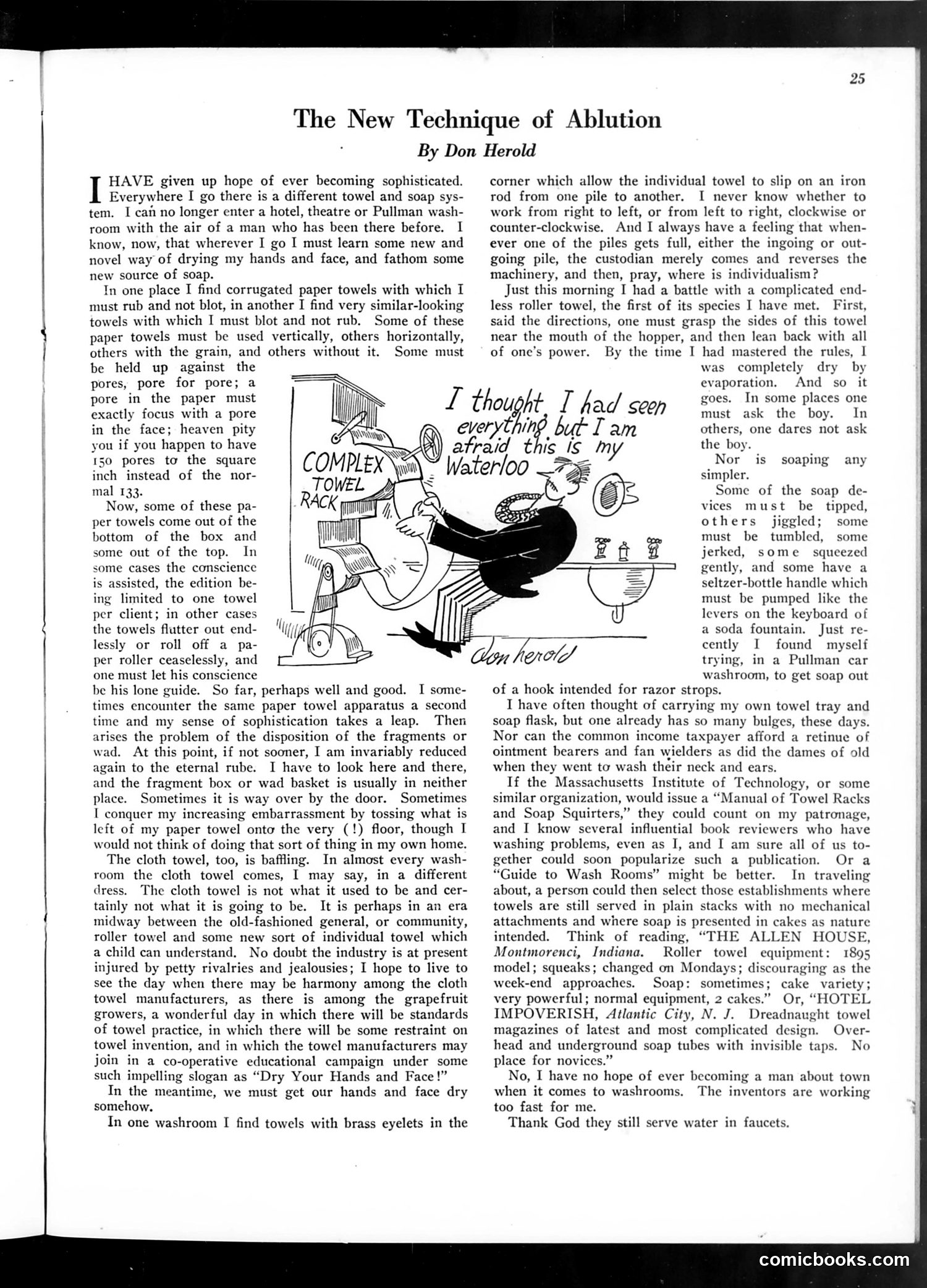
This is a humorous essay satirizing the bewildering proliferation of different towel and soap systems in American public washrooms (hotels, theaters, trains). The cartoon illustration shows a man overwhelmed by an absurdly complex towel-drying apparatus. Herold's satire targets the rapid industrialization and over-innovation of everyday conveniences in early 20th-century America. Rather than improving life, manufacturers' competitive "petty rivalries" create confusion—each washroom features different designs, sizes, and operating methods. The author cannot enter a public restroom with confidence; he must constantly relearn basic procedures. The joke is that this supposedly "modern" progress actually reduces sophisticated, educated people to confused "rubes" (rural simpletons). Herold advocates for industry standardization and cooperation, even joking about a campaign slogan: "Dry Your Hands and Face!" The piece mocks how technological innovation, unchecked by standards or coordination, paradoxically complicates rather than simplifies ordinary life.
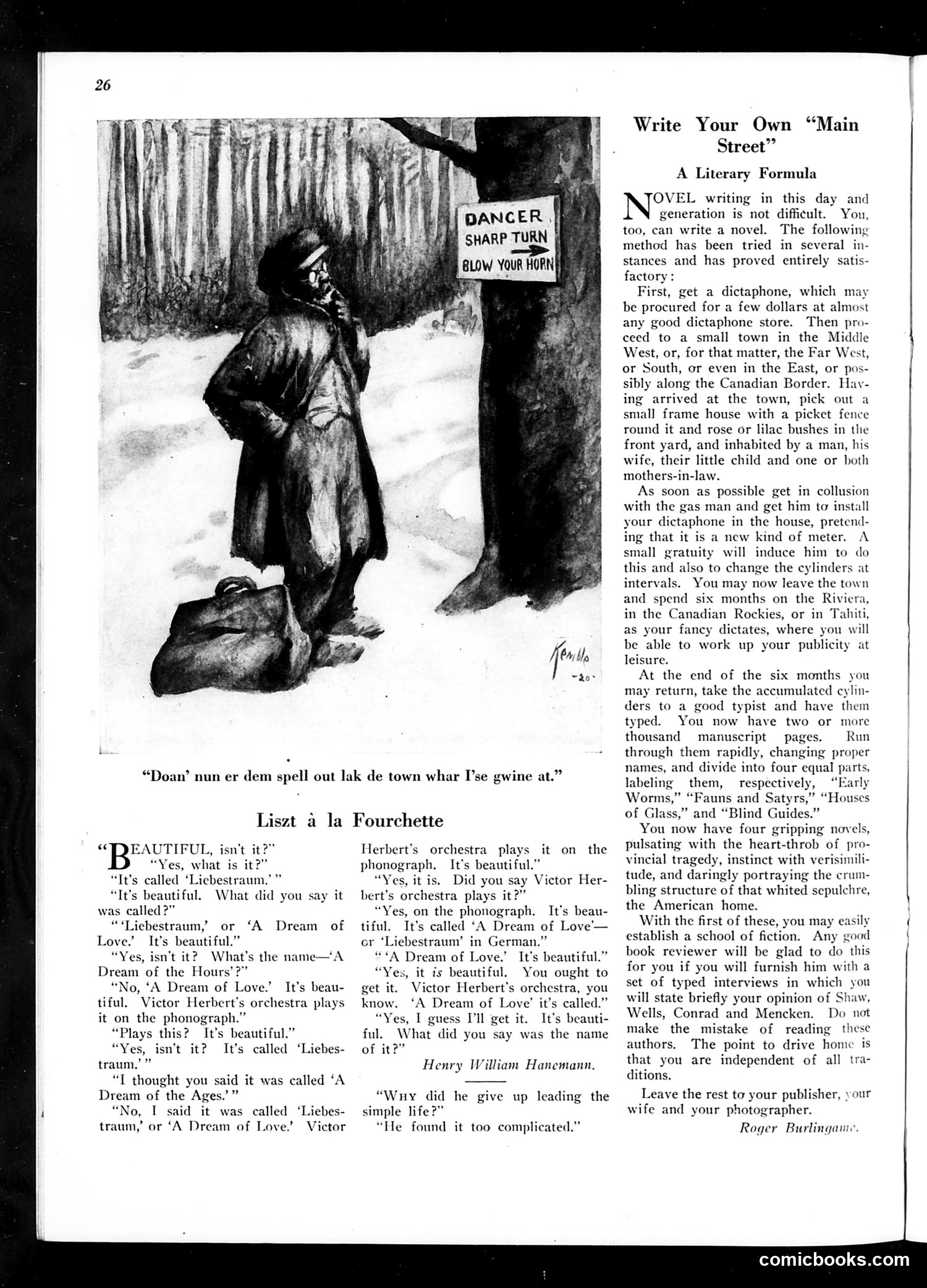
This page contains two satirical pieces from *Life* magazine: **Top Cartoon:** A dialect-humor sketch mocking rural/Southern speech patterns. A traveler asks directions using nonstandard English ("Doan' nun er dem spell out..."), while a road sign warns of a sharp turn ahead. The joke relies on early-20th-century stereotyping of African American or rural Southern speech as comic material. **"Liszt à la Fourchette":** A absurdist dialogue poking fun at pretentious music appreciation. Two people repeatedly discuss a classical piece, constantly confusing its title (*Liebestraum* vs. *A Dream of Love* vs. *Dream of the Hours*), yet insisting it's "beautiful" without understanding what they're discussing. It satirizes performative cultural sophistication and mindless repetition. **"Write Your Own 'Main Street'":** A tongue-in-cheek literary formula mocking the then-popular trend of earnest small-town American novels (referencing Sinclair Lewis's *Main Street*). The joke: hire a dictaphone, hide it in a small-town house, disappear for six months, then edit the recorded conversations into four "profound" novels—satirizing both the formulaic nature of such fiction and pretentious literary marketing.
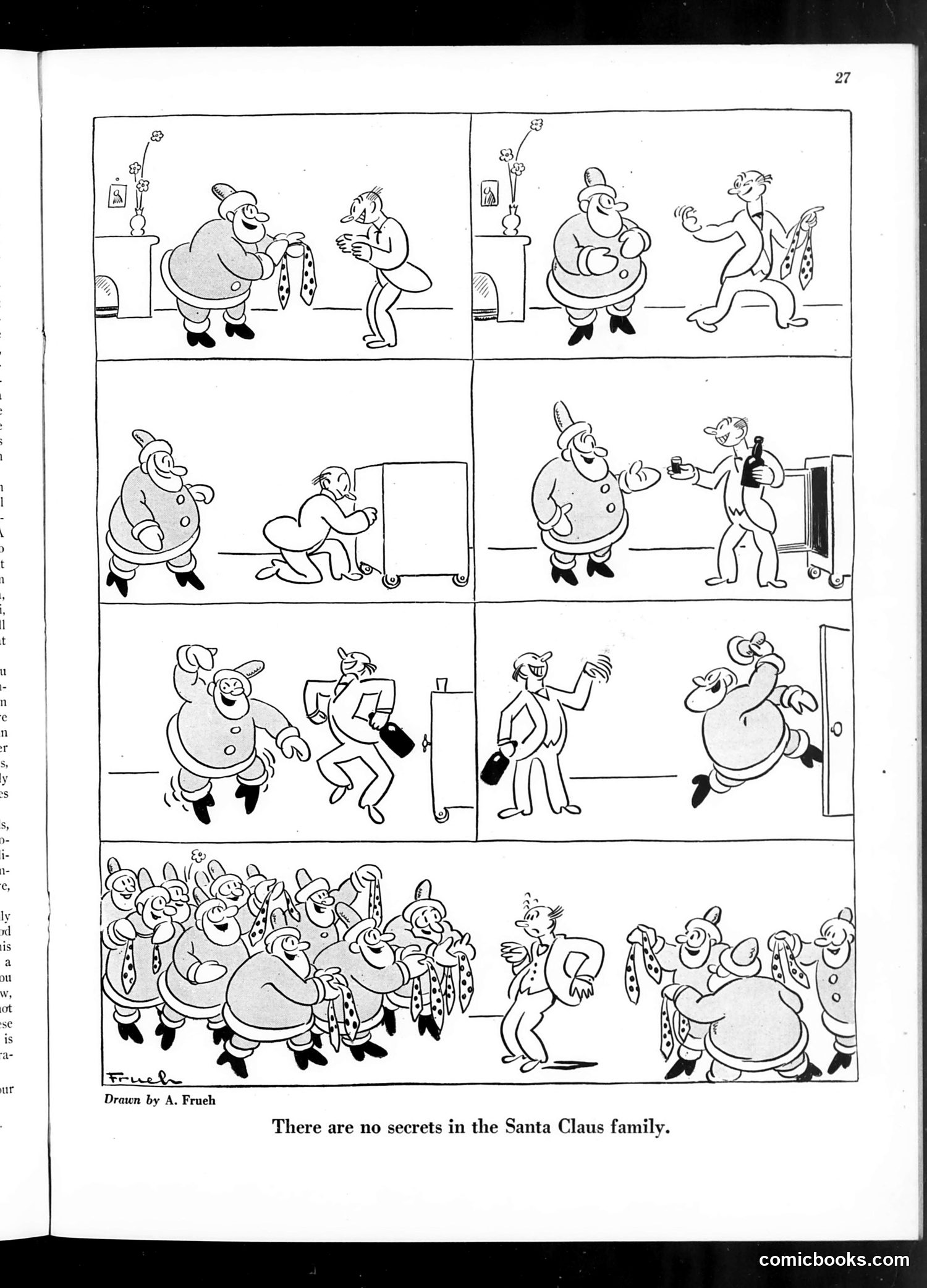
This is a humorous comic strip by A. Frueh depicting Santa Claus and his family. The caption "There are no secrets in the Santa Claus family" serves as the joke's setup. The strip shows Santa and what appear to be family members or elves engaged in various domestic scenes—displaying toys, moving furniture, and other household activities. The final panel reveals a large gathering, suggesting that secrets about Christmas gifts or Santa's operations cannot be kept within the family. The satire appears to target the impossibility of maintaining confidentiality in close-knit family units, particularly regarding Christmas surprises. It's a gentle, family-friendly joke playing on the notion that Santa's magical secret—how he delivers gifts—cannot remain hidden when so many people are involved in the operation. The cartoon reflects mid-20th-century American humor about holiday traditions and family dynamics.
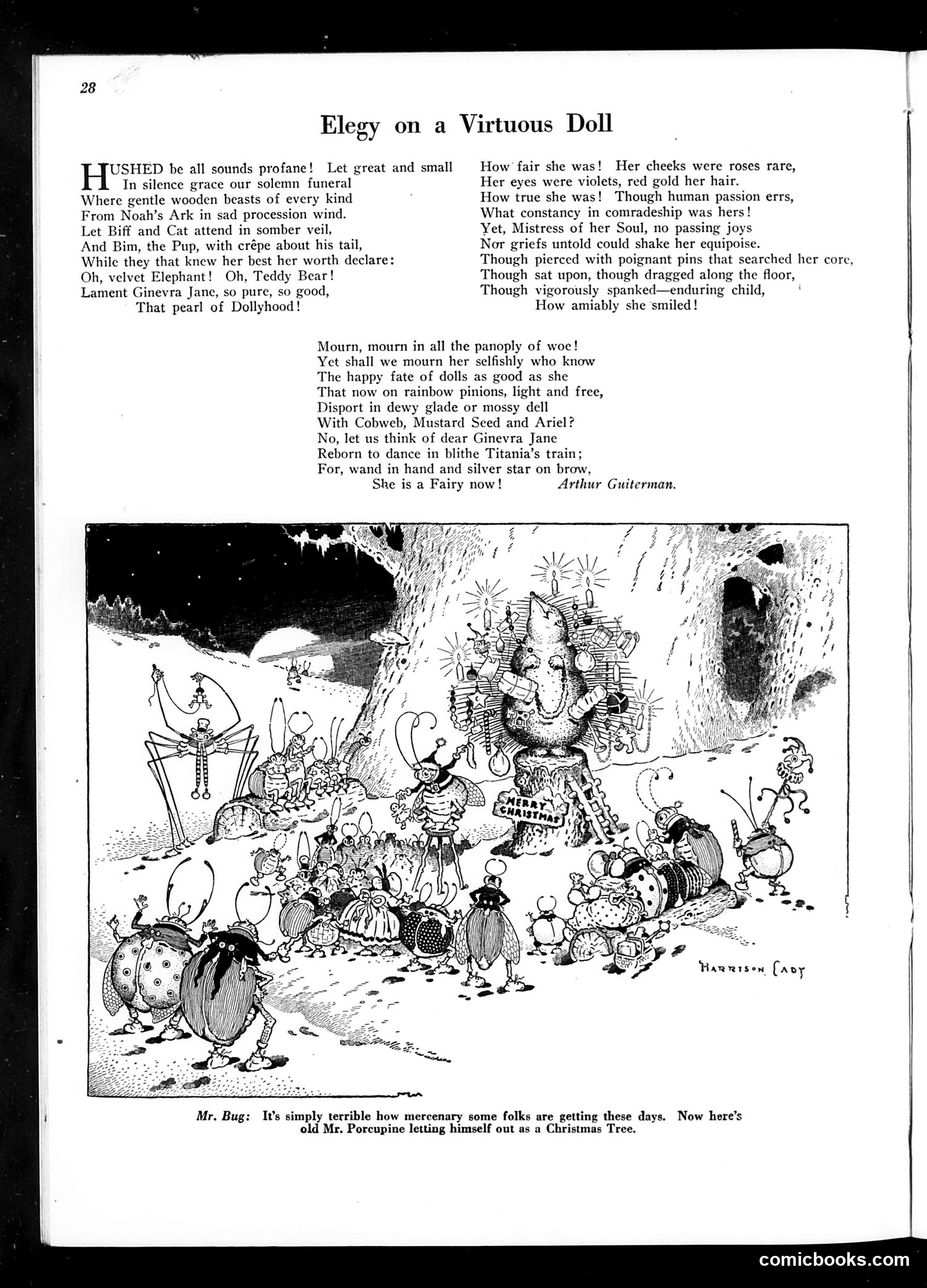
This page contains a mock-serious poem by Arthur Guiterman mourning the "death" of a doll named Ginevra Jane. The satire works on multiple levels: **The Poetry**: A deliberately overwrought elegy treats a worn-out doll's destruction as tragic loss, cataloging her sufferings (pins, being sat upon, spanking). The poem ironically elevates her to sainthood, then offers consolation by imagining her reborn as a fairy in Shakespeare's *A Midsummer Night's Dream* (referencing Titania and magical spirits). **The Cartoon Below**: Shows anthropomorphized animals (insects, a porcupine) in a whimsical forest scene. Mr. Bug's caption satirizes commercialism—a porcupine is renting itself out as a Christmas tree, treating even natural existence as a commodity. **Overall Point**: The page gently mocks both sentimentality toward children's toys and the crass commercialization creeping into holiday traditions. The contrast between romantic fairy-tale language and mundane reality ("Christmas Tree for hire") drives the satire.
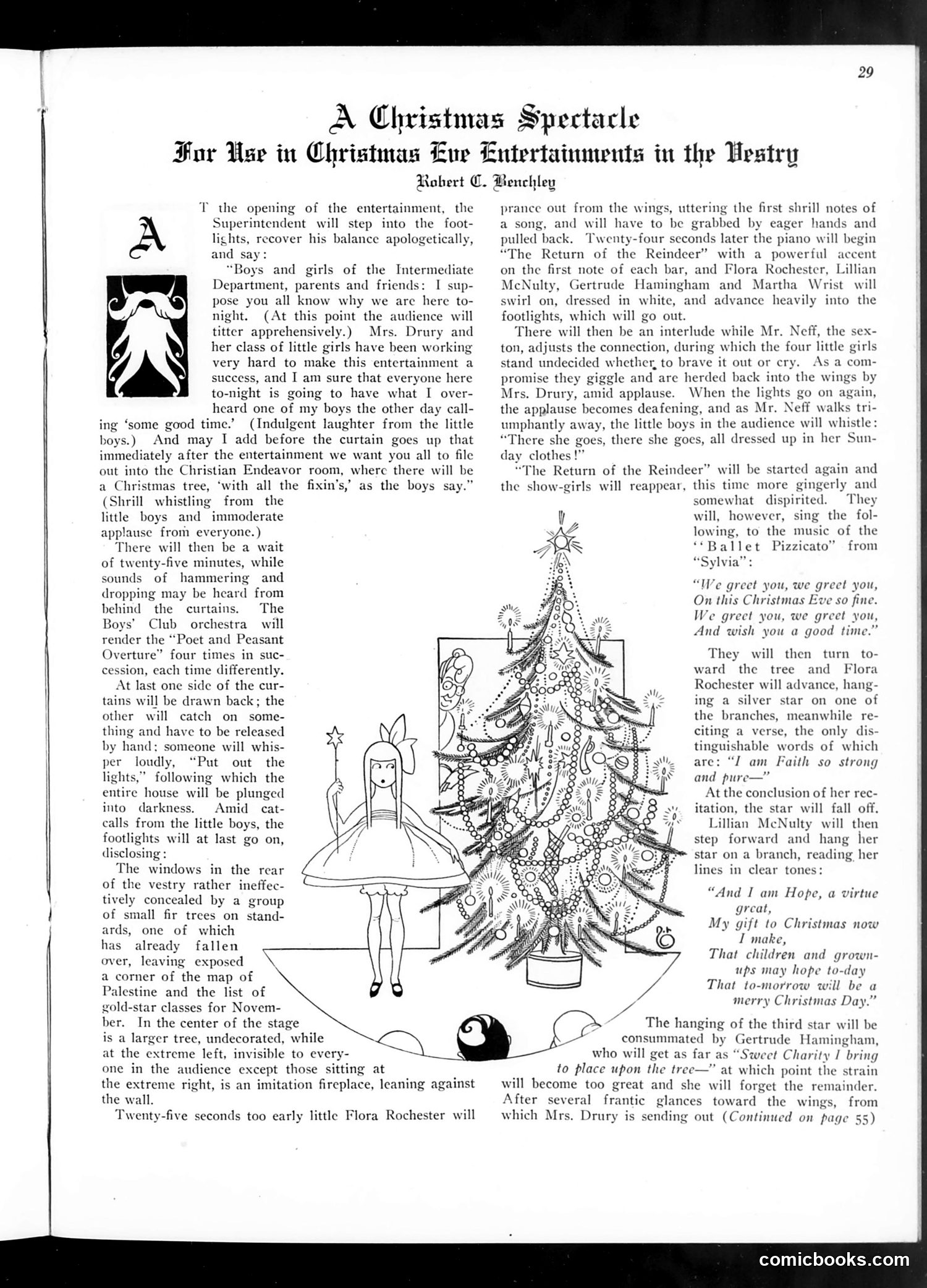
This is not a political cartoon but a humorous *script* for a church Christmas Eve entertainment. Benchley satirizes the chaos of amateur theatrical productions in early 20th-century church vestries. The humor targets the predictable mishaps of such events: the nervous superintendent, children who appear too early, tangled curtains, technical failures (lights going out), backstage noise, and ad-hoc sets (a fallen tree revealing a Palestine map). The dialogue mocks both adult organizers ("Mrs. Drury") and children's behavior—including boys who whistle mockingly at performers. This is gentle, observational satire aimed at middle-class American institutional life. It assumes readers recognize church Christmas pageants as notoriously amateur, well-meaning productions prone to disorder. The joke is that everything goes wrong in expected, repetitive ways. The accompanying illustration shows a girl and decorated tree, supporting this domestic holiday entertainment context.
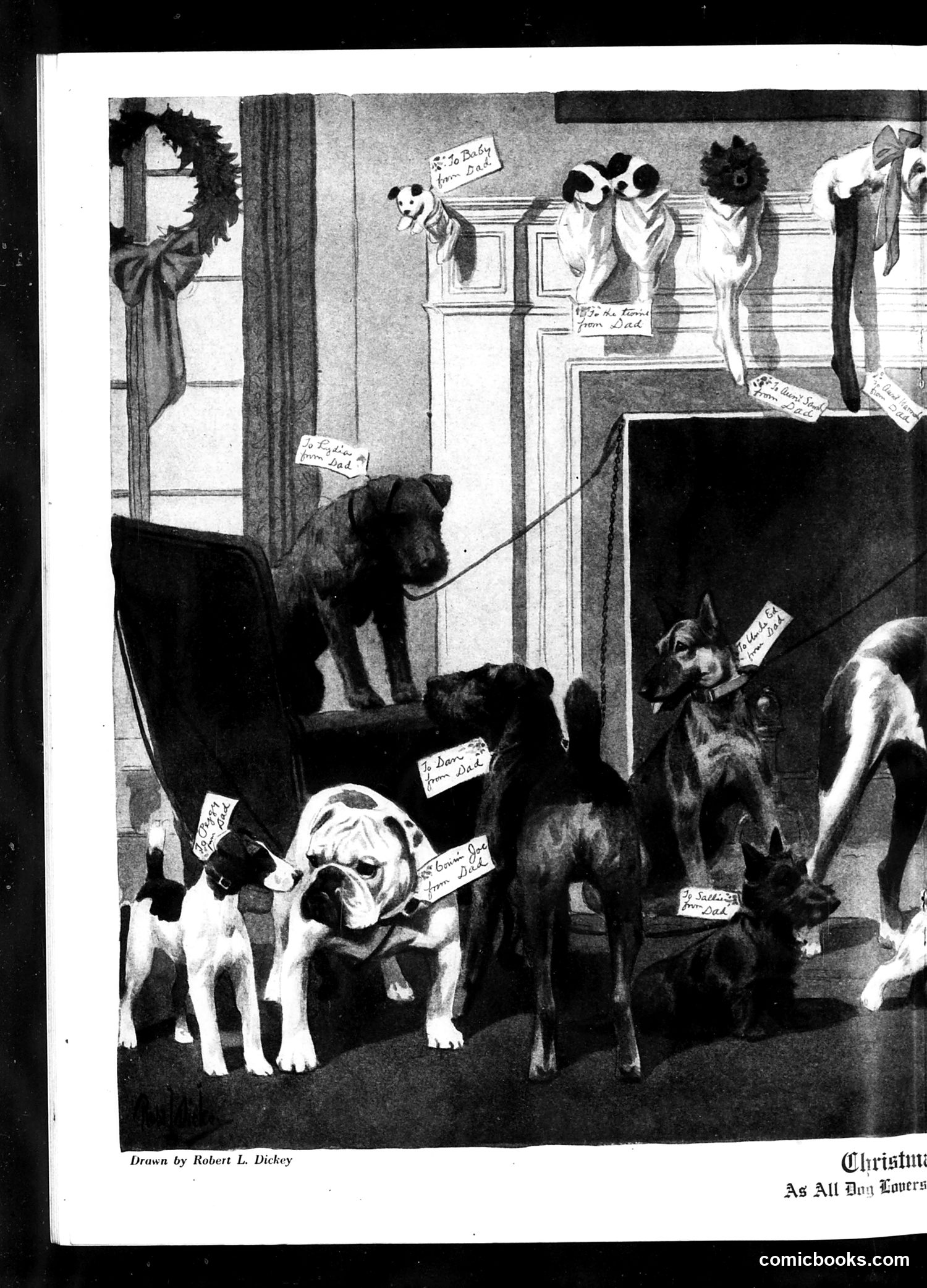
This cartoon by Robert L. Dickey depicts a domestic interior filled with various dogs of different breeds wearing name tags. The dogs are positioned throughout a decorated home—on furniture, mantels, and floors—appearing to be Christmas gifts or beloved pets. The satire targets affluent dog lovers who shower their pets with excessive holiday attention and material gifts. The crowded scene of well-dressed dogs in a formal setting mocks the sentimental indulgence of treating dogs as family members worthy of elaborate Christmas celebrations. The title "As All Dog Lovers" suggests this represents the idealized fantasy of dog enthusiasts during the holiday season—a home filled entirely with pampered canine companions. It's gentle social satire on pet ownership culture and holiday excess.
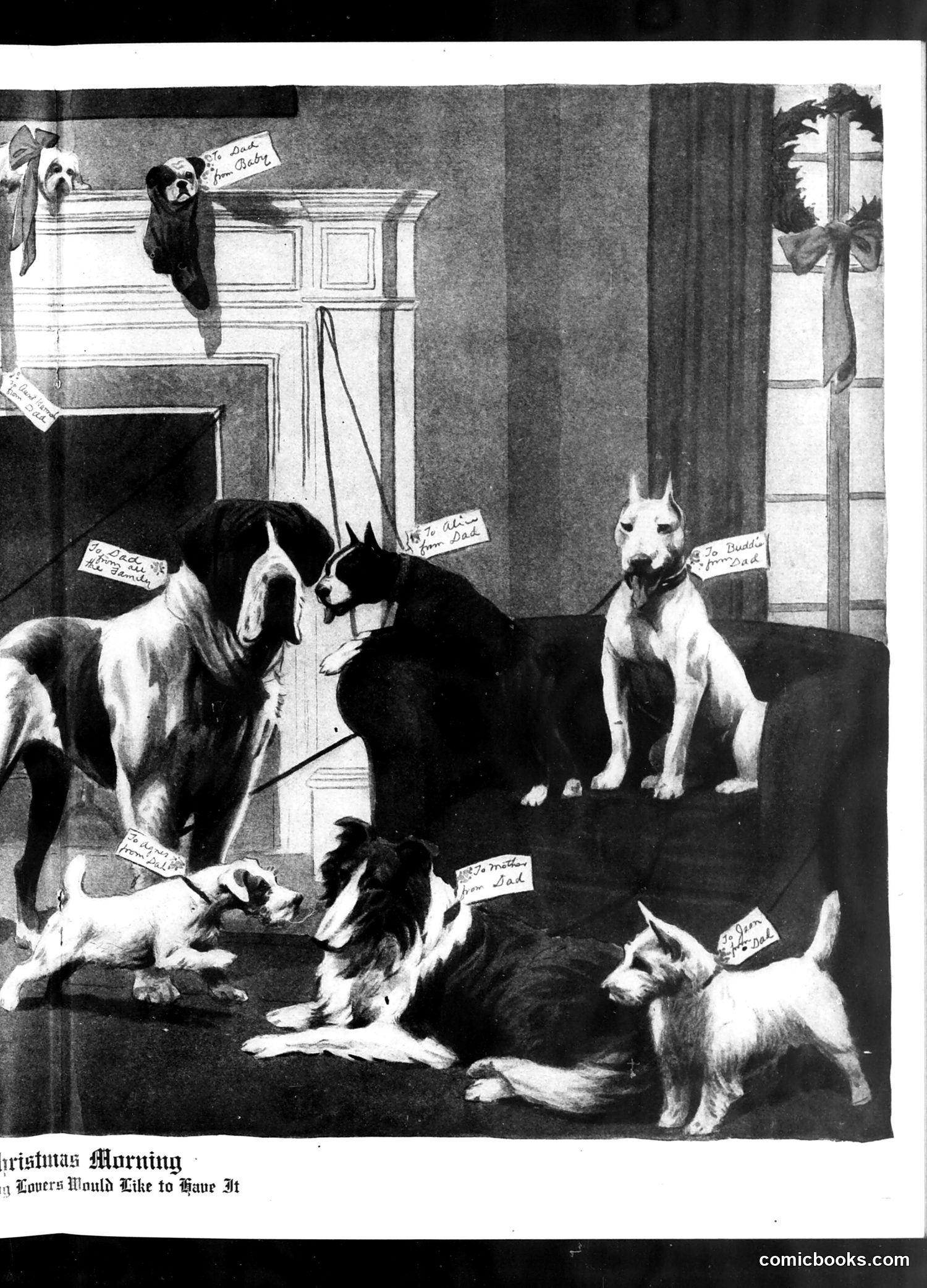
This satirical cartoon depicts an idealized Christmas morning scene populated entirely by dogs wearing gift tags. The humor contrasts the sentimental fantasy ("as lovers would like to have it") with reality—rather than human children or family members opening presents, the image shows various dog breeds in a domestic interior, each labeled with gift tags in what appears to be humorous fashion. The satire likely pokes fun at the sentimentality of holiday gift-giving and the anthropomorphization of pets in wealthy households. By replacing human family members with dogs, the cartoon suggests either that some people prioritize their pets over people, or it mocks the excessive sentiment lavished on animal companions during the holiday season. The specific humor depends on identifying the dog breeds depicted and their accompanying labels.
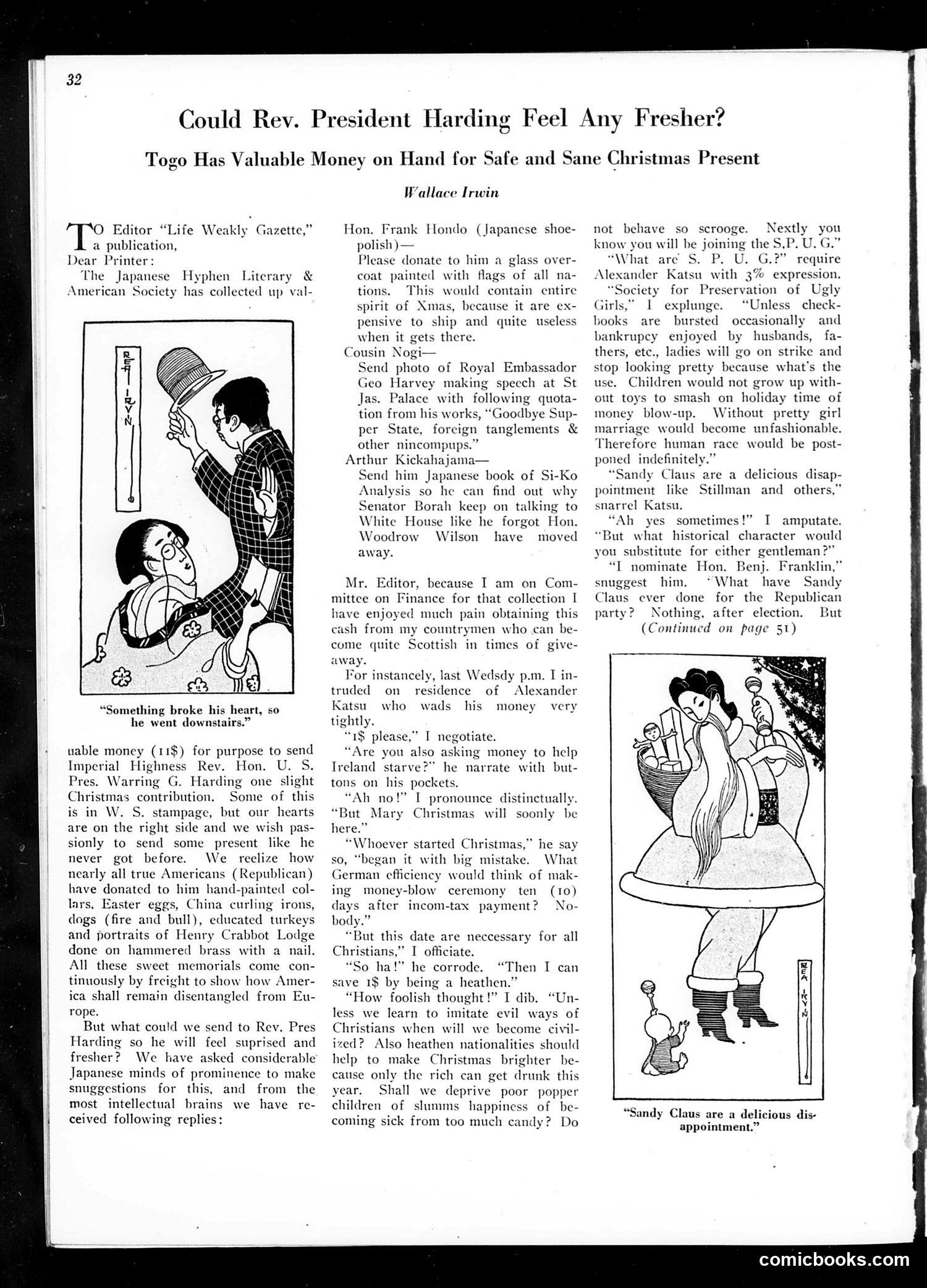
This 1921 satire by Wallace Irwin mocks President Warren G. Harding through mock "gift suggestions" from Japanese donors. The humor rests on several layers: **The Setup**: A fictional "Japanese-American Society" collects money for Harding, a sitting U.S. president—absurd on its face. **The Satire**: Japanese characters (written in exaggerated pidgin English) suggest hilariously impractical gifts while obliquely criticizing Harding's foreign policy. One suggests a "glass overcoat" (expensive and useless); another references Senator Borah's public criticism of the White House, and another jokes about isolationism ("disentangled from Europe"). **The Joke**: The cartoonist uses Japanese personas to critique American politics indirectly—a common early-20th-century satirical device. The pidgin dialogue itself was considered humorous to contemporary readers, though it reads as offensive today. The secondary cartoon depicts a character refusing Christmas donations, satirizing post-tax stinginess among the wealthy during economic hardship.
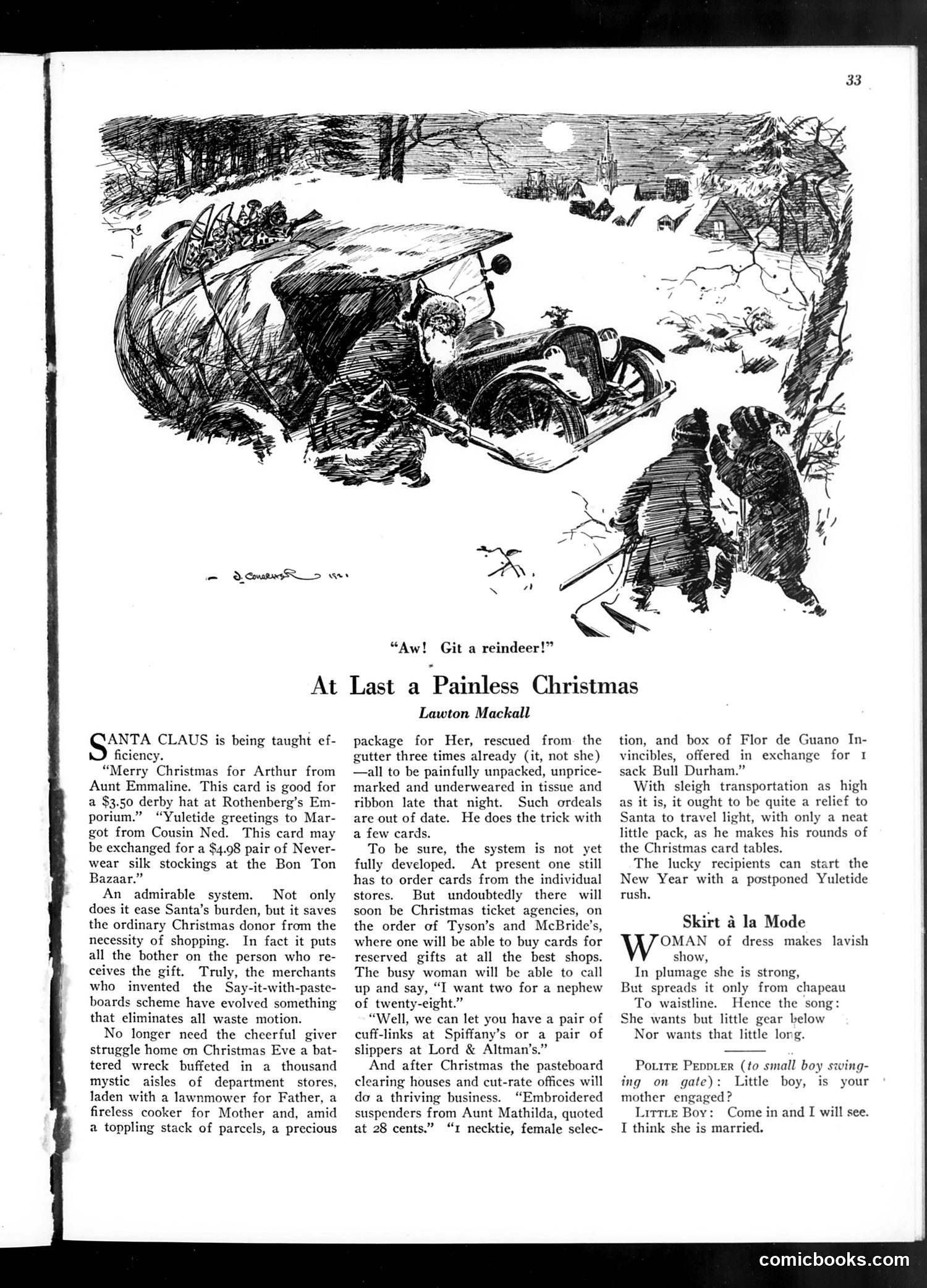
This satirical article mocks an emerging commercial trend: giving Christmas gift certificates or "cards" redeemable at department stores instead of purchasing actual gifts. **The Satire:** The piece feigns approval of this "efficient" system while exposing its absurdity. It shifts all the inconvenience from the giver (who traditionally struggled through crowded stores) to the *receiver*, who must now visit stores to redeem vague vouchers. The author projects this logic forward humorously—imagining "Christmas ticket agencies" that function like stock exchanges, and post-holiday "clearing houses" where recipients can resell unwanted gift cards. **The Cartoon:** Shows Santa arriving by car (a modern touch) rather than sleigh, emphasizing how commercialization has transformed Christmas into efficient business transactions. **Historical Context:** This targets 1920s-era department store marketing that promoted gift certificates as convenient, modern solutions—a predecessor to today's gift card culture. The satire suggests such "efficiency" strips Christmas of genuine personal thoughtfulness.
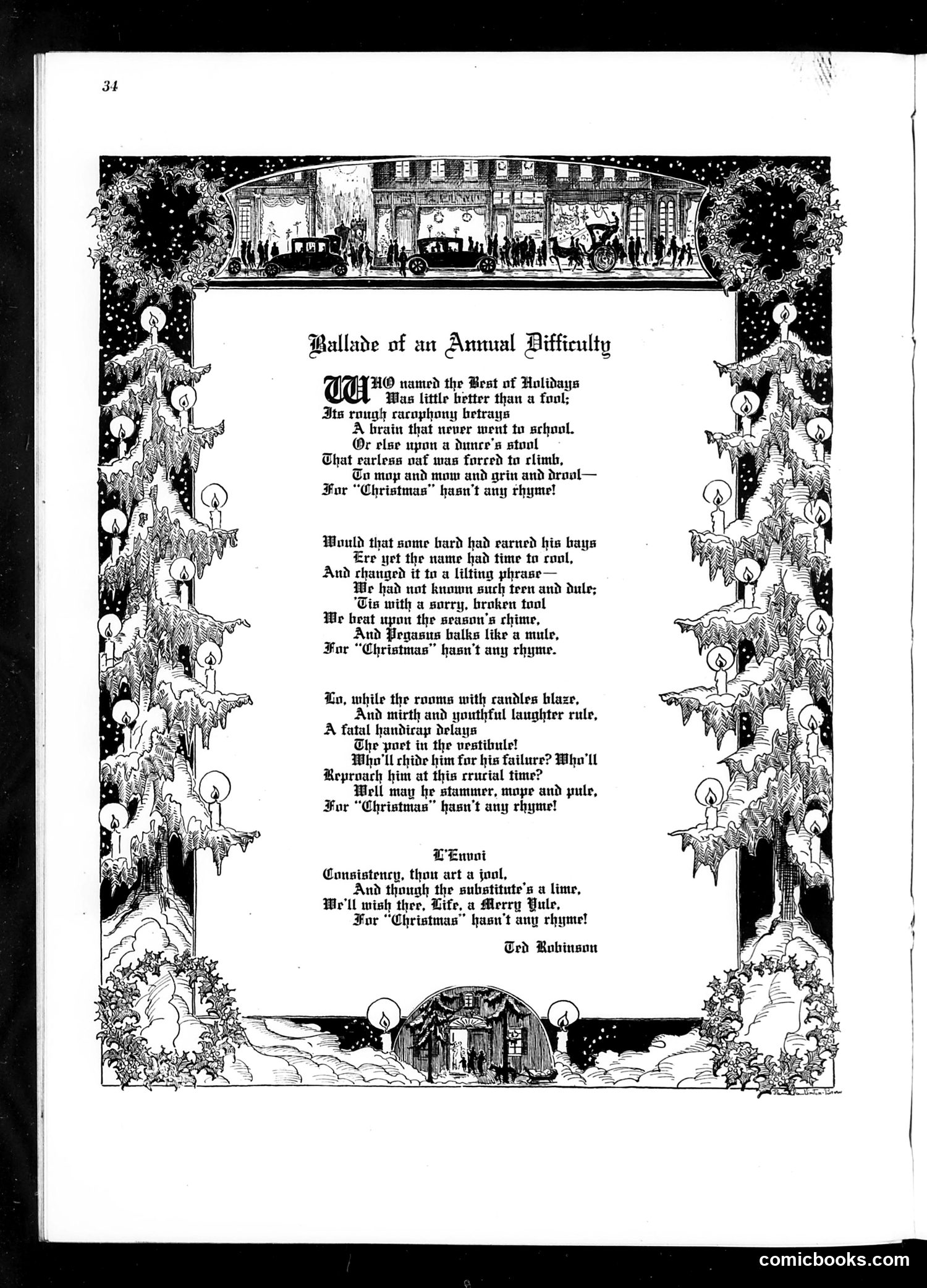
This is a humorous poem by Ted Robinson that satirizes the difficulty of writing Christmas poetry. The "ballad of an annual difficulty" playfully complains that "Christmas" is nearly impossible to rhyme, making the poet's job maddening each December. Robinson personifies the struggle: an incompetent poet forced to produce holiday verses despite lacking talent ("a brain that never went to school"), resorting to awkward forced rhymes and tortured language. He imagines the "fatal handicap" of trying to compose something meaningful when the central word resists rhyming—depicting the poet stammering, moping, and failing. The joke targets the annual tradition of magazine Christmas content: editors demand festive holiday material, but the core word "Christmas" offers limited rhyming options, condemning even willing poets to produce clumsy, strained verse. It's self-aware mockery of *Life* magazine's own seasonal editorial challenges, playfully blaming linguistic constraints rather than writer incompetence for weak holiday doggerel.
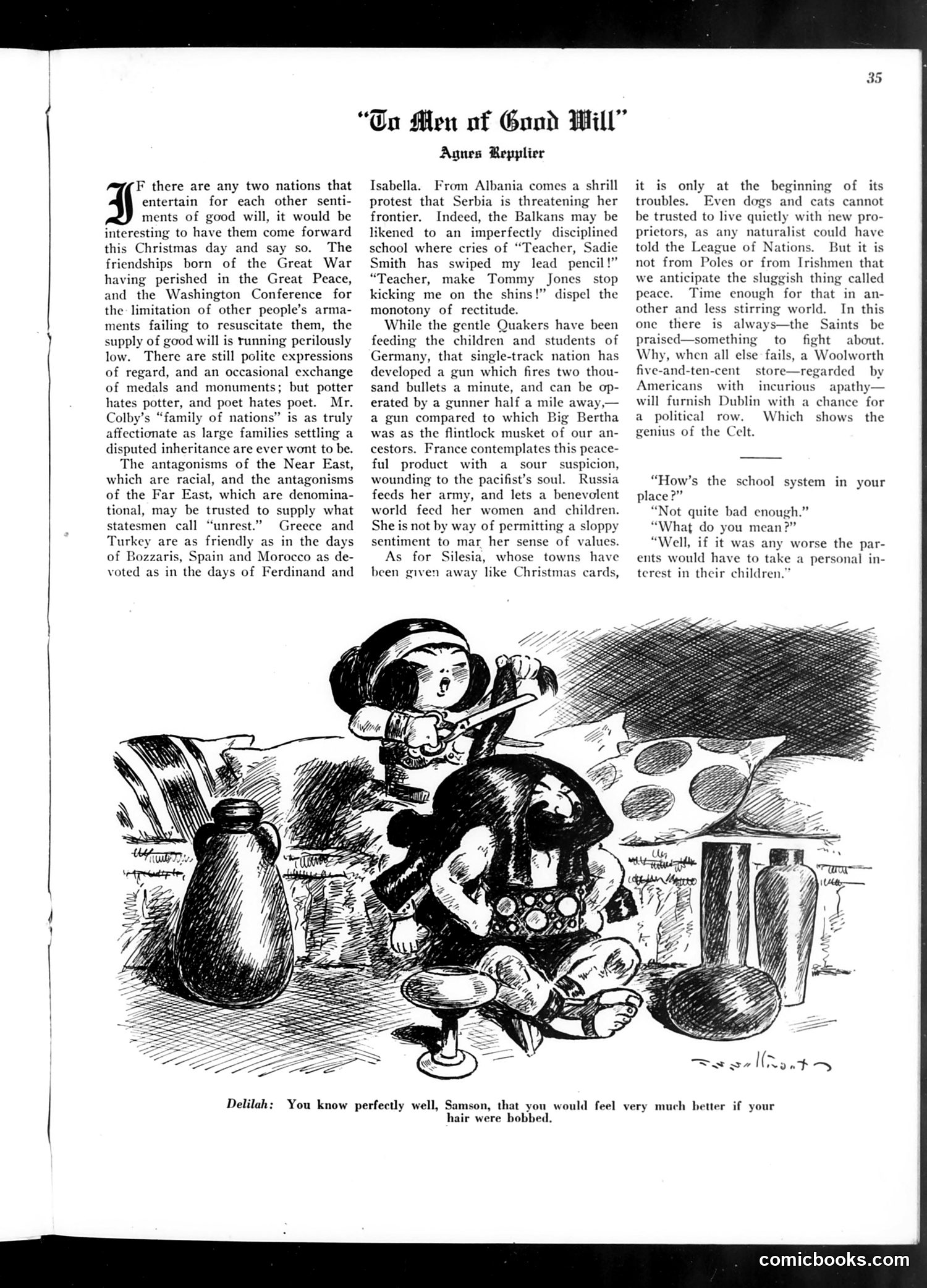
This is Agnes Repplier's satirical essay on post-WWI international relations, accompanied by an unrelated cartoon joke about Samson and Delilah. **The Essay's Context:** Written after WWI and the failed Washington Conference on disarmament, Repplier argues that nations supposedly united by wartime alliance now despise each other. She catalogs specific tensions: Greek-Turkish hostility, Balkan squabbles (depicted as schoolchildren fighting), Germany secretly building advanced weapons despite pacifist hopes, Russia's opportunism, and the unstable partition of Silesia. The tone is darkly comic—she notes that even Quakers feeding German children can't prevent German rearmament, and that ancient rivalries (Ferdinand-Isabella, Spain-Morocco) persist unchanged. **The Cartoon:** Shows Delilah suggesting Samson get a "bob" (1920s short haircut). It's a separate joke about fashion trends of the era, unrelated to the essay's geopolitical pessimism. **The Overall Point:** The essay's title is ironic—despite Christmas appeals to "goodwill," nations remain fundamentally antagonistic, driven by suspicion and self-interest rather than peace.
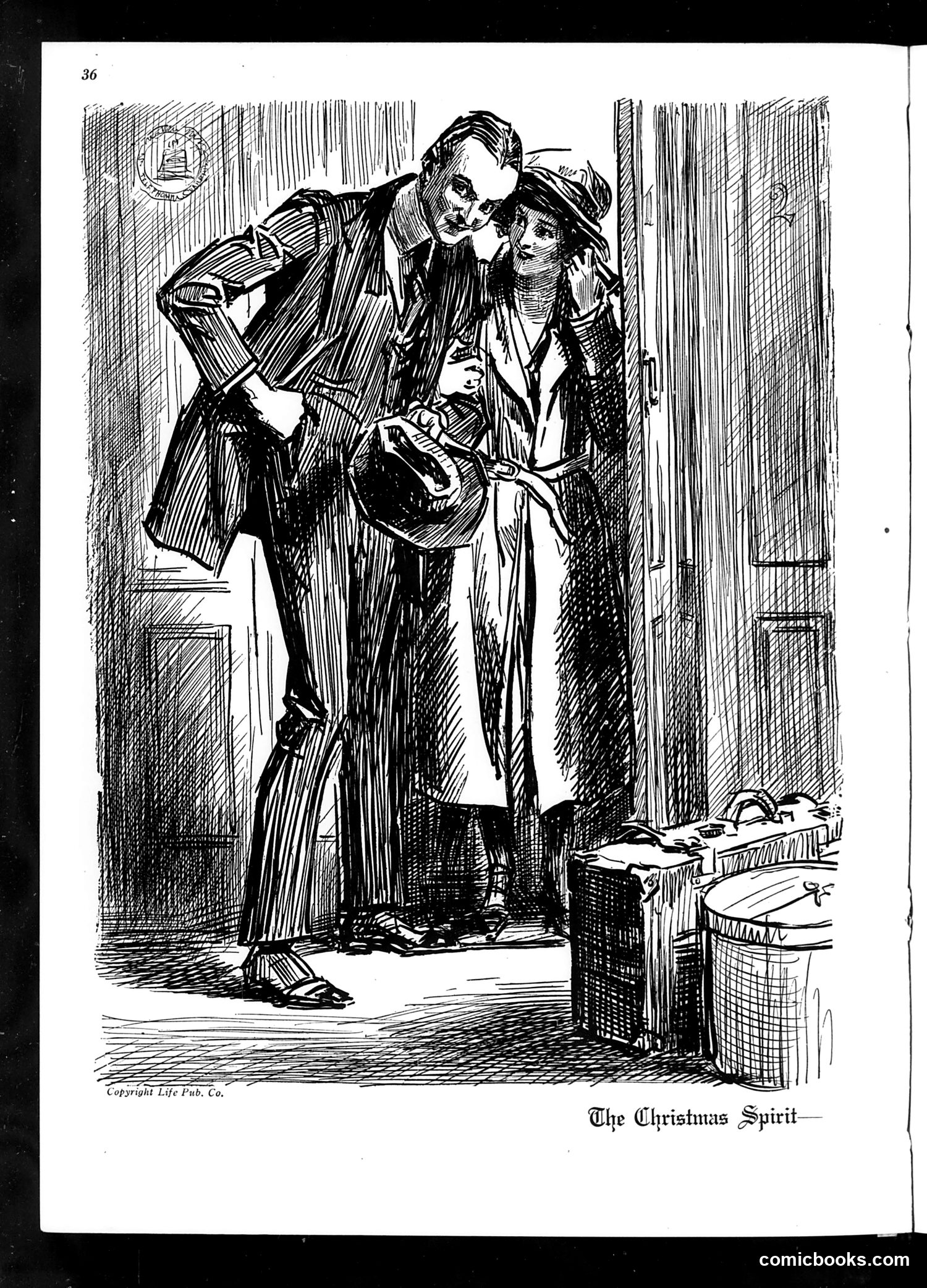
This is a pen-and-ink illustration showing three figures in what appears to be a doorway or entryway. A well-dressed man in a coat and hat stands centrally, with two women beside him—one appears younger, the other older, both wearing hats and coats. They're positioned near luggage and what seems to be household items. The title "The Christmas Spirit" suggests satirical commentary on holiday behavior. Without additional context from the magazine's date or accompanying text, the specific satire is unclear. It likely comments on either family reunions, holiday hospitality, economic conditions affecting holiday visits, or social class dynamics during the Christmas season. The careful dress of the figures and their luggage suggest travel or arrival/departure during the holidays.
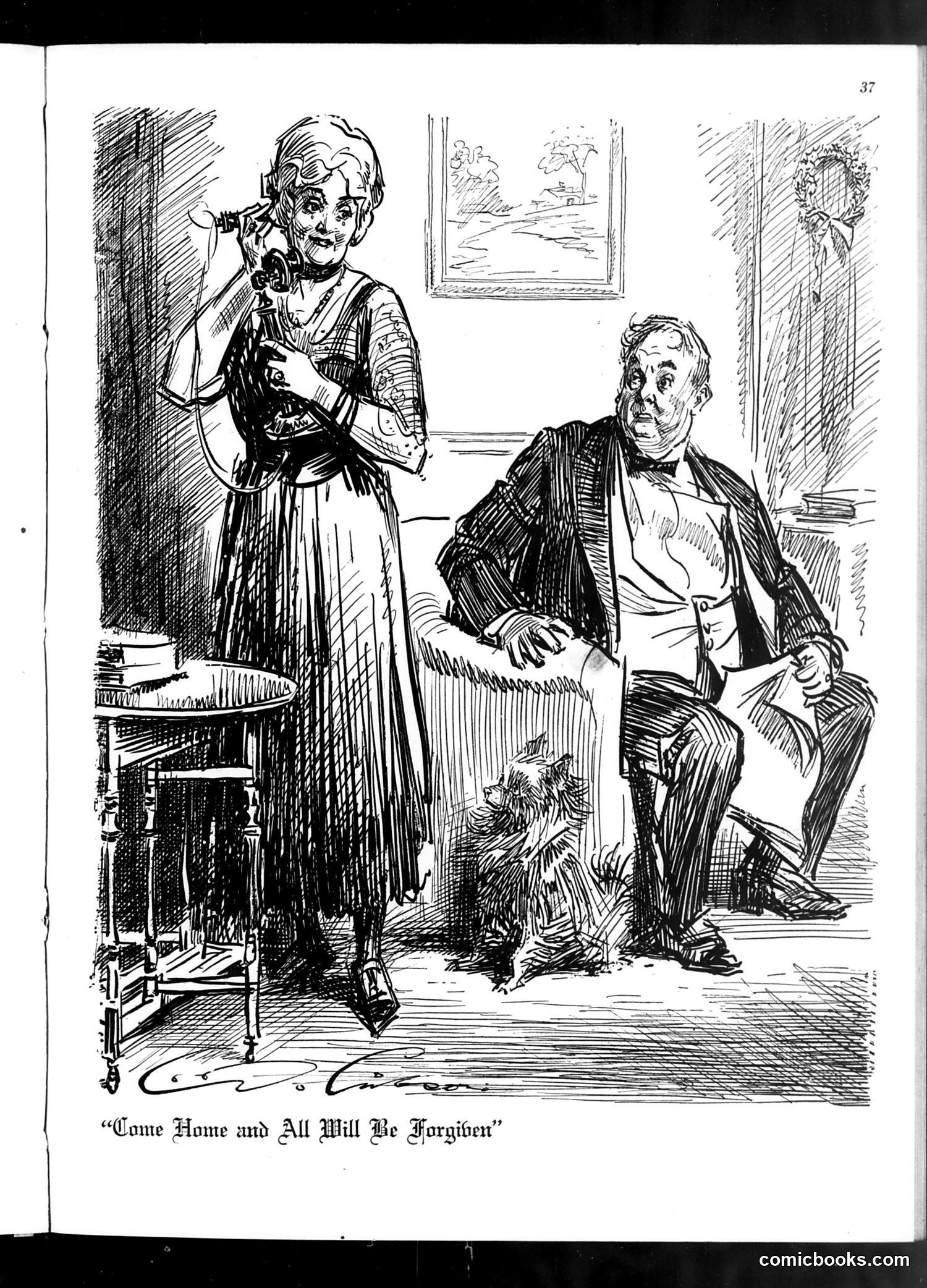
This single-panel cartoon shows a woman on a telephone speaking to a seated man, with a small dog nearby. The caption reads "Come Home and All Will Be Forgiven." The satire appears to target marital reconciliation, likely referencing a domestic dispute. The woman's pleading phone call and the man's skeptical expression suggest a common trope: a wife coaxing an estranged husband back home after a quarrel. The small dog's presence adds domestic sentimentality to the appeal. Without additional context or identifiable caricatured figures, this appears to be a general commentary on marriage dynamics and domestic relations—a frequently satirized subject in early-to-mid 20th century Life magazine. The humor lies in the familiar scenario of attempted reconciliation through maternal/wifely persuasion.
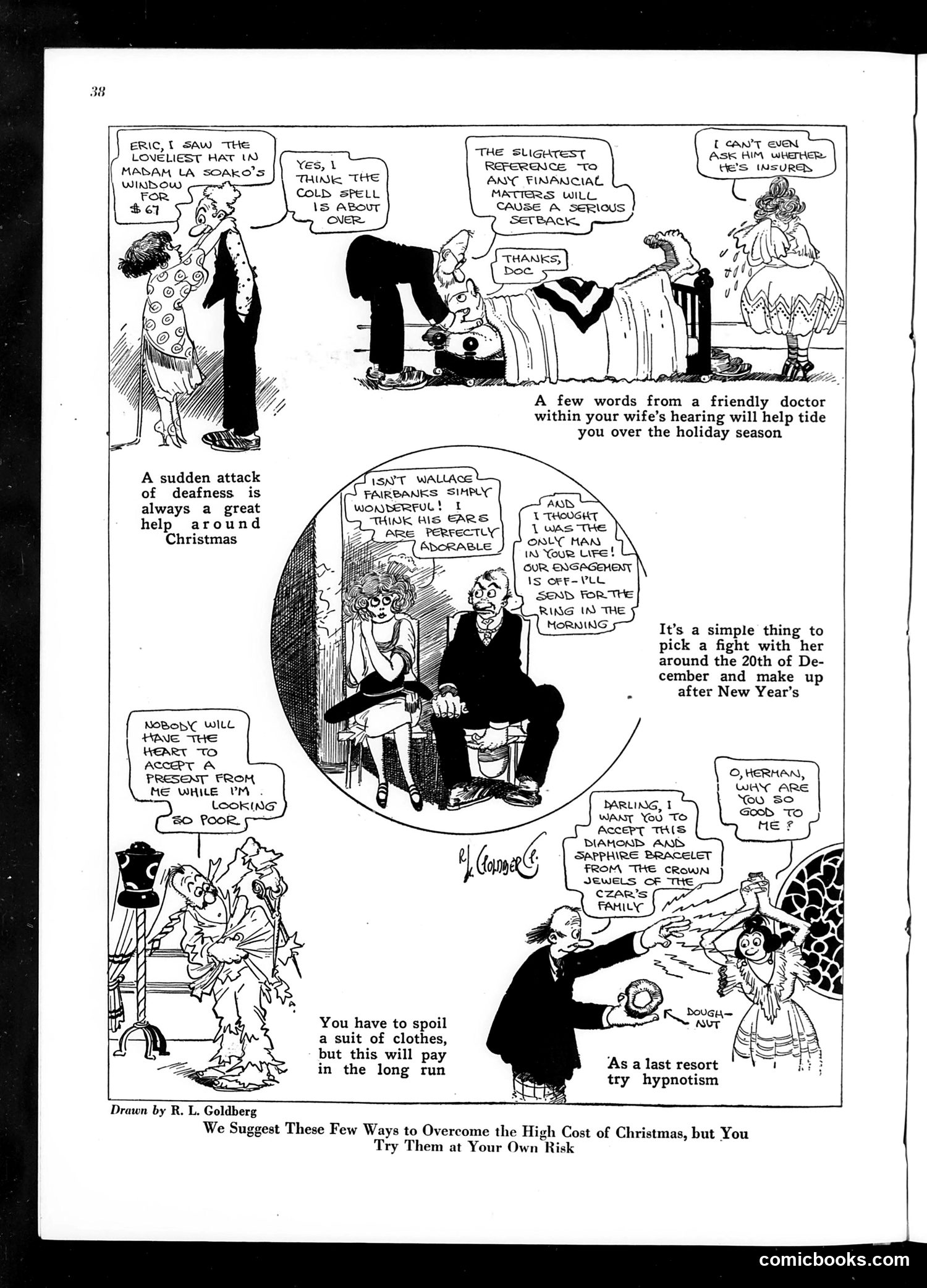
This is a satirical humor page from *Life* magazine offering tongue-in-cheek "solutions" to Christmas spending problems during what appears to be an economically tight period (likely 1920s-1930s based on style). The cartoon presents six absurd strategies for managing holiday expenses: 1. **Feigned deafness** — pretending not to hear about expensive gifts 2. **Doctor's intervention** — having a physician tell your wife to avoid financial discussions 3. **Strategic conflict** — deliberately quarreling around December 20th to justify minimal gift-giving, then reconciling after New Year's 4. **Accepting expensive gifts** — letting others buy you costly items instead 5. **Ruining clothing** — destroying clothes to justify buying replacements as "gifts" 6. **Hypnosis** — implied mind control to avoid spending The humor relies on depicting husbands as scheming to dodge Christmas expenses through deception and manipulation of their wives. The satire targets both marital dynamics and economic anxiety about holiday costs. The byline credits R.L. Goldberg as the artist (likely Rube Goldberg).
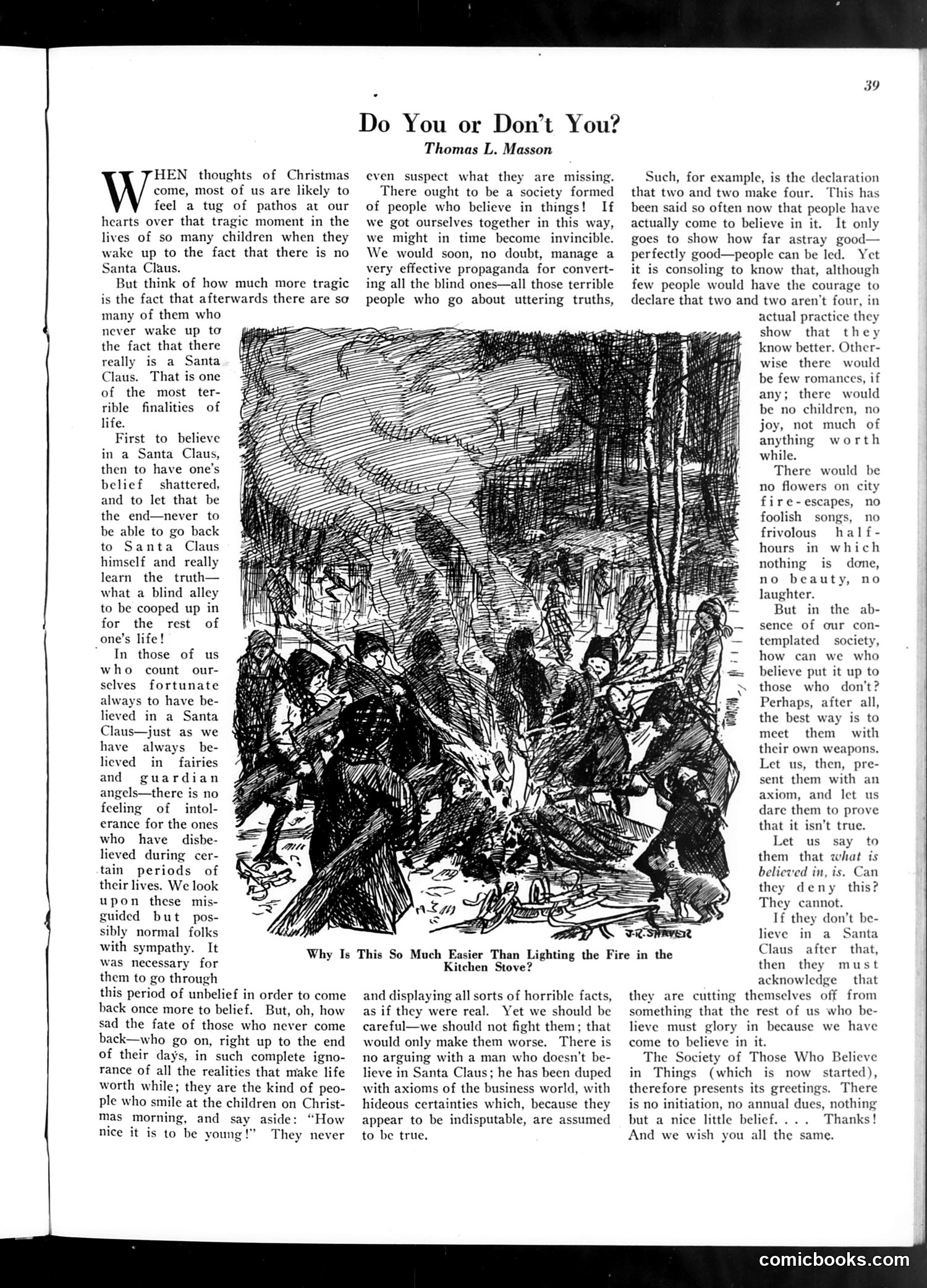
This humorous essay uses Santa Claus as a metaphor for maintaining wonder and belief in life's intangibles. The accompanying sketch depicts a cheerful Christmas gathering, contrasting with Mason's satirical argument. The piece mocks hardheaded rationalists and cynics—those who dismiss Santa, fairy tales, and romantic notions as childish delusions. Mason proposes forming "The Society of Those Who Believe in Things" to combat literal-minded people who traffic in cold facts and mathematical certainties (like "two and two make four"). The satire targets early 20th-century materialism and scientism: the belief that only provable, rational facts matter. Mason argues such thinking kills joy, romance, children, flowers on fire escapes, and beauty itself. He suggests meeting skeptics with their own logical weapons—presenting belief itself as an unprovable axiom they cannot refute. The cartoon's cozy domestic scene embodies the warmth Mason celebrates, while his argument defends imaginative faith against utilitarian cynicism.
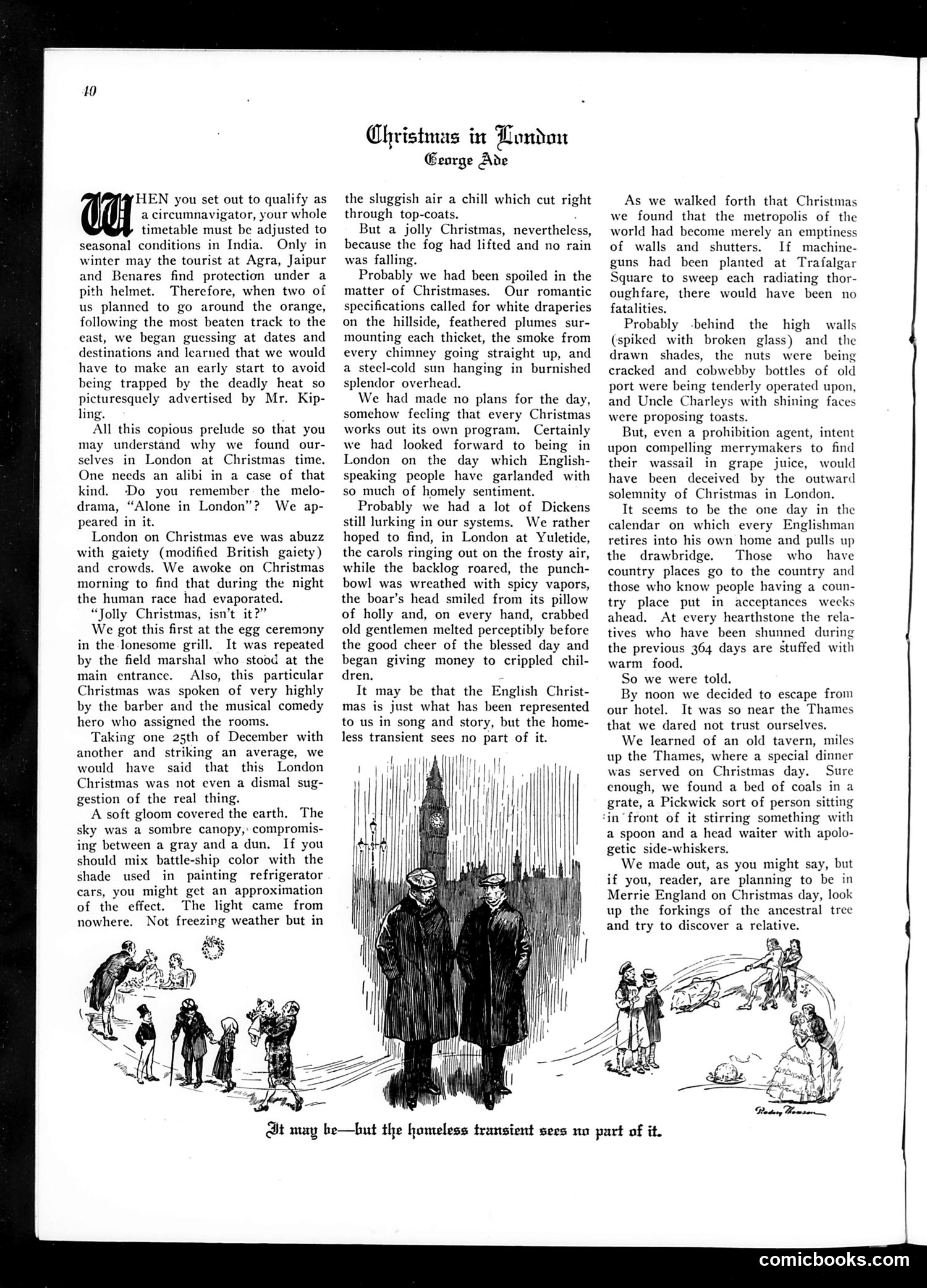
This is a travel essay with satirical illustrations about experiencing Christmas in London. Author Ade describes how two travelers, forced to spend the holiday in London due to scheduling demands of touring India, expected the romanticized Dickensian Christmas—caroling, festive gatherings, generous nobles—but found instead a dreary, empty city. The central satire contrasts the *idealized* Christmas of literature and sentiment with the *actual* experience: gray, cold, cheerless streets with shuttered buildings. More pointedly, Ade observes that while wealthy Londoners celebrate behind their walls, "the homeless transient sees no part of it." The illustrations show contrasts: families enjoying Christmas versus solitary figures in the desolate city. The caption—"It may be—but the homeless transient sees no part of it"—makes the social critique explicit: Christmas plenty exists only for the housed and prosperous. This is gentle but pointed social commentary on class inequality during the holiday season.
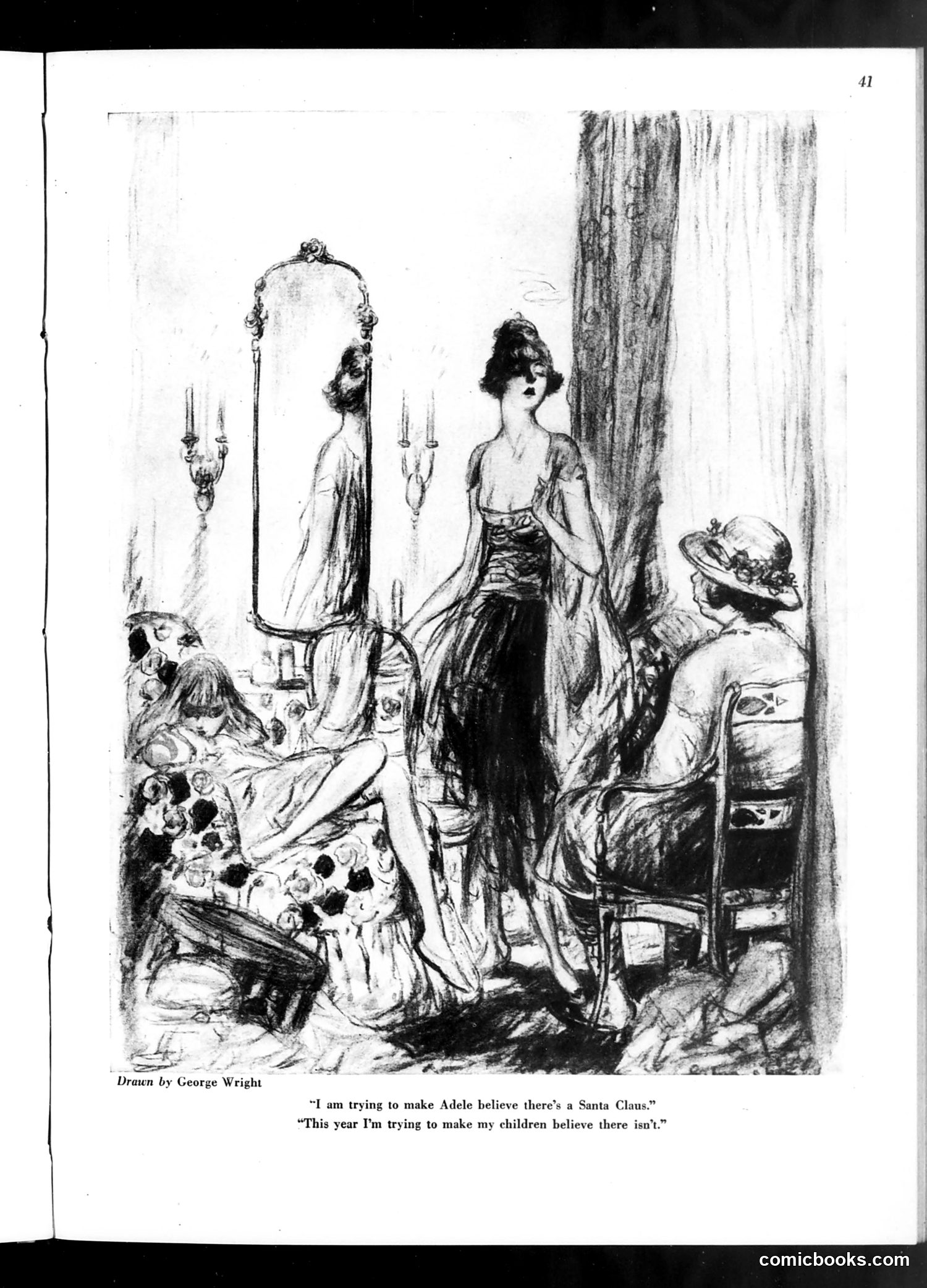
This cartoon by George Wright satirizes contrasting parental philosophies about Santa Claus. A well-dressed woman (likely representing upper-class society) explains she's *encouraging* her child Adele to believe in Santa, while a man in military uniform counters that he's doing the opposite—trying to *disillusion* his children of the myth. The joke hinges on class and generational attitudes: the woman's approach suggests preserving childhood innocence through fantasy, while the uniformed man's pragmatic stance implies a more hardened, realistic worldview—possibly reflecting post-war or early 20th-century attitudes about toughening children through truth rather than comfort. The opposing strategies highlight social commentary about parenting styles and cultural values of the era.
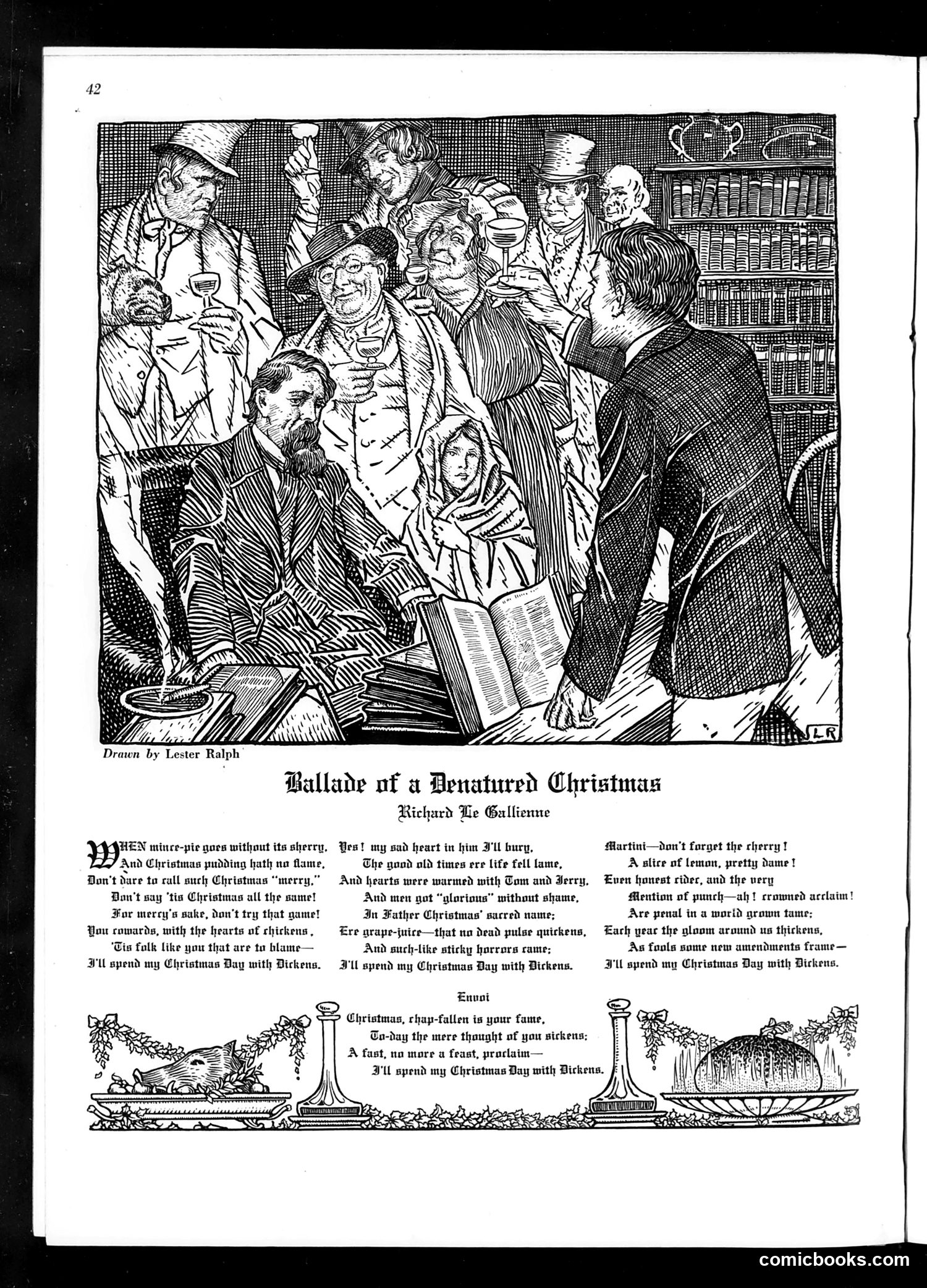
This 1920s satirical poem by Richard De Gallienne, illustrated by Lester Ralph, mourns the loss of traditional Christmas indulgences due to **Prohibition** (alcohol ban, 1920-1933). The cartoon depicts a gathering of disappointed revelers in a library, holding empty glasses. The satire targets how Christmas celebrations have been "denatured"—stripped of their festive character—by legal restrictions on alcohol. Traditional Christmas drinks (sherry with mince pie, flaming pudding, Tom and Jerry, cider, punch) are now forbidden. The poem mockingly suggests alternatives like "Martini" (grape-juice) and warns against calling such a joyless holiday "merry." The repeated refrain ironically proposes spending Christmas with Dickens instead—a literary substitute for actual celebration. The joke: Prohibition has made Christmas itself a fraud, replacing genuine merrymaking with prohibition-compliant tedium. The "denatured" Christmas reflects Americans' bitter resistance to what many viewed as government overreach.
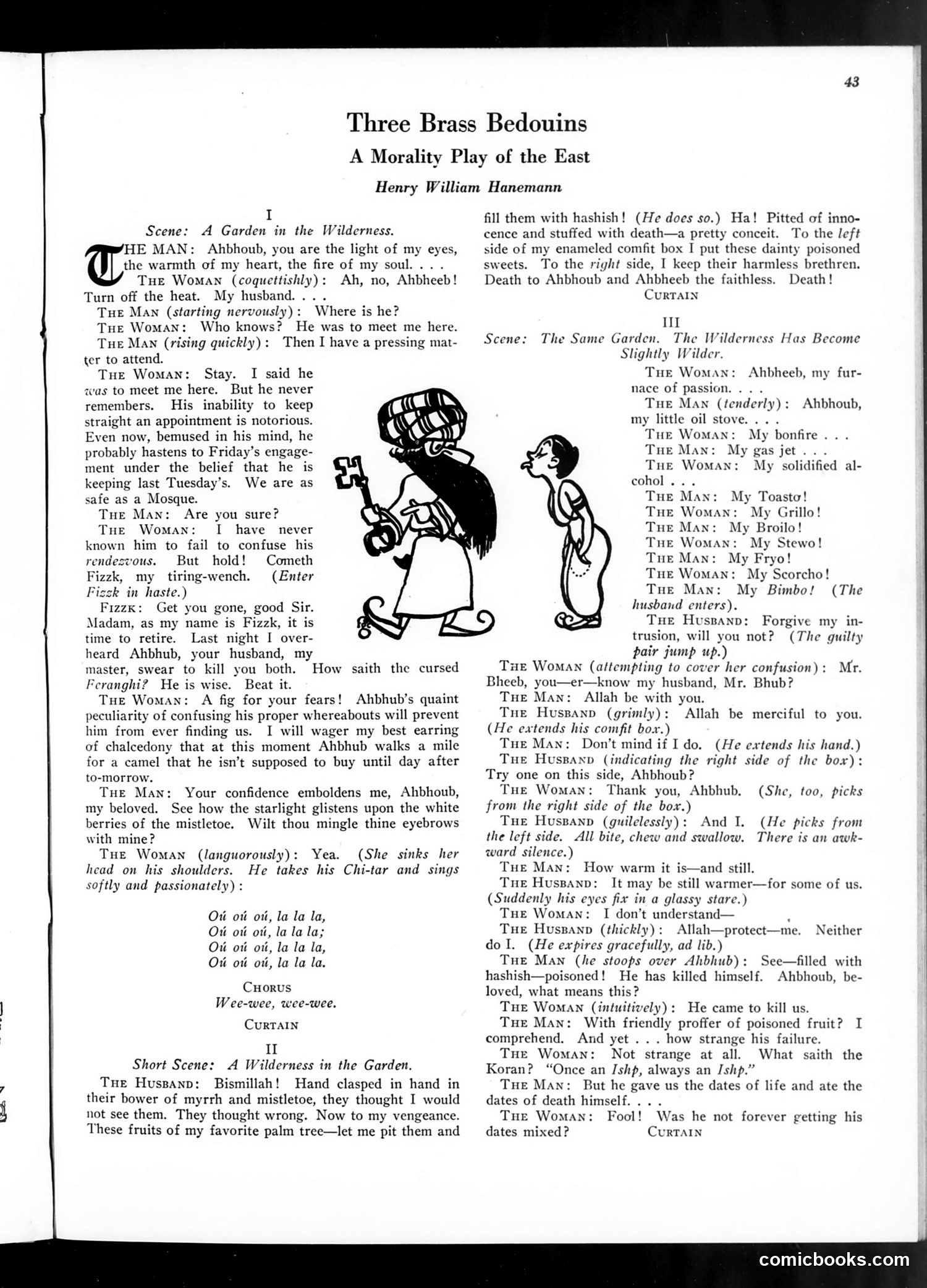
This is a comedic theatrical piece by Henry William Hanemann, presented as a mock-Eastern drama. The narrative follows a conventional adultery plot set in an exotic "wilderness" setting, complete with stock characters: the Man, the Woman, her absent-minded Husband, and a servant (Fizzk). The satire targets Victorian melodrama and orientalist entertainment popular in early 20th-century American periodicals. The humor derives from absurdist complications: the Husband attempts to poison both adulterers using poisoned dates, but through farcical confusion, he accidentally consumes the poison himself and dies. The "morality play" structure is ironic—rather than punishing the unfaithful couple, divine justice (or comic chance) eliminates the wronged husband, subverting audience expectations. The exaggerated dialogue, musical interludes, and cartoon illustrations underscore the piece's theatrical parody of orientalist fantasies and melodramatic conventions that Life magazine's readers would recognize.
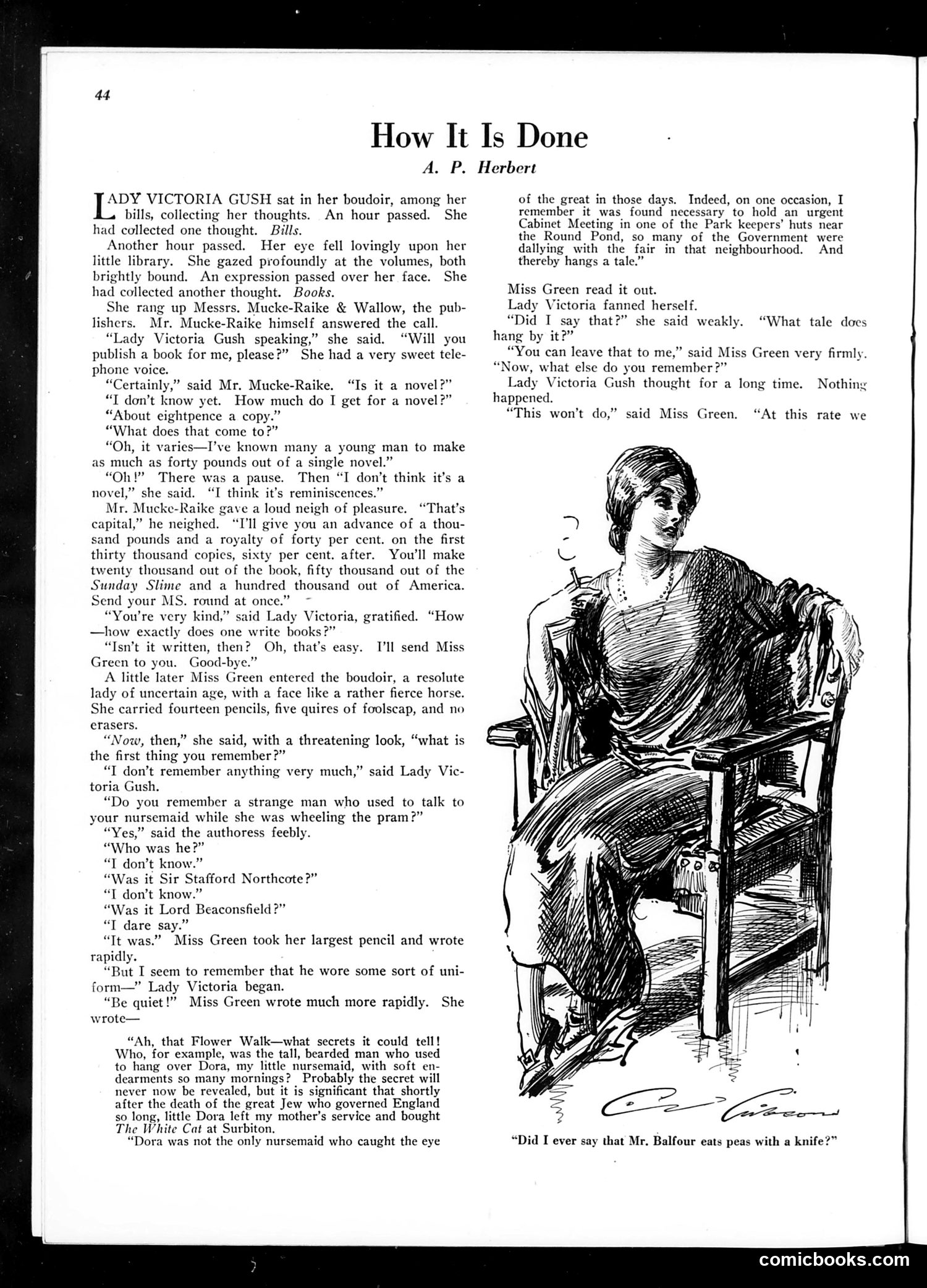
This satirical story mocks the publishing industry's enthusiasm for aristocratic memoirs, however mundane or fabricated. Lady Victoria Gush, a wealthy but intellectually empty noblewoman, decides to write a book solely for profit. A publisher offers vastly better terms for "reminiscences" (£1,000 advance) than novels (eightpence per copy)—revealing how publishers valued celebrity gossip over literary merit. The joke deepens when Miss Green, a professional ghostwriter, actively *invents* the memoir's contents, including fabricated encounters with famous historical figures (Disraeli, Lord Beaconsfield) and scandalous anecdotes about government officials. Lady Victoria doesn't even remember saying these things, yet Miss Green publishes them anyway. The satire targets early-20th-century publishing's willingness to profit from sensationalized, likely false aristocratic gossip—and society's appetite for it. The caption's final joke suggests even basic social etiquette details become publishable scandal.
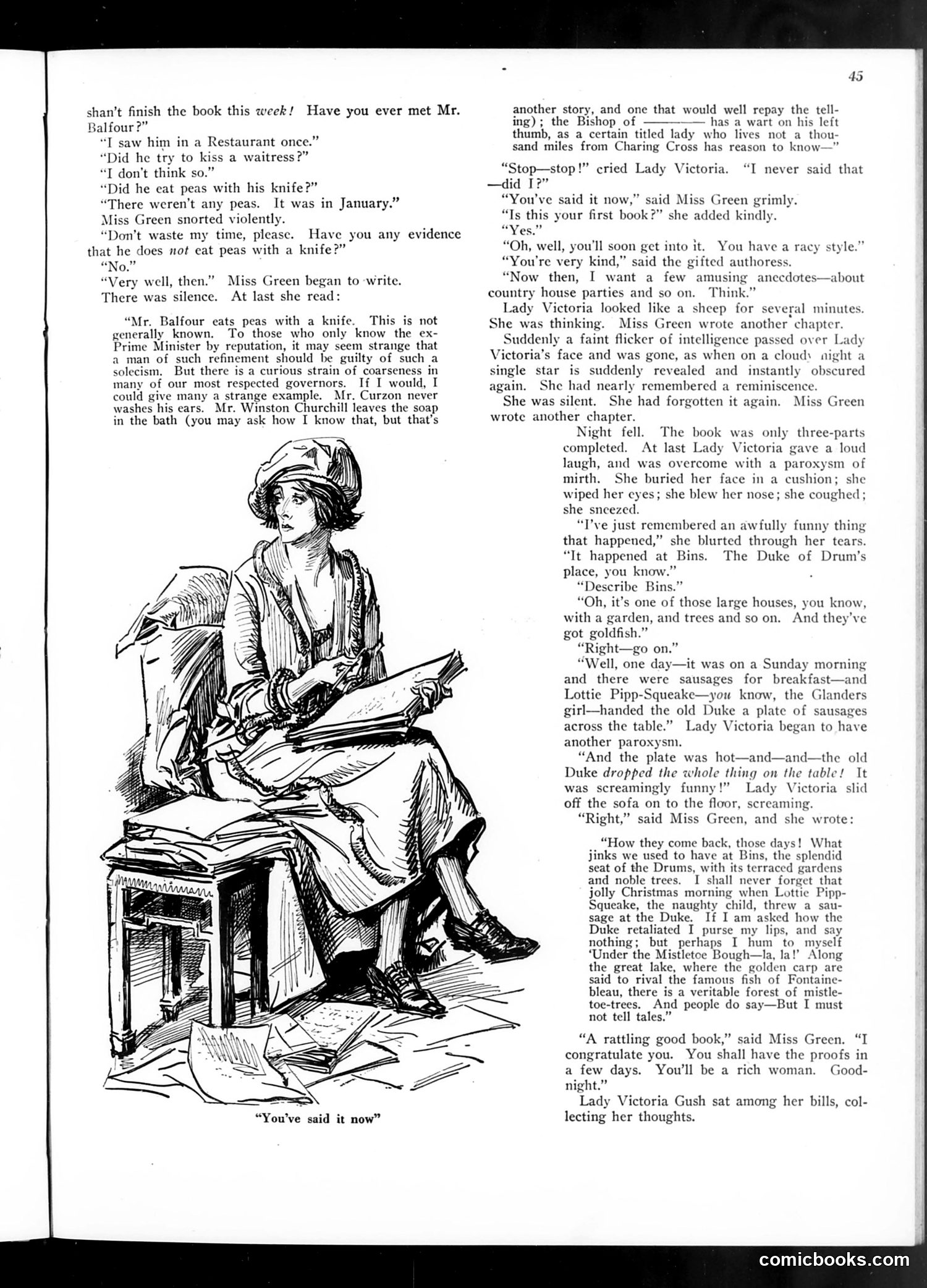
This page satirizes the literary pretensions and vapidity of aristocratic women writing memoirs. Lady Victoria Gush, a titled but intellectually vacant aristocrat, hires Miss Green to ghostwrite her book. The satire targets multiple absurdities: **The Joke:** Miss Green invents scandalous "facts" about prominent political figures (ex-Prime Minister Balfour, Curzon, Winston Churchill, the Bishop) based on zero evidence—simply because Lady Victoria cannot provide contradictions. Lady Victoria then contributes an anecdote so trivial (a dropped plate of sausages) that Miss Green inflates it into flowery, pretentious prose about "jolly Christmas mornings." **The Point:** The cartoon mocks both the empty-headedness of society women and the dishonesty of ghostwriters who fabricate gossip and scandal for profitable "society memoirs." It's satire on fraudulent autobiography and the gullibility of readers who consume such books as truth.
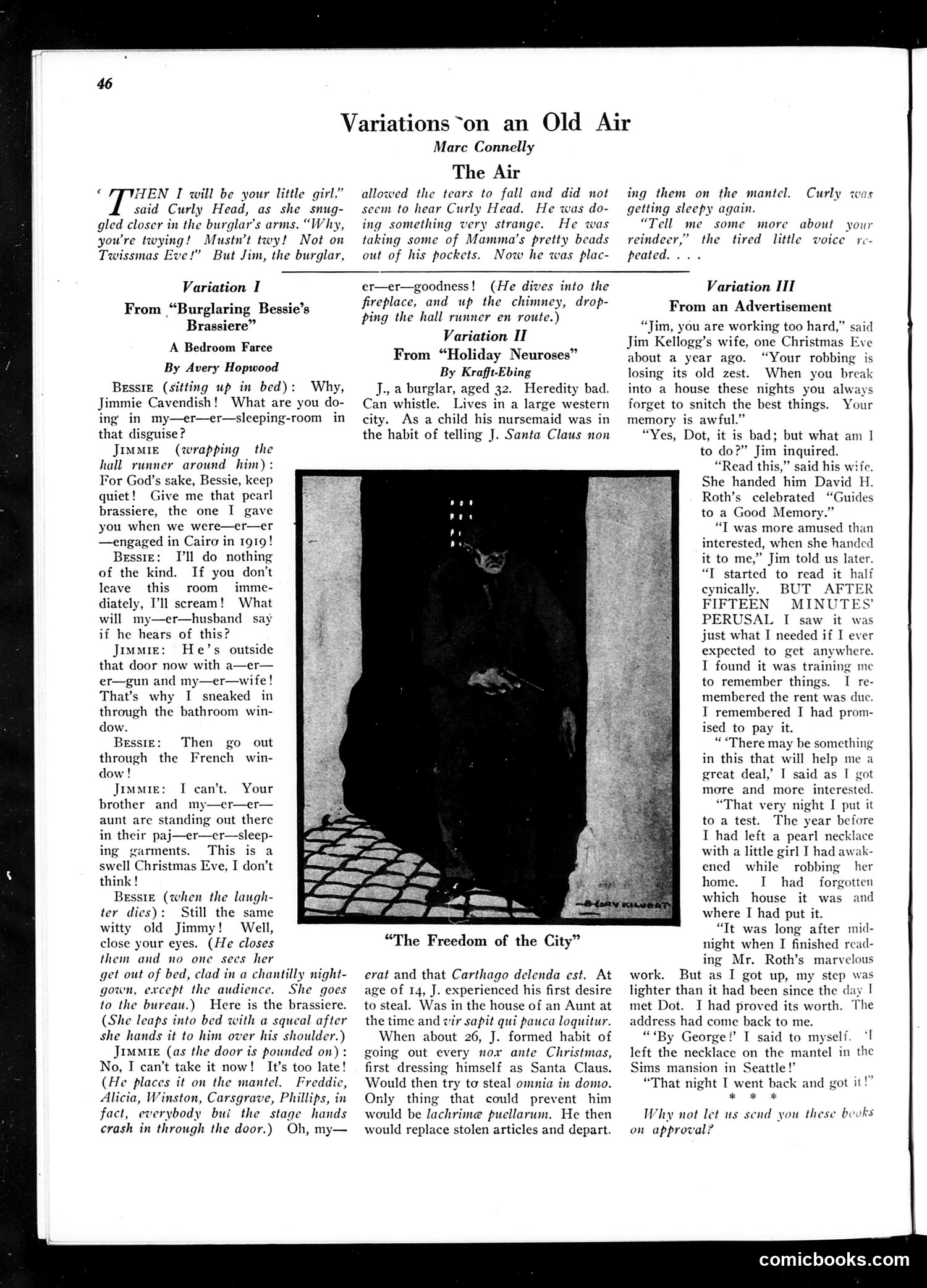
This page from *Life* magazine presents three satirical parodies of a sentimental Christmas story about a burglar who returns stolen items upon seeing a child's innocence. **The three variations mock different literary genres:** 1. **"Burglaring Bessie's Brassiere"** (by Avery Hopwood) parodies bedroom farces—drawing-room comedies popular in early 20th-century theater—by adding absurdist complications (multiple armed relatives, pajama-clad relatives outside). 2. **"Holiday Neuroses"** (credited to Krafft-Ebing, referencing the famous sexologist) parodies psychological case studies, presenting the burglar's compulsion in pseudo-clinical Latin, mocking the era's amateur psychoanalysis craze. 3. **"From an Advertisement"** parodies self-help advertising by having the burglar discover a memory-improvement book that ironically reminds him to pay his rent—deflating both the original sentiment and commercialized wellness culture. The satire targets sentimental Christmas narratives and period literary/advertising conventions simultaneously.
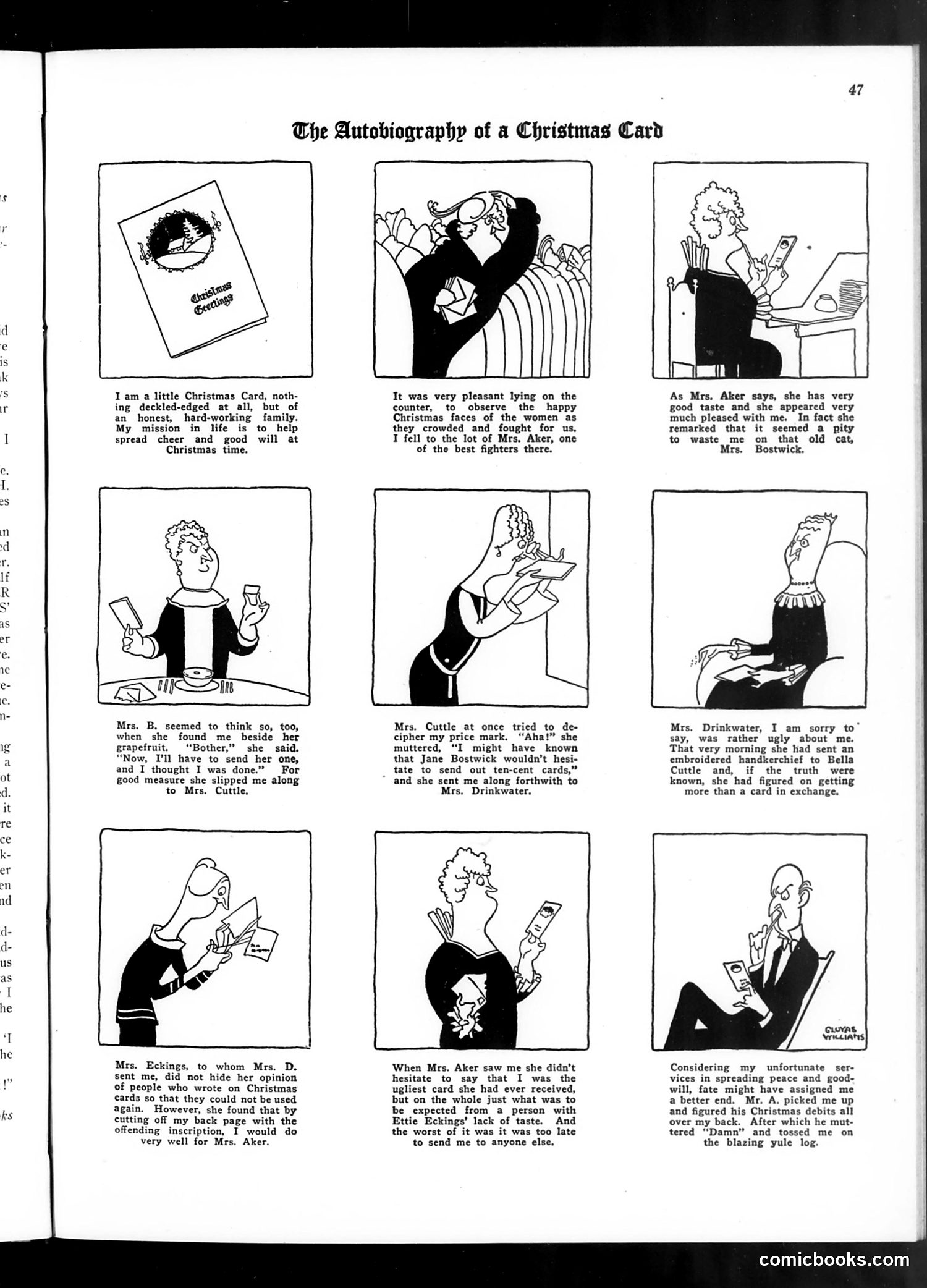
This satirical comic strip personifies a Christmas card, following its journey through several women's hands. The joke exposes the hypocrisy and cheapness lurking beneath Christmas's veneer of goodwill. The card gets passed along between acquaintances—each woman regifting it or reusing it to avoid buying new cards. Mrs. Eckings cuts off the previous inscription so she can reuse it. Mrs. Drinkwater is upset because she'd sent a nicer gift (an embroidered handkerchief) expecting reciprocal generosity but received only a cheap, secondhand card. The final irony: Mr. A. (presumably a husband) uses the card's back to calculate his Christmas expenses, then tosses it into the fireplace. The satire mocks the gap between Christmas's professed message of spreading "cheer and good will" and the actual behavior—penny-pinching, resentment, and transactional gift-giving among supposedly genteel women. It's a cynical take on commercialized holiday observance.
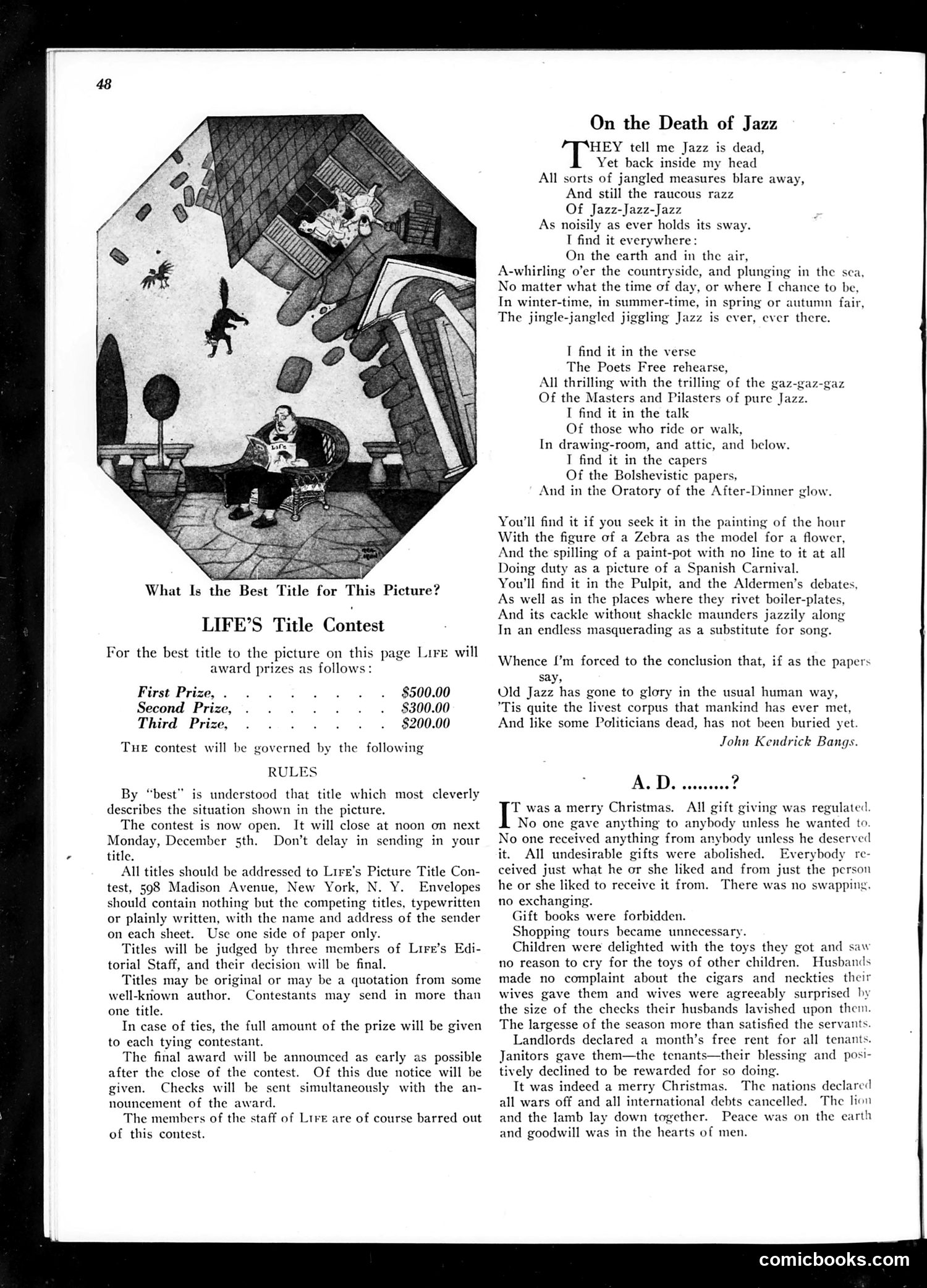
This page contains two distinct pieces: **Left side:** A "Picture Title Contest" from Life magazine (deadline December 5th, offering $500 first prize). The octagonal illustration shows an interior scene with figures in various poses—apparently depicting urban life or domestic chaos. Without seeing the full image clearly, the exact satirical subject is unclear, though the contest invites readers to propose witty captions. **Right side:** Two prose pieces. "On the Death of Jazz" is a poem by John Kendrick Bangs arguing that despite reports jazz is dead, it persists everywhere—in poetry, politics, modernist art (zebra paintings, paint-pot pictures suggesting Cubism/Dada), pulpits, and even boiler factories. The satire mocks both jazz critics and the art world's pretensions. Below that, "A.D. ........?" is a brief utopian sketch imagining a perfectly regulated Christmas where gift-giving follows strict moral rules—no unwanted gifts, no exchanges, perfectly matched presents. The satire gently ridicules both excessive consumerism and idealized social planning.
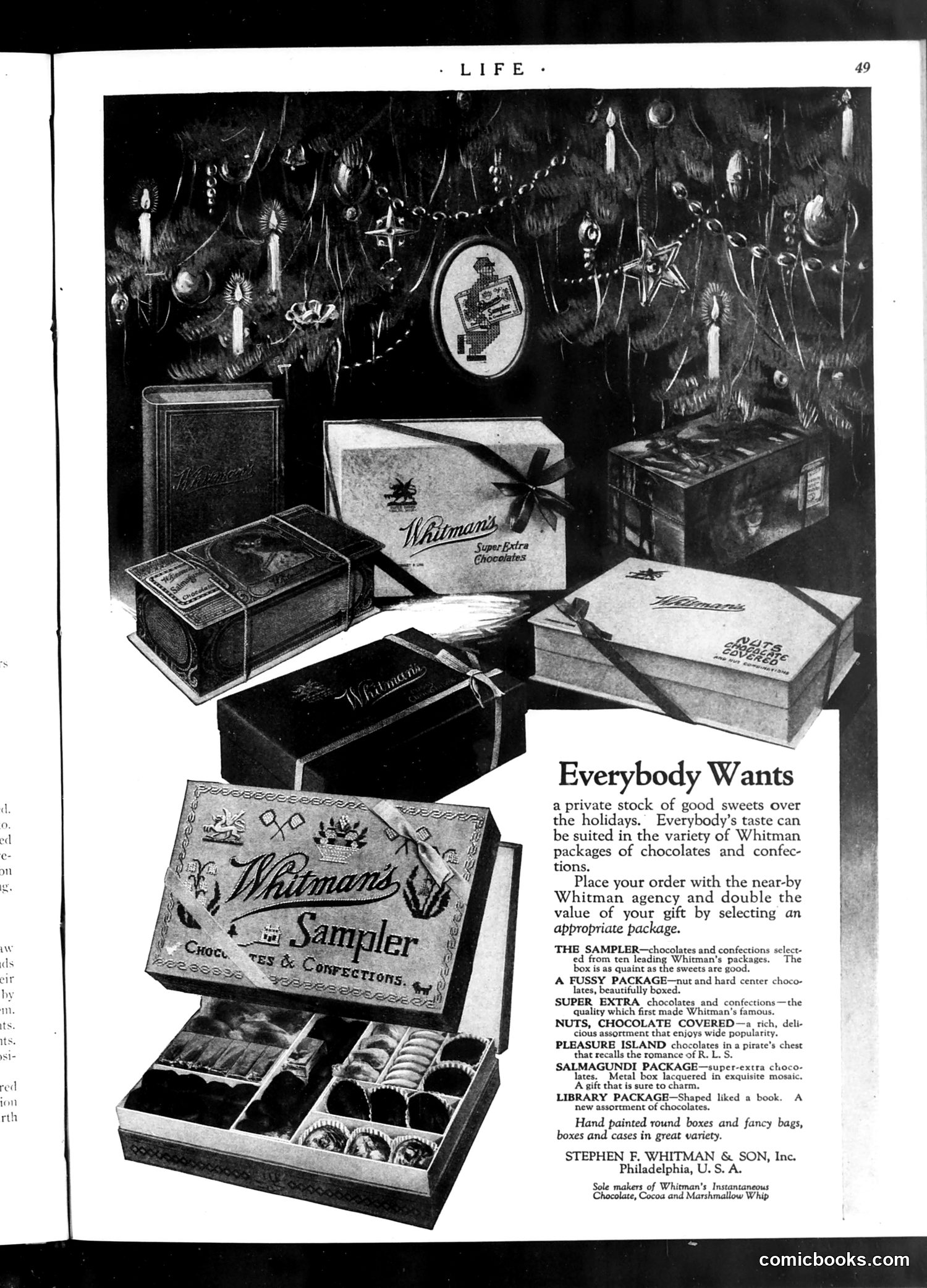
This is a **Whitman's chocolate advertisement**, not a political cartoon. The page promotes various holiday chocolate gift packages from Stephen F. Whitman & Son, a Philadelphia confectioner. The image shows decorated boxes arranged under festive holiday decorations (garland, ornaments, candles). The ad describes multiple package options—"The Sampler," "Fussy Package," "Super Extra," "Pleasure Island" (in a pirate's chest, referencing Robert Louis Stevenson), and "Library Package" (shaped like a book)—each designed to appeal to different tastes and occasions. For modern readers: this represents early 20th-century marketing strategy, emphasizing gift-giving and consumer choice during holidays. The decorative presentation and product variety reflect period advertising that positioned chocolate as an aspirational luxury gift. The whimsical packaging names ("Pleasure Island," "Library") suggest attempts to make confections feel special and themed.
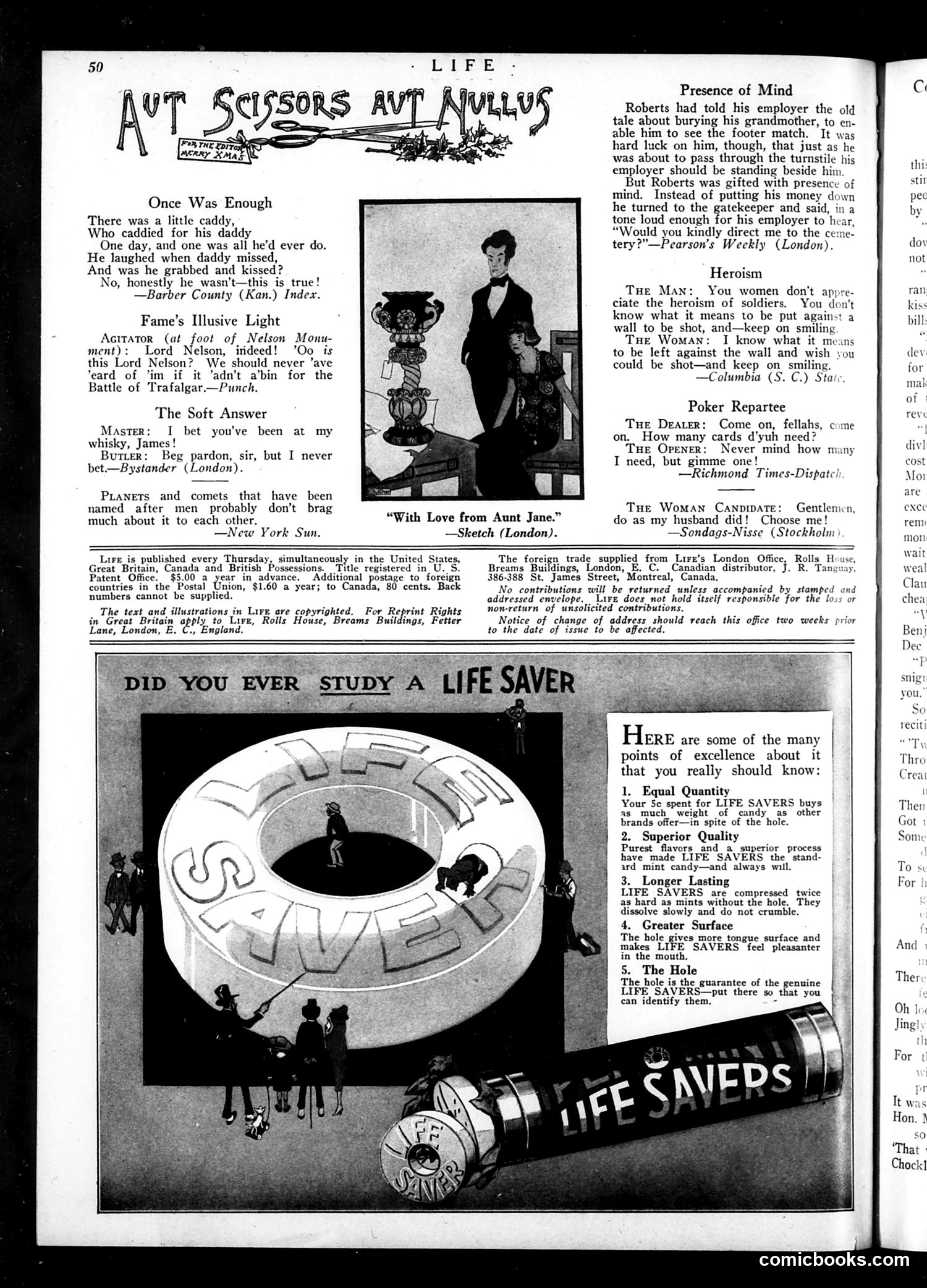
This page contains several brief satirical items typical of Life's humor format, plus a large advertisement for Life Savers candy. **The cartoons and jokes** mock everyday social situations: a caddy who laughs at his father's golf mishit (and surprisingly *isn't* punished), a working-class person crediting Nelson's fame solely to a battle rather than his character, a butler's clever non-answer to accusation of drinking whisky, and a woman's sharp rejoinder about soldiers' "heroism" of facing death—suggesting wives endure equal psychological torment in domestic life. The most substantial cartoon shows a man encountering his employer at a football match after lying about attending his grandmother's funeral. Rather than admit the deception, he quickly asks directions to the cemetery loud enough for the employer to overhear, turning the lie into apparent truth through quick thinking. **The Life Savers advertisement** occupies the lower half, emphasizing the candy's superiority through five product features, particularly highlighting the distinctive hole as a mark of authenticity. The page reflects early 20th-century British and American humor sensibilities—class consciousness, marital dynamics, and consumer brand loyalty.
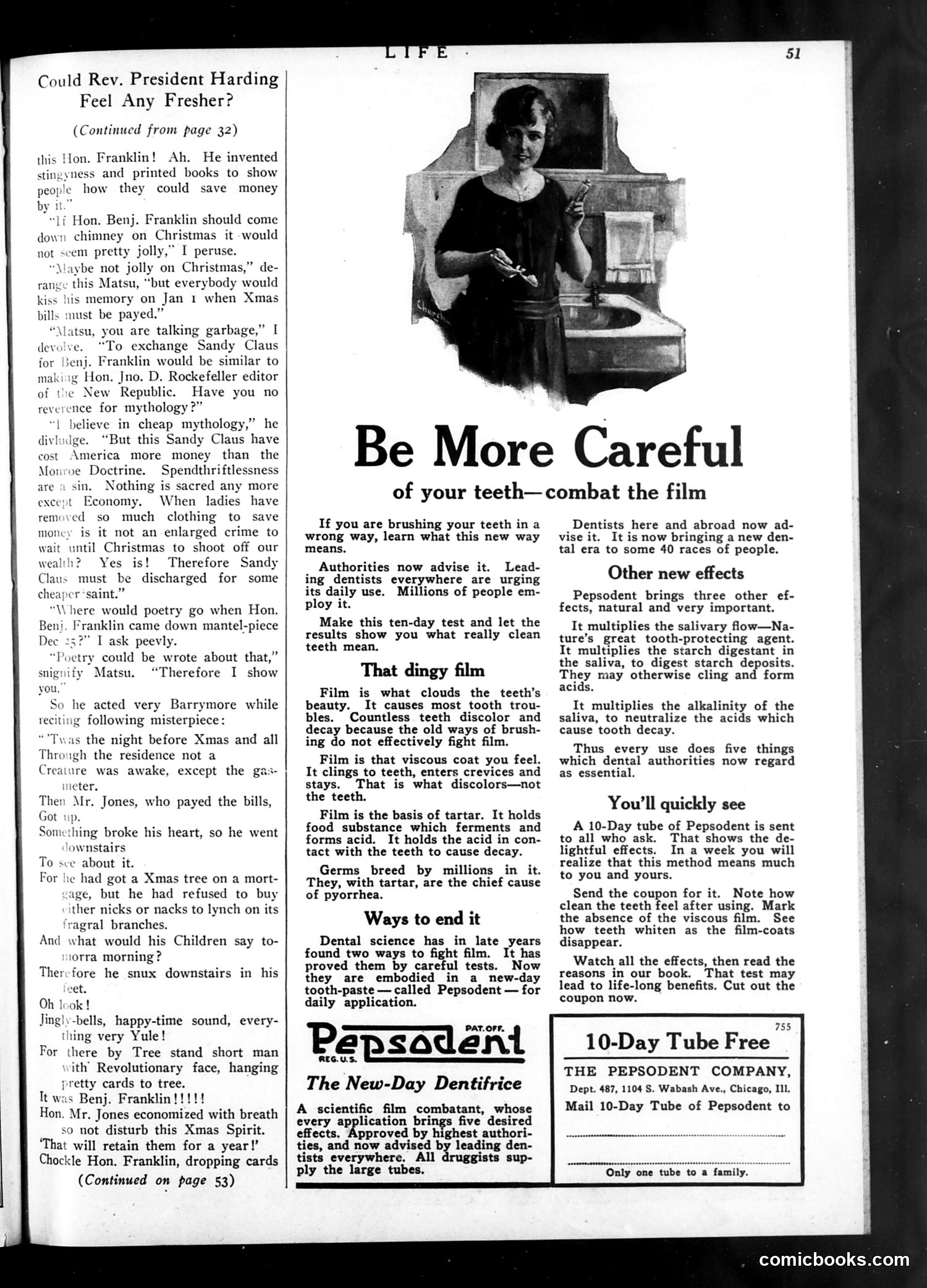
**The Cartoon/Story:** The left column continues a satirical narrative mocking frugality during the post-WWI era. Characters debate whether to replace Santa Claus with Benjamin Franklin as a symbol—Franklin supposedly embodying American thriftiness better than the expensive holiday tradition. The satire ridicules extreme economy: one character argues Santa costs America more than the Monroe Doctrine. A comedic poem follows about "Mr. Jones" who mortgages a Christmas tree but refuses to buy decorations, illustrating the absurdity of misplaced penny-pinching. **The Advertisement:** The right side is a Pepsodent toothpaste advertisement claiming to combat "film" (plaque) on teeth. It promises scientific benefits and appeals to dental authority, offering a free 10-day sample. This represents early 20th-century marketing's use of pseudo-scientific language and professional endorsement to sell consumer products. **Context:** The satire reflects 1920s anxiety about postwar economics and changing values, while the ad exemplifies the era's emerging consumer culture and advertising techniques.
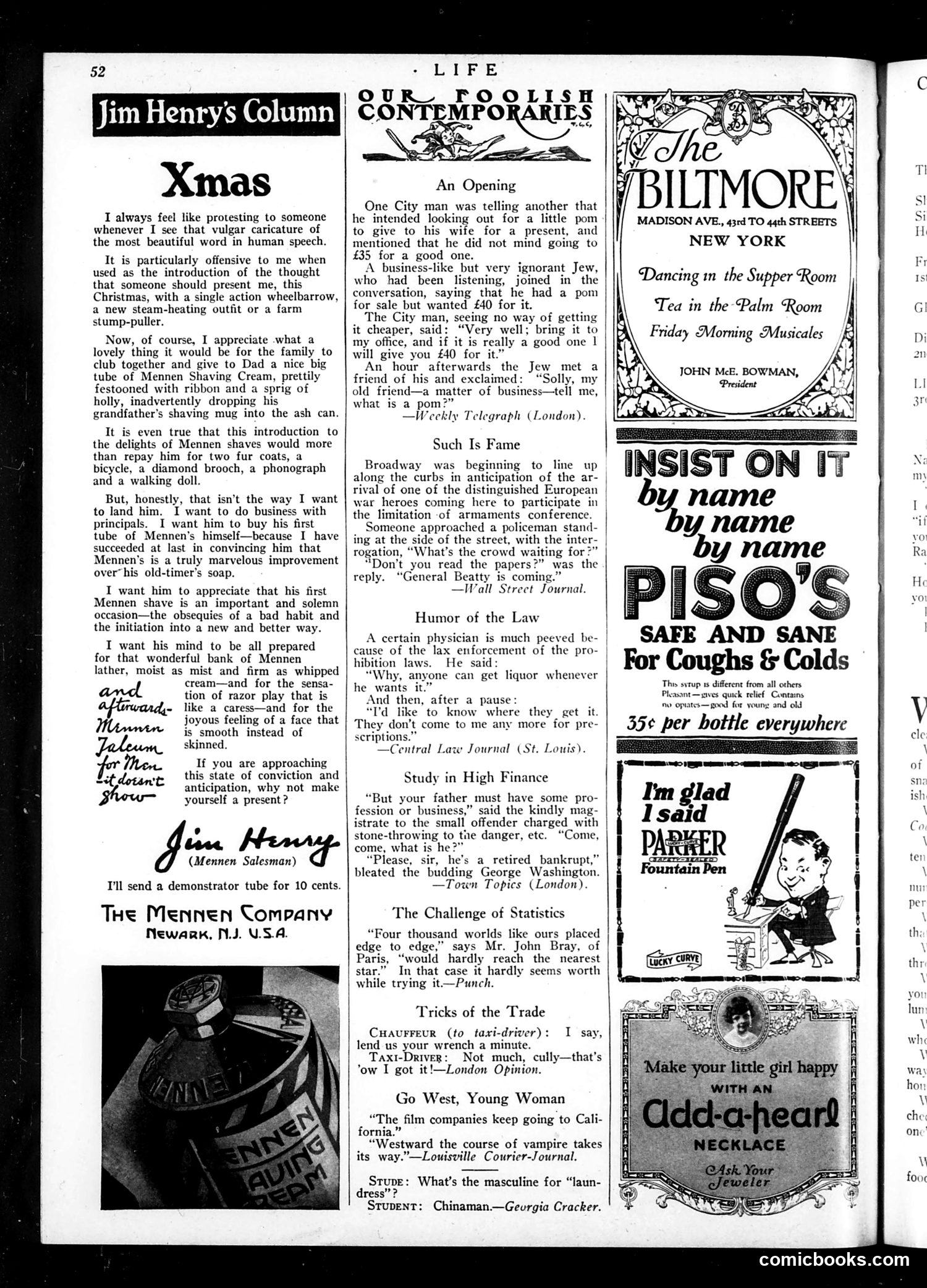
This page from Life magazine (a satirical publication) contains Jim Henry's column promoting Mennen shaving products alongside short humorous anecdotes under "Our Foolish Contemporaries." **Jim Henry's Column**: A thinly-veiled advertisement disguised as editorial commentary. Henry argues against giving his father conventional Christmas gifts, urging instead that he experience the "solemn occasion" of purchasing Mennen Shaving Cream himself—positioning the product as a transformative experience rather than merchandise. **The Anecdotes**: Four brief satirical pieces mocking contemporary society: - A Jewish businessman ignorant of social terminology - A policeman unfamiliar with a war hero (General Beatty, likely Admiral Beatty from WWI) - A doctor lamenting Prohibition's enforcement, losing prescription-writing income - A magistrate questioning a child whose father is a "retired bankrupt" These jokes rely on stereotypes and period social attitudes now considered offensive. The satire targets institutional hypocrisy—particularly Prohibition enforcement and professional corruption—rather than ethnic groups, though the anti-Semitic humor is explicit.
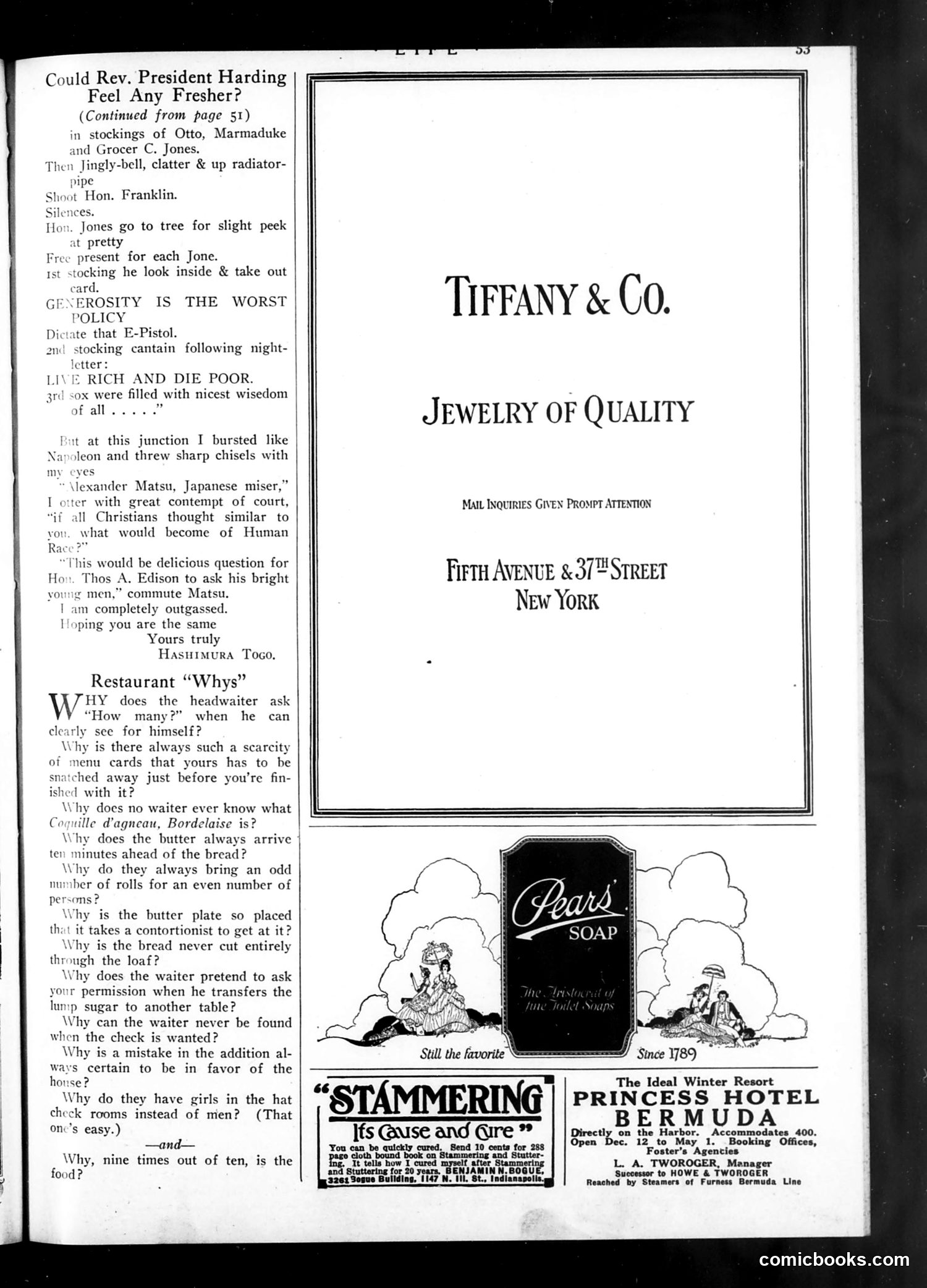
This page is primarily **advertisements and filler content** rather than political satire. The main elements: **"Could Rev. President Harding Feel Any Fresher?"** is a humorous Christmas story (continued from page 51) depicting someone opening stockings filled with quirky gifts and wisdom, including a letter stating "LIVE RICH AND DIE POOR." A Japanese character named "Alexander Matsu" delivers philosophical commentary about Christianity and human nature. The piece is absurdist holiday humor rather than pointed political commentary. **"Restaurant 'Whys'"** is a comedic list of rhetorical questions mocking restaurant service conventions—Why does the headwaiter ask "how many?" when obvious? Why is bread never cut through? Why are menu cards always scarce?—typical satirical complaints about dining etiquette and incompetence. The remainder consists of **luxury advertisements**: Tiffany & Co. jewelry and the Princess Hotel in Bermuda, plus a Pears Soap ad and a medical advertisement for stammering treatment. The Harding reference in the title appears to be incidental wordplay rather than political criticism.
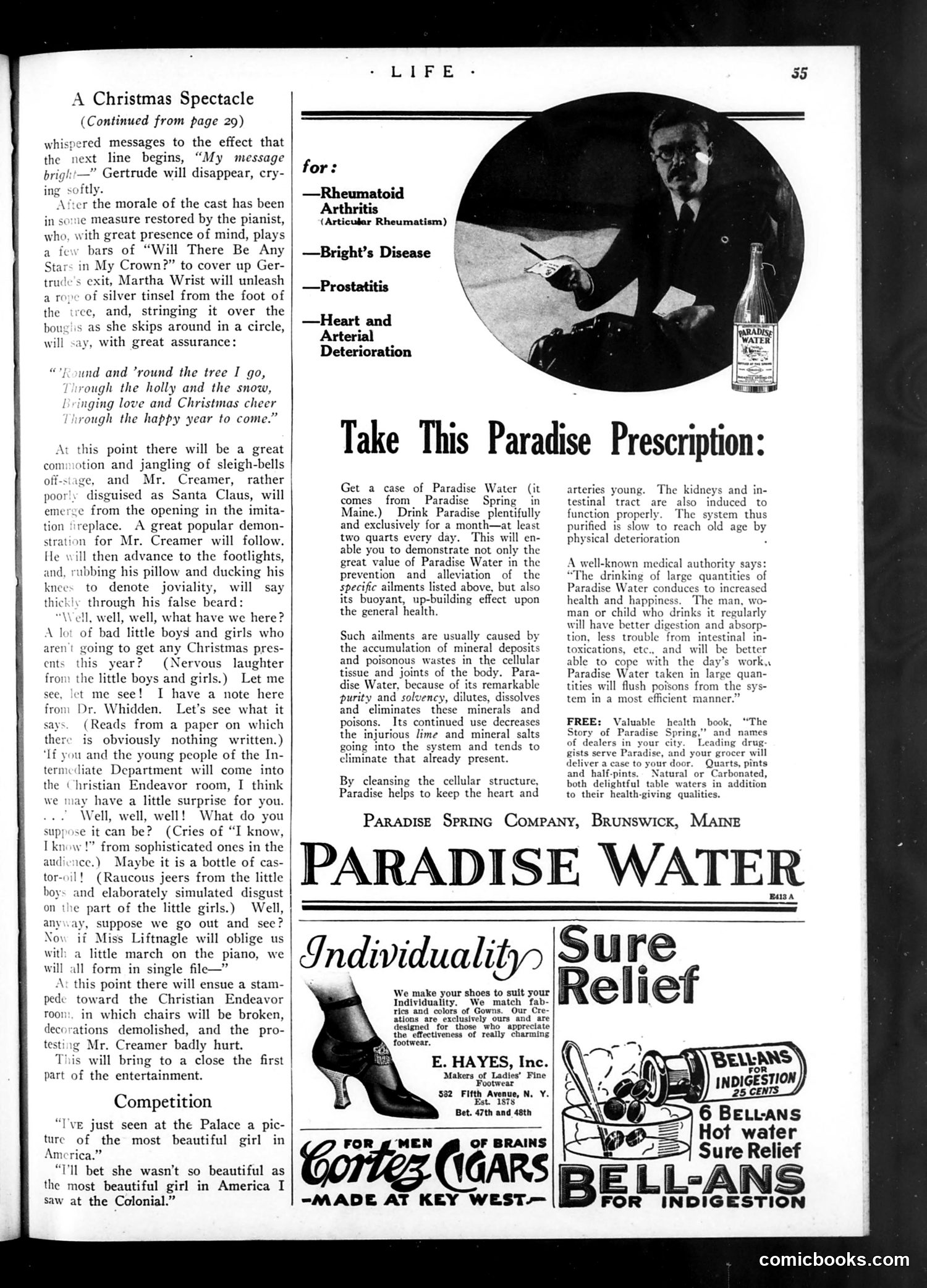
This page contains two distinct sections: **Upper half:** A continuation of "A Christmas Spectacle"—a satirical theater piece depicting a chaotic amateur Christmas pageant at what appears to be a church or community center. The humor comes from the predictable mishaps: actors forgetting lines, elaborate but fragile stage props, and the final stampede when children rush offstage. The satire targets earnest but incompetent amateur theatrical productions common in the era. **Lower half:** Primarily advertisements, including a prominent pitch for "Paradise Water"—a patent medicine claiming to cure arthritis, Bright's disease, prostatitis, and heart problems. This exemplifies the era's widespread medical quackery; such tonics were unregulated and made unfounded health claims. The ad's grandiose language ("remarkable purity," "eliminates poisons") was typical of fraudulent wellness marketing of the period. The page reflects Life's dual mission: satirizing contemporary American life while accepting dubious advertisements—a contradiction modern readers find striking.
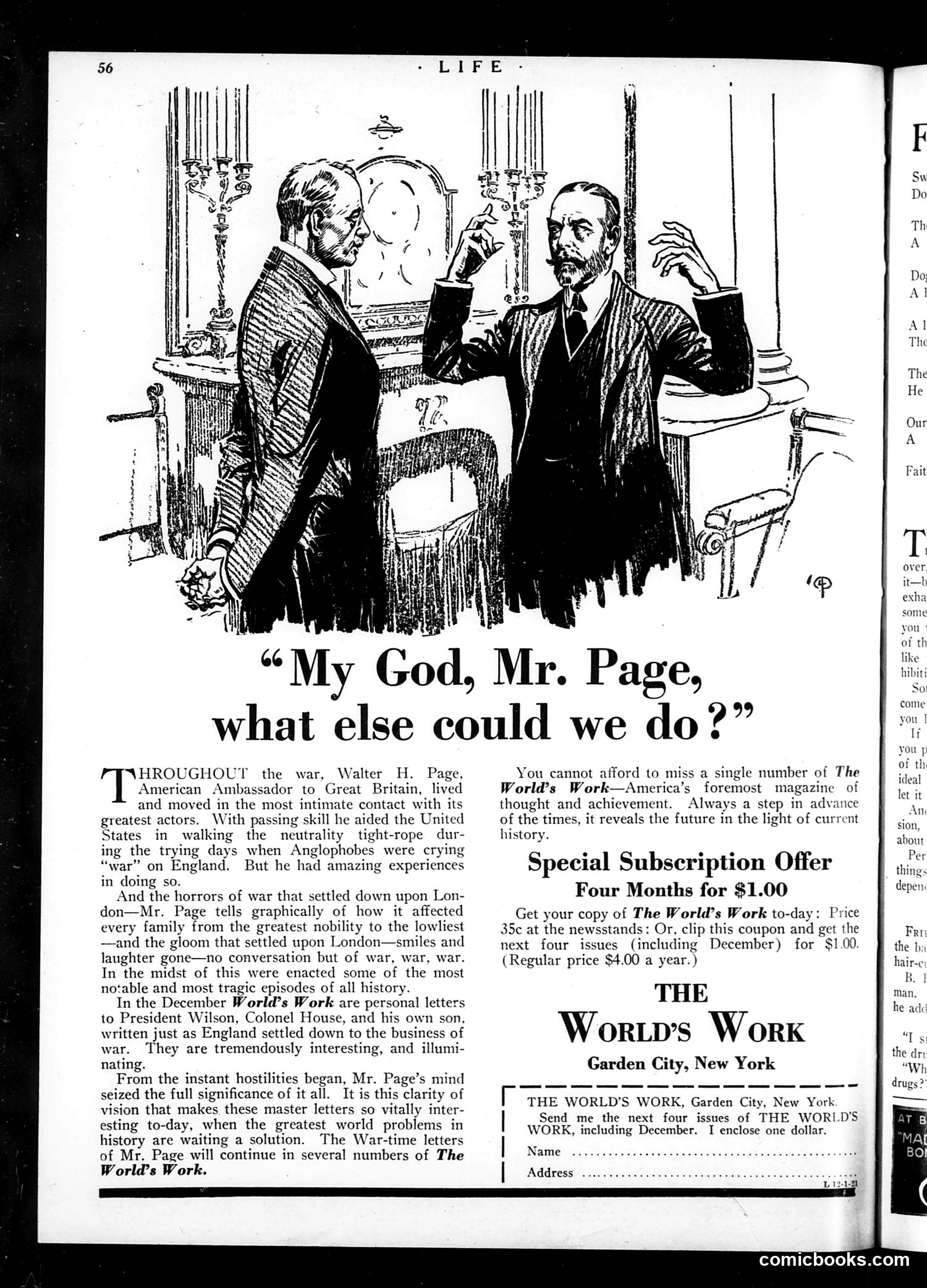
This page promotes *The World's Work* magazine through an article about Walter H. Page, the American Ambassador to Great Britain during World War I. The cartoon depicts Page (likely on the right) in conversation with a British official, with the caption "My God, Mr. Page, what else could we do?"—suggesting the difficult diplomatic and moral choices England faced during the war. The article emphasizes Page's insider access to British decision-making and his personal correspondence with President Wilson and Colonel House, framing these letters as historically significant commentary on wartime leadership. The satire is subtle: the advertisement uses Page's prestigious position and intimate knowledge of British affairs to establish the magazine's credibility as a serious source on major historical events and "world problems." This reflects *Life*'s positioning as an intellectual, opinion-shaping publication for educated readers concerned with international affairs during and after WWI.
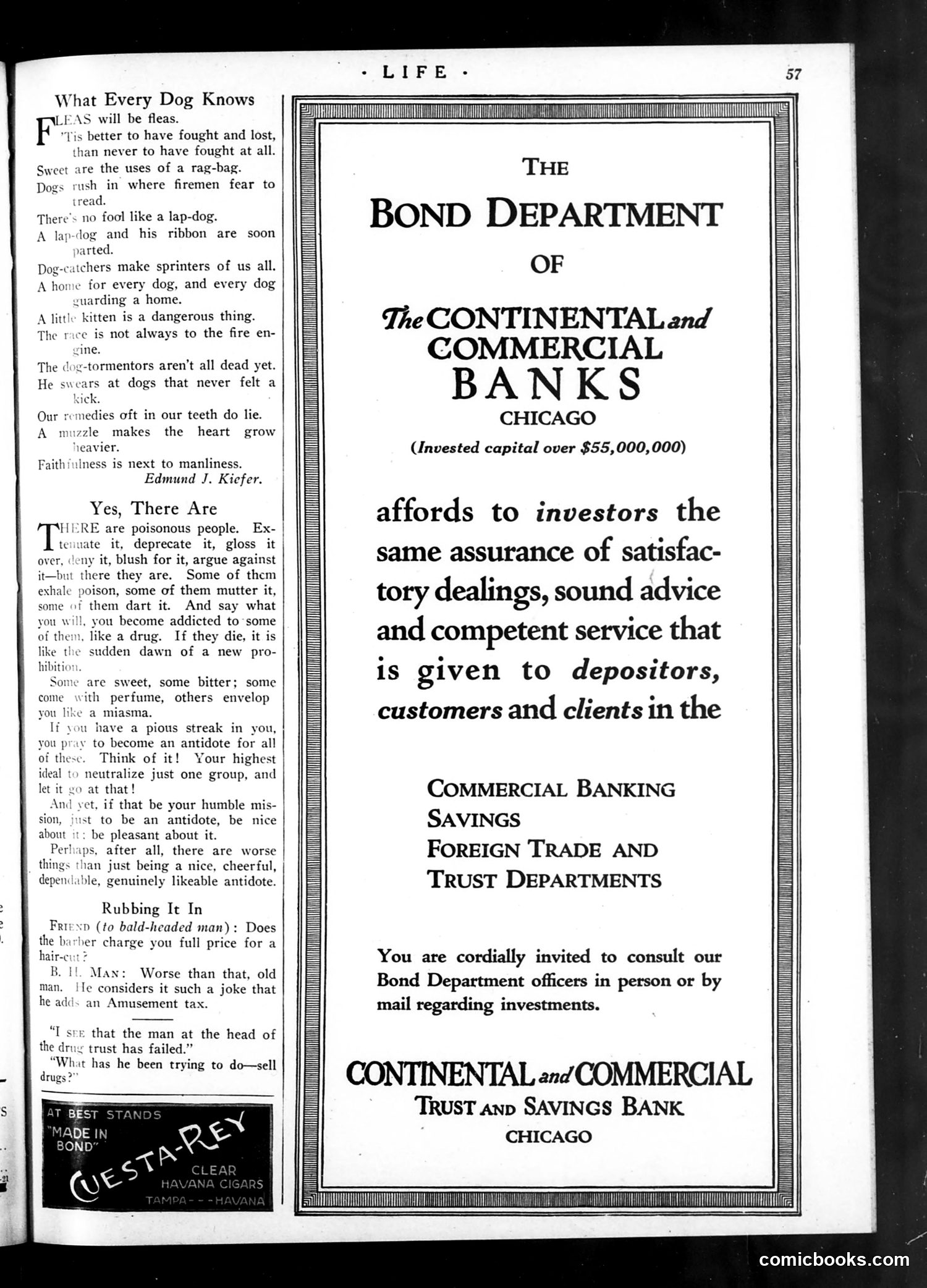
This page contains primarily **advertising and humor columns**, not political cartoons. **Left side:** Three separate humor pieces: 1. "What Every Dog Knows"—mock-serious aphorisms about dogs (parodies of philosophical sayings) 2. "Yes, There Are"—a moralistic essay about "poisonous people" and being a moral antidote to them 3. "Rubbing It In"—a brief joke about a bald man being charged an "Amusement tax" by his barber **Right side:** A full-page advertisement for the Continental and Commercial Banks' Bond Department in Chicago, emphasizing investor confidence and available services. **Bottom:** A small cigar advertisement for "Cuesta-Rey" cigars. **Satire present:** The humor is gentle social commentary on personality types and human nature, plus a mild jab at commercialism (the barber's "amusement tax" joke). No specific political figures or events are referenced.
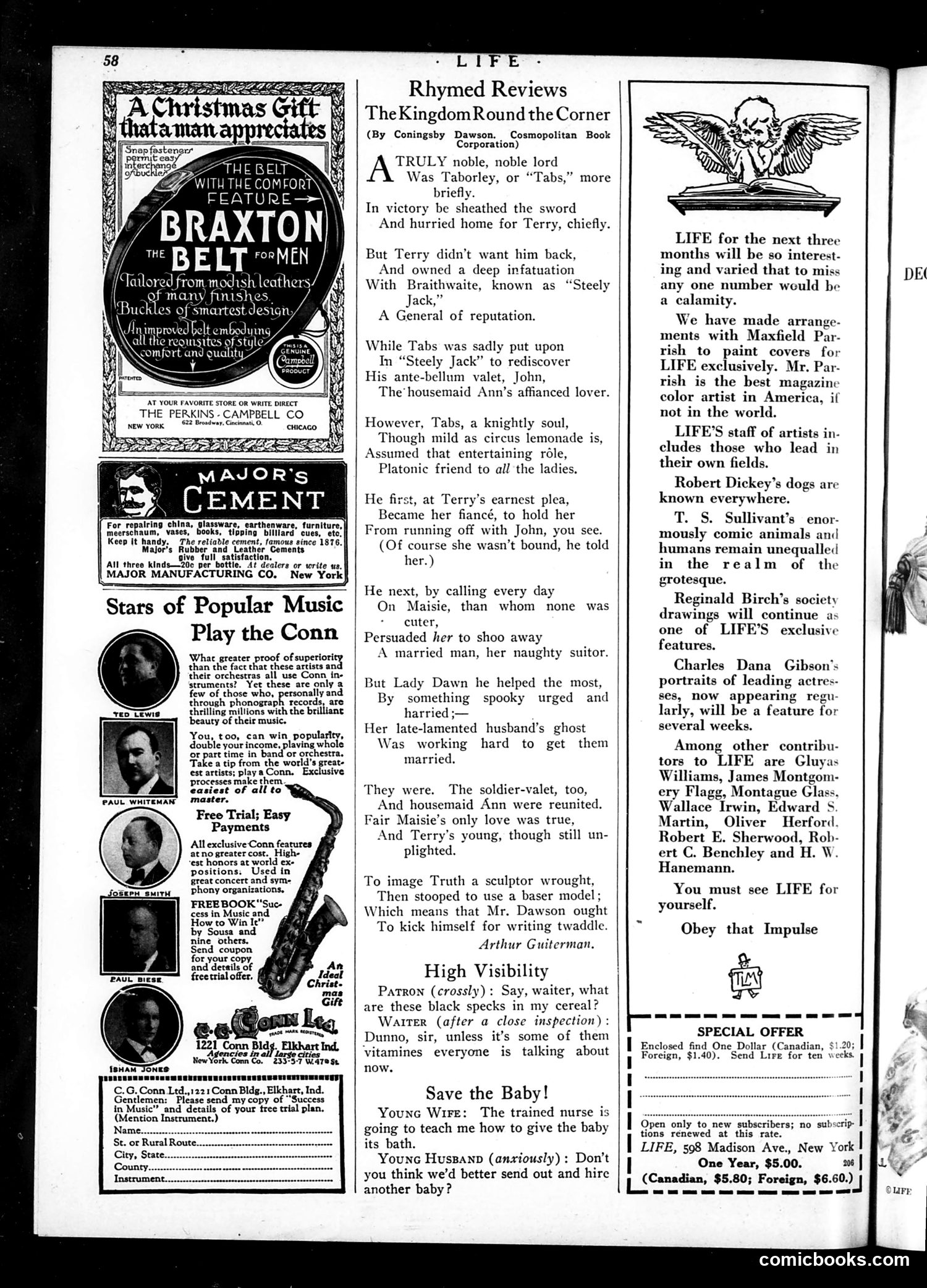
This page from *Life* magazine contains mostly **advertisements and literary content** rather than political cartoons. The main editorial content is a **book review in verse** by Arthur Guiterman of Coningsby Dawson's novel *The Kingdom Round the Corner*. The review mocks the plot's romantic entanglements—a noble lord ("Tabs") selflessly plays matchmaker for various women while suppressing his own feelings. Guiterman's final couplet delivers the satire: the author used a "baser model" instead of genuine truth, and "ought to kick himself for writing twaddle." This is literary criticism disguised as humorous verse. Below that, a brief joke labeled "High Visibility" puns on the contemporary wellness trend of "vitamins," with a waiter attributing cereal specks to popular health supplements rather than admitting contamination. The remaining content consists of period **product advertisements** (belts, cement, musical instruments) and a subscription offer for *Life* itself—typical magazine filler of the era.