
Life, 1921-12-01 · page 4 of 58
Life — December 1, 1921 — page 4: what you’re looking at
What you’re looking at
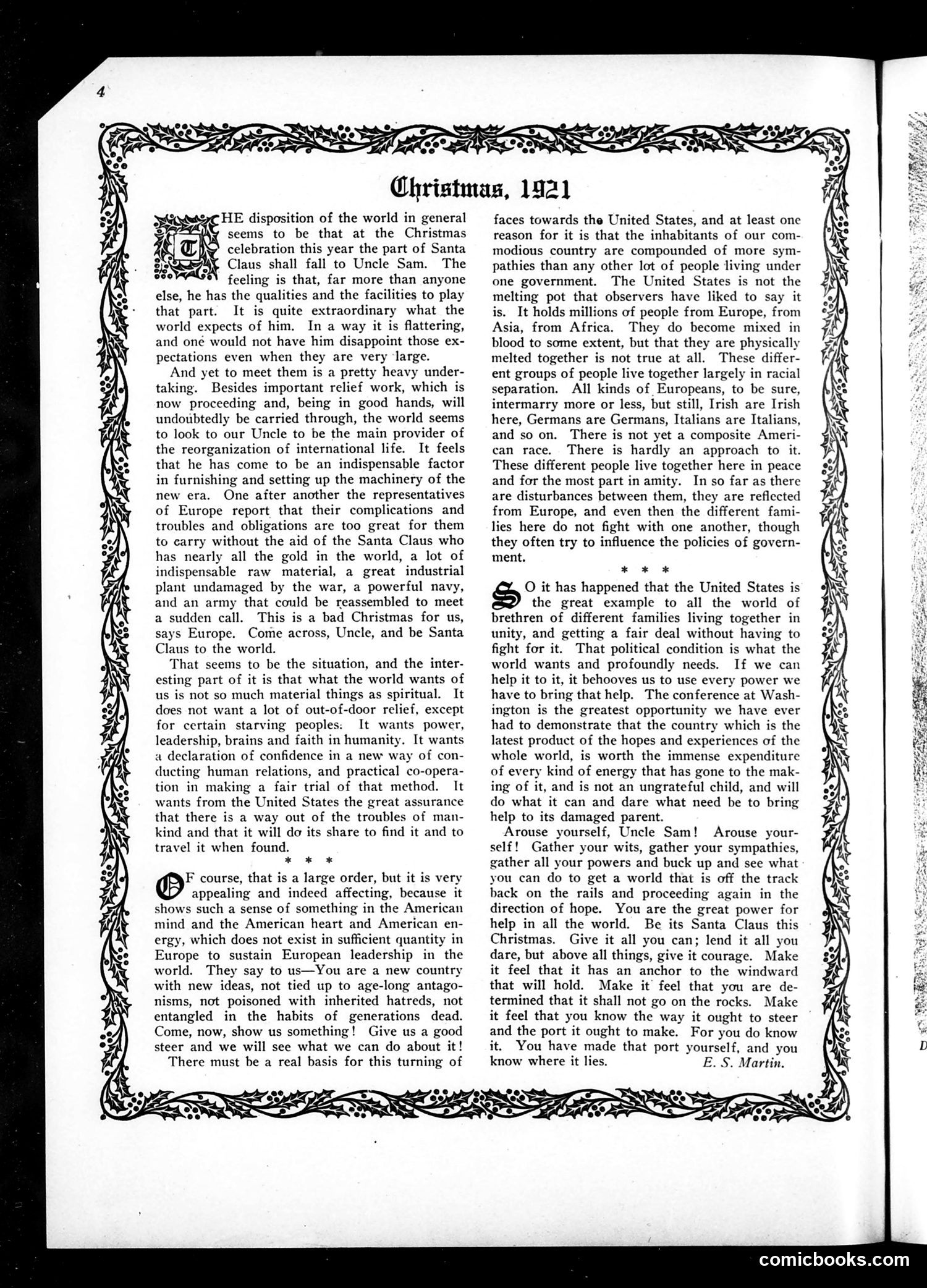
This is not a cartoon page but rather an editorial essay by E.S. Martin titled "Christmas, 1921." The text addresses post-WWI America's role as a world leader and moral example. Martin argues that the United States, composed of diverse immigrant populations living together peacefully, should use its influence to help restore international order after the war's devastation. He criticizes Europe's continued antagonisms and appeals to American idealism and confidence to lead global recovery. The essay concludes with a call to action: Americans should gather their sympathies and powers to steer the world "back on the rails" toward hope. It's essentially a patriotic plea for American moral leadership during the uncertain post-war period.
📄 Transcribed text from this page (OCR, searchable)
Machine-transcribed from the original scan — historical spelling and the odd misread are preserved.
Christmas, 1921 soxdtc HE disposition of the world in general Yeeeah s seems to be that at the Christmas ‘ah celebration this year the part of Santa SSH) Claus shall fall to Uncle Sam. The feeling is that, far more than anyone else, he has the qualities and the facilities to play that part. It is quite extraordinary what the world expects of him. In a way it is flattering, and oné would not have him disappoint those ex- pectations even when they are very large. And yet to meet them is a pretty heavy under- taking. Besides important relief work, which is now proceeding and, being in good hands, will undoubtedly be carried through, the world seems to look to our Uncle to be the main provider of the reorganization of international life. It feels that he has come to be an indispensable factor in furnishing and setting up the machinery of the new era. One after another the representatives of Europe report that their complications and troubles and obligations are too great for them to carry without the aid of the Santa Claus who has nearly all the gold in the world, a lot of indispensable raw material, a great industrial plant undamaged by the war, a powerful navy, and an army that could be reassembled to meet a sudden call. This is a bad Christmas for us, says Europe. Come across, Uncle, and be Santa Claus to the world. That seems to be the situation, and the inter- esting part of it is that what the world wants of us is not so much material things as spiritual. It does not want a lot of out-of-door relief, except for certain starving peoples: It wants power, leadership, brains and faith in humanity. It wants a declaration of confidence in a new way of con- ducting human relations, and practical co-opera- tion in making a fair trial of that method. It wants from the United States the great assurance that there is a way out of the troubles of man- kind and that it will do its share to find it and to travel it when found. x ok Ok F course, that is a large order, but it is very appealing and indeed affecting, because it shows such a sense of something in the American mind and the American heart and American en- ergy, which does not exist in sufficient quantity in Europe to sustain European leadership in the world. They say to us—You are a new country with new ideas, not tied up to age-long antago- nisms, not poisoned with inherited hatreds, not entangled in the habits of generations dead. Come, now, show us something! Give us a good steer and we will see what we can do about it! There must be a real basis for this turning of faces towards the United States, and at least one reason for it is that the inhabitants of our com- modious country are compounded of more sym- pathies than any other lot of people living under one government. The United States is not the melting pot that observers have liked to say it is. It holds millions of people from Europe, from Asia, from Africa. They do become mixed in blood to some extent, but that they are physically melted together is not true at all. These differ- ent groups of people live together largely in racial separation. All kinds of Europeans, to be sure, intermarry more or less, but still, Irish are Irish here, Germans are Germans, Italians are Italians, and so on. There is not yet a composite Ameri- can race. There is hardly an approach to it. These different people live together here in peace and for the most part in amity. In so far as there are disturbances between them, they are reflected from Europe, and even then the different fami- lies here do not fight with one another, though they often try to influence the policies of govern- ment. ee O it has happened that the United States is the great example to all the world of brethren of different families living together in unity, and getting a fair deal without having to fight for it. That political condition is what the world wants and profoundly needs. If we can help it to it, it behooves us to use every power we have to bring that help. The conference at Wash- ington is the greatest opportunity we have ever had to demonstrate that the country which is the latest product of the hopes and experiences of the whole world, is worth the immense expenditure of every kind of energy that has gone to the mak- ing of it, and is not an ungrateful child, and will do what it can and dare what need be to bring help to its damaged parent. Arouse yourself, Uncle Sam! Arouse your- self! Gather your wits, gather your sympathies, gather all your powers and buck up and see what you can do to get a world that is off the track back on the rails and proceeding again in the direction of hope. You are the great power for help in all the world. Be its Santa Claus this Christmas. Give it all you can; lend it all you dare, but above all things, give it courage. Make it feel that it has an anchor to the windward that will hold. Make it feel that you are de- termined that it shall not go on the rocks. Make it feel that you know the way it ought to steer and the port it ought to make. For you do know it. You have made that port yourself, and you know where it lies. E. S. Martin. comicbooks.com