
Life, 1921-12-01 · page 21 of 58
Life — December 1, 1921 — page 21: what you’re looking at
What you’re looking at
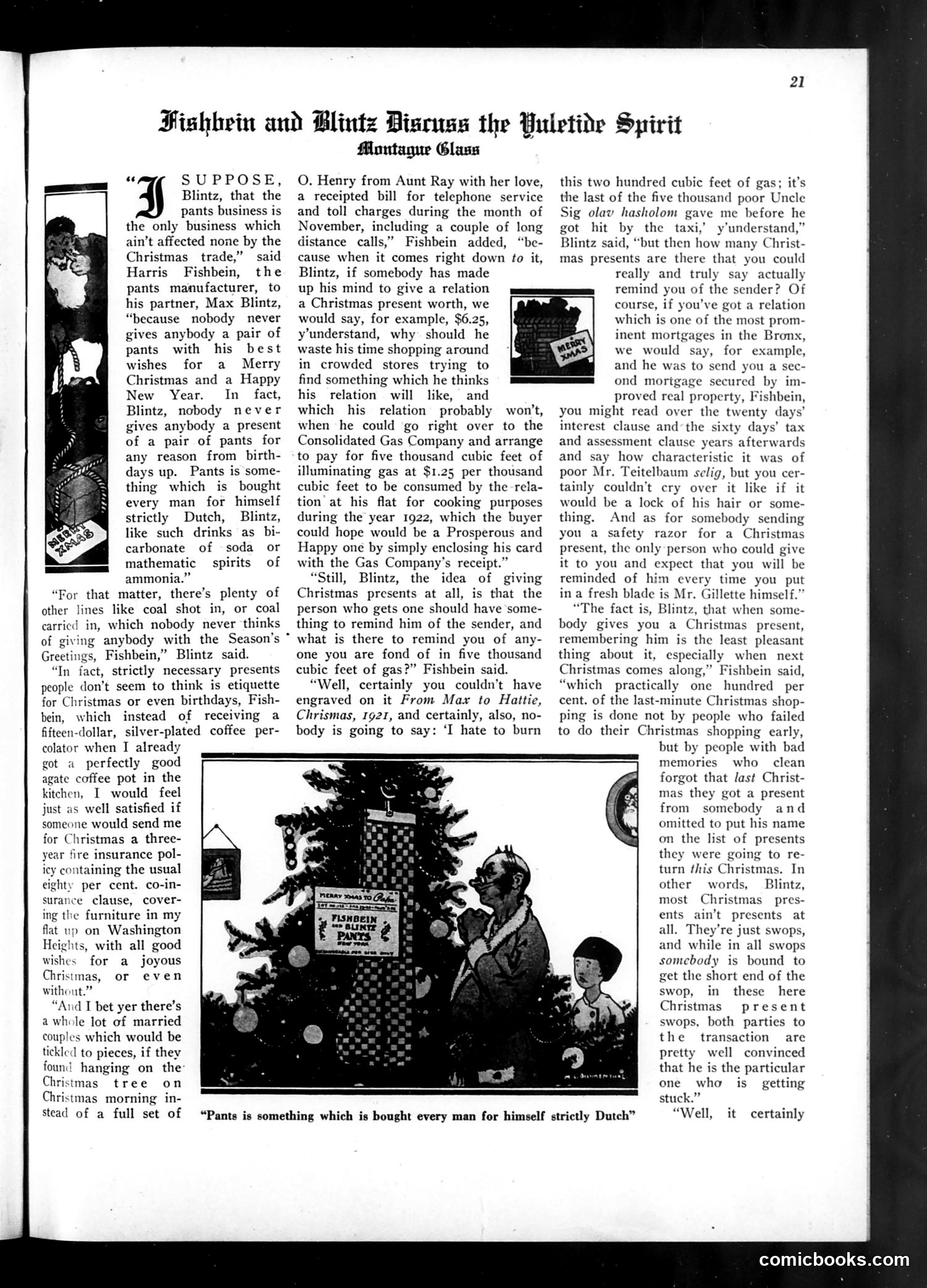
This is a satirical dialogue between two Yiddish-American businessmen—Harris Fishbein (pants manufacturer) and Max Blintz (his partner)—debating the absurdity of Christmas gift-giving conventions. **The Satire:** Fishbein argues that practical necessities (pants, coal, utilities) make terrible gifts because no one buys these *for* others as presents. Blintz sarcastically extends this logic to propose genuinely impractical "gifts": a three-year fire insurance policy, a phone bill receipt, and crucially, a gas company bill for five thousand cubic feet of illuminating gas—presented as a sentimental Christmas present. **The Point:** The humor mocks both excessive Christmas commercialism and the greeting-card sentimentality surrounding gift-giving. By proposing utterly ridiculous "gifts" (utility bills, insurance policies), the characters expose how arbitrary and wasteful conventional present-buying is. The joke lands hardest with the gas bill "gift"—completely useless yet technically "thoughtful." **Context:** This reflects 1920s Jewish-American immigrant humor, using vernacular speech ("olav hasholom," "y'understand") and the characters' outsider perspective to critique mainstream American consumer culture.
📄 Transcribed text from this page (OCR, searchable)
Machine-transcribed from the original scan — historical spelling and the odd misread are preserved.
Fishbein and Blintz Biseuss the Yuletide Spirit Montague Glass SUPPOSE, Blintz, that the pants business is the only business which ain’t affected none by the Christmas trade,” said Harris Fishbein, the pants manufacturer, to his partner, Max Blintz, “because nobody never gives anybody a pair of pants with his best wishes for a Merry Christmas and a Happy New Year. In fact, Blintz, nobody never gives anybody a present of a pair of pants for any reason from birth- days up. Pants is some- thing which is bought every man for himself strictly Dutch, Blintz, like such drinks as bi- carbonate of soda or mathematic spirits of ammonia.” “For that matter, there’s plenty of other lines like coal shot in, or coal carried in, which nobody never thinks of giving anybody with the Season's * Greetings, Fishbein,” Blintz said. “In fact, strictly necessary presents people don’t seem to think is etiquette for Christmas or even birthdays, Fish- bein, which instead of receiving a fifteen-dollar, silver-plated coffee per- colator when I already got a perfectly good agate coffee pot in the kitchen, I would feel just as well satisfied if someone would send me for Christmas a three- year fire insurance pol- icy containing the usual eighty per cent. co-in- surance clause, cover- ing the furniture in my flat up on Washington Heights, with all good wishes for a joyous Christmas, or even without.” “And I bet yer there’s a whole lot of married couples which would be tickled to pieces, if they found hanging on the Christmas tree on Christmas morning in- stead of a full set of O. Henry from Aunt Ray with her love, a receipted bill for telephone service and toll charges during the month of November, including a couple of long distance calls,’ Fishbein added, “be- cause when it comes right down fo it, Blintz, if somebody has made up his mind to give a relation a Christmas present worth, we would say, for example, $6.25, y’understand, why should he waste his time shopping around in crowded stores trying to find something which he thinks his relation will like, and which his relation probably won't, when he could go right over to the Consolidated Gas Company and arrange to pay for five thousand cubic feet of illuminating gas at $1.25 per thousand cubic feet to be consumed by the -rela- tion’ at his flat for cooking purposes during the year 1922, which the buyer could hope would be a Prosperous and Happy one by simply enclosing his card with the Gas Company’s receipt.” “Still, Blintz, the idea of giving Christmas presents at all, is that the person who gets one should have some- thing to remind him of the sender, and what is there to remind you of any- one you are fond of in five thousand cubic feet of gas?” Fishbein said. “Well, certainly you couldn’t have engraved on it From Max to Hattie, Chrismas, 1921, and certainly, also, no- body is going to say: ‘I hate to burn this two hundred cubic feet of gas; it’s the last of the five thousand poor Uncle Sig olav hasholom gave me before he got hit by the taxi,’ y’understand,” Blintz said, “but then how many Christ- mas presents are there that you could really and truly actually remind you of the sender? Of course, if you've got a relation which is one of the most prom- inent mortgages in the Bronx, we would say, for example, and he was to send you a sec- ond mortgage secured by im- proved real property, Fishbein, you might read over the twenty days’ interest clause and*the sixty days’ tax and assessment clause years afterwards and say how characteristic it was of poor Mr. Teitelbaum selig, but you cer- tainly couldn’t cry over it like if it would be a lock of his hair or some- thing. And as for somebody sending you a safety razor for a Christmas present, the only person who could give it to you and expect that you will be reminded of him every time you put ina fresh blade is Mr. Gillette himself.” “The fact is, Blintz, that when some- body gives you a Christmas present, remembering him is the least pleasant thing about it, especially when next Christmas comes along,” Fishbein said, “which practically one hundred per cent. of the last-minute Christmas shop- ping is done not by people who failed to do their Christmas shopping early, but by people with bad “Pants is something which is bought every man for himself strictly Dutch” memories who clean forgot that last Christ- mas they got a present from somebody and omitted to put his name on the list of presents they were going to re- turn this Christmas. In other words, Blintz, most Christmas pres- ents ain’t presents at all. They're just swops, and while in all swops somebody is bound to get the short end of the swop, in these here Christmas present swops, both parties to the transaction are pretty well convinced that he is the particular one who is getting stuck.” “Well, it certainly comicbooks.com