
Life, 1921-12-01 · page 40 of 58
Life — December 1, 1921 — page 40: what you’re looking at
What you’re looking at
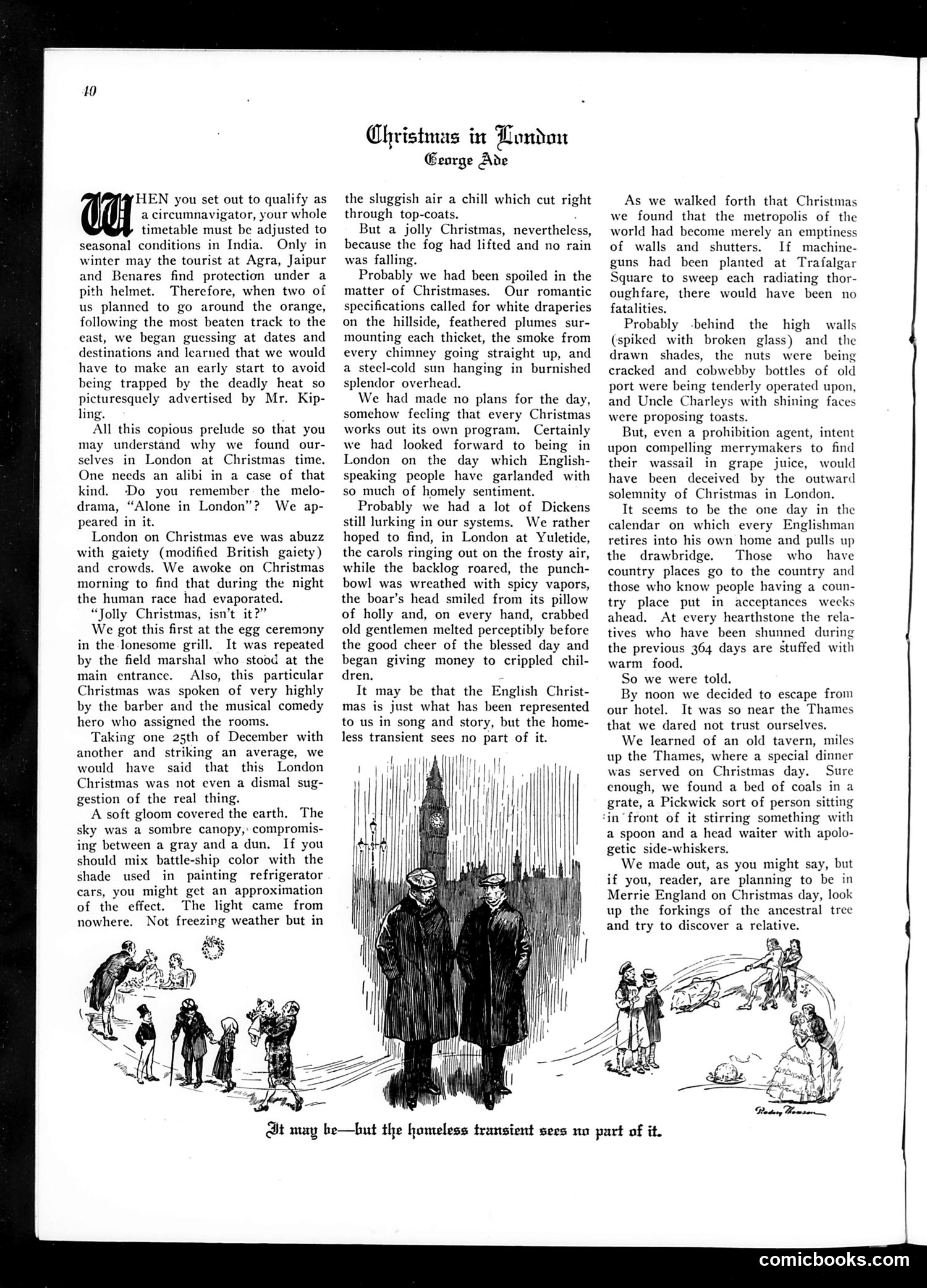
This is a travel essay with satirical illustrations about experiencing Christmas in London. Author Ade describes how two travelers, forced to spend the holiday in London due to scheduling demands of touring India, expected the romanticized Dickensian Christmas—caroling, festive gatherings, generous nobles—but found instead a dreary, empty city. The central satire contrasts the *idealized* Christmas of literature and sentiment with the *actual* experience: gray, cold, cheerless streets with shuttered buildings. More pointedly, Ade observes that while wealthy Londoners celebrate behind their walls, "the homeless transient sees no part of it." The illustrations show contrasts: families enjoying Christmas versus solitary figures in the desolate city. The caption—"It may be—but the homeless transient sees no part of it"—makes the social critique explicit: Christmas plenty exists only for the housed and prosperous. This is gentle but pointed social commentary on class inequality during the holiday season.
📄 Transcribed text from this page (OCR, searchable)
Machine-transcribed from the original scan — historical spelling and the odd misread are preserved.
HEN you set out to qualify as a circumnavigator, your whole timetable must be adjusted to seasonal conditions in India. Only in winter may the tourist at Agra, Jaipur and Benares find protection under a pith helmet. Therefore, when two of us planned to go around the orange, following the most beaten track to the east, we began guessing at dates and destinations and learned that we would have to make an early start to avoid being trapped by the deadly heat so picturesquely advertised by Mr. Kip- ling. All this copious prelude so that you may understand why we found our- selves in London at Christmas time. One needs an alibi in a case of that kind. Do you remember the melo- drama, “Alone in London”? We ap- peared in it. London on Christmas eve was abuzz with gaiety (modified British gaiety) and crowds. We awoke on Christmas morning to find that during the night the human race had evaporated. “Jolly Christmas, isn’t it?” We got this first at the egg ceremony in the lonesome grill. It was repeated by the field marshal who stood at the main entrance. Also, this particular Christmas was spoken of very highly by the barber and the musical comedy hero who assigned the rooms. Taking one 25th of December with another and striking an average, we would have said that this London Christmas was not even a dismal sug- gestion of the real thing. A soft gloom covered the earth, The sky was a sombre canopy,: compromis- ing between a gray and a dun. If you should mix battle-ship color with the shade used in painting refrigerator cars, you might get an approximation of the effect. The light came from nowhere. Not freezing weather but in Christmas in Dondou George Ade the sluggish air a chill which cut right through top-coats. But a jolly Christmas, nevertheless, because the fog had lifted and no rain was falling. Probably we had been spoiled in the matter of Christmases. Our romantic specifications called for white draperies on the hillside, feathered plumes sur- mounting each thicket, the smoke from every chimney going straight up, and a steel-cold sun hanging in burnished splendor overhead. We had made no plans for the day, somehow fecling that every Christmas works out its own program. Certainly we had looked forward to being in London on the day which English- speaking people have garlanded with so much of homely sentiment. Probably we had a lot of Dickens still lurking in our systems. We rather hoped to find, in London at Yuletide, the carols ringing out on the frosty air, while the backlog roared, the punch- bowl was wreathed with spicy vapors, the boar’s head smiled from its pillow of holly and, on every hand, crabbed old gentlemen melted perceptibly before the good cheer of the blessed day and began giving money to crippled chil- dren, It may be that the English Christ- mas is just what has been represented to us in song and story, but the home- less transient sees no part of it. 1 As we walked forth that Christmas we found that the metropolis of the world had become merely an emptiness of walls and shutters. If machine- guns had been planted at Trafalgar Square to sweep each radiating thor- oughfare, there would have been no fatalities. Probably -behind the high walls (spiked with broken glass) and the drawn shades, the nuts were being cracked and cobwebby bottles of old port were being tenderly operated upon, and Uncle Charleys with shining faces were proposing toasts. But, even a prohibition agent, intent upon compelling merrymakers to find their wassail in grape juice, would have been deceived by the outward solemnity of Christmas in London. It seems to be the one day in the calendar on which every Englishman retires into his own home and pulls up the drawbridge. Those who have country places go to the country and those who know people having a coun- try place put in acceptances weeks ahead. At every hearthstone the rela- tives who have been shunned during the previous 364 days are stuffed with warm food. So we were told. By noon we decided to escape from our hotel. It was so near the Thames that we dared not trust ourselves. We learned of an old tavern, miles up the Thames, where a special dinner was served on Christmas day. Sure enough, we found a bed of coals in a grate, a Pickwick sort of person sitting ‘infront of it stirring something with a spoon and a head waiter with apolo- getic side-whiskers. We made out, as you might say, but if you, reader, are planning to be in Merrie England on Christmas day, look up the forkings of the ancestral tree and try to discover a relative. Gt may be—but the homeless transient sees no part of it. comicbooks.com