
Life, 1921-12-01 · page 12 of 58
Life — December 1, 1921 — page 12: what you’re looking at
What you’re looking at
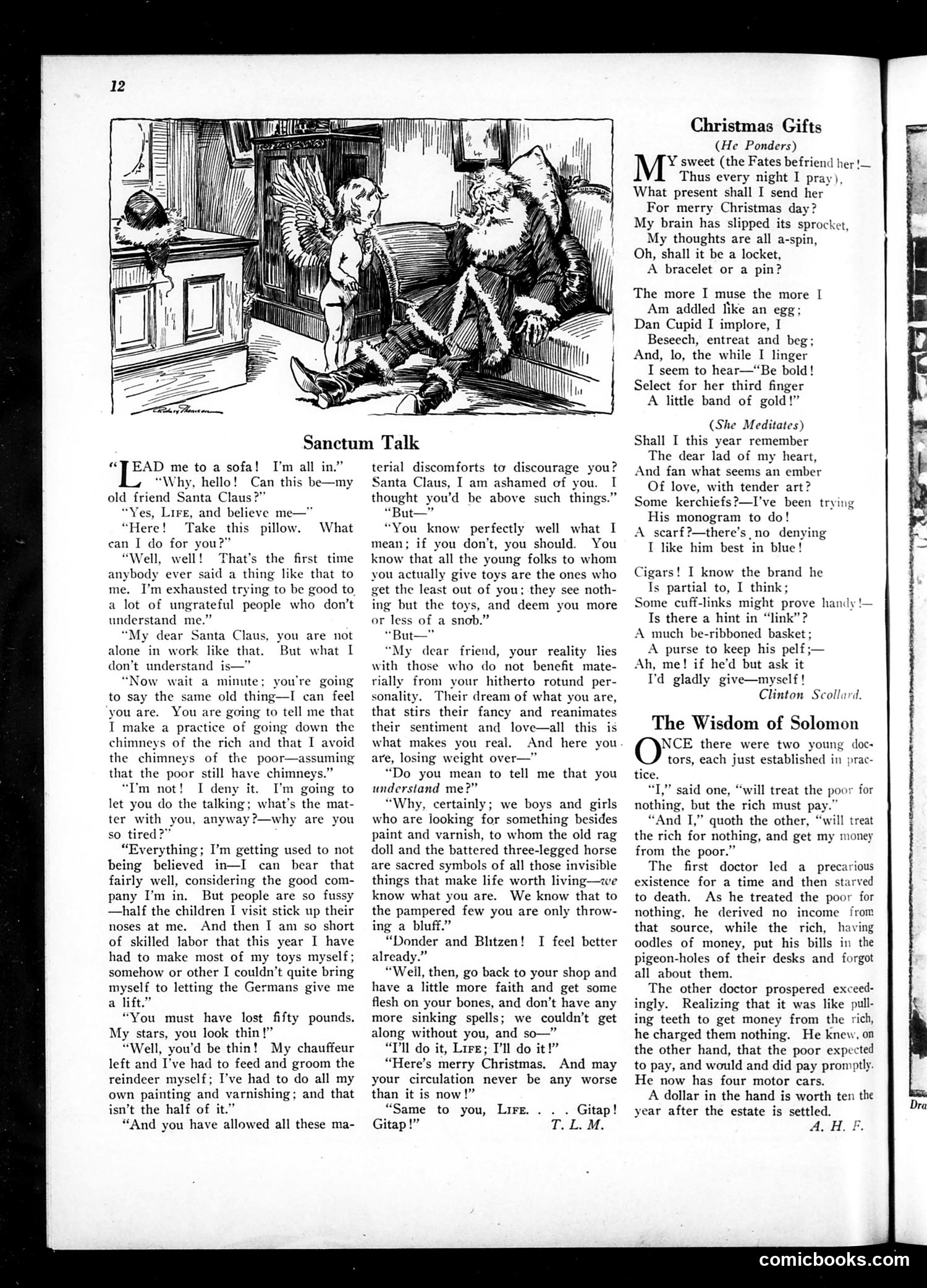
The page contains three distinct pieces: 1. **"Christmas Gifts" (top)**: A sketch showing Santa Claus with a child, accompanied by verses about gift-giving anxieties—the speaker worries over selecting the perfect present. 2. **"Sanctum Talk" (middle)**: A dialogue between "Life" (the magazine's personified voice) and Santa Claus, where Life complains about Christmas commercialism and materialism. Santa defends gift-giving as meaningful, arguing that toys symbolize "invisible things that make life worth living." Life remains cynical about consumerism. 3. **"The Wisdom of Solomon" (bottom right)**: A parable contrasting two doctors—one who treats the poor for nothing while remaining poor himself, and another who exploits wealthy patients, becoming rich. The moral critiques class inequality and greed. The page satirizes Christmas commercialism while offering social commentary on poverty and wealth disparity.
📄 Transcribed text from this page (OCR, searchable)
Machine-transcribed from the original scan — historical spelling and the odd misread are preserved.
Sanctum Talk “JEAD me to a sofa! I'm all in.” “Why, hello! Can this be—my old friend Santa Claus?” “Yes, Lire, and believe me—" “Here! Take this pillow. can I do for you?” “Well, well! That's the first time anybody ever said a thing like that to me. I’m exhausted trying to be good to. a lot of ungrateful people who don’t understand me.” “My dear Santa Claus, you are not alone in work like that. But what I don’t understand is—” “Now wait a minute; you're going to say the same old thing—I can feel you are. You are going to tell me that I make a practice of going down the chimneys of the rich and that I avoid the chimneys of the poor—assuming that the poor still have chimneys.” “I'm not! I deny it. I’m going to let you do the talking; what's the mat- ter with you, anyway?—why are you so tired?” “Everything; I’m getting used to not being believed in—I can bear that fairly well, considering the good com- pany I’m in. But people are so fussy —half the children I visit stick up their noses at me. And then I am so short of skilled labor that this year I have had to make most of my toys myself; somehow or other I couldn’t quite bring myself to letting the Germans give me a lift.” “You must have lost fifty pounds. My stars, you look thin!” “Well, you'd be thin! My chauffeur left and I've had to feed and groom the reindeer myself; I’ve had to do all my own painting and varnishing; and that isn’t the half of it.” “And you have allowed all these ma- What terial discomforts to discourage you? Santa Claus, I am ashamed of you. I thought you’d be above such things.” “But—” “You know perfectly well what I mean; if you don’t, you should. You know that all the young folks to whom you actually give toys are the ones who get the least out of you; they see noth- ing but the toys, and deem you more or less of a snob.” “But—" “My dear friend, your reality lies with those who do not benefit mate- rially from your hitherto rotund per- sonality. Their dream of what you are, that stirs their fancy and reanimates their sentiment and love—all this is what makes you real. And here you are, losing weight over—" “Do you mean to tell me that you understand me?” “Why, certainly; we boys and girls who are looking for something besides paint and varnish, to whom the old rag doll and the battered three-legged horse are sacred symbols of all those invisible things that make life worth living—we know what you are. We know that to the pampered few you are only throw- ing a bluff.” “Donder and Blitzen! already.” “Weil, then, go back to your shop and have a little more faith and get some flesh on your bones, and don’t have any more sinking spells; we couldn’t get along without you, and so—” “Tl do it, Lire; I’ll do it!” “Here’s merry Christmas. And may your circulation never be any worse than it is now!” “Same to you, Lire... . Gitap! Gitap !” {head oad a I feel better Christmas Gifts (He Ponders) Y sweet (the Fates befriend her!— Thus every night I pray), What present shall I send her For merry Christmas day? My brain has slipped its sprocket, My thoughts are all a-spin, Oh, shall it be a locket, A bracelet or a pin? The more I muse the more [| Am addled like an egg; Dan Cupid I implore, I Beseech, entreat and beg; And, lo, the while I linger I seem to hear—“Be bold! Select for her third finger A little band of gold!” (She Meditates) Shall I this year remember The dear lad of my heart, And fan what seems an ember Of love, with tender art? Some kerchiefs?—I’ve been trying His monogram to do! A scarf?—there’s no denying I like him best in blue! Cigars! I know the brand he Is partial to, I think; Some cuff-links might prove handy !— Is there a hint in “link”? A much be-ribboned basket ; A purse to keep his pel Ah, me! if he’d but ask it I'd gladly give—myself! Clinton Scollard. The Wisdom of Solomon NCE there were two young doc- tors, each just established in prac- tice. “TI,” said one, “will treat the poor for nothing, but the rich must pay.” “And I,” quoth the other, “will treat the rich for nothing, and get my money from the poor.” The first doctor led a_ precarious existence for a time and then starved to death. As he treated the poor for nothing, he derived no income from that source, while the rich, having oodles of money, put his bills in the pigeon-holes of their desks and forgot all about them. The other doctor prospered exceed- ingly. Realizing that it was like pull- ing teeth to get money from the rich, he charged them nothing. He knew, on the other hand, that the poor expected to pay, and would and did pay promptly. He now has four motor cars. A dollar in the hand is worth ten the year after the estate is settled. AH. F. comicbooks.com