
Life, 1921-12-01 · page 39 of 58
Life — December 1, 1921 — page 39: what you’re looking at
What you’re looking at
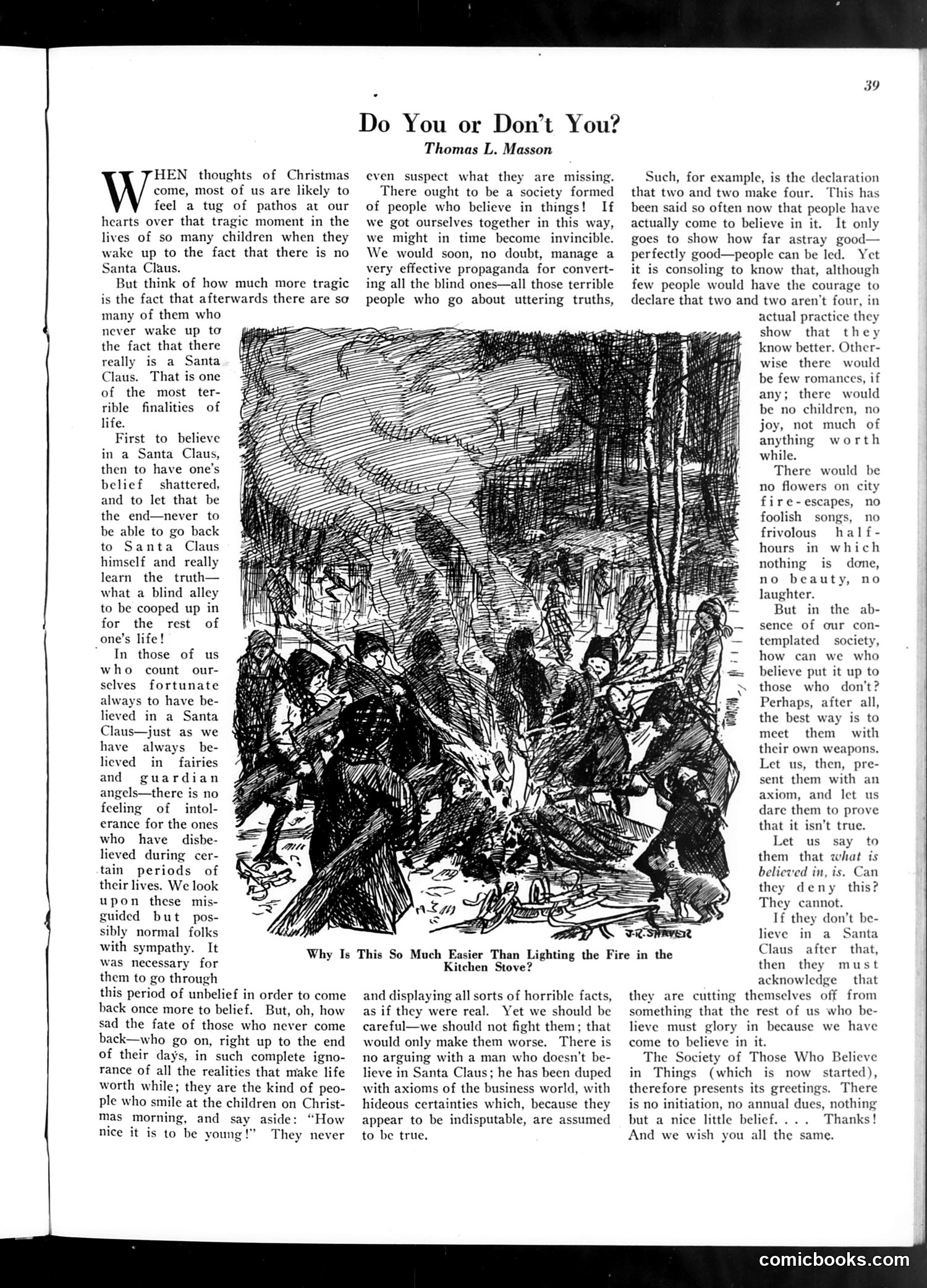
This humorous essay uses Santa Claus as a metaphor for maintaining wonder and belief in life's intangibles. The accompanying sketch depicts a cheerful Christmas gathering, contrasting with Mason's satirical argument. The piece mocks hardheaded rationalists and cynics—those who dismiss Santa, fairy tales, and romantic notions as childish delusions. Mason proposes forming "The Society of Those Who Believe in Things" to combat literal-minded people who traffic in cold facts and mathematical certainties (like "two and two make four"). The satire targets early 20th-century materialism and scientism: the belief that only provable, rational facts matter. Mason argues such thinking kills joy, romance, children, flowers on fire escapes, and beauty itself. He suggests meeting skeptics with their own logical weapons—presenting belief itself as an unprovable axiom they cannot refute. The cartoon's cozy domestic scene embodies the warmth Mason celebrates, while his argument defends imaginative faith against utilitarian cynicism.
📄 Transcribed text from this page (OCR, searchable)
Machine-transcribed from the original scan — historical spelling and the odd misread are preserved.
HEN thoughts of Christmas come, most of us are likely to feel a tug of pathos at our hearts over that tragic moment in the lives of so many children when they wake up to the fact that there is no Santa Claus. But think of how much more tragic is the fact that afterwards there are so many of them who never wake up to the fact that there really is a Santa Claus. That is one of the most ter- tible finalities of life. First to believe in a Santa Claus, then to have one’s belief shattered, and to let that be the end—never to be able to go back to Santa Claus himself and really learn the truth— what a blind alley to be cooped up in for the rest of one’s life! “In those of us who count our- selves fortunate always to have be- lieved in a Santa Claus—just as we have always be- lieved in fairies and guardian angels—there is no feeling of intol- erance for the ones who have disbe- lieved during cer- tain periods of their lives. We look upon these mis- guided but pos- sibly normal folks with sympathy. It was necessary for them to go through this period of unbelief in order to come back once more to belief. But, oh, how sad the fate of those who never come back—who go on, right up to the end of their days, in such complete igno- rance of all the realities that make life worth while; they are the kind of peo- ple who smile at the children on Christ- mas morning, and say aside: “How nice it is to be young!” They never Do You or Don’t Thomas L. Masson You? even suspect what they are missing. There ought to be a society formed of people who believe in things! If we got ourselves together in this way, we might in time become invincible. We would soon, no doubt, manage a very effective propaganda for convert- ing all the blind ones—all those terrible people who go about uttering truths, Why Is This So Much Easier Than Lighting the Fire in the Kitchen Stove? and displaying all sorts of horrible facts, as if they were real. Yet we should be careful—we should not fight them; that would only make them worse. There is no arguing with a man who doesn't be- lieve in Santa Claus; he has been duped with axioms of the business world, with hideous certainties which, because they appear to be indisputable, are assumed to be true. Such, for example, is the declaration that two and two make four. This has been said so often now that people have actually come to believe in It only goes to show how far astray good— perfectly good—people can be led. Yet it is consoling to know that, although few people would have the courage to declare that two and two aren't four, in actual practice they show that they know better. Other- wise there would be few romances, if any; there would be no children, no joy, not much of anything worth while. There would be no flowers on city fire-escapes, no foolish songs, no frivolous half- hours in which nothing is done, no beauty, no laughter. But in the ab- sence of our con- templated society, how can we who believe put it up to those who don't? Perhaps, after all, the best way is to meet them with their own weapons. Let us, then, pre- sent them with an axiom, and let us dare them to prove that it isn’t true. Let us say them that what is believed in, is. Can they deny this? They cannot. If they don’t be- lieve in a Santa to Claus after that, then they must acknowledge _ that they are cutting themselves off from something that the rest of us who be- lieve must glory in because we have come to believe in it. The Society of Those Who Believe in Things (which is now started), therefore presents its greetings. There is no initiation, no annual dues, nothing but a nice little belief... . Thanks! And we wish you all the same. comicbooks.com