
Life, 1921-12-01 · page 6 of 58
Life — December 1, 1921 — page 6: what you’re looking at
What you’re looking at
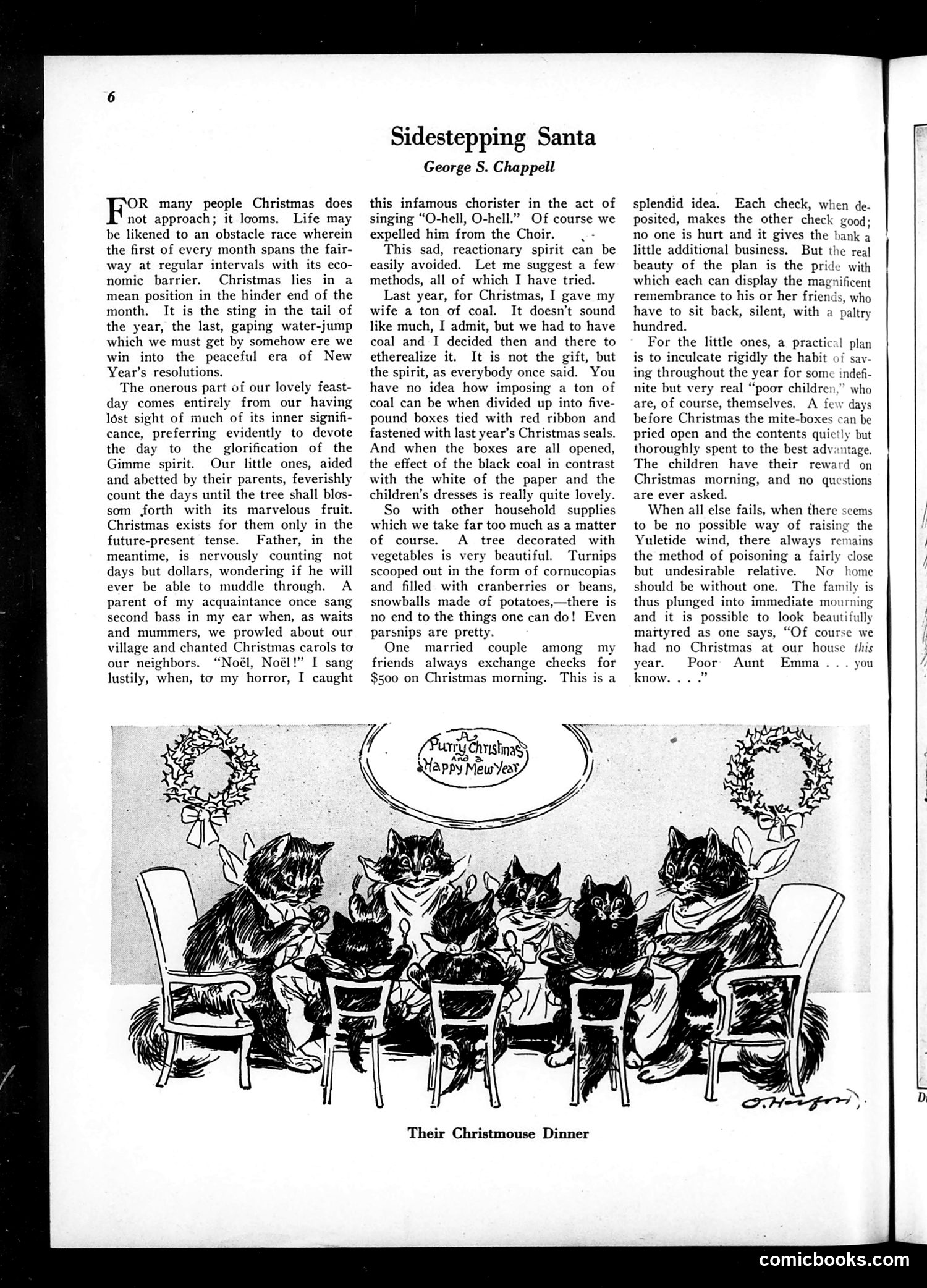
This is a humorous essay by George S. Chappell about managing Christmas expenses during economically challenging times. The author describes practical alternatives to expensive gifts: giving coal (divided into smaller boxes with ribbons), decorating with household items like vegetables, and exchanging small checks instead of presents. The accompanying illustration shows cats dining together at a formal table with wreaths and a "Merry Christmas & Happy New Year" banner—a whimsical visual pun on "their Christmouse dinner" (mice/mouse being cats' natural prey). The overall satirical point targets the commercialization of Christmas and suggests that meaningful celebrations don't require expensive purchases—a commentary relevant to readers facing financial constraints, likely during an economic downturn in the early 20th century.
📄 Transcribed text from this page (OCR, searchable)
Machine-transcribed from the original scan — historical spelling and the odd misread are preserved.
OR many people Christmas does not approach; it looms. Life may be likened to an obstacle race wherein the first of every month spans the fair- way at regular intervals with its eco- nomic barrier. Christmas lies in a mean position in the hinder end of the month. It is the sting in the tail of the year, the last, gaping water-jump which we must get by somehow ere we win into the peaceful era of New Year’s resolutions. The onerous part of our lovely feast- day comes entirely from our having lést sight of much of its inner signifi- cance, preferring evidently to devote the day to the glorification of the Gimme spirit. Our little ones, aided and abetted by their parents, feverishly count the days until the tree shall blos- som forth with its marvelous fruit. Christmas exists for them only in the future-present tense. Father, in the meantime, is nervously counting not days but dollars, wondering if he will ever be able to muddle through. A parent of my acquaintance once sang second bass in my ear when, as waits and mummers, we prowled about our village and chanted Christmas carols to our neighbors. ‘‘Noél, Noél!” I sang lustily, when, to my horror, I caught Sidestepping Santa George S. Chappell this infamous chorister in the act of singing “O-hell, O-hell.” Of course we expelled him from the Choir. This sad, reactionary spirit can be easily avoided. Let me suggest a few methods, all of which I have tried. Last year, for Christmas, I gave my wife a ton of coal. It doesn’t sound like much, I admit, but we had to have coal and I decided then and there to etherealize it. It is not the gift, but the spirit, as everybody once said. You have no idea how imposing a ton of coal can be when divided up into five- pound boxes tied with red ribbon and fastened with last year’s Christmas seals. And when the boxes are all opened, the effect of the black coal in contrast with the white of the paper and the children’s dresses is really quite lovely. So with other household supplies which we take far too much as a matter of course. A tree decorated with vegetables is very beautiful. Turnips scooped out in the form of cornucopias and filled with cranberries or beans, snowballs made of potatoes,—there is no end to the things one can do! Even parsnips are pretty. One married couple among my friends always exchange checks for $500 on Christmas morning. This is a ¥ ‘a (Sexi rnsing Ya Pav Mew ey) Mel ae, Their Christmouse Dinner splendid idea. Each check, when de- posited, makes the other check good; no one is hurt and it gives the bank a little additional business. But the real beauty of the plan is the pride with which each can display the magnificent remembrance to his or her friends, who have to sit back, silent, with a paltry hundred. For the little ones, a practical plan is to inculcate rigidly the habit of sav- ing throughout the year for some indefi- nite but very real “poor children,” who are, of course, themselves. A fe before Christmas the mite-box: pried open and the contents quietly thoroughly spent to the best adv The children have their rewar Christmas morning, and no questions are ever asked. When all else fails, when there scems to be no possible way of raisin Yuletide wind, there always rer the method of poisoning a fairly close but undesirable relative. No home should be without one. The family is thus plunged into immediate mourning and it is possible to look beautifully martyred as one says, “Of course we had no Christmas at our house this year. Poor Aunt Emma... you know. .. .” comicbooks.com