
Life, 1921-12-01 · page 26 of 58
Life — December 1, 1921 — page 26: what you’re looking at
What you’re looking at
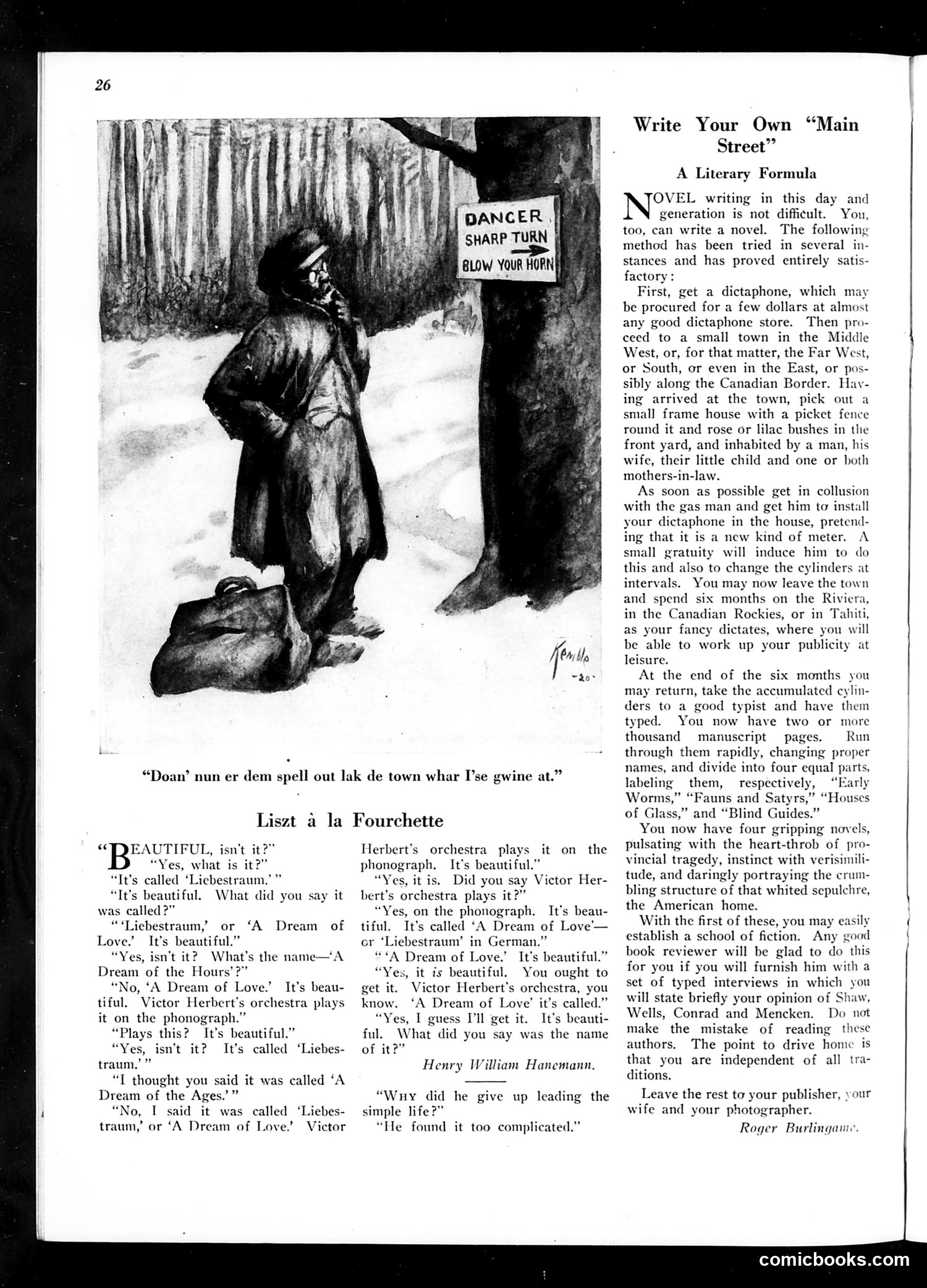
This page contains two satirical pieces from *Life* magazine: **Top Cartoon:** A dialect-humor sketch mocking rural/Southern speech patterns. A traveler asks directions using nonstandard English ("Doan' nun er dem spell out..."), while a road sign warns of a sharp turn ahead. The joke relies on early-20th-century stereotyping of African American or rural Southern speech as comic material. **"Liszt à la Fourchette":** A absurdist dialogue poking fun at pretentious music appreciation. Two people repeatedly discuss a classical piece, constantly confusing its title (*Liebestraum* vs. *A Dream of Love* vs. *Dream of the Hours*), yet insisting it's "beautiful" without understanding what they're discussing. It satirizes performative cultural sophistication and mindless repetition. **"Write Your Own 'Main Street'":** A tongue-in-cheek literary formula mocking the then-popular trend of earnest small-town American novels (referencing Sinclair Lewis's *Main Street*). The joke: hire a dictaphone, hide it in a small-town house, disappear for six months, then edit the recorded conversations into four "profound" novels—satirizing both the formulaic nature of such fiction and pretentious literary marketing.
📄 Transcribed text from this page (OCR, searchable)
Machine-transcribed from the original scan — historical spelling and the odd misread are preserved.
‘DANCER, # SHARP TURN BLOW YOUR HORN “Doan’ nun er dem spell out lak de town whar I’se gwine at.” Liszt a la Fourchette “ AUTIFUL, isn’t it?” “Yes, what is it?” “It's called ‘Liebestraum.’ “It's beautiful. What did you say it was called?” “‘Liebestraum, or ‘A Love.’ It's beautiful.” “Yes, isn’t it? What’s the name. Dream of the Hours’?” “No, ‘A Dream of Love.’ It’s beau- tiful. Victor Herbert's orchestra plays it on the phonograph.” “Plays this? It’s beautiful.” “Yes, isn’t it? It’s called traum,’” “I thought you said it was called ‘A Dream of the Ages.’” “No, I said it was called Dream of A ‘Liebes- ‘Liebes- Victor traum,’ or ‘A Dream of Love,’ Herbert’s orchestra plays it on the phonograph. It's beautiful. “Yes, it is. Did you say bert’s orchestra plays it?” “Yes, on the phonograph. It's beau- tiful. It’s called ‘A Dream of Love’— cr ‘Liebestraum’ in German.” “*A Dream of Love.’ It’s beautiful.” “Yes, it is beautiful. You ought to Victor Her- get it. Victor Herbert’s orchestra, you know. ‘A Dream of Love’ it’s called.” “Yes, I guess I'll get it. It’s beauti- ful. What did you say was the name of it?” Henry William Hanemann, “Wuy did he give up leading the simple life?” “He found it too complicated.” Write Your Own “Main Street” A Literary Formula OVEL writing in this day and generation is not difficult. You, too, can write a novel. The following method has been tried in several in- stances and has proved entirely satis- factory: First, get a dictaphone, which may be procured for a few dollars at almost any good dictaphone store. Then pro- ceed to a small town in the Middle West, or, for that matter, the Far West, or South, or even in the East, or pos- sibly along the Canadian Border. Havy- ing arrived at the town, pick out a small frame house with a picket fence round it and rose or lilac bushes in the front yard, and inhabited by a man, his wife, their little child and one or both mothers-in-law. As soon as possible get in collusion with the gas man and get him to install your dictaphone in the house, pretend- ing that it is a new kind of meter. A small gratuity will induce him to do this and also to change the cylinders at intervals. You may now leave the town and spend six months on the Riviera, in the Canadian Rockies, or in Tahiti, as your fancy dictates, where you will be able to work up your publicity at leisure. At the end of the six months you may return, take the accumulated cylin- ders to a good typist and have them typed. You now have two or more thousand manuscript pages. Run through them rapidly, changing proper names, and divide into four equal parts, labeling them, respectively, “Early Worms,” “Fauns and Satyrs,” “Houses of Glass,” and “Blind Guides.” You now have four gripping novels, pulsating with the heart-throb of pro- vincial tragedy, instinct with verisimili- tude, and daringly portraying the crum- bling structure of that whited sepulchre, the American home. With the first of these, you may easily establish a school of fiction. Any good book reviewer will be glad to do this for you if you will furnish him with a set of typed interviews in which you will state briefly your opinion of Shaw, Wells, Conrad and Mencken. Do not make the mistake of reading these authors. The point to drive home is that you are independent of all tra- ditions. Leave the rest to your publisher, your wife and your photographer. Roger Burlinganie. comicbooks.com