
Life, 1921-12-01 · page 46 of 58
Life — December 1, 1921 — page 46: what you’re looking at
What you’re looking at
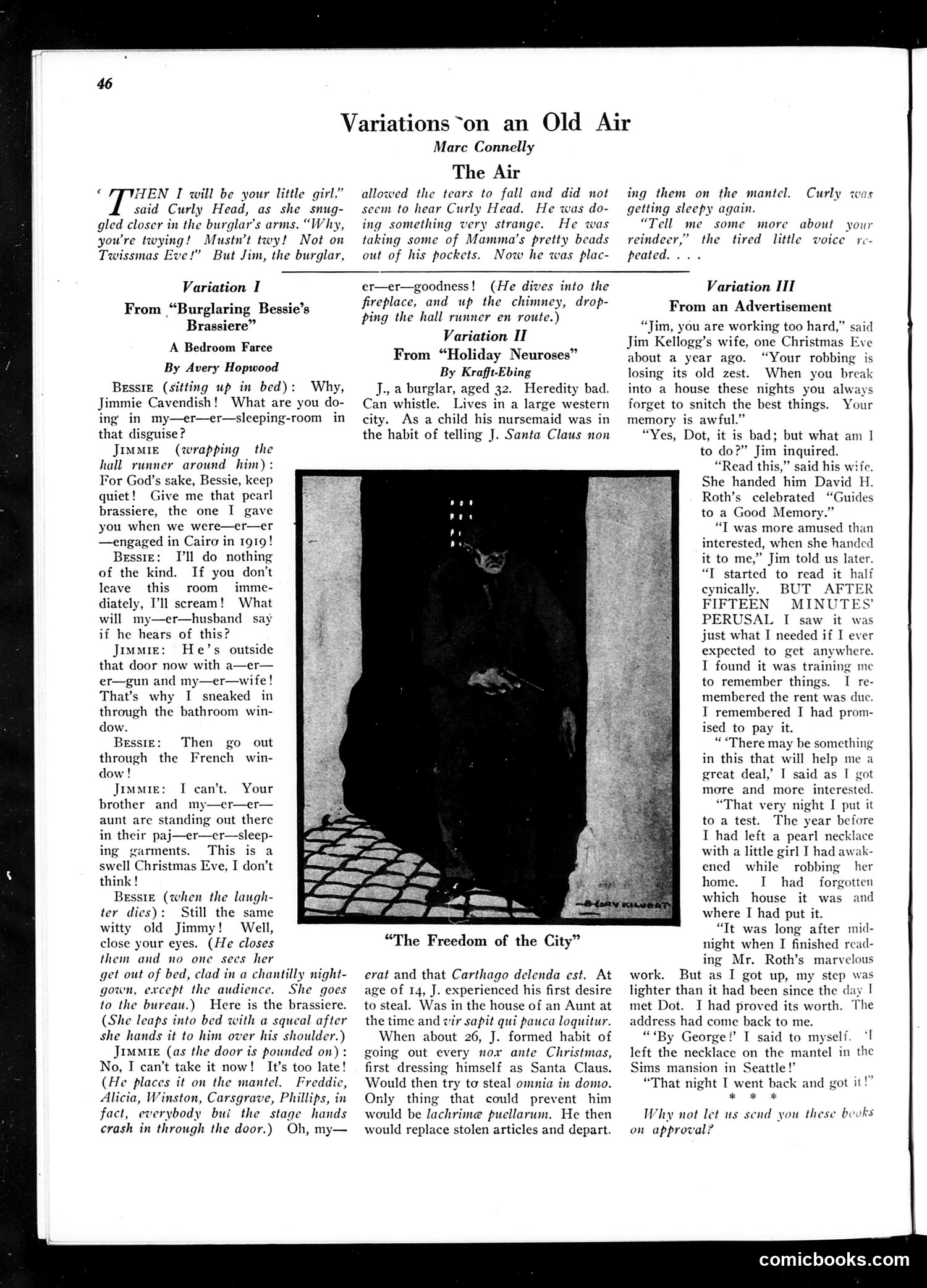
This page from *Life* magazine presents three satirical parodies of a sentimental Christmas story about a burglar who returns stolen items upon seeing a child's innocence. **The three variations mock different literary genres:** 1. **"Burglaring Bessie's Brassiere"** (by Avery Hopwood) parodies bedroom farces—drawing-room comedies popular in early 20th-century theater—by adding absurdist complications (multiple armed relatives, pajama-clad relatives outside). 2. **"Holiday Neuroses"** (credited to Krafft-Ebing, referencing the famous sexologist) parodies psychological case studies, presenting the burglar's compulsion in pseudo-clinical Latin, mocking the era's amateur psychoanalysis craze. 3. **"From an Advertisement"** parodies self-help advertising by having the burglar discover a memory-improvement book that ironically reminds him to pay his rent—deflating both the original sentiment and commercialized wellness culture. The satire targets sentimental Christmas narratives and period literary/advertising conventions simultaneously.
📄 Transcribed text from this page (OCR, searchable)
Machine-transcribed from the original scan — historical spelling and the odd misread are preserved.
Variations~on an Old Air € (ey I will be your little girl,” said Curly Head, as she snug- gled closer in the burglar’s arms. “Why, you're twyin! Mustn’t twy! Not on Twissmas Eve!” But Jim, the burglar, Marc Connelly The Air allowed the tears to fall and did not seem to hear Curly Head. He was do- ing something very strange. He was taking some of Mamma’s pretty beads out of his pockets. Now he was plac- ing them on the mantel. getting sleepy again. “Tell me some reindeer,” the peated... . Curly more about tired little your voice re- Variation I From “Burglaring Bessie’s Brassiere” A Bedroom Farce By Avery Hopwood Bessie (sitting up in bed): Why, Jimmie Cavendish! What are you do- ing in my—er—er—sleeping-room in that disguise? Jimmie (wrapping the hall runner around him): For God’s sake, Bessie, keep quiet! Give me that pearl brassiere, the one I gave you when we were—er—er —engaged in Cairo in 1919! Bessie: I’ll do nothing of the kind. If you don’t leave this room imme- diately, I’ll scream! What will my—er—husband say if he hears of this? Jimmie: He’s outside that door now with a—er— er—gun and my—er—wife! That’s why I sneaked in through the bathroom win- dow. Bessie: through the dow! Jimmie: I can’t. Your brother and my—er—er— aunt are standing out there in their paj—er—er—sleep- ing garments. This is a swell Christmas Eve, I don’t think ! Bessie (when the laugh- ter dies): Still the same witty old Jimmy! Well, close your eyes. (He closes them and no one sees her get out of bed, clad in a chantilly night- gown, except the audience. She goes to the bureau.) Here is the brassiere. (She leaps into bed with a squeal after she hands it to him over his shoulder.) Jimmie (as the door is pounded on): No, I can't take it now! It’s too late! (He places it on the mantel. Freddie, Alicia, Winston, Carsgrave, Phillips, in fact, everybody bui the stage hands crash in through the door.) Oh, my— out win- Then go French er—er—goodness! (He dives into the fireplace, and up the chimney, drop- ping the hall runner en route.) Variation II From “Holiday Neuroses” By Krafft-Ebing J., a burglar, aged 32. Heredity bad. Can whistle. Lives in a large western city. As a child his nursemaid was in the habit of telling J. Santa Claus non “The Freedom of the City” erat and that Carthago delenda est. At age of 14, J. experienced his first desire to steal. Was in the house of an Aunt at the time and vir sapit qui pauca loquitur. When about 26, J. formed habit of going out every nox ante Christmas, first dressing himself as Santa Claus. Would then try to steal omnia in domo. Only thing that could prevent him would be lachrim@ puellarum. He then would replace stolen articles and depart. Variation III From an Advertisement “Jim, you are working too hard,” said Jim Kellogg’s wife, one Christmas Eve about a year ago. “Your robbing is losing its old zest. When you break into a house these nights you always forget to snitch the best things. Your memory is awful.” “Yes, Dot, it is bad; but what am | to do?” Jim inquired. “Read this,” said his . She handed him David H. Roth’s celebrated “Guides to a Good Memory.” “T was more amused than interested, when she handed it to me,” Jim told us later. “T started to read it half cynically, BUT AFTE FIFTEEN MINUTE PERUSAL I saw it was just what I needed if I ever expected to get anywhere. I found it was training me to remember things. I re- membered the rent was due. I remembered I had prom- ised to pay it. ““There may be something in this that will help me a great deal,’ I said as I got more and more interested. “That very night I put it to a test. The year before I had left a pearl necklace with a little girl I had awak- ened while robbing her home. I had _ forgotten which house it was and where I had put it. “Tt was long after mid- night when I finished read- ing Mr. Roth’s marvelous work. But as I got up, my step was lighter than it had been since the day I met Dot. I had proved its worth. The address had come back to me. “‘By George!’ I said to myself. ‘I left the necklace on the mantel in the Sims mansion in Seattle!’ “That night I went back and got it!” * * * Why not let us send you these b on approval? comicbooks.com