
Life, 1921-12-01 · page 25 of 58
Life — December 1, 1921 — page 25: what you’re looking at
What you’re looking at
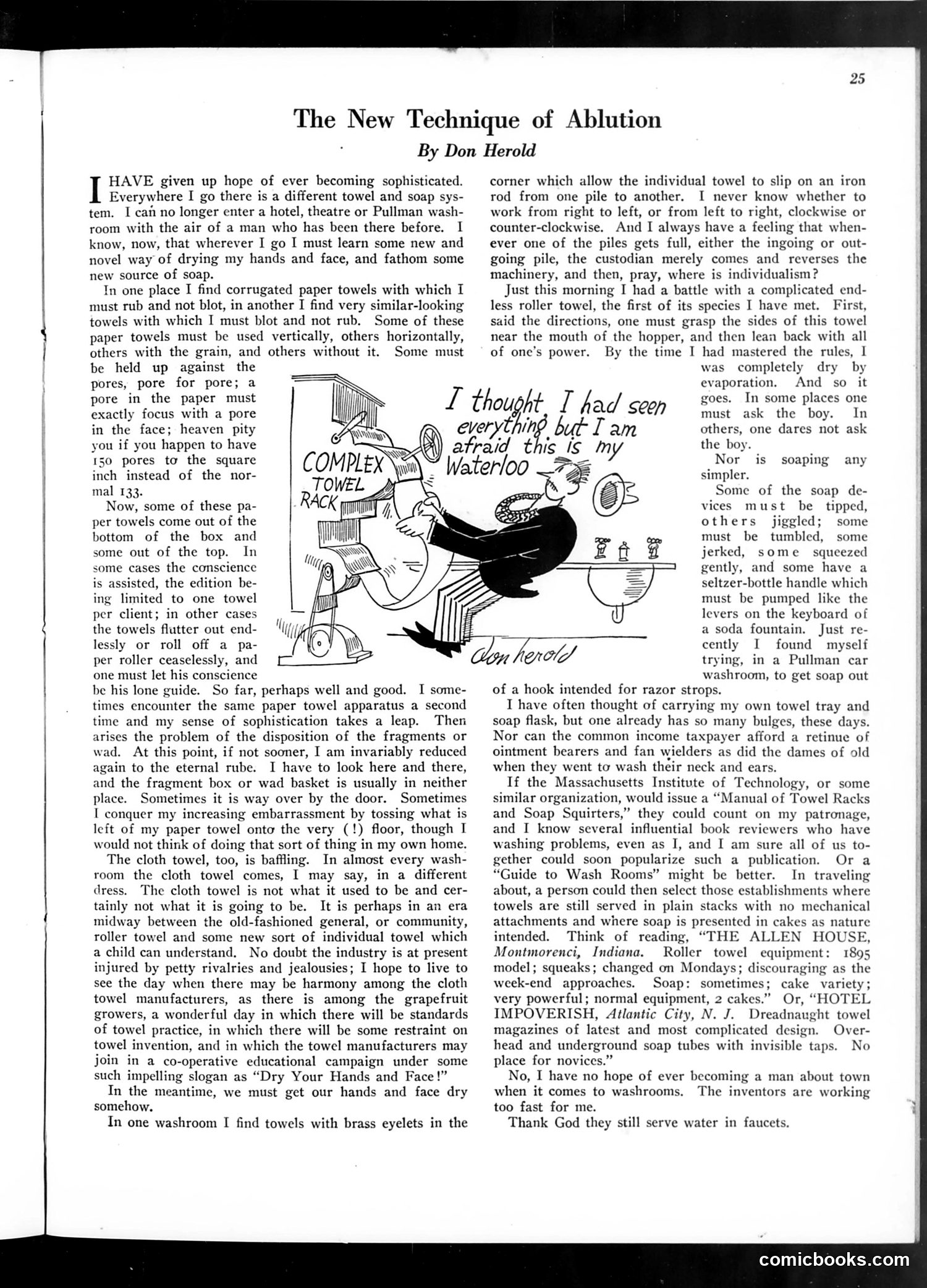
This is a humorous essay satirizing the bewildering proliferation of different towel and soap systems in American public washrooms (hotels, theaters, trains). The cartoon illustration shows a man overwhelmed by an absurdly complex towel-drying apparatus. Herold's satire targets the rapid industrialization and over-innovation of everyday conveniences in early 20th-century America. Rather than improving life, manufacturers' competitive "petty rivalries" create confusion—each washroom features different designs, sizes, and operating methods. The author cannot enter a public restroom with confidence; he must constantly relearn basic procedures. The joke is that this supposedly "modern" progress actually reduces sophisticated, educated people to confused "rubes" (rural simpletons). Herold advocates for industry standardization and cooperation, even joking about a campaign slogan: "Dry Your Hands and Face!" The piece mocks how technological innovation, unchecked by standards or coordination, paradoxically complicates rather than simplifies ordinary life.
📄 Transcribed text from this page (OCR, searchable)
Machine-transcribed from the original scan — historical spelling and the odd misread are preserved.
—A——— HAVE given up hope of ever becoming sophisticated. Everywhere I go there is a different towel and soap sys- tem. I can no longer enter a hotel, theatre or Pullman wash- room with the air of a man who has been there before. I know, now, that wherever I go I must learn some new and novel way of drying my hands and face, and fathom some new source of soap. In one place I find corrugated paper towels with which I must rub and not blot, in another I find very similar-looking towels with which I must blot and not rub. Some of these paper towels must be used vertically, others horizontally, others with the grain, and others without it. Some must be held up against the pores, pore for pore; a pore in the paper must exactly focus with a pore in the face; heaven pity you if you happen to have 150 pores to the square inch instead of the nor- mal 133. Now, some of these pa- per towels come out of the bottom of the box and some out of the top. In some cases the conscience is assisted, the edition be- ing limited to one towel per client; in other cases the towels flutter out end- lessly or roll off a pa- per roller ceaselessly, and one must let his conscience be his lone guide. So far, perhaps well and good. I some- times encounter the same paper towel apparatus a second time and my sense of sophistication takes a leap. Then arises the problem of the disposition of the fragments or wad. At this point, if not sooner, I am invariably reduced again to the eternal rube. I have to look here and there, and the fragment box or wad basket is usually in neither place. Sometimes it is way over by the door. Sometimes I conquer my increasing embarrassment by tossing what is left of my paper towel onto the very (!) floor, though I would not think of doing that sort of thing in my own home. The cloth towel, too, is baffling. In almost every wash- room the cloth towel comes, I may say, in a different dress. The cloth towel is not what it used to be and cer- tainly not what it is going to be. It is perhaps in an era midway between the old-fashioned general, or community, roller towel and some new sort of individual towel which a child can understand. No doubt the industry is at present injured by petty rivalries and jealousies; I hope to live to see the day when there may be harmony among the cloth towel manufacturers, as there is among the grapefruit growers, a wonderful day in which there will be standards of towel practice, in which there will be some restraint on towel invention, and in which the towel manufacturers may join in a co-operative educational campaign under some such impelling slogan as “Dry Your Hands and Face!” In the meantime, we must get our hands and face dry somehow. In one washroom I find towels with brass eyelets in the The New Technique of Ablution By Don Herold corner which allow the individual towel to slip on an iron rod from one pile to another. I never know whether to work from right to left, or from left to right, clockwise or counter-clockwise. And I always have a feeling that when- ever one of the piles gets full, either the ingoing or out- going pile, the custodian merely comes and reverses the machinery, and then, pray, where is individualism? Just this morning I had a battle with a complicated less roller towel, the first of its species I have met. F said the directions, one must grasp the sides of this towel near the mouth of the hopper, and then lean back with all of one’s power. By the time I had mastered the rules, I was completely dry by evaporation. And so it I thou ot LT had seen goes. In some places one Pie but I am atraid this Is Waterloo 7% must ask the boy. In others, one dares not ask the boy. ny Nor is simpler. Some of the soap de- vices must be tipped, others jiggled; some must be tumbled, some jerked, some squeezed gently, and some have a seltzer-bottle handle which must be pumped like the levers on the keyboard of a soda fountain. Just re- cently I found myself trying, in a Pullman car washroom, to get soap out of a hook intended for razor strops. T have often thought of carrying my own towel tray and soap flask, but one already has so many bulges, these days. Nor can the common income taxpayer afford a retinue of ointment bearers and fan wielders as did the dames of old when they went to wash their neck and ears. If the Massachusetts Institute of Technology, or some similar organization, would issue a “Manual of Towel Racks and Soap Squirters,” they could count on my patronage, and I know several influential book reviewers who have washing problems, even as I, and I am sure all of us to- gether could soon popularize such a publication. Or a “Guide to Wash Rooms” might be better. In traveling about, a person could then select those establishments where towels are still served in plain stacks with no mechanical attachments and where soap is presented in cakes as nature intended. Think of reading, “THE AL HOUS Montmorenci, Indiana. Roller towel equipment: 1895 model; squeaks; changed on Mondays; discouraging as the week-end approaches. Soap: sometimes; cake variety; very powerful; normal equipment, 2 cakes.” Or, “HOTEL IMPOVERISH, Atlantic City, N. J. Dreadnaught towel magazines of latest and most complicated design. Over- head and underground soap tubes with invisible taps. No place for novices.” No, I have no hope of ever becoming a man about town when it comes to washrooms. The inventors are working too fast for me. Thank God they still serve water in faucets. soaping any comicbooks.com