
Life, 1921-12-01 · page 35 of 58
Life — December 1, 1921 — page 35: what you’re looking at
What you’re looking at
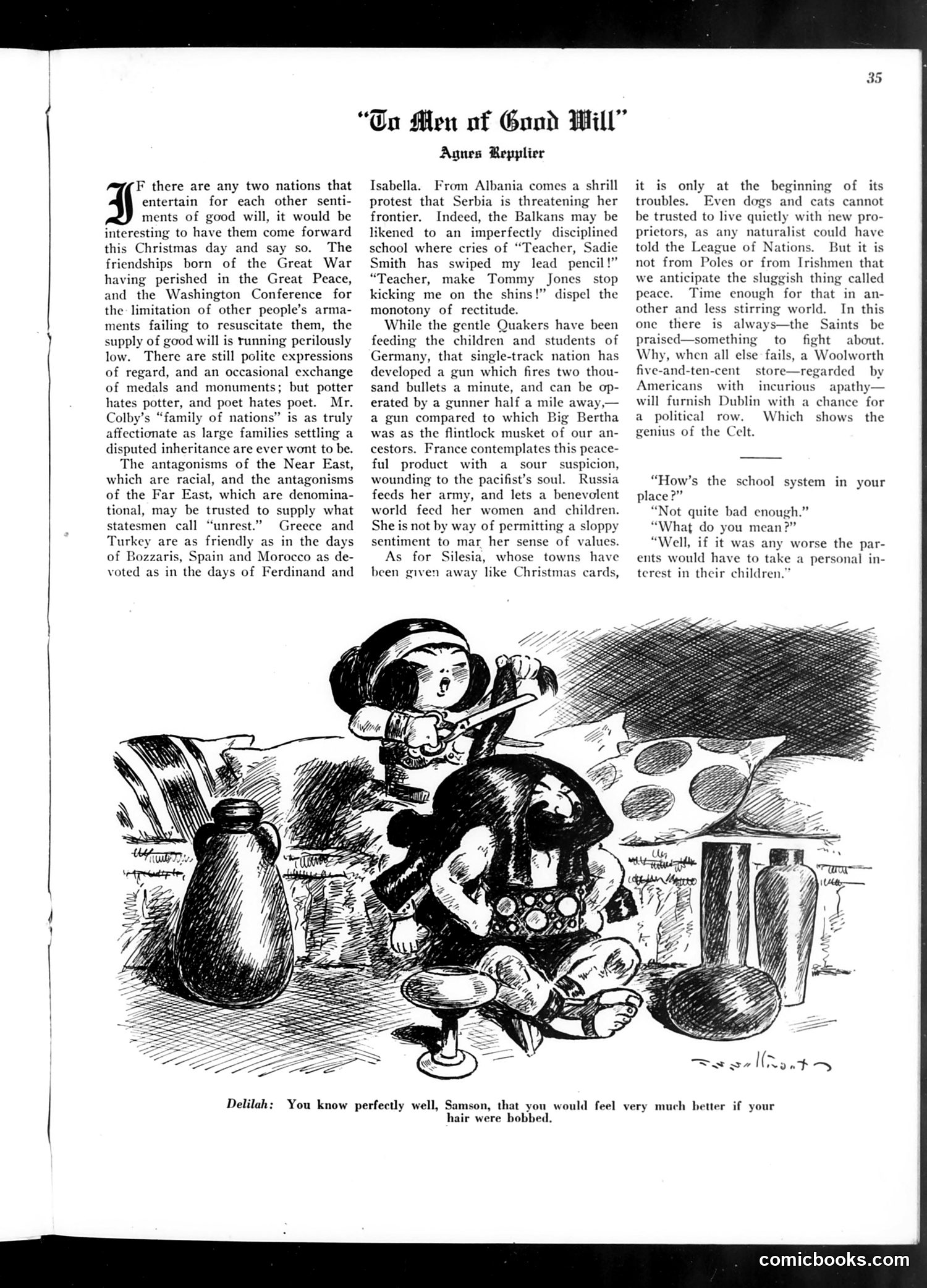
This is Agnes Repplier's satirical essay on post-WWI international relations, accompanied by an unrelated cartoon joke about Samson and Delilah. **The Essay's Context:** Written after WWI and the failed Washington Conference on disarmament, Repplier argues that nations supposedly united by wartime alliance now despise each other. She catalogs specific tensions: Greek-Turkish hostility, Balkan squabbles (depicted as schoolchildren fighting), Germany secretly building advanced weapons despite pacifist hopes, Russia's opportunism, and the unstable partition of Silesia. The tone is darkly comic—she notes that even Quakers feeding German children can't prevent German rearmament, and that ancient rivalries (Ferdinand-Isabella, Spain-Morocco) persist unchanged. **The Cartoon:** Shows Delilah suggesting Samson get a "bob" (1920s short haircut). It's a separate joke about fashion trends of the era, unrelated to the essay's geopolitical pessimism. **The Overall Point:** The essay's title is ironic—despite Christmas appeals to "goodwill," nations remain fundamentally antagonistic, driven by suspicion and self-interest rather than peace.
📄 Transcribed text from this page (OCR, searchable)
Machine-transcribed from the original scan — historical spelling and the odd misread are preserved.
F there are any two nations that entertain for each other senti- ments of good will, it would be interesting to have them come forward this Christmas day and say so. The friendships born of the Great War having perished in the Great Peace, and the Washington Conference for the limitation of other people’s arma- ments failing to resuscitate them, the supply of good will is running perilously low. There are still polite expressions of regard, and an occasional exchange of medals and monuments; but potter hates potter, and poet hates poet. Mr. Colby’s “family of nations” is as truly affectionate as large families settling a disputed inheritance are ever wont to be. The antagonisms of the Near East, which are racial, and the antagonisms of the Far East, which are denomina- tional, may be trusted to supply what statesmen call “unrest.” Greece and Turkey are as friendly as in the days of Bozzaris, Spain and Morocco as de- voted as in the days of Ferdinand and “Cn Men of Good Will” Agues Bepplier Isabella. From Albania comes a shrill protest that Serbia is threatening her frontier. Indeed, the Balkans may be likened to an imperfectly disciplined school where cries of “Teacher, Sadie Smith has swiped my lead _ pencil!” “Teacher, make Tommy Jones stop kicking me on the shins!” dispel the monotony of rectitude. While the gentle Quakers have been feeding the children and students of Germany, that single-track nation has developed a gun which fires two thou- sand bullets a minute, and can be op- erated by a gunner half a mile away,— a gun compared to which Big Bertha was as the flintlock musket of our an- cestors. France contemplates this peace- ful product with a sour suspicion, wounding to the pacifist’s soul. Russia feeds her army, and lets a benevolent world feed her women and children. She is not by way of permitting a sloppy sentiment to mar her sense of values. As for Silesia, whose towns have been given away like Christmas cards, it is only at the beginning of its troubles. Even dogs and cats cannot be trusted to live quictly with new pro- prietors, as any naturalist could have told the League of Nations. But it is not from Poles or from Irishmen that we anticipate the sluggish thing called peace. Time enough for that in an- other and less stirring world. In this one there is always—the Saints be praised—something to fight about. Why, when all else fails, a Woolworth five-and-ten-cent store—regarded by Americans with incurious apathy— will furnish Dublin with a chance for a political row. Which shows the genius of the Celt. “How’s the school system in your place?” “Not quite bad enough.” “What do you mean?” “Well, if it was any worse the par- ents would have to take a personal in- terest in their children.” Delilah: hair were bobbed. You know perfectly well, Samson, that you would feel very much better if your comicbooks.com