
Life, 1921-12-01 · page 22 of 58
Life — December 1, 1921 — page 22: what you’re looking at
What you’re looking at
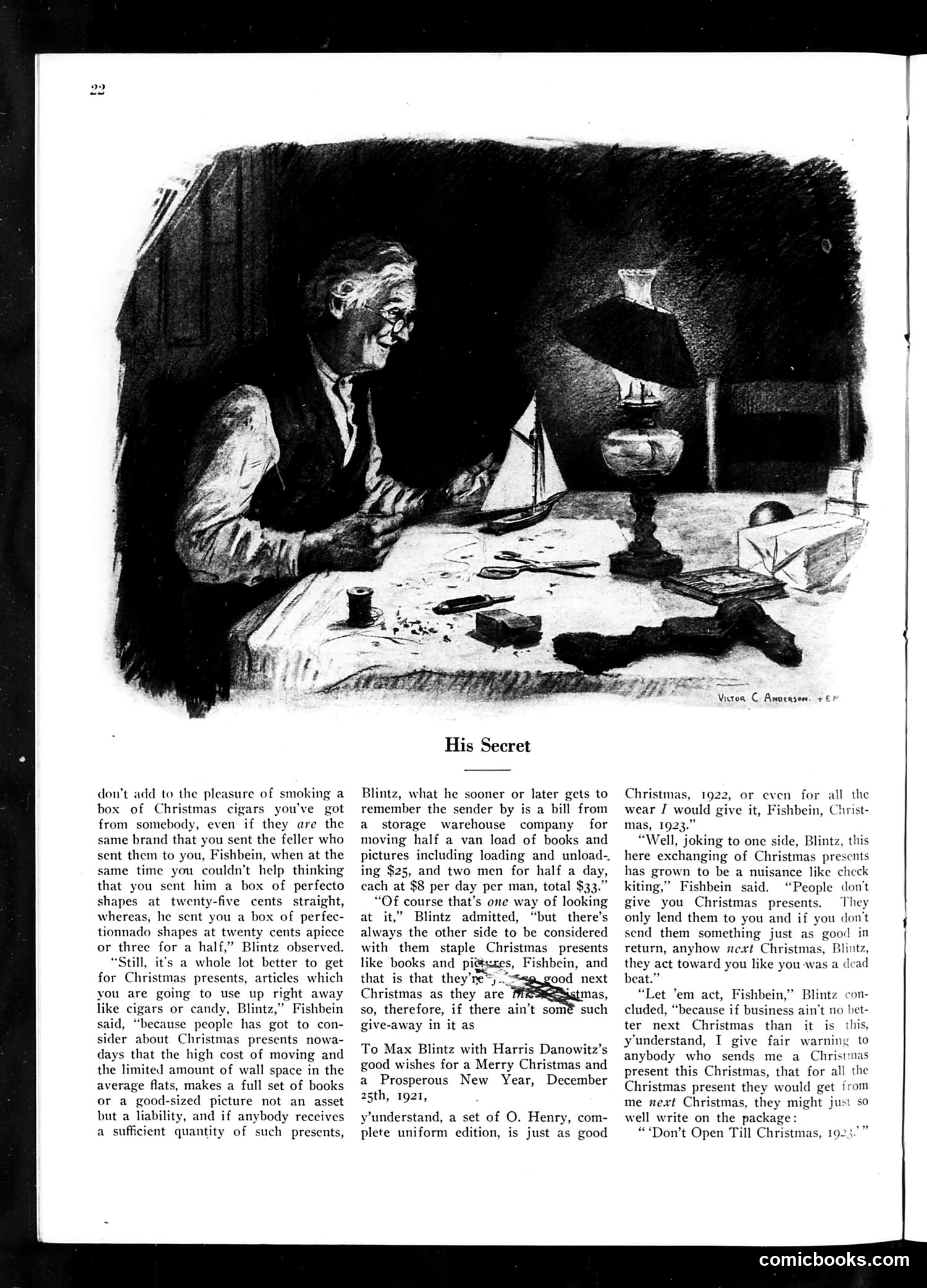
This is a satirical dialogue between two working-class characters, Blintz and Fishbein, discussing the burden of Christmas gift-giving etiquette during economically tight times (post-WWI recession). **The Joke:** The men debate whether to give practical consumables (cigars, candy) or lasting gifts (books, pictures). Fishbein points out that lasting gifts become financial *liabilities*—storage warehouse fees ($33 mentioned) eat up savings. Blintz cynically concludes the whole exchange has become a coercive obligation rather than genuine giving. **The Satire:** The cartoon mocks how Christmas gifting, supposedly about goodwill, has devolved into a transactional burden where people "lend" gifts expecting equal-value returns, or risk being treated "like a dead beat." **The Context:** December 1921 was economically difficult; the cartoon reflects real anxiety about affording holiday customs. The working-class dialect and characters suggest Life was satirizing middle and lower-middle-class anxieties about maintaining social appearances despite financial strain.
📄 Transcribed text from this page (OCR, searchable)
Machine-transcribed from the original scan — historical spelling and the odd misread are preserved.
don’t add to the pleasure of smoking a box of Christmas cigars you've got from somebody, even if they are the same brand that you sent the feller who sent them to you, Fishbein, when at the same time you couldn’t help thinking that you sent him a box of perfecto shapes at twenty-five cents straight, whereas, he sent you a box of perfec- tionnado shapes at twenty cents apiece or three for a half,” Blintz observed. “Still, it's a whole lot better to get for Christmas presents, articles which you are going to use up right away like cigars or candy, Blintz,” Fishbein said, “because people has got to con- sider about Christmas presents nowa- days that the high cost of moving and the limited amount of wall space in the average flats, makes a full set of books or a good-sized picture not an asset but a liability, and if anybody receives a sufficient quantity of such presents, His Secret Blintz, what he sooner or later gets to remember the sender by is a bill from a storage warehouse company for moving half a van load of books and pictures including loading and unload-. ing $25, and two men for half a day, cach at $8 per day per man, total $33.” “Of course that’s one way of looking at it,” Blintz admitted, “but there’s always the other side to be considered with them staple Christmas presents like books and piészes, Fishbein, and that is that they’re>, ood next Christmas as they are hii at so, therefore, if there ain’t som@ such give-away in it as To Max Blintz with Harris Danowitz’s good wishes for a Merry Christmas and a Prosperous New Year, December 25th, 1921, y’understand, a set of O. Henry, com- plete uniform edition, is just as good Viton C Awoersen. + €r Christmas, 1922, or even for all the wear I would give it, Fishbein, Christ- mas, 1923.” “Well, joking to one side, Blintz, this here exchanging of Christmas presents has grown to be a nuisance like check kiting,” Fishbein said. “People don't give you Christmas presents. They only lend them to you and if you don't send them something just as good in return, anyhow next Christmas, Blintz, they act toward you like you-was a dead beat.” “Let ‘em act, Fishbein,” Blintz con- cluded, “because if business ain't no bet- ter next Christmas than it is this, yunderstand, I give fair warning to anybody who sends me a Christnas present this Christmas, that for all the Christmas present they would get from me next Christmas, they might just so well write on the package: “Don’t Open Till Christmas, 1923."” comicbooks.com