
A complete issue · 44 pages · 1920
Life — December 9, 1920
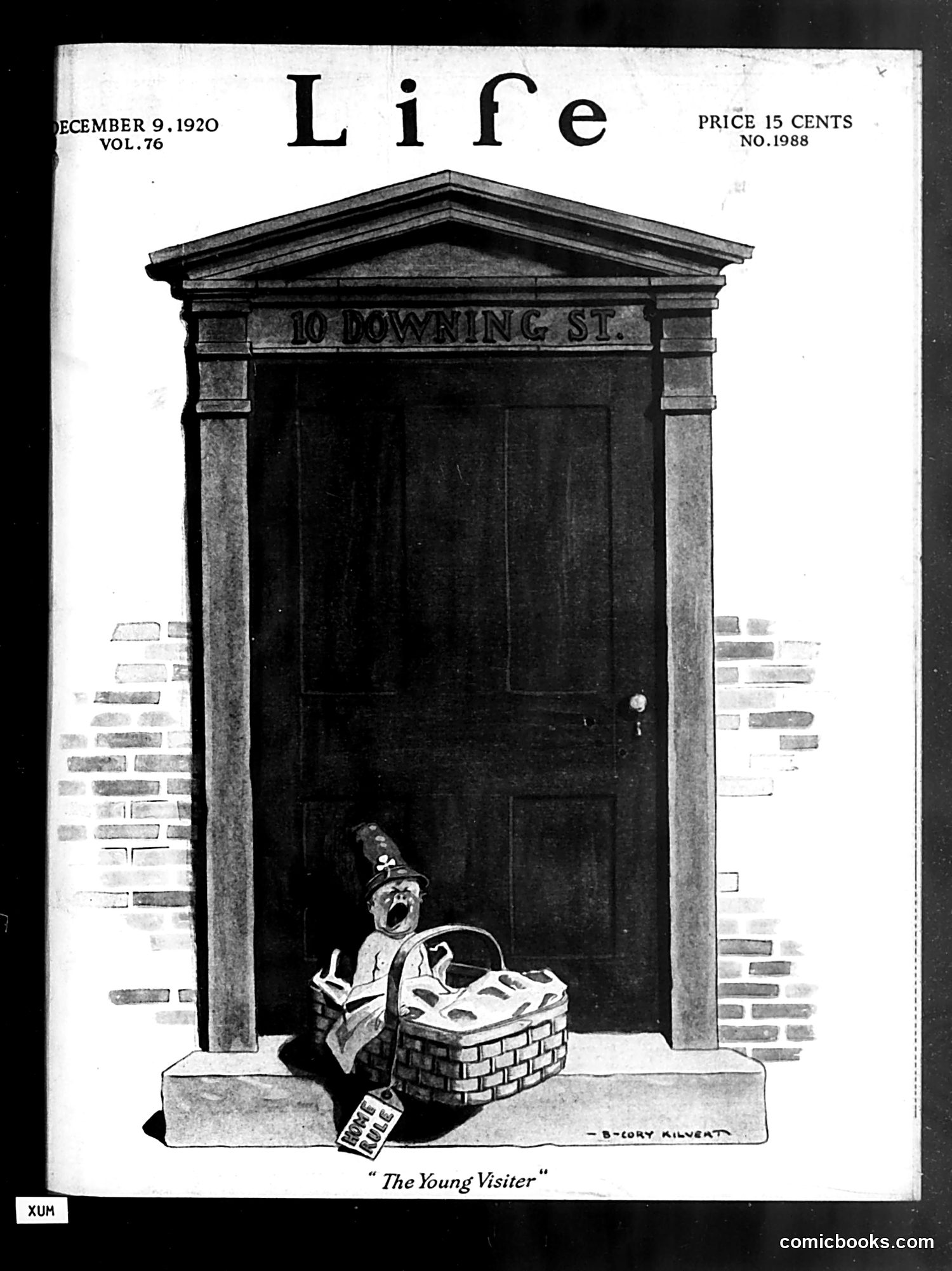
This cartoon, signed by Cesare Rimini, depicts a baby or small child sitting at the doorstep of 10 Downing Street (the British Prime Minister's residence) with a basket. The infant appears distressed or crying. The cartoon likely satirizes the post-WWI political situation in Britain, though the specific reference is unclear without additional context. The "young visitor" could reference a new political issue, crisis, or unwanted problem literally being "delivered" to the Prime Minister's door. The basket suggests either an abandoned burden being left for the government to handle, or possibly references wartime/postwar conditions affecting children and families. The satire critiques how Britain's leadership must address urgent social problems thrust upon them.
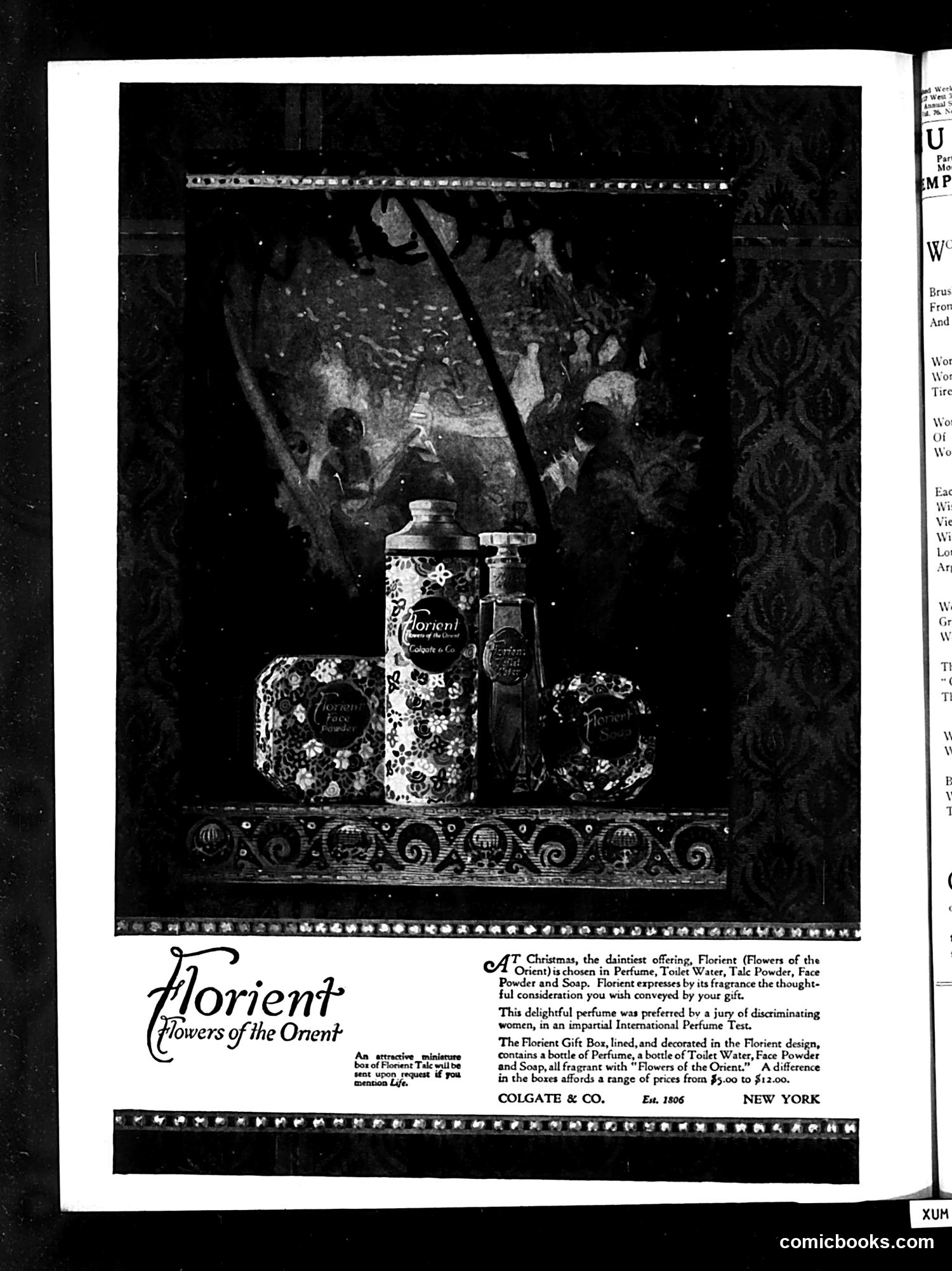
This page is **not a political cartoon or satire—it is a commercial advertisement** for Florient perfume by Colgate & Co., established 1806 in New York. The ad promotes a luxury gift box containing perfume, toilet water, face powder, and soap, all scented with "Flowers of the Orient." The copy emphasizes that the product was "preferred by a jury of discriminating women" in an "impartial International Perfume Test." The image shows ornately decorated bottles and containers arranged on a decorative shelf, styled to evoke exotic orientalism—a common marketing aesthetic of the early 20th century. The ad promises price options ranging from $3.00 to $12.00. This is purely commercial content, not editorial satire.
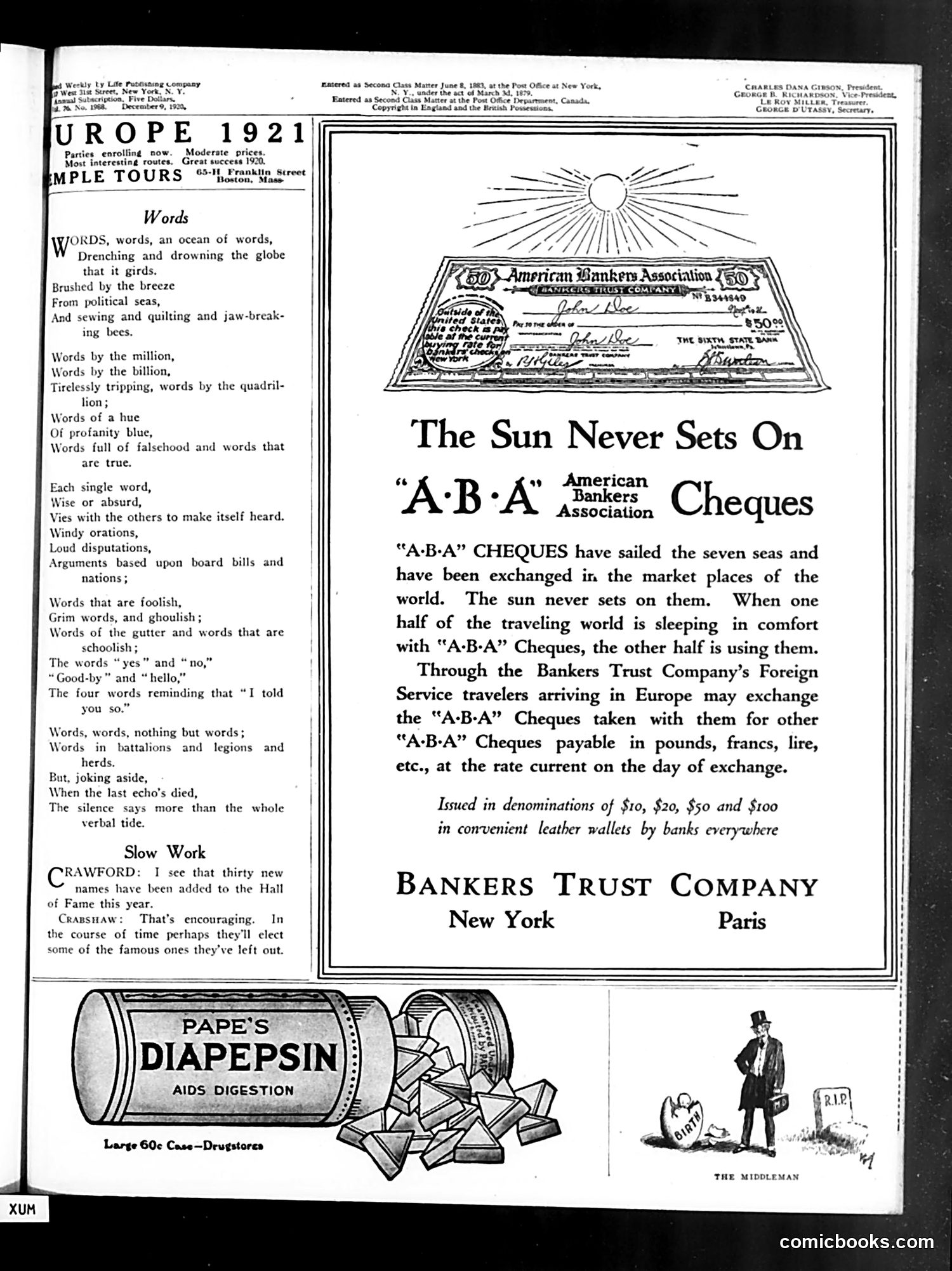
This page is primarily **advertising**, not political satire. The dominant content advertises: 1. **"A·B·A" American Bankers Association Cheques** — traveler's checks promoted as globally accepted currency ("The Sun Never Sets On" them), issued by Bankers Trust Company with offices in New York and Paris. 2. **Pape's Diapepsin** — a digestive aid medication. The only cartoon is a small illustration titled "The Middleman" showing a well-dressed man in a top hat standing between a gravestone and a "Dirt" sign. This appears to be social commentary on an intermediary or opportunist profiting from others' misfortune, though the specific reference is unclear without additional context.
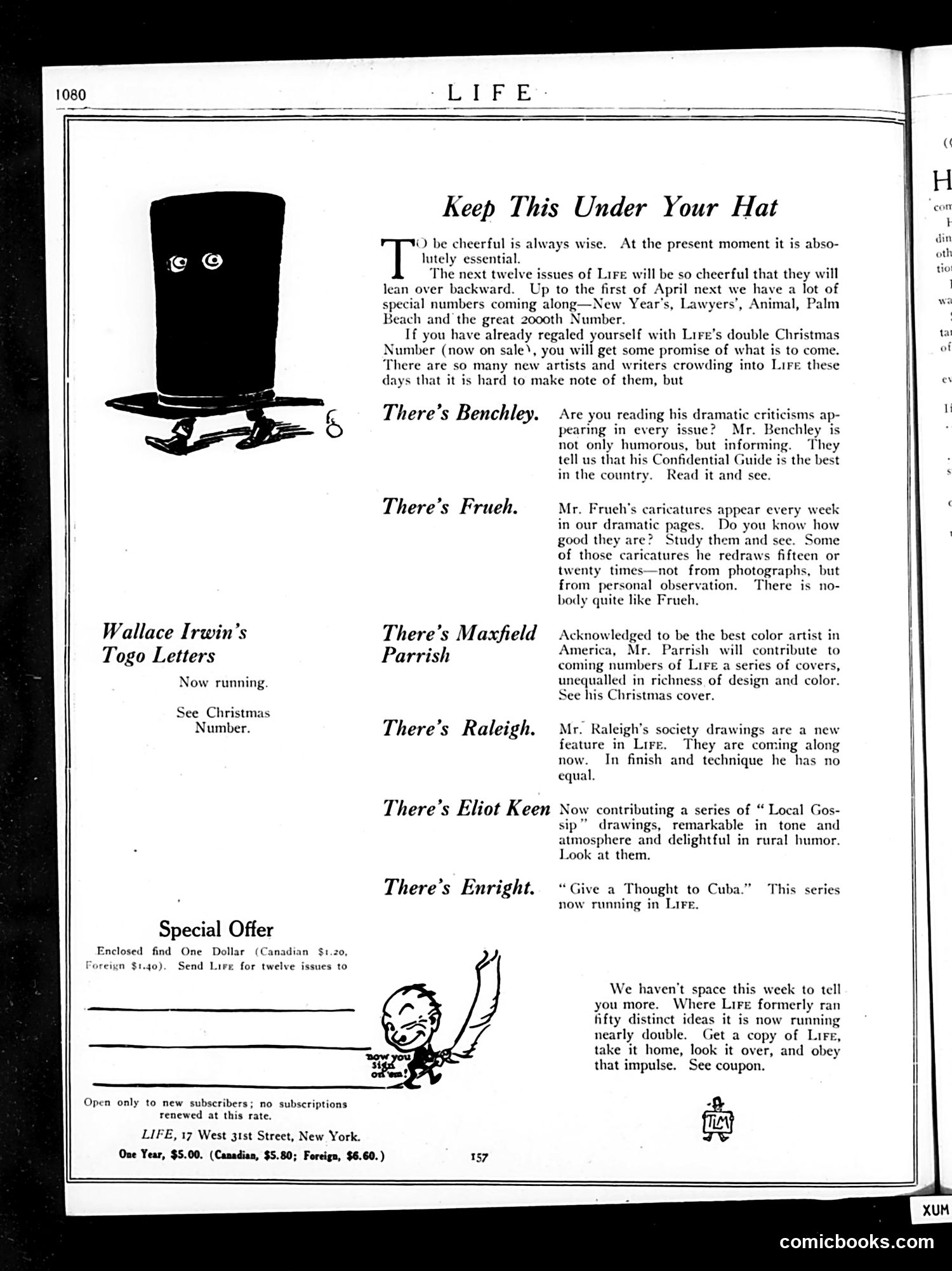
This is primarily a **house advertisement** promoting Life magazine's contributors and content. The stylized top hat with a smiling face is Life's mascot, used decoratively. The page highlights upcoming features: Wallace Irwin's "Togo Letters" serialization; dramatic criticisms by Benchley; caricatures by Frueh (redrawn from observation, not photographs); color covers by Maxfield Parrish; society drawings by Raleigh; "Local Gossip" drawings by Eliot Keen; and Enright's "Give a Thought to Cuba" series. A **special subscription offer** appears below (one dollar for twelve issues to new subscribers). The smiling baby cartoon emphasizes the magazine's humorous tone. The content suggests this is early 20th-century Life—focused on satirical commentary, illustration, and cultural commentary rather than news.
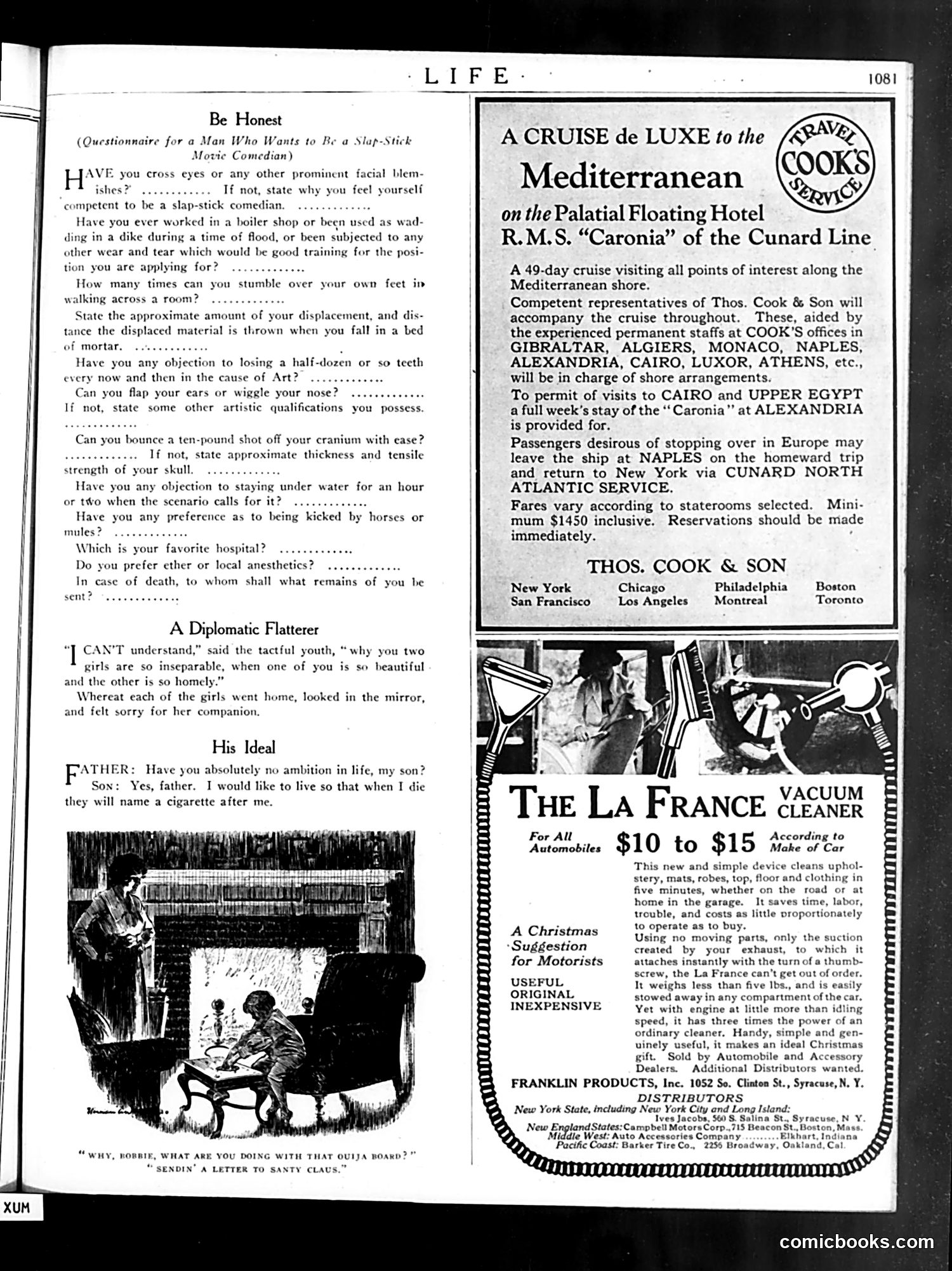
This page contains three distinct sections: **"Be Honest"** (left): A humorous questionnaire for aspiring slapstick comedians, asking whether candidates have the physical tolerance for comedy—crossing eyes, working in boiler shops, falling in beds of mortar, losing teeth, staying underwater. This satirizes the physical demands and pain involved in silent-film slapstick comedy, which was hugely popular in the 1920s. **"A Diplomatic Flatterer"** and **"His Ideal"**: Two brief joke sections about social manners and ambition. **Right side**: Primarily advertisements for a Mediterranean cruise on the Cunard Line's R.M.S. "Caronia" and the La France vacuum cleaner. The cartoon at bottom shows a child with a Ouija board, captioned about "sending a letter to Sandy Claus"—a playful misspelling suggesting children's mishearing of "Santa Claus."
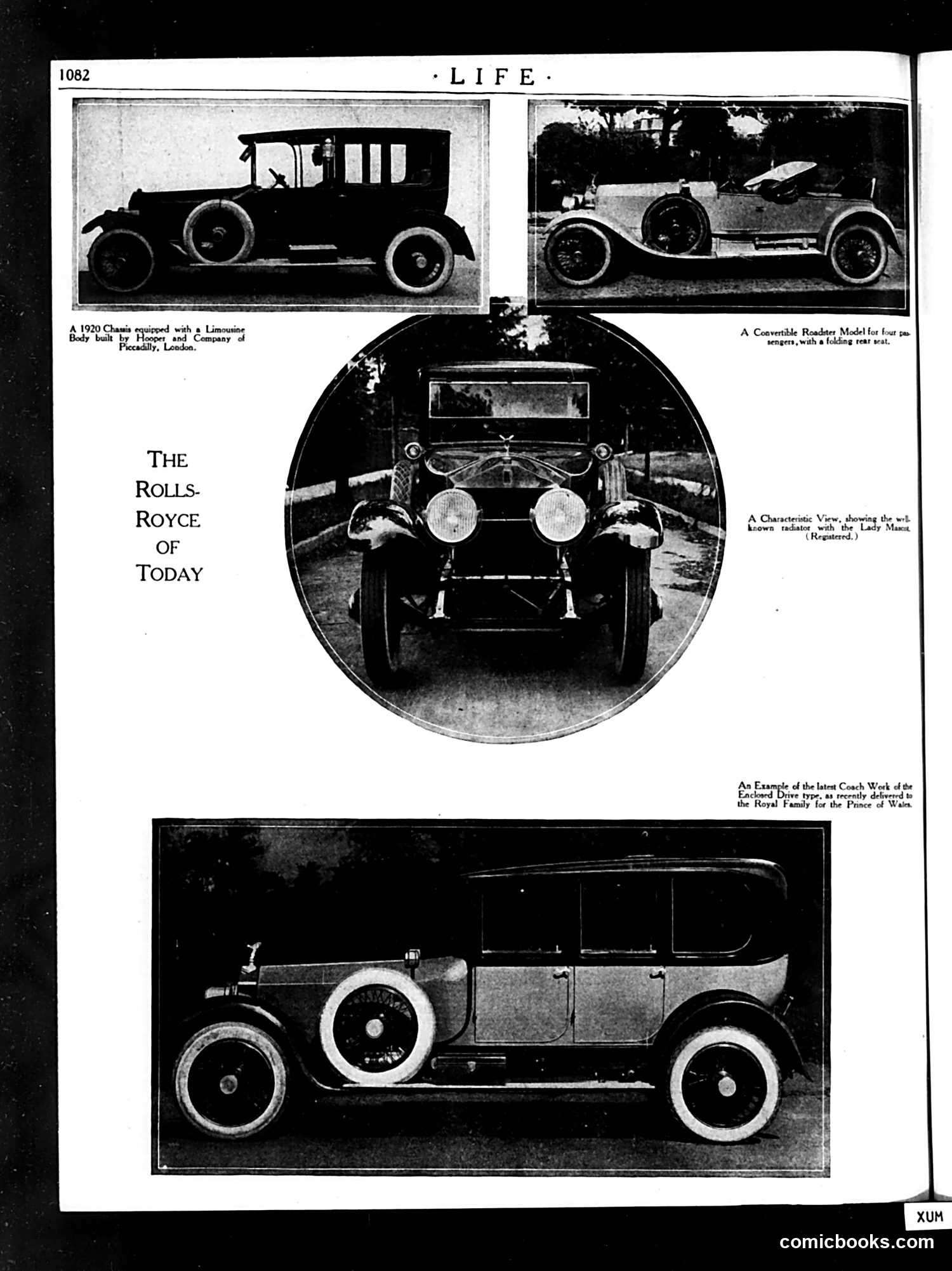
This page is **not a political cartoon but automotive advertising/editorial content** from Life magazine (page 1082). It showcases various **Rolls-Royce automobile models** from approximately 1920, displaying different body styles: a limousine, a convertible roadster, and what appears to be a touring car. The circular front-view photograph highlights the vehicle's distinctive radiator and headlights. The headline "The Rolls-Royce of Today" suggests this is promotional content celebrating the luxury car manufacturer's current offerings. The multiple angles and body variations indicate Rolls-Royce's customization options for wealthy buyers. This represents straightforward product promotion rather than satire—typical of Life's mixed advertising and editorial format during this era.
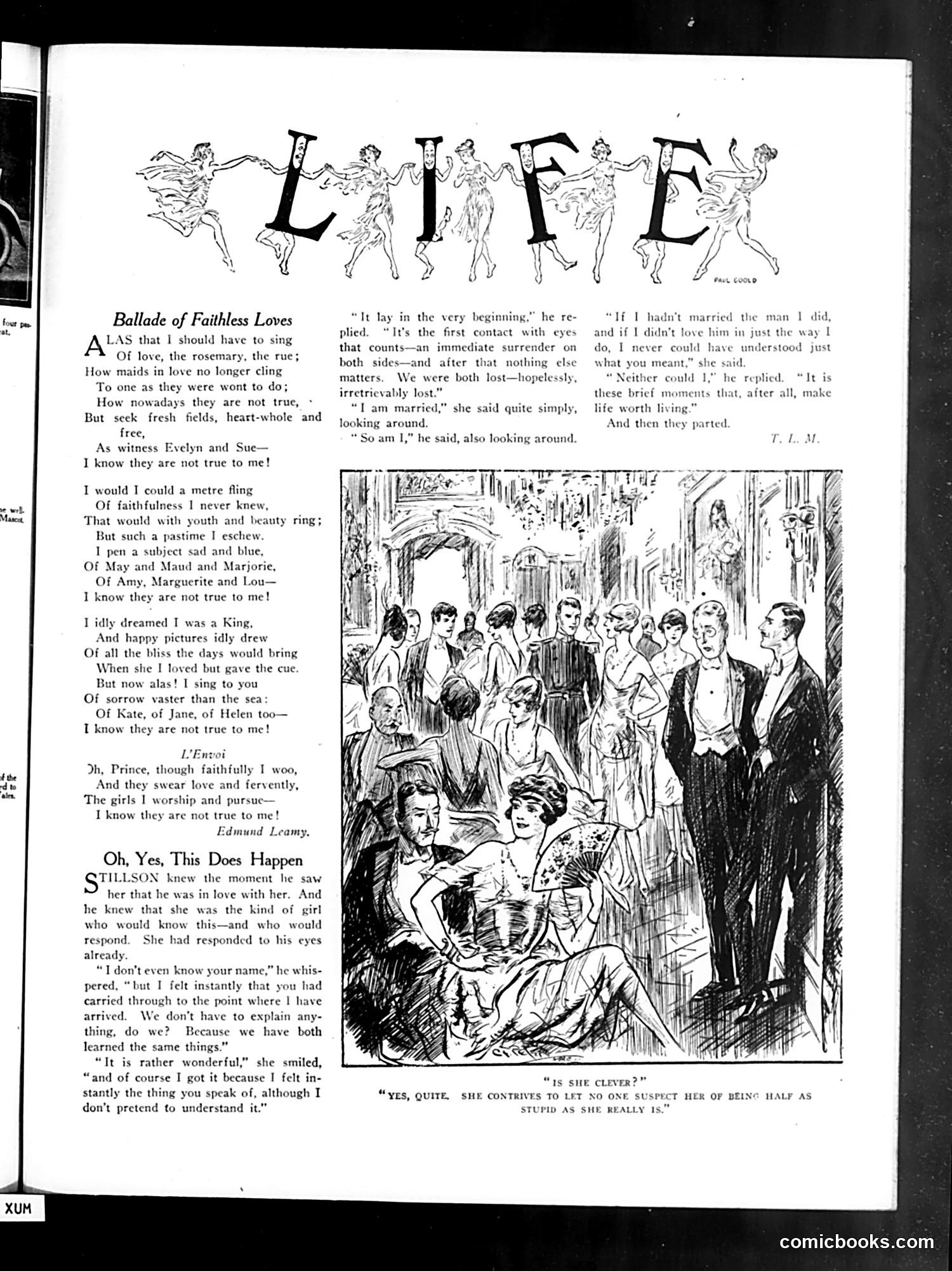
This page combines poetry with illustration and social commentary on romantic infidelity. The poem "Ballade of Faithless Loves" (left) laments women's unfaithfulness, listing names like Evelyn, Sue, May, Maul, Marjorie, Amy, Margaret, and Helen as examples of romantic betrayal. The illustration (right) depicts a formal social gathering—likely a wealthy drawing room or party—where a man (Stillson, based on the story text) observes a woman he loves flirting with another man. The caption reads: "IS SHE CLEVER?" with the response "YES, QUITE. SHE CONTRIVES TO LET NO ONE SUSPECT HER OF BEING HALF AS STUPID AS SHE REALLY IS." This satirizes upper-class women as manipulative and deceptive in romantic pursuits, reflecting early 20th-century attitudes about gender and courtship.
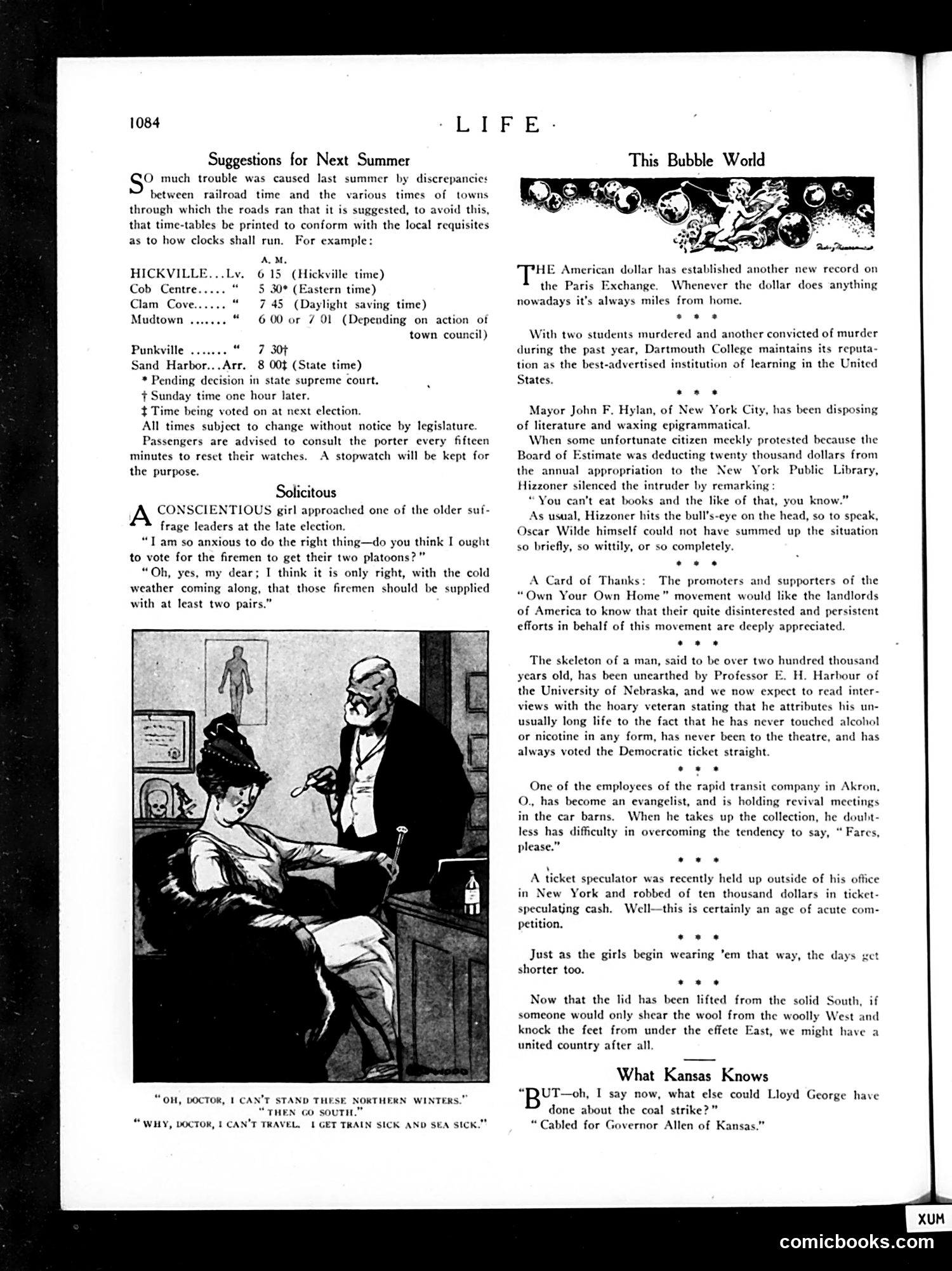
The main cartoon depicts a doctor-patient conversation about winter travel. The patient, dressed for southern weather, complains he cannot tolerate northern winters and cannot travel due to seasickness. The doctor responds by suggesting he go south instead. The satire targets American regional divisions and travel difficulties of the era. The patient represents someone caught between conflicting health complaints—unable to endure cold weather yet unable to travel to escape it. The joke relies on the absurdity of his contradictory excuses. The page also contains brief satirical items about currency exchange rates, college murders, New York politics, and other contemporary social issues, typical of Life's short-form humor format. The cartoon humorously illustrates early 20th-century American concerns about climate, class, and leisure travel.
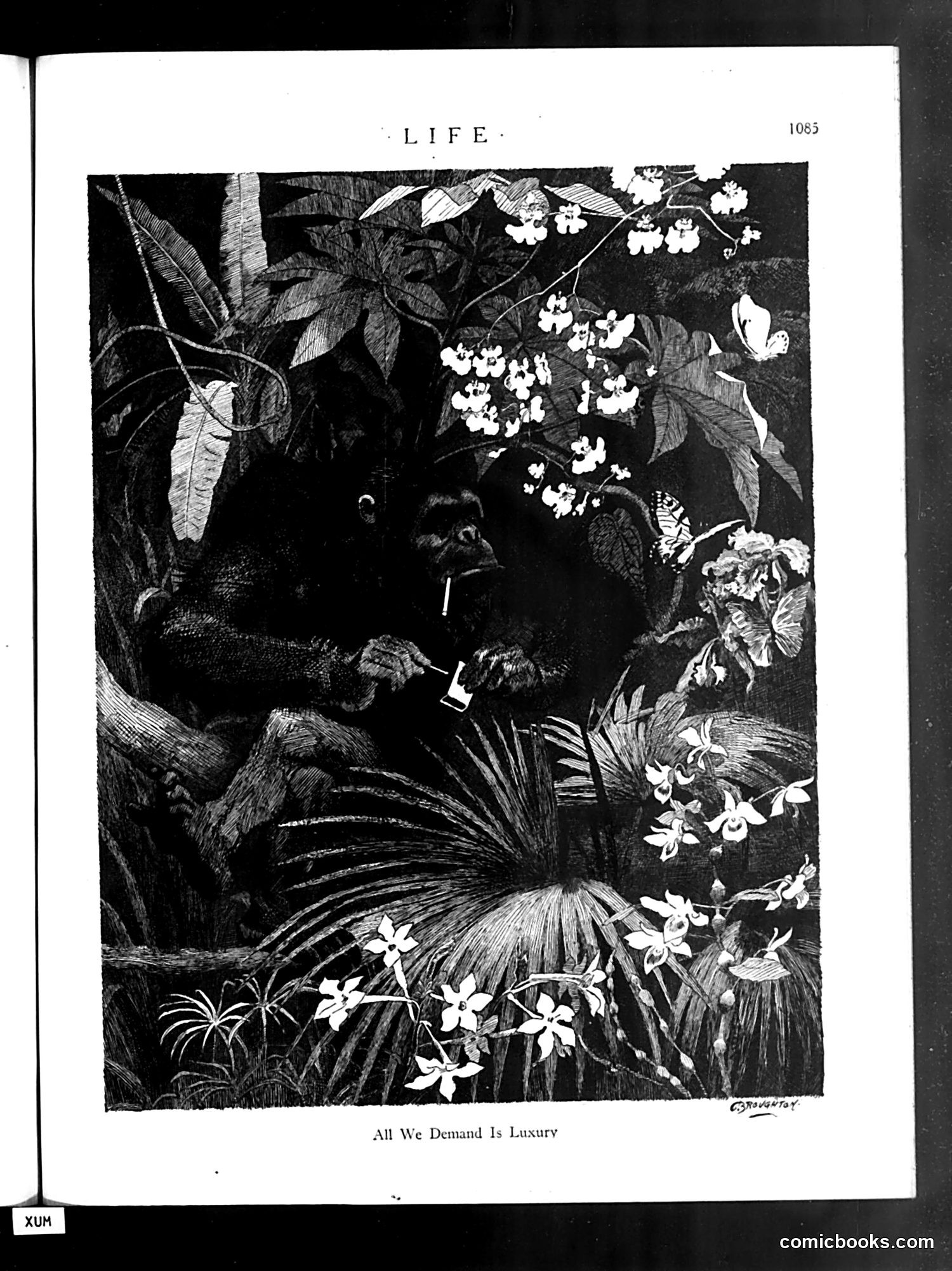
This satirical illustration depicts two chimpanzees in a lush tropical garden surrounded by flowering plants. The title suggests ironic commentary on labor demands or consumer desires of the era. The image likely critiques either workers' rights movements or consumer culture by portraying demands for comfort as animalistic or primitive. By depicting apes rather than humans making these requests, the cartoonist implies such desires are base or unreasonable—a common rhetorical strategy in early-to-mid 20th century satire. The artist's signature appears to read "Cesare[?]" in the lower right. Without the specific publication date visible, the exact political or labor context remains unclear, though the overall message appears dismissive of those seeking improved living standards or material comfort.
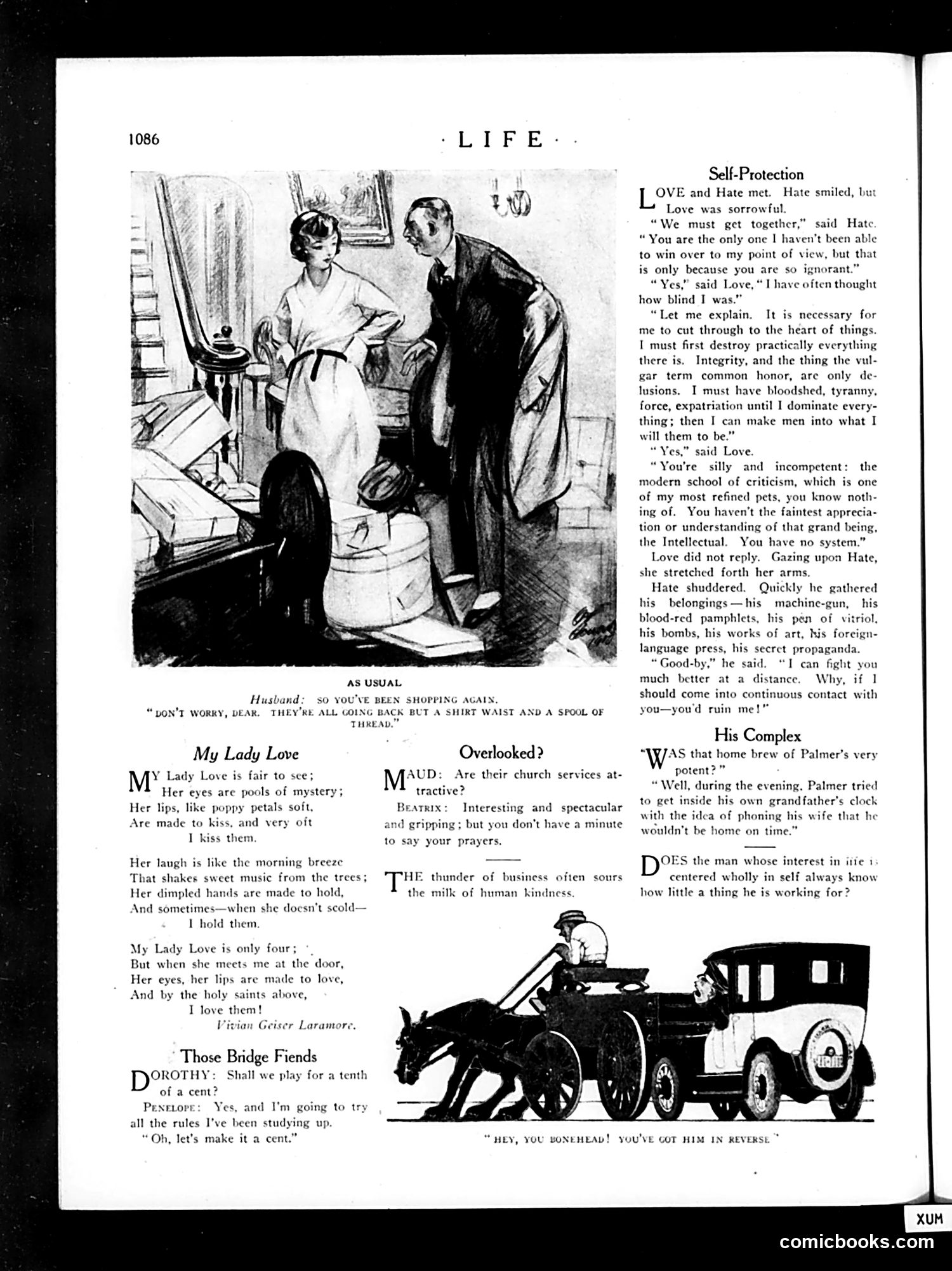
This page contains several satirical pieces typical of early 20th-century Life magazine humor: **"Self-Protection"** (top): A dialogue between "Love" and "Hate" where Hate argues he must "destroy practically everything" and dominate to be effective, while Love counters he's "silly and incompetent." The satire critiques extremist political ideologies and their rhetorical justifications—likely referencing contemporary radical movements. **"My Lady Love"** and other verses are romantic poetry with no apparent satirical intent. **"Those Bridge Fiends"** is a brief comedic dialogue about card-playing stakes. **"His Complex"** and **"Overlooked?"** are short humorous anecdotes about domestic life and inattention. The horse-and-car cartoon captioned "HEY, YOU BONEHEAD! YOU'VE GOT HIM IN REVERSE" depicts early automotive confusion—likely mocking the novelty of automobiles compared to horse-drawn transport.
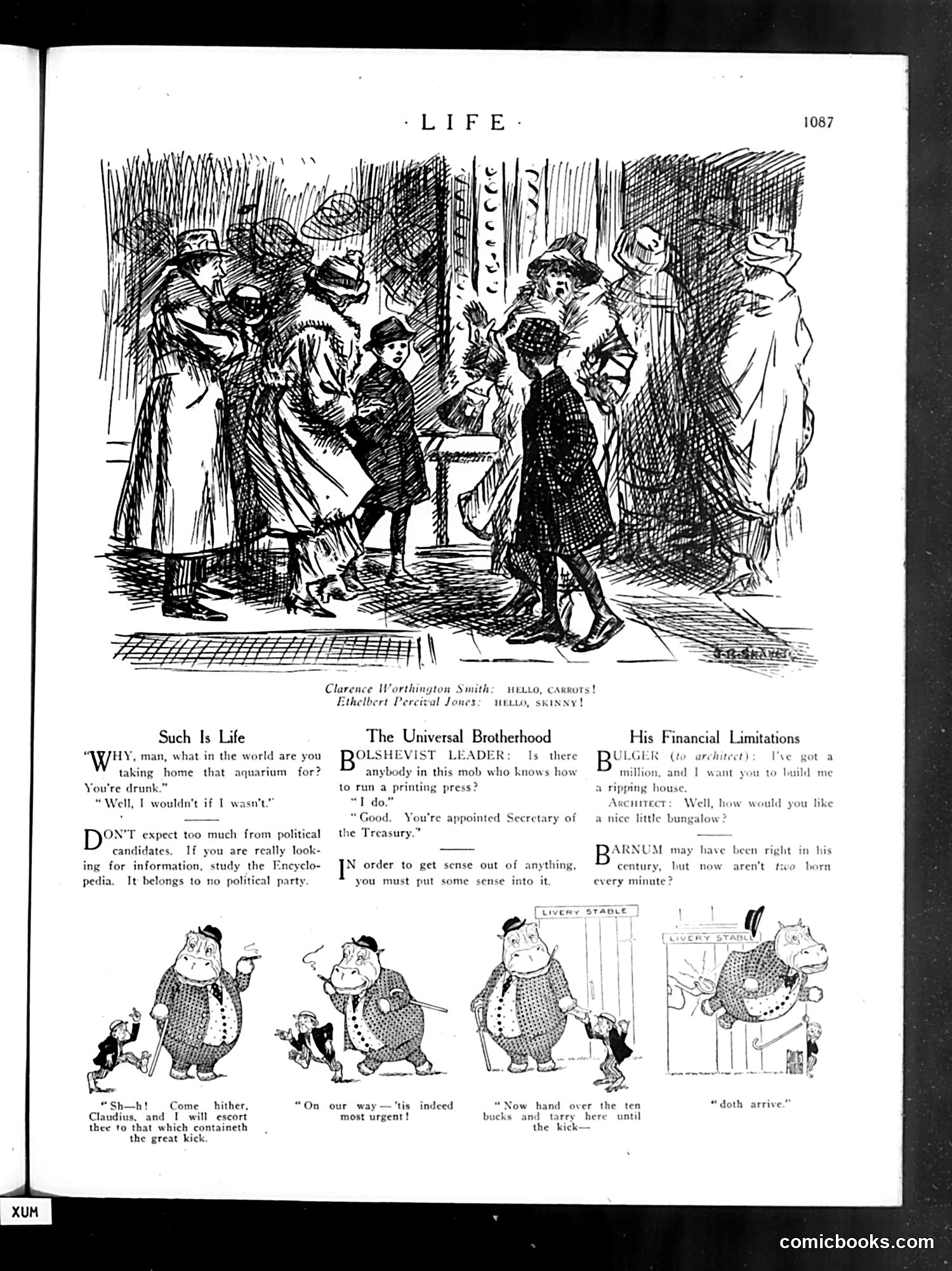
This page contains three separate satirical pieces: 1. **"Such Is Life"** (top): A crowded street scene mocking political candidates. The text advises against trusting politicians for information, suggesting consulting an encyclopedia instead—satirizing politicians as unreliable sources. 2. **"The Universal Brotherhood"** (middle): A Bolshevik leader asks if anyone can operate a printing press, then appoints someone "Secretary of the Treasury." This mocks Soviet incompetence and the chaos of the early Communist government, suggesting leaders were appointed without qualification. 3. **"His Financial Limitations"** (right): An architect and client discuss building options, with the architect noting financial constraints. This satirizes economic limitations on ambition. The bottom strip featuring a character named Claudius appears to be an ongoing comic series, unrelated to the above satirical pieces.
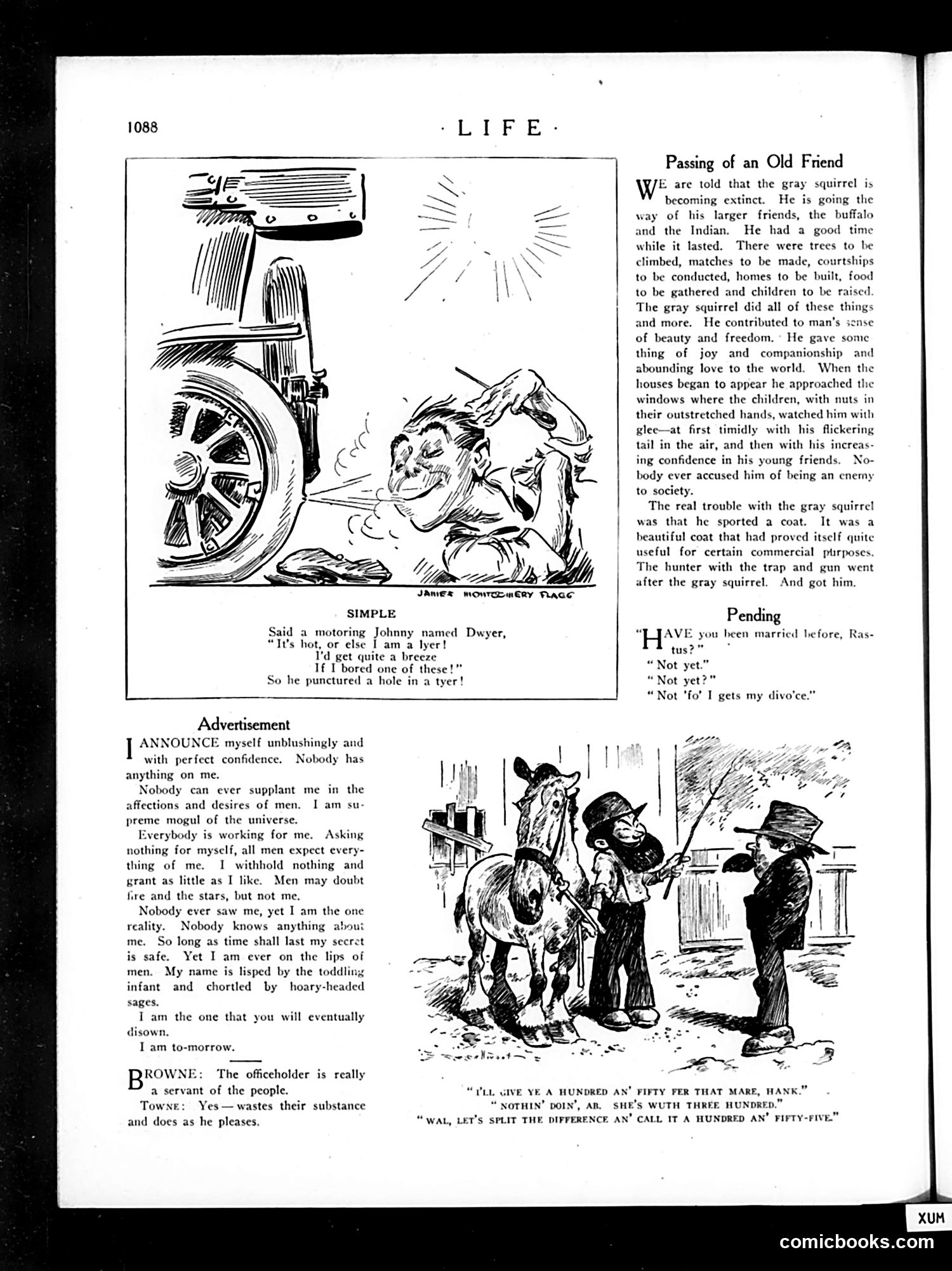
This page contains three separate pieces: 1. **"Simple"** (top): A cartoon mocking motorist Johnny Dwyer, who claims overheating ("It's hot, or else I am a liar!") and blames his vehicle rather than admit poor driving. The joke satirizes early automobile owners who made excuses for mechanical problems. 2. **"Passing of an Old Friend"** (right): A sentimental short story about a gray squirrel hunted for its coat. It contrasts the squirrel's positive contributions to nature and children's joy against commercial exploitation. This reflects early conservation concerns. 3. **"Advertisement"** (center-left): A pompous self-advertisement where someone boasts of universal superiority and eventual dominance, with a dialogue between Browne and Towne questioning whether officeholders serve the people or themselves—typical political commentary on bureaucratic self-interest.
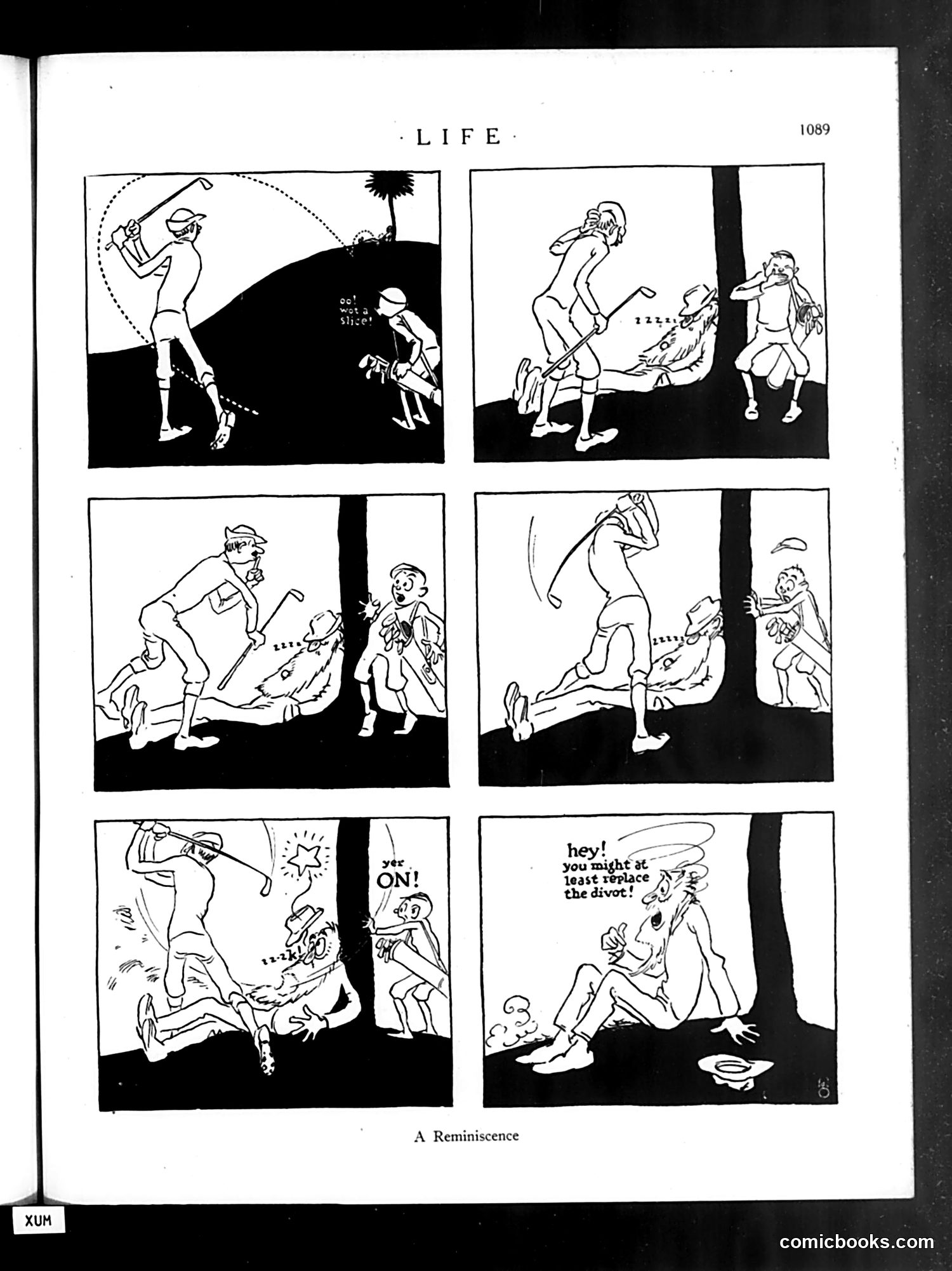
This six-panel golf comic depicts a humorous domestic scene. A man and woman play golf together, with the woman consistently outperforming the man. In the early panels, she makes excellent shots while he struggles. By the final panels, the man becomes increasingly frustrated—the text reads "ON!" and "hey! you said least replace the divot!"—suggesting the woman has embarrassed him through her superior golfing skill. The satire likely mocks traditional gender dynamics of the era: a husband's wounded pride when outshone athletically by his wife. The title "A Reminiscence" suggests this depicts a memorable, humbling experience. The humor relies on inverting expected gender roles in sports, presenting the woman as the competent golfer while the man's frustration reveals his fragile ego.
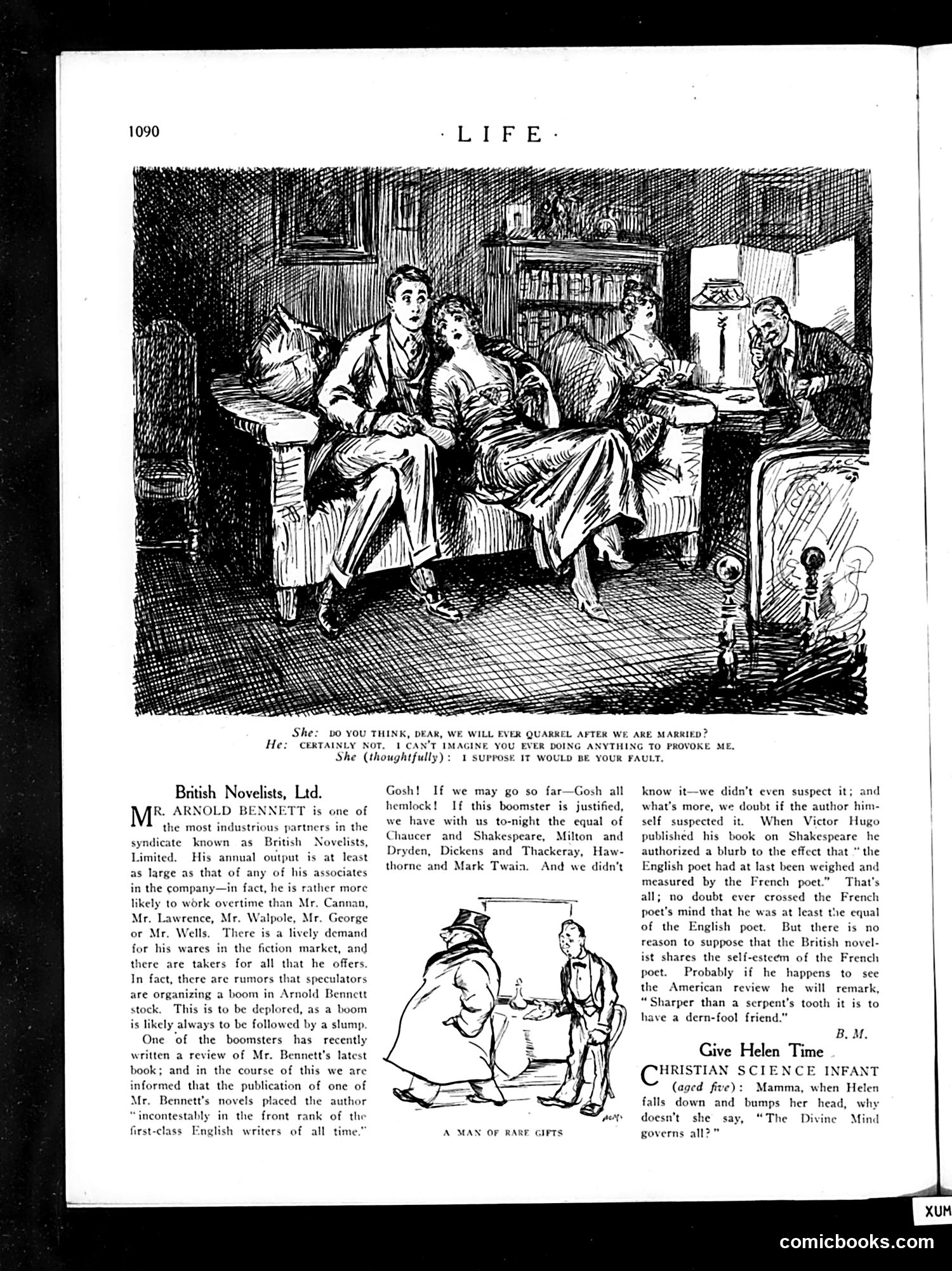
This page contains satirical commentary on British novelist Arnold Bennett and his literary reputation. The top illustration shows a domestic scene where a woman asks her husband if they'll quarrel after marriage; he dismissively says certainly not, implying she'd be at fault if they did. Below, the article mocks Bennett's recent positive review, which claimed his work places him among "first-class English writers." The satire suggests this assessment is inflated—the reviewer compares Bennett favorably to Shakespeare, Milton, and Dickens, which the Life writer finds absurdly generous. The accompanying cartoon titled "A Man of Rare Gifts" appears to illustrate Bennett receiving undeserved praise. The page ridicules both Bennett's pretensions and the critical establishment's tendency toward excessive flattery.
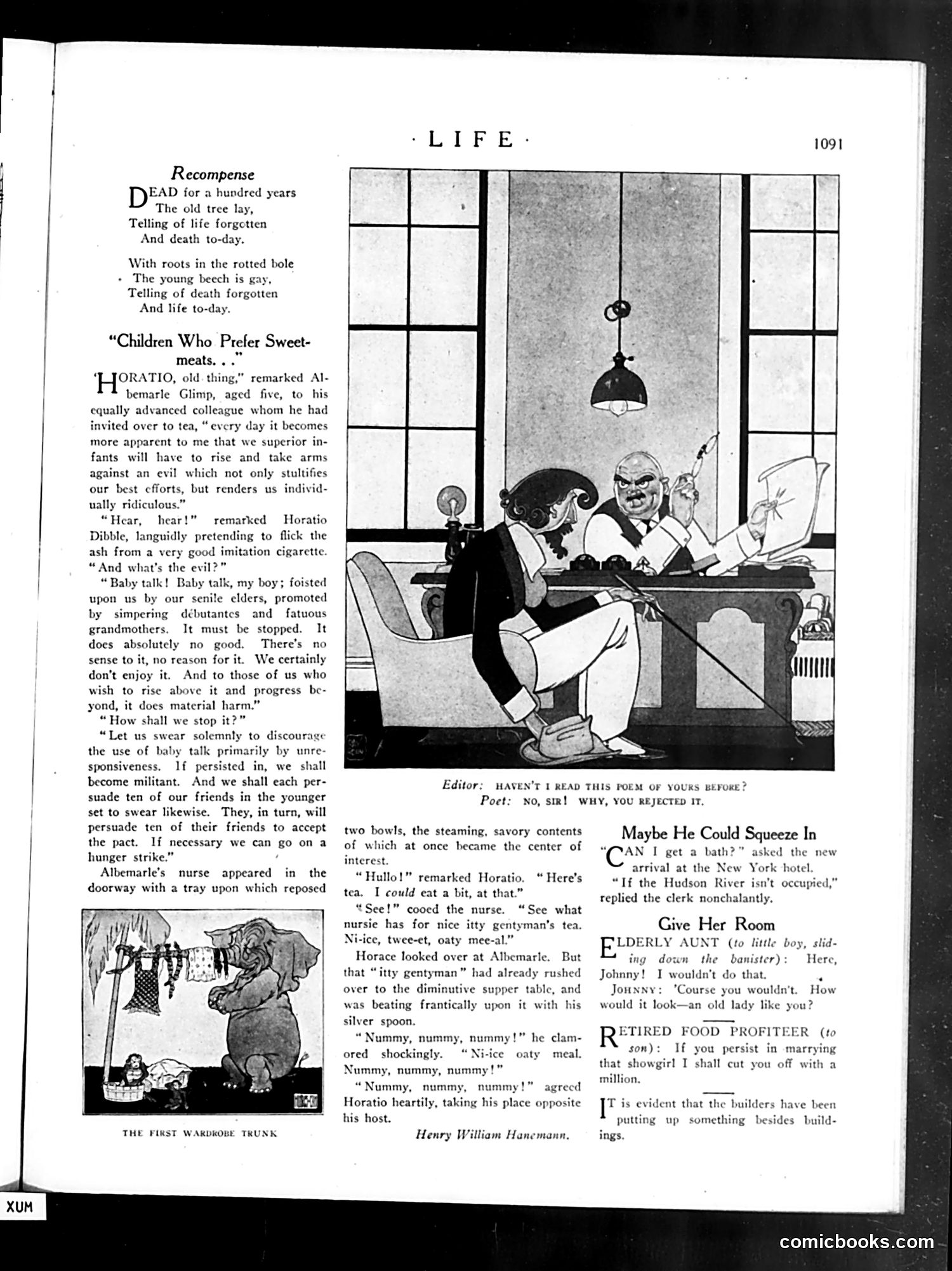
This *Life* magazine page contains social satire about child behavior and manners. The main cartoon depicts two adults (appearing to be Horatio Dibble and an older gentleman) reacting with disapproval to children's "baby talk" — the repetition of "nummy, nummy, nummy" during a meal. The dialogue criticizes this behavior as both ridiculous and harmful, arguing it should be discouraged through social pressure rather than tolerated. The adults advocate swearing oaths to stop children from using baby talk, framing it as a moral issue affecting societal progress. This reflects early 20th-century anxieties about child-rearing and etiquette, when strict standards of adult behavior were considered essential to civilization. The joke targets both indulgent parents and children's perceived affectations.
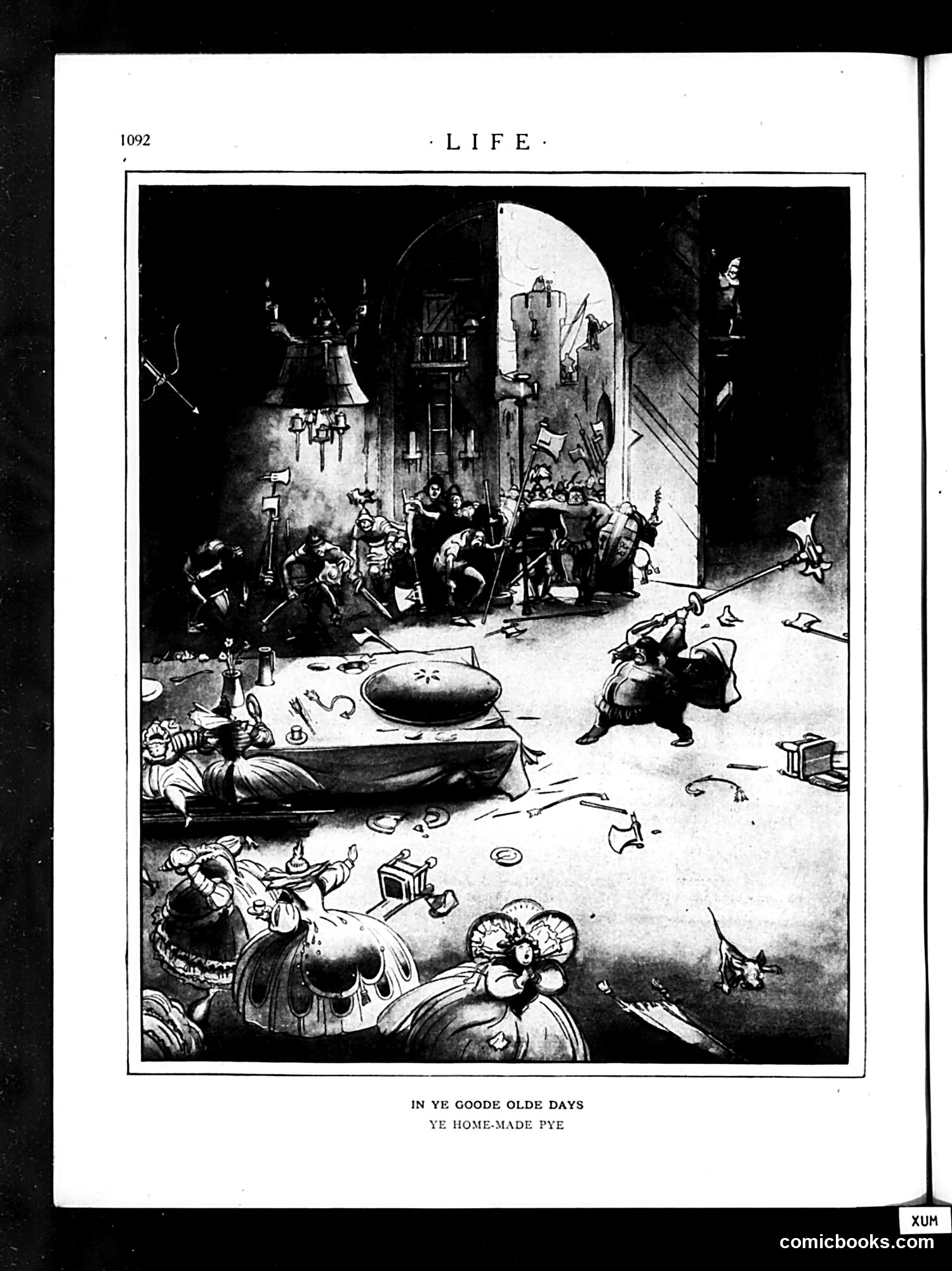
This is a satirical illustration titled "IN YE GOODE OLDE DAYS / YE HOME-MADE PYE," presenting a chaotic medieval or fantastical kitchen scene. The image depicts numerous figures engaged in pie-making—some appear to be cooking, fighting, or causing mayhem around a large central pie dish. The satire likely critiques the romanticization of "good old days" by showing the reality: disorder, violence, and confusion. The busy composition with overlapping characters suggests incompetence rather than quaint nostalgia. This appears to be satirizing contemporary nostalgia for simpler times, implying that past domesticity was actually messy and problematic. The specific political or social targets remain unclear without additional context, but the visual joke effectively undermines sentimental historical fantasy through exaggerated visual chaos.
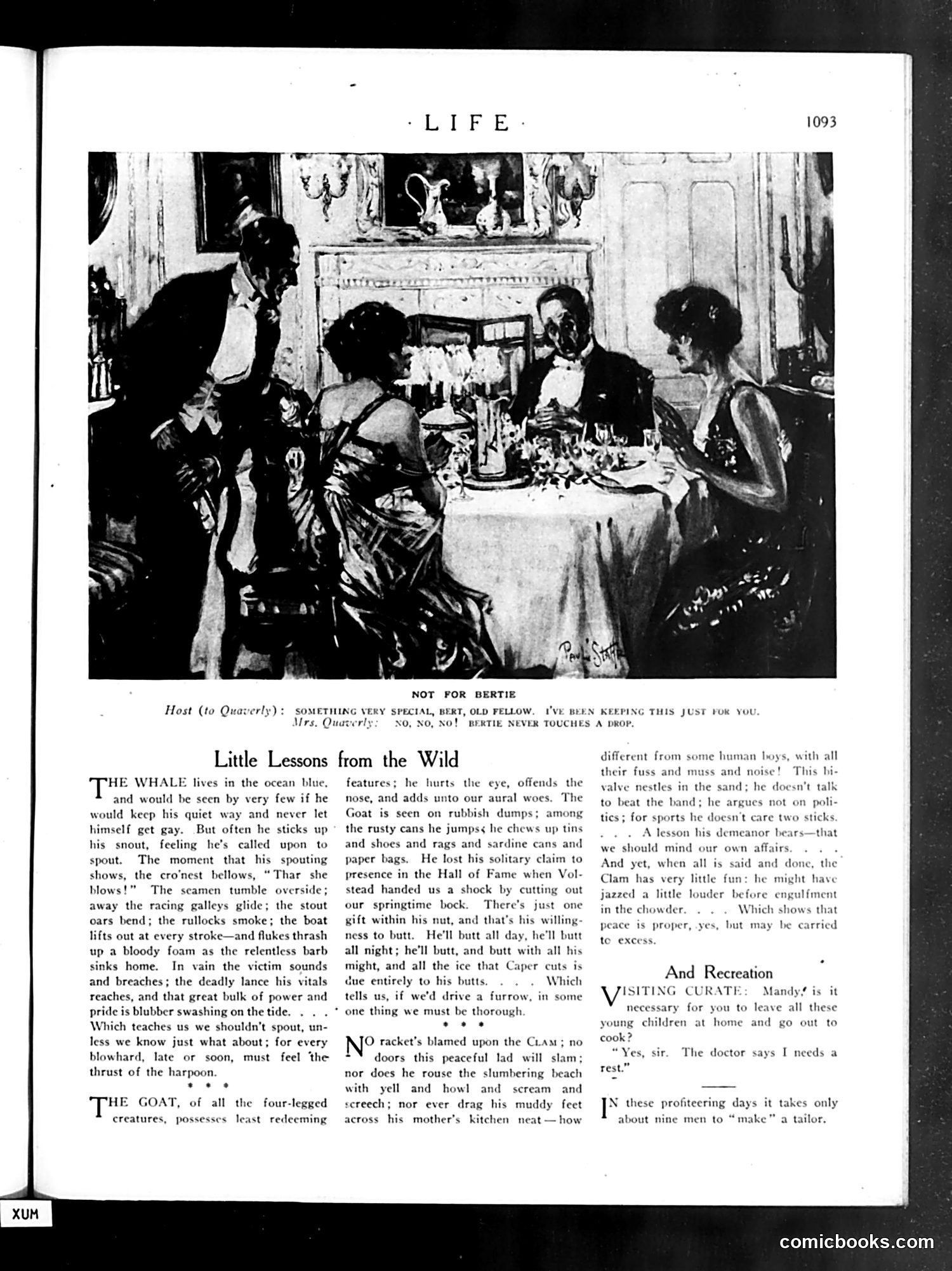
The top illustration shows a formal dinner scene with the caption "Not for Bertie"—a joke about temperance. The host tells his guest he's kept something "special" for him, but the hostess interrupts: "No, No! Bertie never touches a drop," meaning alcohol. This satirizes social pretense around Prohibition (likely early 1920s context, given references to "Volstead" in the text below). The page's main content, "Little Lessons from the Wild," uses animal fables to mock human behavior. The whale represents loudmouths who "spout" without wisdom and face consequences. The goat, despite being useful (butting through obstacles), lost status after Prohibition eliminated the demand for springtime beer. The clam represents the ideal citizen—quiet, peaceful, unintrusive—yet lives joylessly. The final joke about a visiting curate's cook needing rest "to cook" satirizes postwar labor shortages and domestic help scarcity—nine men now needed to "make" a tailor, suggesting economic disruption.
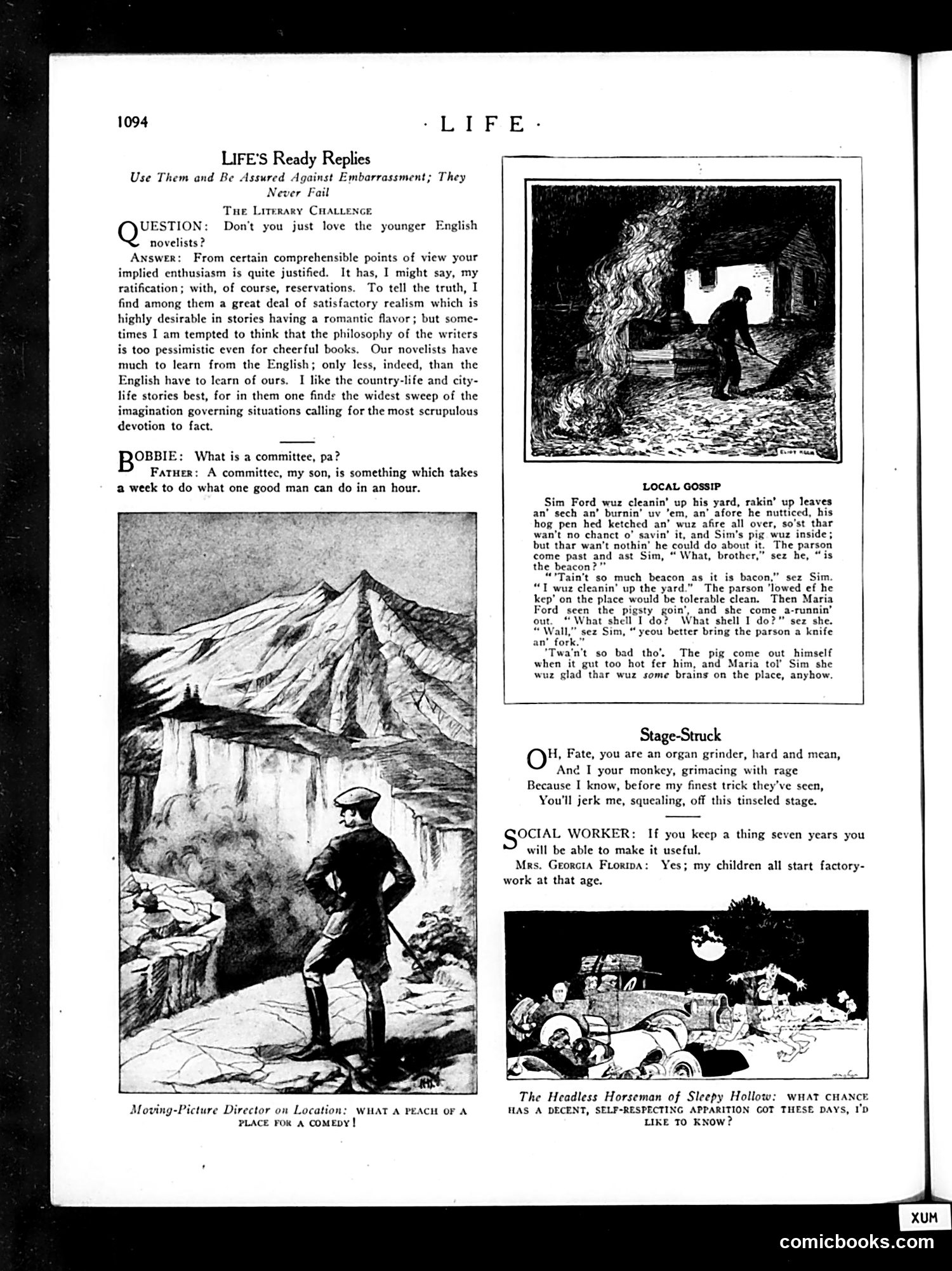
This page from *Life* magazine presents multiple satirical pieces mocking American social conventions and pretension. **"Literary Challenge"** ridicules affected sophistication—offering a deliberately pompous non-answer about English novelists that says nothing while sounding erudite, satirizing how people use empty verbosity to appear cultured. **"Bobbie" joke** mocks committees as bureaucratic inefficiency—a straightforward jab at institutional waste. **"Local Gossip"** presents rural dialect humor about a farmer (Sim Ford) whose pig pen catches fire. The satire targets rural simplicity; the parson's comment about "beacon" vs. "bacon" plays on the absurdity of the situation, while the pig surviving represents dark, crude humor. **"Stage-Struck"** uses theatrical metaphor to critique Fate as a cruel puppet-master exploiting performers. **"Social Worker"** satirizes the disconnect between progressive social policy and economic reality—a social worker's advice about seven-year utility conflicts with a Georgia woman's matter-of-fact acceptance that her children work in factories at that age, exposing child labor's persistence despite reform efforts.
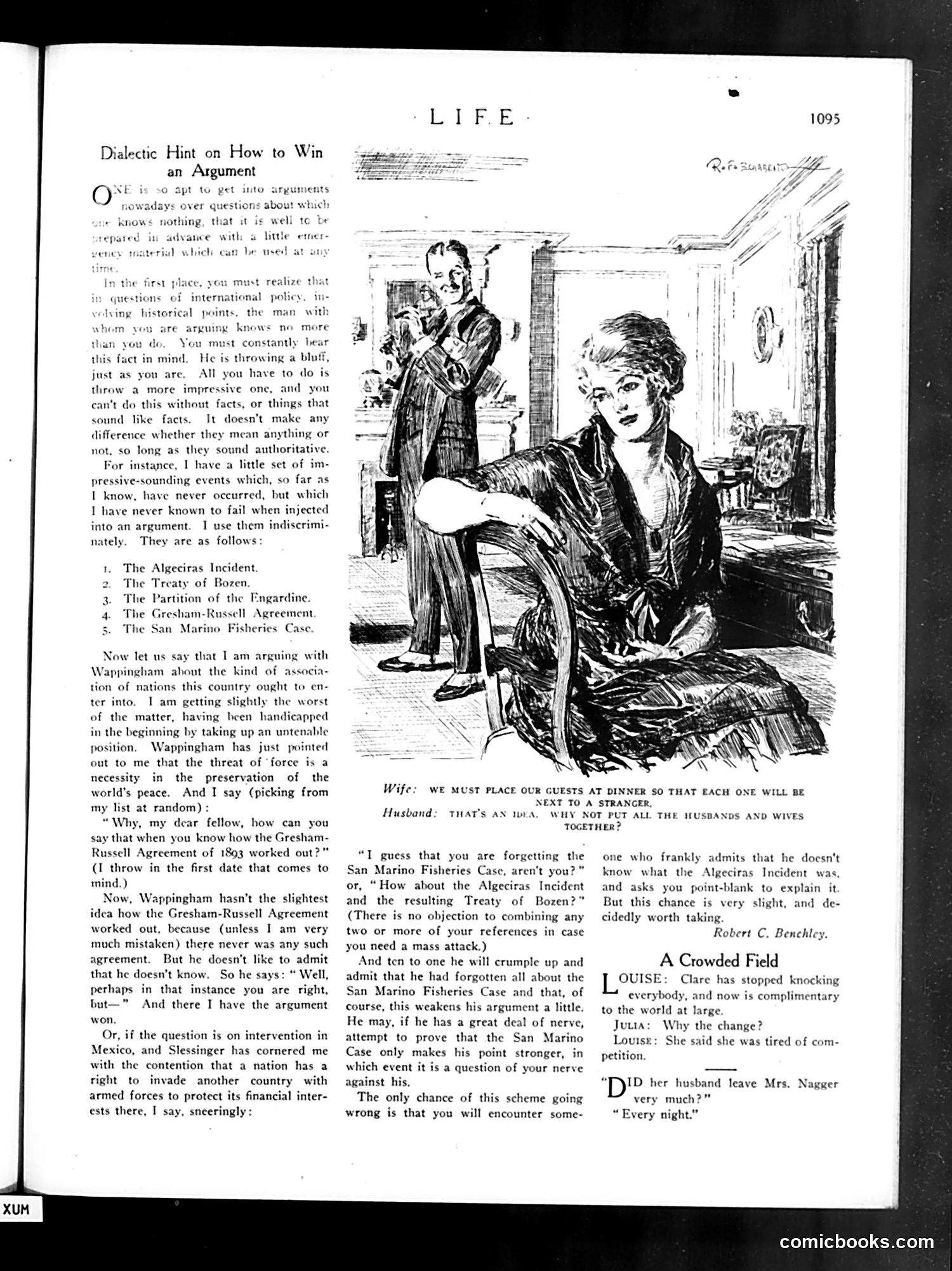
This page contains two distinct pieces of satirical content: **"Dialectic Hint on How to Win an Argument"** (main article with illustration): The author humorously reveals a debating trick—inventing fake historical references with authoritative-sounding names (the "Algeciras Incident," "Treaty of Bozen," "Gresham-Russell Agreement") to win arguments about topics you don't actually understand. The point: most people won't admit ignorance, so confident-sounding BS works. The illustration shows a man smugly lecturing a woman, exemplifying this bluffing technique. This satirizes intellectual dishonesty and social pretense common in public discourse. **"A Crowded Field"** (brief comic dialogue): A woman named Clare stops criticizing others and becomes complimentary—not from kindness, but because she's tired of the competition from other gossips. The husband joke suggests he leaves home nightly to escape her nagging. This mocks superficial social climbing and competitive cattiness among society women. Both pieces target early 20th-century social pretense and the gap between appearance and reality in polite society.
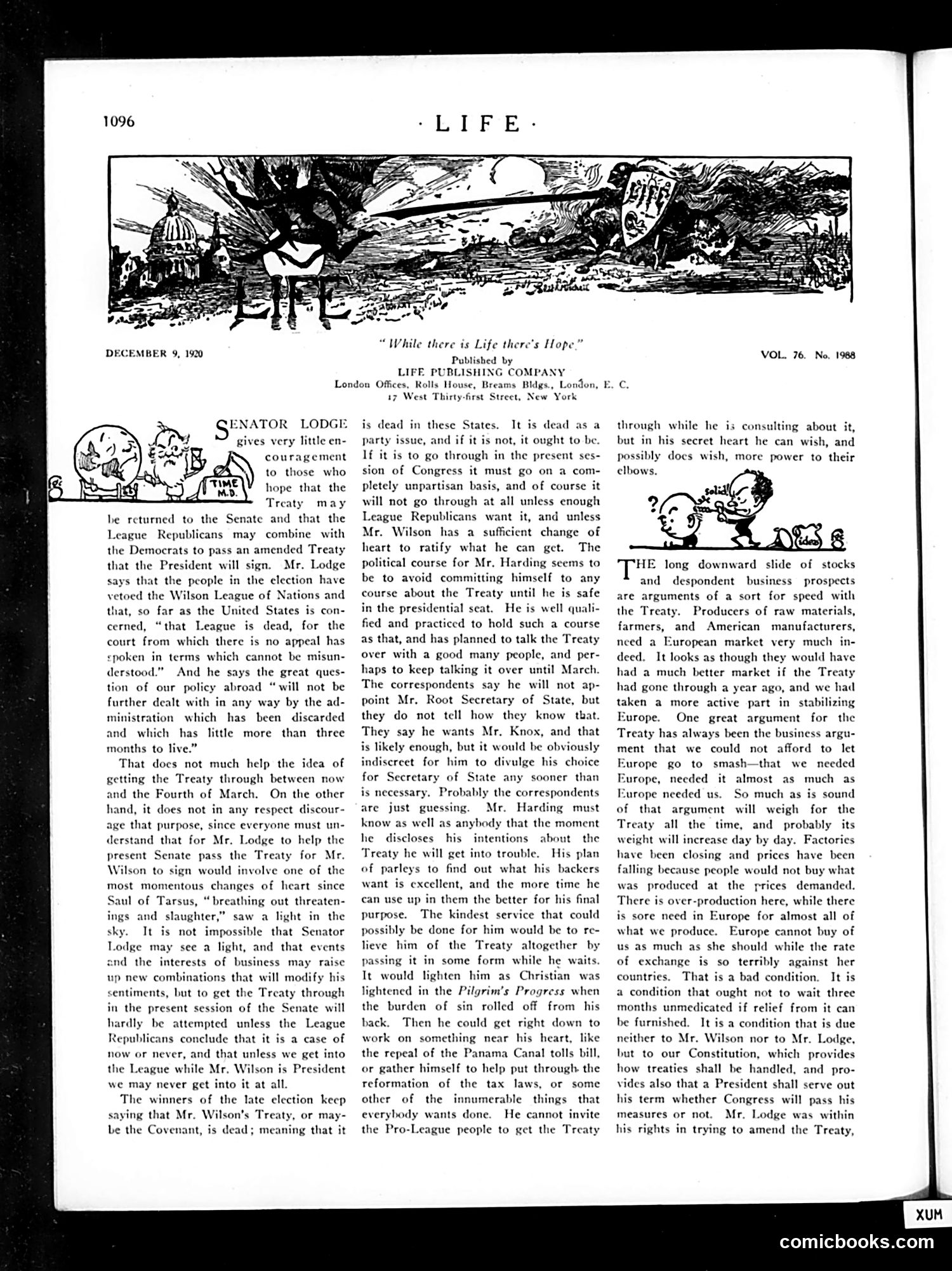
This page contains editorial analysis (not a cartoon) addressing Senator Henry Cabot Lodge's opposition to President Wilson's League of Nations treaty following the 1920 election. **The Political Context:** Wilson's Democrats lost the 1920 election to Republican Warren G. Harding. Lodge, a prominent Republican senator, declared the League "dead" and blocked its passage. The editorial argues the Treaty is a legitimate policy matter that should transcend partisan politics and pass on "completely unpartisan basis." **The Satire's Point:** The writer mocks Lodge's unlikely conversion, comparing it to Saul of Tarsus's miraculous religious transformation—suggesting Lodge reversing his position would be equally miraculous. The piece also gently satirizes Harding's evasiveness about appointing a Secretary of State, noting he'll avoid committing to anything about the Treaty until safely inaugurated. **The "Hope":** The title suggests hoping Republicans and Democrats might compromise on an amended Treaty before March 4, 1921 (Inauguration Day).
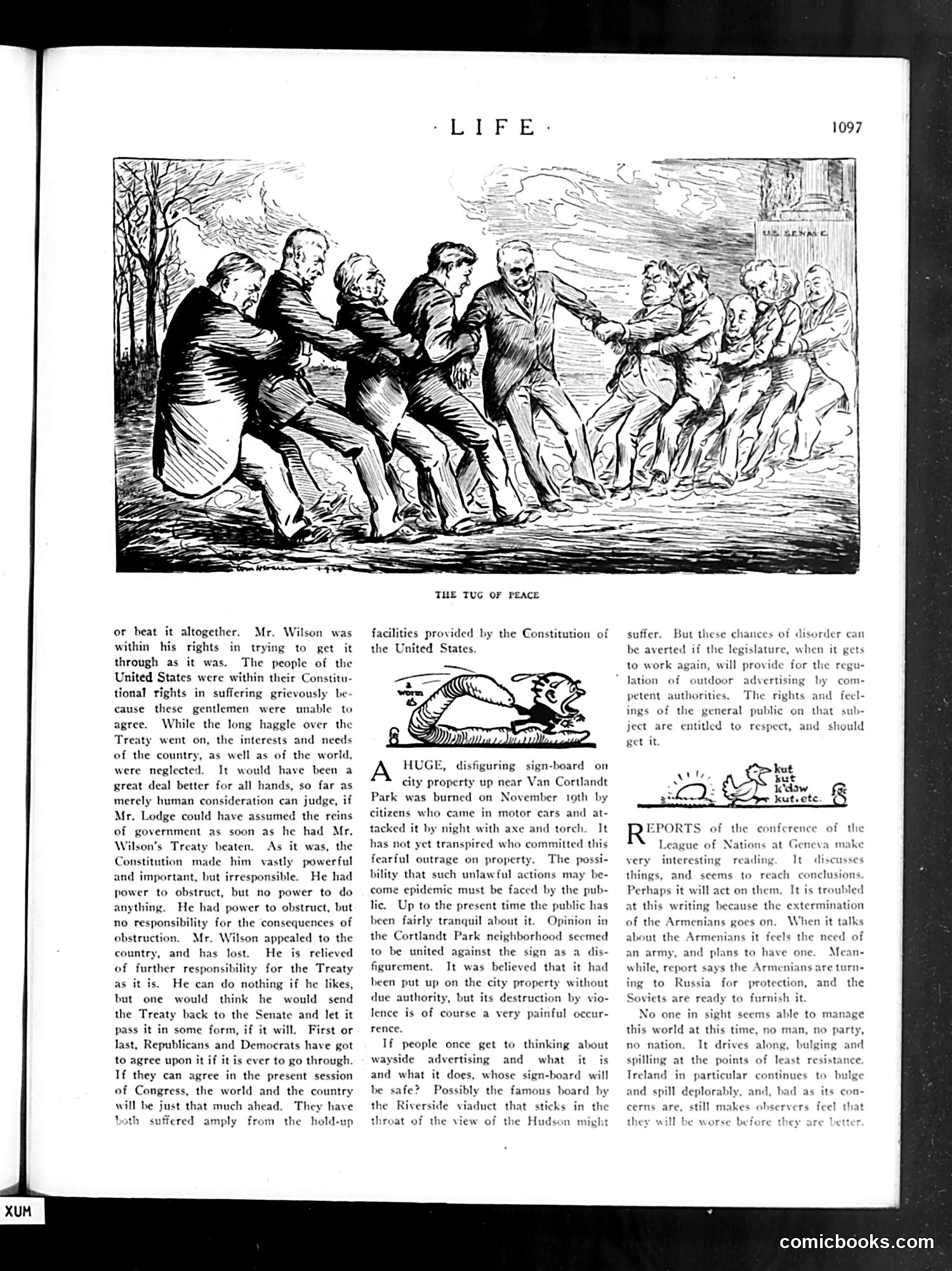
**The Cartoon:** Shows two groups of men in a literal tug-of-war, illustrating political deadlock. The figures represent President Wilson and Senator Henry Lodge (leader of Republican opposition) and their respective supporters, locked in struggle over ratification of the Treaty of Versailles. **The Context:** After World War I, Wilson's League of Nations treaty faced Senate opposition. Lodge controlled enough votes to block passage but lacked power to impose an alternative. The article criticizes this constitutional standoff—both sides had power to obstruct but neither could govern decisively, leaving national and international interests neglected. **The Satire:** The cartoon mocks how constitutional checks-and-balances created destructive gridlock. Rather than either side winning or compromising, both sides remained locked in futile struggle while the country suffered. The "tug of peace" is ironic—a peace treaty becomes the object of contentious political warfare.
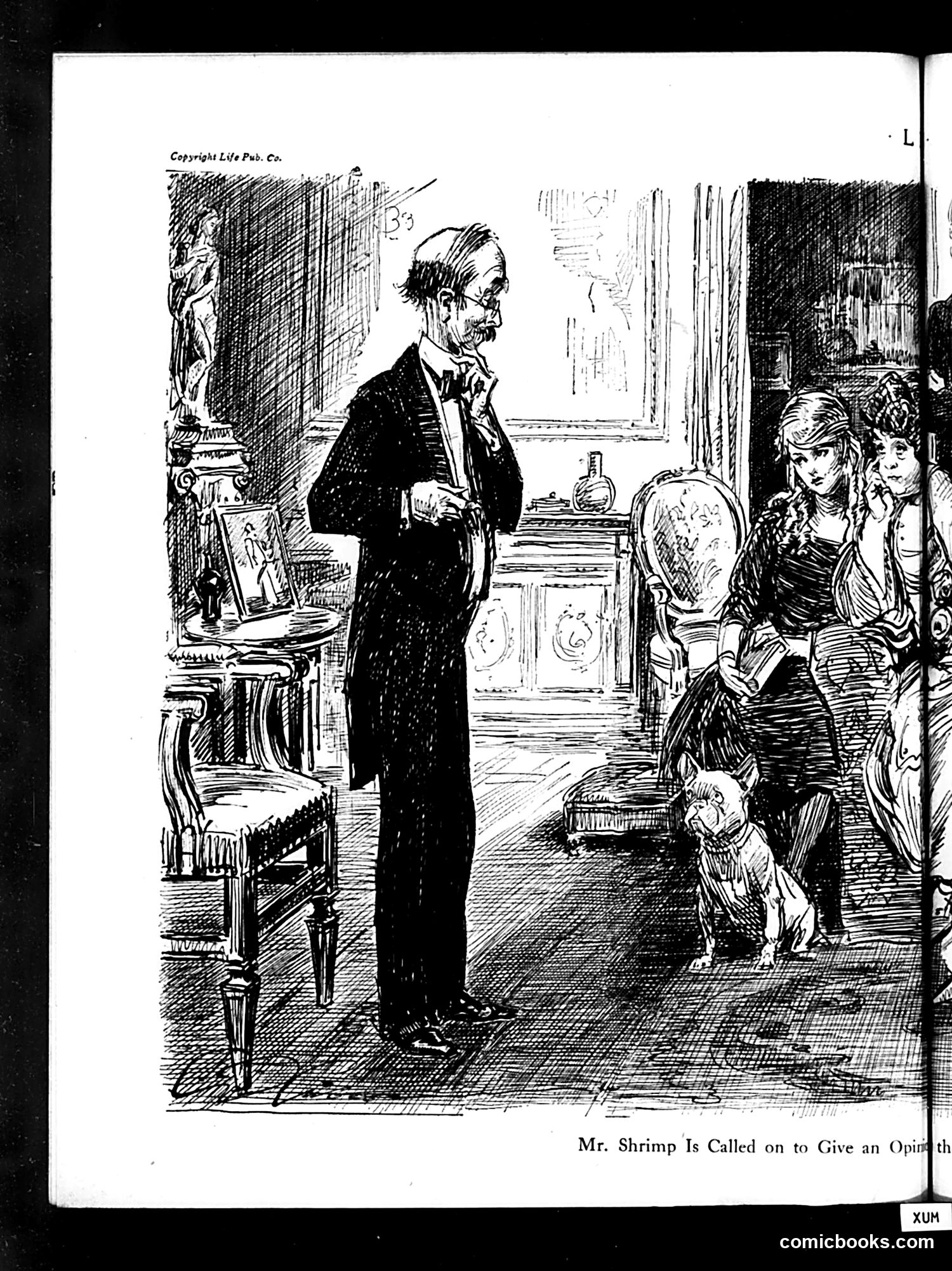
This satirical illustration depicts a thin, somewhat pompous gentleman in formal attire (identified as "Mr. Shrimp" by the caption) standing in an elegant parlor, apparently about to offer his opinion to a seated woman and children. The humor derives from the visual irony: despite his pretentious demeanor and formal dress, his surname "Shrimp" suggests he is insignificant or diminutive in actual importance or stature. The cartoon satirizes social pretension—the gap between how some people present themselves and their actual worth or influence. The scene mocks those who assume an air of authority or expertise despite being relatively unimportant, a common target of *Life* magazine's social satire during the early 20th century.
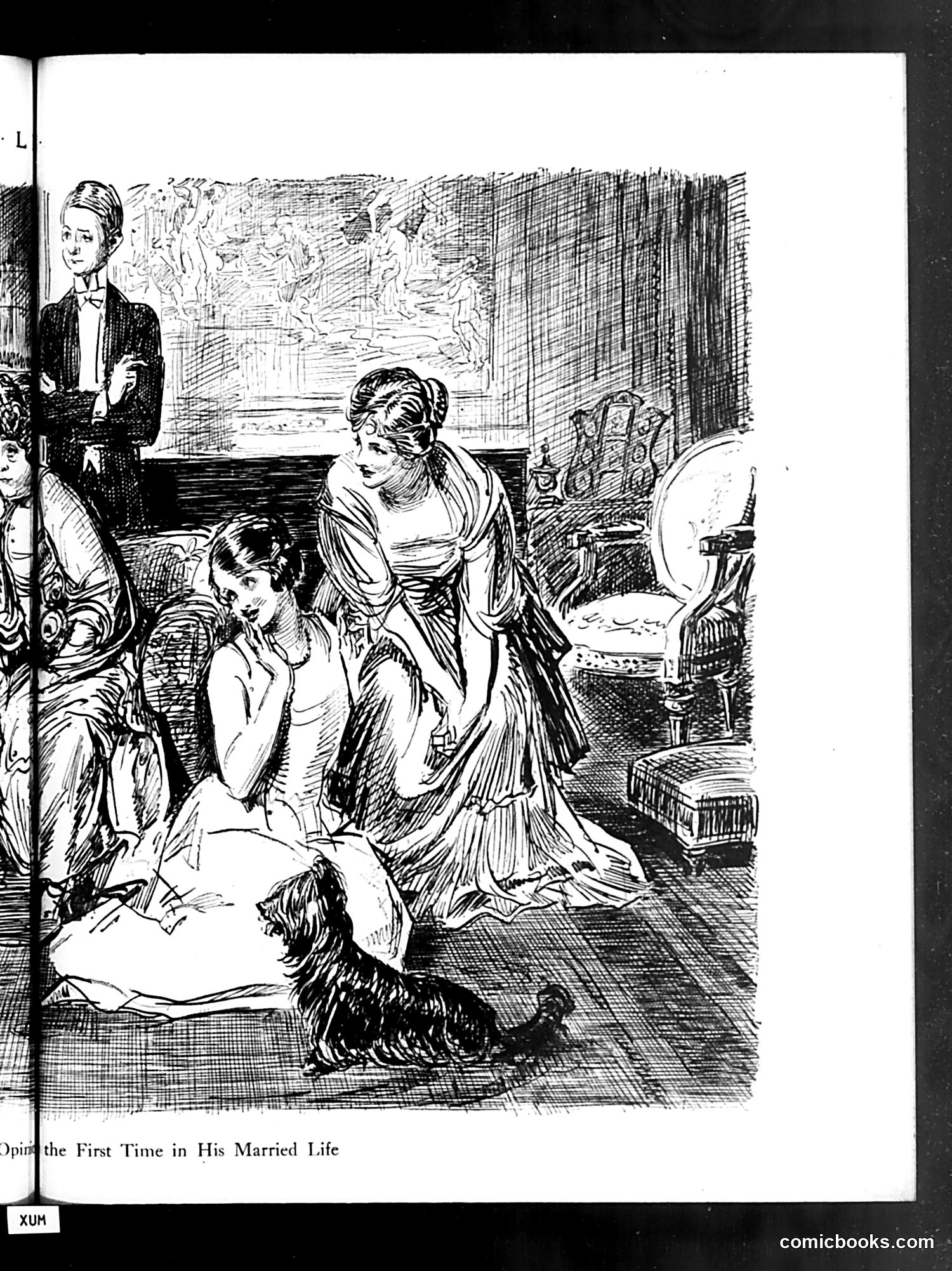
The caption reads "Opine the First Time in His Married Life," showing a domestic scene with satirical intent. A woman kneels before a seated man while others observe in an elegant drawing room. A small dog is also present. The joke appears to target marital dynamics, likely satirizing the moment when a husband finally agrees with or complies with his wife's wishes—suggesting this is noteworthy enough to be remarked upon as exceptional. This reflects early 20th-century gender humor common to *Life* magazine, which frequently joked about wives' supposed dominance in marriage and husbands' reluctant submission. The specific "opinion" being referenced remains unclear from the image alone, but the satire centers on portraying spousal disagreement and compromise as a comedic reversal of expected hierarchy.
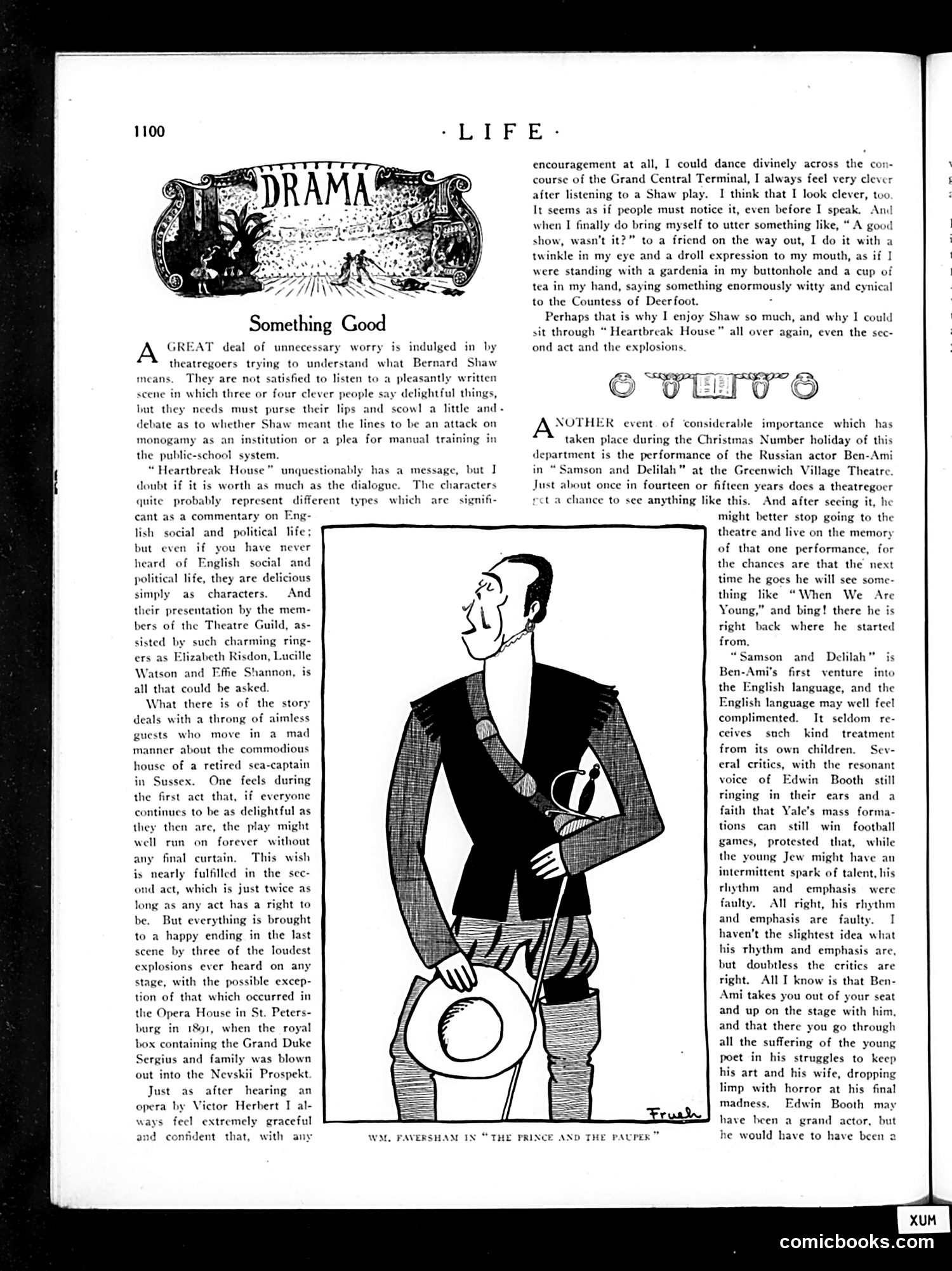
This page reviews two theatrical productions. The main illustration depicts **William Faversham in "The Prince and the Pauper,"** shown as a gentleman in formal dress holding a hat—likely satirizing the genteel, self-satisfied demeanor audiences adopt after attending plays. The text critiques **Bernard Shaw's "Heartbreak House,"** performed by the Theatre Guild. The author mocks theatergoers who over-intellectualize Shaw's work, searching for political messages about monogamy or public education when they should simply enjoy the witty dialogue and charming performances (citing actresses Elizabeth Risdon, Lucille Watson, and Effie Shannon). A secondary review praises Russian actor **Ben-Ami's performance in "Samson and Delilah"** at Greenwich Village Theatre, calling it exceptional enough to retire from theater-going afterward. The humor targets pretentious theater audiences who feel artificially clever after Shaw plays, adopting affected sophistication they don't genuinely possess.
This page from *Life* magazine consists primarily of theatrical reviews and advertisements, not political cartoons. The "Confidential Guide" section at the bottom is a disclaimer explaining that due to printing delays, readers should verify theater listings in daily newspapers. The main content reviews various Broadway productions, with critic Robert C. Benchley providing commentary on shows including musicals ("Jimmie," "Tickle Me") and plays ("Thy Name Is Woman," "The Bat," "Heartbreak House"). The reviews employ Benchley's characteristic wit, dismissing some productions as derivative or poorly written while praising performances by actors like Pauline Lord and Margaret Anglin. The references are to contemporary 1920s Broadway entertainment—no political satire is evident. The page reflects typical theatrical journalism of the era, evaluating dramatic quality and actor performances.
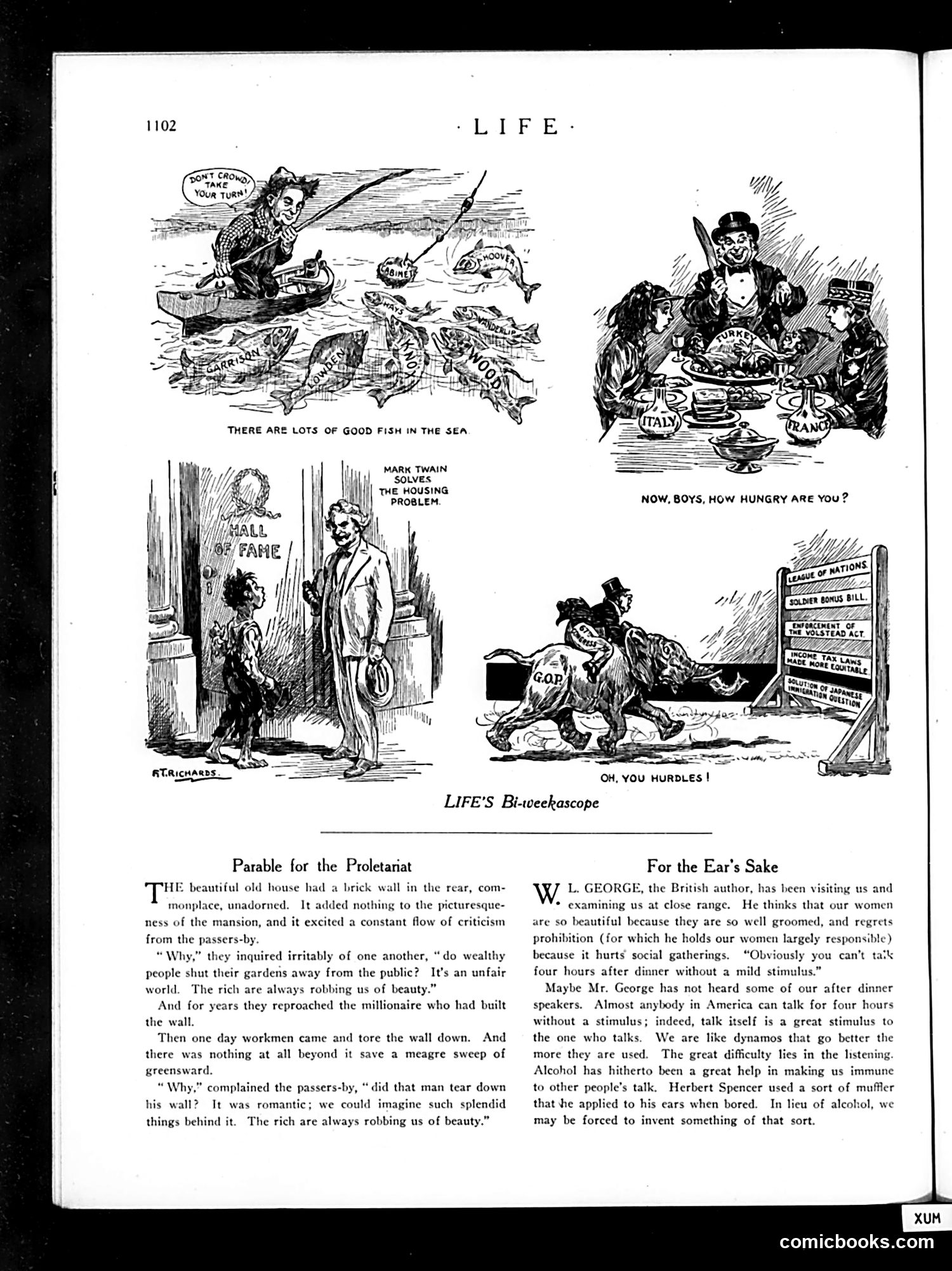
This page contains three distinct satirical pieces: **"Life's Bi-weekascope"** presents four political cartoons mocking contemporary issues. The top-left shows fishermen struggling with overfished seas (labeled with various nations), satirizing post-WWI resource competition. The top-right depicts Italy and France at a banquet, likely commenting on Allied tensions over war reparations and League of Nations disputes. The bottom-right cartoon shows a figure jumping hurdles labeled with League of Nations resolutions, mocking the organization's ineffectual bureaucracy. **"Parable for the Proletarian"** uses a fable structure to satirize working-class envy of the wealthy. The point: common people romanticize what they cannot see and blame the rich regardless—condemning both a hidden garden and its removal as theft of beauty. It's social commentary on class resentment. **"For the Ear's Sake"** responds to British author W.L. George's observations about American women and Prohibition, sardonically suggesting alcohol served primarily to silence boring after-dinner speakers. The satire critiques American social habits and Prohibition's unintended consequences.
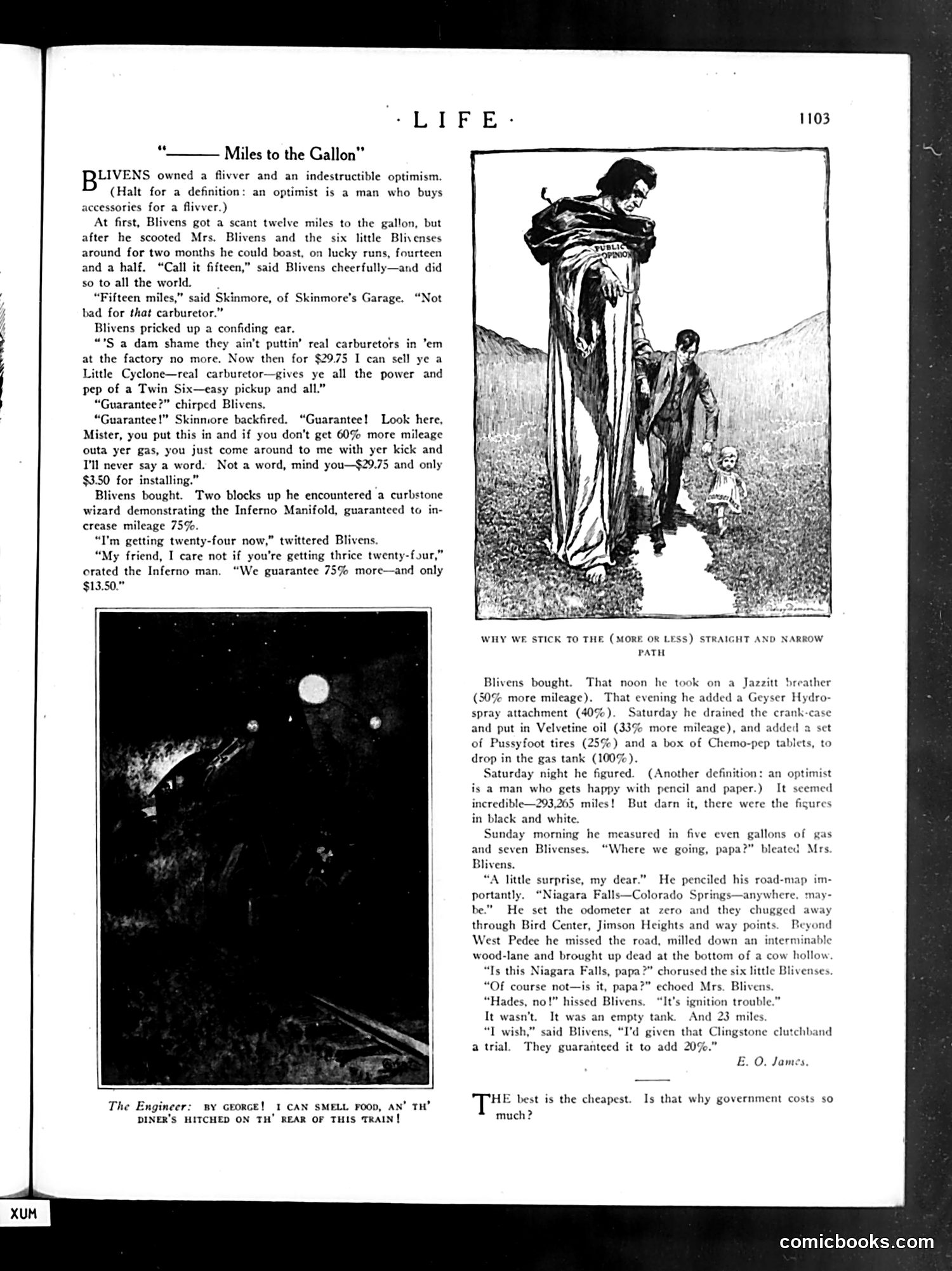
This satirical story mocks the gullibility of American consumers and aggressive automotive aftermarket sales tactics of the 1920s. Blivens, an optimistic car owner (a "flivver" is a Model T Ford), repeatedly purchases dubious fuel-efficiency accessories—carburetors, manifolds, oils, and tablets—each guaranteed to dramatically improve mileage (60%, 75%, 100% increases claimed). The joke: after spending money on multiple "improvements," Blivens calculates he should travel 293,265 miles on five gallons. In reality, he travels only 23 miles before the tank empties. The story satirizes both consumer naivety and deceptive marketing practices that exploited optimistic buyers with impossible promises. The closing caption extends the critique to government spending, suggesting similar wasteful practices occur elsewhere.
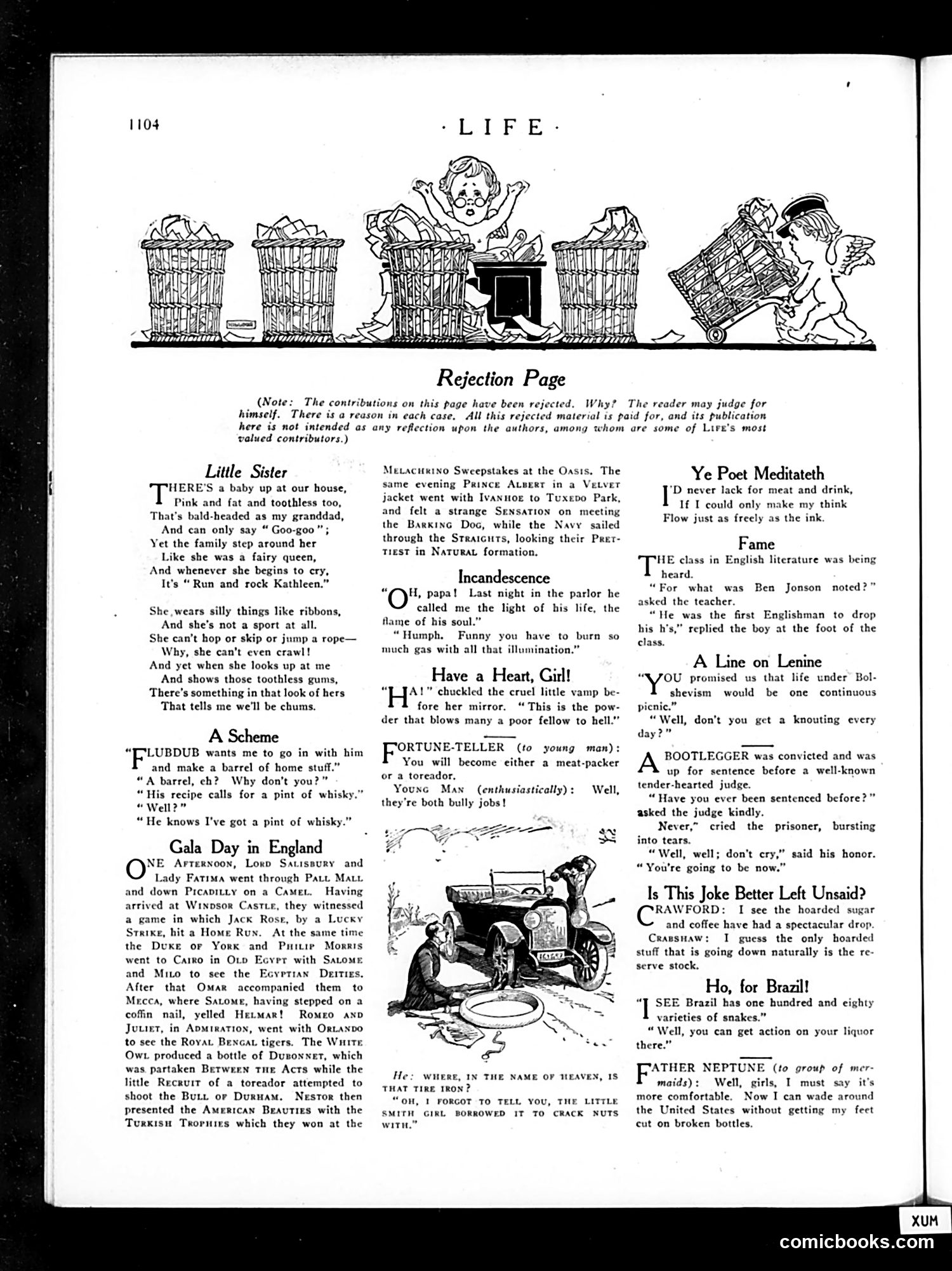
This is Life's "Rejection Page"—a feature publishing submissions deemed unsuitable for the main magazine, with a note that readers can judge why each was rejected. The page is a meta-joke about editorial standards. The content includes light domestic humor ("Little Sister," "A Scheme" about bootleg whisky), and puns relying on brand names and song titles ("Gala Day in England" uses *Lucky Strike, Home Run, Jack Rose*, etc.). There's mild social commentary on Prohibition-era bootlegging and brief references to contemporary figures (Lord Salisbury, Prince Albert) in absurdist scenarios. The cartoons feature simple line drawings depicting everyday situations: a baby, whisky-making schemes, fortune-telling, and a bootlegger facing sentencing. The satire is gentle—poking fun at rejected submissions' quality rather than attacking specific political targets. The page itself is the joke: Life's ironic presentation of "bad" material as a form of humor.
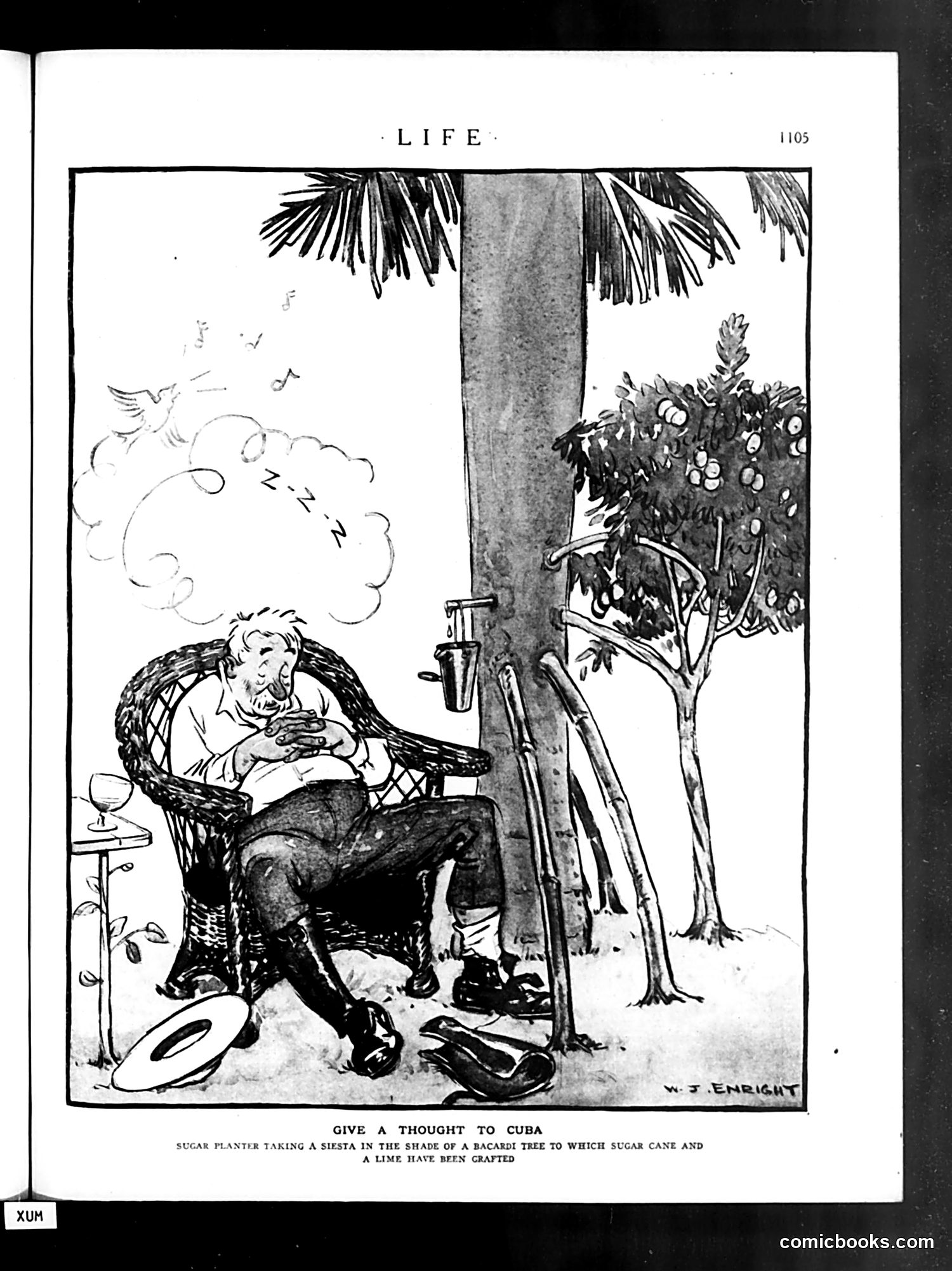
This cartoon satirizes the relationship between Cuban sugar production and alcohol manufacturing. A relaxed sugar planter sleeps beneath a fantastical "Bacardi tree"—a fictional hybrid grafted with sugar cane and lime. The joke plays on Bacardi rum's Cuban origins and its key ingredients: sugar cane and citrus. The siesta-taking planter represents leisure and wealth derived from Cuba's sugar industry. The impossible hybrid tree is absurdist humor suggesting how intimately connected these products are—that you could literally grow rum ingredients on a single tree. A glass sits nearby, completing the satirical image of colonial ease built on agricultural wealth. The cartoon likely appeared during a period when American interest in Cuba's resources was high, mocking both the planter class and American fascination with Cuban rum and sugar commodities.
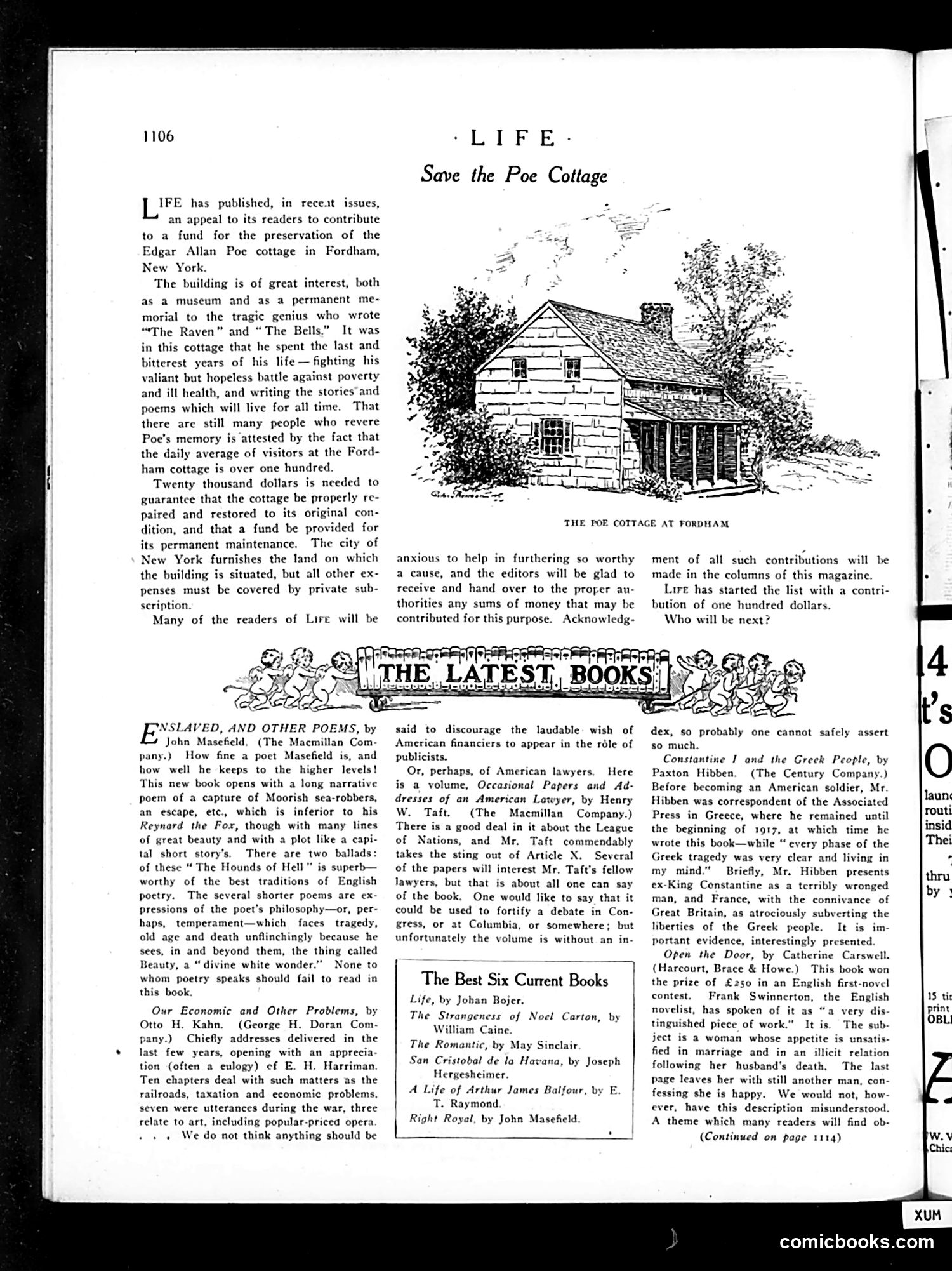
This page presents **Life magazine's fundraising campaign** to preserve Edgar Allan Poe's cottage in Fordham, New York, where the poet spent his final impoverished years. The accompanying sketch shows the modest wooden structure. The appeal is straightforward—not satirical: Life solicits readers' contributions to a $20,000 preservation fund, noting the cottage receives over 100 daily visitors and deserves proper restoration and endowment for maintenance. New York City provides the land; private donations must cover remaining costs. The page's lower half contains unrelated book reviews, including works by Masefield, Kahn, and Taft—standard literary criticism without satirical content. **This is a sincere preservation appeal**, not a political cartoon or satire, reflecting early 20th-century cultural interest in memorializing American literary figures.
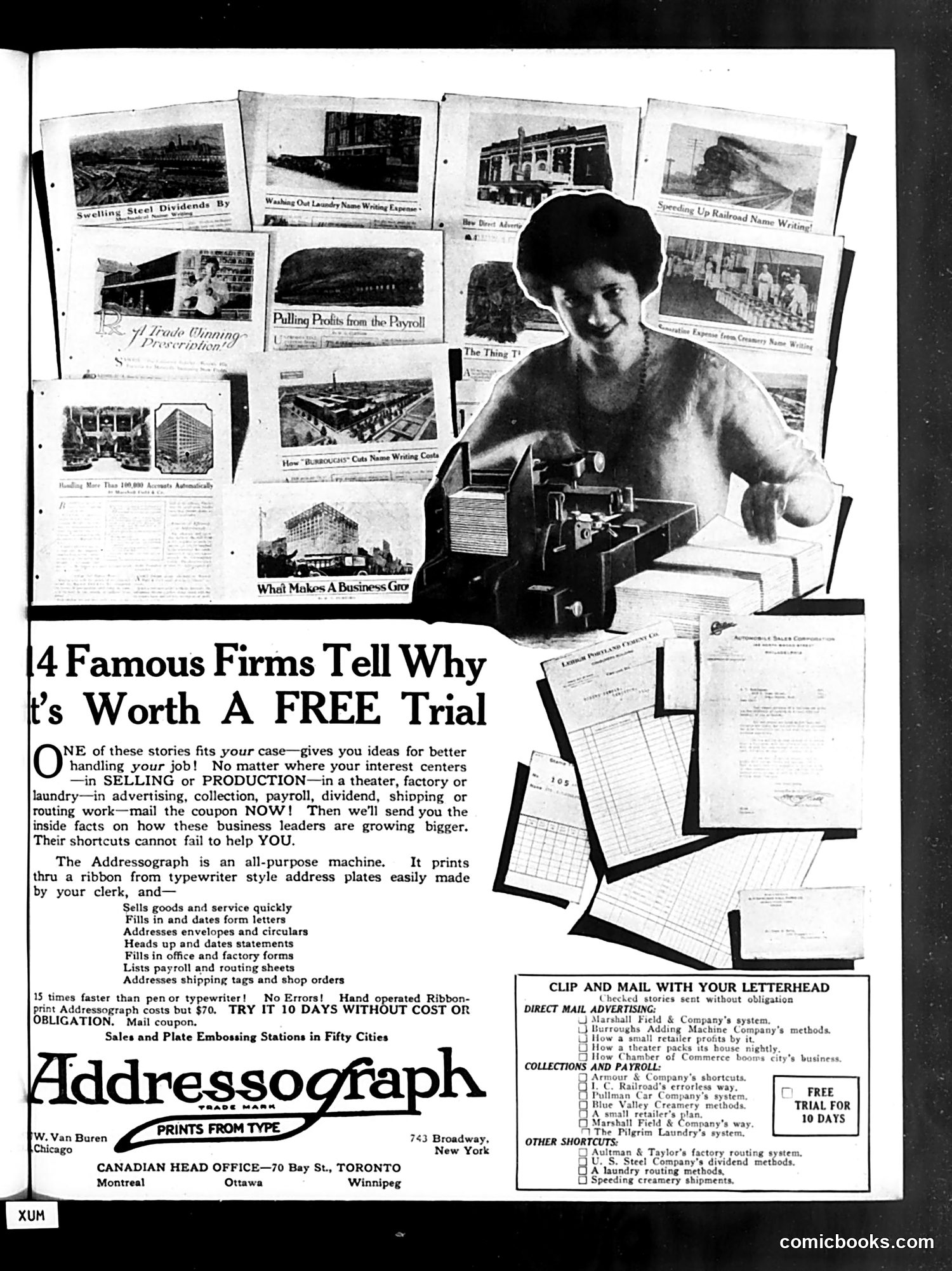
This page is primarily a **business-to-business advertisement**, not a cartoon. It promotes the Addressograph machine—an early mechanical device for printing addresses on envelopes, forms, and documents. The central image shows a man operating the machine, positioned among scattered business documents and case studies. The advertisement appeals to office workers, factory managers, and business owners by offering a "free 10-day trial" and promising the machine works "15 times faster than pen or typewriter." The pitch emphasizes practical applications: addressing mail, filling forms, managing payroll, and routing work. Four famous companies (Marshall Field, Burroughs, Pilgrim Laundry, and others) supposedly endorse the system through included case studies. This reflects early-20th-century enthusiasm for **mechanization and efficiency** in office work—themes central to business culture of the era. There is no political satire here; it's straightforward product marketing.
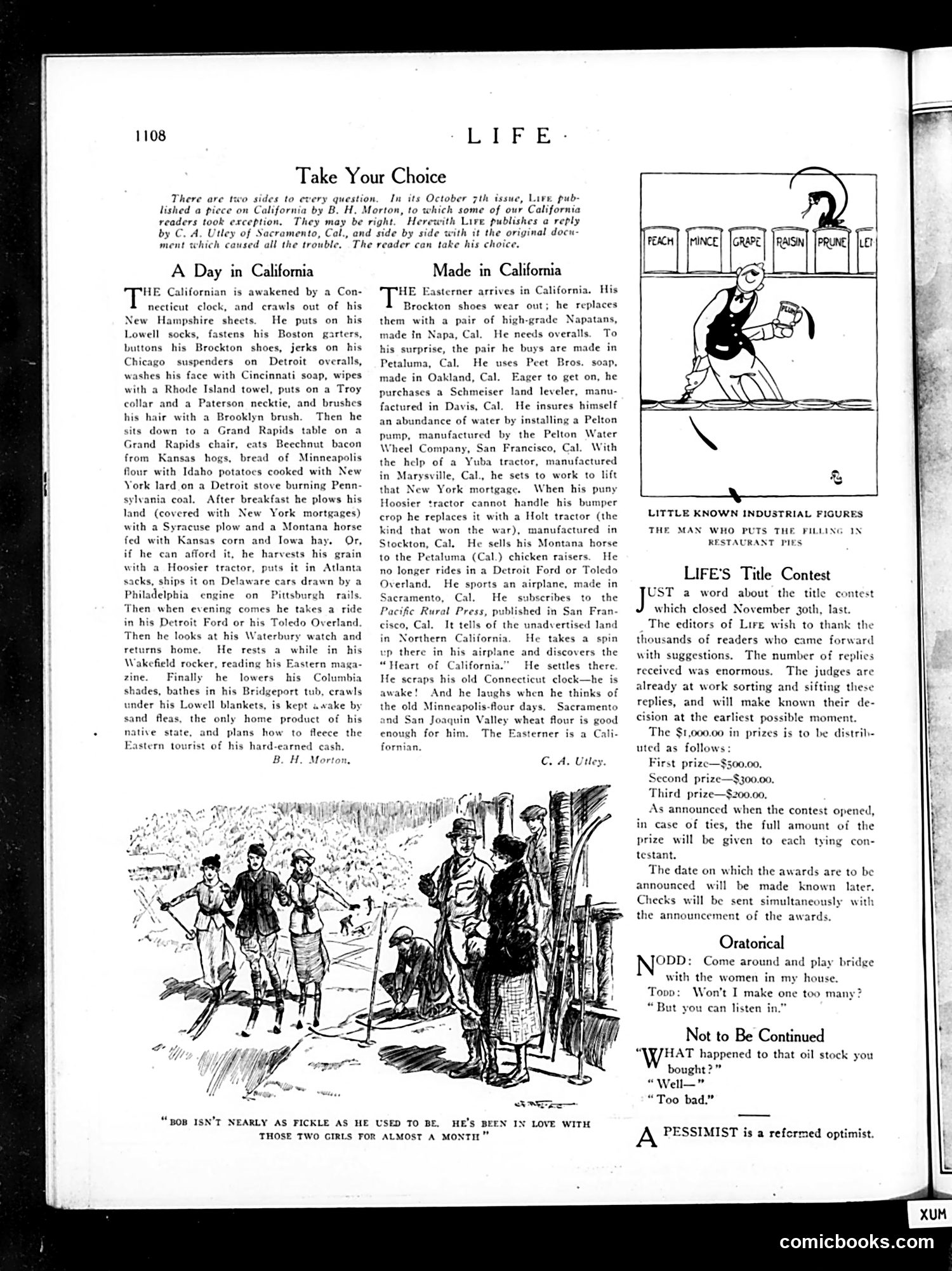
This page presents two opposing satirical pieces debating California's economic independence. The first article ("A Day in California") humorously catalogs how a Californian's entire life—from his Connecticut clock to his Lowell blankets—depends on Eastern manufactured goods, suggesting California is merely an agricultural outpost of Eastern industry. The opposing article ("Made in California") counters by listing homegrown California manufacturers replacing those Eastern products: Napa leather, Oakland soap, Davis equipment, San Francisco pumps, Marysville tractors, and Stockton farm machinery. The Easterner protagonist gradually abandons his Eastern dependencies for California-made alternatives. The satire addresses early 20th-century regional economic tensions—specifically California's growing industrial capacity challenging Eastern industrial dominance. By presenting both perspectives, *Life* mocks the boosterism of both regions while acknowledging California's genuine manufacturing development. The cartoon below (showing "Bob" with two girls) appears unrelated, likely filler content.
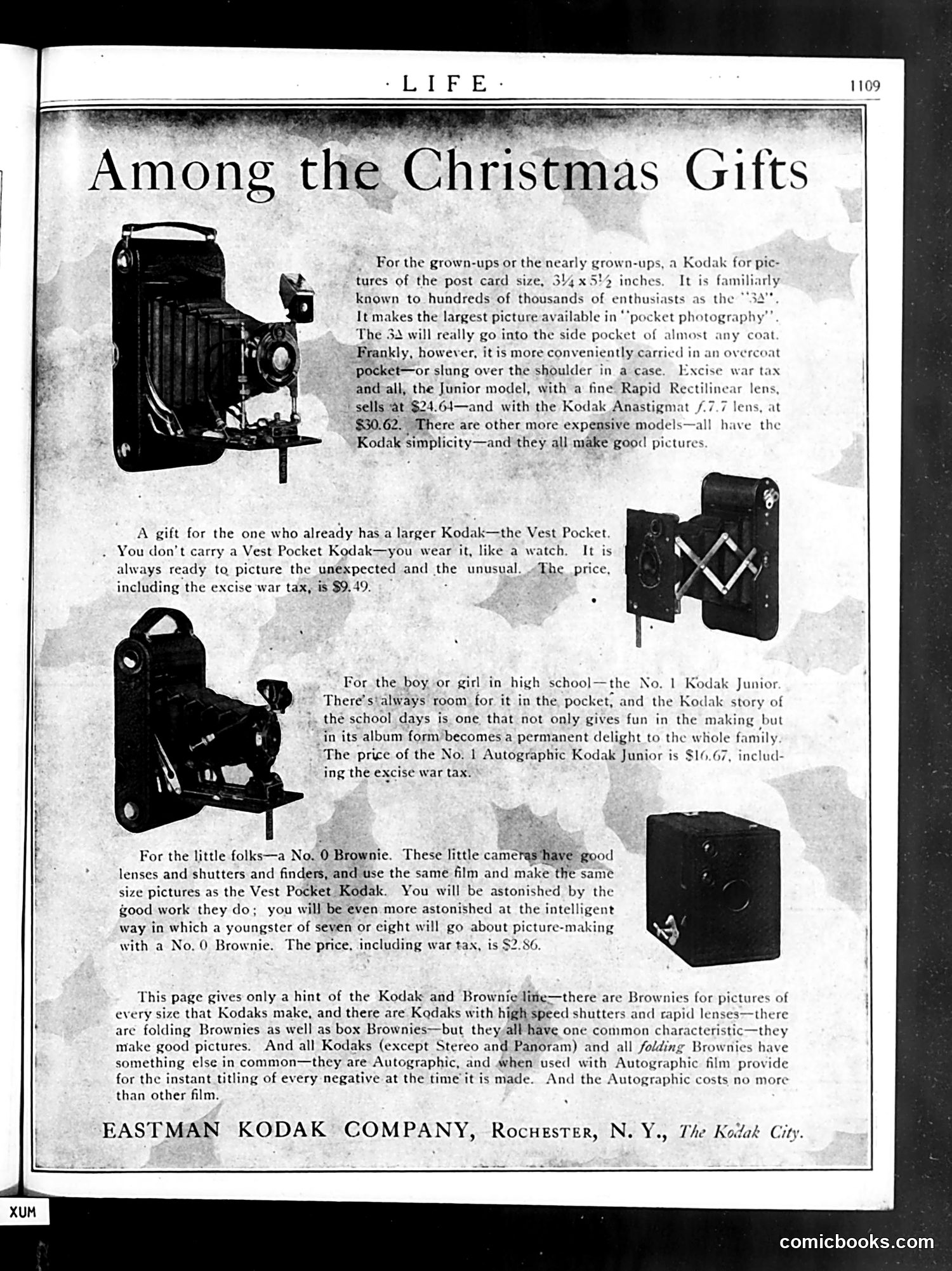
This is not a cartoon or satire—it's a **straightforward advertisement** for Eastman Kodak cameras appearing in *Life* magazine (circa 1918, based on repeated references to "excise war tax"). The page promotes Kodak and Brownie camera models as Christmas gifts, organized by recipient: adults (the "33" model), existing Kodak owners (Vest Pocket model), high schoolers (No. 1 Junior), and children (No. 0 Brownie). The text emphasizes practical features—pocket-size, portability, ease of use—and prices ranging from $2.86 to $30.62. A recurring sales pitch highlights "Autographic" film technology, which allowed users to caption negatives instantly. The accompanying photographs show the actual camera models being advertised, displayed at various angles. **For modern readers:** This reflects early 20th-century consumer culture and the democratization of photography—cameras marketed not as professional tools but as accessible devices for everyday families documenting their lives.
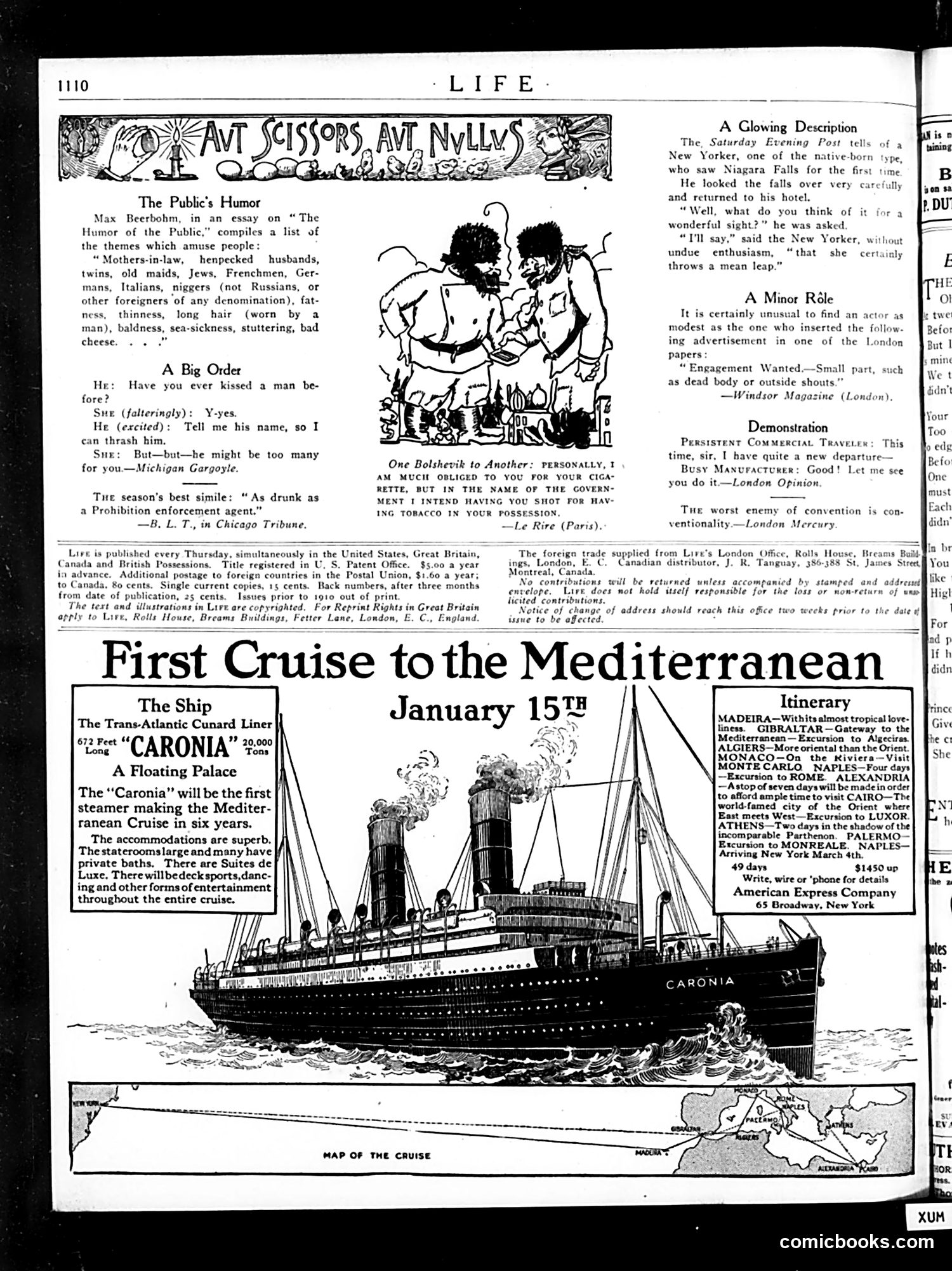
This page is primarily **advertising and humor content**, not political commentary. **The cartoons/jokes** are light social satire: - "The Public's Humor" references Max Beerbohm's essay on what audiences find funny, including period stereotypes (mothers-in-law, ethnic groups, physical traits) - "A Big Order" is a flirtation joke about a woman admitting to kissing someone - The Bolshevik joke satirizes Soviet ideology—even thanking someone for cigarettes gets you shot for possessing tobacco (mocking Communist paranoia) - "A Minor Rôle" mocks an actor so desperate he'll play a corpse - "A Glowing Description" humorously portrays a native New Yorker's underwhelmed reaction to Niagara Falls **The main content** is a **Cunard Line cruise advertisement** for the SS *Caronia's* Mediterranean voyage departing January 15th, featuring ports like Madeira, Gibraltar, Monte Carlo, Cairo, and Athens. The ship is described as "a floating palace" with luxury accommodations and entertainment.
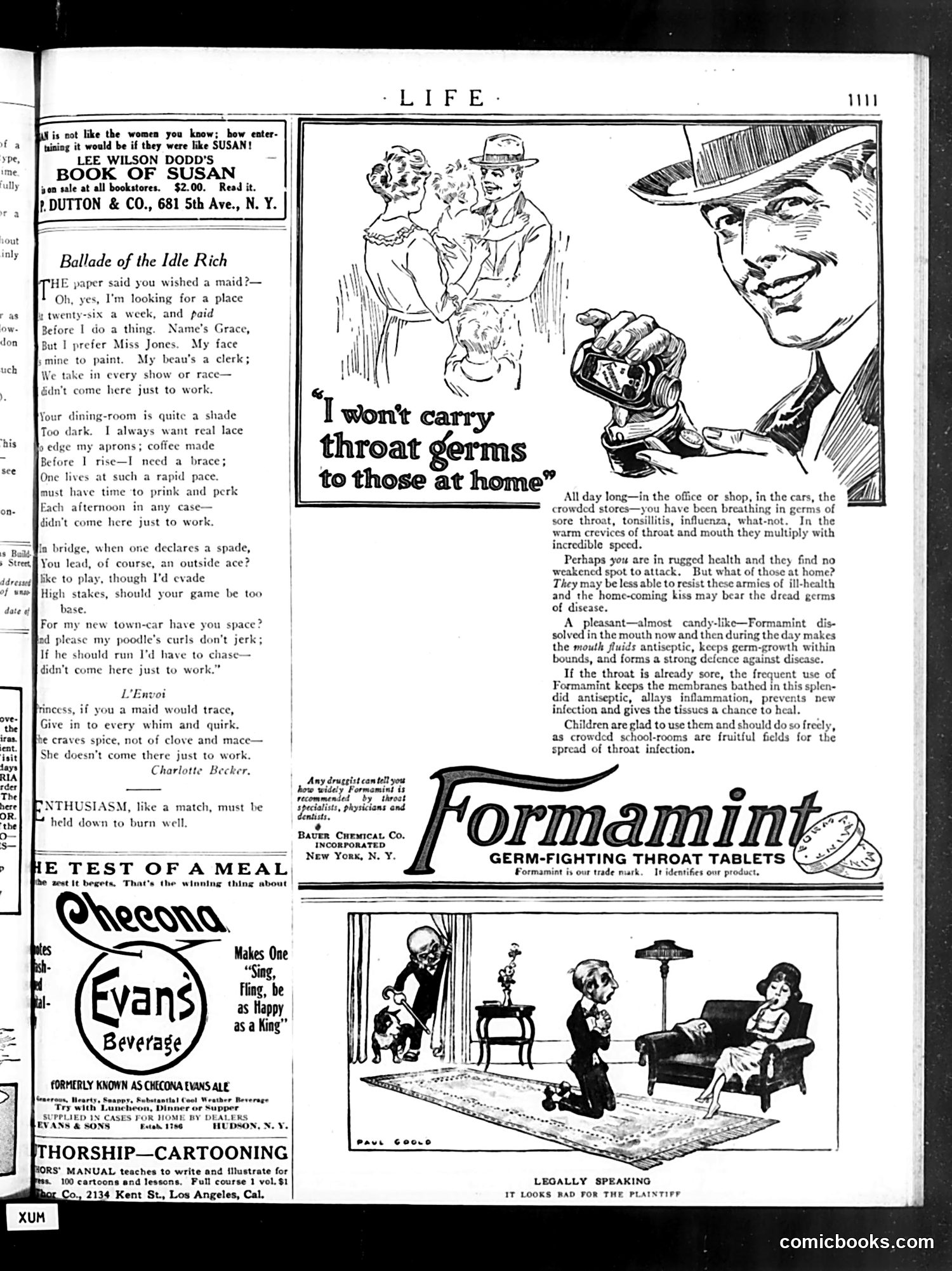
**"Ballade of the Idle Rich"** satirizes wealthy employers' expectations of domestic servants. The poem presents a maid named Grace who demands luxuries (high wages for minimal work, time to socialize, leisure afternoons) while performing no actual labor. The repeated refrain—"didn't come here just to work"—is ironic: she clearly *won't* work. This mocks the perceived entitlement and laziness of the wealthy class who hire servants yet expect to be served lavishly themselves, reversing typical power dynamics. It's social commentary on class pretension. **"Legally Speaking"** (bottom cartoon by Paul Gooch) shows a domestic scene where a lawyer or judge appears to be examining evidence or discussing a case with a woman. The caption "It looks bad for the plaintiff" suggests the plaintiff's case is weakening—likely implying infidelity or marital misconduct based on the intimate setting depicted. The cartoon's humor lies in the awkward domestic situation being scrutinized in legal proceedings. Both pieces target upper-class behavior through gentle satire typical of *Life* magazine's social commentary.
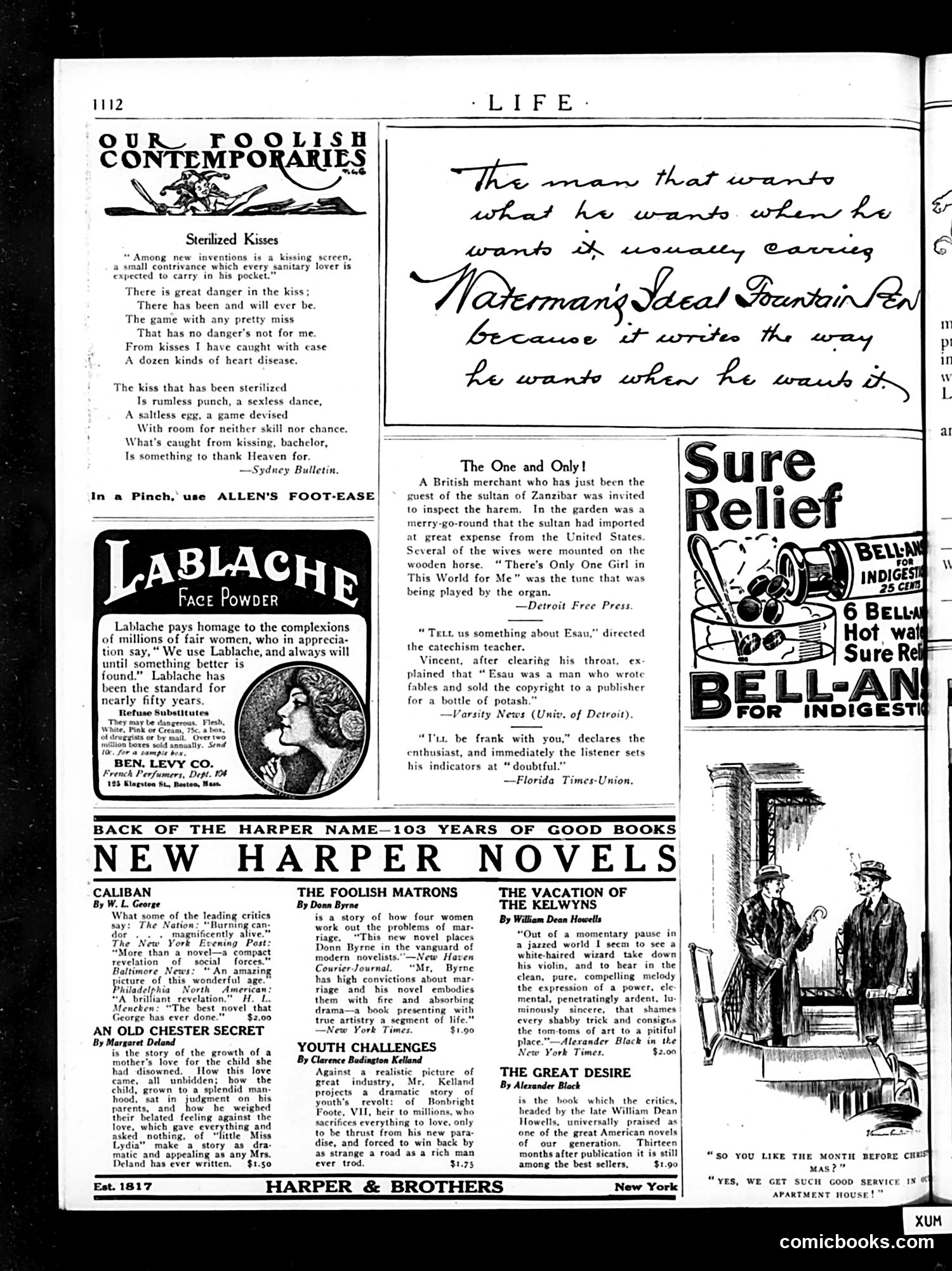
This page is primarily **advertising and book promotion**, not political satire. The main content advertises Harper & Brothers' new novels. The humor appears in three brief comic anecdotes: 1. **"Sterilized Kisses"**: A satirical poem mocking a new "kissing screen" invention meant for hygiene-conscious courting. The joke is that removing all risk and spontaneity from kissing makes it pointless. 2. **"The One and Only!"**: A joke about a British merchant visiting a sultan's harem where wives ride a merry-go-round while organ music plays "There's Only One Girl in This World for Me"—ironic commentary on the sultan's many wives. 3. **"Esau" anecdote**: A brief joke where a student misunderstands a Bible reference, thinking Esau was an author who "sold the copyright to a publisher for a bottle of potash" (a cleaning chemical). These are gentle, everyday humor pieces typical of Life's satirical style—poking fun at modern inventions, cultural absurdities, and innocent misunderstandings rather than serious political issues.
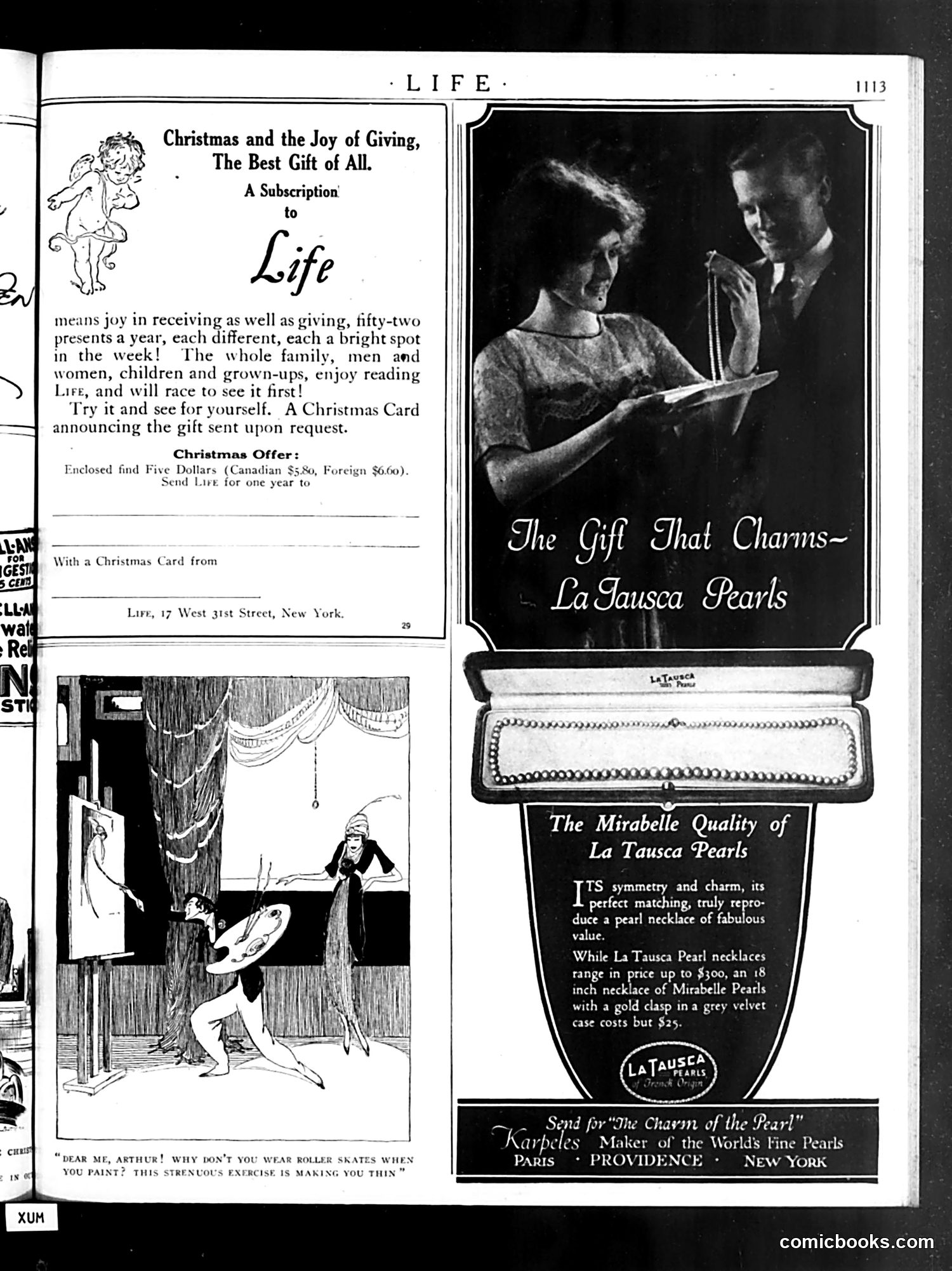
This page mixes editorial promotion with advertising. The left side advertises **Life magazine subscriptions as Christmas gifts** — positioning weekly issues as "fifty-two presents a year" for the whole family. A small cartoon below shows a woman suggesting her husband wear roller skates while painting to make the exercise less strenuous, a mild domestic humor joke with no deeper satire. The right side is a **full-page advertisement for La Tausca/Mirabelle pearls**, featuring a photograph of a couple examining a pearl necklace. The ad emphasizes that their imitation pearls ($25) replicate expensive genuine pearl necklaces (up to $300), marketing affordable luxury to middle-class consumers. This reflects early-20th-century commercial strategy: making luxury goods accessible through synthetic alternatives. There is no political content; this is primarily commercial material.
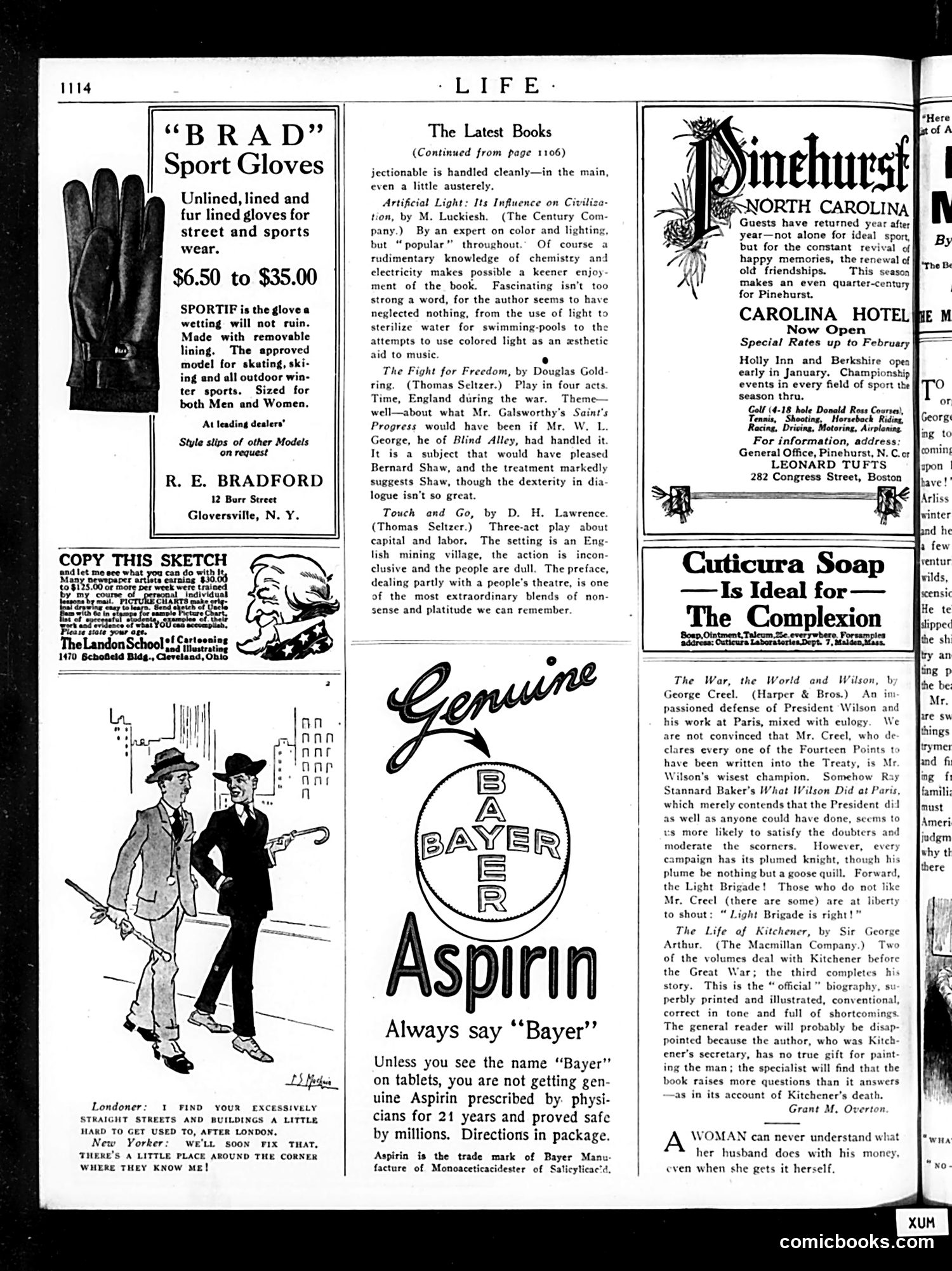
This page is primarily **advertisements and book reviews** with one satirical cartoon. ## The Cartoon The single cartoon (bottom left) depicts a **Londoner and New Yorker conversation**. A British visitor complains about New York's "excessively straight streets and buildings" compared to London's layout. The New Yorker responds confidently: "We'll soon fix that. There's a little place around the corner where they know me!" **The joke**: The New Yorker ironically suggests he can use personal connections ("where they know me"—implying a speakeasy or illegal establishment) to obtain alcohol during Prohibition, thereby making the streets "crooked" through drunkenness. This references the chaotic social effects of Prohibition (1920-1933) and the prevalence of underground drinking establishments. ## Rest of Page The remaining content consists of: sport glove advertisements (R.E. Bradford), book reviews (including works about artificial light and WWI-related titles), Bayer Aspirin advertisement, and resort advertisements for Pinehurst, North Carolina and Cuticura Soap.
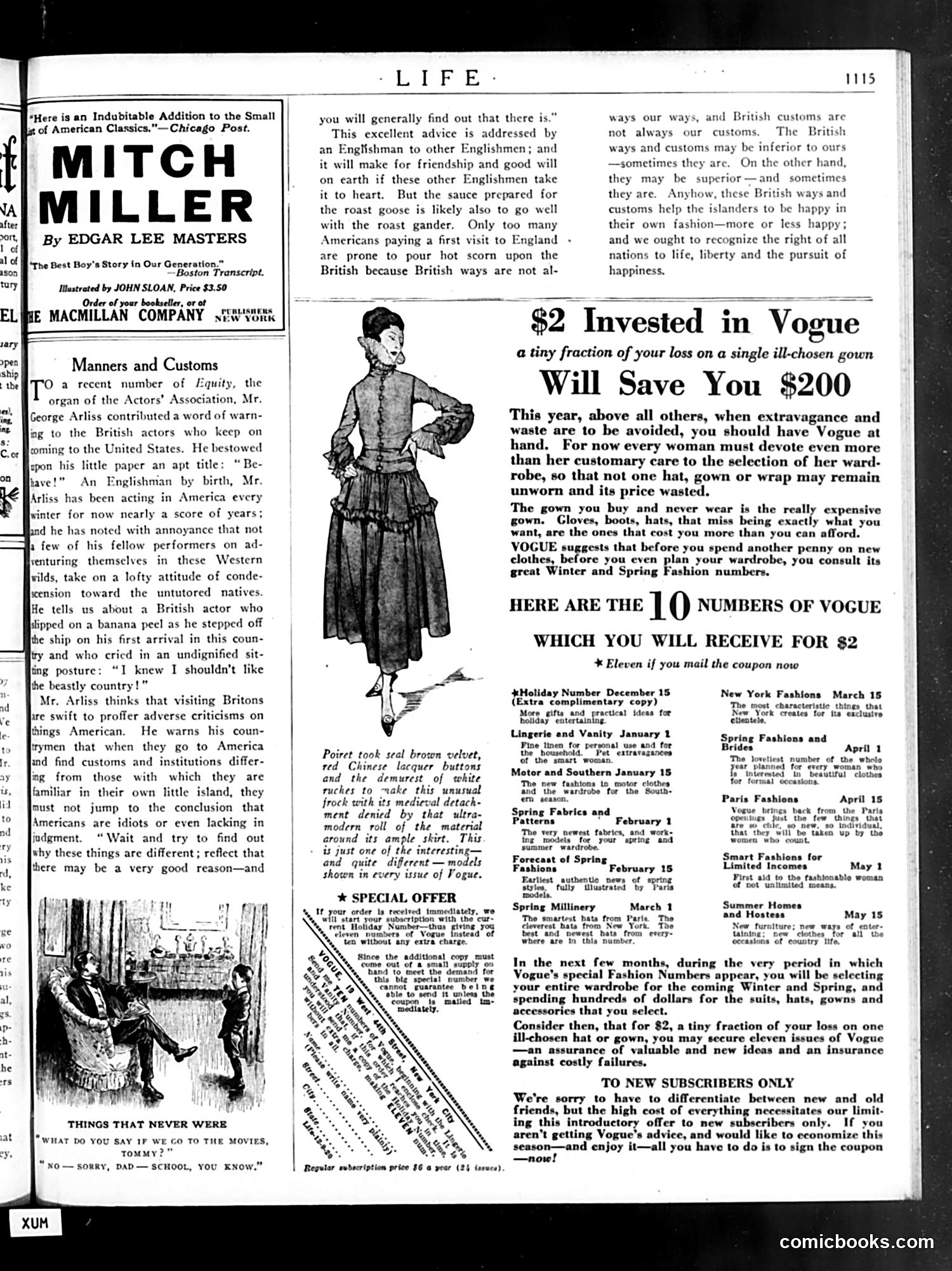
This page contains a book advertisement for Edgar Lee Masters' novel "Mitch Miller" (illustrated by John Sloan) alongside an essay titled "Manners and Customs." The essay addresses Anglo-American cultural friction. Actor George Arliss, a British-born performer long active in America, warned fellow British actors against sneering at American customs. The piece satirizes British snobbery—notably citing an anecdote where a visiting British actor, slipping on a banana peel upon arrival, complains indignantly about "the beastly country." The satirical point: both Americans and British visitors to each other's countries assume superiority rather than understanding. The author argues that different customs aren't necessarily inferior—they reflect each nation's legitimate right to its own way of life. This reflects Progressive-era debates about immigration and cultural assimilation in early 20th-century America, where British visitors' condescension toward American culture was apparently a recognizable social phenomenon worthy of mockery.
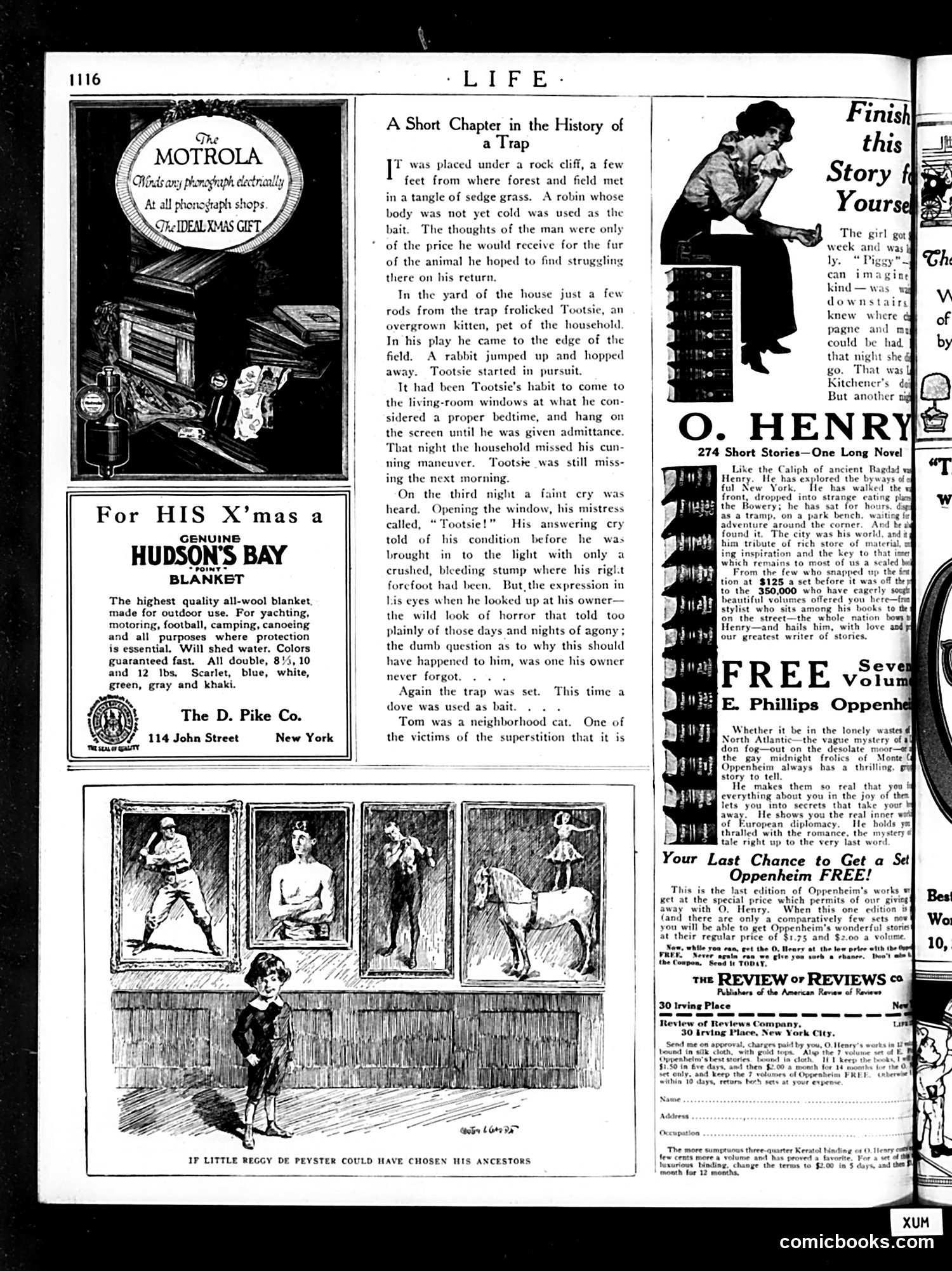
This page combines **literary advertising with a moral tale**. The main narrative, "A Short Chapter in the History of a Trap," is a tragic story about animal suffering: a man sets a trap baited with a dead robin, hoping to catch fur-bearing prey. Instead, his neighbor's pet cat Tootsie is caught and loses her paw. The trap is reset, and another neighborhood cat is implied to meet the same fate. The story appears to **critique casual cruelty and indifference to animal suffering**—the trapper thinks only of profit, unaware of the domestic pets endangered by his trap. The repeated victimization (implied by "One of the victims") suggests systemic carelessness. The page also advertises **O. Henry collections and Hudson's Bay Blankets** as Christmas gifts, seemingly incongruous with the dark animal-suffering narrative above. The bottom illustration shows a small figure viewing framed portraits on a wall, captioned "IF LITTLE BEGGY OF PEYSTER COULD HAVE CHOSEN HIS ANCESTORS"—a separate satirical comment on heredity and social status.
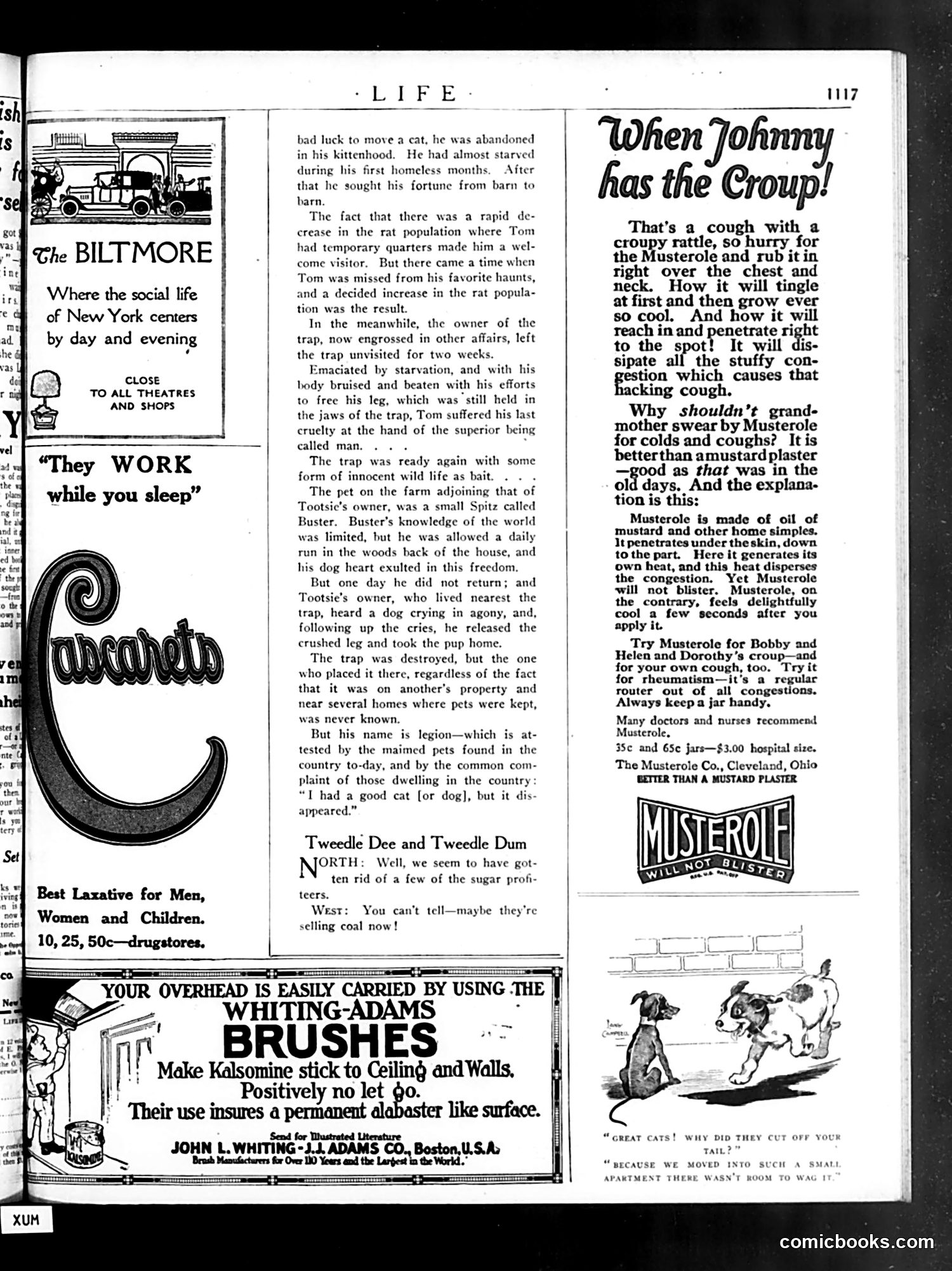
This page contains two distinct narrative elements: **Left side:** A story about animal suffering from carelessly-placed rat traps. A cat named Tom dies trapped; a dog named Buster is rescued but maimed. The text criticizes rural residents who set traps on others' property near homes with pets, noting the common complaint: "I had a good cat [or dog], but it disappeared." This appears to be social commentary criticizing negligence and cruelty toward animals. **Right side:** A brief political cartoon titled "Tweedle Dee and Tweedle Dum" mocking profiteers. One character suggests sugar profiteers haven't disappeared—they've simply moved to selling coal instead. This satirizes how unethical businessmen merely shift to new markets rather than face genuine consequences for exploitation. The page is otherwise dominated by period advertisements for laxatives, hotels, Musterole (a medicinal rub), and brushes. A cartoon shows cats complaining about tail-docking due to apartment living.
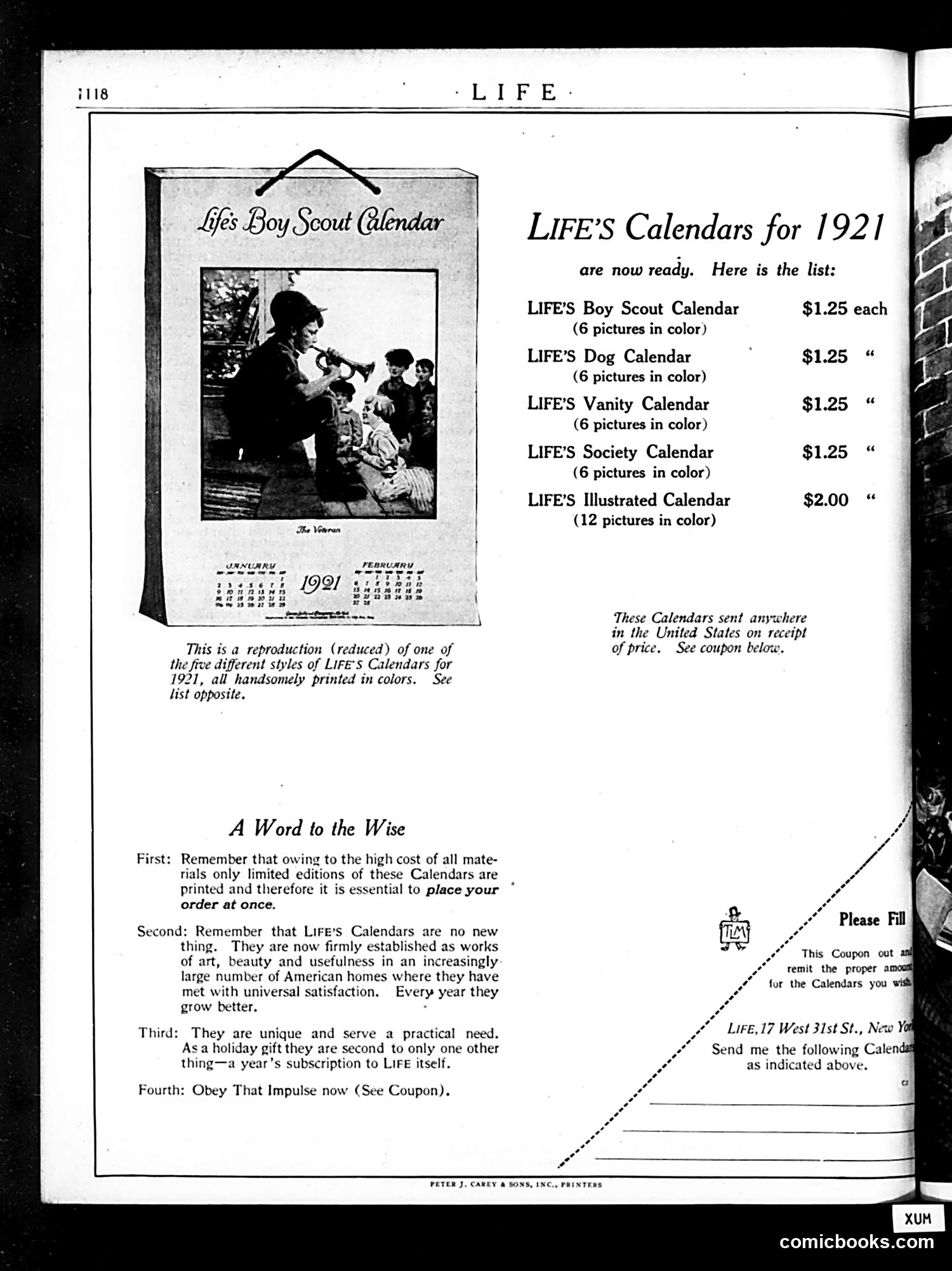
This is primarily a **product advertisement**, not political satire. Life magazine is promoting its 1921 calendar line—five different themed calendars priced at $1.25–$2.00 each. The left side shows the Boy Scout Calendar cover featuring a scoutmaster with a trumpet and young scouts, illustrating the calendars' appeal as decorative art suitable for American homes. The "Word to the Wise" section employs gentle persuasion typical of 1920s advertising: calendars are positioned as established, valued items; limited editions create urgency to order immediately; they're framed as superior holiday gifts (second only to a Life subscription itself); and the final line humorously commands readers to "Obey That Impulse now." The page reflects post-WWI consumer culture and Life's established reputation for combining quality illustration with commercial products.
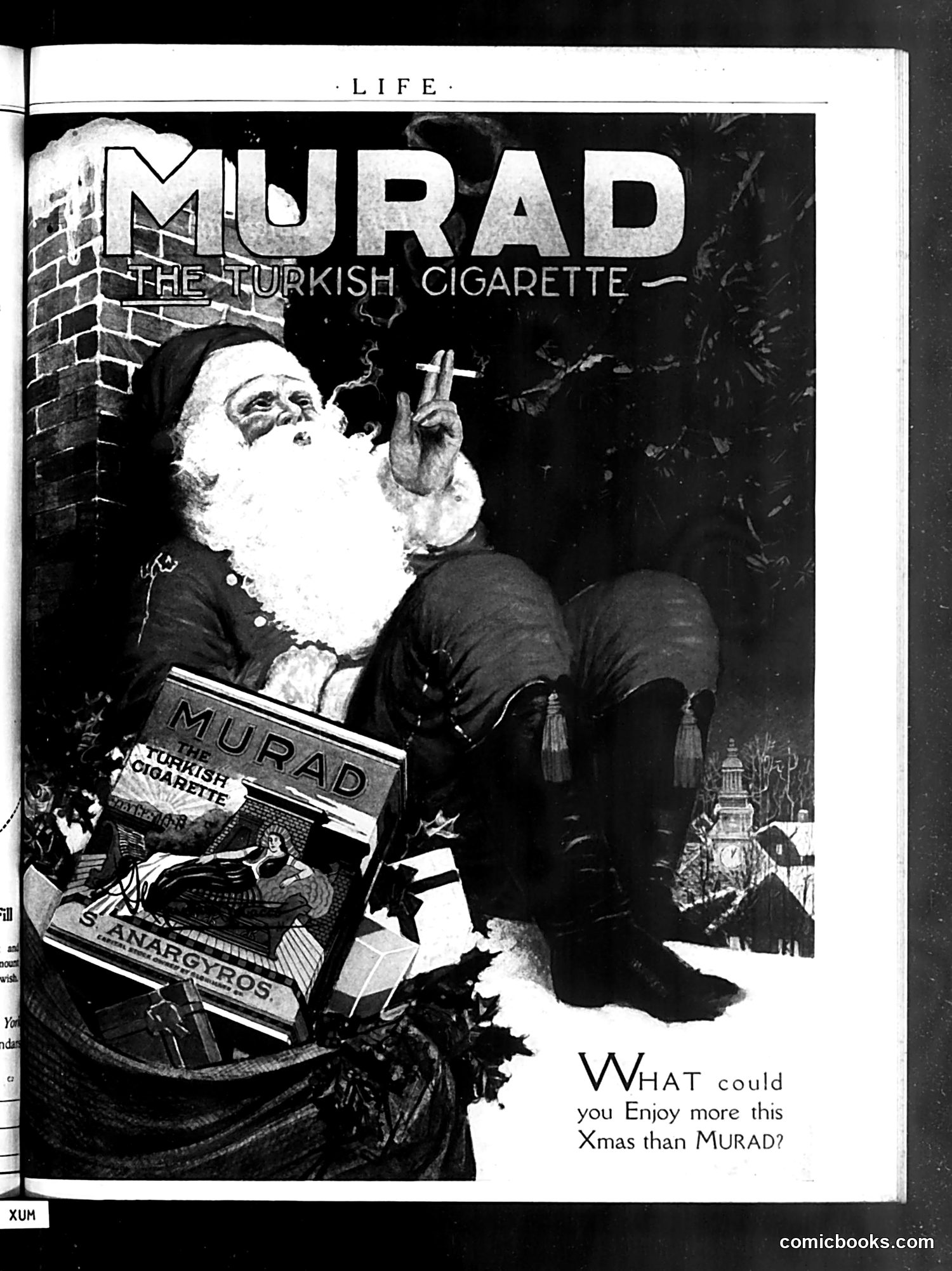
This is a Christmas-themed cigarette advertisement for Murad, a Turkish cigarette brand. The image depicts Santa Claus smoking a Murad cigarette, with a box of the product visible beside him. A snowy European cityscape (possibly Constantinople/Istanbul, given the Turkish connection) appears in the background. The tagline poses a rhetorical question: "What could you enjoy more this Xmas than MURAD?" — suggesting cigarettes as an ideal holiday gift. This represents early 20th-century advertising before tobacco health warnings. The ad exploits Santa's cultural prestige and the holiday gift-giving season to market the product. The Turkish origin is emphasized as exotic and desirable. Such direct tobacco advertising to general audiences, including implicit appeal to all ages, would be illegal in modern advertising standards.
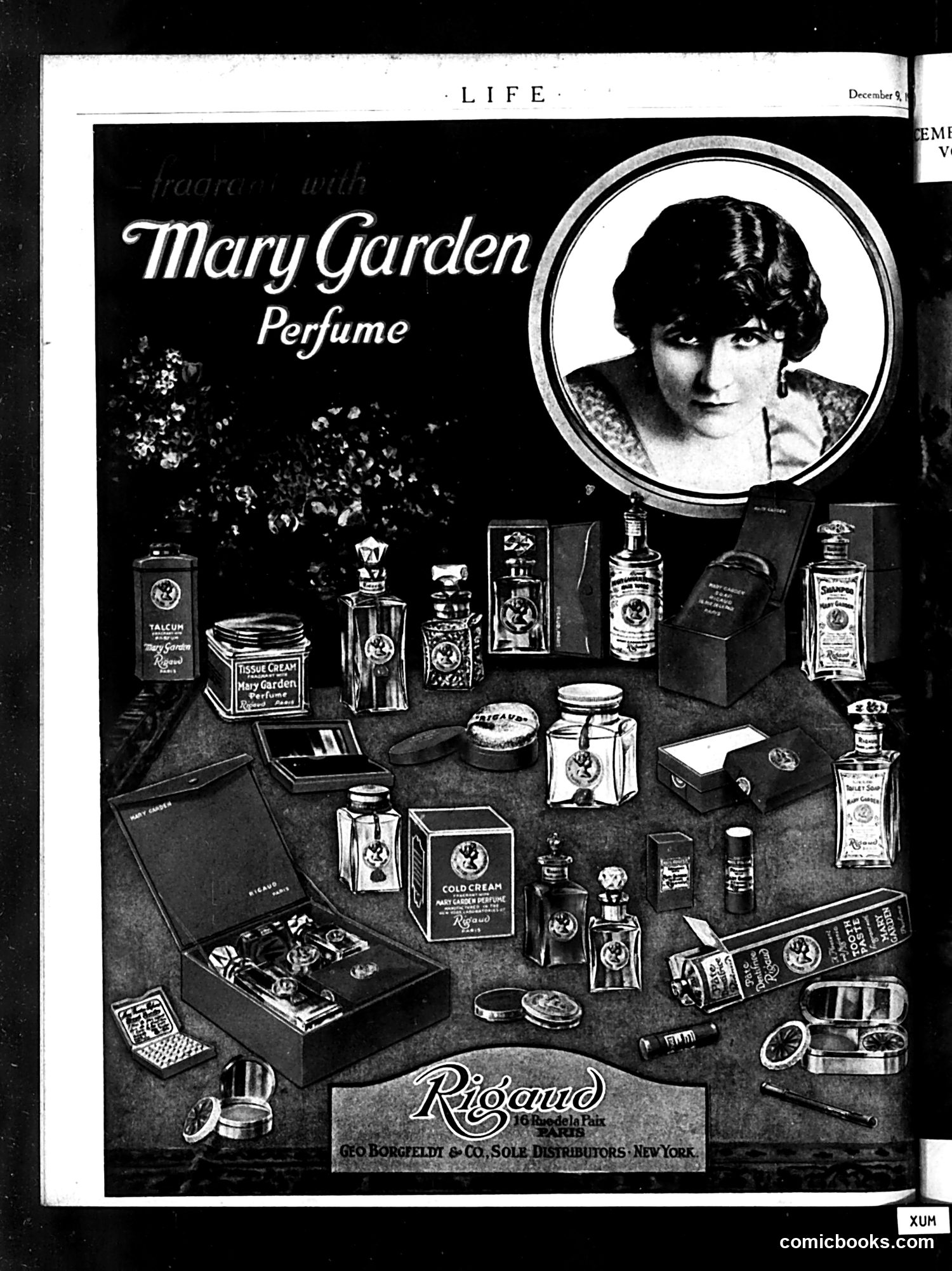
This is a **perfume advertisement**, not political satire. It promotes "Mary Garden Perfume" by Rigaud, a French luxury brand. The page features a circular portrait of what appears to be Mary Garden herself—likely the famous opera singer of that era—positioned above an elaborate display of cosmetic and fragrance products bearing her name. The advertisement showcases an extensive product line including perfume bottles, cold cream, talcum powder, and other beauty items, all branded with the Mary Garden name and circular logo. The distributor is listed as Geo. Borgeldi & Co. in New York. This reflects early-20th-century marketing practices where celebrity endorsements—particularly from famous entertainers—were used to sell luxury cosmetics and fragrances.