
Life, 1920-12-09 · page 33 of 44
Life — December 9, 1920 — page 33: what you’re looking at
What you’re looking at
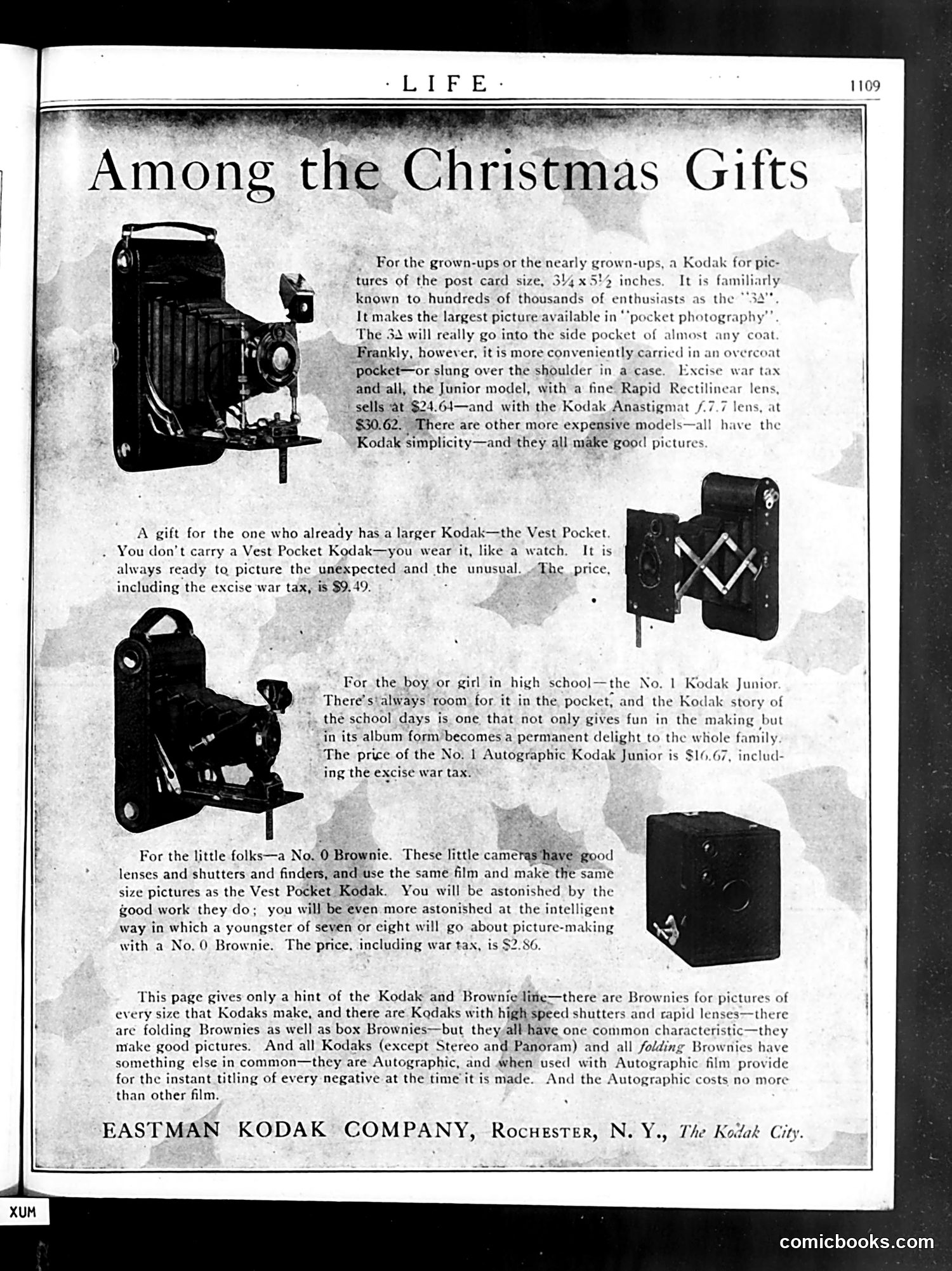
This is not a cartoon or satire—it's a **straightforward advertisement** for Eastman Kodak cameras appearing in *Life* magazine (circa 1918, based on repeated references to "excise war tax"). The page promotes Kodak and Brownie camera models as Christmas gifts, organized by recipient: adults (the "33" model), existing Kodak owners (Vest Pocket model), high schoolers (No. 1 Junior), and children (No. 0 Brownie). The text emphasizes practical features—pocket-size, portability, ease of use—and prices ranging from $2.86 to $30.62. A recurring sales pitch highlights "Autographic" film technology, which allowed users to caption negatives instantly. The accompanying photographs show the actual camera models being advertised, displayed at various angles. **For modern readers:** This reflects early 20th-century consumer culture and the democratization of photography—cameras marketed not as professional tools but as accessible devices for everyday families documenting their lives.
📄 Transcribed text from this page (OCR, searchable)
Machine-transcribed from the original scan — historical spelling and the odd misread are preserved.
ong the Christmas Gift Am For the grown-ups or the nearly grown-ups, a Kodak for pic- tures of the post card size, 344x5'%4 inches. It is familiarly known to hundreds of thousands of enthusiasts as the “33” It makes the largest picture available in ‘pocket photography”’ The 32 will really go into the side pocket of almost any coat Frankly, however, it is more conveniently carried in an overcoat pocket—or slung over the shoulder in a case. Excise war tax and all, the Junior model, with a fine Rapid Rectilinear lens, sells at $24.64—and with the Kodak Anastigmat (7.7 lens, at $30.62. There are other more expensive models—al! have the Kodak simplicity—and they all make good pictures A gift for the one who already has a larger Kodak—the Vest Pocket You don’t carry a Vest Pocket Kodak—you wear it, like a watch. It is always ready to picture the unexpected and the unusual. «The price, including the excise war tax, is $9.49. For the boy or girl in high school—the No. 1 Kodak Junior There’s!always room for it in the pocket) and the Kodak story of the school days is one that not only gives fun in the making but in its album form’becomes a permanent delight to the whole family The price of the No. 1 Autographic Kodak Junior is $16.67, includ- ing the excise war tax. For the little folks—a No. 0 Brownie. These little cameras have good lenses and shutters and finders, and use the same film and make the same size pictures as the Vest Pocket Kodak. You will be astonished by the food work they do; you will be even more astonished at the intelligent way in which a youngster of seven or eight will go about picture-making with a No. 0 Brownie. The price, including war tax, is $2.86. This page gives only a hint of the Kodak and Brownie litte—there are Brownies for pictures of every size that Kodaks make, and there are Kodaks with high speed shutters and rapid lenses—there } are folding Brownies as well as box Brownies—but theyall have one common characteristic—they make good pictures. And all Kodaks (except Stereo and Panoram) and all folding Brownies have | something else in common—they are Autographic, and when used with Autographic film provide for the instant titling of every negative at the time it is made. And the Autographic costs no more than other film. EASTMAN KODAK COMPANY, Rocuester, N. Y., Vhe Kotak City. comicbooks.com