
Life, 1920-12-09 · page 19 of 44
Life — December 9, 1920 — page 19: what you’re looking at
What you’re looking at
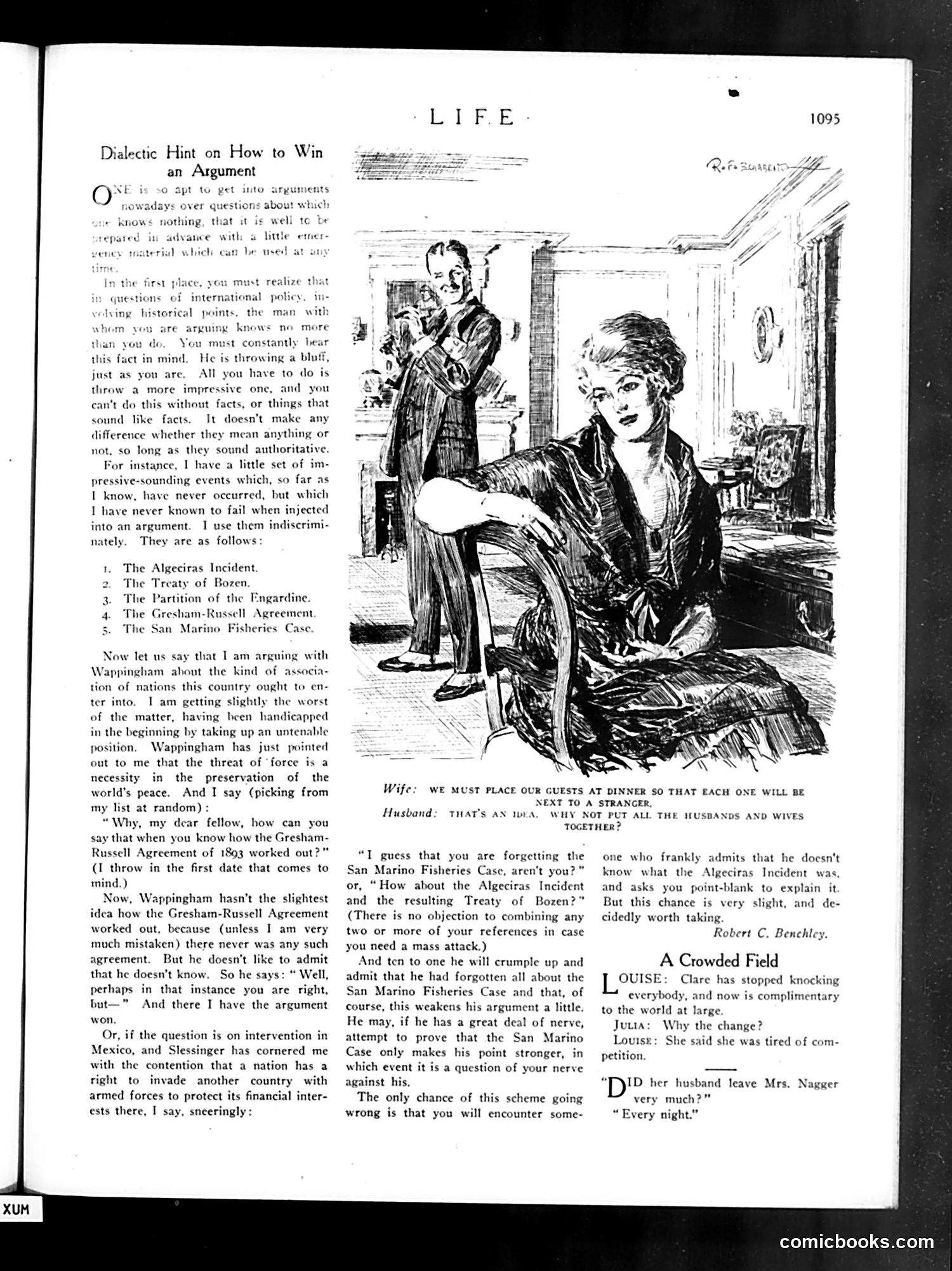
This page contains two distinct pieces of satirical content: **"Dialectic Hint on How to Win an Argument"** (main article with illustration): The author humorously reveals a debating trick—inventing fake historical references with authoritative-sounding names (the "Algeciras Incident," "Treaty of Bozen," "Gresham-Russell Agreement") to win arguments about topics you don't actually understand. The point: most people won't admit ignorance, so confident-sounding BS works. The illustration shows a man smugly lecturing a woman, exemplifying this bluffing technique. This satirizes intellectual dishonesty and social pretense common in public discourse. **"A Crowded Field"** (brief comic dialogue): A woman named Clare stops criticizing others and becomes complimentary—not from kindness, but because she's tired of the competition from other gossips. The husband joke suggests he leaves home nightly to escape her nagging. This mocks superficial social climbing and competitive cattiness among society women. Both pieces target early 20th-century social pretense and the gap between appearance and reality in polite society.
📄 Transcribed text from this page (OCR, searchable)
Machine-transcribed from the original scan — historical spelling and the odd misread are preserved.
Dialectic Hint on How to Win an Argument on © apt to get into arguments nowadays over questions about whic knows nothing, that 1 with well to be tepared in advance a little emer- venes material which t realize nal policy. in of internati ints, the historical man with are arguing knows ne more ing whom than you de You must constantly bear this fa He is throwing a bluff, just as you are. All you have to do is throw a more impressive one, and you can't do this without facts, or things that sound like facts. It doesn’t make any difference whether they mean anything or not, so long as they sound authoritative. ‘or instance, I have a little set of im- pressive-sounding events which, so far as I know, have never occurred, but which I have never known to fail when injected into an argument. I use them indiscrimi- t in mind. nately. They are as follows: 1. The Algeciras Incident 2. The Treaty of Bozen. 3. The Partition of the Engardine. 4. The Gresham-Russell Agreement 3. The San Marino Fisheries Case. Now let us say that Tam arguing with Wappingham about the kind of associa- tion of nations this country ought to en- ter into. I am getting slightly the worst of the matter, having been handicapped in the beginning by taking up an untenable position. Wappingham has just pointed out to me that the threat of ‘force is a necessity in the preservation of the world’s peace. And I say (picking from my list at random): “Why, my dear fellow, how can you say that when you know how the Gresham- Russell Agreement of 1893 worked out?” (I throw the first date that comes to mind.) Now, Wappingham hasn't the slightest idea how the Gresham-Russell Agreement worked out, because (unless I am very much mistaken) there never was any such agreement. But he doesn't like to admit that he doesn’t know. So he says: “ Well, perhaps in that instance you are right, but—" And there I have the argument won, Or, if the question is on intervention in Mexico, and Slessinger has cornered me with the contention that a nation has a right to invade another country with armed forces to protect its financial inter- ests there, I say, sneeringly: Wife: Husband: THAT'S AN IDEA, “T guess that you are forgetting the San Marino Fisheries Case, aren't you?” or, “How about the Algeciras Incident and the resulting Treaty of Bozen?” (There is no objection to combining any two or more of your references in case you need a mass attack.) And ten to one he will crumple up and admit that he had forgotten all about the San Marino Fisheries Case and that, of course, this weakens his argument a little. He may, if he has a great deal of nerve, attempt to prove that the San Marino Case only makes his point stronger, in which event it is a question of your nerve against his. The only chance of this scheme going wrong is that you will encounter some- WE MUST PLACE OUR GUESTS AT DINNER $O THAT EACH ONE WILL BE NEXT TO A STRANGER. WHY NOT PUT ALL TOGETHER? THE HUSBANDS AND WIVES one who frankly admits that he doesn't know what the Algeciras Incident was, and asks you point-blank to explain it But this chance is very slight, and de- cidedly worth taking. Robert C. Bench A Crowded Field OUISE: Clare has stopped knocking everybody, and now is complimentary to the world at large. Jutta: Why the change? Louise: She said she was tired of com- petition. “PID her husband leave Mrs. Nagger >” very much “Every night.” comicbooks.com