
Life, 1920-12-09 · page 30 of 44
Life — December 9, 1920 — page 30: what you’re looking at
What you’re looking at
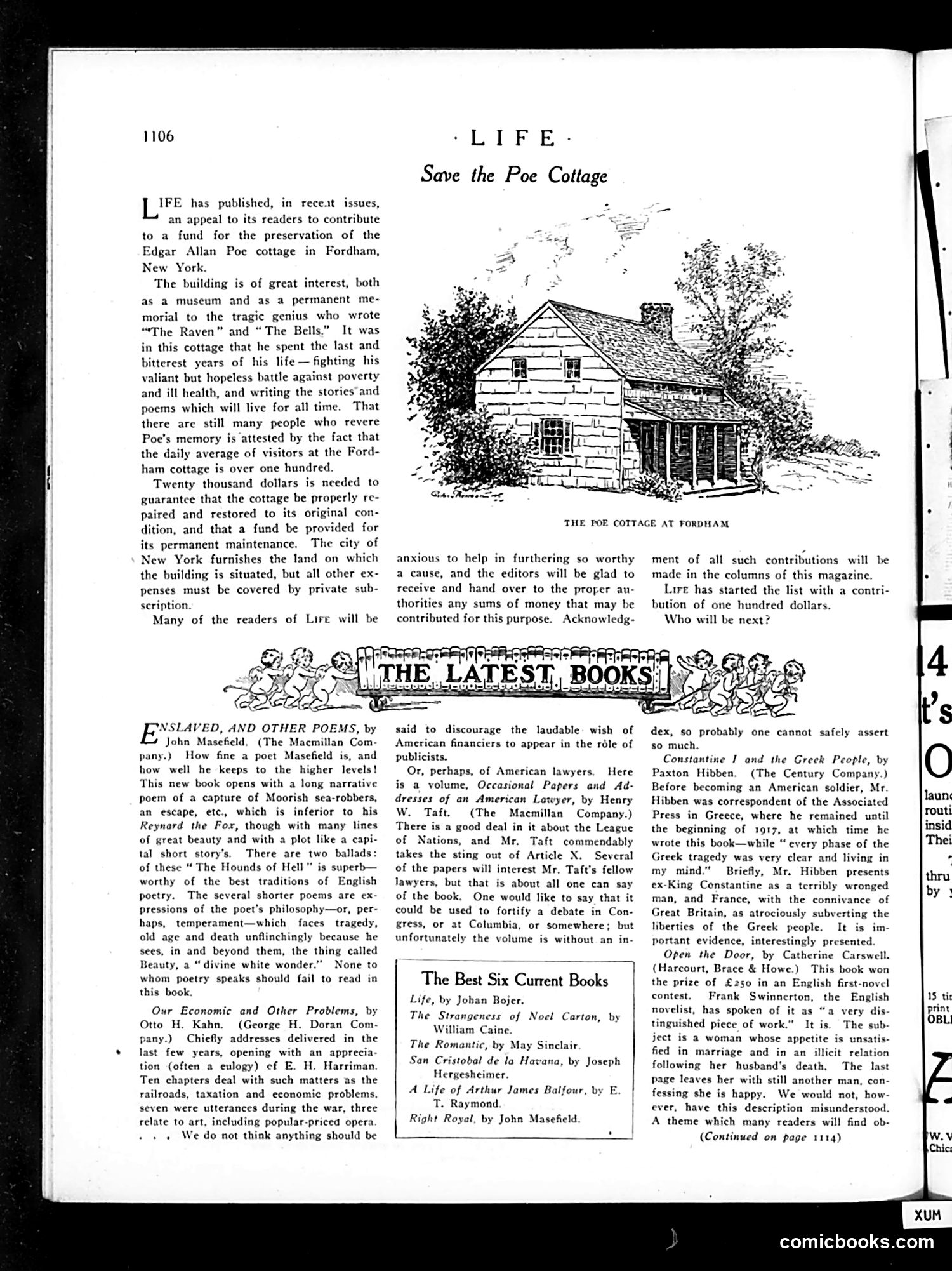
This page presents **Life magazine's fundraising campaign** to preserve Edgar Allan Poe's cottage in Fordham, New York, where the poet spent his final impoverished years. The accompanying sketch shows the modest wooden structure. The appeal is straightforward—not satirical: Life solicits readers' contributions to a $20,000 preservation fund, noting the cottage receives over 100 daily visitors and deserves proper restoration and endowment for maintenance. New York City provides the land; private donations must cover remaining costs. The page's lower half contains unrelated book reviews, including works by Masefield, Kahn, and Taft—standard literary criticism without satirical content. **This is a sincere preservation appeal**, not a political cartoon or satire, reflecting early 20th-century cultural interest in memorializing American literary figures.
📄 Transcribed text from this page (OCR, searchable)
Machine-transcribed from the original scan — historical spelling and the odd misread are preserved.
IFE has published, in receat issues, an appeal to its readers to contribute to a fund for the preservation of the Edgar Allan Poe cottage in Fordham, New York, The building is of great interest, both as a museum and as a permanent me- morial to the tragic genius who wrote “The Raven” and “The Bells.” It was in this cottage that he spent the last and bitterest years of his life— fighting his valiant but hopeless battle against poverty and ill health, and writing the stories and poems which will live for all time. That there are still many people who revere Poe’s memory is attested by the fact that the daily average of visitors at the Ford- ham cottage is over one hundred. Twenty thousand dollars is needed to guarantce that the cottage be properly re- paired and restored to its original con- dition, and that a fund be provided for its permanent maintenance. The city of New York furnishes the land on which the building is situated, but all other ex- penses must be covered by private sub- scription. Many of the readers of Lire will be NSLAVED, AND OTHER POEMS, by John Masefield, (The Macmillan Com- pany.) How fine a poet Masefield is, and how well he keeps to the higher levels! This new book opens with a long narrative poem of a capture of Moorish sea-robbers, an escape, etc, which is inferior to his Reynard the Fox, though with many lines of great beauty and with a plot like a capi- tal short story's. There are two ballads: of these “ The Hounds of Hell” is superb— worthy of the best traditions of English poetry. The several shorter poems are ex- pressions of the poet's philosophy—or, per- haps, temperament—which faces tragedy, old age and death unflinchingly because he sees, in and beyond them, the thing called Beauty, a “divine white wonder.” None to whom poetry speaks should fail to read in this book. Our Economic and Other Problems, by Otto H. Kahn. (George H. Doran Com- pany.) Chiefly addresses delivered in the last few years, opening with an apprecia- tion (often a eulogy) ef E. H. Harriman Ten chapters deal with such matters as the railroads, taxation and economic problems, seven were utterances during the war, three relate to art, including popular-priced opera . « We do not think anything should be LIFE Save the Poe Cottage THE POE COTTAGE AT FORDHAM anxious to help in furthering so worthy a cause, and the editors will be glad to receive and hand over to the proper au- thorities any sums of money that may be contributed for this purpose. Acknowledg- said to discourage the laudable wish of American financiers to appear in the réle of publicists, Or, perhaps, of American lawyers. Here is a volume, Occasional Papers and Ad- dresses of an American Lawyer, by Henry W. Taft. (The Macmillan Company.) There is a good deal in it about the League of Nations, and Mr. Taft commendably takes the sting out of Article X. Several of the papers will interest Mr. Taft's fellow lawyers, but that is about all one can say of the book. One would like to say that it could be used to fortify a debate in Con- gress, or at Columbia, or somewher. unfortunately the volume is without an in- ———=y The Best Six C Current Books | Life, by Johan Bojer. The Strangeness of Noel Carton, by William Caine. The Romantic, by May Sinclair San Cristobal de la Havana, by Joseph Hergesheimer. A Life of Arthur James Balfour, by E. T. Raymond Right Royal, by John Masefield. ment of all such contributions will be made in the columns of this magazine. Lire has started the list with a contri- bution of one hundred dollars. Who will be next? dex, so probably one cannot safely assert so much, Constantine I and the Greek People, by Paxton Hibben. (The Century Company.) Before becoming an American soldier, Mr. Hibben was correspondent of the Associated Press in Greece, where he remained until the beginning of 1917, at which time he wrote this book—while “every phase of the Greek tragedy was very clear and living in my mind.” Briefly, Mr. Hibben presents ex-King Constantine as a terribly wronged man, and France, with the connivance of Great Britain, as atrociously subverting the liberties of the Greek people. It is im- portant evidence, interestingly presented. Open the Door, by Catherine Carswell. (Harcourt, Brace & Howe.) This book won the prize of £250 in an English first-novel contest. Frank Swinnerton, the English novelist, has spoken of it as “a very dis- tinguished piece of work.” It is. The sub- ject is a woman whose appetite is unsatis- fied in marriage and in an illicit relation following her husband's death. The last page leaves her with still another man, con- fessing she is happy. We would not, how- ever, have this description misunderstood. A theme which many readers will find ob- (Continued on page 1114) comicbooks.com