
Life, 1920-12-09 · page 24 of 44
Life — December 9, 1920 — page 24: what you’re looking at
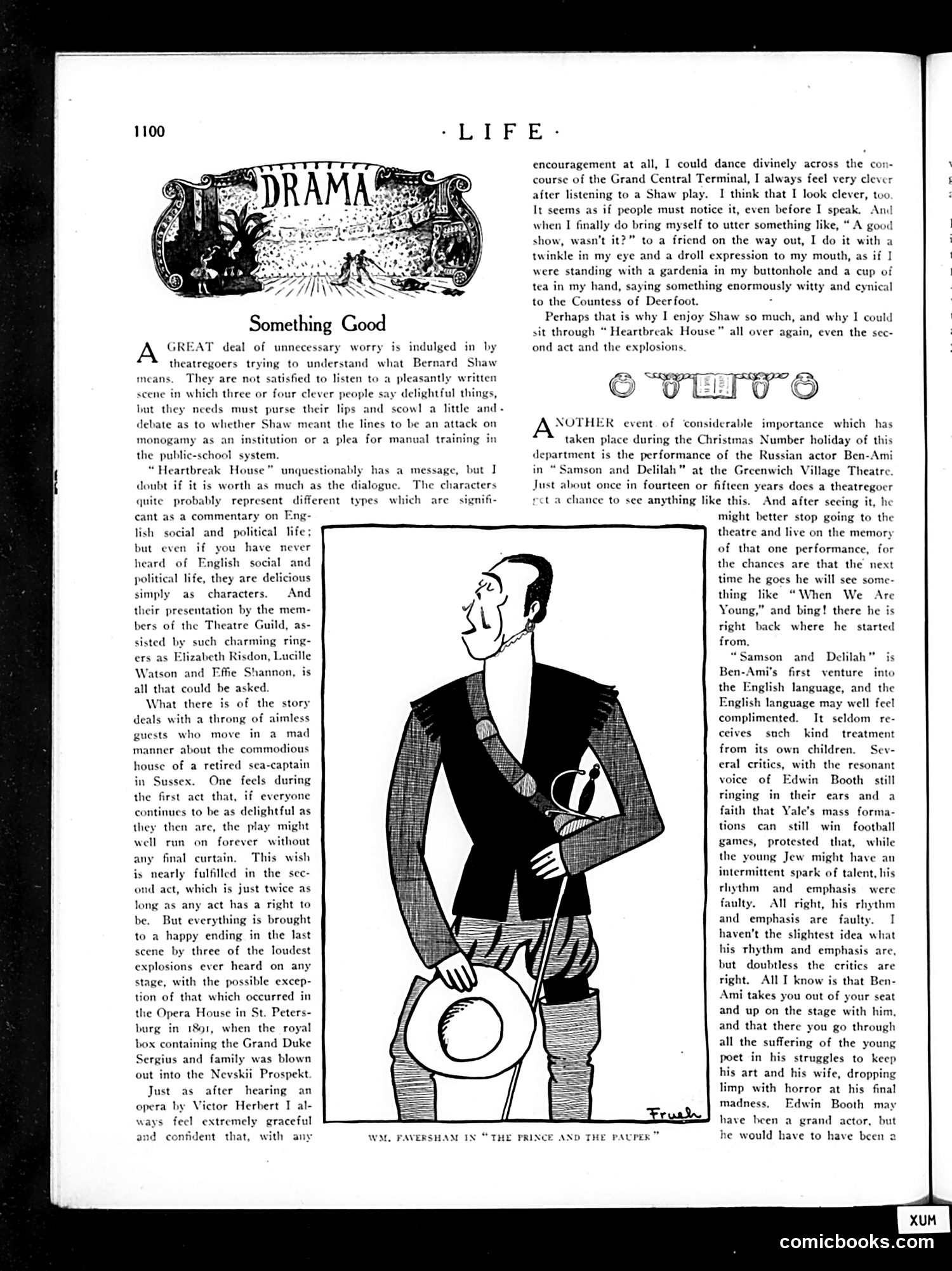
What you’re looking at
This page reviews two theatrical productions. The main illustration depicts **William Faversham in "The Prince and the Pauper,"** shown as a gentleman in formal dress holding a hat—likely satirizing the genteel, self-satisfied demeanor audiences adopt after attending plays. The text critiques **Bernard Shaw's "Heartbreak House,"** performed by the Theatre Guild. The author mocks theatergoers who over-intellectualize Shaw's work, searching for political messages about monogamy or public education when they should simply enjoy the witty dialogue and charming performances (citing actresses Elizabeth Risdon, Lucille Watson, and Effie Shannon). A secondary review praises Russian actor **Ben-Ami's performance in "Samson and Delilah"** at Greenwich Village Theatre, calling it exceptional enough to retire from theater-going afterward. The humor targets pretentious theater audiences who feel artificially clever after Shaw plays, adopting affected sophistication they don't genuinely possess.
📄 Transcribed text from this page (OCR, searchable)
Machine-transcribed from the original scan — historical spelling and the odd misread are preserved.
-LIFE- Something Good A GREAT deal of theatregoers trying to understand what Bernard Shaw means. They are not satisfied to listen to a pleasantly written scene in which three or four clever people say delightful things, unnecessary worry is indulged in by but they needs must purse their lips and scowl a little and- debate as to whether Shaw meant the lines to be an attack on monogamy as an institution or a plea for manual training in the public-school system. “Heartbreak House” unquestionably has a message, but J doubt if it is worth as much as the dialogue. The characters quite probably represent different. types which are signifi- cant as a commentary on Eng- lish social and_ political life; but even if have heard of English social and cal life, they are delicious characters. And their presentation by the mem- bers of the Theatre Guild, as- you never polit simply as such charming ring- ers as Elizabeth Risdon, Lucille Watson and Effie Shannon, is all that could be asked. What there is of the story deals with a throng of aimless mad sisted by guests who move in a manner about the commodious house of a retired sea-captain in Sussex. One feels during the first act that, if everyone continues to be as delightful as they then are, the play might well run on forever without any final curtain, This wish is nearly fulfilled in the sec- ond act, which is just twice as long as any act has a right to be. But everything is brought to a happy ending in the last scene by three of the loudest explosions ever heard on any stage, with the possible excep- tion of that which occurred in the Opera House in St. Peters- burg in 1891, when the royal box containing the Grand Duke Sergius and family was blown out into the Nevskii Prospekt Just as after hearing an opera by Victor Herbert I al- ways feel extremely graceful confident that, with and any WM, FAVERSHAM IN “ “THE PRINCE AND THE PAUPER” encouragement at all, I could dance divinely across the con- course of the Grand Central Terminal, I always feel very clever after listening to a Shaw play. I think that I look clever, too. It seems as if people must notice it, even before I spe: And when I finally do bring myself to utter something like, “A good show, wasn't it?” to a friend on the way out, I do it with a twinkle in my eye and a droll expression to my mouth, as if I were standing with a gardenia in my buttonhole and a cup of tea in my hand, saying something enormously witty and cynical to the Countess of Deerfoot. g Perhaps that is why I enjoy Shaw so much, and why I could sit through “ Heartbreak House” all over a ond act and the explosions. in, even the sec- “THIvS NOTHER event of ‘considerable importance which has taken place during the Christmas Number holiday of this department is the performance of the Russian actor Ben-Ami in “Samson and Delilah” at the Greenwich Village Theatre. Just about once in fourteen or fifteen years does a theatregoer a chance to see anything like this. And after seeing it, he might better stop going to the theatre and live on the memory of that one performance, for the chances are that the next time he goes he will see some- thing like “When We Are Young,” and bing! there he is right back where he started from. “Samson and Ben-Ami's first the English language, and the English language may well feel complimented. It seldom re- ceives kind treatment from its own children. Sev- eral critics, with the resonant voice of Edwin Booth still ringing in their ears and a faith that Yale’s mass forma- still win football protested that, while the young Jew might have an intermittent spark of talent, his thythm and emphasis were faulty. All right, his rhythm and emphasis are faulty. I haven't the slightest idea what Delilah” i venture into such tions can games, his rhythm and emphasis are, but doubtless the critics are right. All I know is that Ben- Ami takes you out of your seat and up on the stage with him, and that there you go through all the suffering of the young poet in his struggles to keep his art and his wife, dropping limp with horror at his final madness. Edwin Booth may have been a grand actor, but he would have to have been 2 comicbooks.com