
Life, 1920-12-09 · page 32 of 44
Life — December 9, 1920 — page 32: what you’re looking at
What you’re looking at
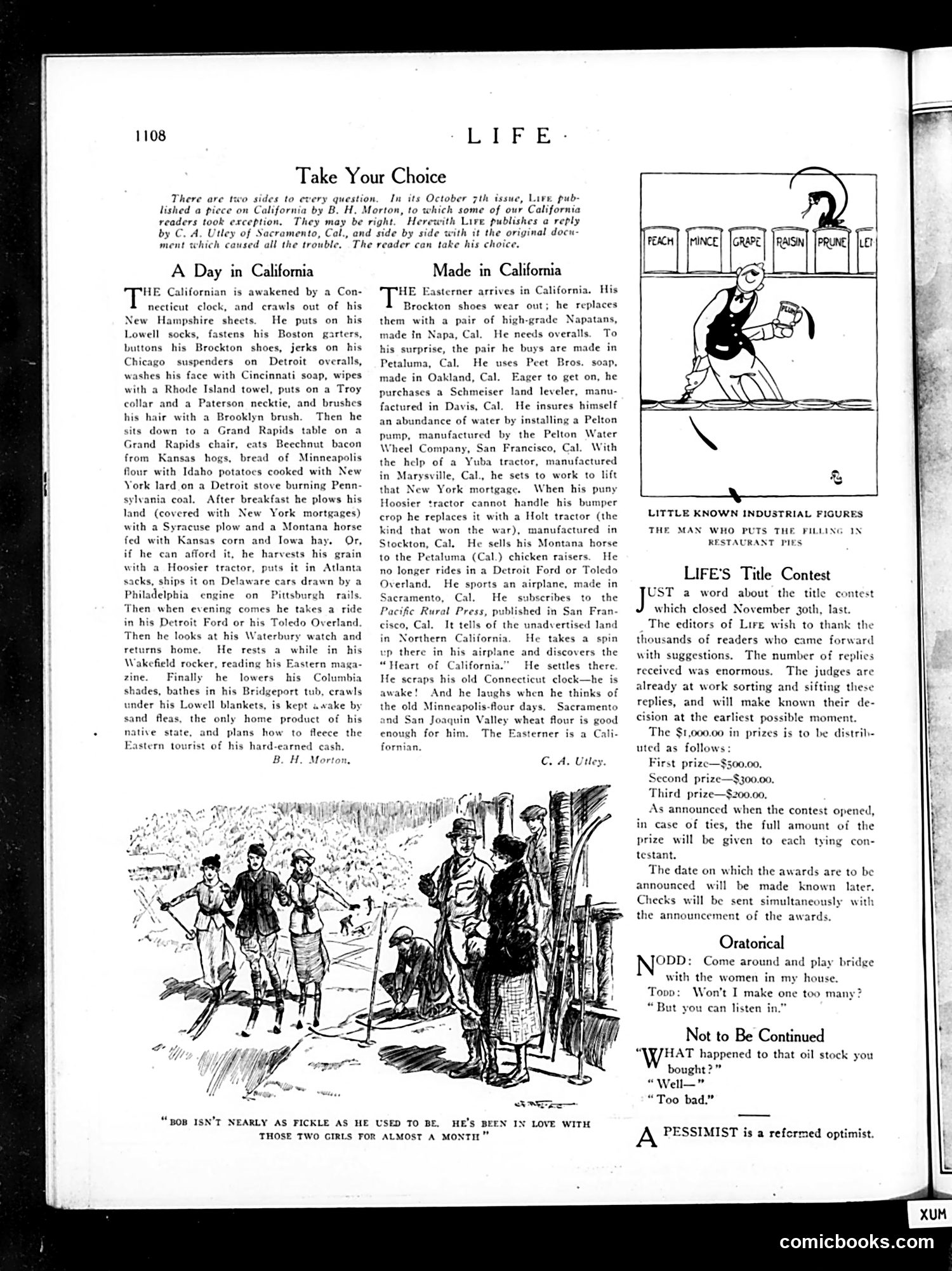
This page presents two opposing satirical pieces debating California's economic independence. The first article ("A Day in California") humorously catalogs how a Californian's entire life—from his Connecticut clock to his Lowell blankets—depends on Eastern manufactured goods, suggesting California is merely an agricultural outpost of Eastern industry. The opposing article ("Made in California") counters by listing homegrown California manufacturers replacing those Eastern products: Napa leather, Oakland soap, Davis equipment, San Francisco pumps, Marysville tractors, and Stockton farm machinery. The Easterner protagonist gradually abandons his Eastern dependencies for California-made alternatives. The satire addresses early 20th-century regional economic tensions—specifically California's growing industrial capacity challenging Eastern industrial dominance. By presenting both perspectives, *Life* mocks the boosterism of both regions while acknowledging California's genuine manufacturing development. The cartoon below (showing "Bob" with two girls) appears unrelated, likely filler content.
📄 Transcribed text from this page (OCR, searchable)
Machine-transcribed from the original scan — historical spelling and the odd misread are preserved.
LIFE. Take Your Choice There are two sides to 7 ¥ question In its October 7th issue, Lire pub- lished a piece on California by B, H, Morton, to which some of our California readers took exception. ment which caused all the trouble, A Day in California HE Californian is awakened by a Con- necticut clock, and crawls out of his Hampshire sheets. He puts on his socks, fastens his Boston garters, buttons his Brockton shoes, jerks on his Chicago Detroit overalls, washes his face with Cincinnati soap, wipes with a Rhode Island towel, puts on a Troy collar and a Paterson necktie, and brushes his hair with a Brooklyn brush. Then he sits down to a Grand Rapids table on a Grand Rapids fr, Beechnut bacon from Kansas hogs, bread of flour with Idaho potatoes cooked with New York lard on a Detroit stove burning Penn- sylvania coal. After breakfast he plows his land (covered with New York mortgages) with a Syracuse plow and a Montana horse fed with Kansas corn and Iowa hay. Or, if he can afford it, he harvests his grain with a Hoosier tractor, puts it in Atlanta sacks, ships it on Delaware cars drawn by a Philadelphia Pittsburgh ra Then when evening comes he takes a ride in his Detroit Ford or his Toledo Overland Then he looks at his Waterbury watch and home, He while in his Wakefield rocker, reading his Eastern maga- Finally he lowers his Columbia shades, bathes in his Bridgeport tub, crawls under his Lowell blankets, is kept awake by sand fleas, the only home product of his native state, and plans how to fleece the Eastern tourist of his hard-earned cash. B. H. Mort New Lowell suspenders on eats Minneapolis engine on returns rests a zine. “BoB ISN'T NEARLY AS FICKLE AS HE USED TO BE. They may be right by C. A. Utley of Sacramento, Cal., and s The reader can take his choice. Herewith Lire publishes a reply le by side with it the original docu- Made in California HE Easterner arrives in California. His Brockton shoes wear out; he replaces them with a pair of high-grade Napatans, made in Napa, Cal. He needs overalls. To his surprise, the pair he buys are made in Petaluma, Cal. He uses Peet Bros. made in Oakland, Cal. Eager to get on, he purchases a Schmeiser land leveler, manu- factured in Davis, Cal. He insures himself an abundance of water by installing a Pelton soap, pump, manufactured by the Pelton Water Wheel Company, San Francisco, Cal. With the help of a Yuba tractor, manufactured in Marysville, Cal., he sets to work to lift that New York mortgage. When his puny Hoosier tractor cannot handle his bumper crop he replaces it with a Holt tractor (the kind that won the war), manufactured in Stockton, Cal, He sells his Montana horse to the Petaluma (Cal.) chicken no longer rides in a Detroit Ford or Toledo Overland, He sports an airplane, made in Sacramento, Cal. He subscribes to the Pacific Rural Press, published in San Fran- cisco, Cal. It tells of the unadvertised land in Northern Californ He takes a spin up there in his airplane and discovers the “Heart of Californi He settles there He scraps his old Connecticut clock—he is awake! And he laughs when he thinks of the old Minneapolis-flour days. Sacramento and San Joaquin Valley wheat flour is good enough for him. The Easterner is a C aisers. He HE'S BEEN IN LOVE WITH THOSE TWO GIRLS FOR ALMOST A MONTIT” LITTLE KNOWN INDUSTRIAL FIGURES THE MAN WHO PUTS THE RESTAURANT PES FILLING IN LIFE’S Title Contest UST a word about the title which closed November 3oth, last. The editors of Lire wish to thank the thousands of readers who came forward contest with suggestions. The number of replies received was enormous. The judges are already at work sorting and sifting these replies, and will make known their de- cision at the earliest possible moment. The $1,000.00 in prizes is to be distrib- uted as follows: First. prizc—$300.00, Second prize—$300.00, hird prize—$200.00, announced when the contest opened, in case of ties, the full amount of the prize will be given to each testant. The date on which the awards are to be announced will be made known later. Checks will be sent simultaneously w the announcement of the awards. tying con- Oratorical ODD: Come around and play bridge with the women in my house. Topo: Won't I make one too many? “But you can listen in.” Not to Be Continued % HAT happened to that oil stock you bought?” “Well— “Too bad.” A PESSIMIST is a reformed optimist. comicbooks.com