
Life, 1920-12-09 · page 20 of 44
Life — December 9, 1920 — page 20: what you’re looking at
What you’re looking at
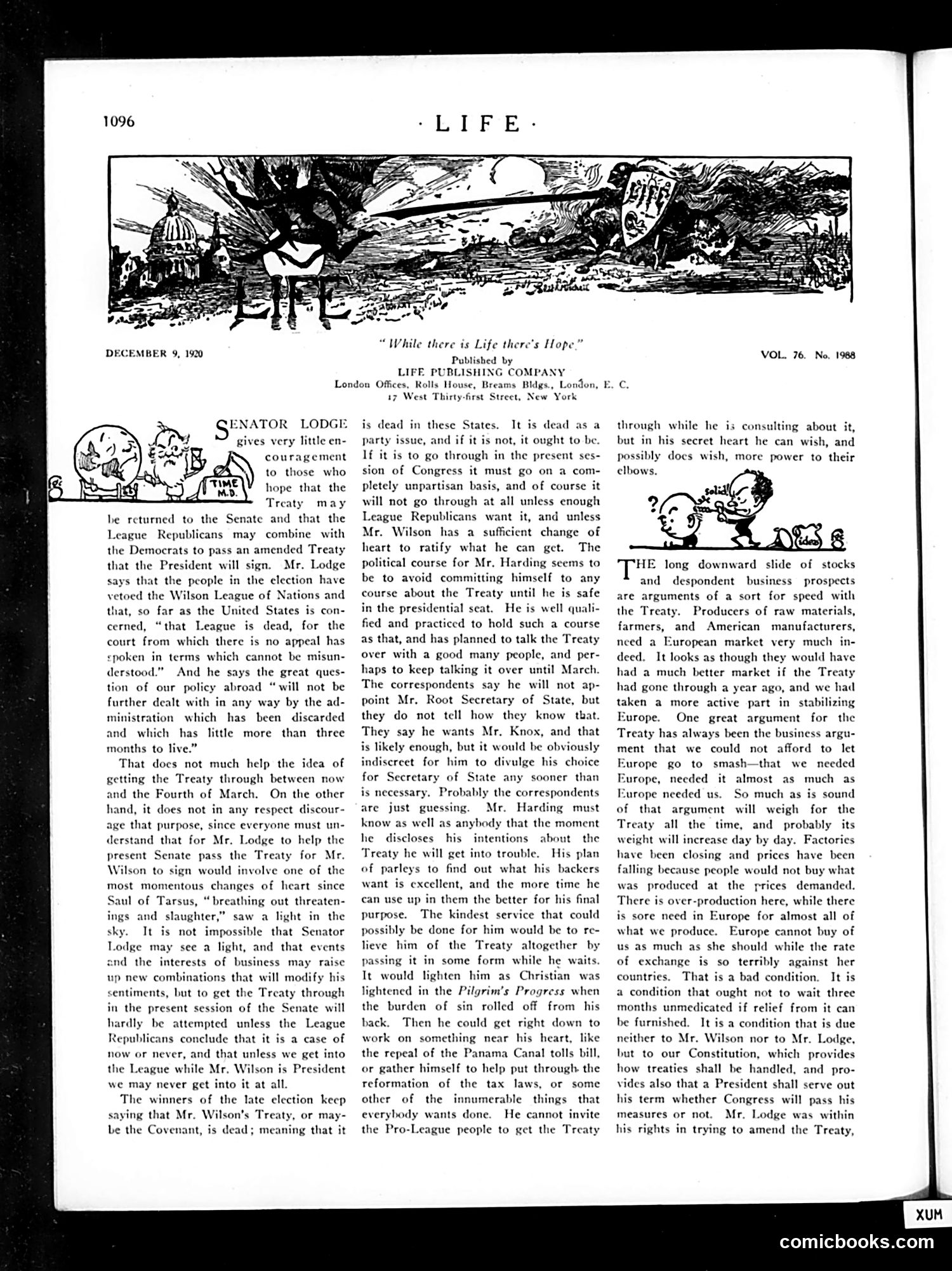
This page contains editorial analysis (not a cartoon) addressing Senator Henry Cabot Lodge's opposition to President Wilson's League of Nations treaty following the 1920 election. **The Political Context:** Wilson's Democrats lost the 1920 election to Republican Warren G. Harding. Lodge, a prominent Republican senator, declared the League "dead" and blocked its passage. The editorial argues the Treaty is a legitimate policy matter that should transcend partisan politics and pass on "completely unpartisan basis." **The Satire's Point:** The writer mocks Lodge's unlikely conversion, comparing it to Saul of Tarsus's miraculous religious transformation—suggesting Lodge reversing his position would be equally miraculous. The piece also gently satirizes Harding's evasiveness about appointing a Secretary of State, noting he'll avoid committing to anything about the Treaty until safely inaugurated. **The "Hope":** The title suggests hoping Republicans and Democrats might compromise on an amended Treaty before March 4, 1921 (Inauguration Day).
📄 Transcribed text from this page (OCR, searchable)
Machine-transcribed from the original scan — historical spelling and the odd misread are preserved.
EMBER 9, 1920 “While there is Life there's Hope” Published by LIFE. PUBLISHING COMPANY London Offices, Rolls House, Breams Bldgs. London, SEN TOR LODGE gives very little en- couragement to those who hope that the Treaty may be returned to the Senate and that the League Republicans may combine with the Democrats to pass an amended Treaty that the President will sign. Mr. Lodge says that the people in the election have vetoed the Wilson League of Nations and that, so far as the United States is con- cerned, “that League is dead, for the court from which there is no appeal has spoken in terms which cannot be misun- derstood.” And he says the great ques- tion of our policy abroad “will not be further dealt with in any way by the ad- ministration which has been discarded and which has little more than three months to live.” That does not much help the idea of getting the Treaty through between now and the Fourth of March. On the other hand, it does not in any respect discour- age that purpose, since everyone must un- derstand that for Mr, Lodge to help the present Senate pass the Treaty for Mr. Wilson to sign would involve one of the most momentous changes of heart since Saul of Tarsus, “breathing out threaten- ings and slaughter,” saw a light in the sky. It is not impossible that Senator Lodge may see a light, and that events and the interests of business may raise up new combinations that will modify his sentiments, but to get the Treaty through in the present session of the Senate will hardly be attempted unless the League Republicans conclude that it is a case of now or never, and that unless we get into the League while Mr. Wilson is President we may never get into it at all. The winners of the late election keep saying that Mr. Wilson's be the Covenant, is dead; mea Treaty, or m. ning that it 17 West Thirty-first Street, New York is dead in these States. It is dead as a party issue, and if it is not, it ought to be. If it is to go through in the present s sion of Congress it must go on a com- pletely unpartisan basis, and of course it will not go through at all unless enough League Republicans want it, and unless Mr. Wilson has a sufficient change of heart to ratify what he can get. The political course for Mr. Harding seems to be to avoid committing himself to any course about the Treaty until he is safe in the presidential seat. He is well quali- fied and practiced to hold such a course as that, and has planned to talk the Treaty over with a good many people, and per- haps to keep talking it over until March. The correspondents say he will not ap- point Mr. Root Secretary of State, but they do not tell how they know that. They say he wants Mr. Knox, and that is likely enough, but it would be obviously indisereet for him to divulge his choice for Secretary of State any sooner than is necessary, Probably the correspondents are just guessing. Mr. Harding must know as well as anybody that the moment he discloses his intentions about the Treaty he will get into trouble. His plan of parleys to find out what his backers want is excellent, and the more time he can use up in them the better for his final purpose. The kindest service that could possibly be done for him would be to re- lieve him of the Treaty altogether by passing it in some form while he waits. It would lighten him as Christian was lightened in the Pilgrim’s Progress when the burden rolled off from his back. Then he could get right down to work on something near his heart, like the repeal of the Panama Canal tolls bill, or gather himself to help put through the reformation of the tax laws, or some other of the innumerable things that everybody wants done. He cannot invite the Pro-League people to get the Treaty of sin VOL. 76. No, 1968 & through while he is consulting about it, but in his secret heart he can wish, and possibly docs wish, more power to their elbows. HE long downward slide of stocks and despondent business prospects are arguments of a sort for speed with the Treaty. Producers of raw materials, farmers, and American manufacturers, need a European market very much in- deed, It looks as though they would have had a much better market if the Treaty had gone through a year ago, and we had taken a more active part in. stabilizing Europe. One great argument for the Treaty has always been the business argu- ment that we could not afford to let Europe go to smash—that we needed Europe, needed almost as much as Europe needed us. So much as is sound of that argument will weigh for the Treaty all the time, and probably its weight will increase day by day. Factories have been closing and prices have been falling because people would not buy what was produced at the prices demanded. There is over-production here, while there is sore need in Europe for almost all of what we produce. Europe cannot buy of us as much as she should while the rate of exchange is so terribly against her That is a bad condition. It is a condition that ought not to wait three months unmedicated if relief from it can be furnished. It is a condition that is due neither to Mr. Wilson nor to Mr. Lodge, but to our Constitution, which provides how treaties shall be handled, and pro- vides also that a President shall serve out his term whether Congress will pass his measures or not. Mr. Lodge was within his rights in trying to amend the Treaty, countries. comicbooks.com