
Life, 1920-12-09 · page 26 of 44
Life — December 9, 1920 — page 26: what you’re looking at
What you’re looking at
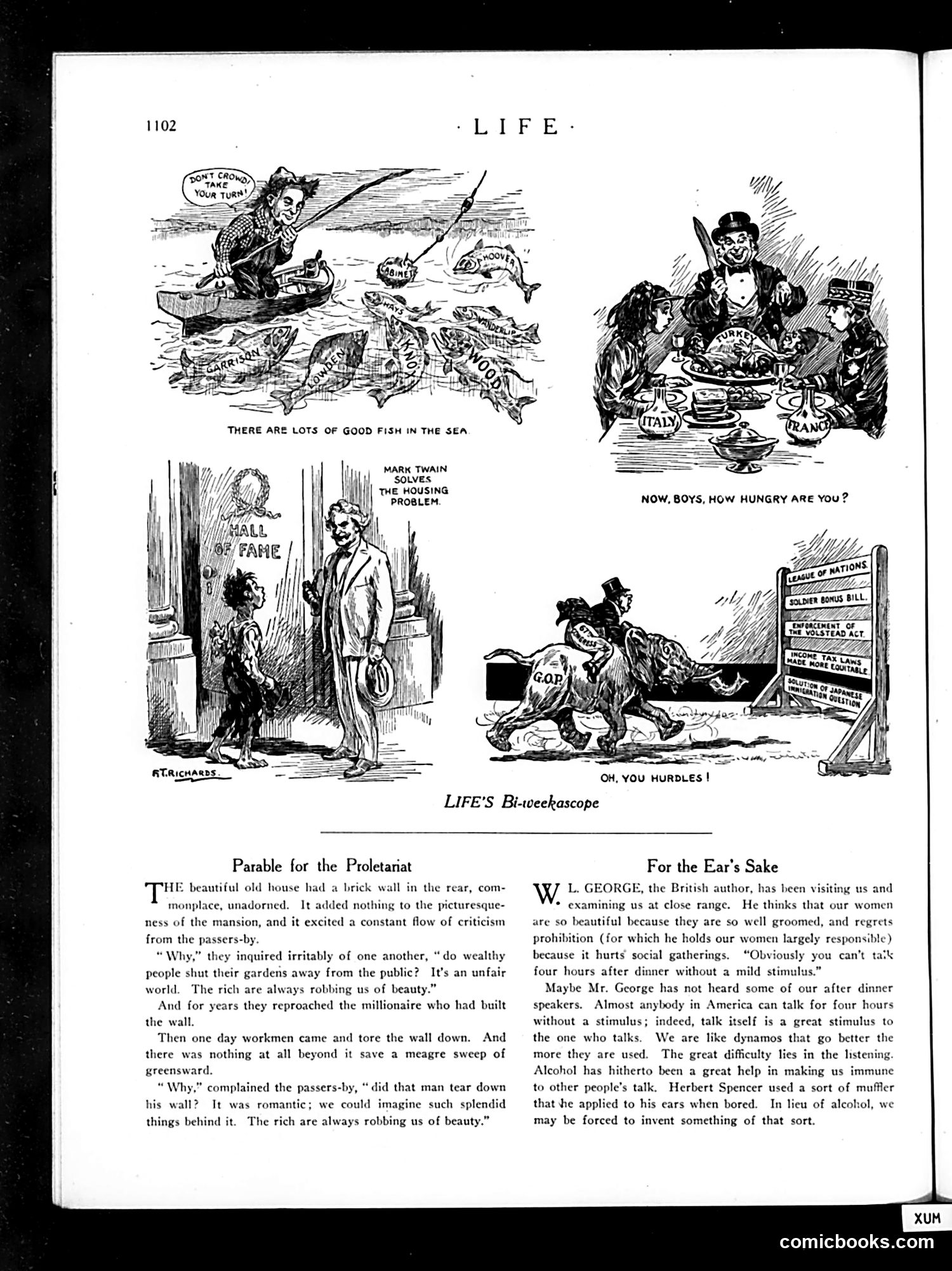
This page contains three distinct satirical pieces: **"Life's Bi-weekascope"** presents four political cartoons mocking contemporary issues. The top-left shows fishermen struggling with overfished seas (labeled with various nations), satirizing post-WWI resource competition. The top-right depicts Italy and France at a banquet, likely commenting on Allied tensions over war reparations and League of Nations disputes. The bottom-right cartoon shows a figure jumping hurdles labeled with League of Nations resolutions, mocking the organization's ineffectual bureaucracy. **"Parable for the Proletarian"** uses a fable structure to satirize working-class envy of the wealthy. The point: common people romanticize what they cannot see and blame the rich regardless—condemning both a hidden garden and its removal as theft of beauty. It's social commentary on class resentment. **"For the Ear's Sake"** responds to British author W.L. George's observations about American women and Prohibition, sardonically suggesting alcohol served primarily to silence boring after-dinner speakers. The satire critiques American social habits and Prohibition's unintended consequences.
📄 Transcribed text from this page (OCR, searchable)
Machine-transcribed from the original scan — historical spelling and the odd misread are preserved.
MARK TWAIN SOLVES THE HOUSING PROBLEM. OH, You HURDLES ! LIFE’S Bi-weekascope Parable for the Proletariat HE beautiful old house had a brick wall in the rear, com- monplace, unadorned. It added nothing to the picturesque- ness of the mansion, and it excited a constant flow of criticism from the passers-by. “Why,” they inquired irritably of one another, “do wealthy people shut their gardens away from the public? It’s an unfair world. The rich are always robbing us of beauty.” And for years they reproached the millionaire who had built the wall. Then one day workmen came and tore the wall down. And there was nothing at all beyond it save a meagre sweep of greensward, “Why,” complained the passers-by, “did that man tear down his wall? It was romantic; we could imagine such splendid things behind it. The rich are always robbing us of beauty.” For the Ear’s Sake L. GEORGE, the British author, has been visiting us and * examining us at close range. He thinks that our women are so beautiful because they are so well groomed, and regrets prohibition (for which he holds our women largely responsible) because it hurts social gatherings. “Obviously you can't ta! four hours after dinner without a mild stimulus.” Maybe Mr. George has not heard some of our after dinner speakers. Almost anybody in America can talk for four hours without a stimulus; indeed, talk itself is a great stimulus to the one who talks. We are like dynamos that go better the The great difficulty lies in the listening. Alcohol has hitherto been a great help in making us immune to other people's talk. Herbert Spencer used a sort of muffler that he applied to his ears when bored. In lieu of alcohol, we may be forced to invent something of that sort. more they are used. comicbooks.com