
A complete issue · 80 pages · 1919
Life — December 4, 1919
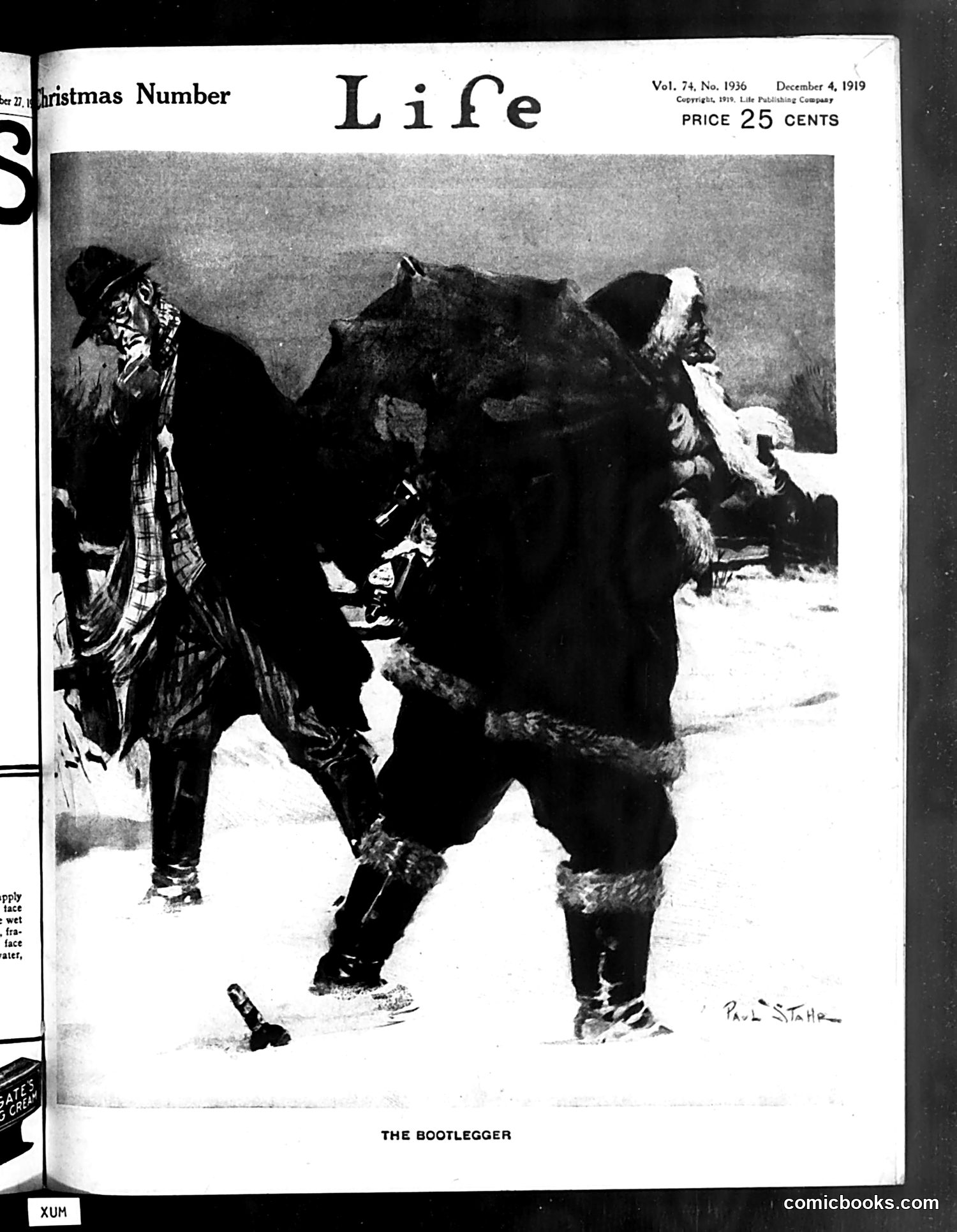
This Christmas-themed cartoon satirizes Prohibition, which became law in January 1920. The image depicts a figure dressed as Santa Claus interacting with two shabby, ragged men in a snowy setting—likely representing poor citizens or criminals involved in illegal alcohol trade. The satire suggests that during Prohibition, "Santa" (representing either illegal alcohol suppliers or the government's enforcement) would arrive bearing bootleg liquor rather than traditional gifts. The contrast between Santa's jolly image and the grim, criminal underworld of illegal alcohol distribution highlights the social chaos and moral complications anticipated from the imminent alcohol ban. The cartoon exposes anxieties about Prohibition's unintended consequences: organized crime and social disorder rather than moral improvement.
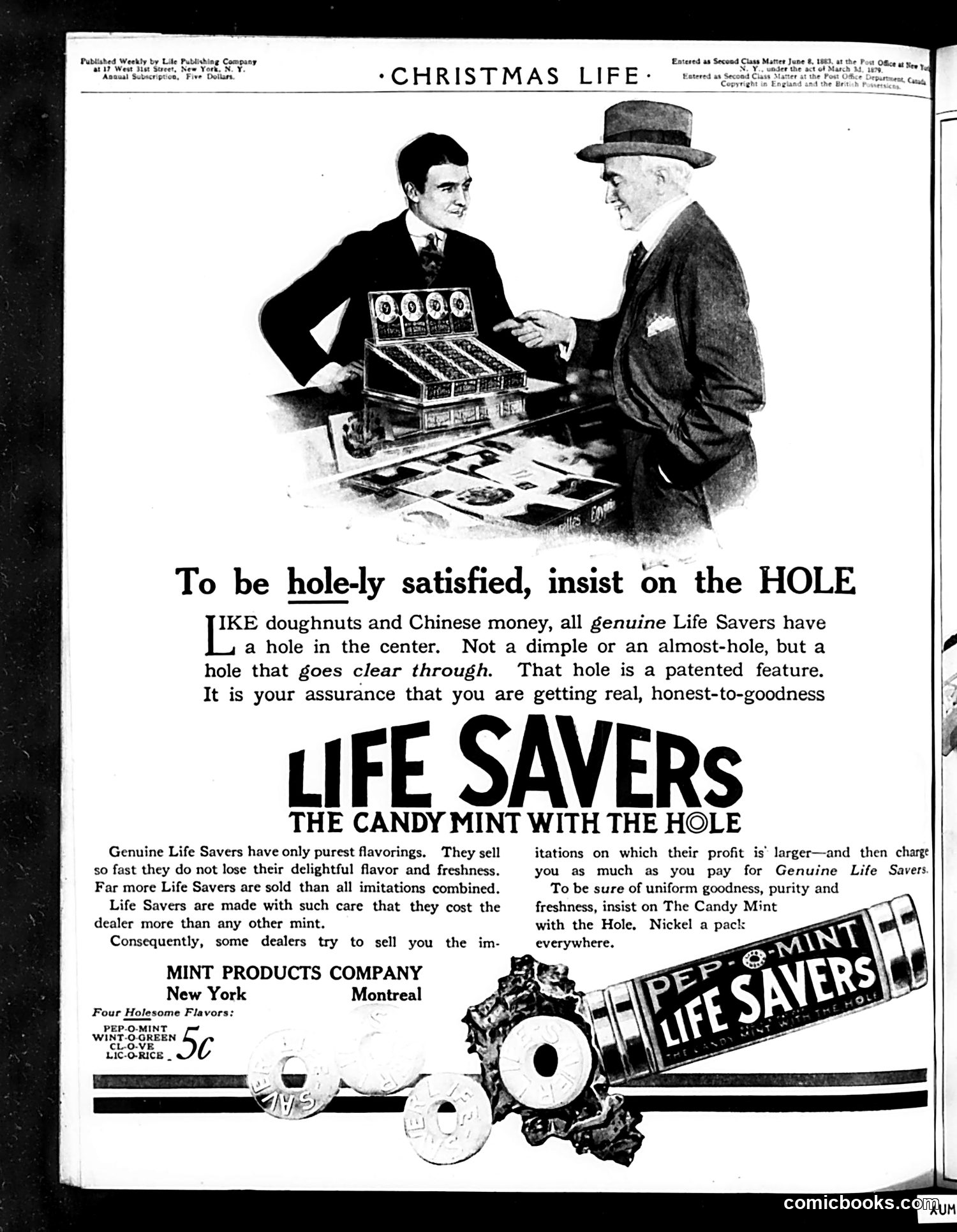
This page is primarily a **candy advertisement**, not political satire. It promotes Life Savers mints, specifically highlighting their distinctive hole as a patented feature that distinguishes genuine products from imitations. The illustration shows two men examining a Life Savers display—likely a salesman and customer or merchant. The ad uses humor by comparing the candy's hole to "doughnuts and Chinese money," making the hole a selling point rather than a defect. The text emphasizes that genuine Life Savers cost dealers more but justify the price through purity, freshness, and the branded hole feature. It warns against cheaper imitations. The four listed flavors sold for 5¢. This represents early 20th-century branded product marketing, targeting both retailers and consumers.
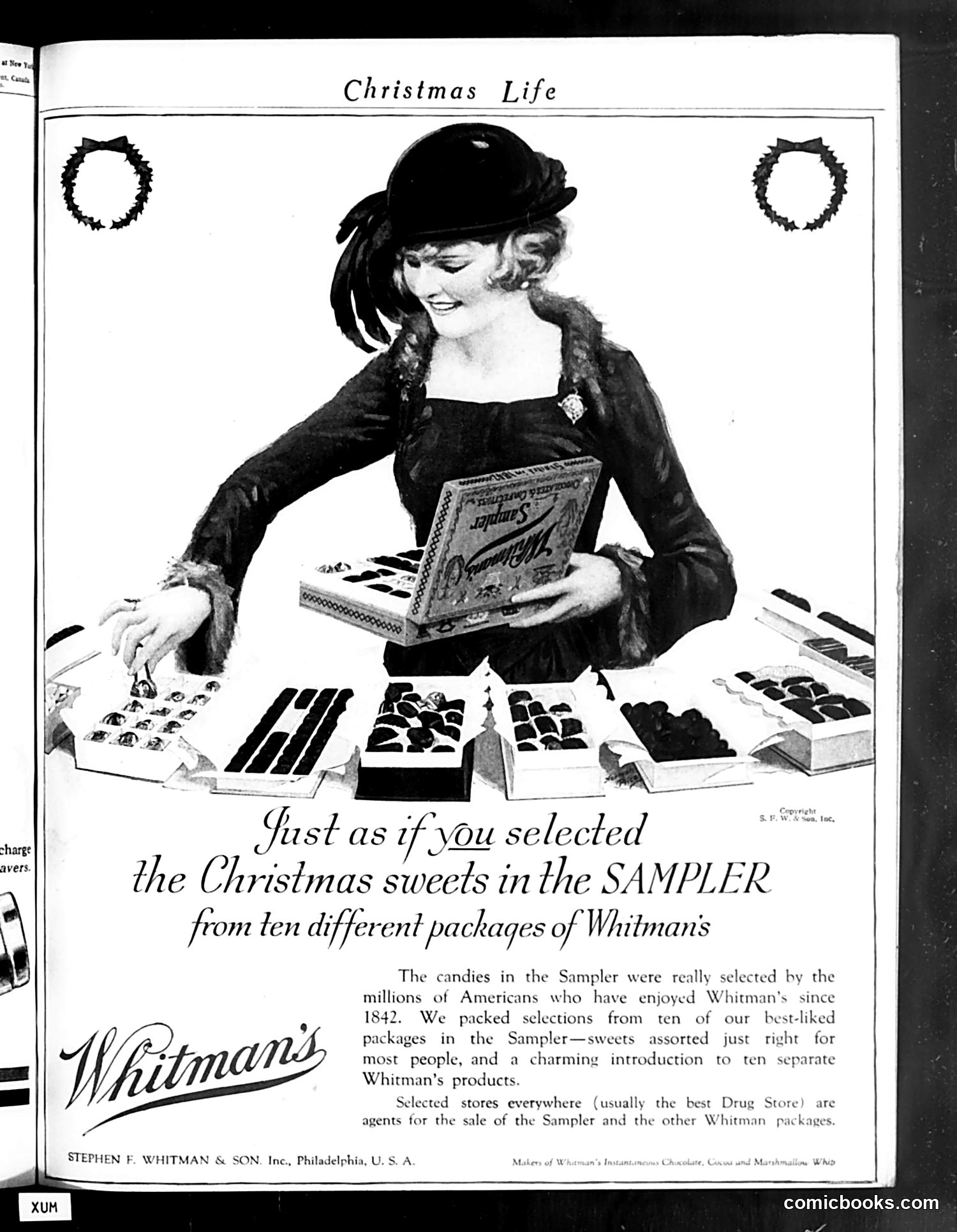
This is not a political cartoon or satire—it's a **Whitman's chocolate advertisement** from Life magazine's "Christmas Life" section. The image shows a well-dressed woman in 1920s attire examining the contents of a "Sampler" box of Whitman's candies. The advertisement emphasizes that consumers can select Christmas sweets "just as if you selected" them personally from ten different Whitman's packages. The pitch appeals to gift-givers by suggesting the Sampler offers curated variety—candies previously chosen by "millions of Americans" since 1842. The ad notes that drug stores (the primary retail outlet of that era) sell these products. This is straightforward commercial messaging rather than editorial content, using aspirational imagery of refined femininity to market premium chocolates as an ideal Christmas gift.
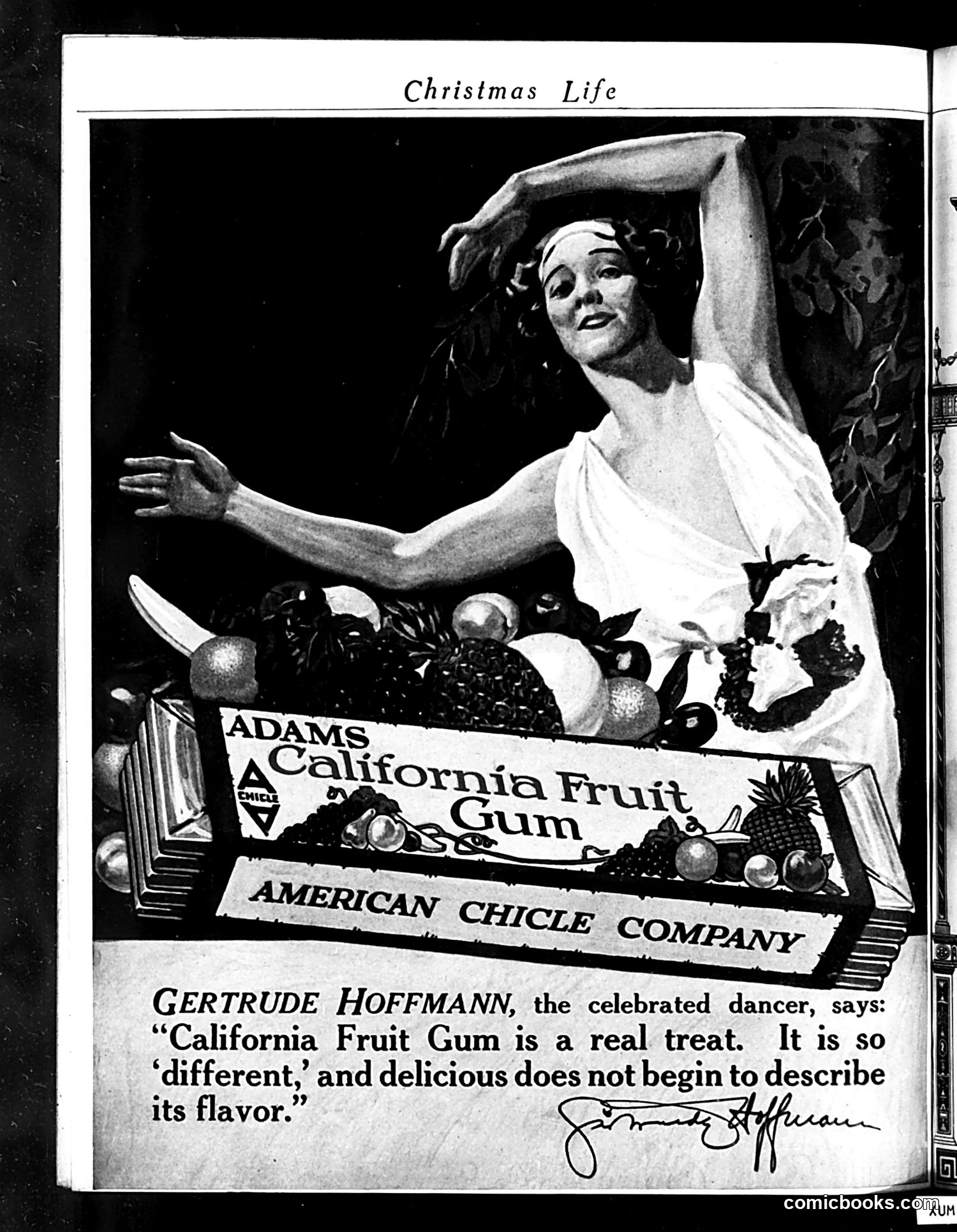
This is **not satire or political commentary**—it's a straightforward **advertisement** for Adams California Fruit Gum, placed in Life magazine's Christmas section. The page features **Gertrude Hoffmann**, identified as "the celebrated dancer," endorsing the product. Hoffmann was a real early-20th-century performer known for interpretive dance. The ad uses her celebrity status and glamorous presentation (draped in white, posed near fruit) to sell chewing gum as a Christmas gift. The "Christmas Life" header and festive fruit imagery position this as holiday-appropriate merchandise. There is no hidden satire—this exemplifies how early-1900s advertising used celebrity endorsements and aspirational imagery to market consumer products, particularly during the Christmas season.
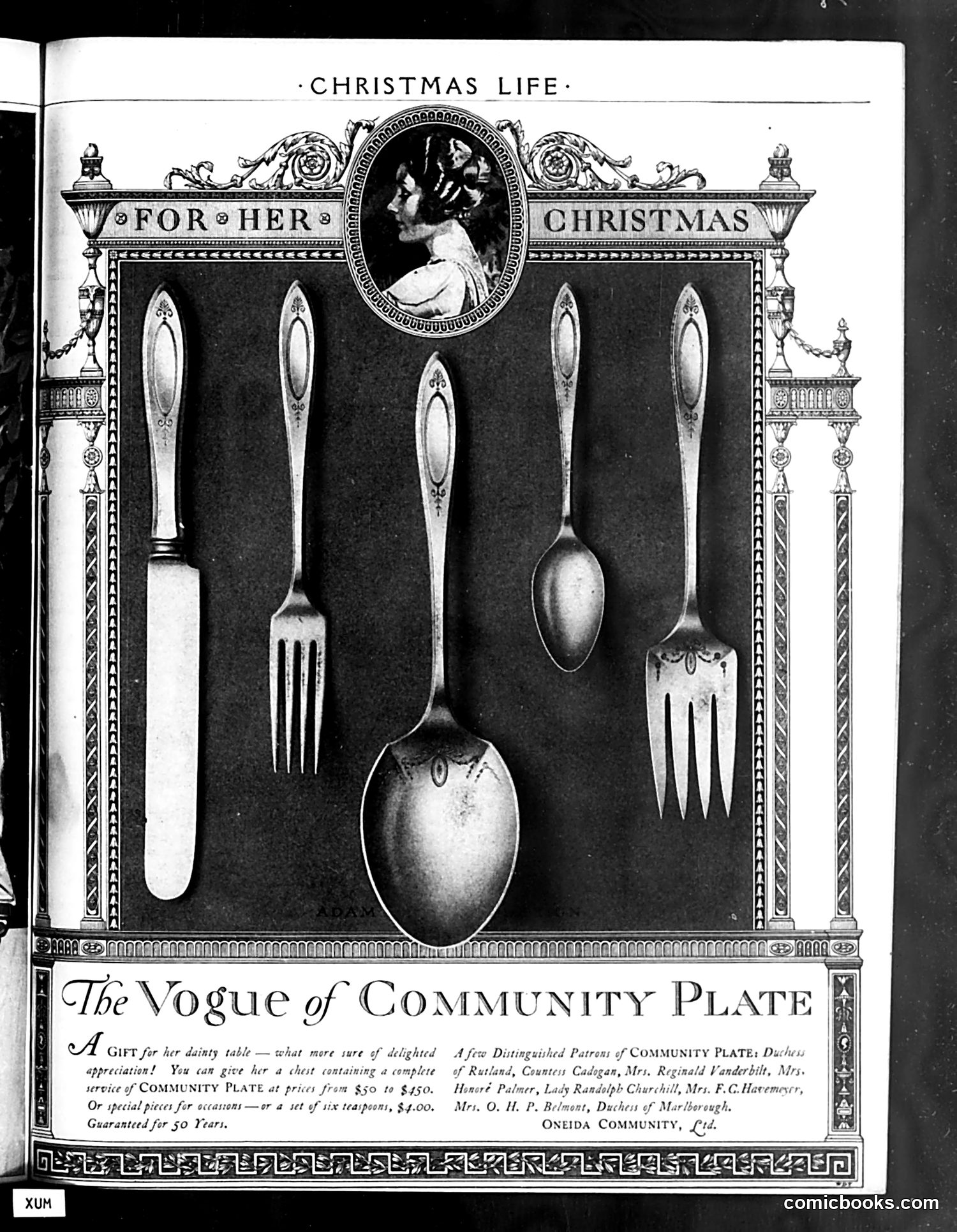
This page is **primarily an advertisement**, not political satire. It's a Christmas gift advertisement for "The Vogue of Community Plate" — flatware/silverware made by Oneida Community, Ltd. The decorative header reads "FOR HER CHRISTMAS" and features an elegant classical cameo portrait of a woman in profile. Below are displayed various pieces of flatware: knives, forks, and spoons arranged symmetrically against a dark background. The sales pitch emphasizes that Community Plate makes an ideal gift for a "dainty table," priced between $50-$150 for complete sets, or individual pieces at $4.00. The ad guarantees durability for 50 years and lists prominent society women as satisfied patrons (Duchess of Rutland, Countess Cadwgan, etc.), lending prestige through celebrity endorsement—a common early 20th-century marketing tactic.
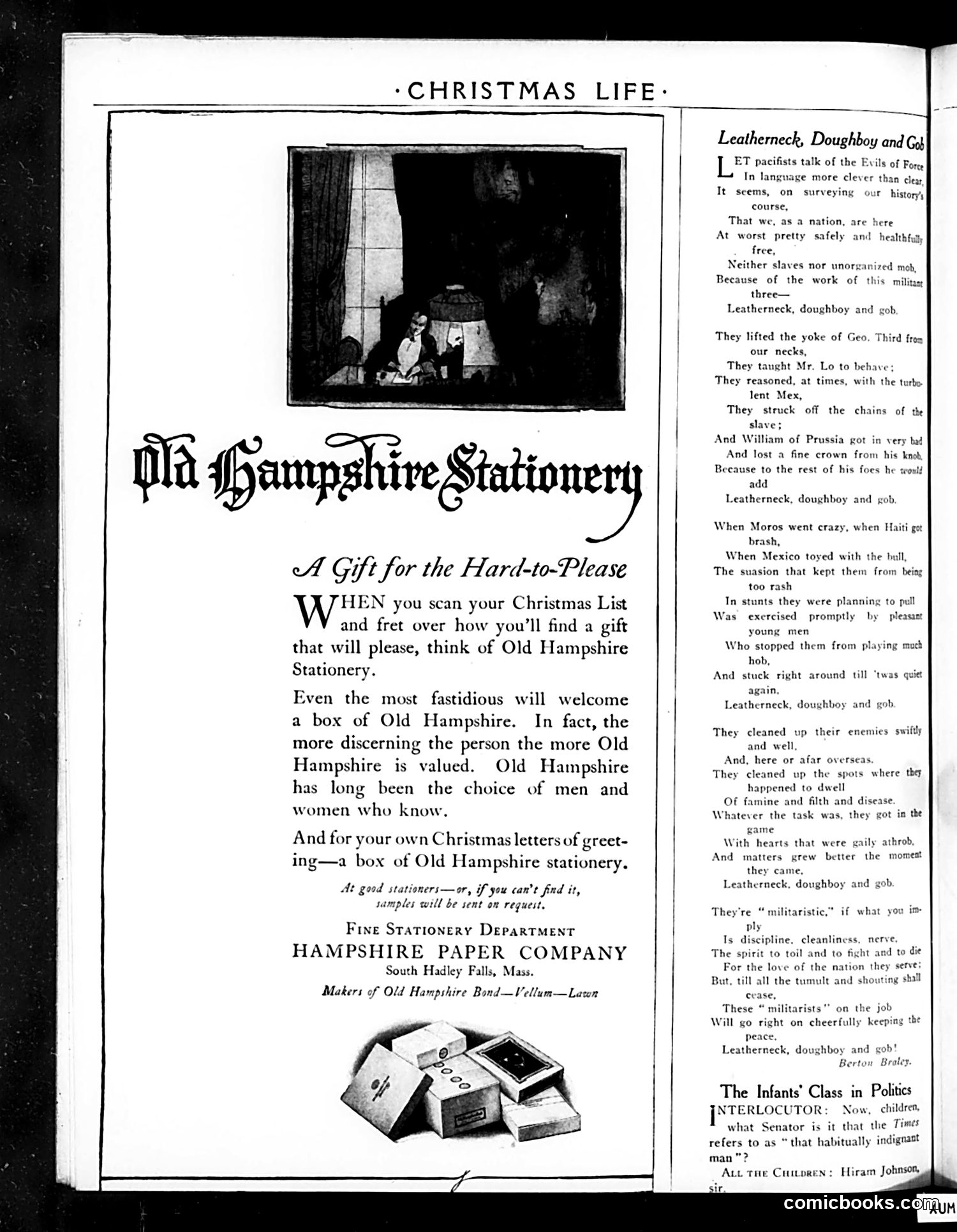
This page is primarily an **advertisement** for Old Hampshire Stationery by the Hampshire Paper Company, positioned as a Christmas gift suggestion. The left side contains the ad; the right side features an unrelated poem titled "Leatherneck, Doughboy and Gob" by Berton Braley. The poem celebrates three military figures—a Marine ("Leatherneck"), Army soldier ("Doughboy"), and Navy sailor ("Gob")—praising their discipline and sacrifice. References include lifting "the yoke of Geo. Third" (possibly King George III), "William of Prussia," Mexico, and "Moros" (likely Philippine insurgents), suggesting **World War I-era** patriotic content. The stationery ad simply leverages this patriotic context as marketing, positioning fine paper as an appropriate gift for discerning people.
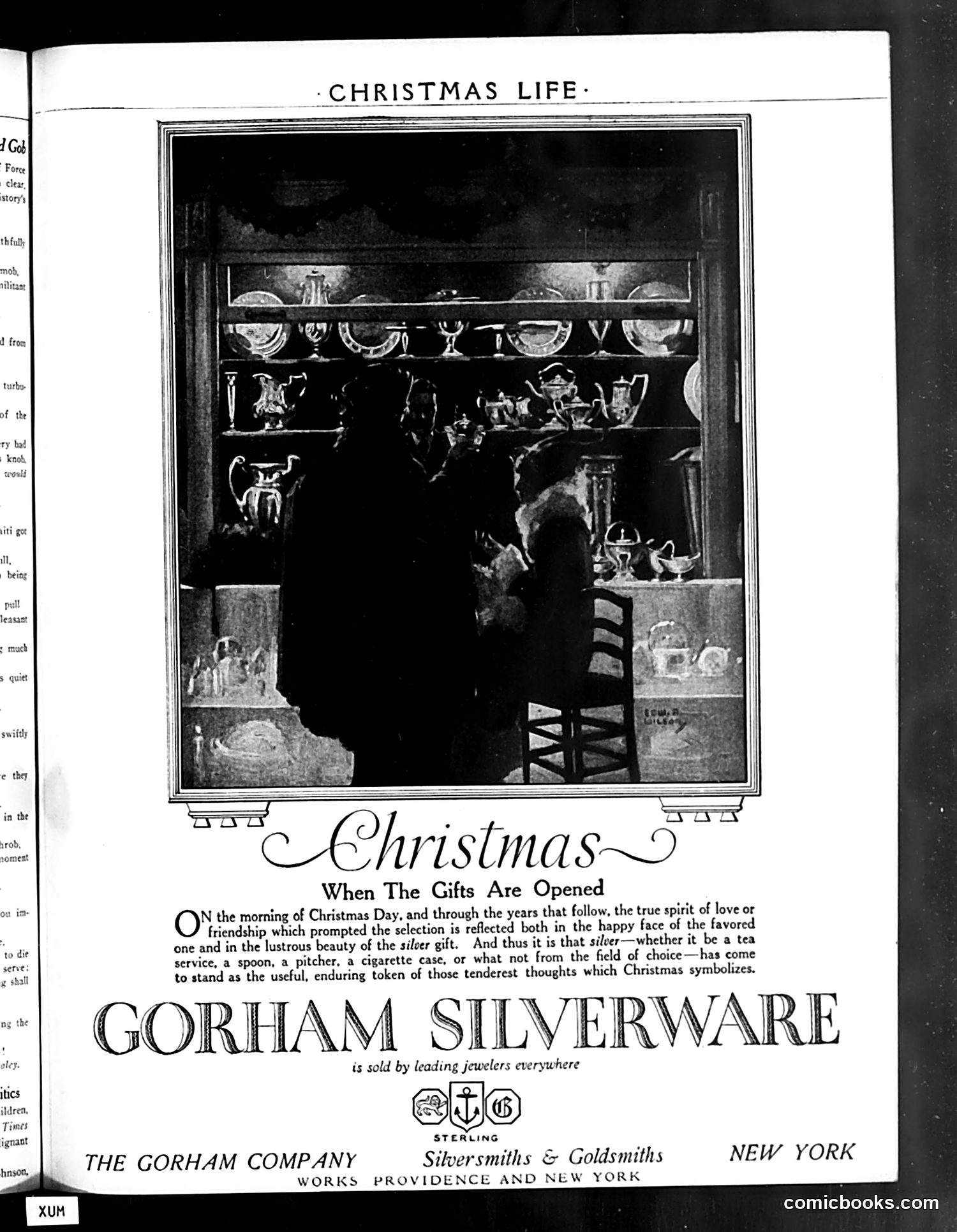
This is a **Gorham Silverware advertisement**, not political satire or a cartoon. The page header reads "CHRISTMAS LIFE" and promotes Gorham's sterling silver products as ideal Christmas gifts. The image shows a silhouetted figure examining a display cabinet filled with silver serving pieces, bowls, pitchers, and decorative items. The accompanying text emphasizes that silver gifts symbolize "love or friendship" and represent "useful, enduring" tokens appropriate for Christmas. This is straightforward holiday marketing from The Gorham Company (Providence and New York), targeting affluent consumers seeking luxury gift items. The page reflects early 20th-century consumer culture and advertising conventions within *Life* magazine.
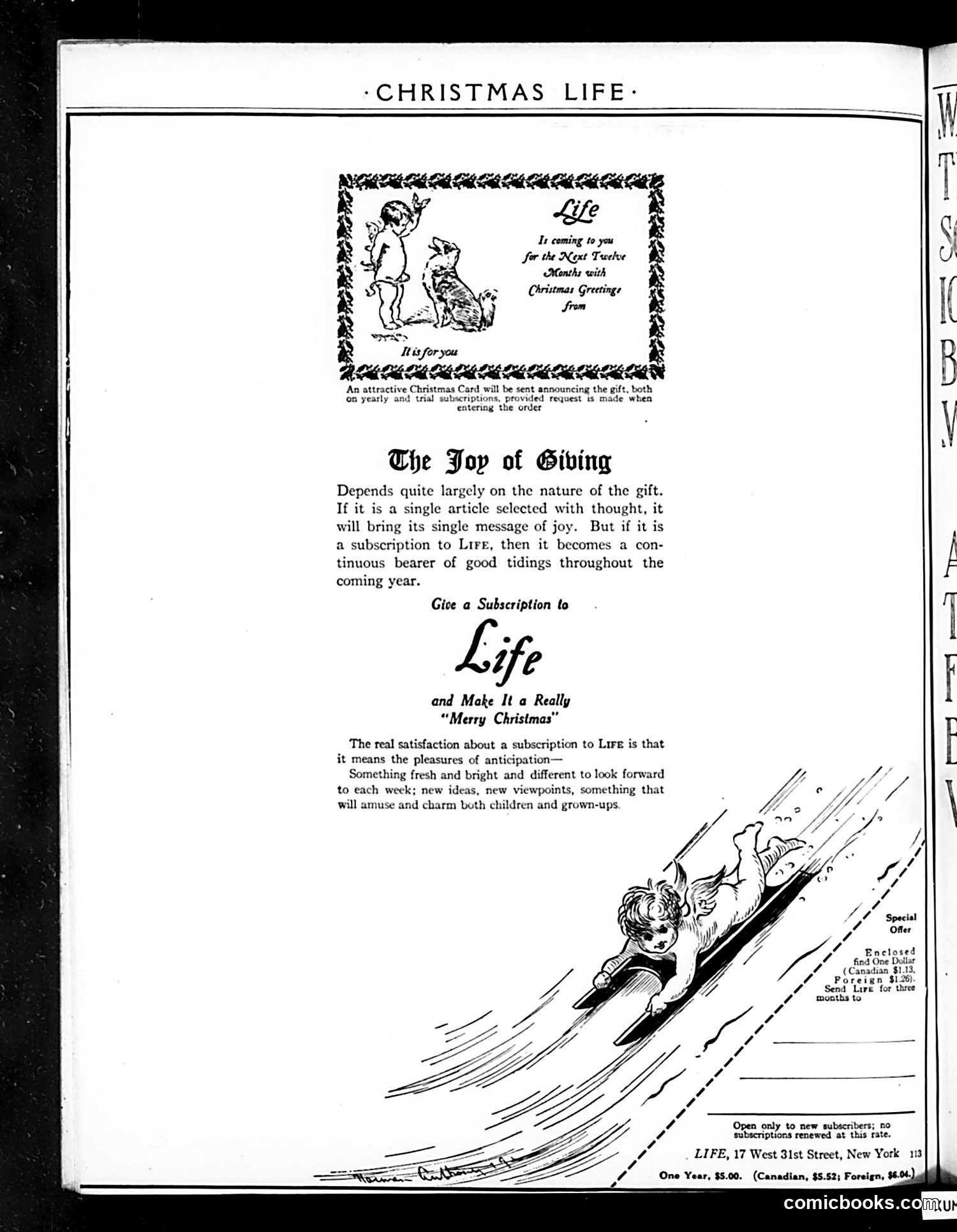
This is primarily a **Christmas gift advertisement** for *Life* magazine subscriptions, not political satire. The page promotes giving a year-long subscription as a holiday present. The two illustrations are decorative rather than satirical: the top shows children with a gift box framed in holly, and the bottom depicts a child sledding downhill. Neither contains caricatures or political commentary. The advertising copy emphasizes that a *Life* subscription provides "continuous bearer of good tidings throughout the coming year"—recurring entertainment and fresh content for both children and adults, unlike single gifts. The special offer section (bottom right) notes pricing and notes this is "Open only to new subscribers." This is essentially a vintage magazine advertisement using holiday themes to market subscriptions.
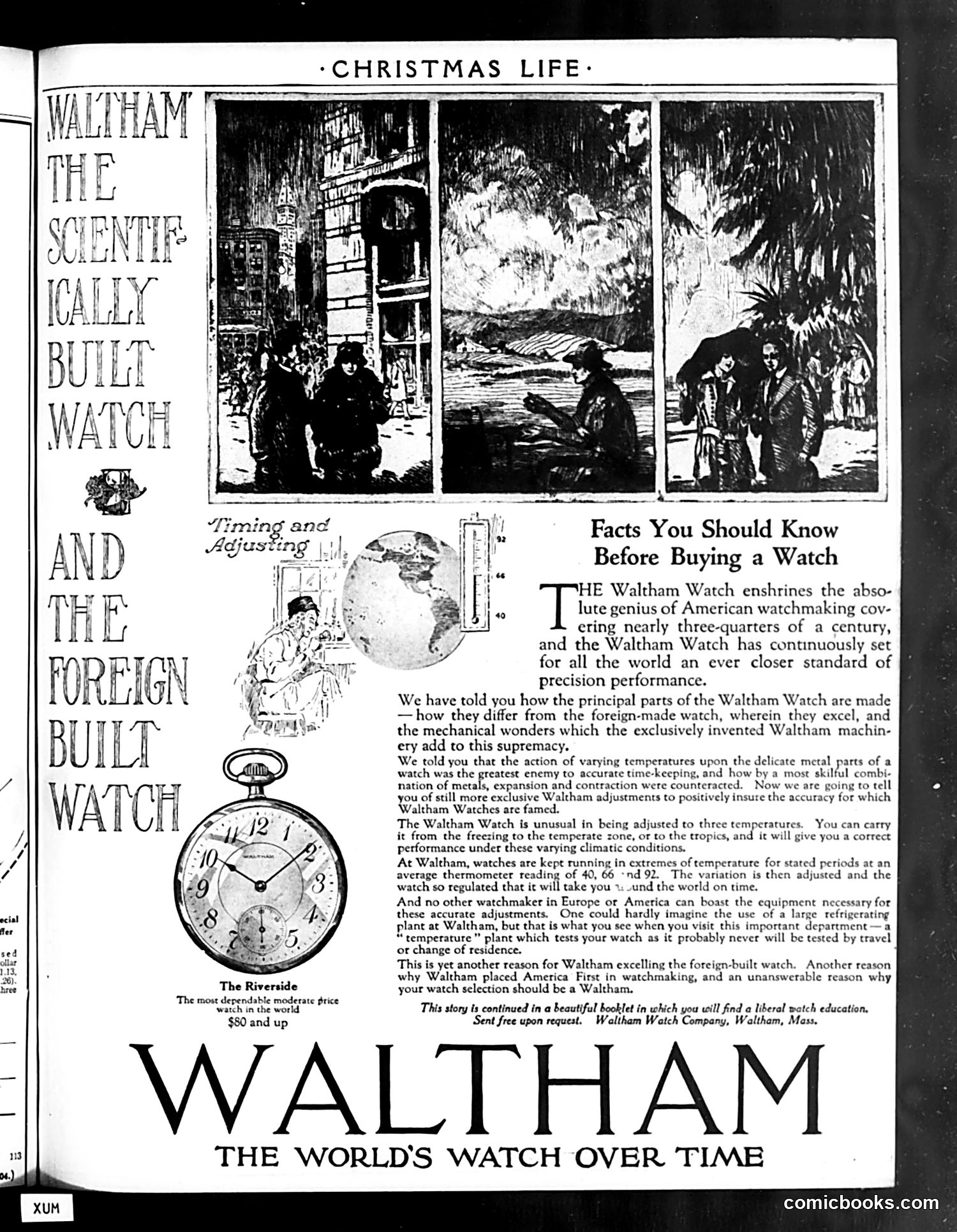
This is primarily **advertising content** for Waltham watches, not political satire. The page features: **Left side:** A stylized advertisement header promoting Waltham as "the scientifically built watch and the foreign built watch," with decorative typography and a watch illustration labeled "The Riverside" ("the most desirable moderate price watch in the world $30 and up"). **Top:** Three illustrated panels labeled "Christmas Life" showing winter/holiday scenes—appears to be thematic holiday imagery. **Right side:** Educational marketing copy explaining Waltham's precision engineering, temperature-adjustment capabilities, and manufacturing superiority over European competitors. **Bottom:** Large branding text: "WALTHAM: THE WORLD'S WATCH OVER TIME" This is **nationalist marketing**, emphasizing American manufacturing excellence during an era (likely early 20th century) of growing competition with European watchmakers. The "facts you should know" section directly argues why consumers should choose American-made Waltham over imported watches.
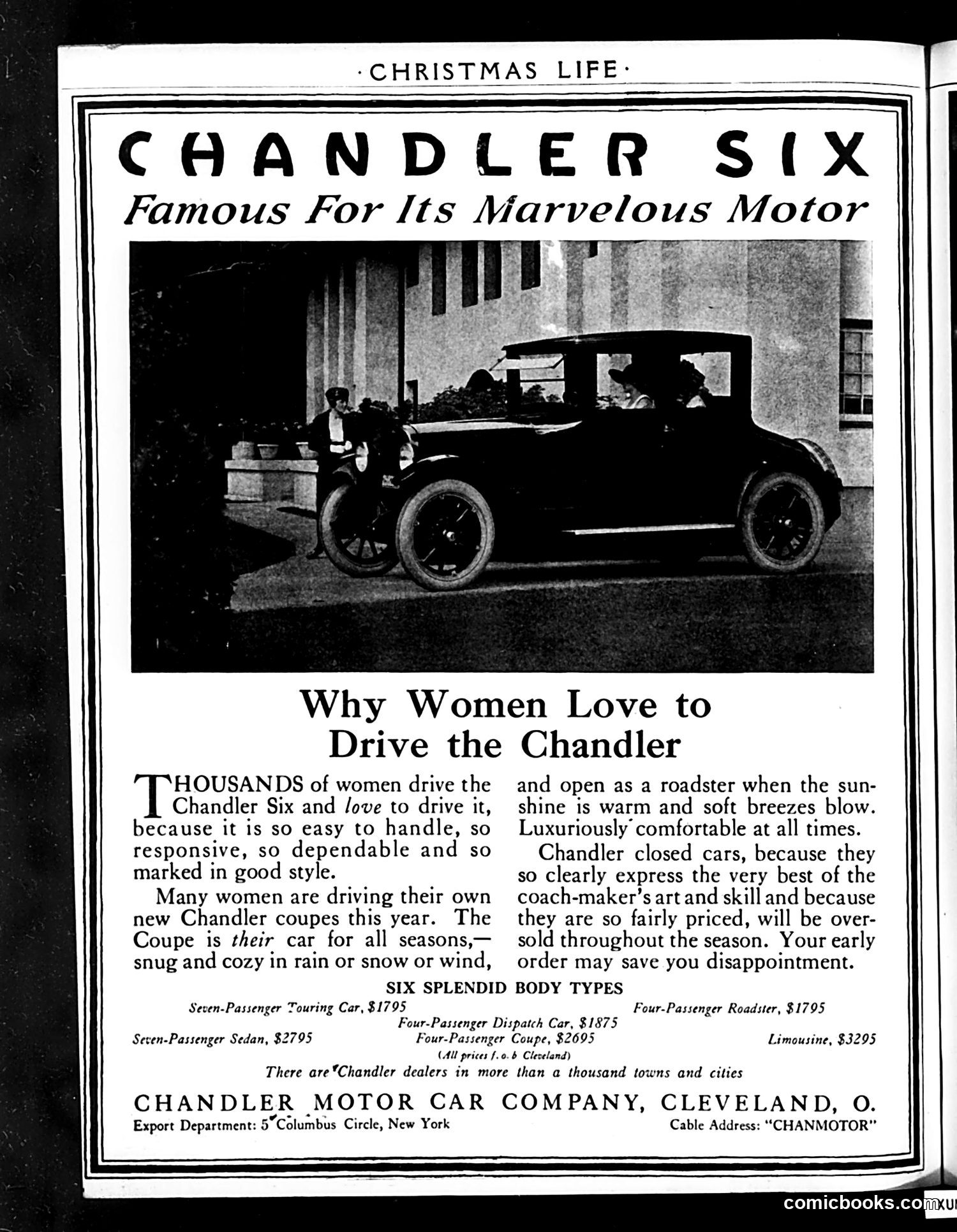
This is a **Chandler Motor Car Company advertisement**, not a political cartoon. It appeared in *Life* magazine during the publication's early advertising-heavy period. The ad targets **women drivers**, a notably progressive marketing angle for the era. The headline "Why Women Love to Drive the Chandler" and accompanying photo of a woman at the wheel emphasize the car's ease of handling and reliability—qualities marketed specifically to female consumers. The text highlights six body styles and notes Chandler's affordability and nationwide dealer network. The ad reflects the 1920s cultural shift toward women's independence and automobile ownership, presenting driving as accessible and desirable for women rather than exclusively masculine.
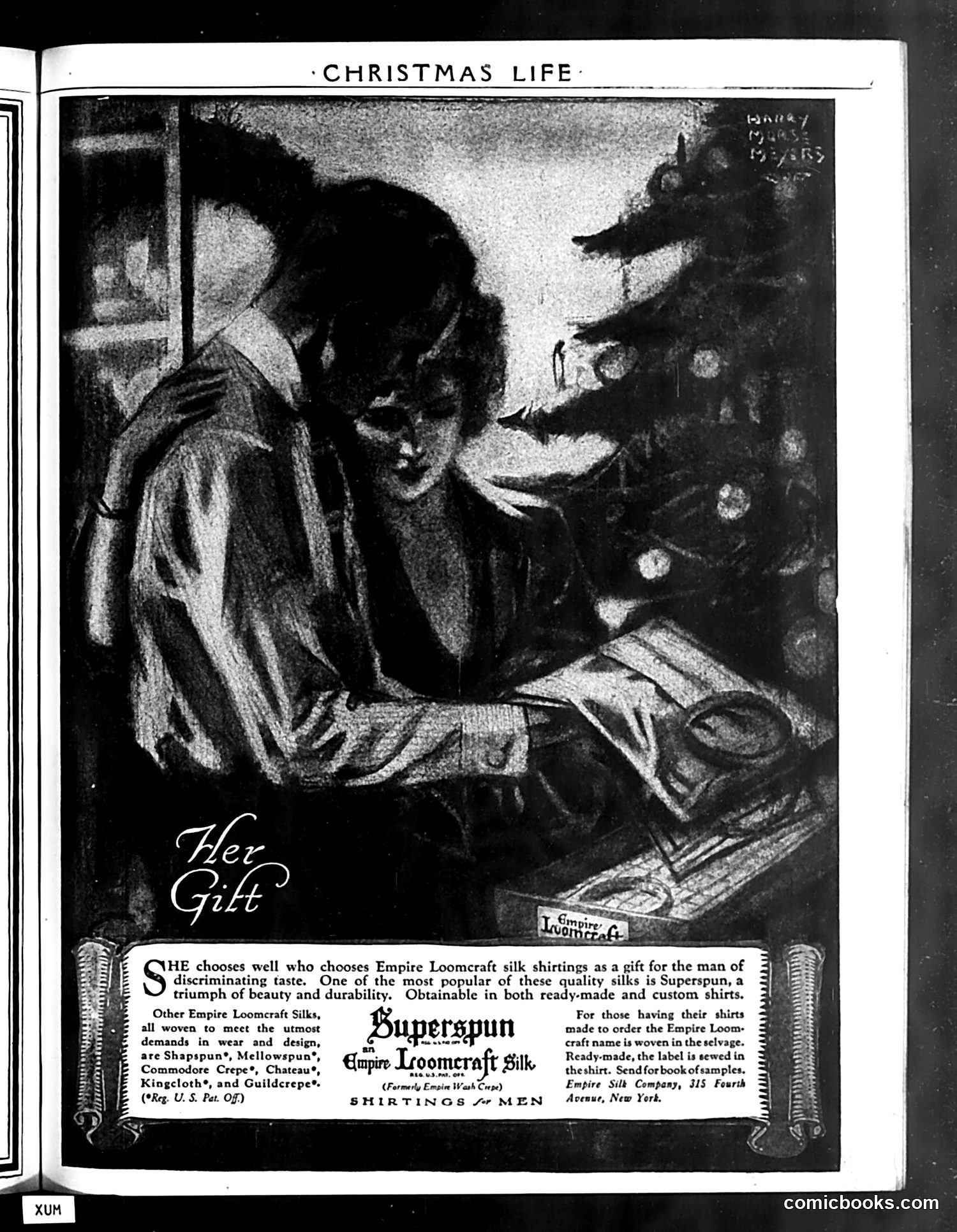
This is primarily a **Christmas gift advertisement** for Empire Loomcraft silk shirts, not political satire. The page is titled "Christmas Life" and features an illustration labeled "Her Gift." The image shows a woman presenting a silk shirt to a man beside a decorated Christmas tree. The accompanying text recommends Empire Loomcraft silk shirts as gifts "for the man of discriminating taste," highlighting their quality and durability. The ad lists various silk options (Superspun, Mellowspun, Chateau, etc.) and notes that custom-made shirts have labels sewn inside. The company address is given as 215 Fourth Avenue, New York. This is straightforward **commercial advertising**, not editorial commentary or political cartoon.
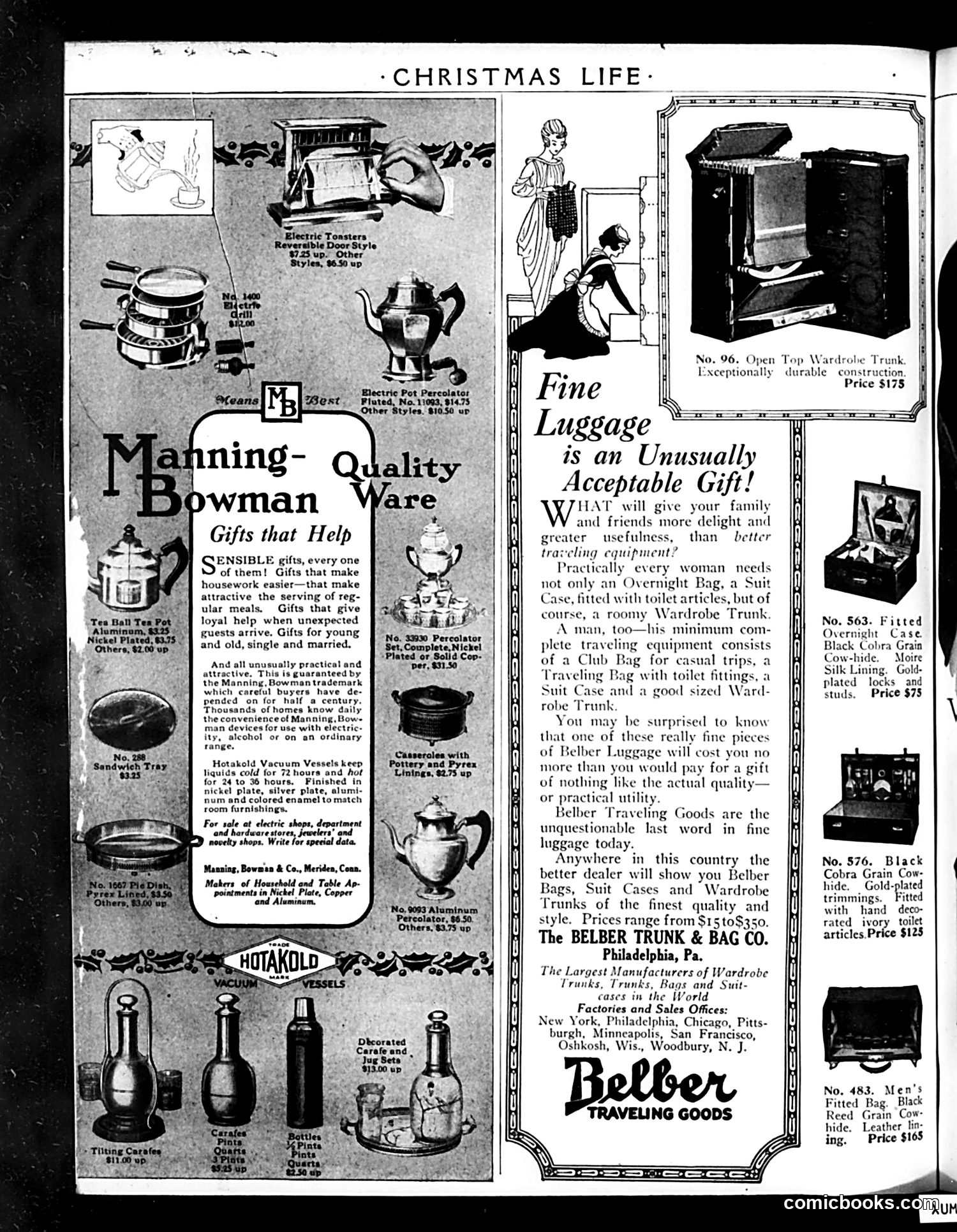
This page is primarily **advertising, not satire or political commentary**. The left side advertises Manning-Bowman quality kitchenware (toasters, tea sets, vacuum vessels, etc.) as sensible Christmas gifts. The ad emphasizes practical utility for housewives. The right side features Belber Traveling Goods—luggage and wardrobe trunks marketed as "an Unusually Acceptable Gift" for women. The accompanying illustration shows a woman packing, reinforcing the idea that quality luggage is a thoughtful present. Both ads reflect **early 20th-century gender assumptions**: women receive domestic/household items or travel goods as appropriate gifts. There is no apparent political satire here—this is straightforward holiday consumer advertising targeting middle-class households.
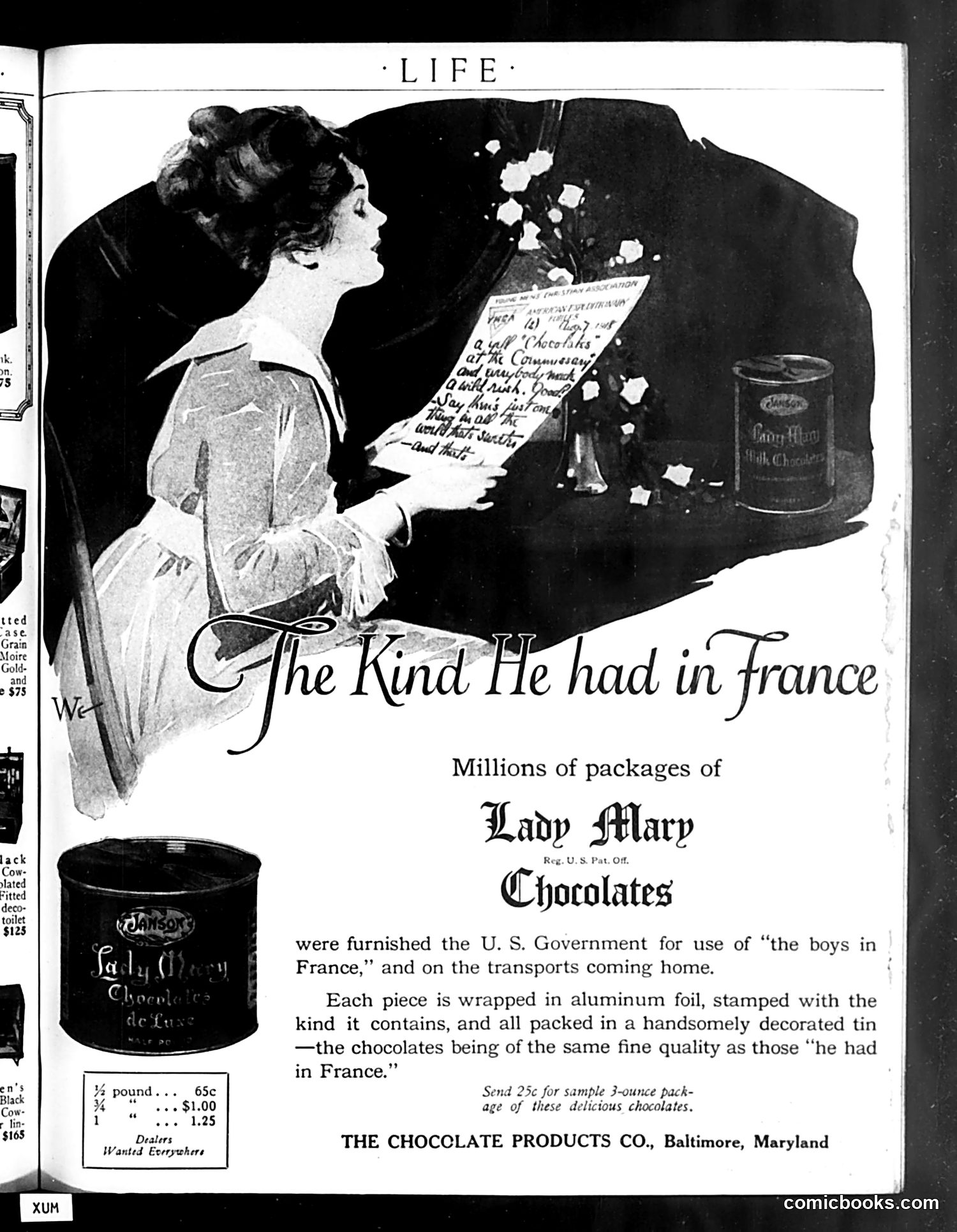
This is a **Lady Mary Chocolates advertisement**, not political satire. The ad exploits American soldiers' WWI experiences to market candy. The image shows a woman reading a soldier's letter from France, with flowers and chocolates visible. The tagline "The Kind He had in France" appeals to nostalgia and romance, implying Lady Mary chocolates matched what soldiers enjoyed abroad. The text states millions of packages were supplied to the U.S. Government "for use of 'the boys in France'" and shipped home on transport vessels. Each piece is wrapped in aluminum foil and packed in decorated tins. **The "satire"** (if any) lies in commercializing soldiers' wartime experiences—using their overseas service and romantic associations to sell luxury goods to American consumers at home.
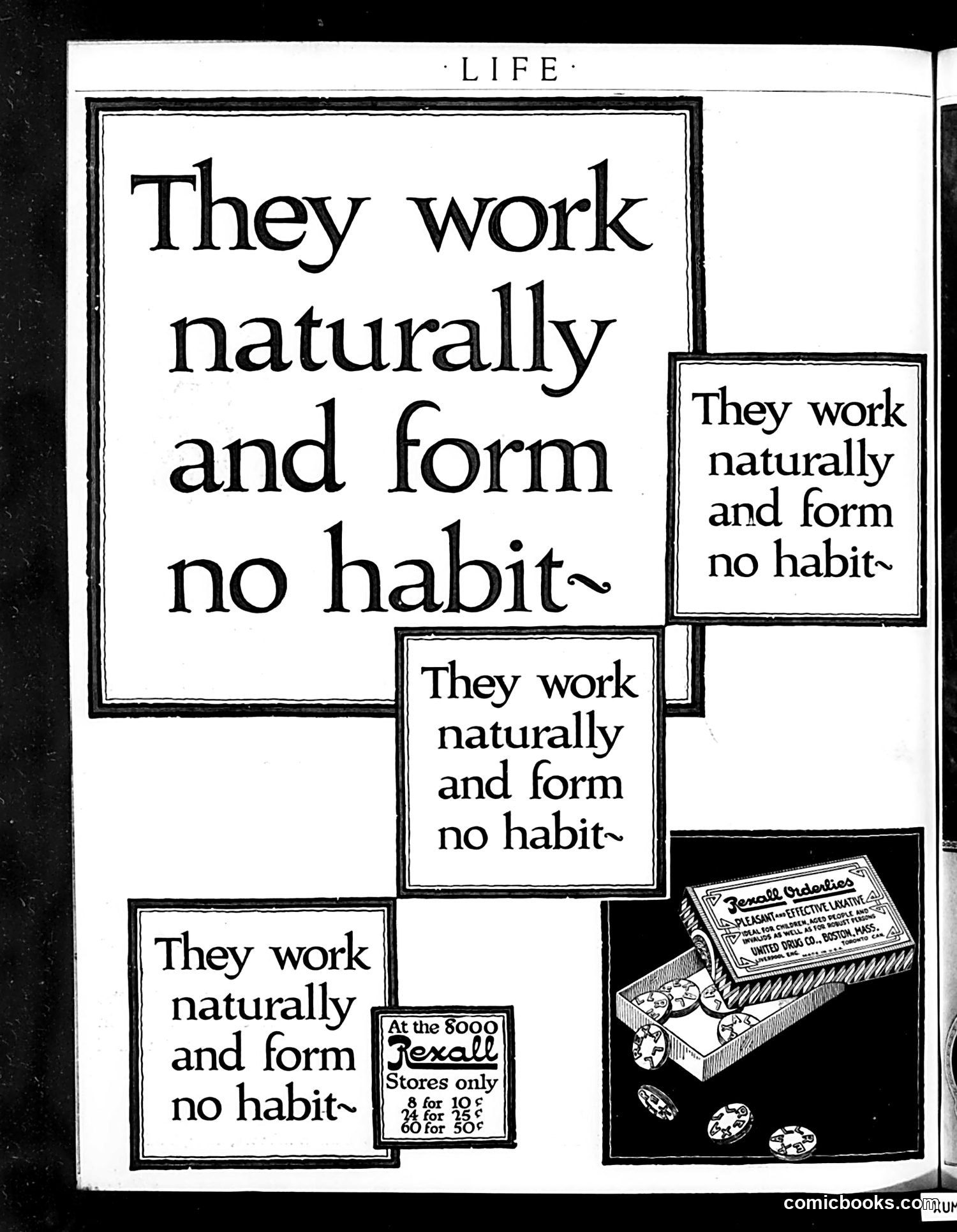
This page is primarily **advertising**, not political satire. It features a repeated message: "They work naturally and form no habit" — appearing in multiple text boxes of varying sizes in a cascading layout. The advertisement is for **Rexall** products (visible in the small illustration of a branded box with pills/tablets), sold at "the 5000 Rexall Stores only" at prices of 8 for 10¢, 24 for 25¢, or 60 for 50¢. The repeated, emphatic messaging about "no habit" formation suggests these are **patent medicines or over-the-counter remedies** marketed during an era (early 20th century) when addiction concerns around such products were becoming public awareness. The advertising strategy reassures consumers that unlike some proprietary medicines of the period, these Rexall products were non-habit-forming—a significant selling point at the time.
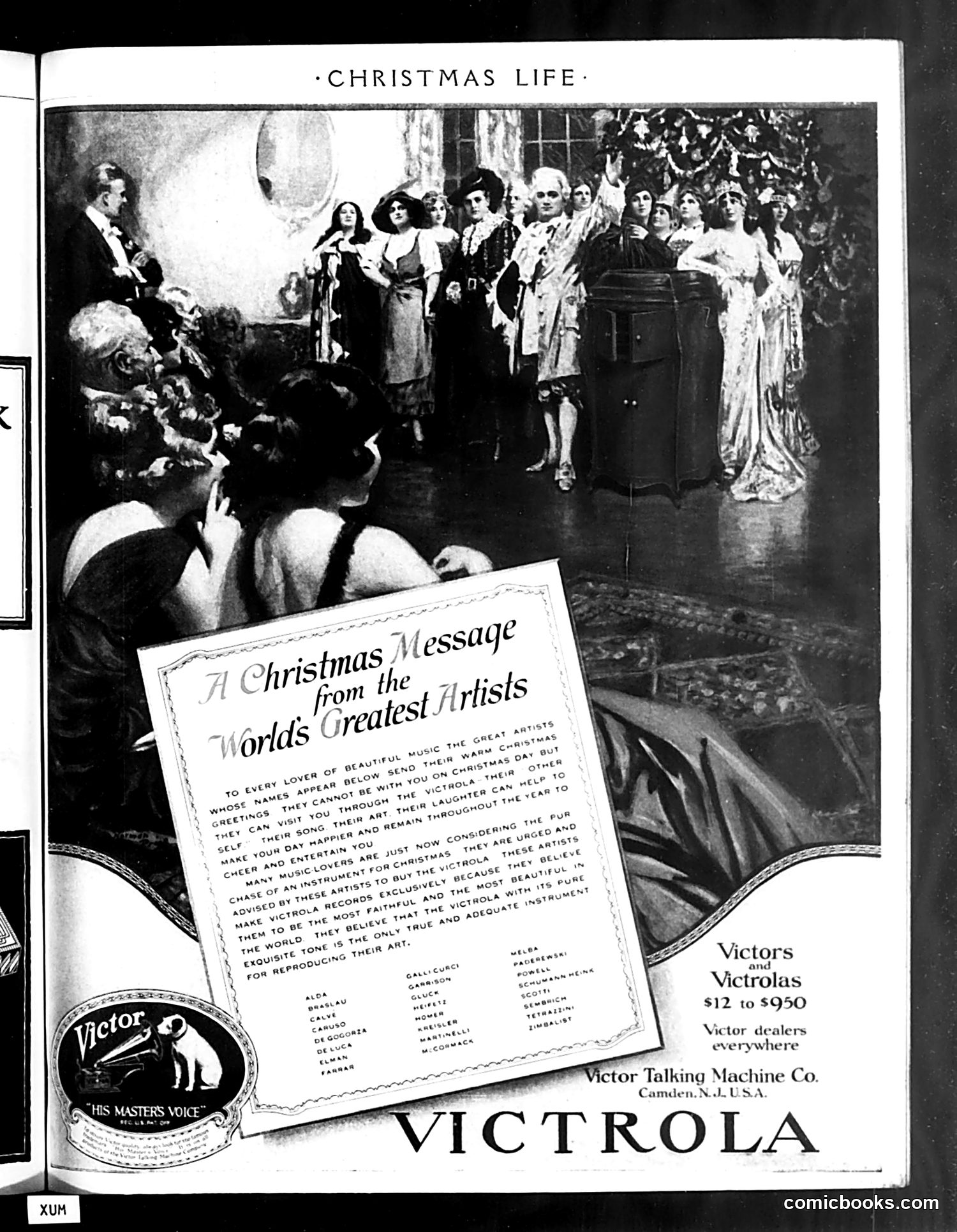
This page is primarily a **Victrola phonograph advertisement**, not a political cartoon. The advertisement features "A Christmas Message from the World's Greatest Artists" promoting Victor Talking Machine Co.'s records. The image shows an elegant Christmas party scene with formally dressed people gathered around a Victrola phonograph. The advertisement appeals to consumers by claiming that famous classical musicians' recorded performances can be heard in one's home during Christmas celebrations. The text emphasizes that these are authentic recordings by celebrated artists, positioning the Victrola as a luxury item that brings high culture and entertainment to middle-class households. The "His Master's Voice" trademark appears at bottom left. This represents early 20th-century marketing: using aspirational imagery and celebrity endorsements to sell consumer technology.
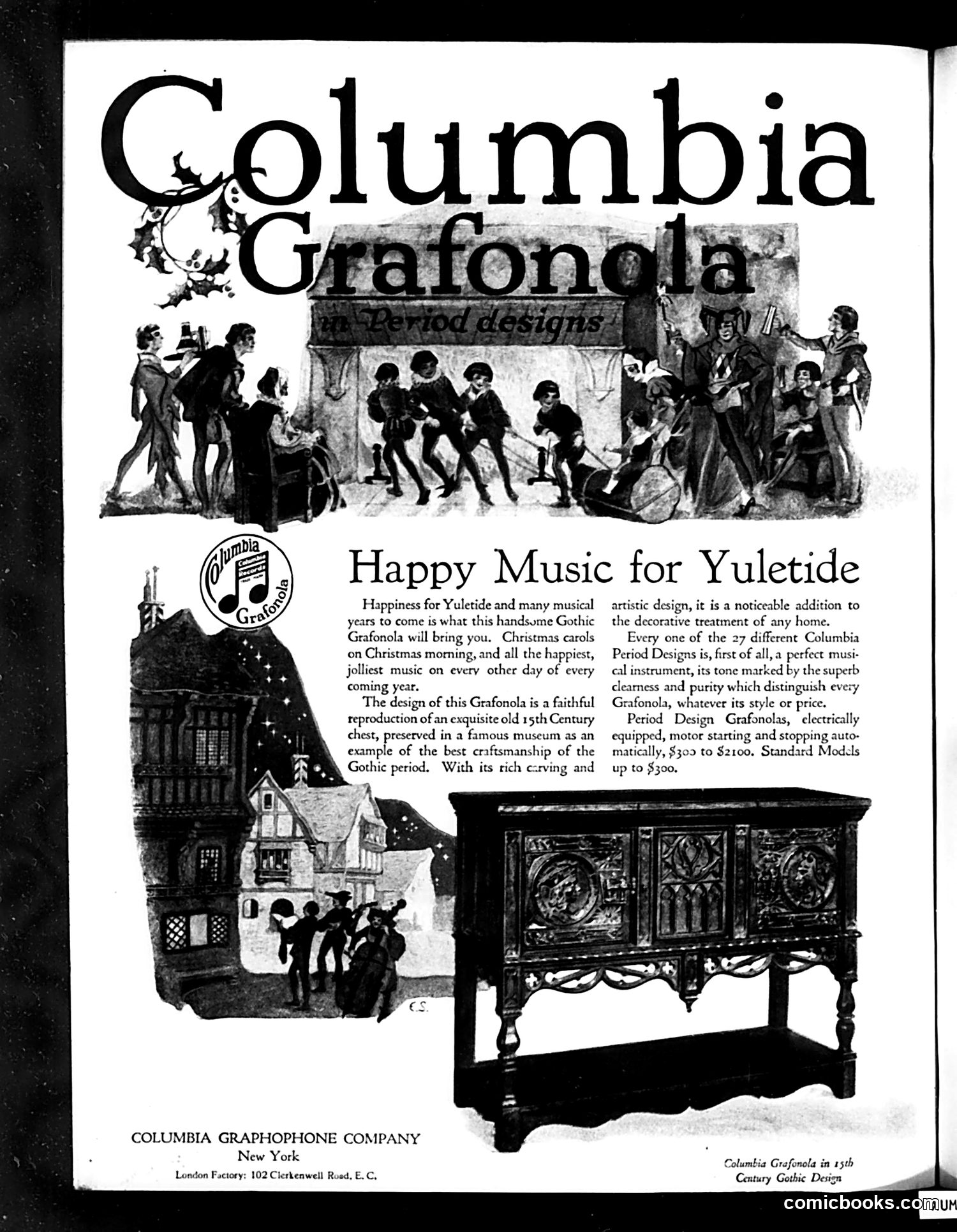
This is not a political cartoon but a **product advertisement** for Columbia Graphophone Company's "Grafonola" (an early phonograph/record player). The page uses festive Christmas imagery—carolers, a Gothic mansion, period decorations—to market a phonograph designed to look like a 15th-century Gothic chest. The visual appeal targets affluent consumers who valued both functionality and home décor. The "satire" (if any) is gentle: the ad promises that this expensive device ($309-$2100, substantial sums in the early 20th century) will bring happiness and "jolliest music" to the home. The nostalgic Gothic styling suggests that modern convenience wrapped in antique aesthetics represents good taste and cultural refinement. This reflects broader 1920s-era consumer culture trends: marketing technology as both practical and decorative, and appealing to middle/upper-class aspirations for cultured domesticity.
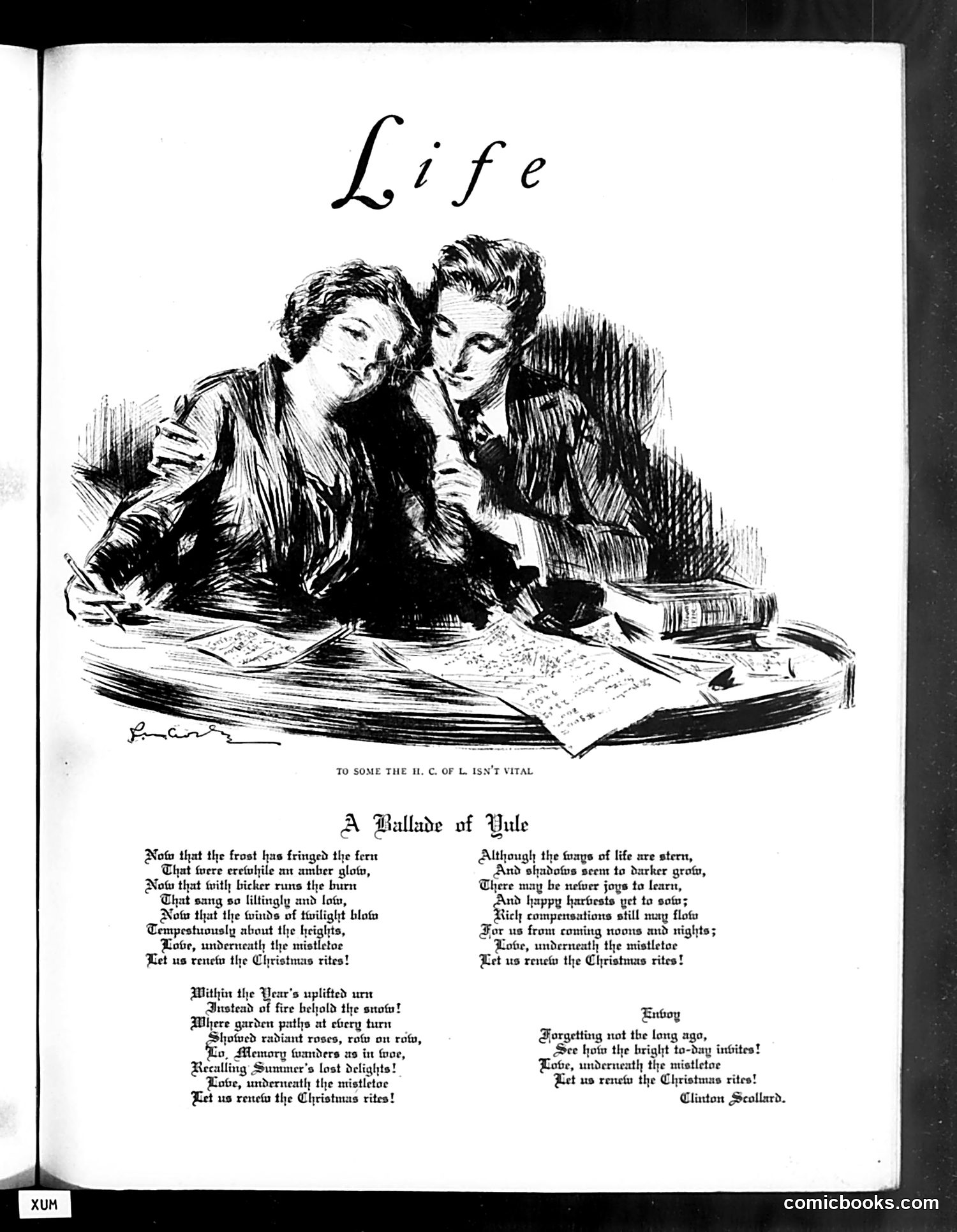
The headline "TO SOME THE H.C. OF L. ISN'T VITAL" refers to the "High Cost of Living"—a major public concern during the 1910s-1920s when inflation and economic hardship affected ordinary Americans. The illustration depicts a couple examining bills and financial documents, suggesting financial stress. The accompanying poem, "A Ballade of Yule" by Clinton Scollard, offers romantic escapism during hard times—encouraging people to embrace Christmas traditions and love ("beneath the mistletoe") despite economic difficulties and gloomy conditions. The satire's point: while some dismiss rising living costs as unimportant, working people clearly cannot. The poem suggests that emotional and spiritual comfort—holiday sentiment and romance—serve as compensation for material hardship. It's gentle social commentary on how people endure economic anxiety through traditional rituals and sentiment.
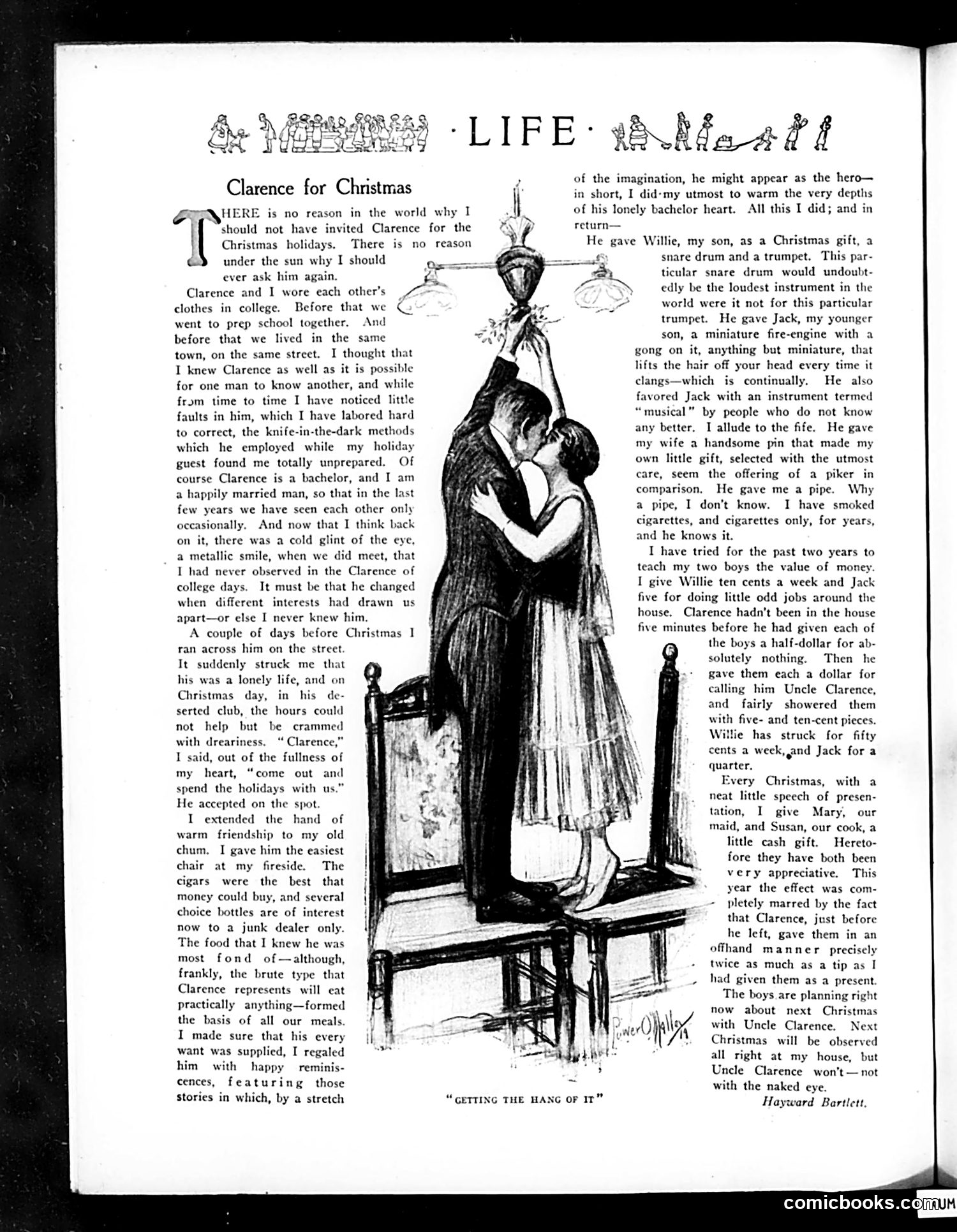
This is a humorous domestic story, not a political cartoon. The illustration shows a woman holding wrapped Christmas gifts, labeled "GETTING THE HANG OF IT." The narrative describes a man who invites his lonely bachelor college friend Clarence for Christmas, treating him generously. The joke centers on Clarence's oblivious rudeness as a guest: he gives the narrator's children loud, obnoxious instruments (snare drum, trumpet, fire-engine gong, fife) that destroy the household peace, undermines the father's attempts to teach the boys financial discipline by lavishing them with money, and gives the wife a superior gift that makes the narrator's own present seem inadequate. He also gives the servants unusually large tips. The humor lies in the contrast between the narrator's selfless hospitality and Clarence's tactless, disruptive behavior—representing the "difficult houseguest" archetype that would resonate with readers managing holiday visitors.
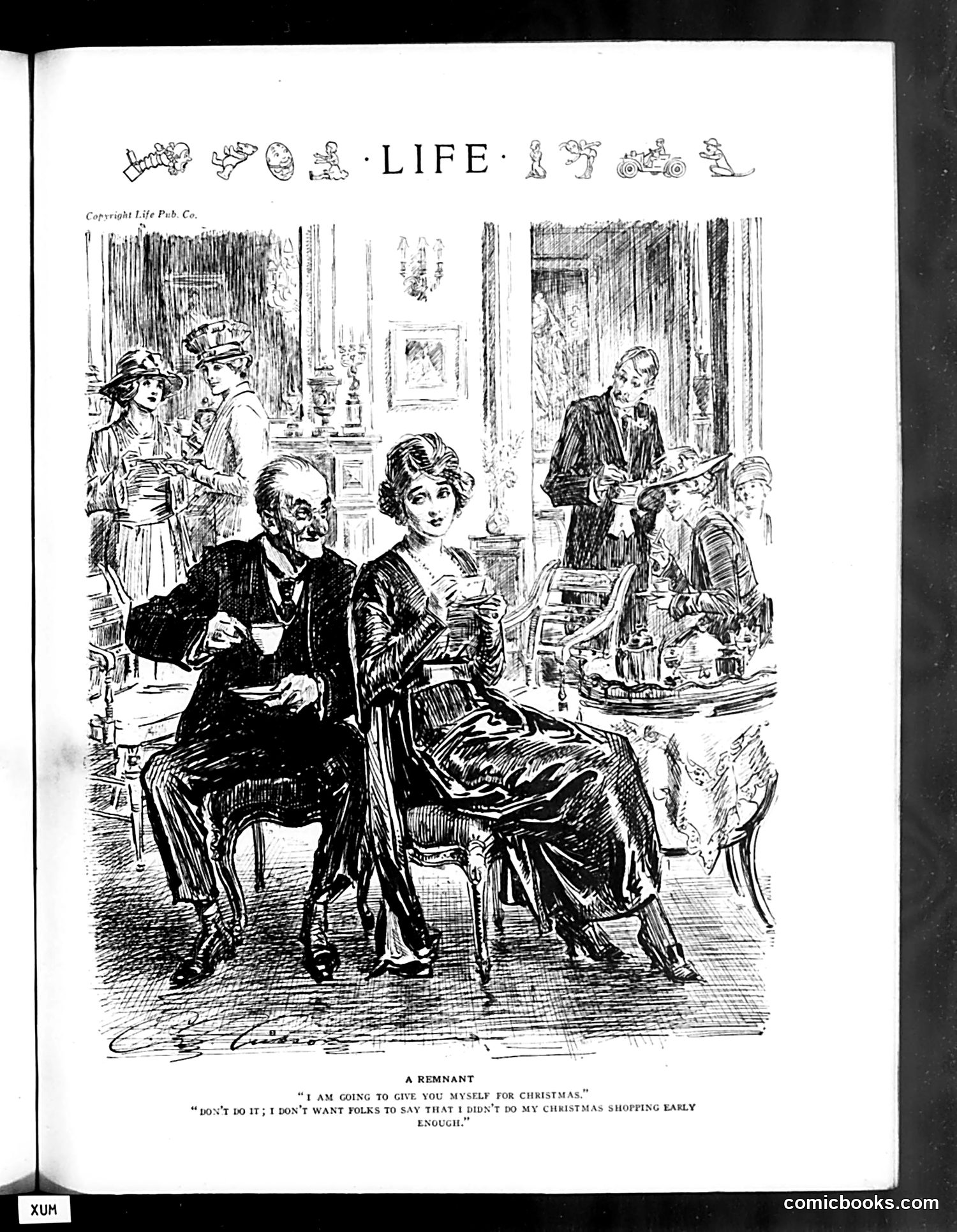
This is a domestic humor cartoon depicting a Christmas gift-giving dilemma. An older gentleman offers himself as a Christmas present to a woman (likely his wife), claiming it's a personal gift. She refuses, fearing social embarrassment—specifically that people will think she failed to shop early enough for Christmas. The satire targets early 20th-century consumer culture and gender expectations: women were expected to complete holiday shopping well in advance, and receiving a last-minute personal gesture (rather than a purchased item) would suggest poor planning or laziness. The joke mocks both the commercialization of Christmas and the social pressure women faced to demonstrate proper domestic competence through timely gift acquisition. The woman prioritizes her social reputation over her husband's sentimental offering.
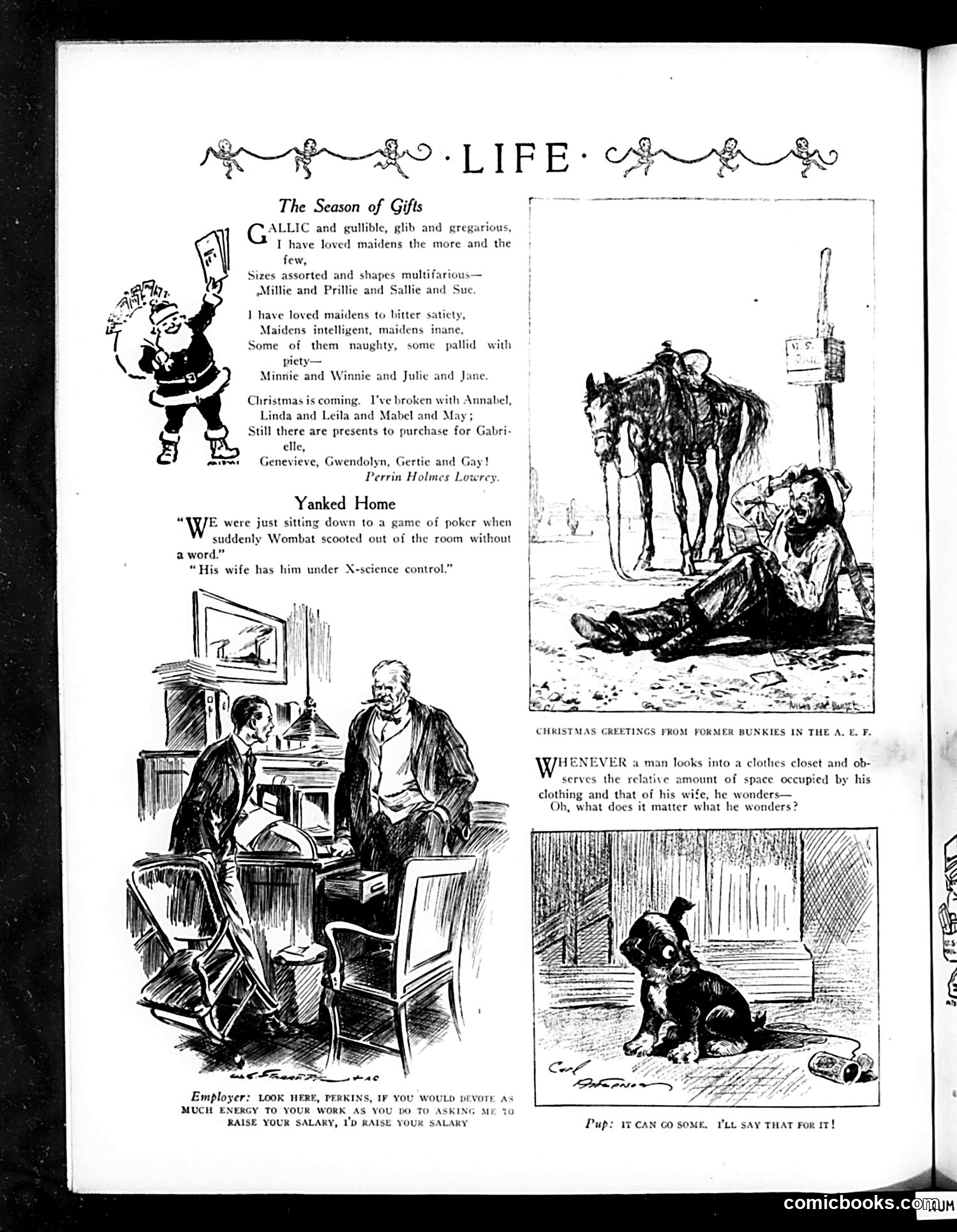
This page from *Life* magazine presents three separate satirical pieces: **"The Season of Gifts"** — A humorous poem about a serial romantic who has cycled through many girlfriends (named Millie, Sallie, Minnie, Annabel, etc.) and must now buy Christmas presents for all of them, highlighting male infidelity and the financial burden of maintaining multiple romantic interests. **"Yanked Home"** — A joke about a man named Wombat who abruptly leaves a poker game because his wife controls him through "X-science" (likely referring to Christian Science or similar pseudoscience movements popular in the early 20th century). The humor targets both henpecked husbands and women's supposed manipulation of men. **The employer/Perkins cartoon** — Satirizes an employee constantly requesting raises rather than focusing on work productivity. The dog caption offers ironic agreement. **Upper right illustration** — Shows "Christmas greetings from former bunkies in the A.E.F." (American Expeditionary Force in WWI), depicting soldiers in harsh conditions—dark humor about wartime Christmas. The page reflects early 20th-century anxieties about gender relations, workplace dynamics, and war's reality.
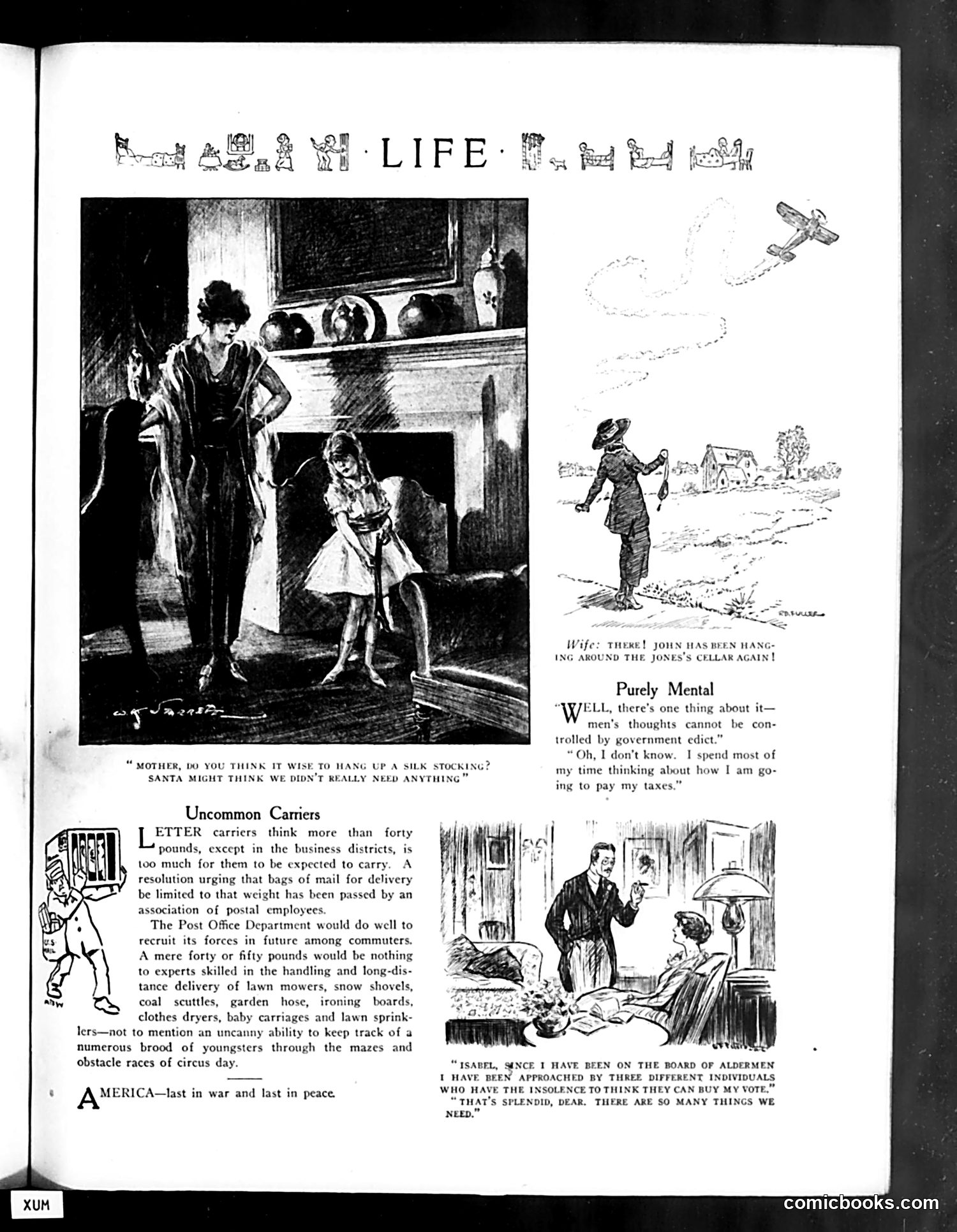
This page contains three separate satirical pieces: 1. **"Mother, Do You Think It Wise..."** – A Christmas-themed cartoon mocking wartime/Depression-era austerity. A mother worries that hanging a silk stocking signals the family doesn't "need anything," fearing Santa will judge them as ungrateful or wealthy. 2. **"Purely Mental"** – A joke about government control of thought. A wife mentions her husband can't be controlled by edict, but he counters that he already is—his thoughts are consumed by tax anxiety, showing government indirectly controls minds through financial burden. 3. **"Uncommon Carriers"** – Commentary on postal workers refusing to carry packages over 40 pounds. The piece sarcastically suggests recruiting commuters instead, who routinely handle heavier loads (lawn mowers, coal, baby carriages). It criticizes mail carriers as weak or shirking duty. 4. **"Isabel" cartoon** – A boardmember boasts about rejecting three bribes, implying he's virtuous. His wife responds that they need many things anyway—suggesting he could have accepted the corruption without consequences. All pieces mock American attitudes toward duty, government, and morality.
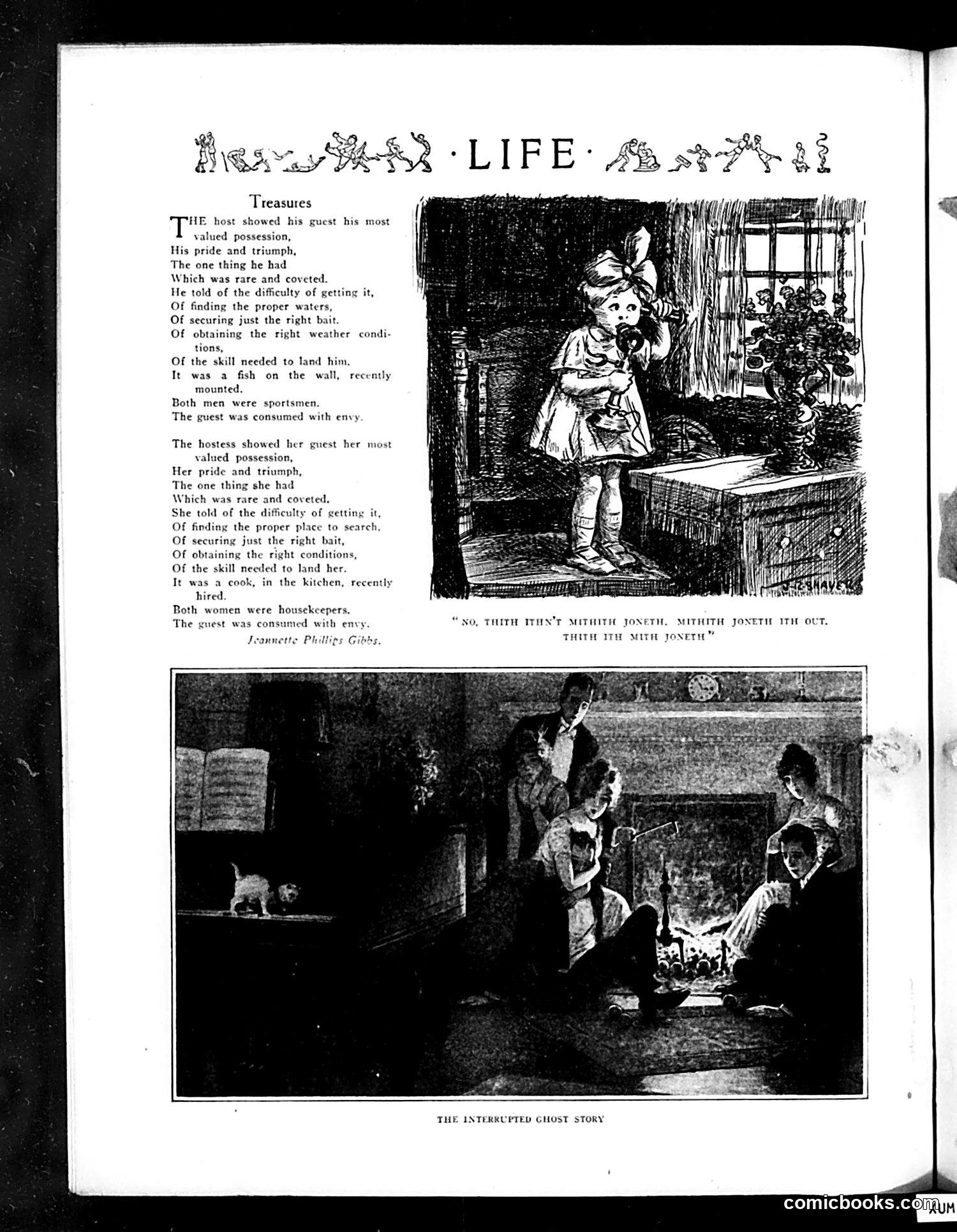
This two-part comic uses parallel structure to satirize domestic gender roles. The male host boasts about acquiring a prized mounted fish through sportmanship and skill—hunting, patience, proper technique. The female hostess describes obtaining her "treasure" in identical language: a skilled cook, pursued with equal difficulty through searching, the "right bait," and landing her. The joke exposes how women's domestic achievement—securing household help—mirrors men's sporting triumphs in seriousness and effort, yet the comparison reveals the absurdity of treating servant acquisition as equivalent to sportsman's pride. It's satirizing both masculine vanity about fishing and the class dynamics of early 20th-century household management, where finding reliable domestic workers was genuinely competitive among housewives. The second illustration, "The Interrupted Ghost Story," appears unrelated—showing a family gathered around a fireplace, likely a separate comic vignette about supernatural storytelling.
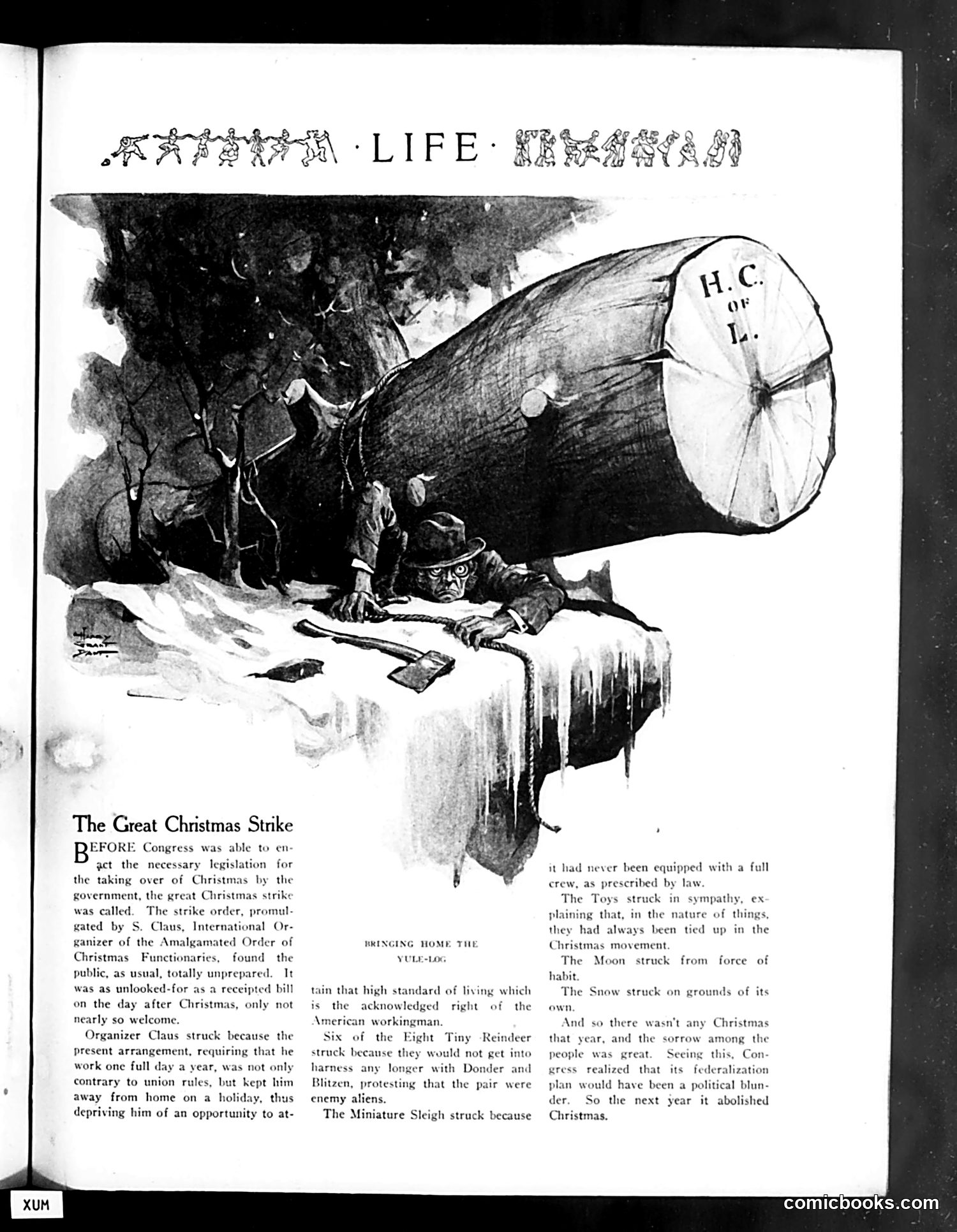
This is a satirical piece imagining Christmas as a labor dispute. Santa Claus, depicted as a union organizer, leads a strike against government takeover of Christmas. The strikers include: - **Santa's reindeer** (protesting unfair labor conditions and refusing to work with "enemy aliens" Donder and Blitzen) - **Christmas toys** (claiming they're always "tied up" in the Christmas movement) - **The moon and snow** (striking on principle) The satire mocks **1920s labor unions and government intervention**. By treating Christmas—a sacred holiday—as a labor negotiation, it ridicules both union demands for better working conditions and government attempts at economic control. The punchline: Congress abolishes Christmas rather than negotiate. The illustration shows Santa as a worker at a camp or construction site, emphasizing the absurdist inversion of sacred holiday into industrial labor dispute. This reflects anxieties about labor radicalism and government overreach during the early 20th century.
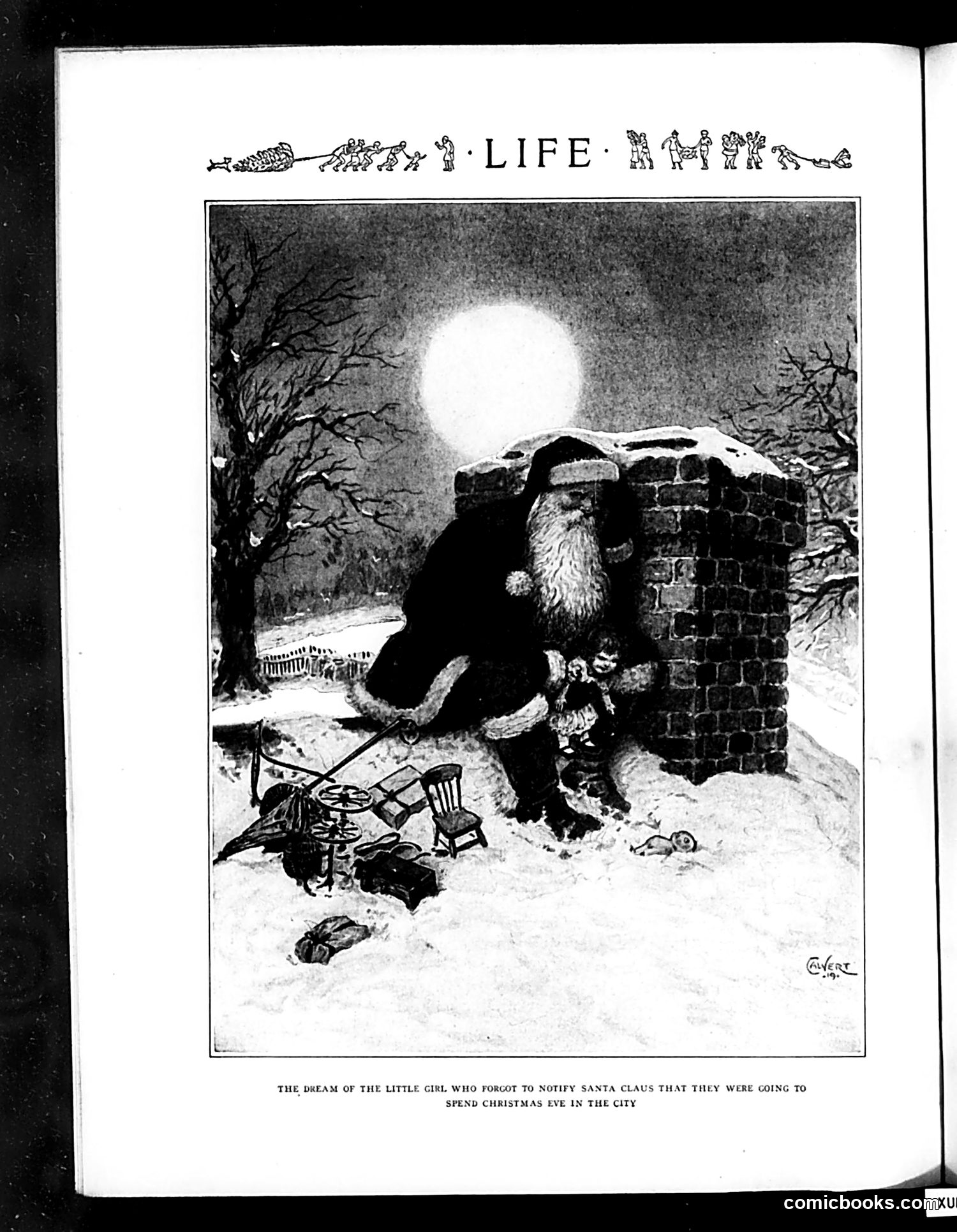
This is a Christmas-themed illustration showing Santa Claus visiting a brick chimney in a snowy urban setting, with a full moon behind him. The caption indicates the image depicts a child's dream—specifically, the fantasy of a little girl who neglected to inform Santa that her family would be spending Christmas Eve in the city rather than at home. The satire appears to target the disruption of traditional Christmas customs caused by urban life and modernization. The joke suggests the irony of Santa still making his rural/domestic rounds while families increasingly relocate to cities for holiday celebrations, creating a comedic mismatch between holiday expectations and modern reality. The illustration romanticizes the nostalgic image of Santa while gently mocking the complications posed by changing living patterns.
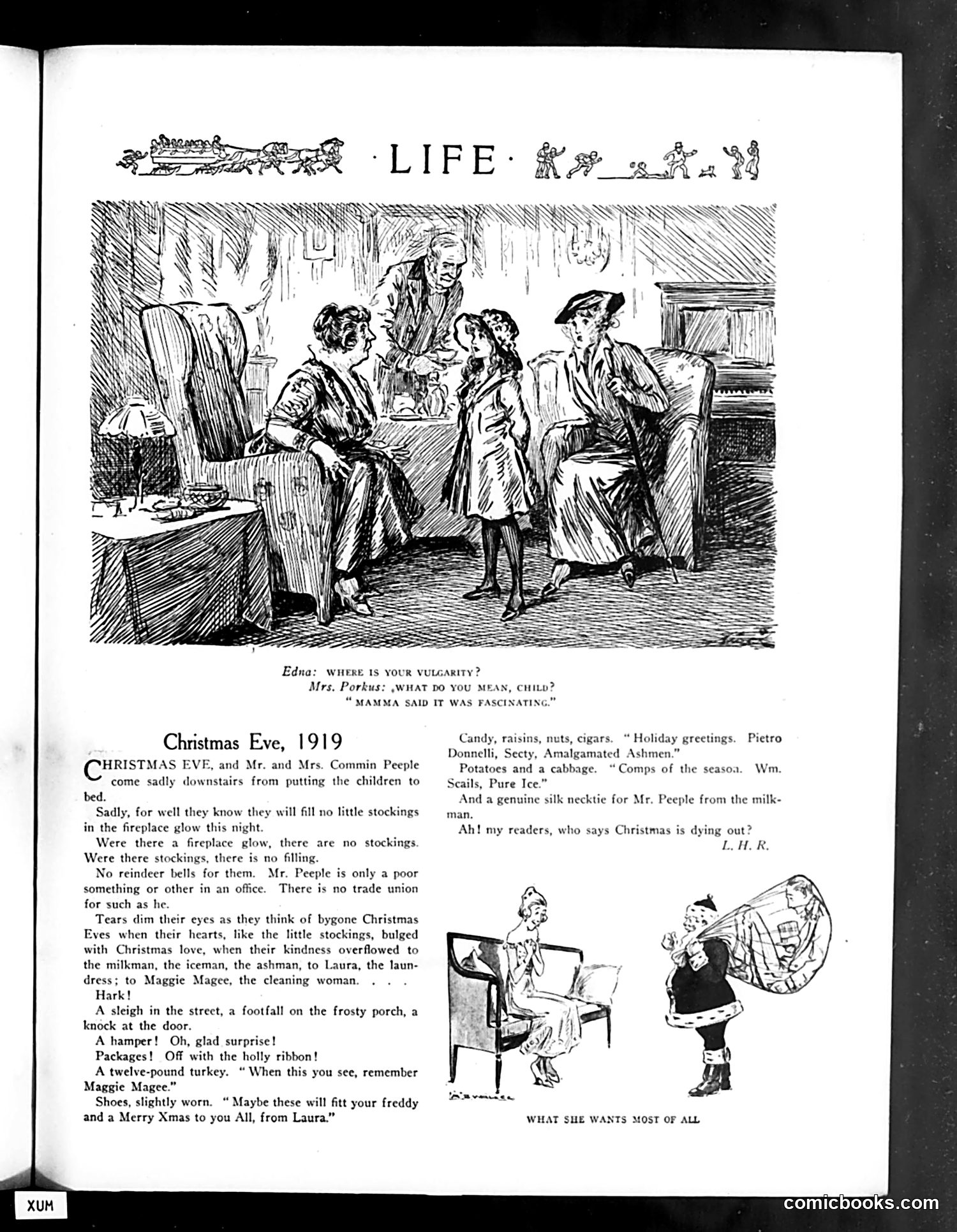
This satirical story and cartoon address post-WWI economic hardship. The "Commin Peeple" are a poor middle-class family who cannot afford Christmas gifts for their children—Mr. Peeple works a modest office job with no union protection. The joke's twist: unexpected generosity arrives from working-class service providers (milkman, iceman, ashman, laundress, ice delivery man) whom the family previously helped during better times. Each gift comes with a personalized note showing gratitude. The satire cuts two ways: it both mocks the family's reduced circumstances and celebrates the loyalty of humble workers. The caption "Ah! my readers, who says Christmas is dying out?" suggests Life's optimistic message that despite economic hardship in 1919, human kindness and community bonds endure. The accompanying cartoon showing a child's confusion about "vulgarity" appears unrelated—likely a separate joke about social propriety.
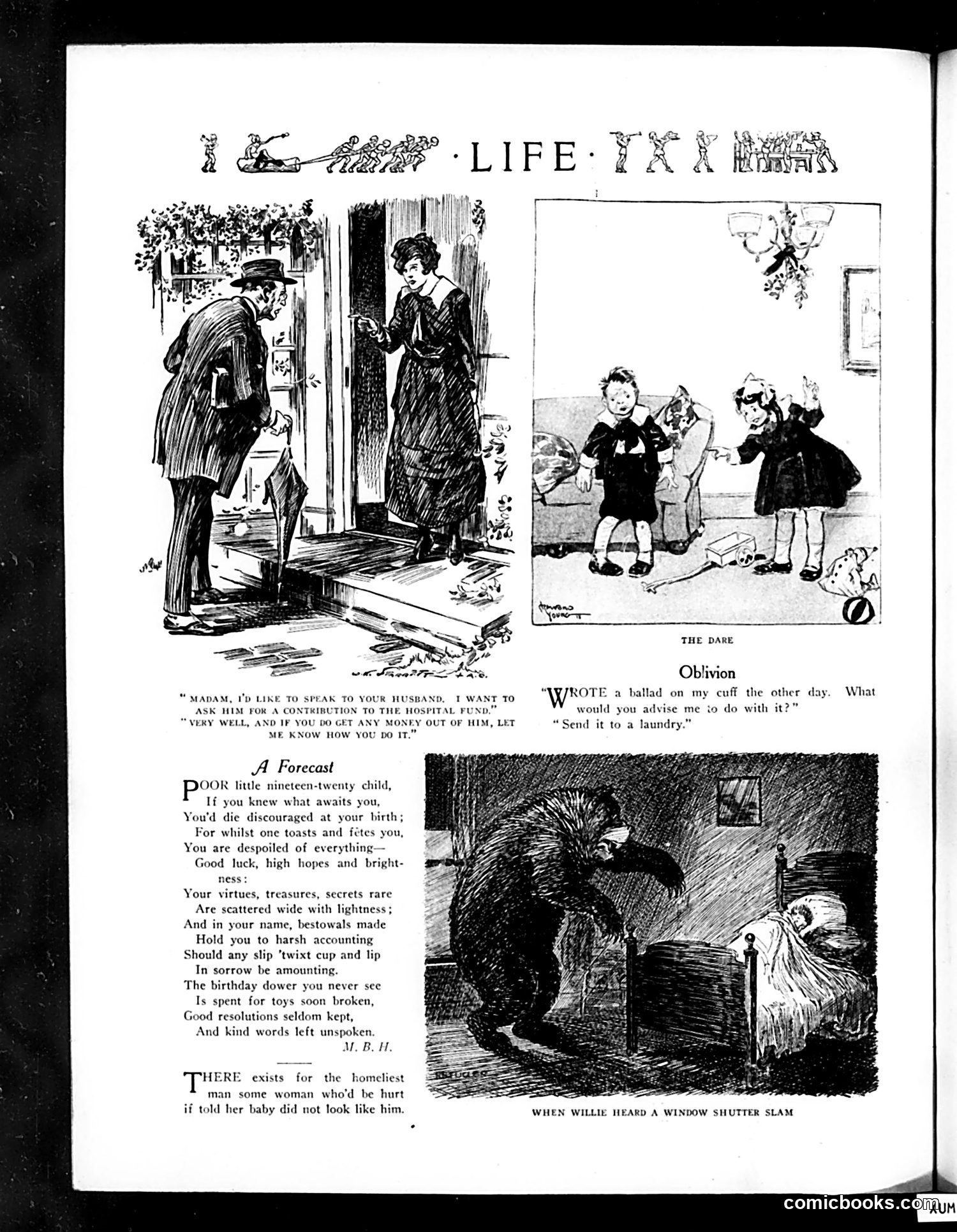
This page contains three separate satirical pieces typical of early 20th-century Life magazine humor: **Top cartoon**: A charity collector asks a husband for hospital donations while the wife sarcastically implies he never gives money away—mocking stingy husbands and the difficulty of extracting charitable contributions. **"A Forecast" poem**: A cynical verse about a nineteen-year-old child's bleak future, suggesting life will bring disappointment, scattered virtues, broken toys, and unkept promises. It's darkly humorous social commentary on the futility of childhood optimism. **"Oblivion" joke**: A man wrote poetry on his shirt cuff and asks what to do with it; the answer is to send it to a laundry—implying the verse is worthless and should be washed away. **Bottom illustration**: Titled "When Willie Heard a Window Shutter Slam," showing a child's startled reaction, likely illustrating a humorous anecdote about childhood nervousness or misbehavior. The page reflects early 20th-century Life's characteristic blend of domestic comedy, cynicism about human nature, and gentle mockery of everyday life.
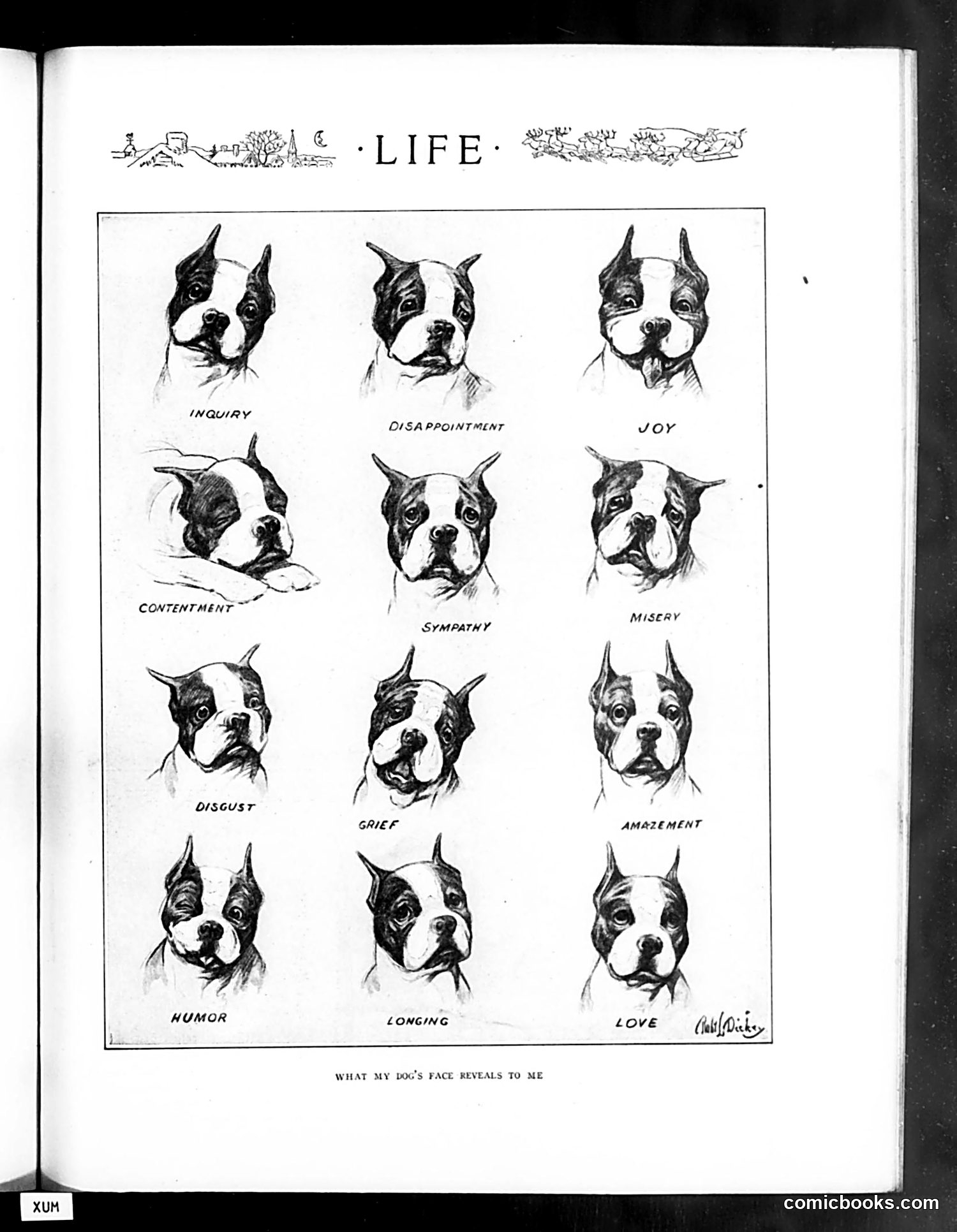
This is a humorous illustration from *Life* magazine showing twelve Boston Terrier dog faces, each labeled with a human emotion: Inquiry, Disappointment, Joy, Contentment, Sympathy, Misery, Disgust, Grief, Amazement, Humor, Longing, and Love. The joke is anthropomorphic—the artist (signed "Hal Oaky") claims dogs can express complex human emotions through facial expressions alone. By carefully arranging the ears, eyes, and mouth position in slightly different ways, each sketch convincingly suggests a distinct emotional state. The satire gently mocks sentimental pet owners who project elaborate feelings onto their animals. It's playing on the common Victorian and early-20th-century tendency to romanticize pets as emotionally sophisticated companions, suggesting that what owners "read" in their dog's face says more about human perception than canine psychology.
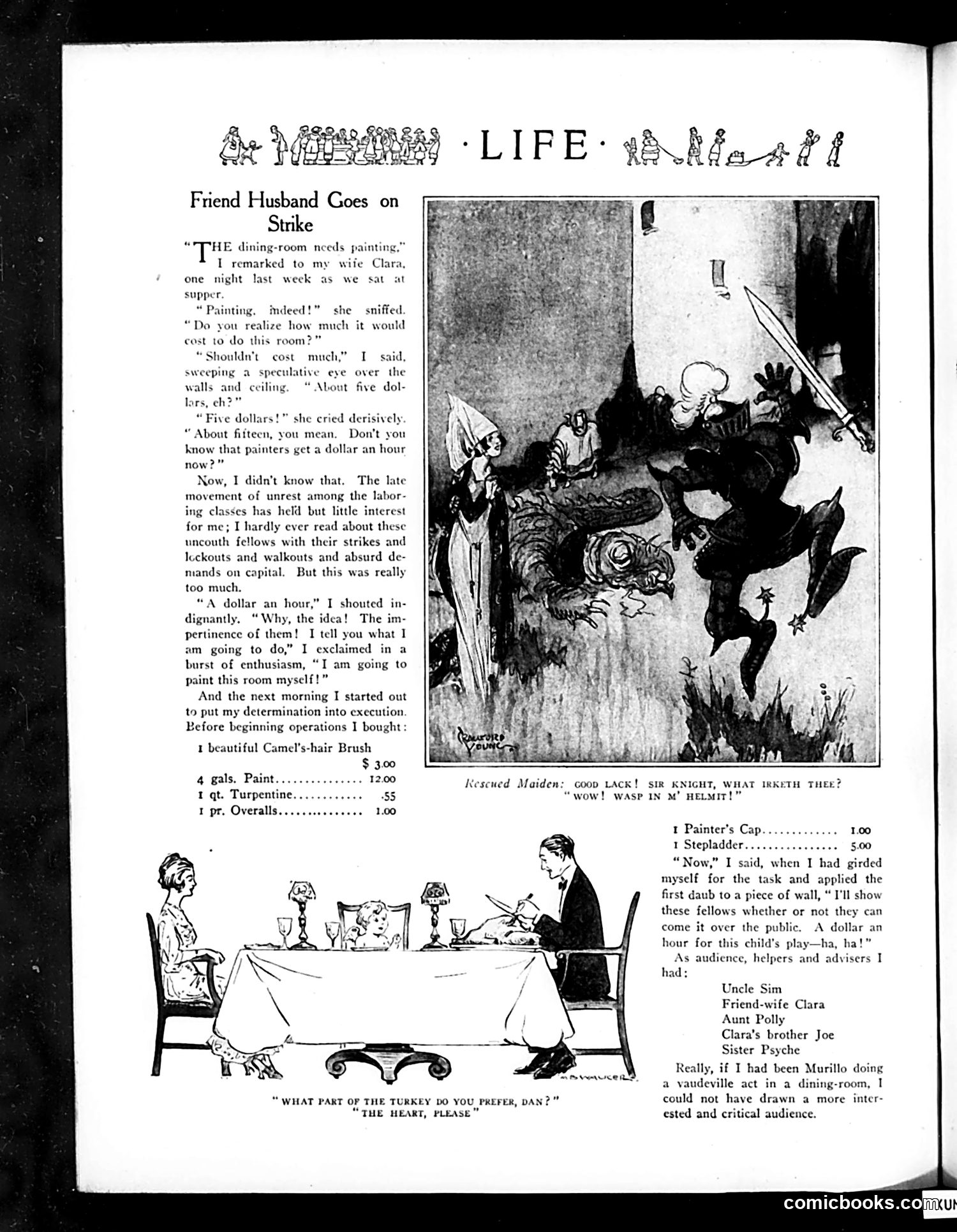
This is a humorous domestic story mocking labor unions and striking workers through a satirical narrative. A smugly middle-class husband, dismissing labor unrest as unimportant, learns that house painters now earn a dollar per hour—shocking him into indignation. To prove workers are overpaid, he decides to paint his dining room himself. The joke's target: middle-class men who ignore or scoff at labor movements until they personally confront higher wages. The story satirizes his assumption that painting is "child's play" unworthy of such pay, while the accompanying illustration humorously shows his actual painting attempt—chaotic and absurd, with his wife and relatives watching critically. The message: privileged people dismissing workers' demands lack understanding of actual labor difficulty. The cartoon undermines the narrator's arrogant confidence through physical comedy, revealing the gap between his contempt for workers and the reality of skilled work.
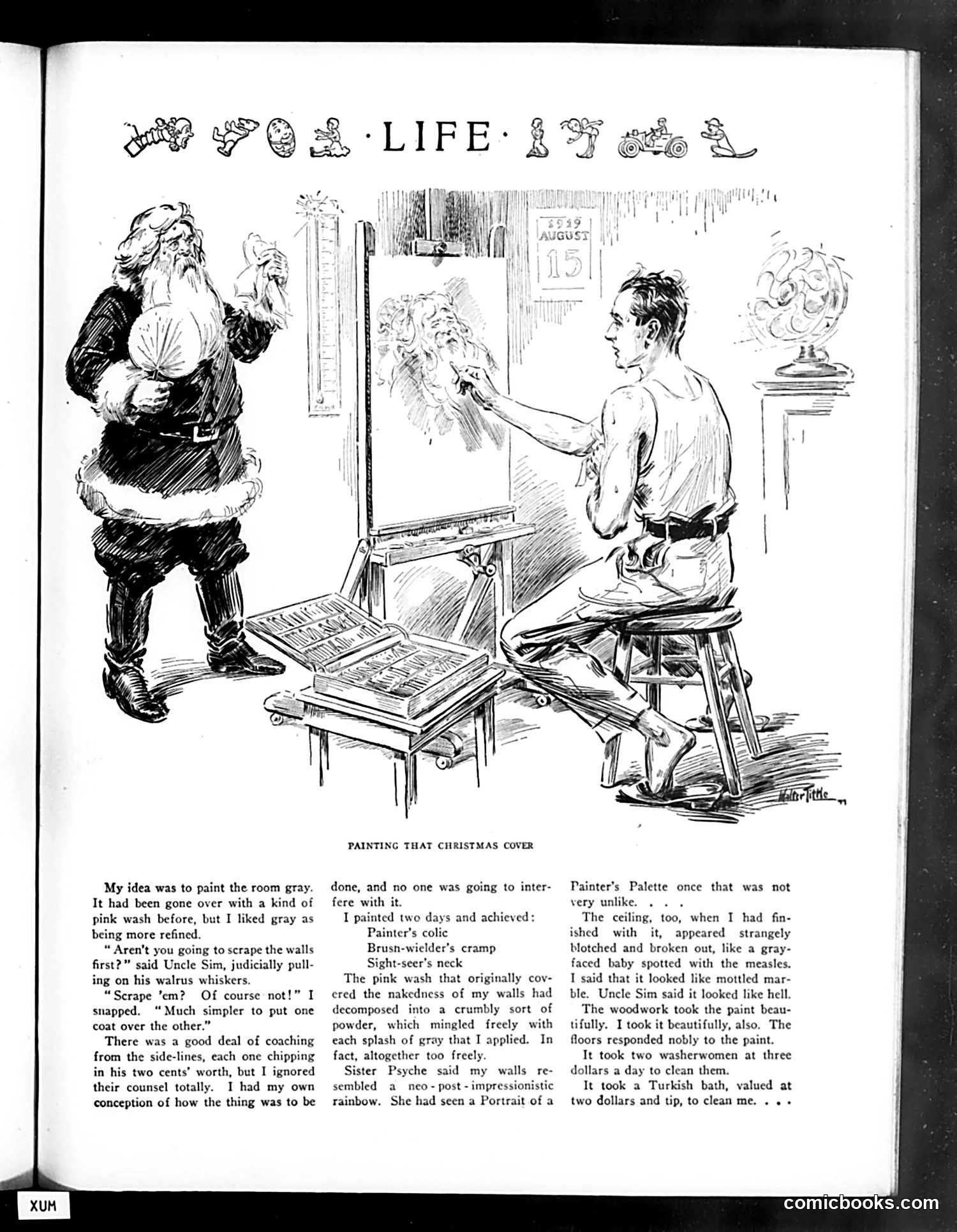
This is a humorous domestic narrative about an amateur painter's disastrous attempt to repaint a room gray without proper preparation. The cartoon illustrates the moment: a shirtless man sits painting while an older bearded gentleman (Uncle Sim) offers unsolicited advice. The satire targets overconfident DIY incompetence. The narrator ignores basic instruction (scraping old paint first), suffers physical consequences (painter's colic, cramps), and produces laughable results—walls that look like "neo-post-impressionistic" chaos, a ceiling resembling measles. Family members mock the outcome, yet he rationalizes failures as intentional artistic effects. The joke's appeal lies in relatable frustration: well-meaning amateurs stubbornly rejecting expert guidance, then paying dearly—literally, through hiring cleaners and a Turkish bath—for their pride. The title suggests this disaster became *Life* magazine's Christmas cover illustration.
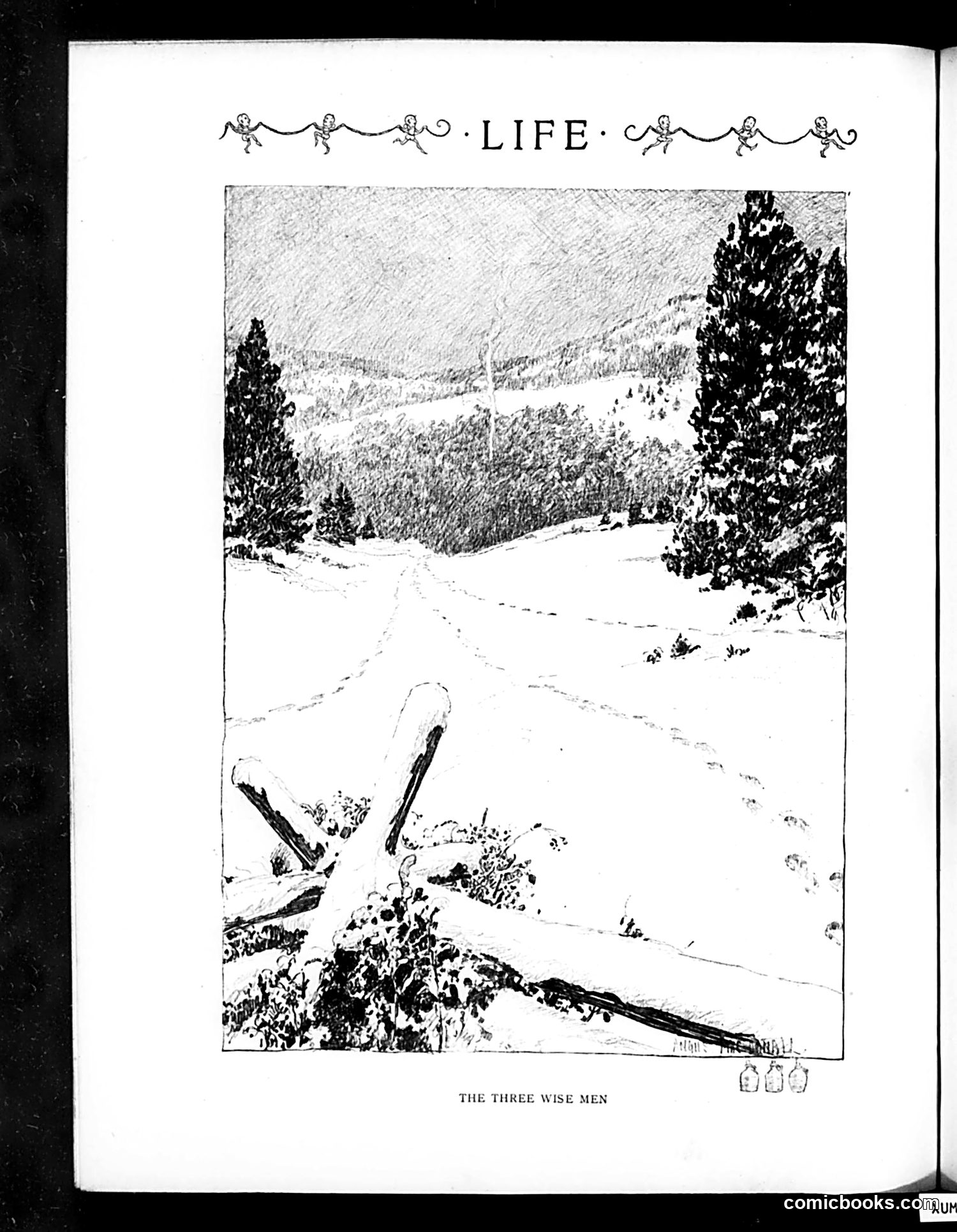
This Life magazine illustration depicts a snowy mountain landscape with skis planted in the snow and evergreen trees framing the scene. The caption "The Three Wise Men" suggests political satire, likely referencing three contemporary leaders or public figures. Without visible faces or clearer identifying details in the image itself, I cannot definitively name which specific political figures are being satirized. The "wise men" reference may invoke the biblical Magi, perhaps ironically commenting on the wisdom (or lack thereof) of three leaders during a particular historical moment. The winter/skiing setting could symbolize a specific geopolitical situation, but the exact meaning requires additional context about Life magazine's publication date and contemporary events that this page would have addressed.
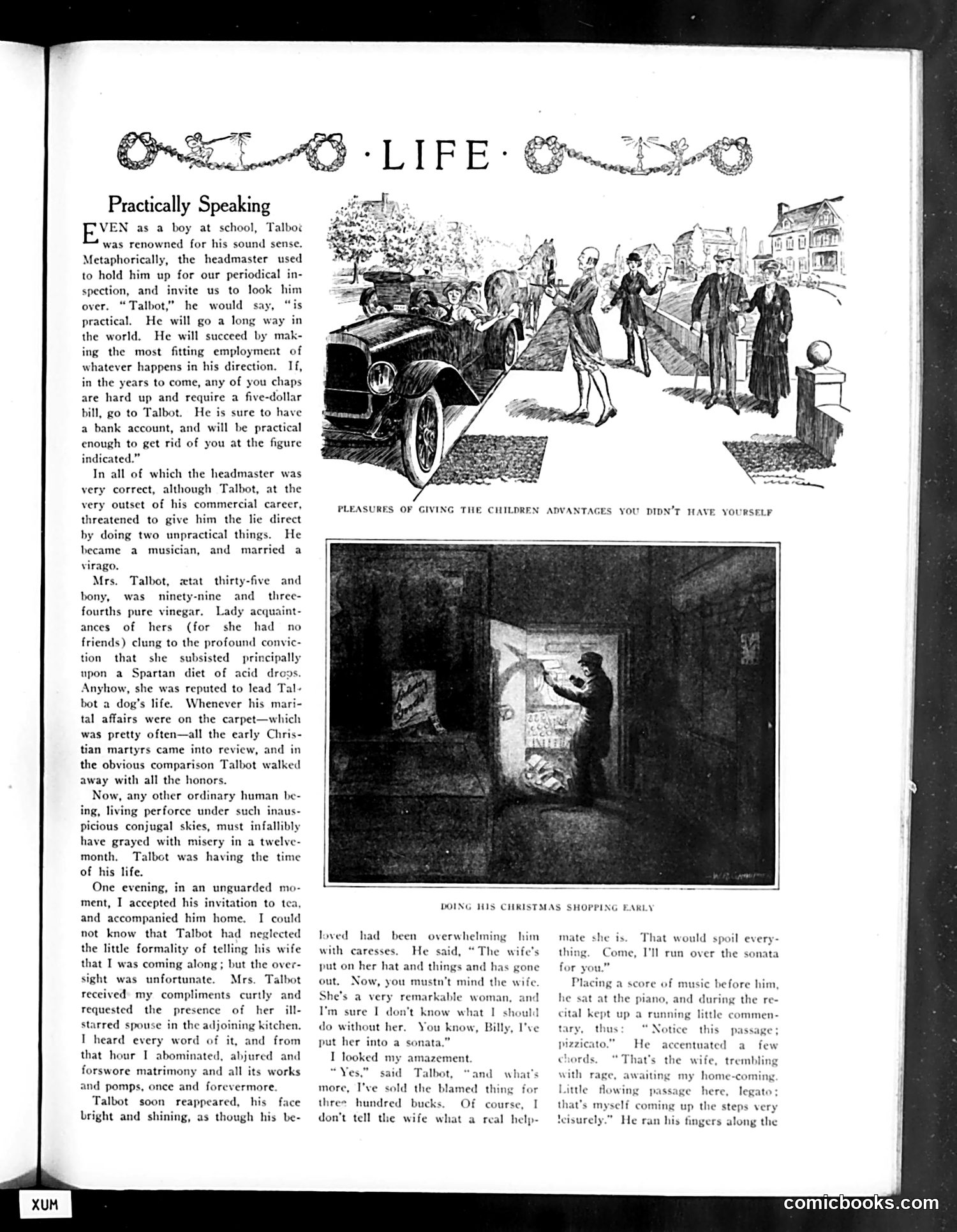
This satirical story mocks the concept of "practicality" through Talbot, a man praised in school for his sensible nature who paradoxically becomes a musician and marries a notoriously difficult woman—two allegedly impractical choices. The joke's twist: Talbot is actually thriving. His shrewish wife (depicted as vinegar-like, friendless, and acid-tongued) has unknowingly become his muse. He's composed a sonata inspired by her and sold it for three hundred dollars—profiting from his "misery." The cartoons show: (top) Talbot displaying wealth and automobiles to neighbors, suggesting his commercial success despite marrying poorly; (bottom) him at the piano, composing during Christmas season. The satire critiques both rigid definitions of practicality and suggests that what appears disastrous on the surface (an awful marriage) can paradoxically fuel creative and financial success. The "practical" choice isn't always the obvious one.
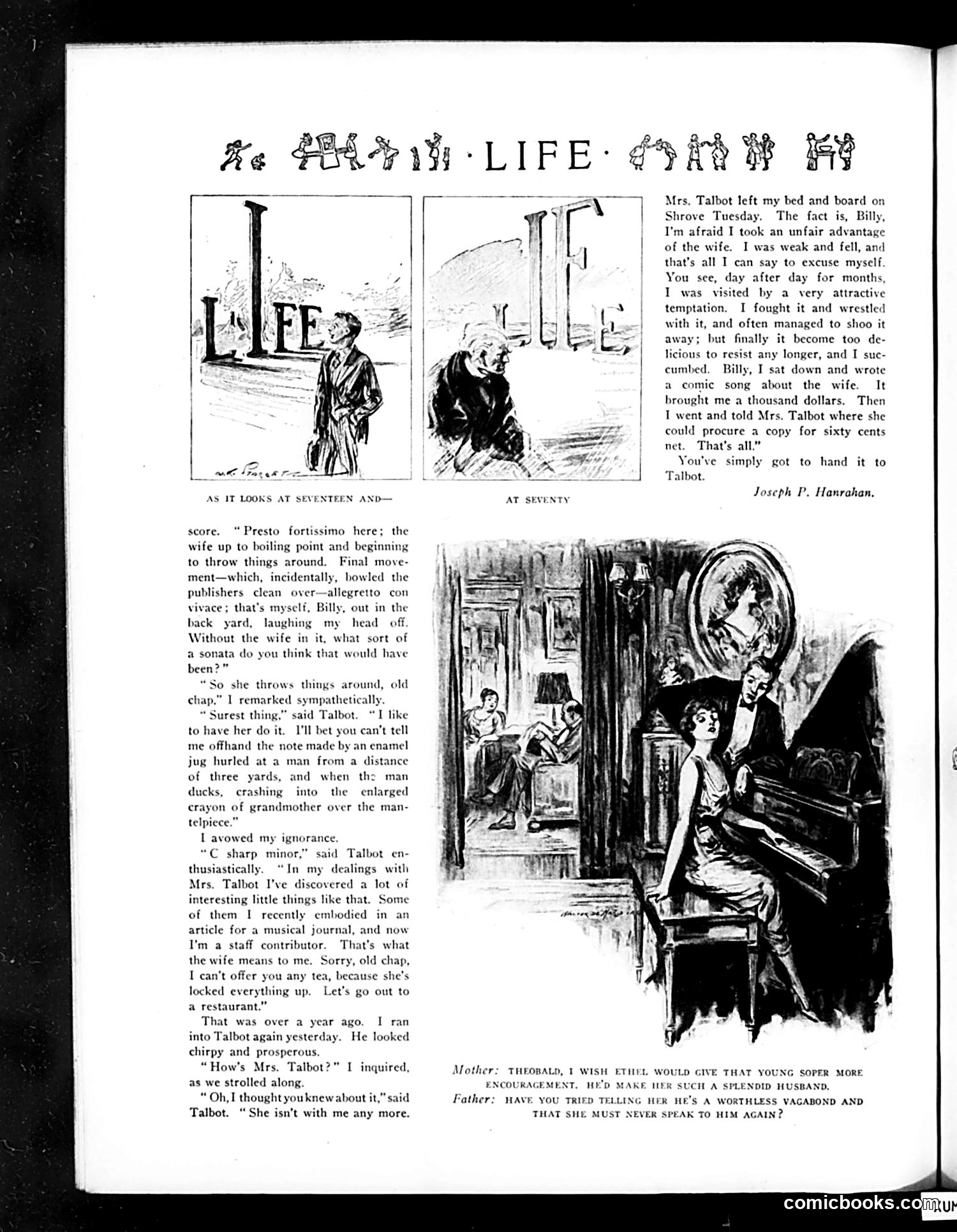
This page presents a comedic story about a husband who exploits his wife's anger for artistic profit. The narrative describes a man named Talbot who writes a comic song about his quarrelsome wife, earning $1,000 from publishers. Rather than hide this from her, he tells her exactly where to buy it for 60 cents—deliberately provoking her further. He romanticizes their conflict, even cataloging the "musical" sounds of household objects she throws at him, which he later publishes in musical journals as a "staff contributor." The satire targets early 20th-century commercialism and masculine opportunism: a man profits from marital discord while portraying himself as clever and his wife as a shrew. The bottom illustration shows parents encouraging their daughter toward an unsuitable suitor—reversing typical matchmaking logic through sardonic advice. The humor relies on readers recognizing the husband's shameless commodification of domestic strife and his self-congratulatory obliviousness to his own moral failings.
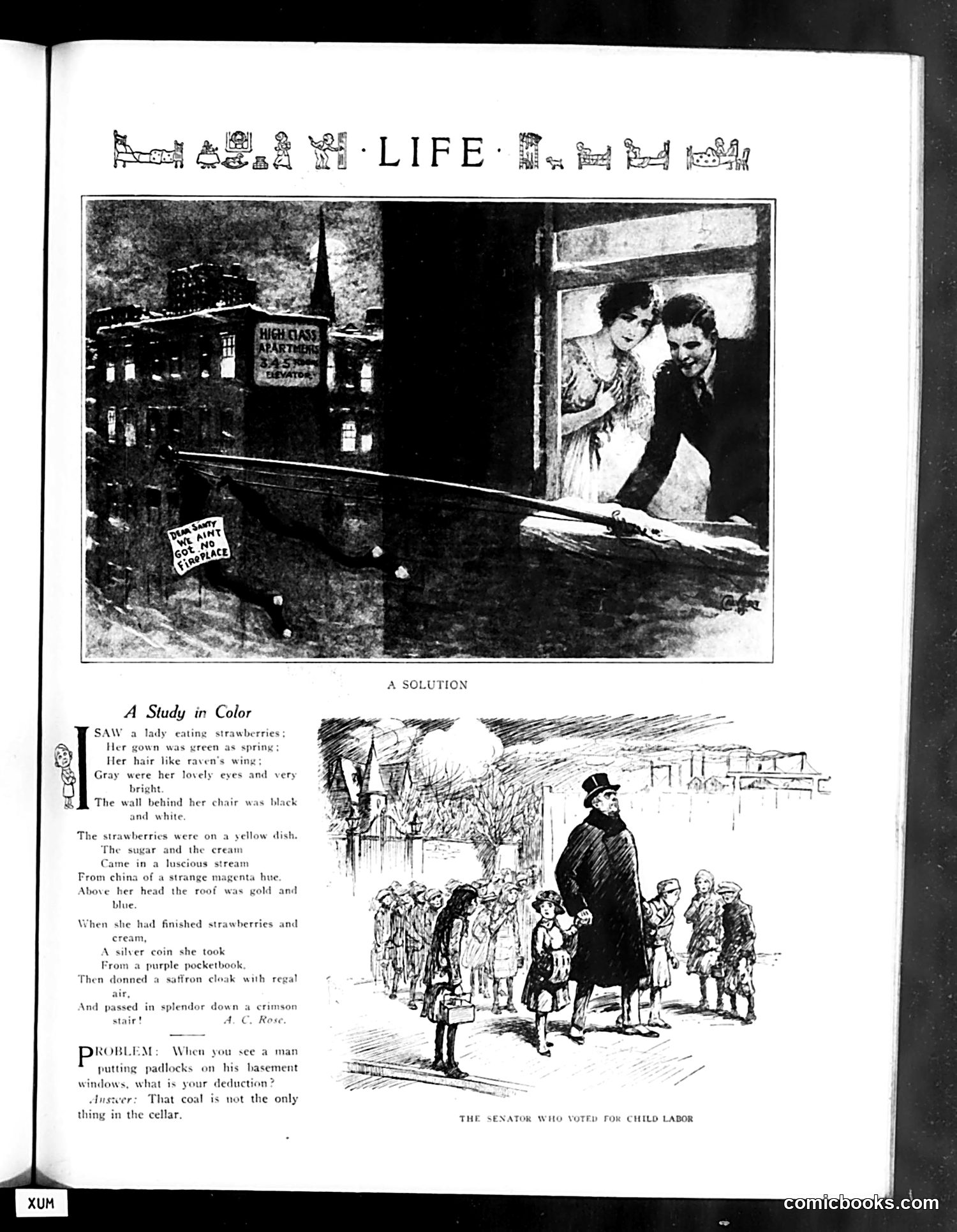
This Life magazine page contains two distinct pieces of satire: **"A Study in Color"** (top and middle): A whimsical poem about a lady eating strawberries, emphasizing vivid colors throughout the scene. This appears to be light, aesthetic humor—poking fun at overly flowery, color-obsessed descriptive writing popular in the era. **"The Senator Who Voted for Child Labor"** (bottom illustration): The sketch shows a well-dressed man in a top hat standing among working children in what appears to be an industrial or urban setting. This is pointed social commentary criticizing politicians who opposed child labor laws. The caption's irony is clear: the senator's fine clothing and demeanor contrast sharply with the children's poverty, suggesting hypocrisy or moral blindness. **"Problem/Answer" joke** (middle-left): A quick gag about a man putting padlocks on basement windows—implying he's hiding something illegal or improper inside, not just coal storage. The page satirizes both aesthetic pretension and political corruption regarding worker protections.
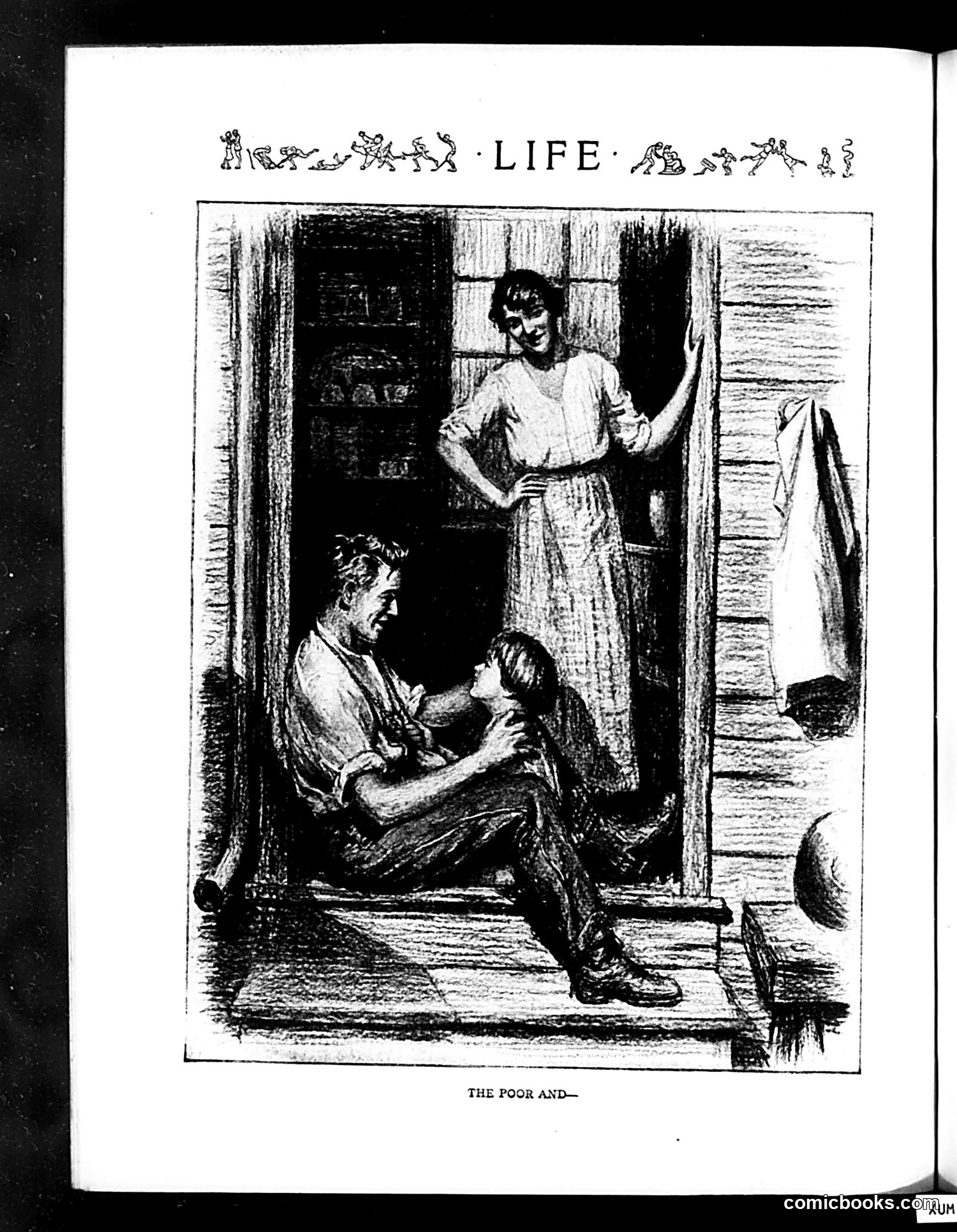
This illustration from *Life* magazine depicts a domestic scene titled "The Poor and—" (the title appears incomplete). The sketch shows a family in modest circumstances: a man sitting on the floor with a child, a woman standing in a doorway, and another figure visible on the right. The setting appears to be a simple, sparsely furnished home. The satire likely comments on **poverty and social conditions**, though the incomplete title makes the exact target unclear. Given *Life*'s tradition of social commentary, this could critique either the plight of poor families or perhaps attitudes toward poverty. The composition emphasizes the cramped, humble domestic space and apparent economic hardship of the subjects depicted. Without the complete title or additional context, the specific satirical point remains uncertain—whether it aims sympathy for the poor or criticism of their circumstances.
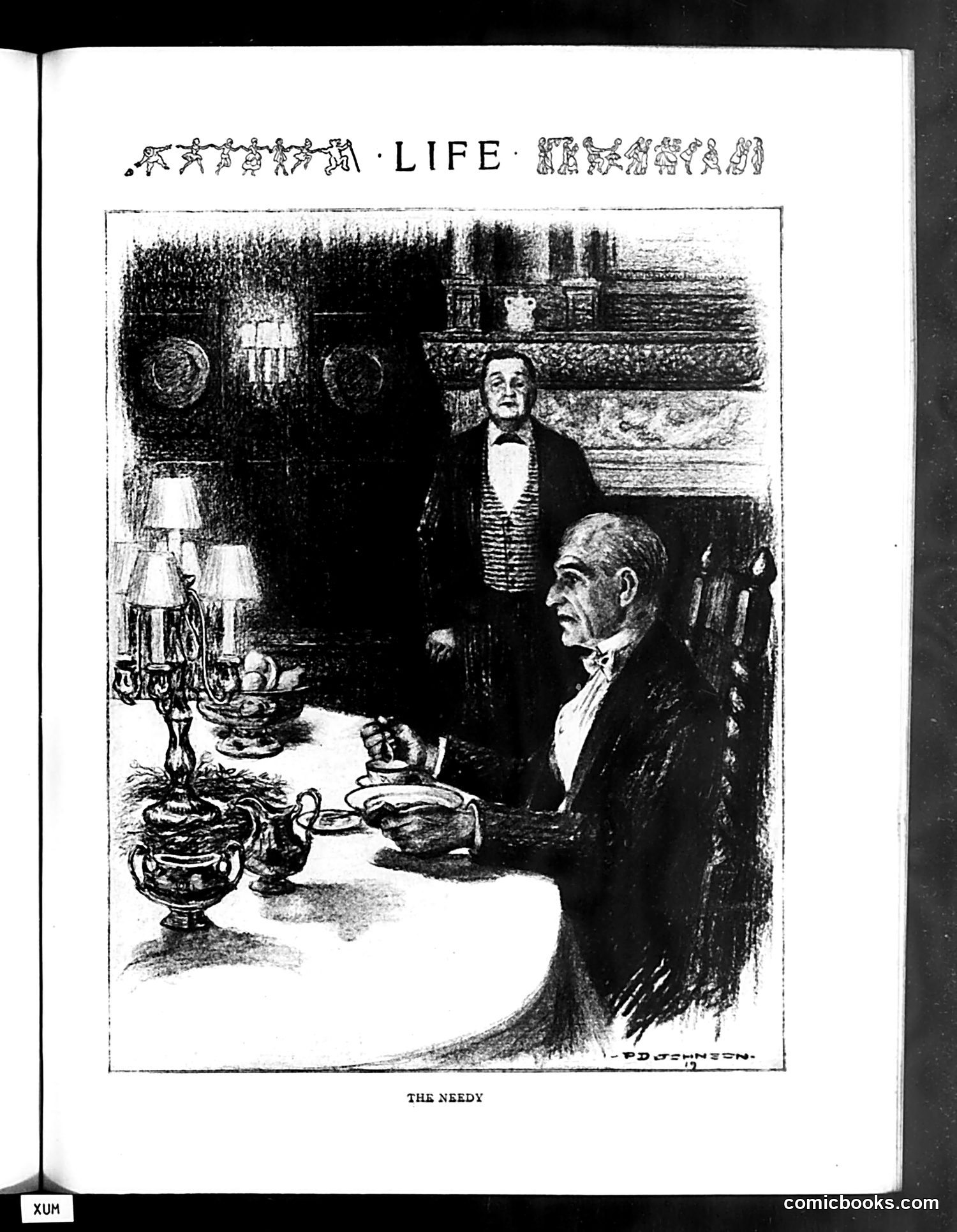
This cartoon depicts a wealthy gentleman seated at an elegant dinner table, attended by a servant standing behind him. The setting features fine furnishings, decorative lamps, and ornate dishware—clear markers of wealth and privilege. The caption "THE NEEDY" is ironic: the title refers to the seated man, who despite his obvious affluence and comfortable circumstances, appears to be the subject of commentary about neediness. This likely satirizes wealthy individuals who, despite their abundance, continually seek more—whether through charity solicitations, business ventures, or social climbing. The cartoon critiques the paradox of the rich presenting themselves as "needy" or deserving of further assistance or attention, mocking their insatiable desires or their manipulation of charity systems.
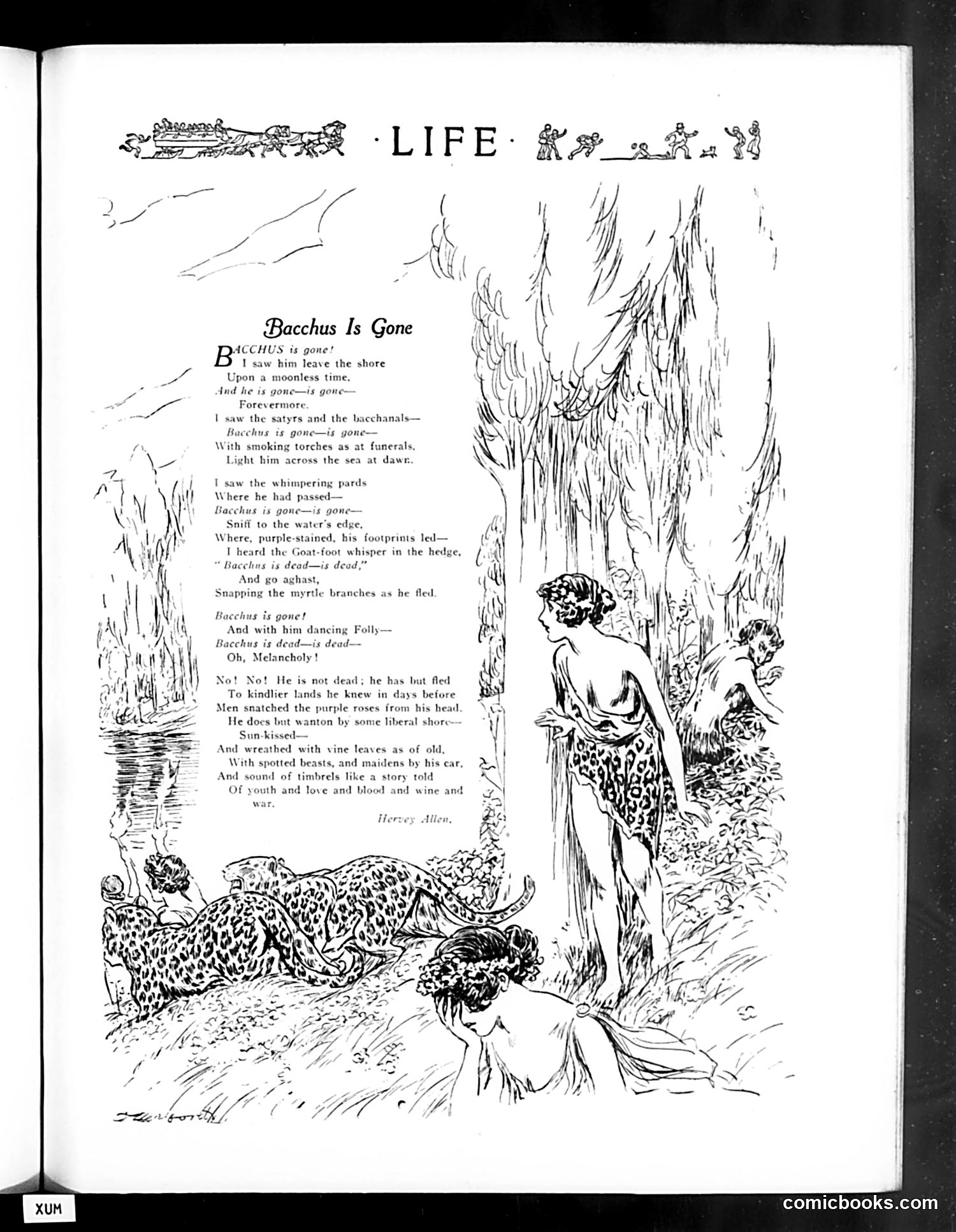
This is a literary/artistic piece rather than political satire. The poem by Hervey Allen (credited at bottom) uses the classical god Bacchus—deity of wine, revelry, and excess—as an allegorical figure for a vanishing way of life. The text mourns Bacchus's departure ("he is gone—is gone—Forevermore"), depicting his exit through classical imagery: satyrs, leopards, torch-lit processions. The accompanying illustration shows wood nymphs and mythological creatures in a forest shrine. The poem's resolution suggests Bacchus hasn't died but merely fled to "kindlier lands" and "liberal shores" untouched by modern civilization—where men haven't "snatched the purple roses from his head." **For modern readers:** This reflects early 20th-century nostalgia for classical pagan culture and natural freedom, mourning what the author sees as lost to industrial/modern restraint. It's romantic lament rather than topical commentary.
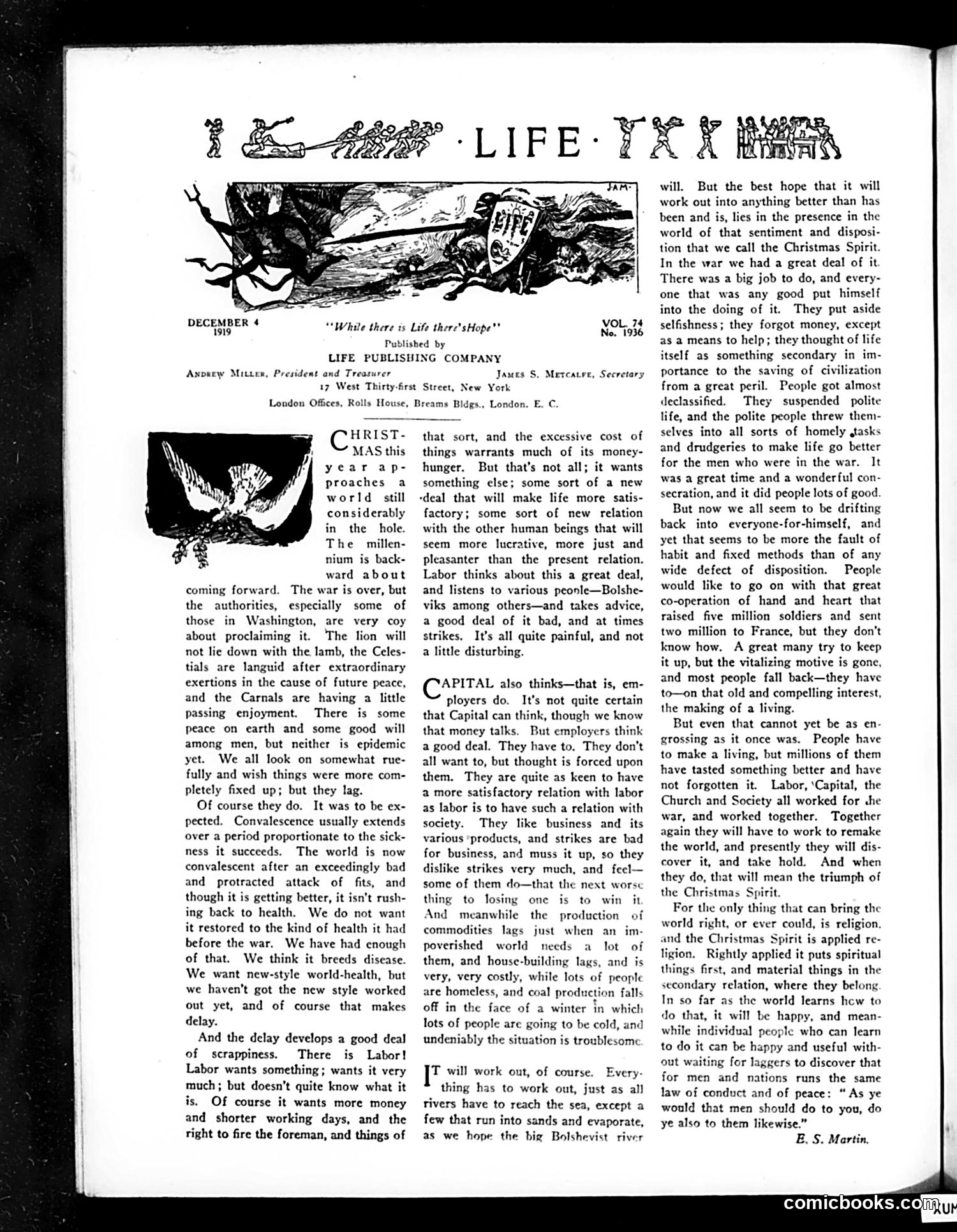
This editorial cartoon addresses post-WWI disillusionment. The small illustration at top left appears to depict figures in conflict or distress, setting a grim tone. The text laments that despite the war's end, authorities won't formally declare peace, and the world remains in poor condition—economically and socially. The author criticizes both **Labor** (demanding better wages, working conditions, and radical restructuring) and **Capital** (employers resisting change) for their mutual antagonism, noting strikes harm production when the impoverished world desperately needs goods, housing, and coal. The piece argues the post-war "convalescence" is slow because society lacks a new working model. Its solution? The "Christmas Spirit"—appealing to shared wartime sacrifice and cooperation to bridge labor-capital divisions and rebuild civilization. This reflects actual 1918-1920 turmoil: widespread strikes, socialist agitation (the "Bolshevist" threat), and anxiety about reconstructing society after catastrophic war.
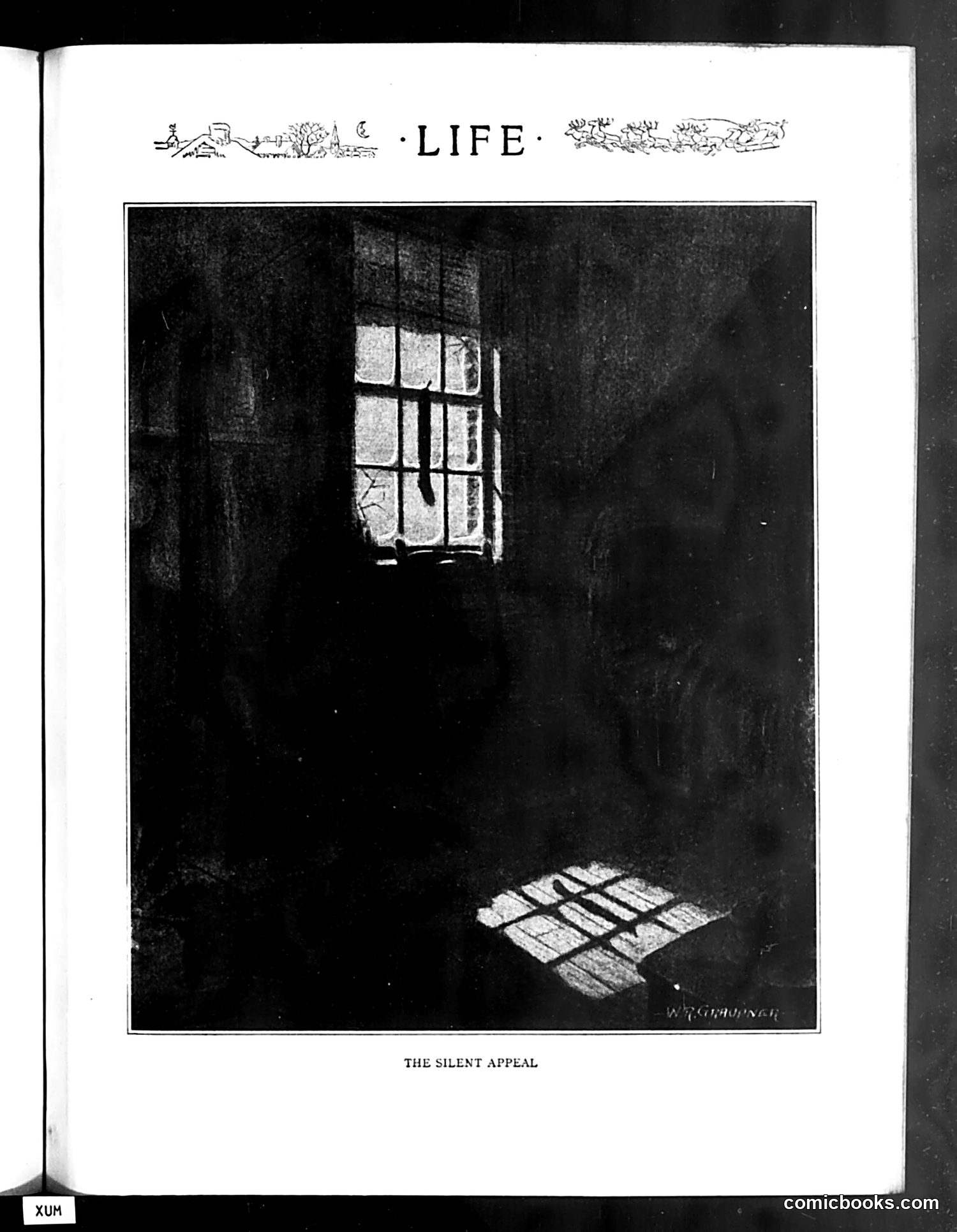
This image depicts a stark prison cell with a single barred window as the only light source. Light streams through the window onto the floor below, creating a visual metaphor of hope or longing for freedom. The composition emphasizes confinement and isolation—the vast darkness of the cell contrasts sharply with the small rectangle of outside light. Without additional context from the magazine issue, the specific subject isn't entirely clear, but the title "The Silent Appeal" suggests this critiques either unjust imprisonment, capital punishment, or prison conditions. The "silent appeal" likely references either an inmate's mute plea for justice or clemency, or broader social commentary on overlooked prisoners' rights—common themes in early 20th-century American political satire.

This appears to be a winter woodland scene featuring two deer in snow, with evergreen trees and bare branches visible. The partial caption at bottom reads "Is This Santa Cl[aus]..." suggesting a Christmas-themed joke or caption. Without the complete caption text, the specific satire or political reference is unclear. The image could be: - A humorous play on reindeer and Santa's sleigh team - Commentary on Christmas commercialism or holiday themes - A visual gag about mistaking deer for Santa's animals The deer appear to be regular wildlife rather than caricatures of identifiable figures. The mountainous winter landscape is rendered realistically in this black-and-white illustration style typical of Life magazine's visual content from that era. The incomplete OCR text prevents definitive interpretation of the intended joke or satirical point.
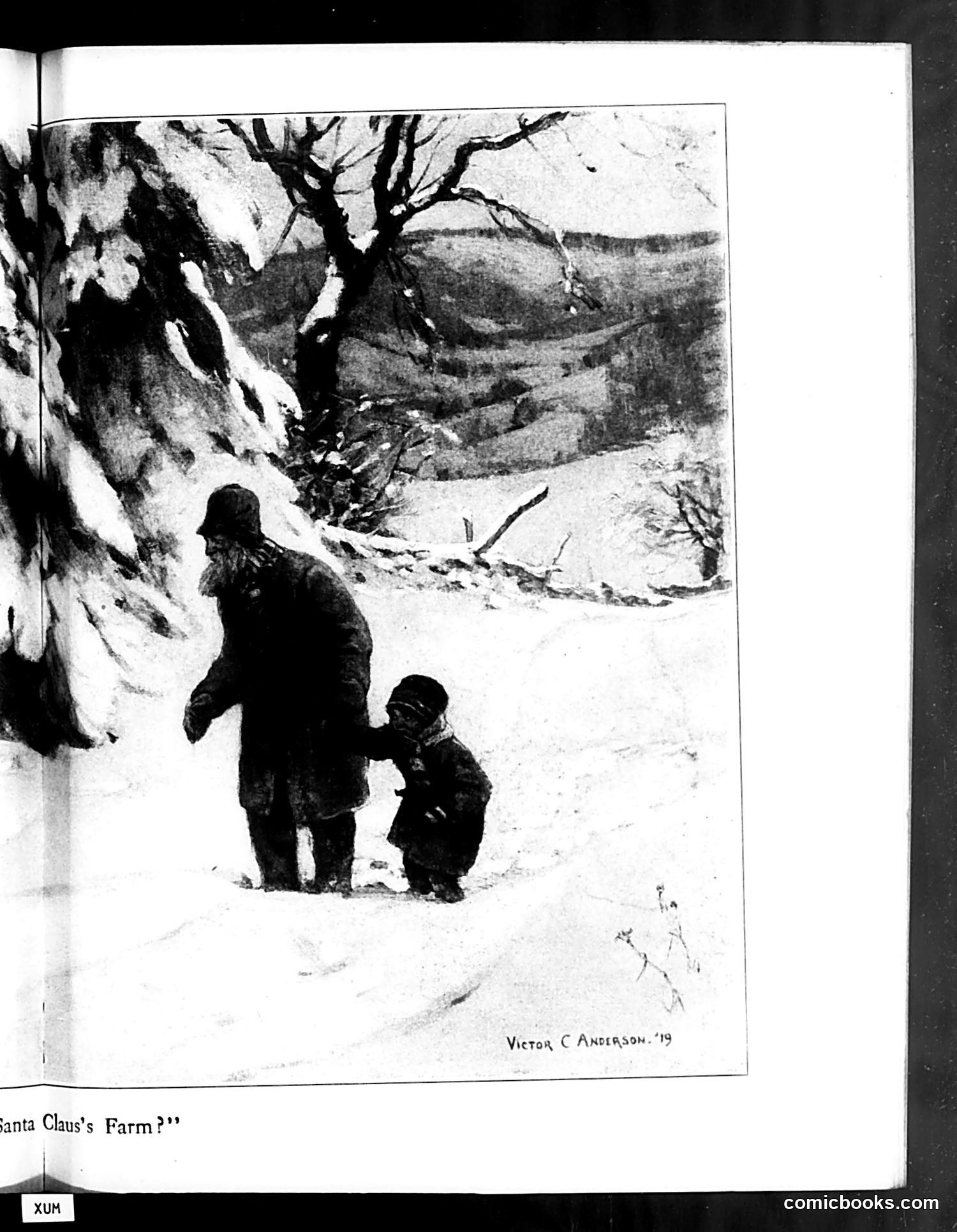
This appears to be an illustration by Victor C. Anderson from 1919 titled "Santa Claus's Farm?" The image shows an adult and child in a snowy winter landscape, standing beneath a gnarled tree with bare branches. In the background are snow-covered hills. The caption's three question marks suggest skepticism or irony about the scene being presented as "Santa Claus's Farm." Without additional context from Life magazine's surrounding text, the precise satirical point remains unclear. However, the questioning tone and juxtaposition of holiday mythology (Santa's farm) with a bleak, barren winter landscape suggests the cartoon may be critiquing false promises, commercialism, or idealized depictions of holiday tradition versus harsh reality—a common satirical theme in early 20th-century publications.
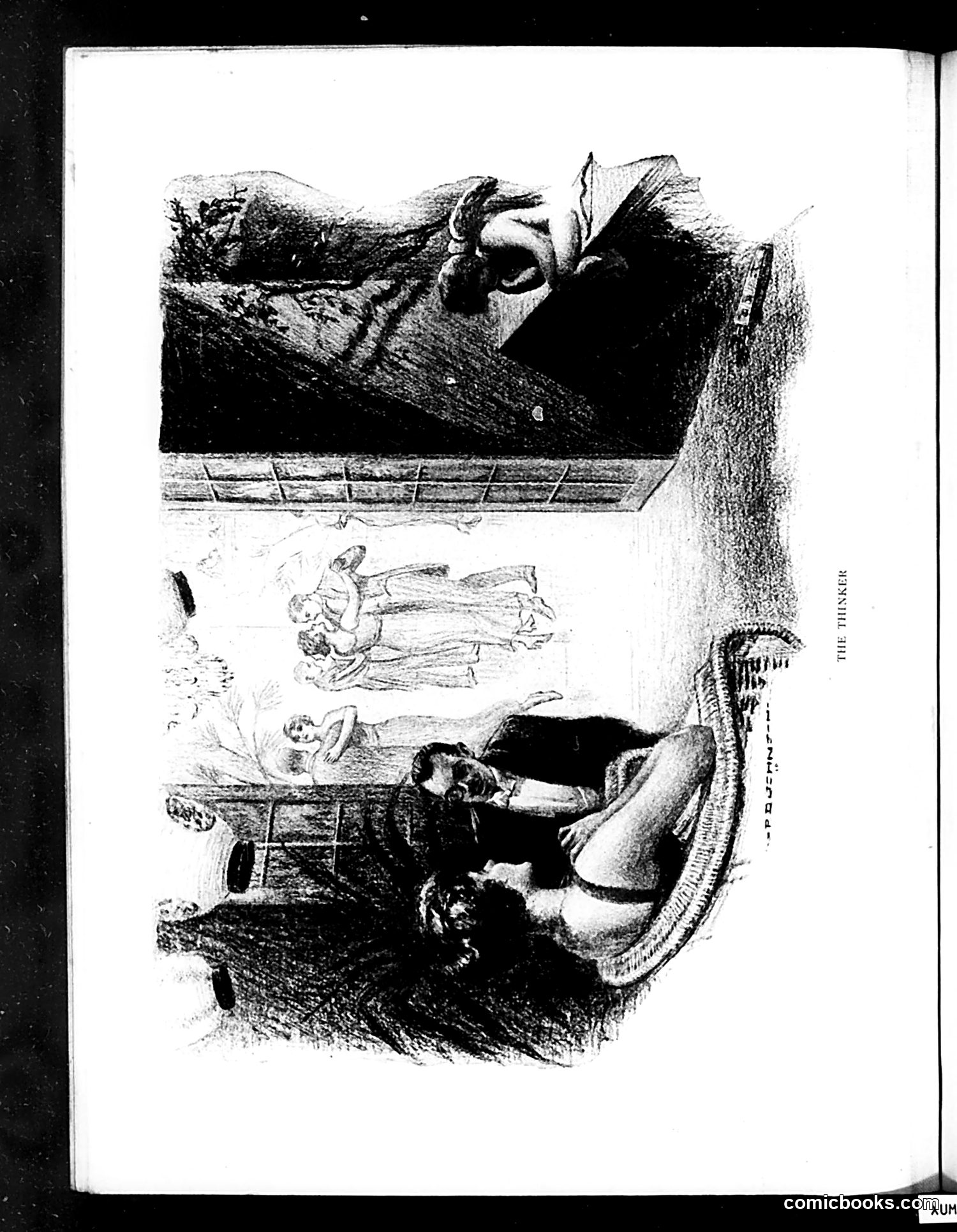
This political cartoon depicts a scene titled "The Tinker" (visible on the right margin). The image shows what appears to be a working-class tradesman or "tinker" (a traveling repair worker) at work, with figures observing from above, possibly in a window or elevated position. The satire likely comments on **class distinctions** or the contrast between working laborers and observers of higher social status. The composition—with the tinker below and well-dressed figures above—emphasizes this social hierarchy. Without additional context about the publication date or specific political events referenced, the precise target of satire remains unclear. However, the cartoon appears to mock either labor conditions, class pretension, or social attitudes toward working-class trades during the era when *Life* magazine published satirical content.
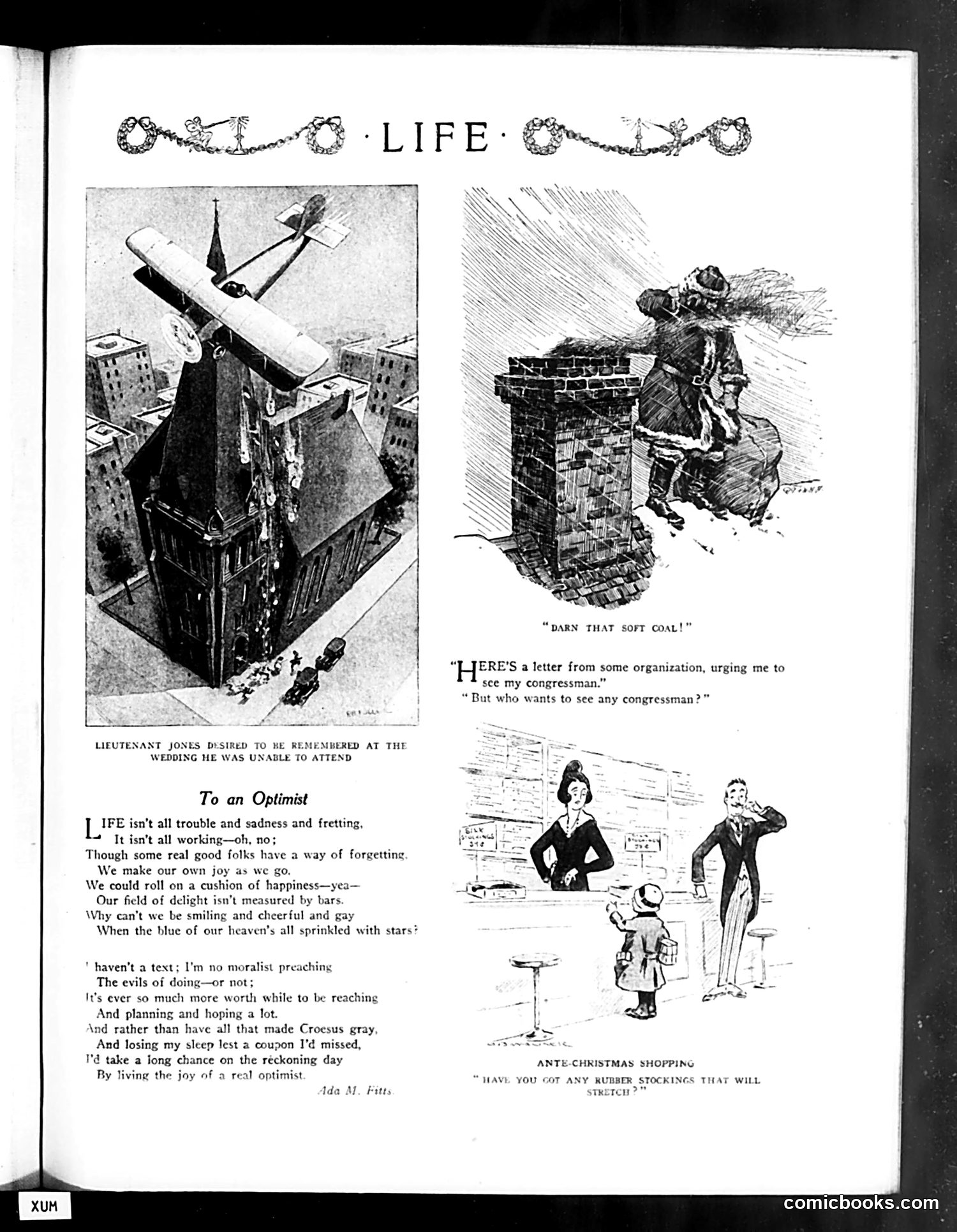
This page contains three separate satirical pieces: **"Darn That Soft Coal"** (top right): A cynical joke about civic engagement. Someone receives a letter urging them to meet their congressman, but dismisses the idea—suggesting congressmen are either ineffective or unworthy of citizens' time. This reflects early 20th-century skepticism about political representation. **"Lieutenant Jones" (left): A humorous illustration showing a military officer's head exploding from a cannon atop a building, captioned as a wedding gift. This appears to be dark wartime humor, likely from WWI era, making light of military service and absence. **"To an Optimist" (center): A poem by Ida M. Fitts celebrating optimism and joy despite life's hardships, encouraging happiness over worry about money or coupon-clipping. **"Ante-Christmas Shopping" (bottom right): A domestic cartoon showing holiday shopping, with someone humorously asking for "rubber stockings that will stretch"—likely a practical joke about holiday gift-giving.
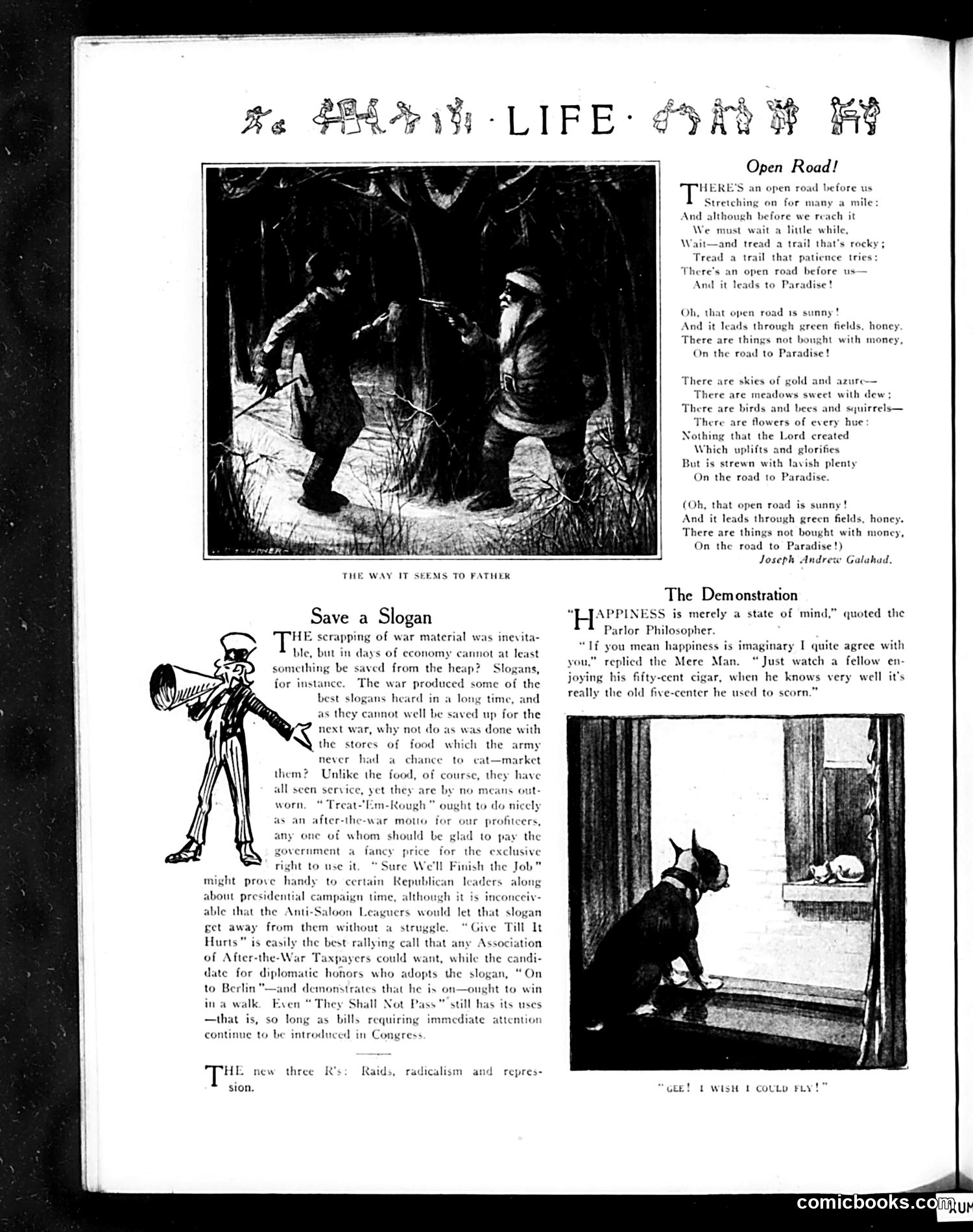
This *Life* magazine page contains post-WWI satirical commentary: **"Open Road!"** is an optimistic poem about spiritual/moral progress after wartime hardship—the "road to Paradise" represents a better future beyond material concerns. **"Save a Slogan"** satirizes war profiteering and political opportunism. The piece suggests recycling popular wartime slogans ("Treat-'Em-Rough," "Sure We'll Finish the Job," "Give Till It Hurts") as marketing tools or political messaging for the post-war era. It mocks how politicians and special interests (like Anti-Saloon Leaguers) would exploit these catchphrases for their own gain. **"The Demonstration"** is a brief philosophical joke: a "Parlor Philosopher" claims happiness is imaginary, but a practical man counters that it's real—he just observed someone enjoying a cheap cigar because they *believed* it was expensive. The illustration shows a wistful dog watching through a window, reinforcing the joke about perception versus reality. The overall page reflects post-war cynicism about both idealism and commercial exploitation.
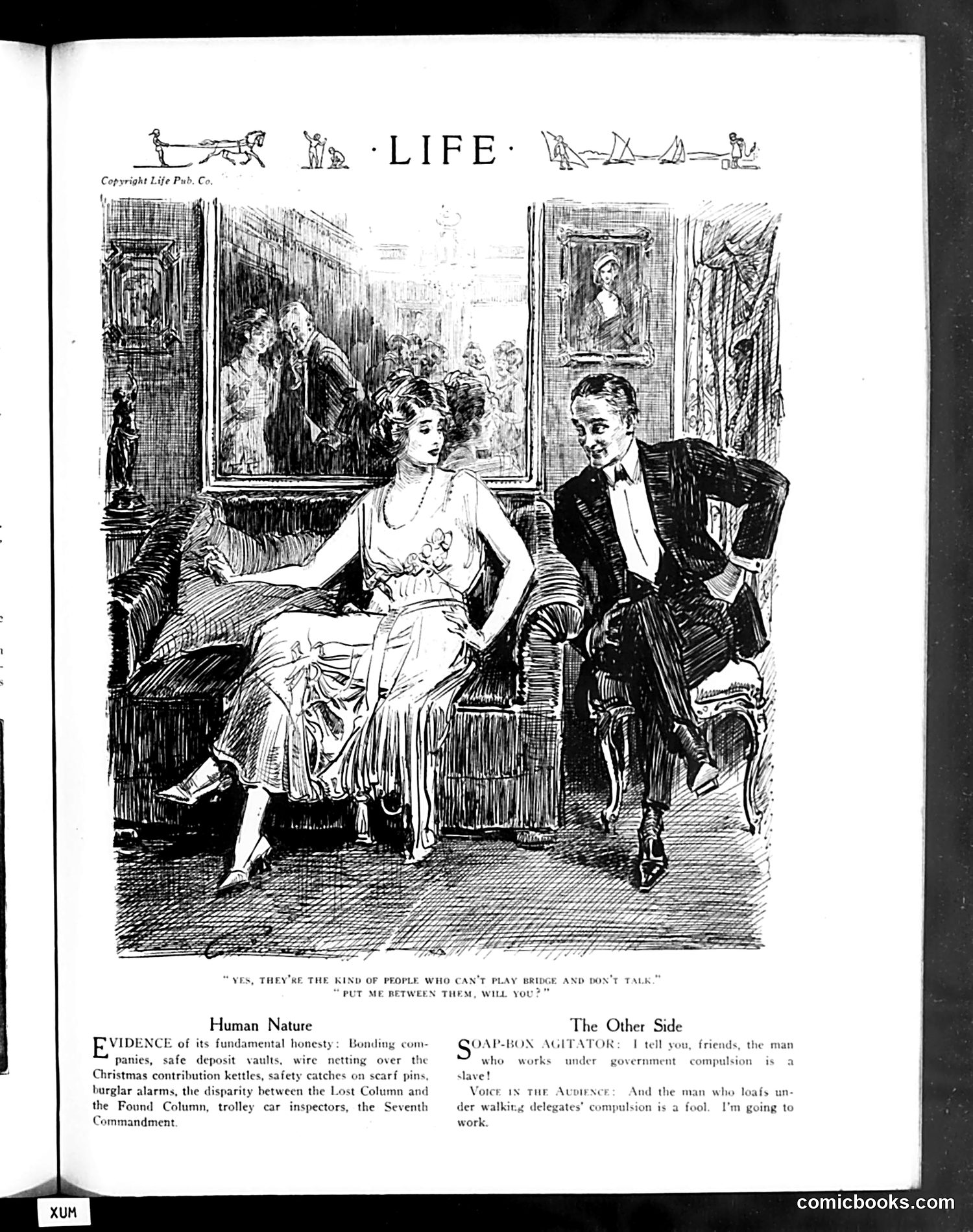
This page contains two contrasting social commentaries. The main illustration depicts an elegant couple at what appears to be a formal social gathering, with the caption joking about inviting taciturn people to fill conversational gaps at social events—a light satire on upper-class dinner party etiquette. Below are two paired columns: **"Human Nature"** sarcastically catalogs evidence of human dishonesty: the need for security measures (bonded companies, wire-netted charity kettles, burglar alarms, safety catches) and the gap between "Lost" and "Found" columns in newspapers—implying people rarely return found items. It mocks the gap between Christian ideals (the Seventh Commandment against stealing) and actual behavior. **"The Other Side"** presents political commentary: a soap-box agitator criticizes government work as slavery, while a heckler counters that lazy people under union "walking delegates'" pressure are equally foolish. This satirizes labor movement rhetoric and debates about worker autonomy versus compulsion. Together, the page contrasts polite social hypocrisy with working-class political disagreement.
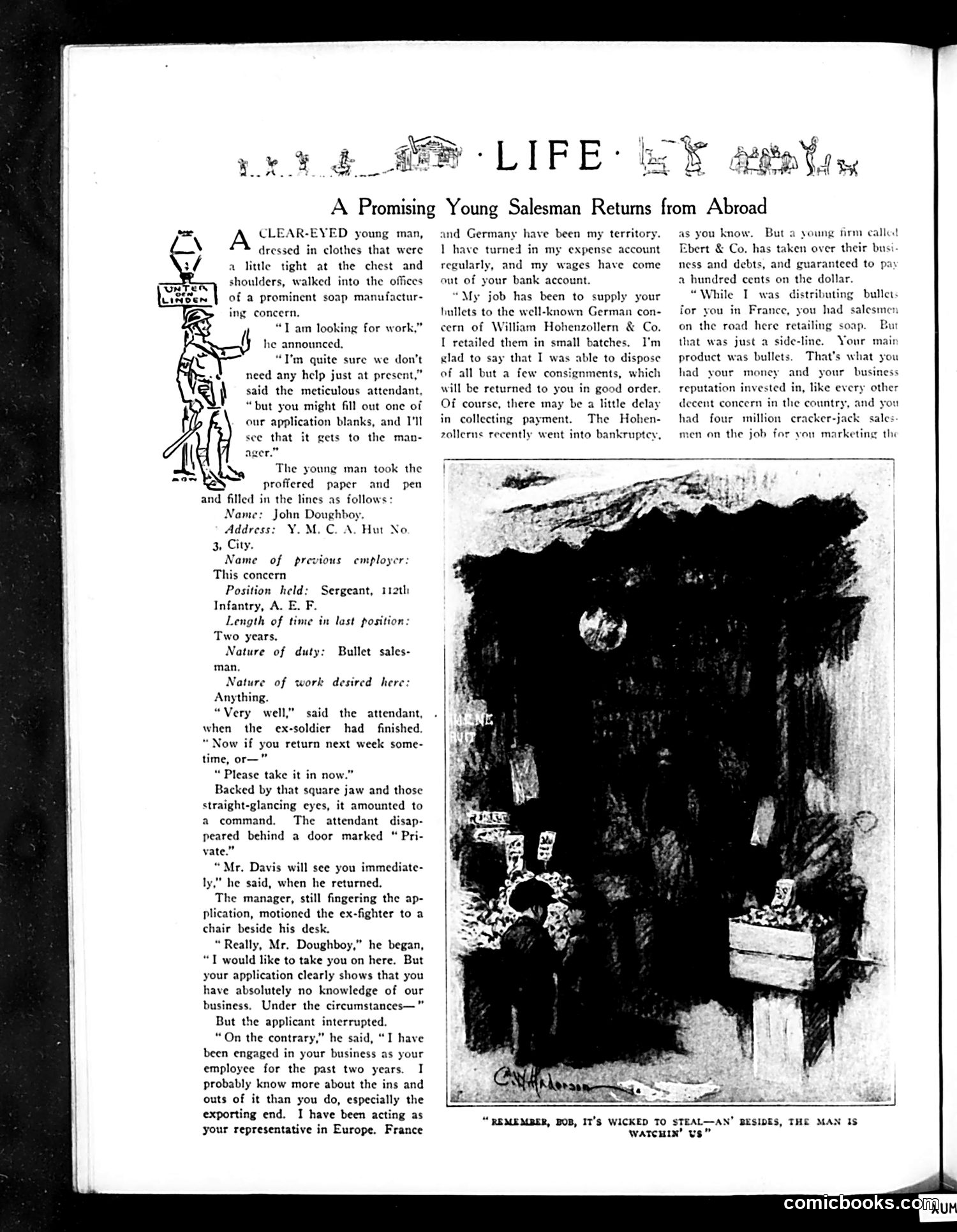
This satirical piece critiques American businessmen who profited from WWI while soldiers fought. **The Setup:** An ex-soldier named "John Doughboy" (representing the typical American soldier) applies for work at a soap manufacturer. His application lists his previous employer as "William Hohenzollern & Co." — a thinly veiled reference to the German Kaiser. **The Satire:** The joke is that Doughboy's actual wartime job was selling bullets to Germany (the enemy). He frames it as legitimate business: he was the company's "representative in Europe," supplied bullets to Germans in "small batches," and now German creditors (represented by the fictional "Ebert & Co.") owe payment. **The Point:** The cartoon mocks American industrialists who sold supplies to Germany before and during U.S. involvement in WWI, profiting from the war while soldiers risked their lives. It suggests corporate greed superseded patriotism—businesses treated warfare as just another market. The ex-soldier's confident tone exposes the hypocrisy: if selling bullets to the enemy was acceptable business practice, why reject hiring him now?
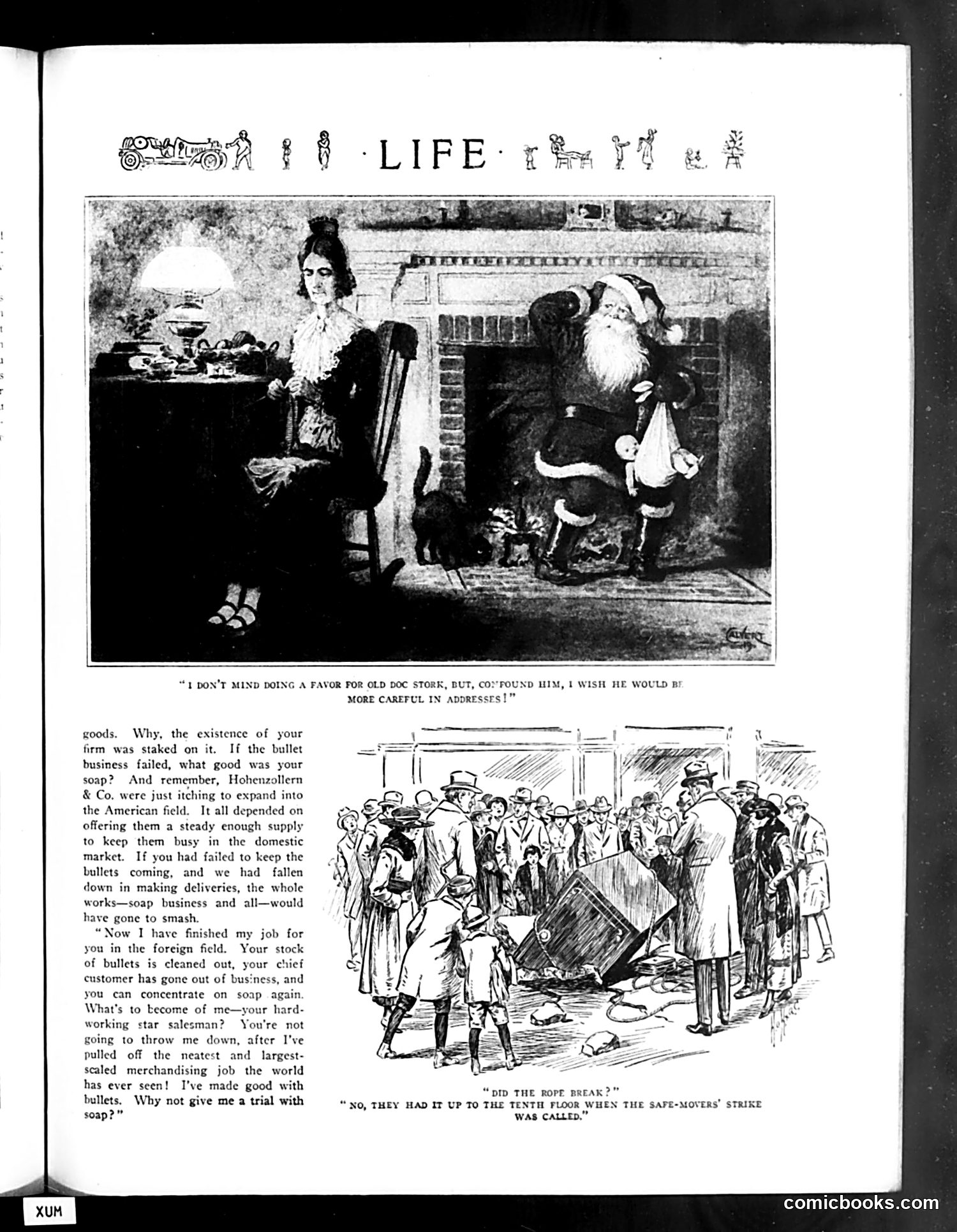
This page satirizes American munitions manufacturers during World War I. The top cartoon shows Santa Claus (representing the munitions industry) delivering bullets to a woman, with the caption joking about being "careful in addresses"—likely referencing accidental harm from the weapons trade. The longer narrative (bottom) depicts a salesman who profited by supplying bullets to Germany during the war. Now that his wartime customer (Germany/"Hohenzollern & Co.") has been defeated, he seeks to pivot back to soap manufacturing. The satire criticizes industrialists who: 1. Profited enormously from wartime munitions sales 2. Supplied enemy nations 3. Now expect smooth business transitions without consequences The lower cartoon about the "safe-movers' strike" appears unrelated—a separate labor-dispute joke. The piece mocks American capitalism's moral flexibility: companies willing to arm enemies for profit, then resume peacetime business as if nothing happened.
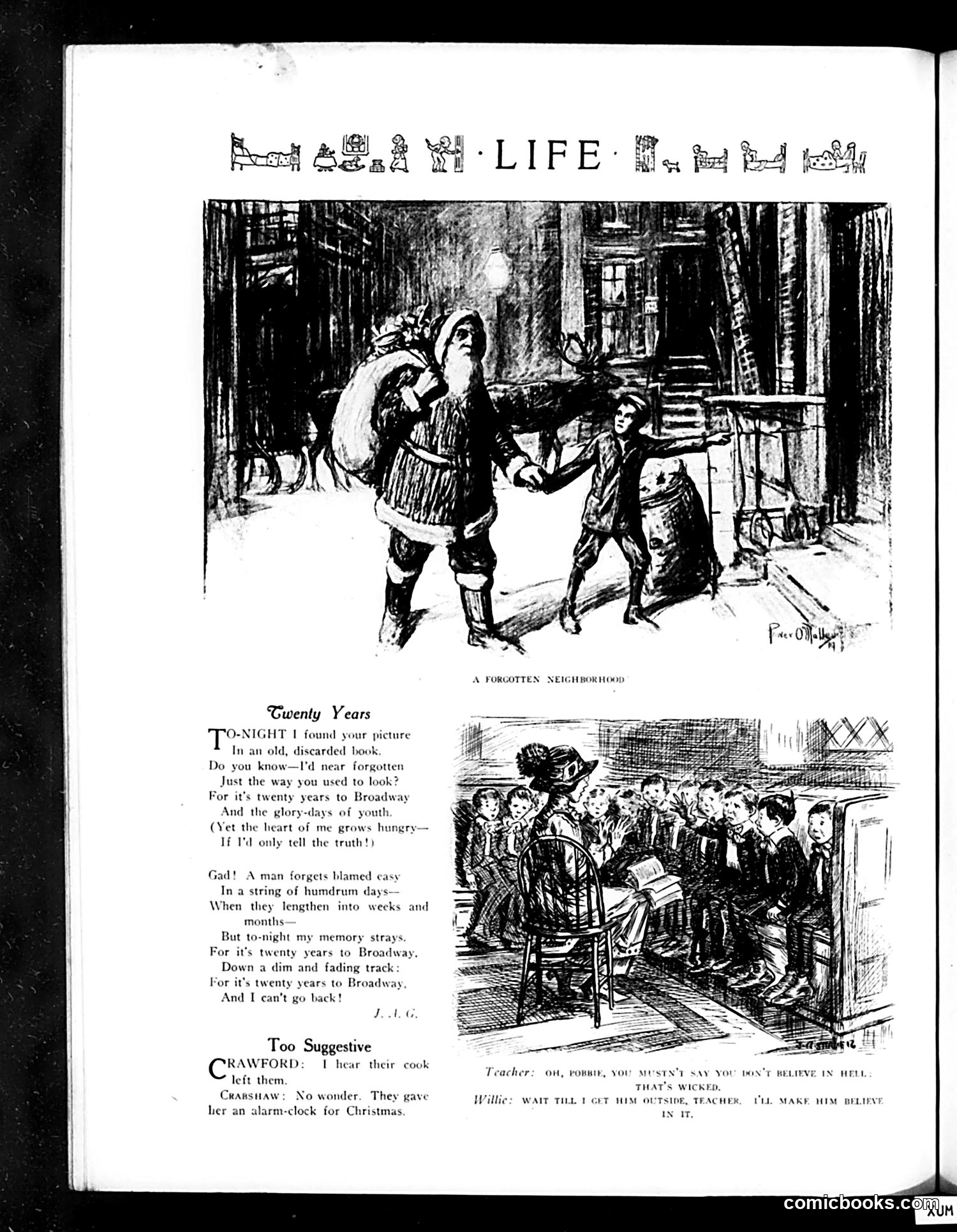
This page contains nostalgic and satirical humor typical of early 20th-century American magazines. **"Twenty Years"** is a sentimental poem about a man rediscovering an old photograph, reflecting on his youthful days on Broadway before settling into mundane adult life. The accompanying sketch depicts Santa Claus in an urban neighborhood, evoking that lost past. **"Too Suggestive"** is a brief joke: Crawford remarks that their cook left them, and Crabshaw responds that no wonder—they gave her an alarm-clock for Christmas. The humor relies on the double meaning: an alarm-clock as a practical gift is insulting/dismissive, implying the employer wanted her to leave promptly. **The classroom sketch** shows children discussing hell. Willie threatens to beat a classmate outside to make him "believe in it"—dark humor about childhood violence and religious instruction. These pieces reflect period attitudes toward class, propriety, and childhood, with satire aimed at social pretension and hypocrisy rather than specific political figures.
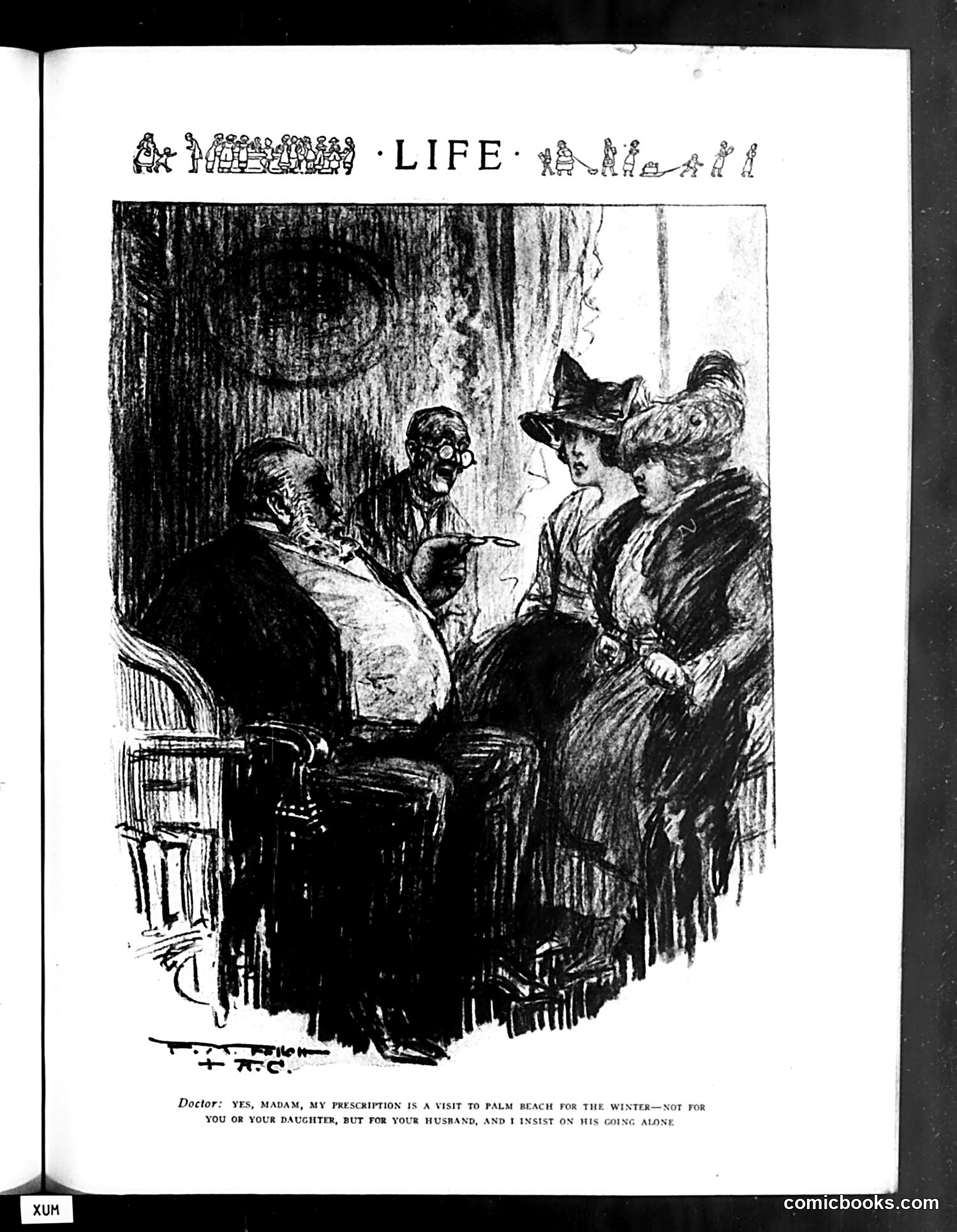
This is a satirical domestic scene showing a doctor prescribing a winter vacation to Palm Beach—but with a twist. He insists the husband go *alone*, explicitly excluding his wife and daughter. The joke targets upper-class marital dynamics of the early 20th century. The satire suggests that wives and daughters are so bothersome or demanding that a husband's health requires solitude away from them. The doctor's stern insistence underscores the implication: the family is the problem, not the solution. The cartoon mocks both the frivolous prescription-writing of doctors and the overbearing nature attributed to wealthy wives and daughters. It reflects period attitudes about gender and marriage, presenting male escape from female company as medically necessary—a sharp critique of domestic relations among the leisure class.
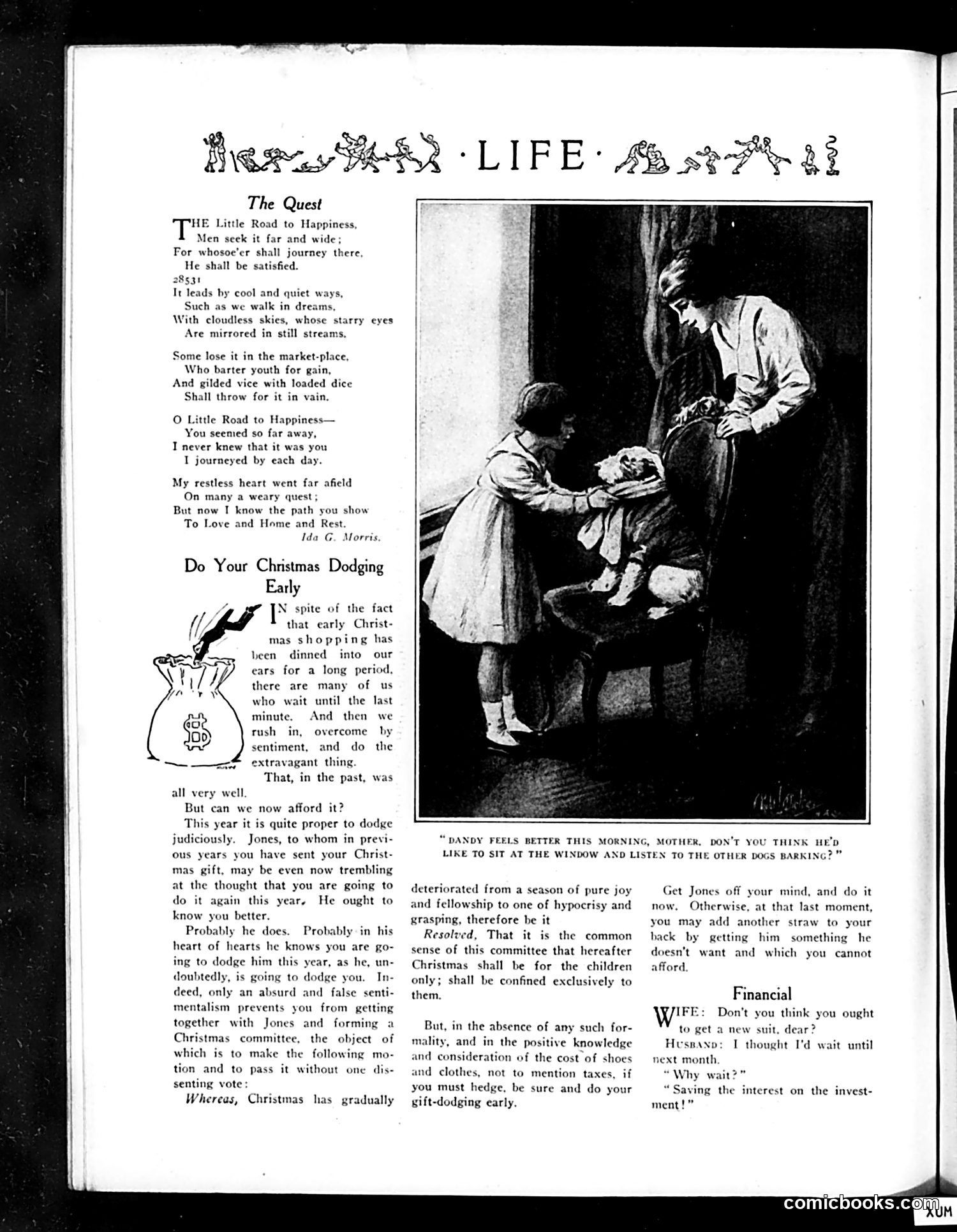
This page presents two satirical pieces reflecting post-WWI economic anxieties: **"The Quest"** is a sentimental poem about pursuing happiness through love and home rather than material gain—likely resonating with 1920s disillusionment with materialism. **"Do Your Christmas Dodging Early"** is the main satirical article. It addresses the economic pressure of gift-giving during financial hardship. The piece proposes that friends should form a "Christmas committee" to mutually *skip* exchanging gifts—eliminating the hypocrisy of obligatory presents people can't afford and don't want. The satirical "resolution" suggests Christmas should be "confined exclusively" to children. The accompanying illustration shows a father teaching his young son, reinforcing this sentiment about Christmas being for children only. **"Financial"** is a brief joke about a husband delaying a suit purchase to "save interest on the investment"—poking fun at overly-rationalized penny-pinching. Together, these pieces humorously acknowledge the economic strain on middle-class Americans, normalizing the idea that skipping adult gift-exchanges is practical and sensible.

This is a **Fisk Cord Tires advertisement**, not political satire or a cartoon. The page appears in Life magazine's "Christmas Life" section and promotes automobile tires through straightforward commercial messaging. The ad features a large photograph of a tire's tread pattern and sidewall. The accompanying text claims that Fisk Tires represent quality and reliability—the company has maintained a twenty-year reputation as "one of the best concerns in the world" for tire manufacturing. The small mascot image (showing what appears to be the Fisk brand character) reinforces brand identity. There is no political commentary or satirical content here—this is simply period advertising using testimonial-style marketing to build consumer trust and encourage purchasing.
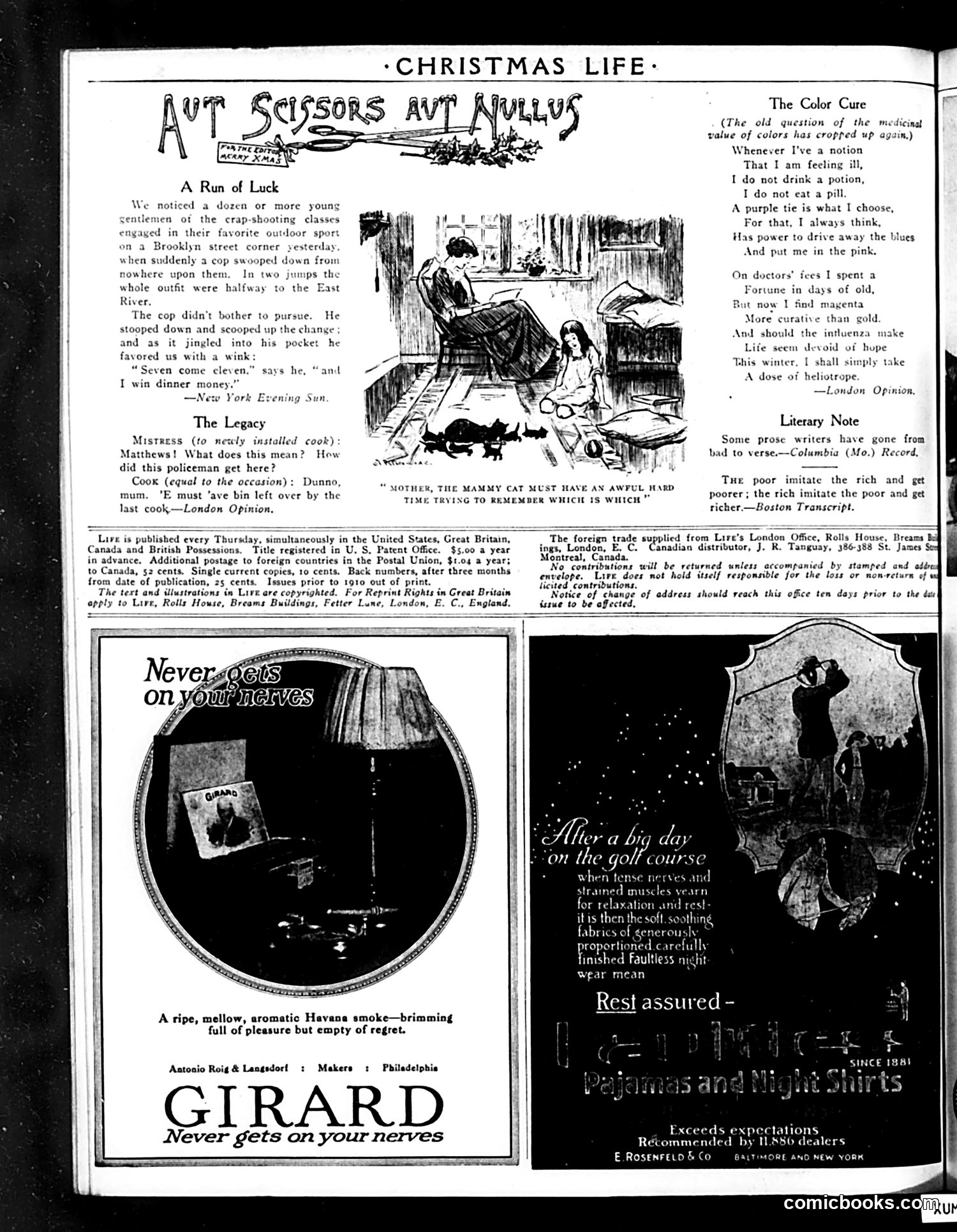
This page from *Life* magazine contains several distinct satirical pieces: **"A Run of Luck"** depicts a common urban complaint: police corruption. Young men are caught craps-shooting (illegal gambling), and rather than arrest them, the cop simply pockets their money and leaves with a wink—treating the confiscation as his personal winnings. The satire targets endemic police graft in early 20th-century American cities. **"The Legacy"** is a brief joke about servant turnover: a newly hired cook is scolded for a mess, then reveals the previous cook left it—implying incompetent household staff were simply abandoned between employers. **"The Color Cure"** humorously mocks pseudo-scientific color-therapy fads by claiming purple ties and magenta cure depression and influenza better than medicine—satirizing popular medical quackery of the era. The page is primarily **advertising** (Girard cigars, pajamas), with light satirical commentary on police corruption, servants, and medical fads typical of the period.
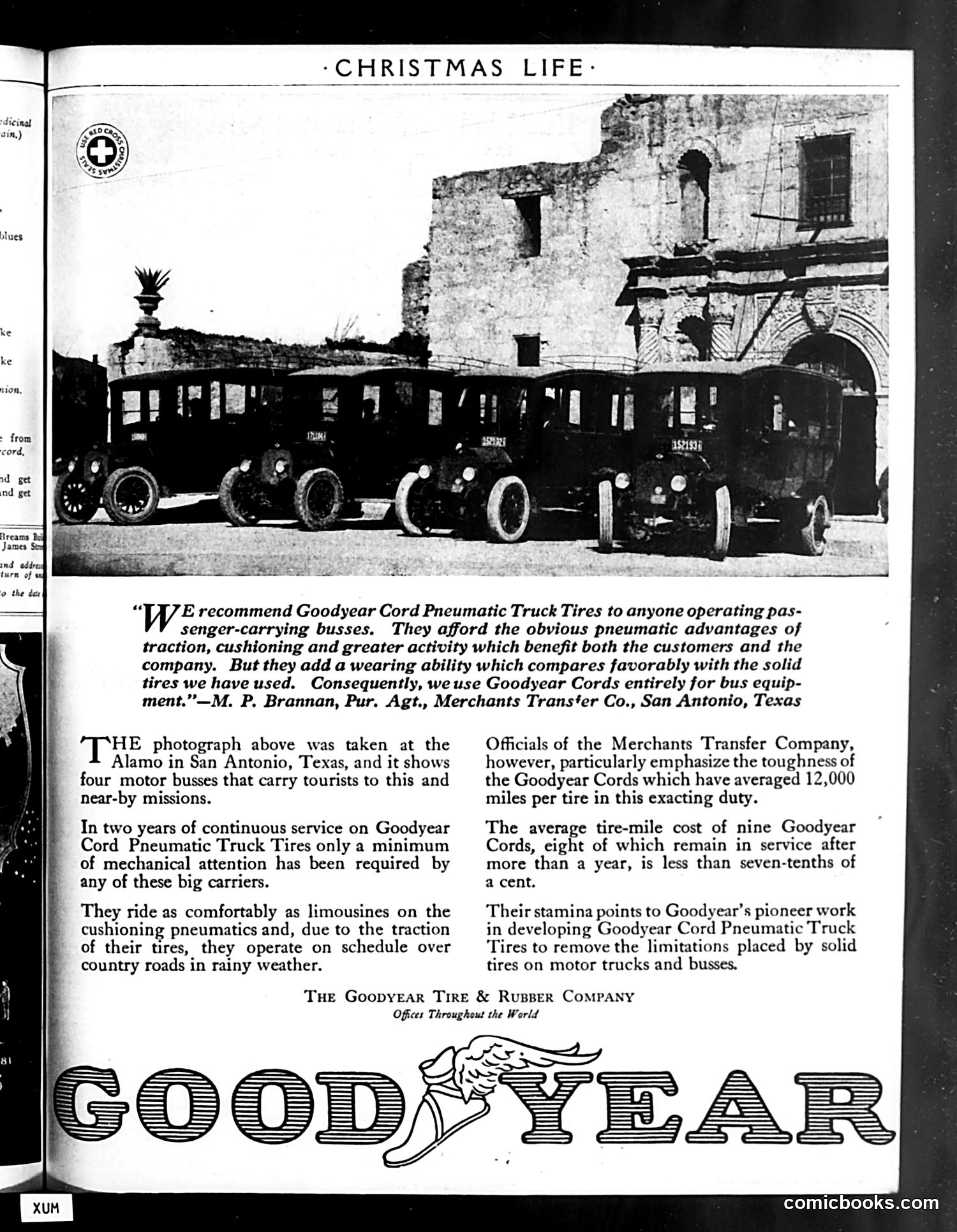
This page from *Life* magazine is a straightforward **advertisement for Goodyear tires**, not political commentary or satire. The image shows tourist buses at the Alamo in San Antonio, Texas, equipped with Goodyear Cord Pneumatic Truck Tires. The "content" consists of a testimonial from M. P. Brannan of the Merchants Transfer Company praising the tires' durability (averaging 12,000 miles), comfort, traction in wet weather, and low cost-per-mile (less than 0.7 cents). The ad emphasizes that pneumatic tires outperform solid tires for commercial passenger vehicles. This is typical early-20th-century corporate advertising in a general-interest magazine, highlighting the practical superiority of a product through real-world examples and user endorsements. There is no cartoon, caricature, or satirical commentary present.
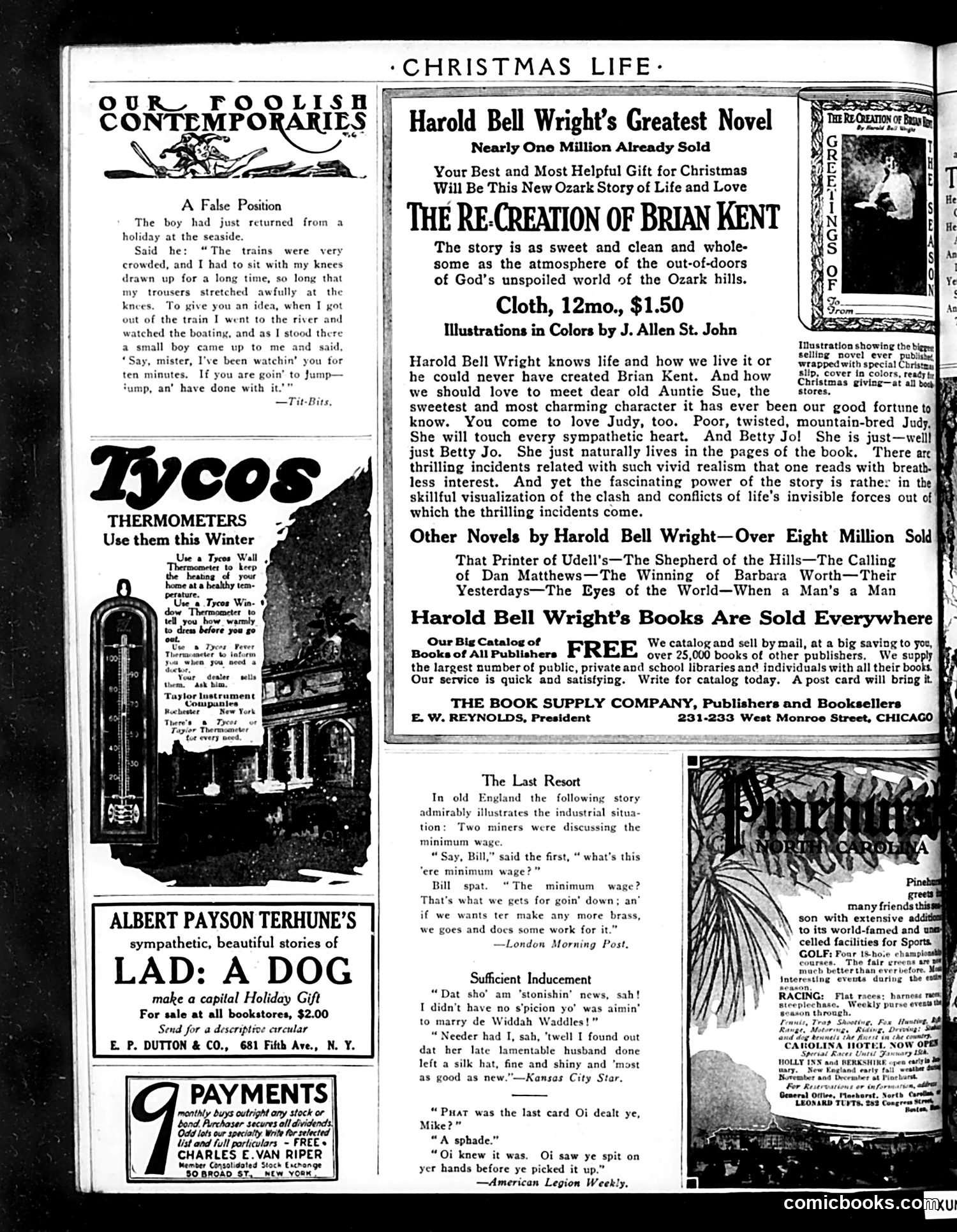
This page is primarily **advertising and light humor**, not political satire. The main content includes: **"A False Position"** (top left): A gentle joke about a self-conscious boy who sat with bent knees on a crowded train. When observed by a river afterward, a younger boy mistakes his awkward posture for suicidal intent, offering him space to jump. It's a simple misunderstanding joke, typical of early 20th-century family humor magazines. **Other content**: The page is dominated by Christmas book advertisements (Harold Bell Wright's novels, Albert Payson Terhune's *Lad: A Dog*) and financial/thermometer ads. Two brief anecdotes below discuss minimum wage and marriage, both employing working-class and dialect humor common to the era but not advancing any particular political argument. The page reflects *Life* magazine's shift toward commercial content rather than the sharper political commentary the publication was known for earlier.
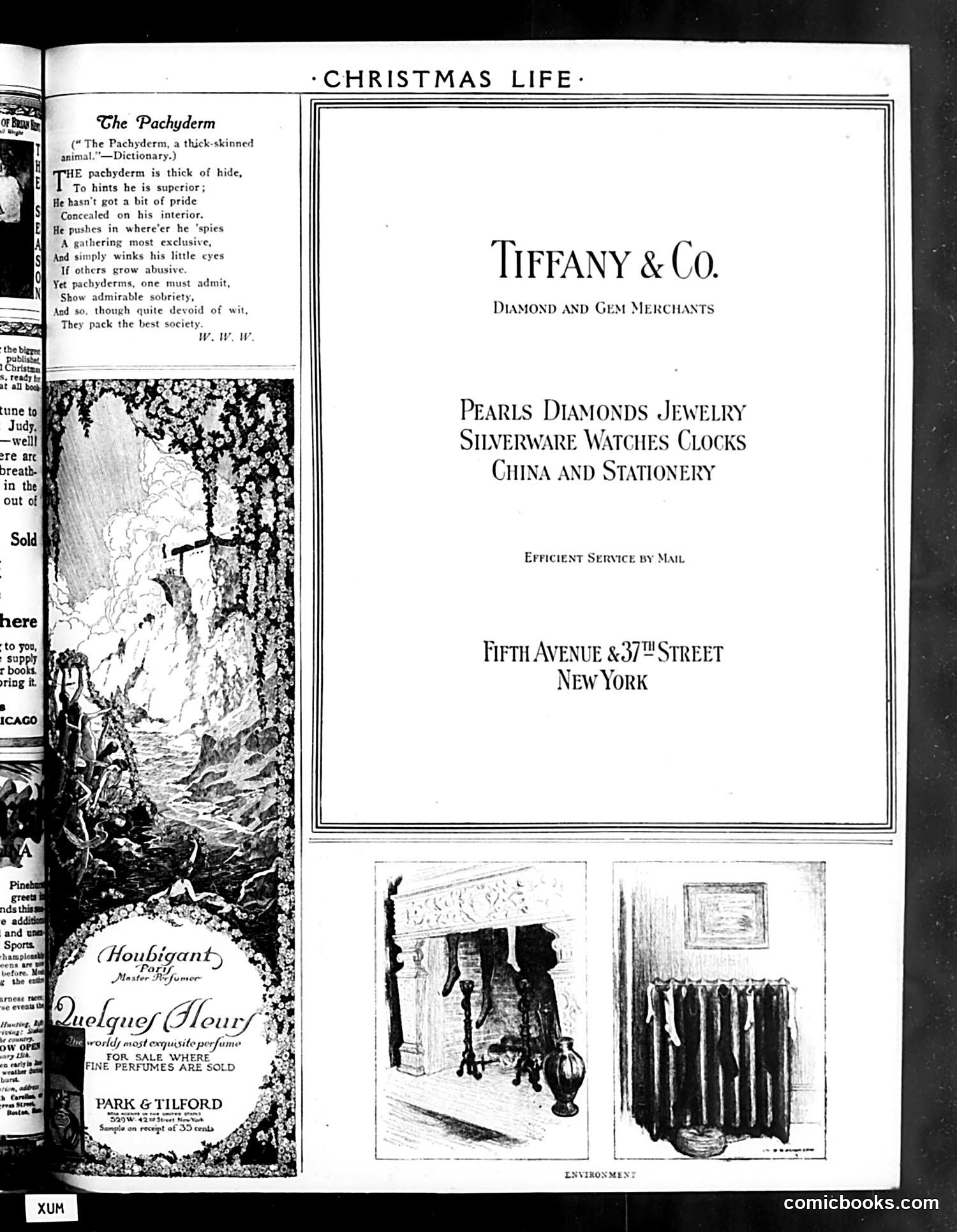
This poem satirizes wealthy elites, particularly those in high society. "Pachyderm" is a metaphor for thick-skinned, insensitive rich people who attend exclusive social gatherings. The satire critiques their moral character: they lack genuine pride ("concealed on his interior"), are impervious to criticism ("thick of hide"), and possess no wit—yet they dominate "the best society" anyway. The joke is that these vapid, unrefined people somehow command social prestige simply through wealth and exclusivity, not merit or intelligence. The accompanying advertisements (Tiffany & Co., Houbigant perfume, Park & Tilford) reinforce the target: luxury goods marketed to precisely this shallow, status-conscious crowd. The satire mocks how financial access, not character, determines social standing during this Gilded Age period.
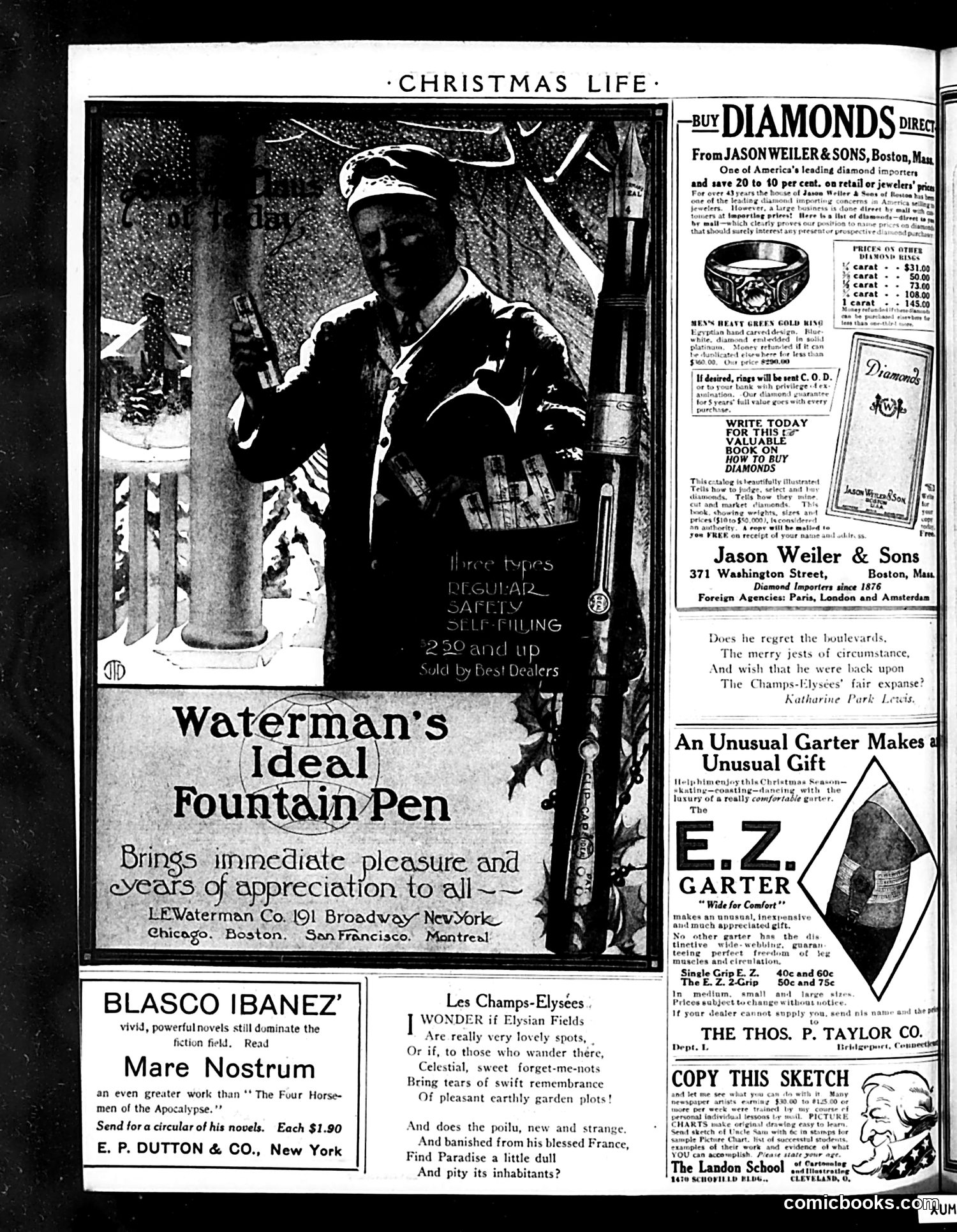
This page is primarily **advertising**, with a small literary poem. The main content includes: **Waterman's Ideal Fountain Pen** (large ad): Features a soldier in military uniform—likely a World War I American serviceman. The copy emphasizes the pen as an appropriate Christmas gift, suggesting soldiers deployed abroad as the intended market. **"Les Champs-Elysées" poem**: A nostalgic verse apparently about French soldiers ("poilu" = French WWI infantryman) homesick for Paris's famous boulevard and French countryside. It references soldiers finding the afterlife ("Paradise") dull, implying commentary on wartime displacement and longing for home. **Supporting ads**: Diamond rings, garters, fountain pens, and novels by Blasco Ibáñez (known for realist fiction)—all marketed as Christmas gifts. **Context**: This appears to be from the WWI era when American soldiers were abroad. The Christmas framing and soldier imagery suggest marketing gift-giving to those with loved ones in military service.
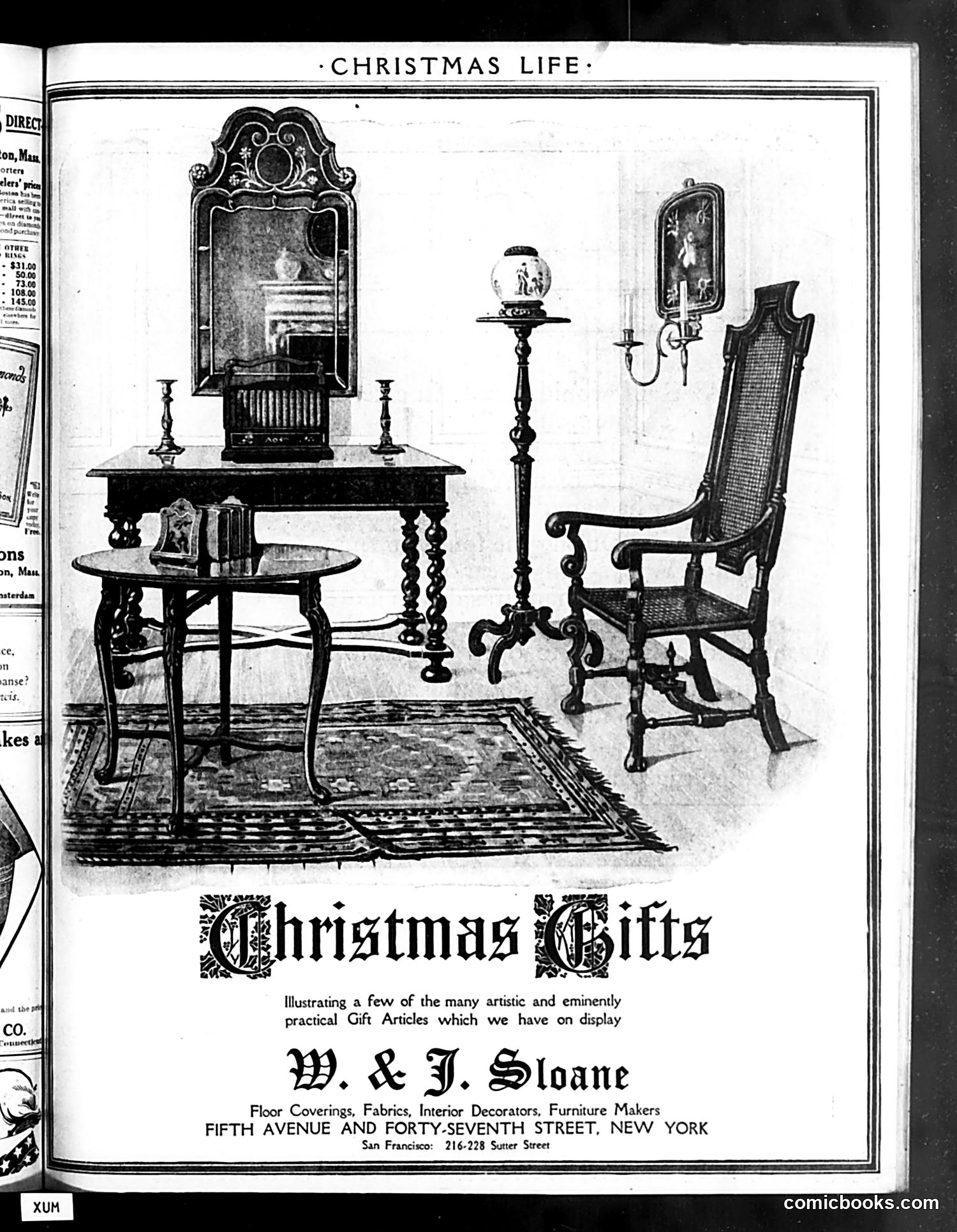
This is a full-page advertisement, not political satire. The page showcases Christmas gift ideas from W. & J. Sloane, a New York furniture and interior design company. The illustration displays period furniture and home décor items: an ornate mirror above a console table with candlesticks, a round side table, a tall pedestal table holding a snow globe, a wall sconce, and an upholstered chair on a decorative rug. The ad emphasizes that these are "artistic and eminently practical" gift options for wealthy holiday shoppers. There is no cartoon or political commentary—it's purely commercial promotion targeting affluent customers seeking luxury furnishings during the Christmas season.
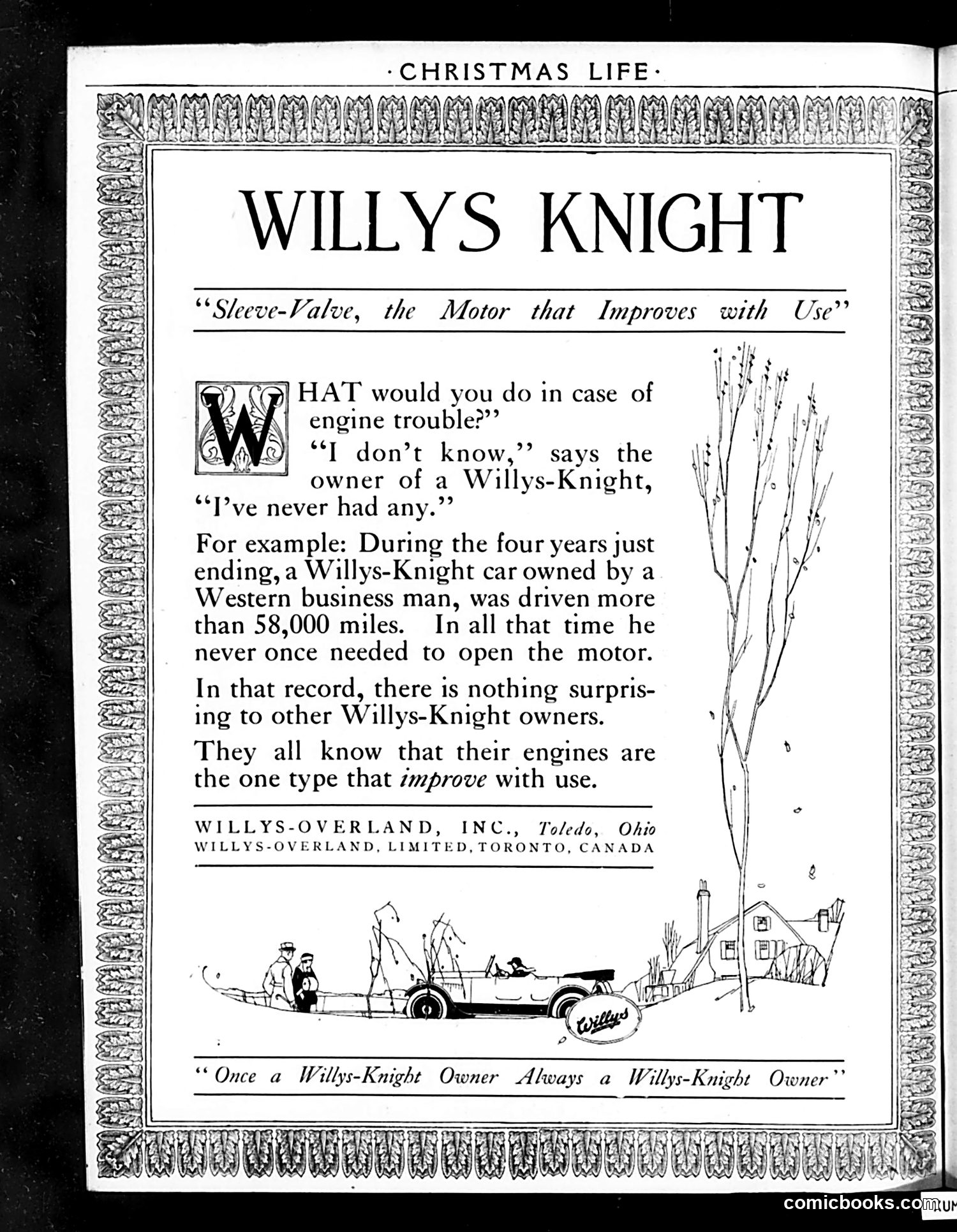
This is primarily a **automobile advertisement**, not satire or political commentary. It appears in *Life* magazine's Christmas section and promotes the Willys-Knight car, manufactured by Willys-Overland. The ad uses a testimonial format: it claims a Western businessman drove his Willys-Knight 58,000 miles over four years without engine trouble—never needing to open the motor. The copy emphasizes the car's "Sleeve-Valve" engine design, asserting it "improves with use," implying durability and reliability. The illustration shows a rural family scene with the Willys-Knight vehicle, conveying dependability for everyday American life. **For modern readers**: This represents early 20th-century car marketing rhetoric—manufacturers competed heavily on engine reliability claims when automobile technology was still relatively new and unreliable. The "improves with use" claim is classic vintage advertising, likely exaggerated. The tagline "Once a Willys-Knight Owner Always a Willys-Knight Owner" attempts brand loyalty messaging.
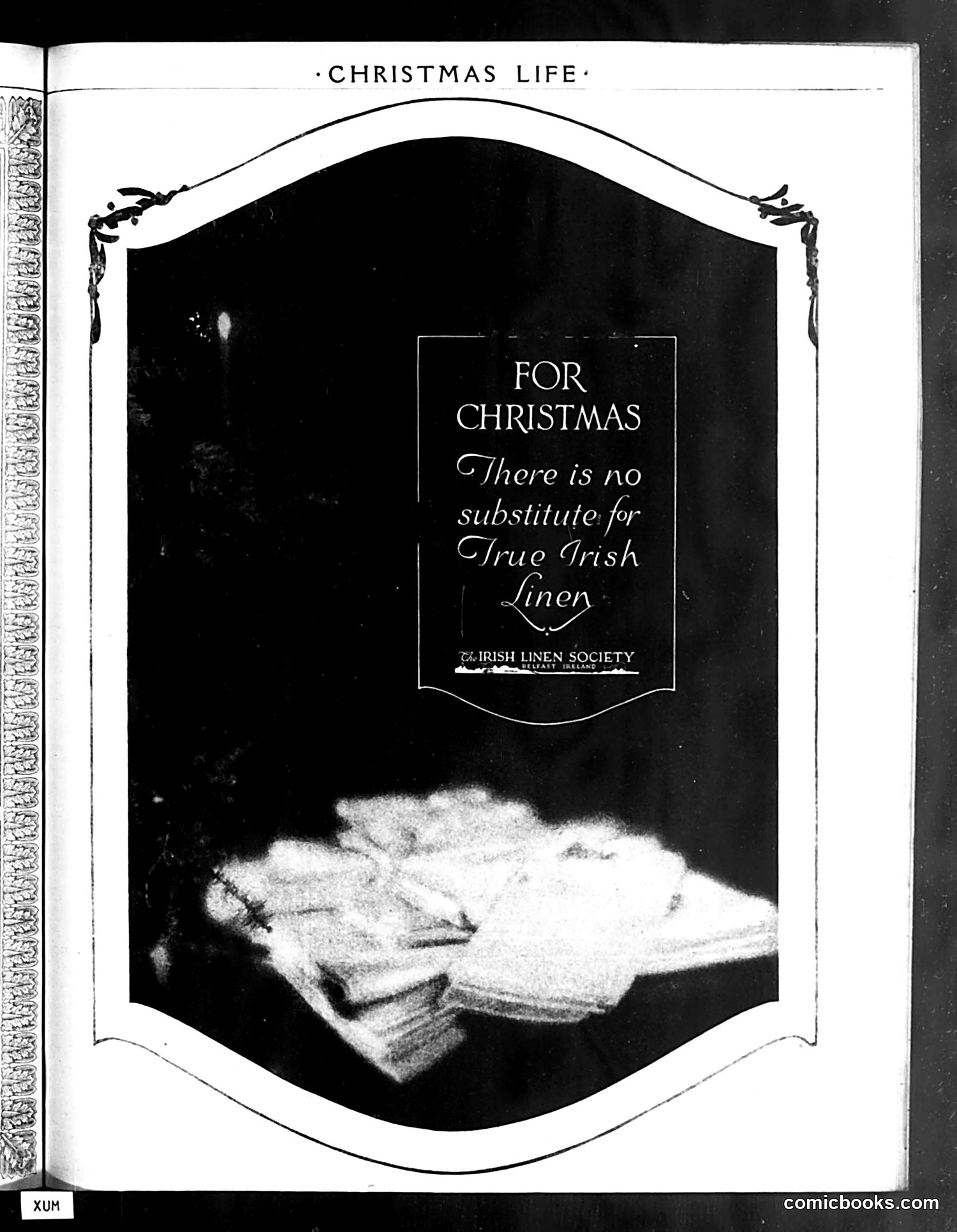
This is a **Christmas advertisement**, not a political cartoon. The page features a promotional ad for the Irish Linen Society, positioned as a holiday gift suggestion. The ad's message is straightforward: "For Christmas there is no substitute for True Irish Linen." It emphasizes the exclusivity and quality of Irish-made linen as a premium gift choice during the holiday season. The image shows folded linens displayed elegantly against a dark background, meant to appeal to affluent readers considering luxury gift purchases. The decorative border and formal typography underscore the product's prestige. This represents **early 20th-century luxury marketing**—positioning imported Irish linen as a desirable status symbol for Christmas gift-giving to the magazine's middle-to-upper-class readership.
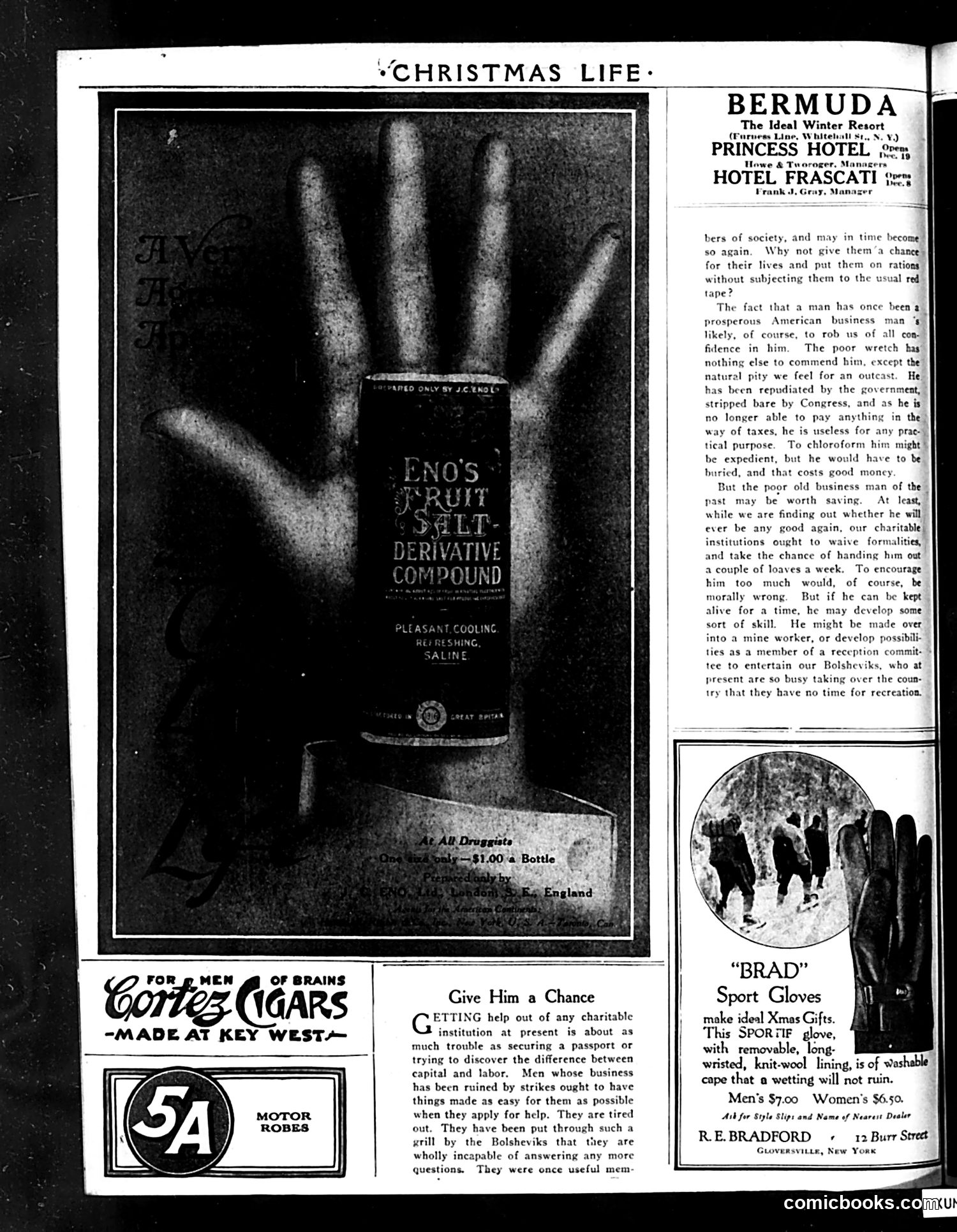
This page mixes advertisements with social commentary typical of *Life* magazine's satirical approach. The main editorial piece, "Give Him a Chance," discusses charitable assistance for businessmen ruined by labor strikes and government action. The text reveals post-WWI American anxieties: wealthy industrialists who've lost fortunes are portrayed as sympathetic victims of "Bolsheviks" (Russian communists, feared during the Red Scare era). The satire is biting—the author sarcastically suggests these ruined businessmen might become "mine workers" or be hired to entertain visiting Bolsheviks, while dismissing them as otherwise worthless to society. The piece critiques both the fallen wealthy and the charitable impulse to help them, questioning whether the poor deserve assistance without "subjecting them to red tape." The advertisements—for Eno's fruit drink, Cortes cigars, motor robes, and Brad sport gloves—are typical period luxury goods, creating ironic contrast with the text's discussion of poverty and economic hardship.
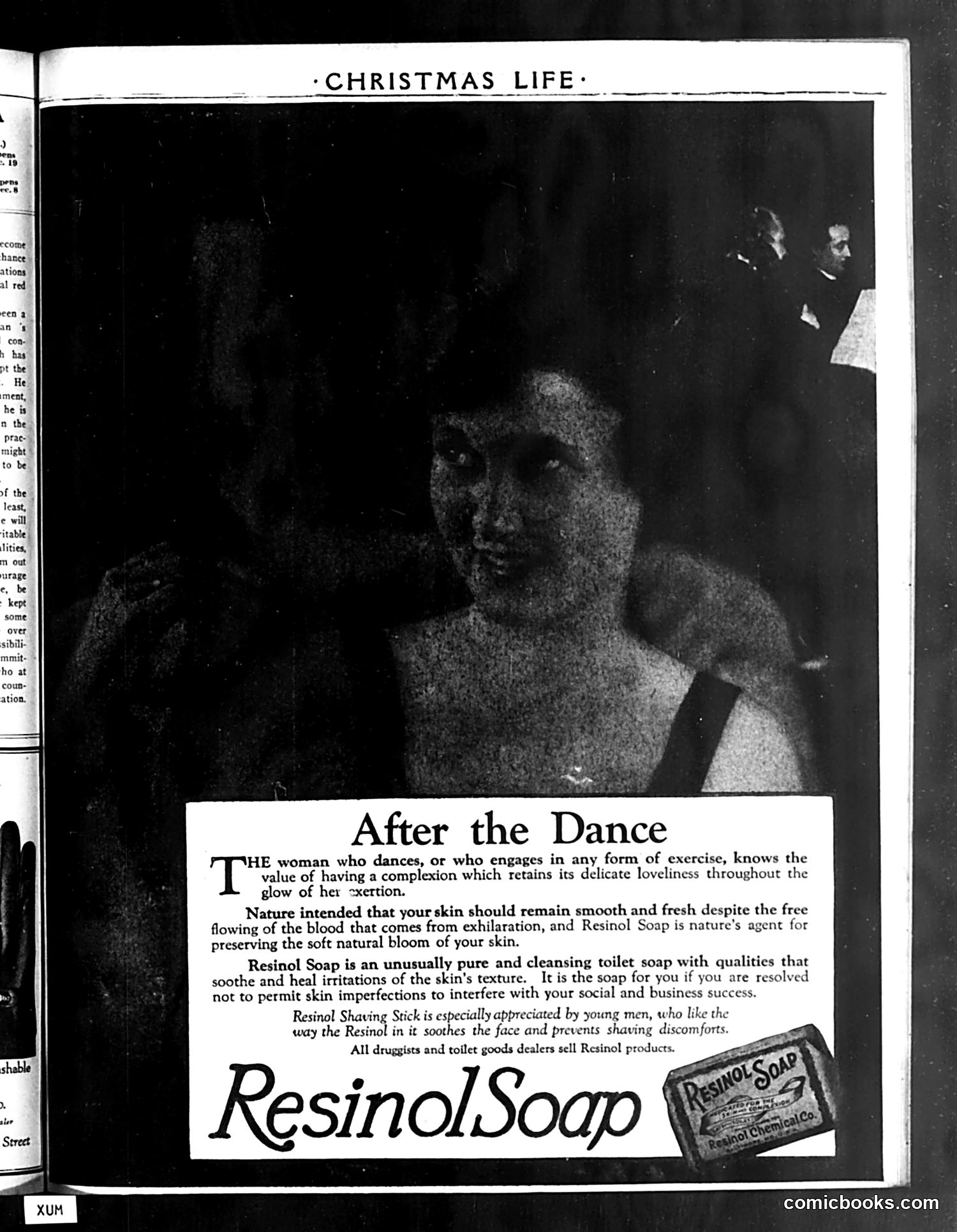
This is a **product advertisement**, not political satire. The page features a photograph of a woman's face (appearing flushed or perspiring) with two figures visible in the background, likely at a social dance or event. The ad promotes Resinol Soap by addressing a social anxiety of the era: that vigorous physical activity—particularly dancing—would damage a woman's complexion and thereby harm her "social and business success." The advertisement reassures female readers that the soap will preserve their skin's "delicate loveliness" despite exertion. The copy reflects early 20th-century beauty standards and gender expectations: women's social standing depended partly on maintaining an unblemished appearance. The ad also mentions Resinol Shaving Stick for men, positioning the product line as essential for both sexes' social acceptability. This is standard commercial messaging, not editorial commentary.
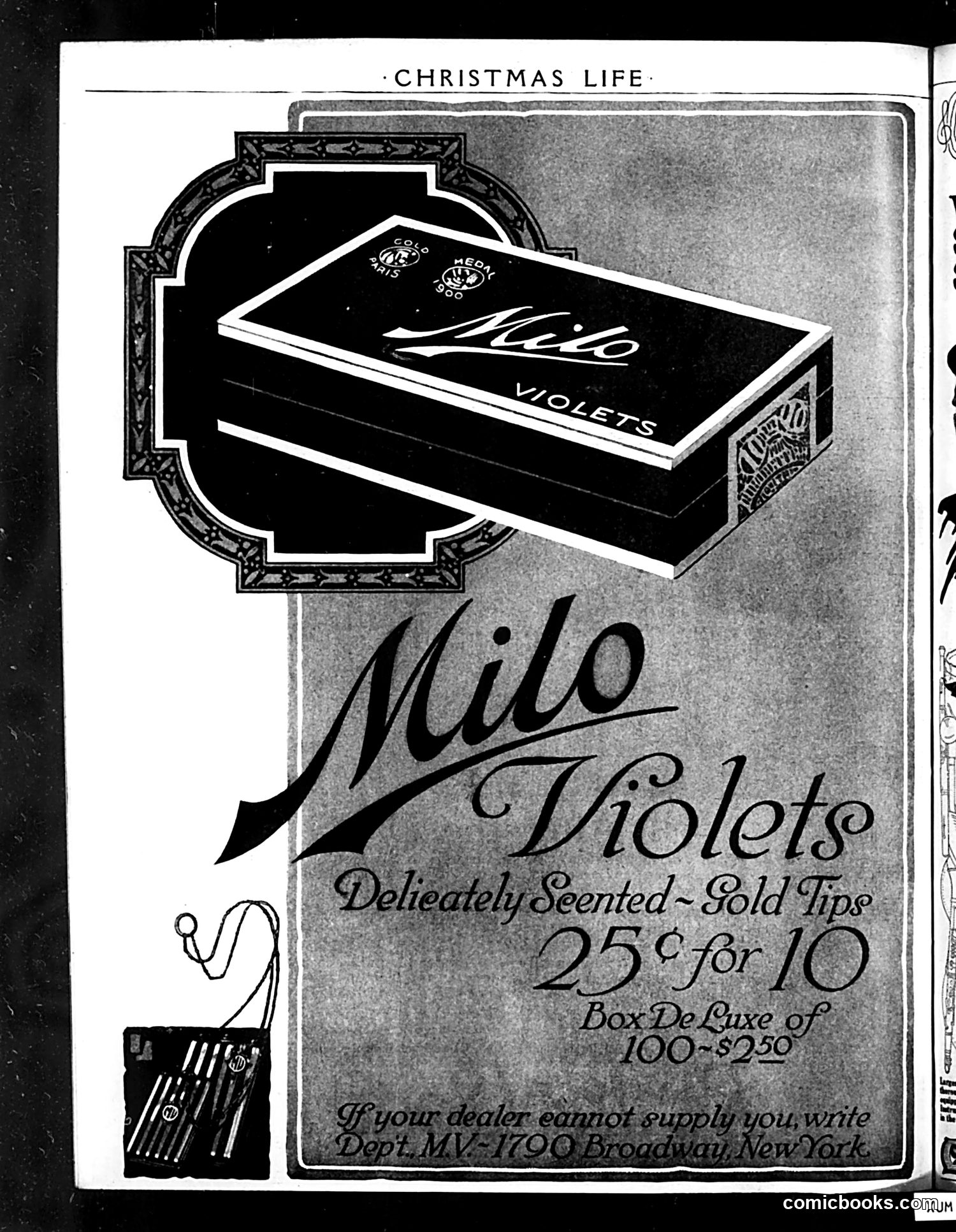
This is a vintage advertisement rather than political satire. It promotes Milo Violets—delicately scented candies with gold tips—priced at 25¢ for a box of 10 (or a larger "Box De Luxe" of 100-250 pieces). The ad appears in a "Christmas Life" section, suggesting seasonal gift-giving. The ornate product packaging is prominently displayed, emphasizing luxury and refinement typical of early-to-mid 20th century advertising. The design and messaging appeal to consumers seeking elegant, scented confections as holiday gifts. Contact information directs those unable to find the product locally to write to the New York distributor. The advertisement reflects period consumer culture and Christmas commerce rather than containing satirical or political commentary.
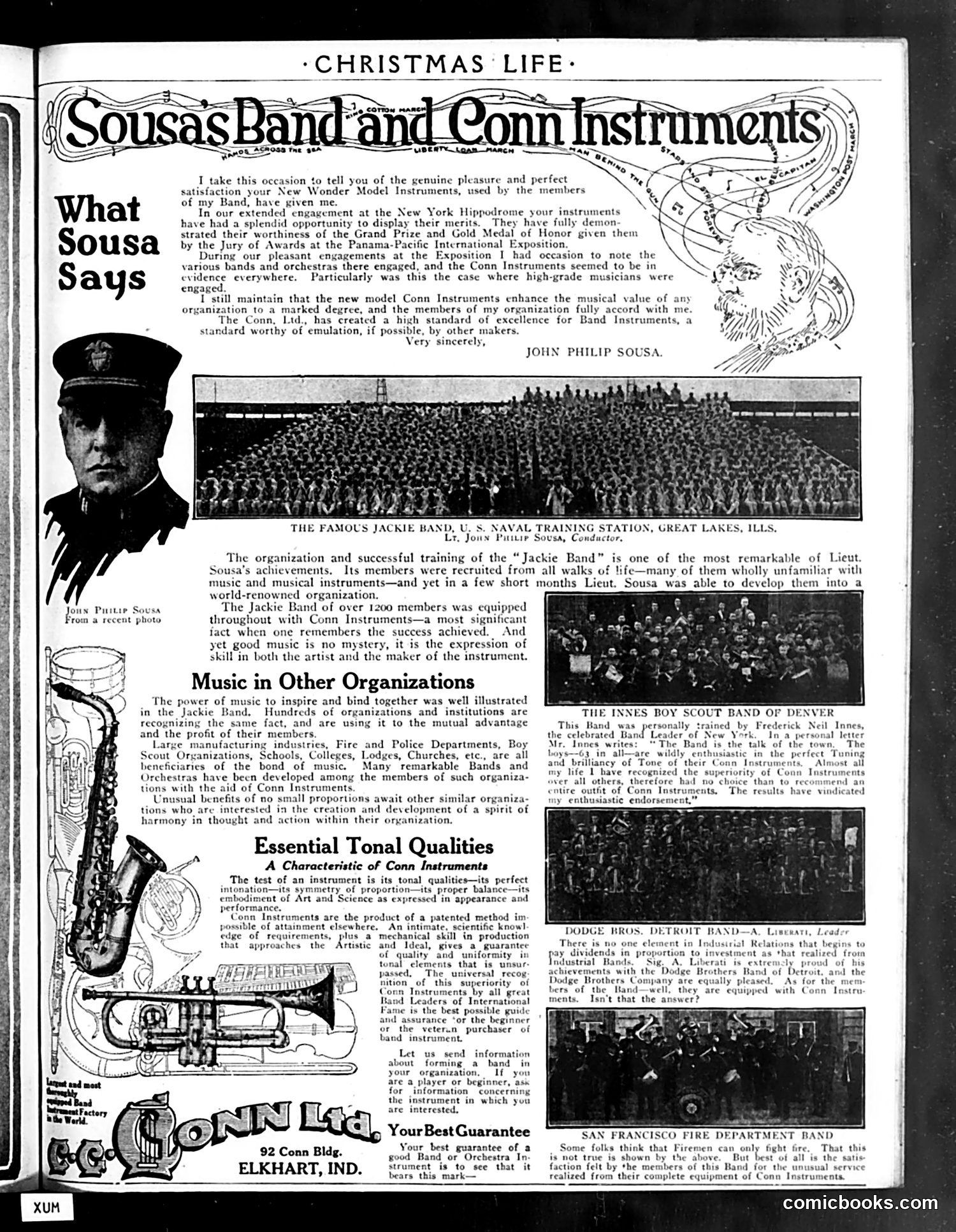
This page is primarily **advertising disguised as editorial content**—a common early 20th-century marketing tactic. The centerpiece is a endorsement letter from **John Philip Sousa**, the famous "March King" conductor, praising Conn band instruments. Below, the magazine showcases photographs of military and civic bands (Jackie Band at Great Lakes Naval Station, Denver Boy Scouts, Detroit and San Francisco fire departments) that supposedly used Conn instruments with great success. The satire or critique here isn't obvious to modern eyes because **there isn't one**—this is genuine promotional material. However, the implicit message is aspirational: if prestigious organizations like the Navy and civic institutions equipped their bands with Conn instruments, ordinary organizations should too. The page conflates product quality with organizational success, suggesting that purchasing the "right" instruments (rather than musician skill or training) explains the bands' achievements. This represents early 20th-century commercial culture's faith in branded goods as solutions to institutional problems.
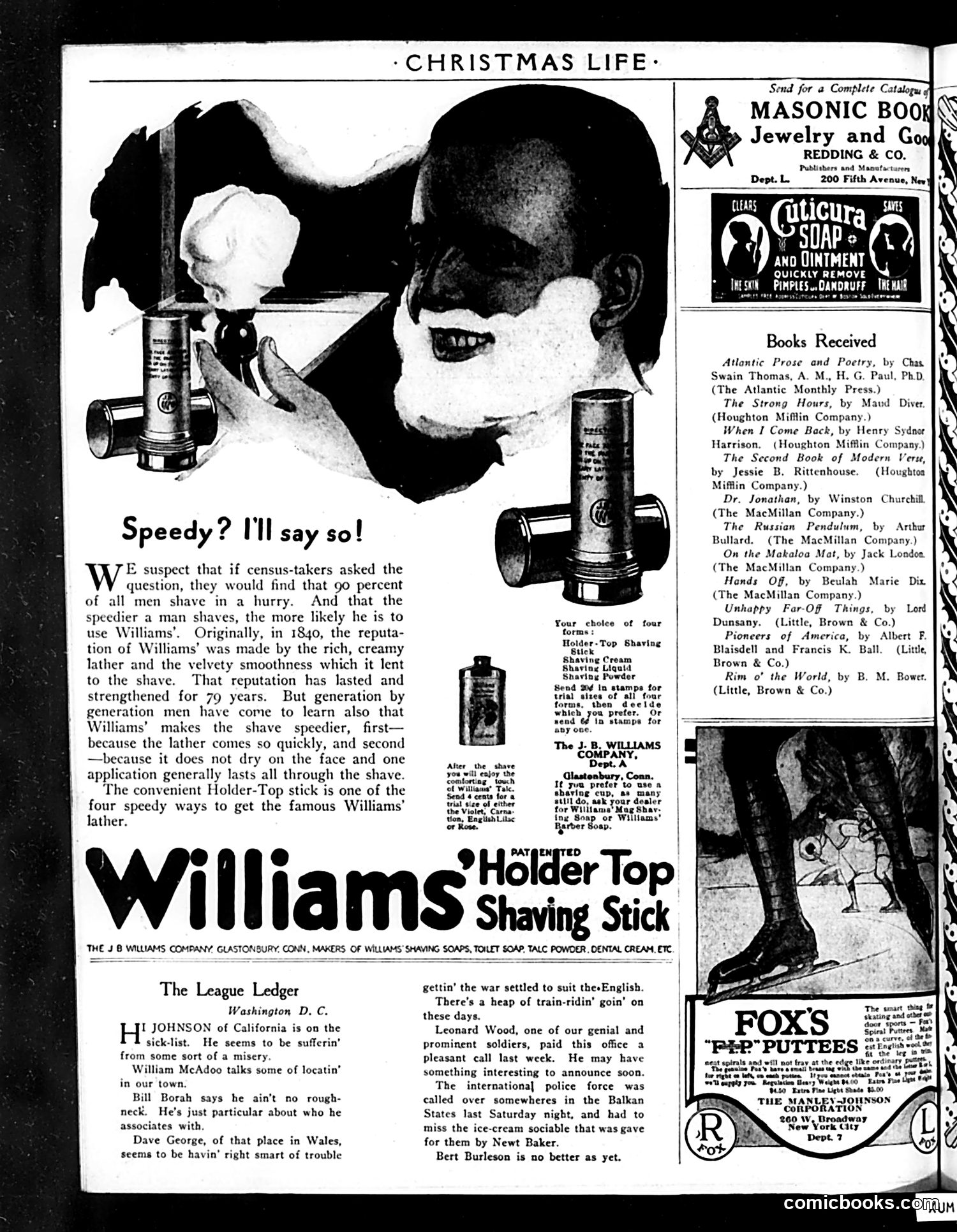
This page is primarily a **Williams' shaving products advertisement** disguised as editorial content in *Life* magazine's "Christmas Life" section. The main illustration shows a man shaving hastily with the tagline "Speedy? I'll say so!" The ad copy claims that 90% of men shave in a hurry, and that Williams' lather—established since 1840—enables faster shaving because it lathers quickly and doesn't dry on the face. The "Holder-Top stick" is promoted as one of four convenient product forms. The page also includes: - **"The League Ledger,"** a satirical gossip column referencing contemporary political figures (Johnson, William McAdoo, Bill Borah, Leonard Wood, Newt Baker, Bert Burleson) with dry humor about their activities and movements - Book reviews and smaller product advertisements (Cuticura soap, Fox's puttees, Masonic books) The satire is gentle rather than biting—typical of *Life*'s style. The column's rural-tinged dialect ("sufferin'," "locatin'") creates comic contrast with Washington political figures.
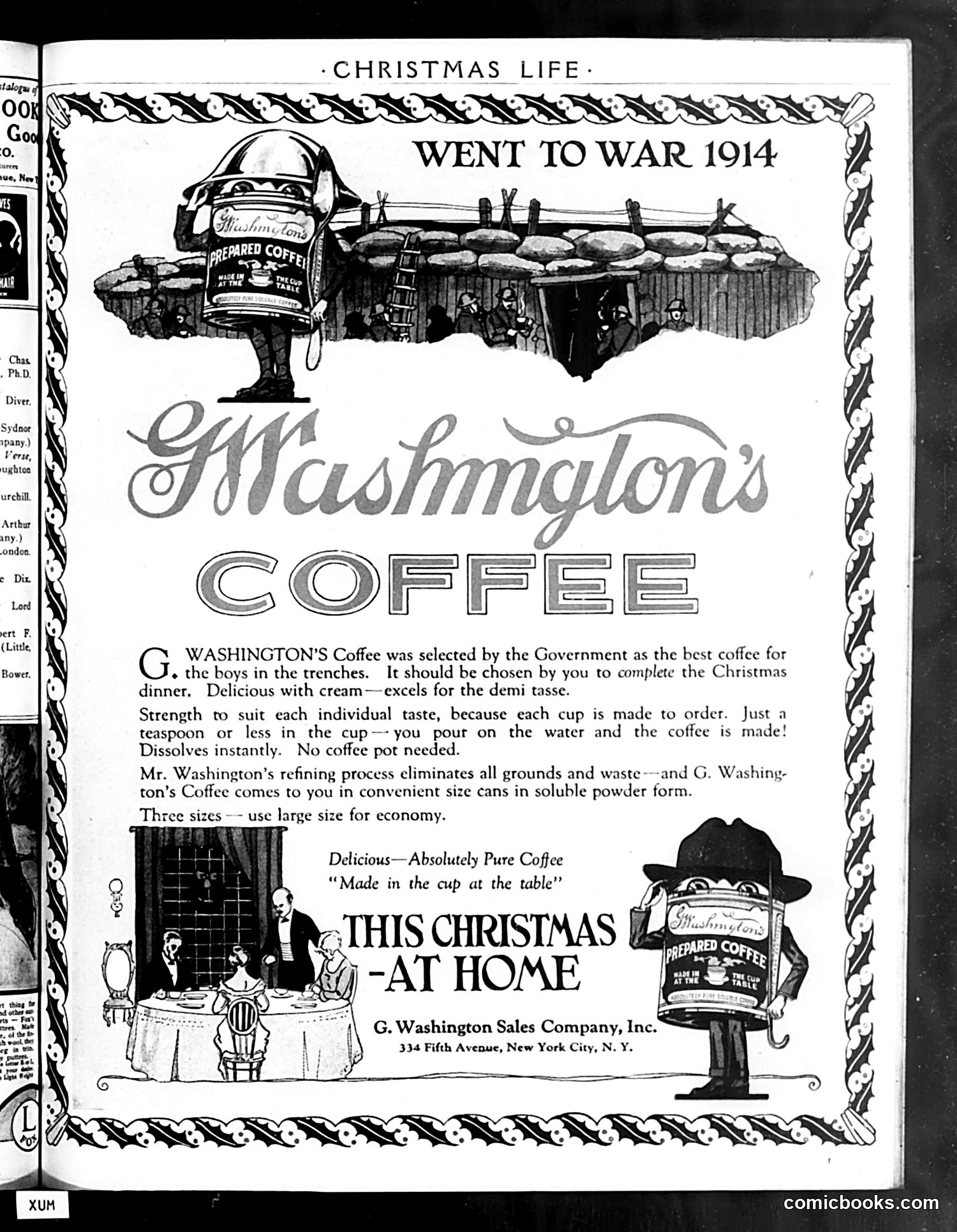
This is a **wartime advertisement**, not political satire. It's a G. Washington instant coffee ad from around 1914-1918, exploiting WWI patriotism. The ad claims the U.S. Government selected this coffee for soldiers in the trenches, establishing patriotic credibility. The imagery shows a soldier carrying an oversized coffee can above a trench scene, and a domestic Christmas dinner scene below—contrasting soldiers abroad with civilians at home. The sales pitch emphasizes convenience (instant, no pot needed) and appeals to female readers' patriotic duty: serve this coffee at Christmas dinner to support the war effort. The copy subtly suggests choosing this brand demonstrates loyalty to troops fighting overseas. For modern readers: this represents how WWI was marketed to American consumers through appeals to patriotism and sacrifice, turning everyday purchases into acts of wartime support.
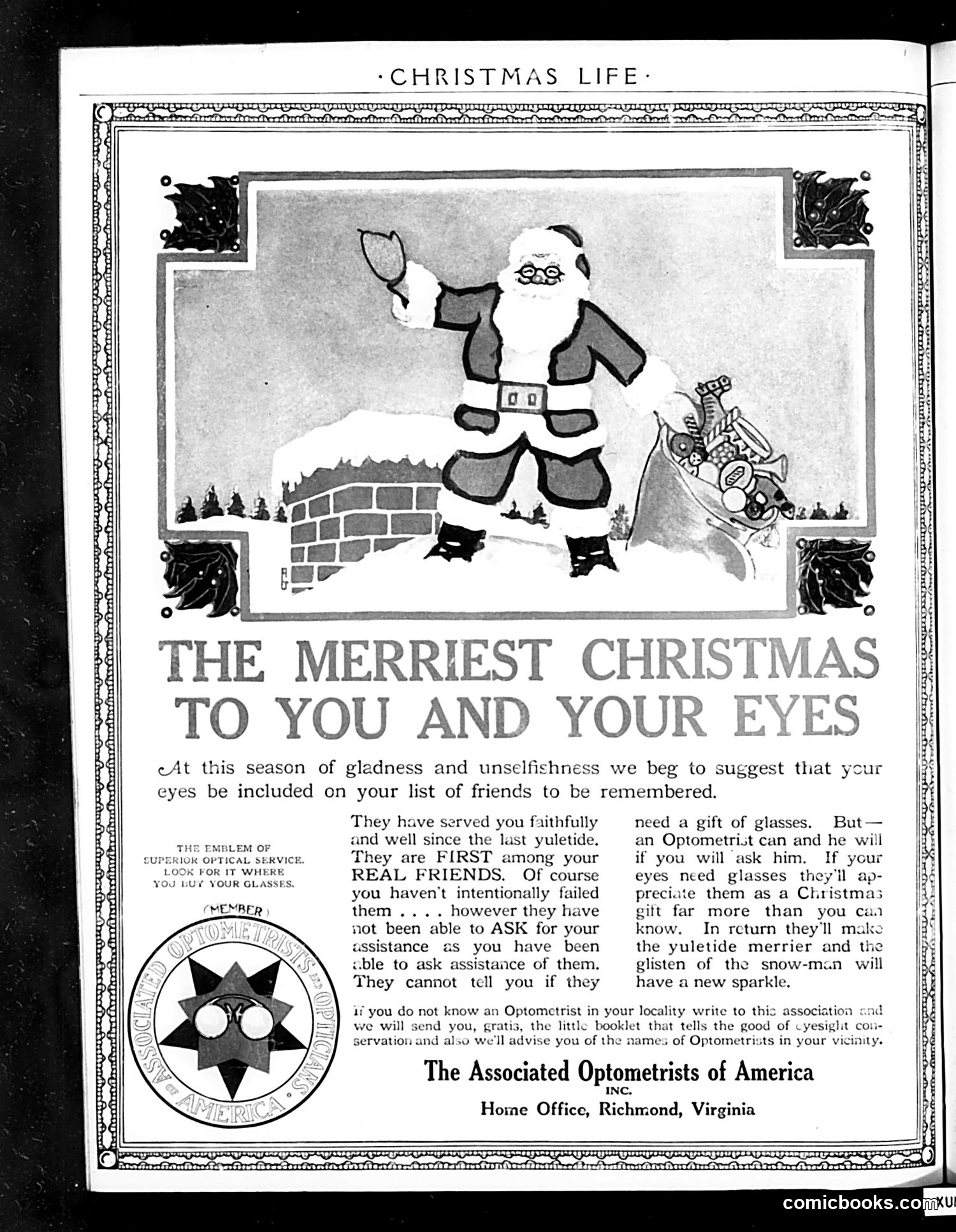
This is a Christmas-themed advertisement, not political satire. The "Associated Optometrists of America" uses a Santa Claus illustration and holiday messaging to promote eyeglasses as gifts. **The pitch:** Eyes are described as "REAL FRIENDS" that have "served you faithfully" but cannot ask for help like human friends can. The ad suggests that if your eyes need correction, an optometrist can determine this, and glasses make an ideal Christmas present—one your eyes will "appreciate" more than you'd expect. **The appeal:** Framed as altruism ("season of gladness and unselfishness"), the advertisement encourages readers to visit an optometrist to check whether they or loved ones need spectacles. The tagline promises that corrected vision will make Christmas "merrier" and brighter ("glisten of the snow-man will have a new sparkle"). This is straightforward early-20th-century advertising using emotional and personification appeals—treating eyes as deserving companions worthy of care and gift-giving.
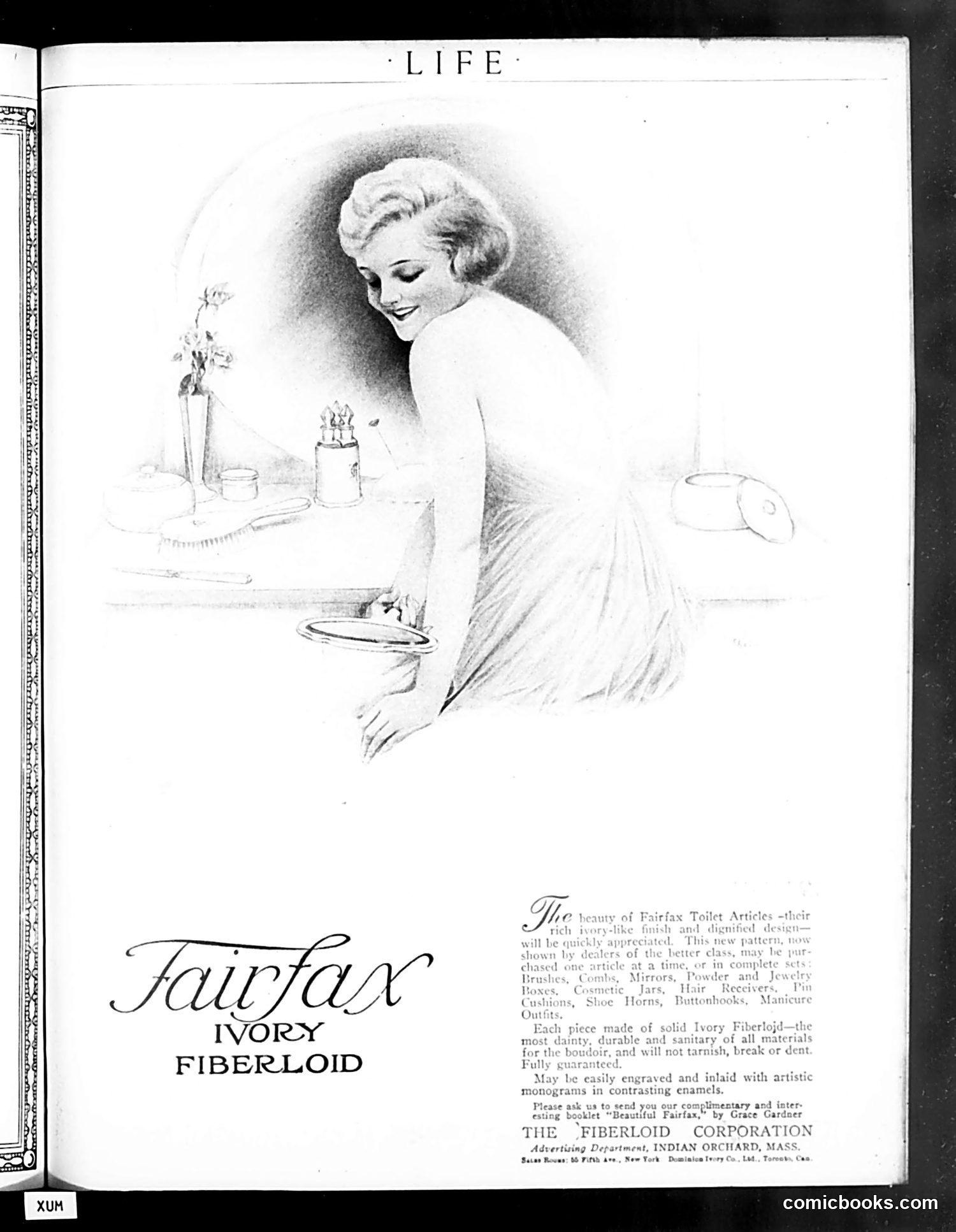
This page is primarily an **advertisement** rather than satire or political commentary. It features a magazine illustration of an elegant woman at her vanity, advertising "Fairfax Ivory Fiberloid" toilet articles. The ad emphasizes the product's "rich ivory-like finish and dignified design," promising items like cosmetic jars, hair receivers, and other bathroom accessories made from "solid ivory Fiberloid"—a durable, sanitary synthetic material that mimics real ivory. The text notes these products are "easily engraved and inlaid with artistic monograms in contrasting enamels," suggesting luxury appeal to middle and upper-class consumers. This reflects early 20th-century marketing that sold affordable synthetic materials by emphasizing their ability to replicate expensive natural materials like ivory.
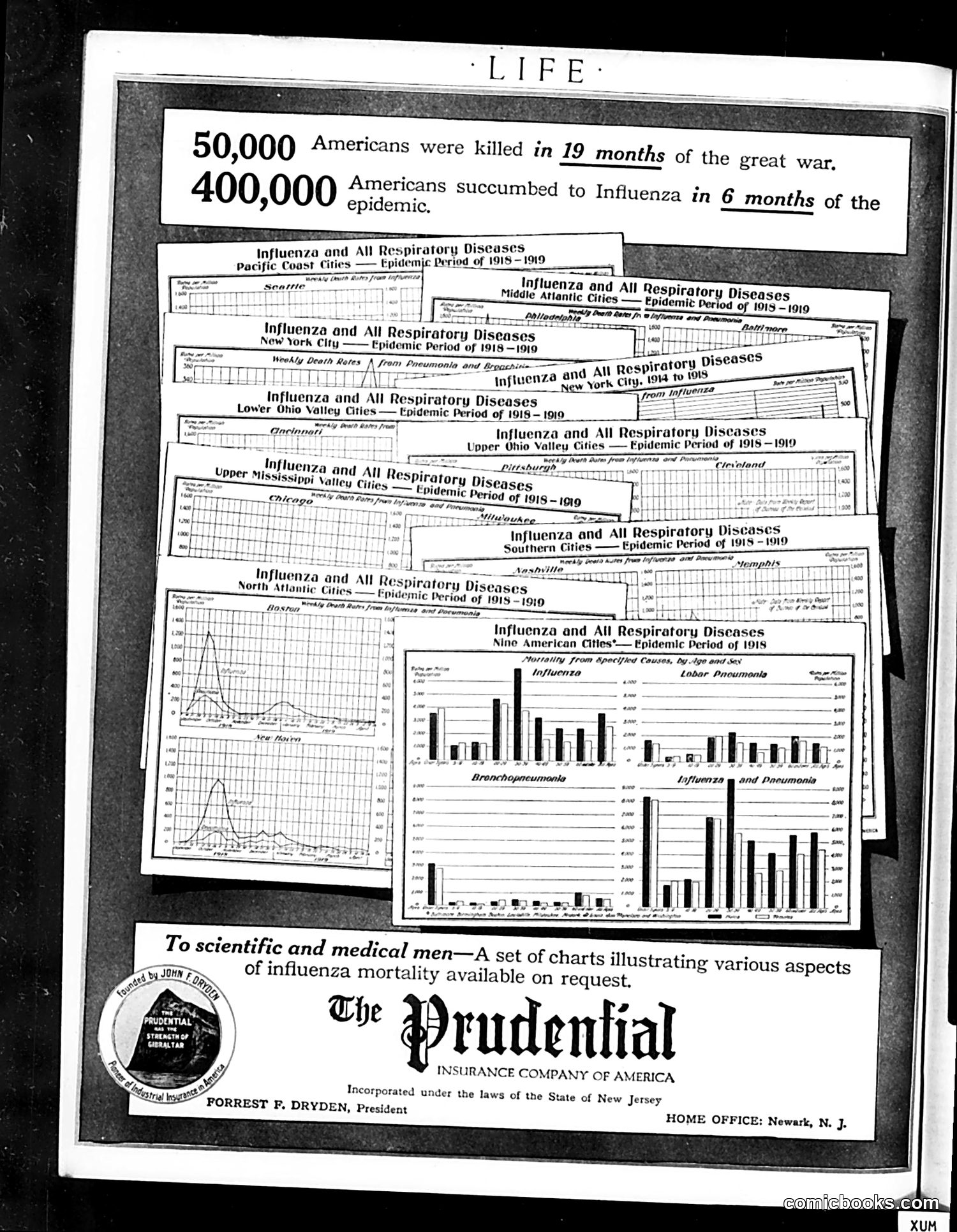
This is a **public health advertisement** by Prudential Insurance, not a political cartoon or satire. The page presents stark mortality statistics comparing World War I casualties (50,000 Americans in 19 months) against influenza deaths (400,000 in 6 months). This comparison emphasizes the devastating impact of the 1918 Spanish Flu pandemic. The bulk of the page displays epidemiological charts tracking influenza and respiratory disease patterns across nine American regions during 1918-1919, showing infection waves, mortality rates, and disease-specific breakdowns by age and sex. **The message**: Prudential offers detailed mortality data to "scientific and medical men" to aid pandemic understanding and response. This represents early public health communication, positioning the insurance company as a data resource during a national health crisis—a form of corporate responsibility advertising common in this era.
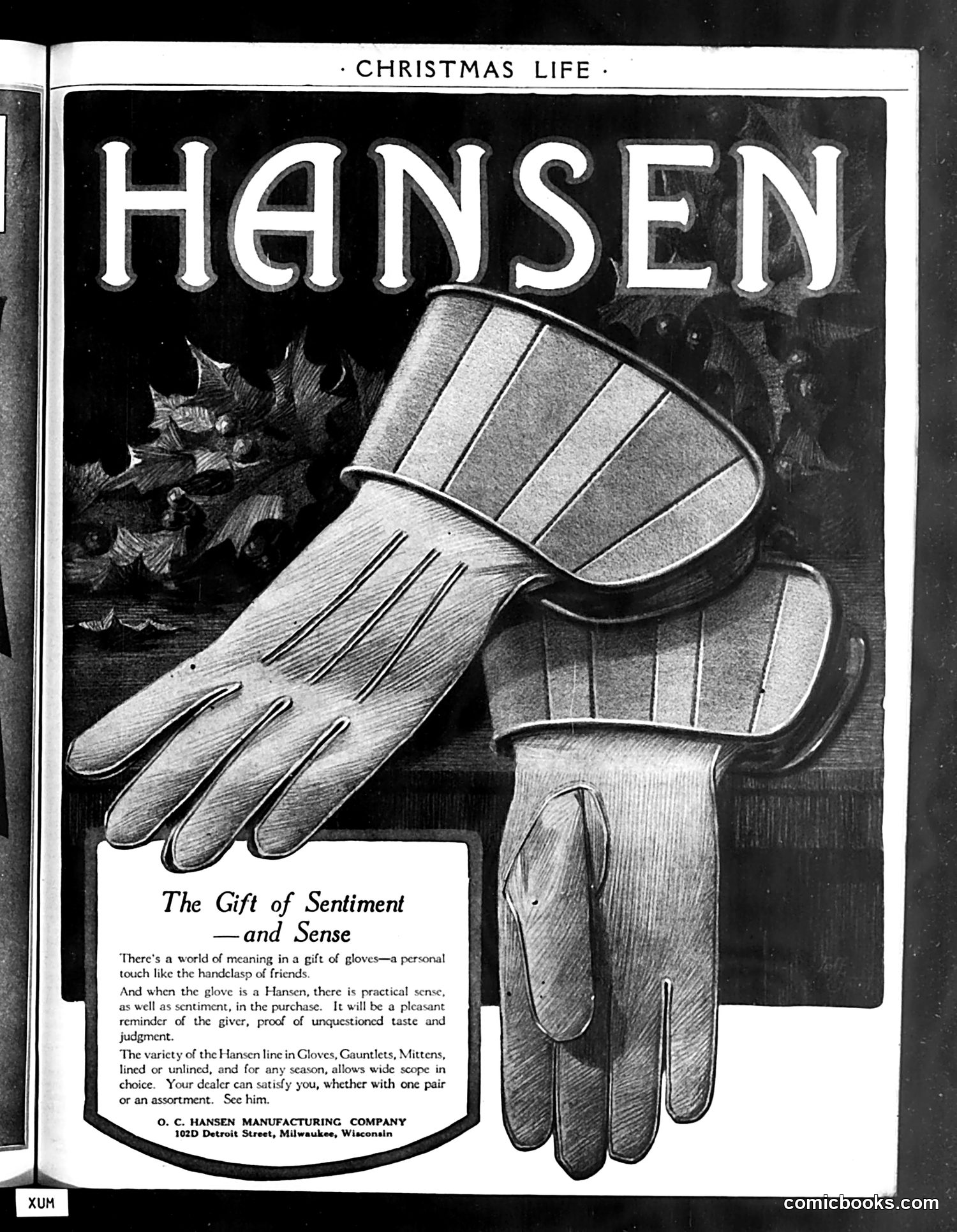
This is a **Christmas advertisement**, not a political cartoon. The page appears from *Life* magazine's holiday issue and promotes Hansen brand gloves as gift merchandise. The imagery shows a detailed illustration of ladies' gloves and gauntlets with decorative stitching. A small holly sprig appears in the background for seasonal context. The advertisement's messaging emphasizes that gloves represent "sentiment and sense"—a personal, meaningful gift choice that demonstrates the giver's "taste and judgment." It appeals to consumers by highlighting the product line's variety (lined/unlined, different styles for different seasons) and encouraging readers to visit their local dealer. There is **no satire or political commentary** present. This is straightforward early-twentieth-century luxury goods advertising that uses emotional language to market a practical holiday gift item.
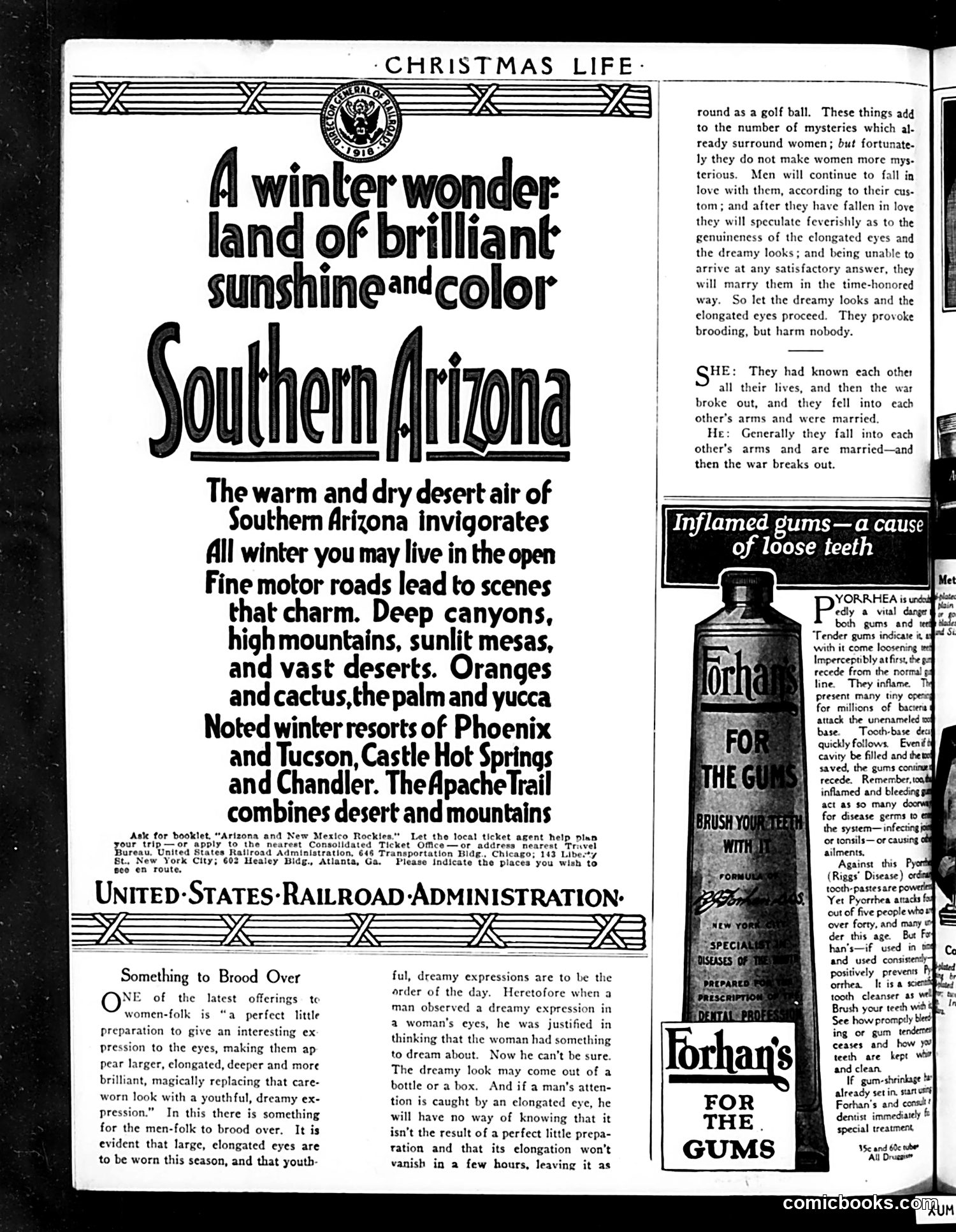
This page contains **period advertising and light satirical commentary**, not political cartoons. The main content is a **railroad tourism advertisement** for Southern Arizona, promoting winter travel to Phoenix, Tucson, and scenic attractions via the Apache Trail—typical early 20th-century travel marketing. Below this is a brief **satirical essay titled "Something to Brood Over,"** mocking a cosmetic product promising to enlarge and brighten women's eyes artificially. The satire targets male anxiety: men historically interpreted large, dreamy eyes as signs of female contemplation or attraction, but artificial enhancement means men can no longer trust what they see. The author wryly notes this won't stop men from falling in love or marrying—they'll simply "brood" over whether a woman's appealing gaze is genuine or cosmetic. It's gentle commentary on emerging beauty products and the uncertainty they create. The page also includes **period advertisements** for Forhan's toothpaste and gum disease treatment—standard commercial content of the era.
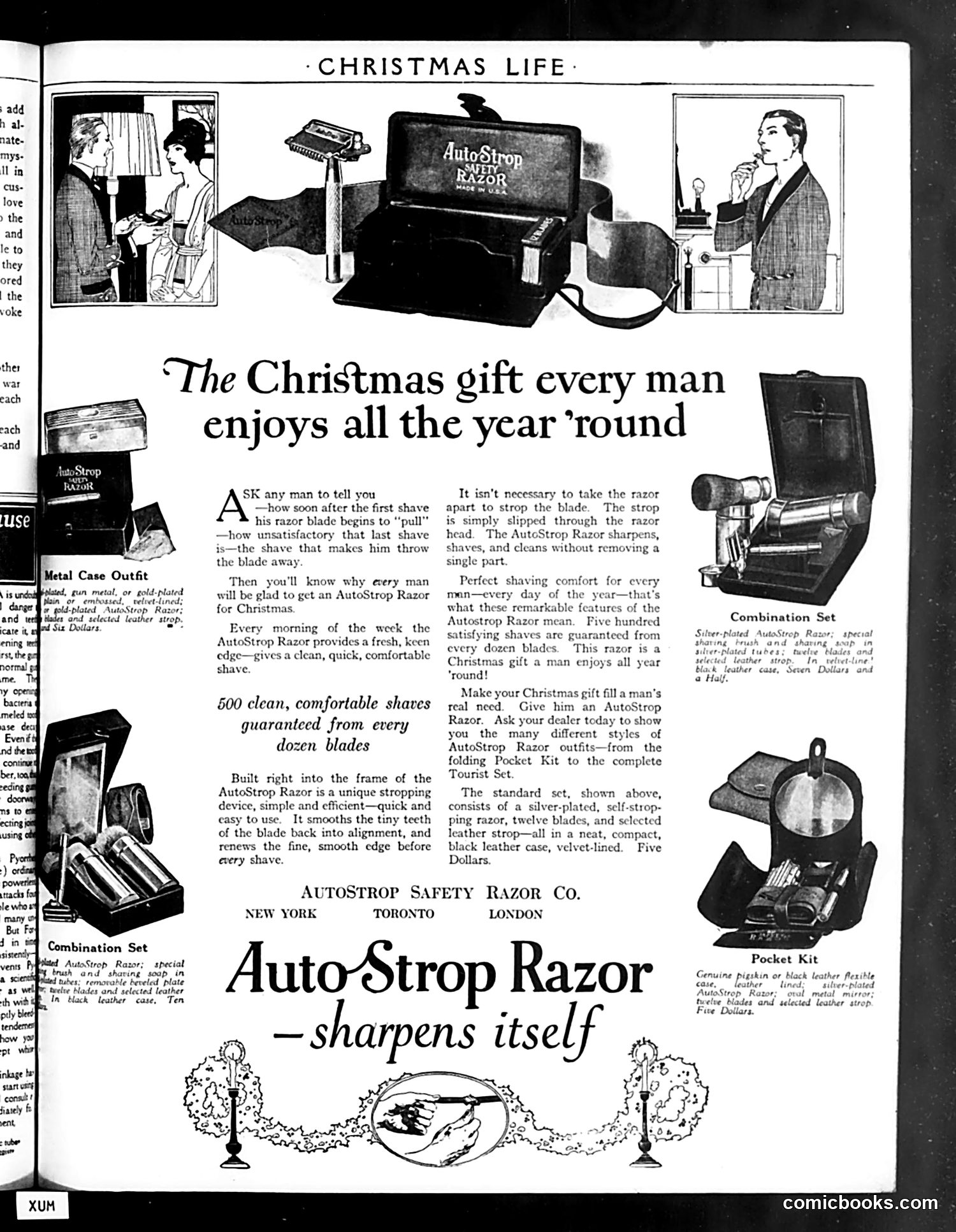
This is **not a cartoon or satire** — it's a straightforward Christmas product advertisement for the AutoStrop Safety Razor, appearing in Life magazine's "Christmas Life" gift section. The page showcases the razor's key selling point: its **self-stropping mechanism** that automatically sharpens the blade during use, eliminating the need for manual stropping. The advertisement emphasizes convenience and economy — claiming "500 clean, comfortable shaves guaranteed from every dozen blades." The small illustrations at the top show gift-giving scenarios and product demonstrations. Different purchase "sets" are displayed (Combination Set, Pocket Kit, Tourist Set) at various price points ($5–$10), marketed as ideal Christmas gifts for men. There is no political commentary or satire here — simply a commercial pitch leveraging the holiday season to sell grooming products to male consumers who wanted reliable, low-maintenance shaving solutions.

This is primarily an advertisement for Ruud Automatic Gas Water Heaters, not a political cartoon. The "Christmas Life" header and satirical content function as framing for the ad. The page contrasts an outdated Parisian method—a man carrying hot water upstairs in buckets (labeled "La Rue Brise Miche," a French street reference)—with modern American convenience. The sketch shows the labor-intensive European approach, while the ad promotes the Ruud system's efficiency: instant hot water from any faucet, available in 150,000 American homes. The satire is mild: the implicit joke is that Americans have superior domestic technology compared to supposedly more "cultured" Europeans. This reflects early 20th-century American consumer optimism and technological pride. The advertisement emphasizes modernity, efficiency, and labor-saving as desirable markers of progress—typical messaging for appliance ads of this era.
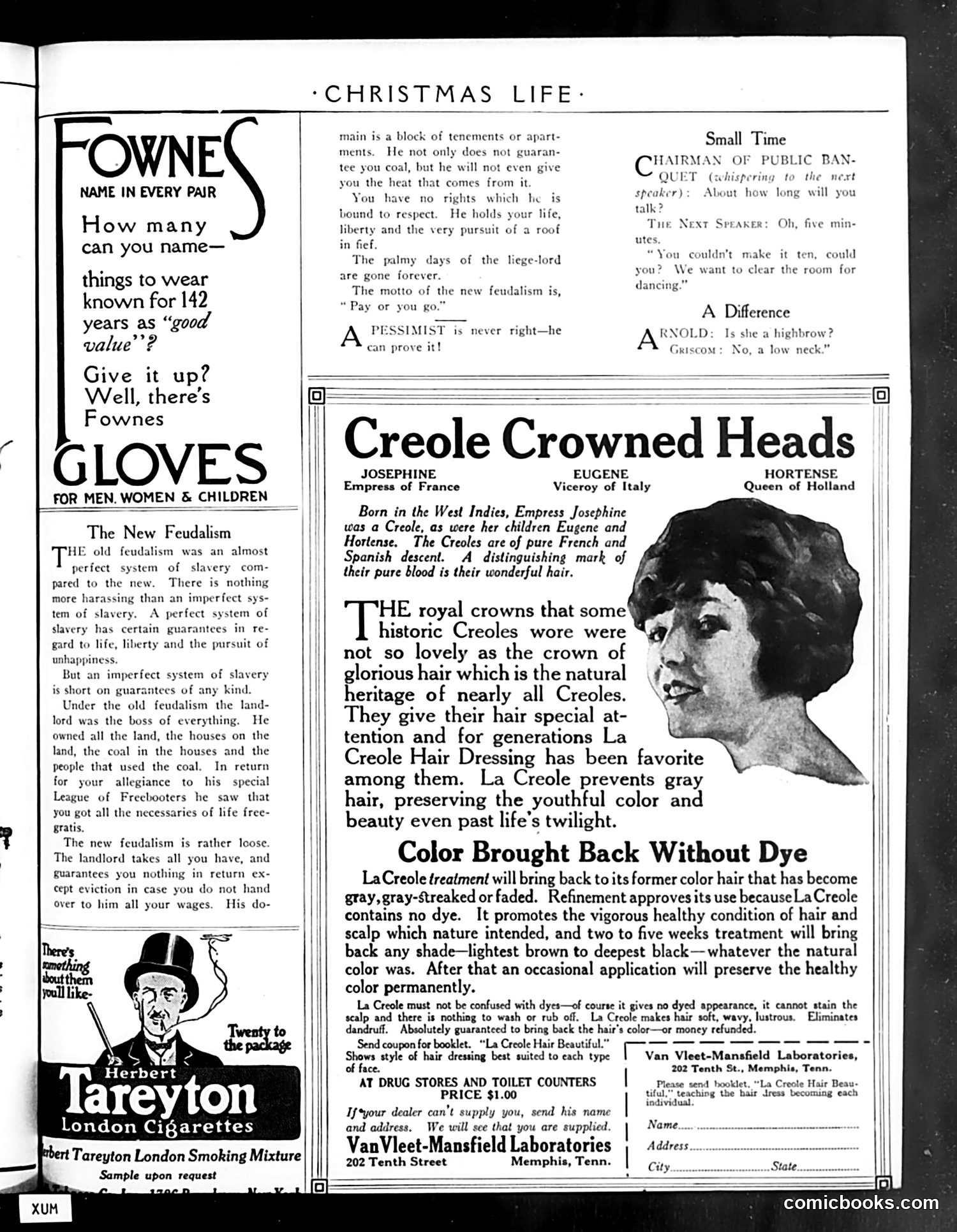
This Life magazine page contains three distinct elements: **"The New Feudalism" editorial**: A satirical critique comparing modern landlord-tenant relationships to medieval feudalism. It argues that the old feudal system, though oppressive, at least guaranteed tenants basic necessities (coal, shelter). Modern "feudalism" is worse—landlords extract all wages but guarantee nothing, leaving tenants vulnerable to eviction. The satire highlights economic inequality and housing insecurity in early 20th-century America. **"Small Time" joke**: A brief humor piece about a banquet chairman trying to rush a speaker. **"Creole Crowned Heads" advertisement**: A hair product ad featuring historical figures (Josephine, Eugene, Hortense—Napoleon's family members born in the West Indies). The ad promotes La Creole hair dressing, claiming it restores natural hair color without dye and celebrates the hair texture of Creole women. The page is primarily advertisements mixed with social commentary typical of Life's satirical approach to contemporary issues.
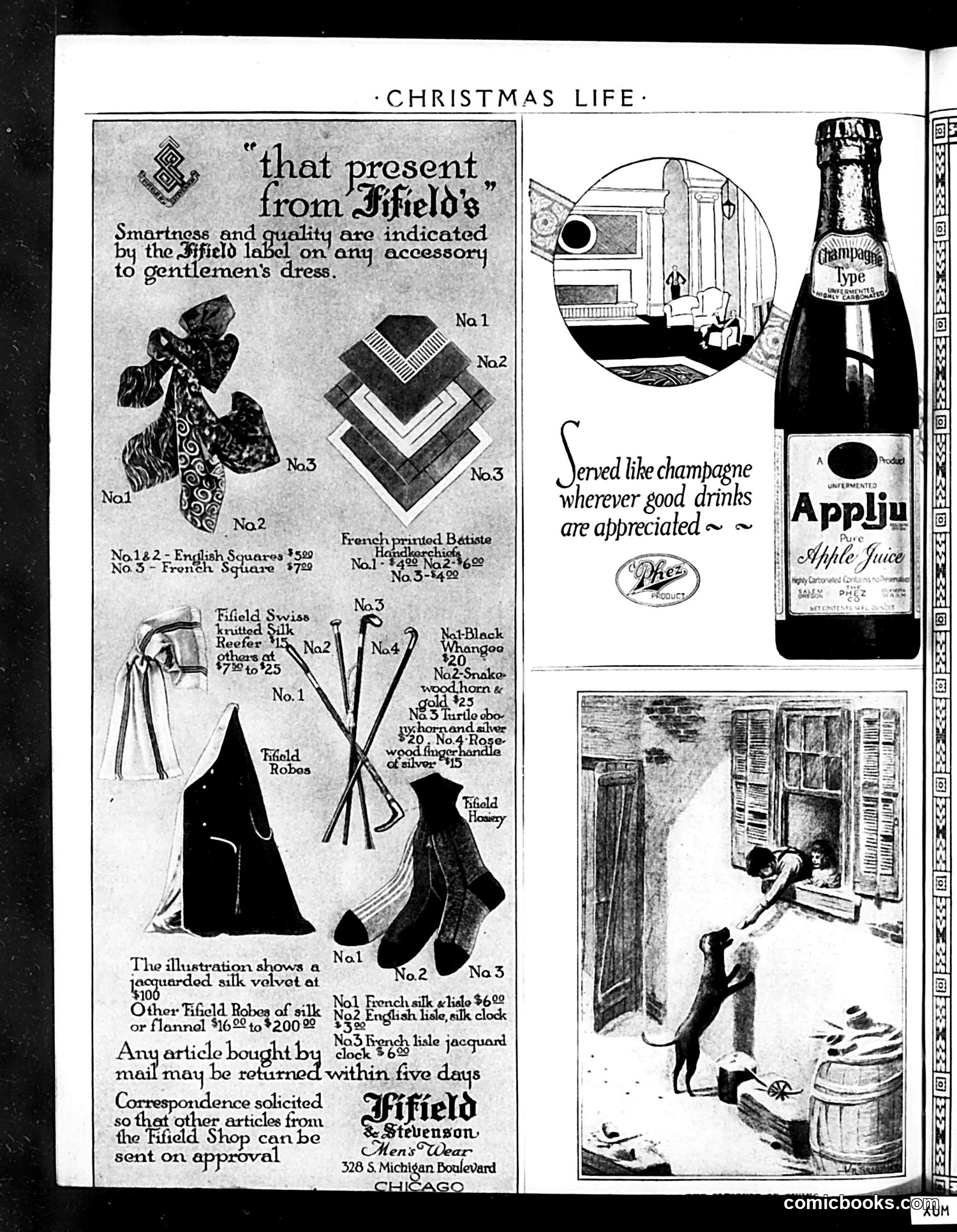
This page is primarily **advertising, not political satire**. It contains Christmas gift advertisements for Fifield's men's wear shop in Chicago. The left side showcases gentleman's accessories (neckties, robes, handkerchiefs) with prices and product descriptions. The right side advertises Applin apple juice in a champagne bottle, accompanied by an illustration of children looking out a window. The only satirical element is the **Applin juice advertisement's framing**: marketing non-alcoholic apple juice "like champagne" plays on the irony that during Prohibition (roughly 1920-1933), legitimately marketed beverages had to avoid appearing to substitute for actual champagne—yet this ad does exactly that, suggesting the product as an acceptable alternative for "good drinks." The children's window scene reinforces family/wholesome values positioning. Otherwise, this is straightforward holiday retail promotion typical of *Life* magazine's commercial content.

This is **not a cartoon or satirical content** — it's a full-page advertisement for Simmons Company metal beds, appearing in *Life* magazine's Christmas issue (dated 1919 based on the copyright mark). The ad promotes Simmons' new "true design in metal beds," emphasizing modern improvements: seamless tubing, quiet construction (no squeaks or rattles), better spring systems, and aesthetic appeal in various finishes (oxidized copper, silver gray). It references their advocacy for the "Twin Bed principle" and highlights products like the "Stuyvesant" model. The only potentially humorous element is subtle: the ad's repeated emphasis on beds being "quiet" and "free from squeak, rattle and knock" — implying previous metal bed designs were unpleasantly noisy, a relatable domestic complaint for readers. This represents typical early-20th-century advertising strategy: mixing design/lifestyle aspirations with practical benefits to appeal to housewives managing bedroom furnishings.
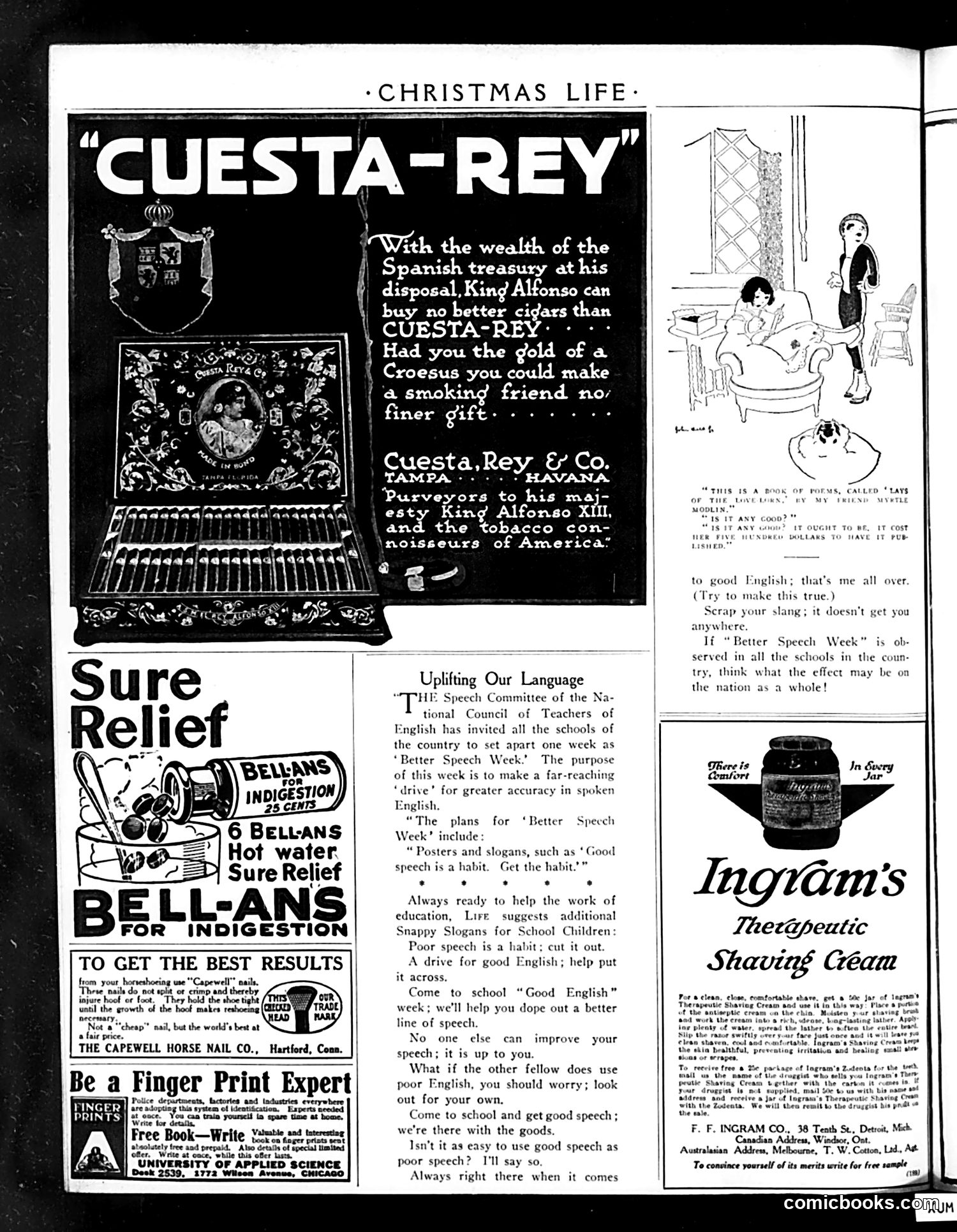
This page combines a luxury cigar advertisement with a satirical commentary on American speech standards, typical of 1920s Life magazine content. **The Cuesta-Rey Advertisement:** The top ad promotes expensive Spanish cigars by claiming King Alfonso XIII of Spain—despite having access to Spain's entire treasury—cannot buy finer cigars. It's aspirational advertising suggesting that owning these cigars demonstrates refined taste equal to royalty. **The Satire:** The bulk of the page mocks the National Council of Teachers of English's "Better Speech Week" initiative, which aimed to improve spoken English in schools. Life ridicules this earnest campaign by suggesting absurd slogans ("Poor speech is a habit; cut it out") and questioning whether lecturing poor speakers actually changes behavior. The magazine's skepticism suggests the campaign is well-intentioned but ultimately ineffective—a common target of Life's satirical humor about progressive educational movements. The page also includes period advertisements for indigestion relief, fingerprinting courses, and shaving cream, filling space in the magazine's typical mixed-content format.
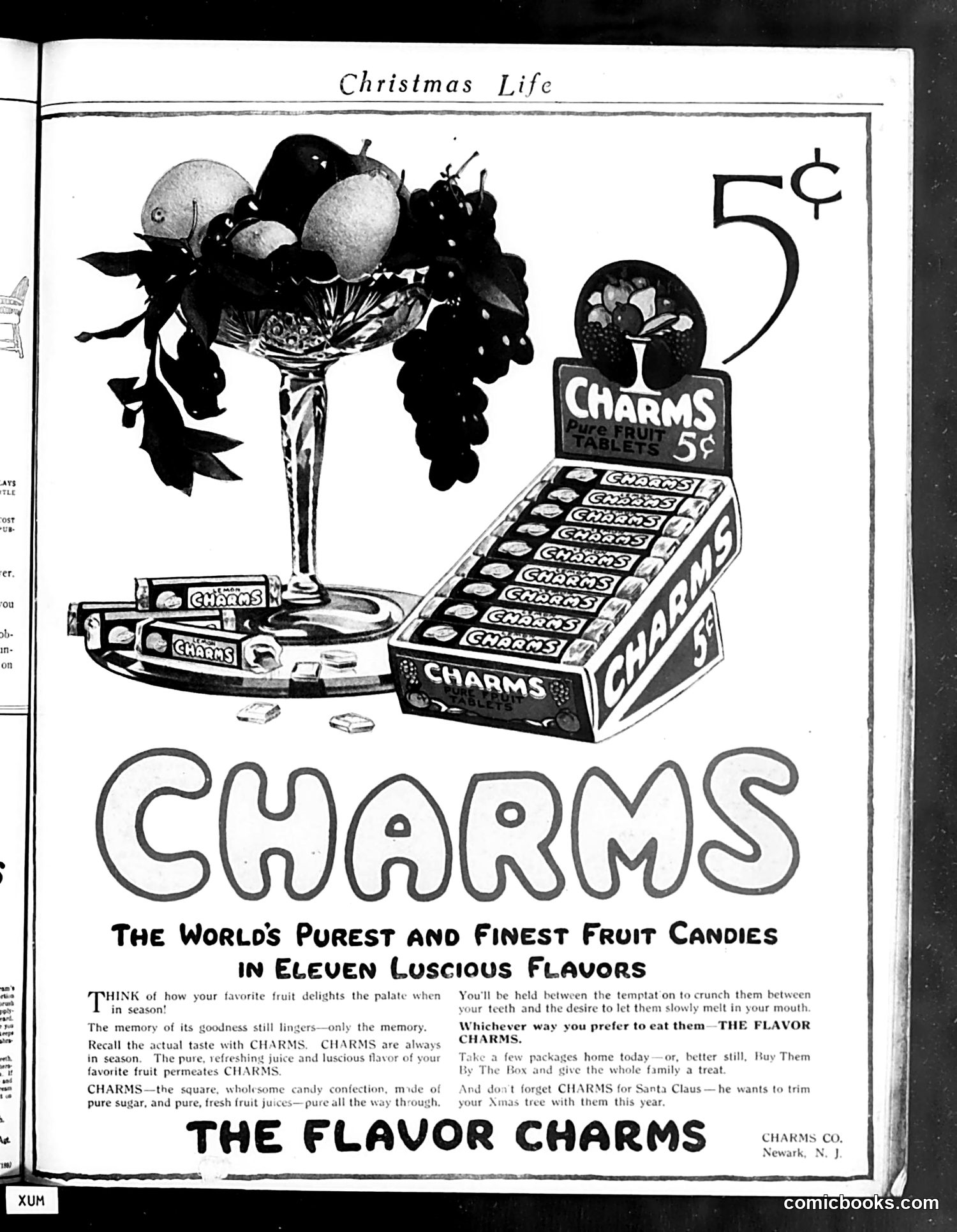
This is a **Christmas advertisement**, not a political cartoon or satire. The page promotes Charms candy—specifically "Pure Fruit Tablets" priced at 5 cents. The ad features a decorative fruit bowl arrangement alongside product packaging and display boxes. The marketing appeal targets holiday gift-giving: the text encourages readers to buy Charms "by the box" as Christmas presents for families, and specifically suggests using them to decorate Christmas trees ("he wants to trim your Xmas tree with them this year"). There is no political commentary, satire, or caricature present. This is straightforward commercial advertising from an era when Life magazine (before becoming primarily a photojournalism publication) contained substantial advertising alongside editorial content. The product positioning emphasizes the candy's pure ingredients and fruity flavors as a wholesome seasonal gift option.
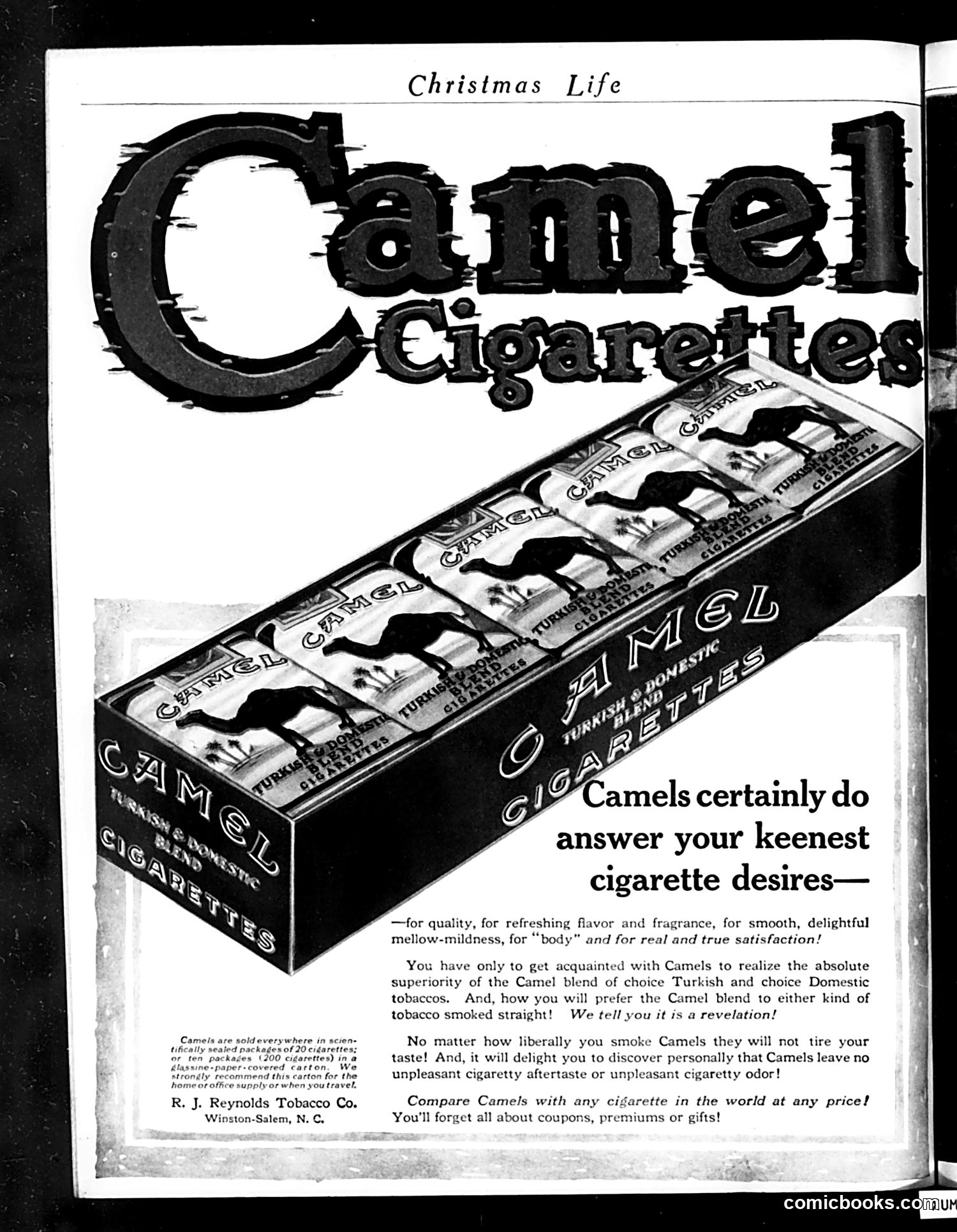
This page is entirely a **Camel cigarette advertisement**, not political satire or editorial cartoon. It appears in *Life* magazine's Christmas issue and promotes Camel cigarettes as an ideal gift. The ad features a product shot of a Camel cigarette carton and makes marketing claims typical of mid-20th-century tobacco advertising: superior flavor, smooth taste, no unpleasant aftertaste, and a blend of Turkish and domestic tobacco. The copy emphasizes quality and satisfaction while challenging consumers to compare Camels favorably against competitors—notably without mentioning health concerns, which would not become standard disclaimers until decades later. The only visual "content" is the branded product box. There is no cartoon, caricature, or satirical commentary present. This represents straightforward commercial advertising from an era when such cigarette promotions were routine in mainstream publications.
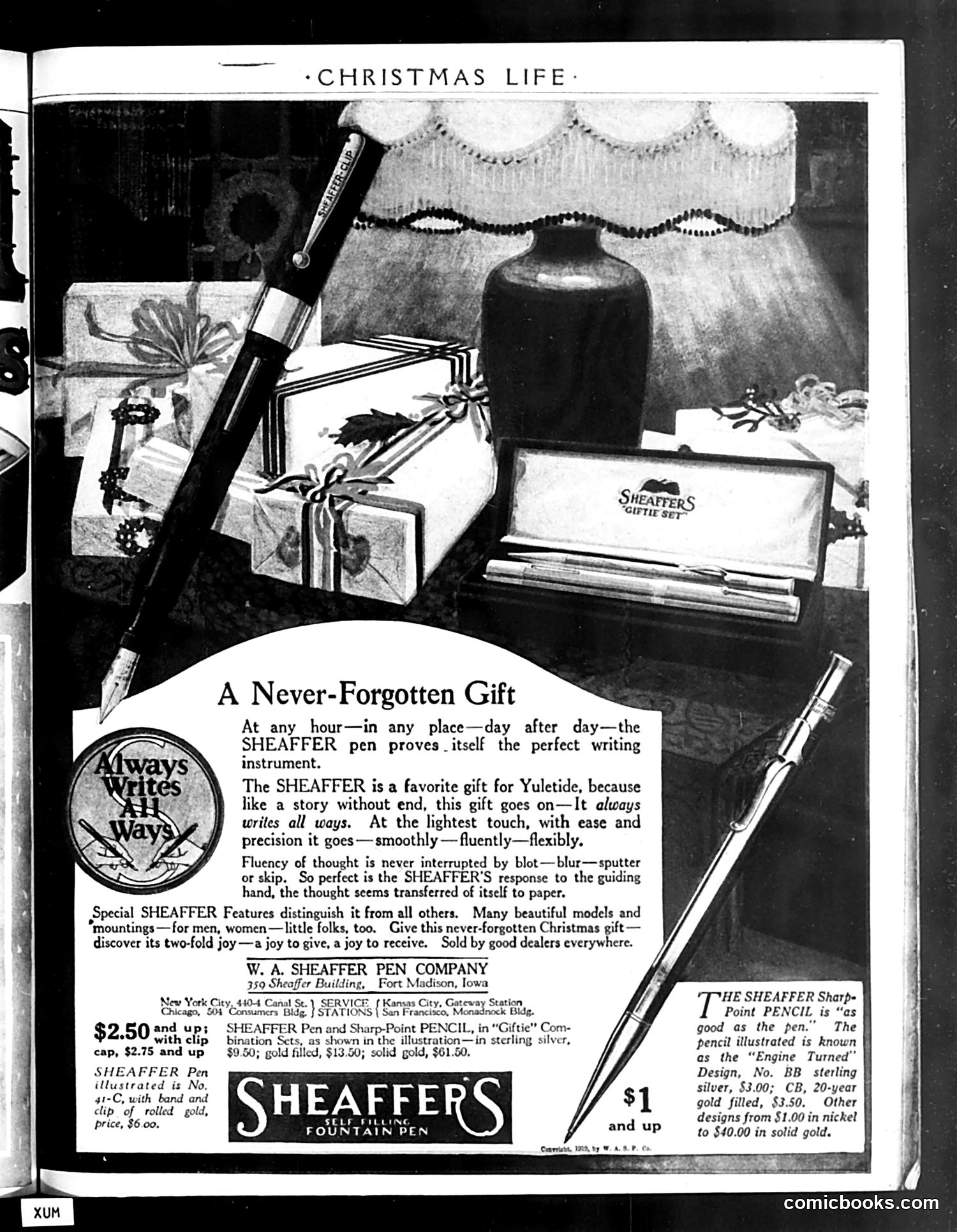
This page is primarily a **Christmas advertisement for Sheaffer pens and pencils**, not a political cartoon. The ad presents fountain pens as ideal luxury gifts for the holiday season, emphasizing their reliability ("always writes all ways") and elegant design. The imagery shows gift-wrapped boxes and decorated pens arranged in an attractive display, appealing to affluent consumers. The marketing copy uses poetic language ("fluency of thought is never interrupted") to position the pen as a sophisticated writing instrument that captures one's thoughts perfectly on paper. Multiple price points ($2.50 to $61.50) suggest products for different budgets—a common retail strategy. The tagline "a never-forgotten gift" promises emotional resonance beyond the product's function, typical of early 20th-century luxury advertising that linked consumer goods to personal relationships and memories. This reflects the era's emphasis on gift-giving as a marker of taste and social status.
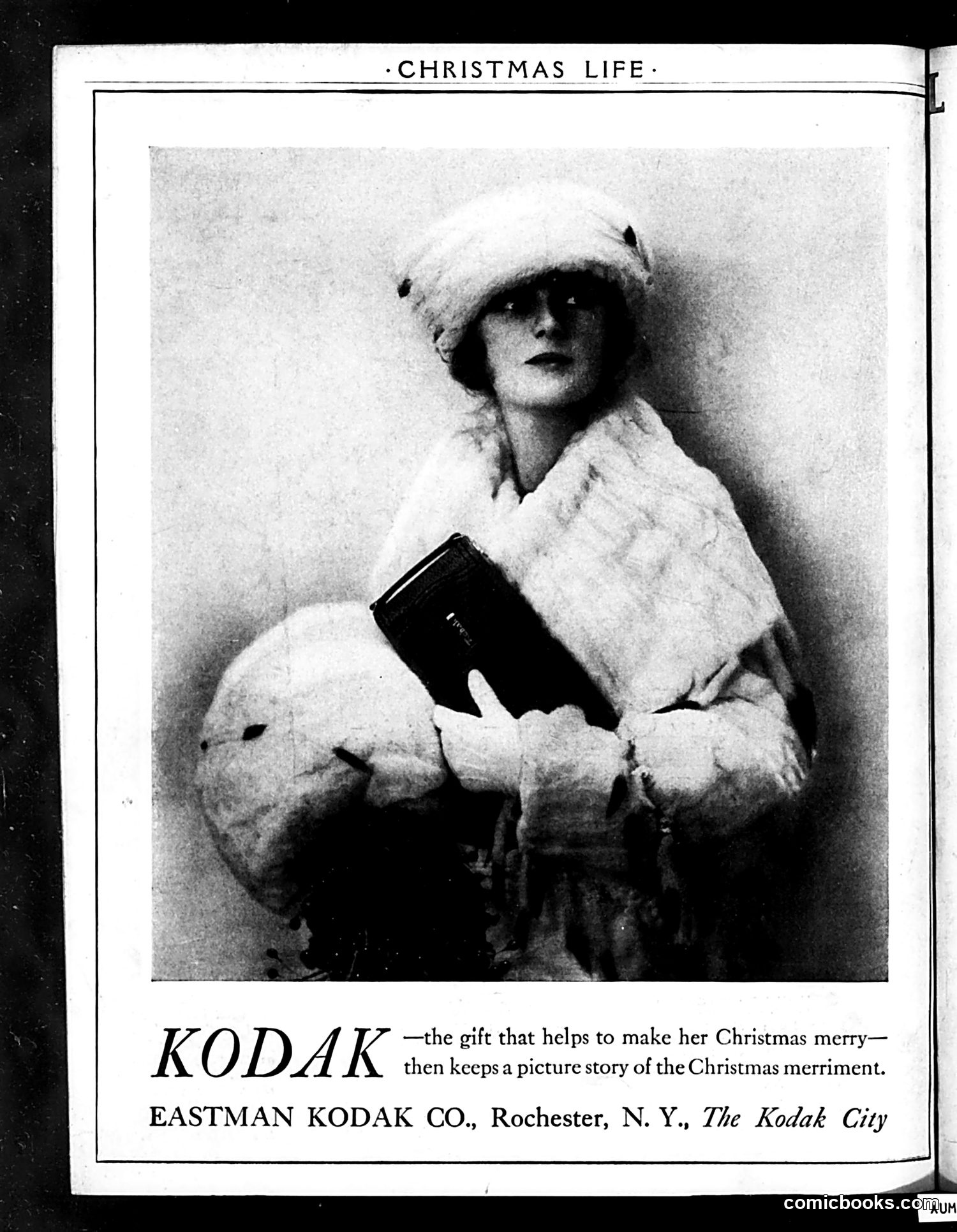
This is a Kodak advertisement from *Life* magazine's Christmas issue, not a political cartoon. The image shows a woman in elegant winter attire (fur stole, decorative hat, dark book) positioned as an aspirational gift recipient. The ad's message positions Kodak cameras as ideal Christmas gifts for women, with the appeal that cameras allow one to "keep a picture story of the Christmas merriment"—capturing memories for posterity. This reflects early 20th-century marketing that associated photography with leisure, domesticity, and feminine refinement. The ad targets affluent consumers by depicting an elegant, well-dressed woman as the ideal camera owner, implying that photography is a cultured pursuit suitable for ladies of means.