
Life, 1919-12-04 · page 44 of 80
Life — December 4, 1919 — page 44: what you’re looking at
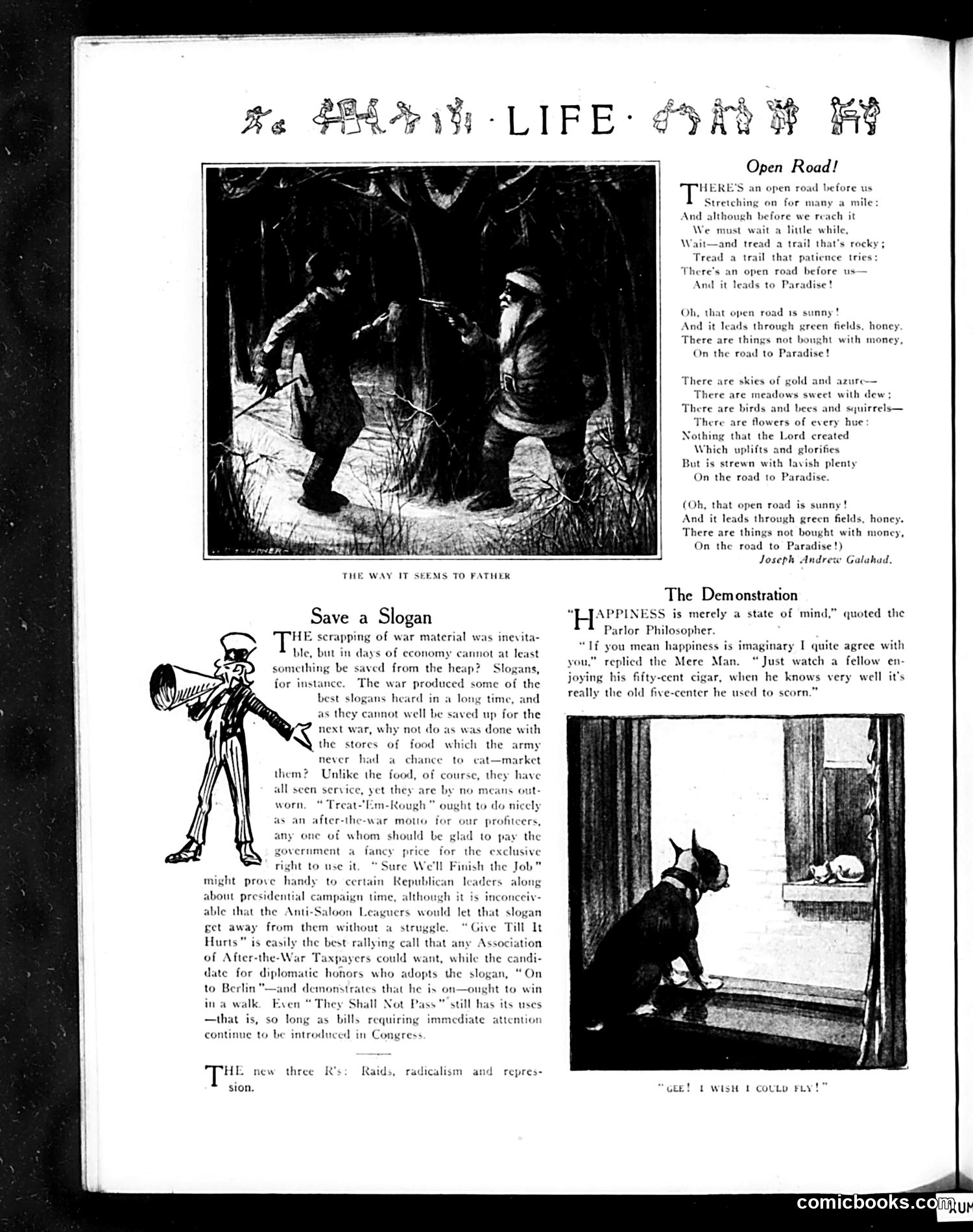
What you’re looking at
This *Life* magazine page contains post-WWI satirical commentary: **"Open Road!"** is an optimistic poem about spiritual/moral progress after wartime hardship—the "road to Paradise" represents a better future beyond material concerns. **"Save a Slogan"** satirizes war profiteering and political opportunism. The piece suggests recycling popular wartime slogans ("Treat-'Em-Rough," "Sure We'll Finish the Job," "Give Till It Hurts") as marketing tools or political messaging for the post-war era. It mocks how politicians and special interests (like Anti-Saloon Leaguers) would exploit these catchphrases for their own gain. **"The Demonstration"** is a brief philosophical joke: a "Parlor Philosopher" claims happiness is imaginary, but a practical man counters that it's real—he just observed someone enjoying a cheap cigar because they *believed* it was expensive. The illustration shows a wistful dog watching through a window, reinforcing the joke about perception versus reality. The overall page reflects post-war cynicism about both idealism and commercial exploitation.
📄 Transcribed text from this page (OCR, searchable)
Machine-transcribed from the original scan — historical spelling and the odd misread are preserved.
Open Road! HERE'S an open road before us Stretching on for many a mile: And although before we reach it We must wait a litle while, Wait—and tread a trail that's rocky; Tread a trail that patience tries: There's an open road before us— Oh, that open road 1s sunny! And it leads through green fields, honey There are things not bought with money, On the road to Paradise! There are skies of gold and azuro— There are meadows sweet with dew; There are There are flowers of every hue Nothing that the Lord created Which uplifts and glorifies But is strewn with lavish plenty On the road to Paradise. rds and bees and squirrels— (Oh, that open road is sunny And it leads through green fields, honey. There are things not bought with money, On the road to Paradise!) THE WAY IT SEEMS TO FATHER Save a Slogan HE scrapping of war material was inevita- Ue, but in days of economy cannot at least something be saved from the heap? Slogans, for instance. The war produced some of the s heard in a long time, and not well be saved up for the best slo; as they ca next war, why not do as was done with the stores of food which the army never had a chance to cat—market them? Unlike the food, of course, they have all seen service, yet they worn. “ Treat-'Em-Rough e by no ans out- ought to do nicely as an after-the-war motto for our profitcers, any one of whom should be glad to pay the government a fancy price for the exclusive right to use it. “Sure We'll Finish the Job” might prove handy to certain Kepublican leaders along about presidential campaign time, althe inconceiv- able that the Anti-Saloon Leaguers would let that slogan get away from them without a struggle. “Give Till It Hurts" is easily the best rallying call that any Association of After-the-War Taxpayers could want, while the candi- date for diplomatic honors who adopts the slogan, “On to Berlin” 1 demonstrates that he is on—ought to win ina walk ven “ They Shall Not Pass" still has its uses —that is, so long as bills requiring immediate attention continue to be introduced in Congress THe new three R's: Raids, sion. radicalism and repres- Joseph Andrew Galahad The Demonstration se! APPID S is merely a state of mind,” quoted the Parlor Philosopher. “Tf you mean happiness is imaginary I quite agree with you,” replied the Mere Man. “Just watch a fellow en- joying his fifty-cent cigar, when he knows very well it's really the old five-center he used to scorn.” “Gee! 1 Wis 1 COULD FL comicbooks.comtf