
Life, 1919-12-04 · page 32 of 80
Life — December 4, 1919 — page 32: what you’re looking at
What you’re looking at
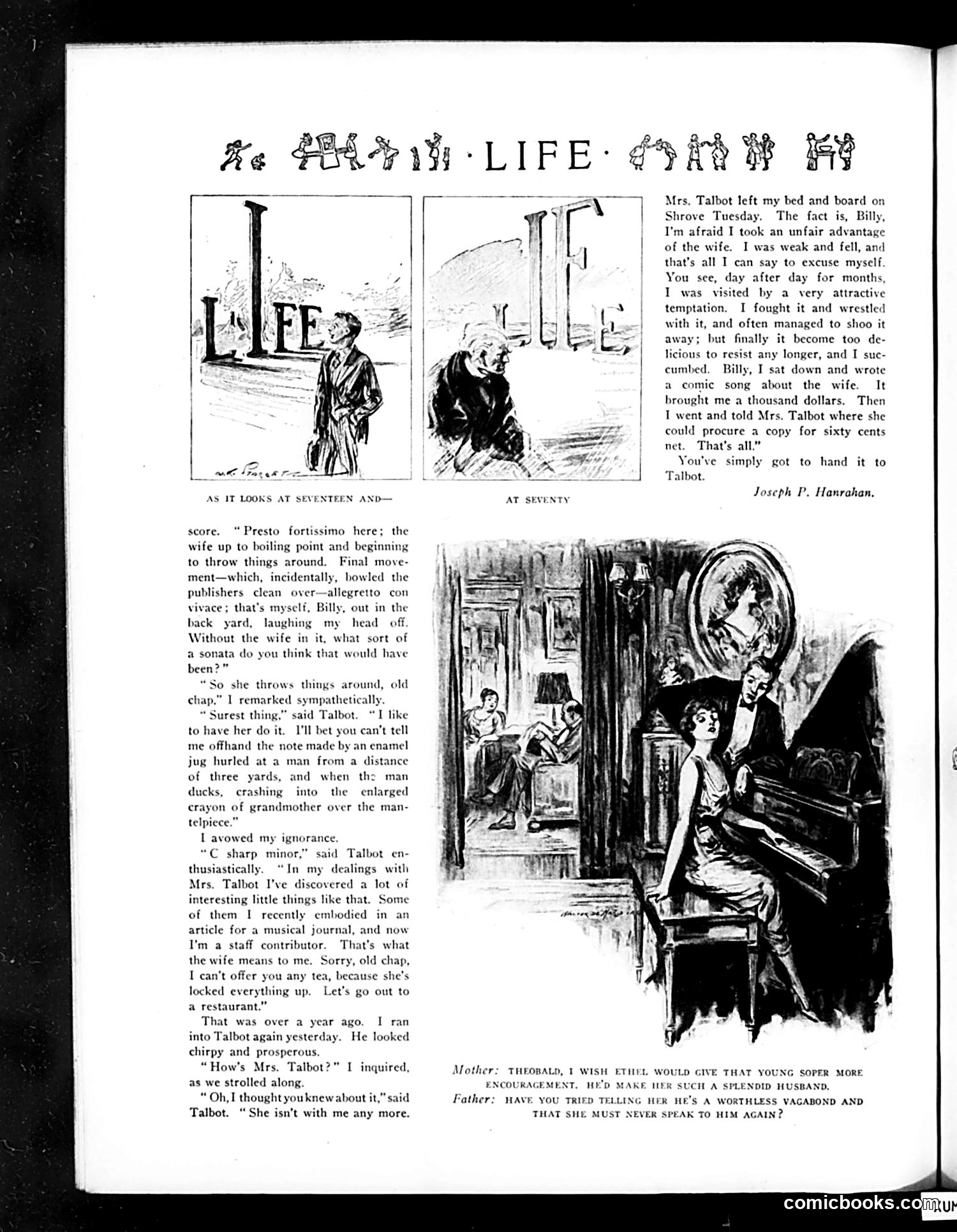
This page presents a comedic story about a husband who exploits his wife's anger for artistic profit. The narrative describes a man named Talbot who writes a comic song about his quarrelsome wife, earning $1,000 from publishers. Rather than hide this from her, he tells her exactly where to buy it for 60 cents—deliberately provoking her further. He romanticizes their conflict, even cataloging the "musical" sounds of household objects she throws at him, which he later publishes in musical journals as a "staff contributor." The satire targets early 20th-century commercialism and masculine opportunism: a man profits from marital discord while portraying himself as clever and his wife as a shrew. The bottom illustration shows parents encouraging their daughter toward an unsuitable suitor—reversing typical matchmaking logic through sardonic advice. The humor relies on readers recognizing the husband's shameless commodification of domestic strife and his self-congratulatory obliviousness to his own moral failings.
📄 Transcribed text from this page (OCR, searchable)
Machine-transcribed from the original scan — historical spelling and the odd misread are preserved.
Ke HAY - LIFE: figs Fe Mrs, Talbot left my bed and board on Shrove Tuesday. The fact is, Billy, I'm afraid I took an unfair advantage of the wife. I was weak and fell, and that’s all I can say to excuse myself. You see, day after day for months, I was visited by a very attractive temptation. I fought it and wrestled with it, and often managed to shoo it away; but finally it become too de- licious to resist any longer, and I suc- cumbed. Billy, I sat down and wrote a comic song about the wife. It brought me a thousand dollars. Then I went and told Mrs. Talbot where she could procure a copy for sixty cents net. That's all.” _ My 7 er bd You've simply got to hand it to ae Recere L tS. = is Talbot. sseph P. AS 1T LOOKS AT SEVENTEEN AND— Joseph P. Hanrahan, score. “Presto fortissimo here; the wife up to boiling point and beginning to throw things around. Final move- ment—which, incidentally, bowled the publishers clean over—allegretto con vivace; that’s myself, Billy, out in the back yard, laughing my head off. Without the wife in it, what sort of a sonata do you think that would have been?” “So she throws things around, old chap,” I remarked sympathetically. Surest thing,” said Talbot. “I like to have her do it. I'll bet you can’t tell : me offhand the note made by an enamel : \ f , jug hurled at a man from a distance 7 i of three yards, and when tho man ducks, crashing into the enlarged ayon of grandmother over the man- telpiece.” L avowed my ignorance. “C sharp minor,” said Talbot en- thusiastically. “In my dealings with Mrs. Talbot I’ve discovered a lot of interesting little things like that. Some of them I recently embodied in an article for a musical journal, and now I'm a staff contributor. That's what the wife means to me. Sorry, old chap, I can’t offer you any tea, because she’s locked everything up. Let's go out to a restaurant.” That was over a year ago. I ran into Talbot again yesterday. He looked chirpy and prosperous. “How's Mrs. Talbot?” I inquired, Mother: THEOBALD, 1 WISH ETHEL WOULD GIVE THAT YOUNG SOPER MORE as we strolled along. ENCOURAGEMENT, HE'D MAKE HER SUCH A SPLENDID HUSBAND, “ Oh, I thought youknew about it,” said Father: WAVe YOU TRIED TELLING HER HE'S A WORTHLESS VAGABOND AND Talbot. “She isn’t with me any more. THAT SHE MUST NEVER SPEAK TO HIM AGAIN? comicbooks.comnm