
A complete issue · 48 pages · 1919
Life — October 2, 1919
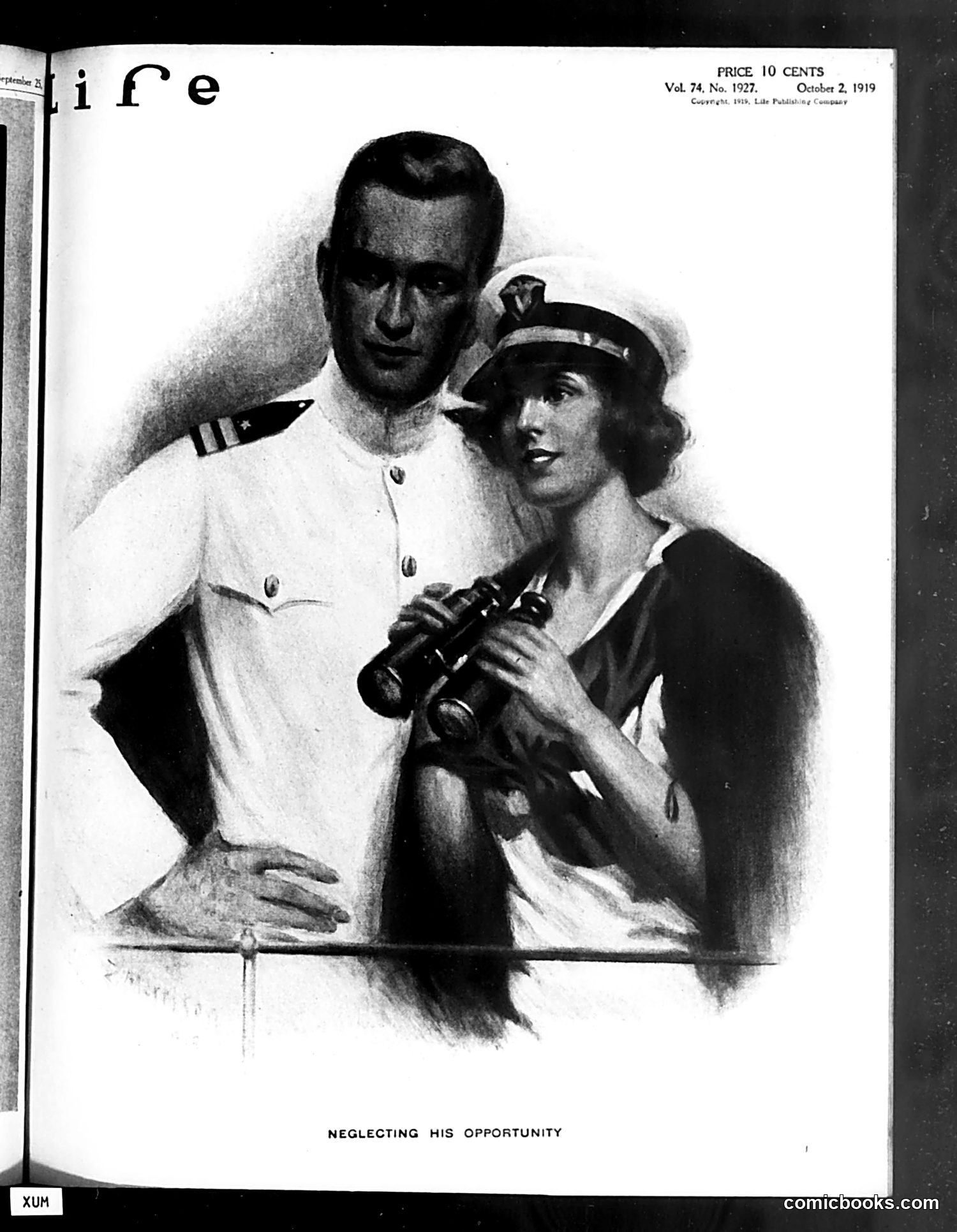
This satirical illustration is titled "Neglecting His Opportunity" and depicts a naval officer in white uniform standing behind a woman holding binoculars. The caption's meaning appears to reference a missed chance or failure to act—likely a contemporary political or social situation from October 1919. The woman in naval attire with binoculars suggests she's actively observing or "keeping watch," while the officer behind her remains passive. The satire likely criticizes male passivity or inaction during a period when women were increasingly visible in public roles, particularly during or after World War I. Without additional context about specific 1919 events, the precise political reference remains unclear, though the gendered commentary on initiative and responsibility is evident.
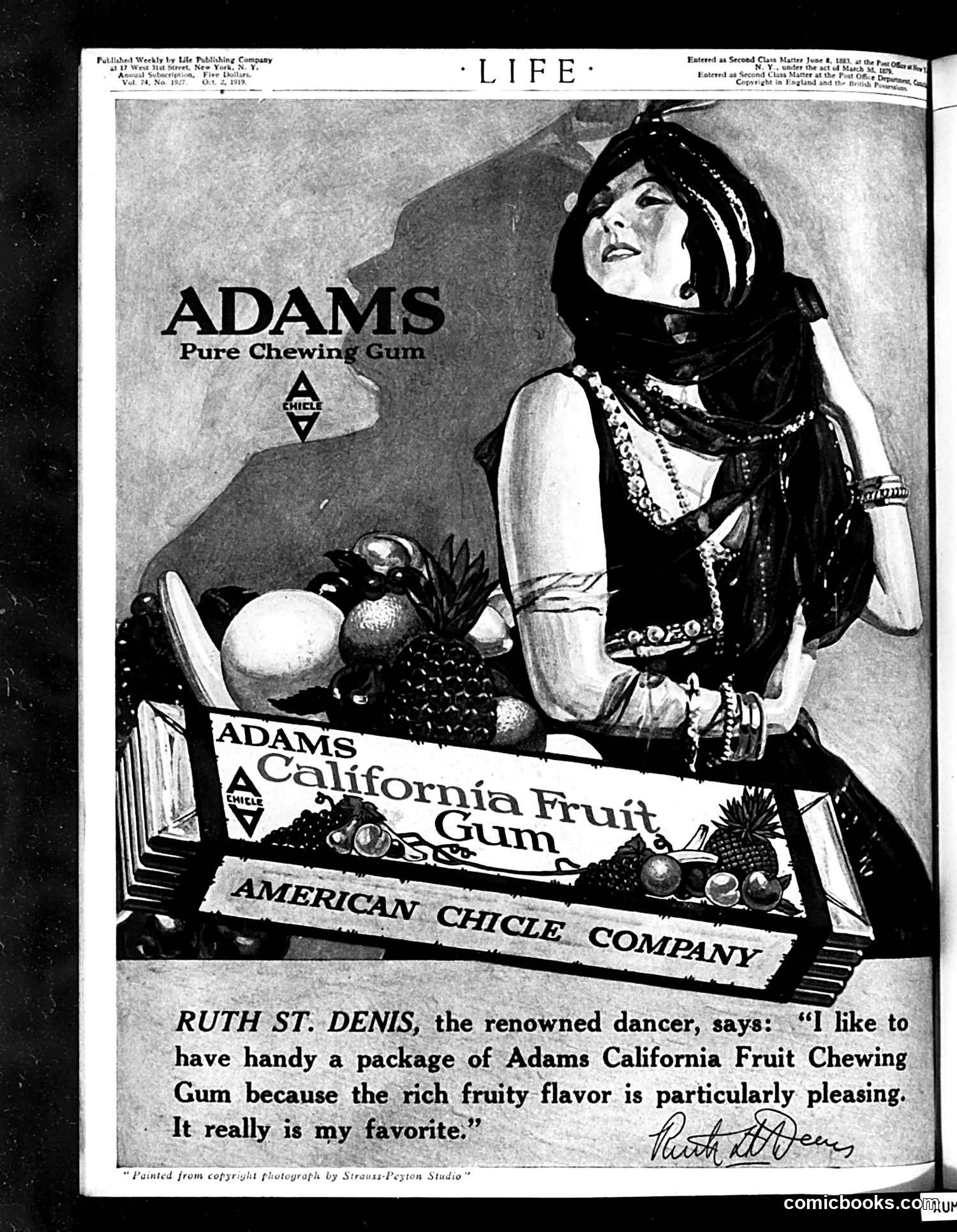
This is **not a political cartoon or satire**—it's a straightforward **advertisement** for Adams chewing gum, appearing in Life magazine. The page features Ruth St. Denis, a renowned dancer of the era, endorsing Adams California Fruit Chewing Gum. She's photographed in exotic costume (turban, jewelry, flowing fabrics) positioned with a display of fresh fruit and product packaging. The text includes her testimonial praising the gum's "rich fruity flavor." This represents typical early 20th-century celebrity endorsement advertising, where famous performers lent their names and likenesses to consumer products. The exotic styling reflects period aesthetics and marketing strategies targeting aspirational consumers. There is no satirical content—Life regularly published advertisements alongside editorial material.
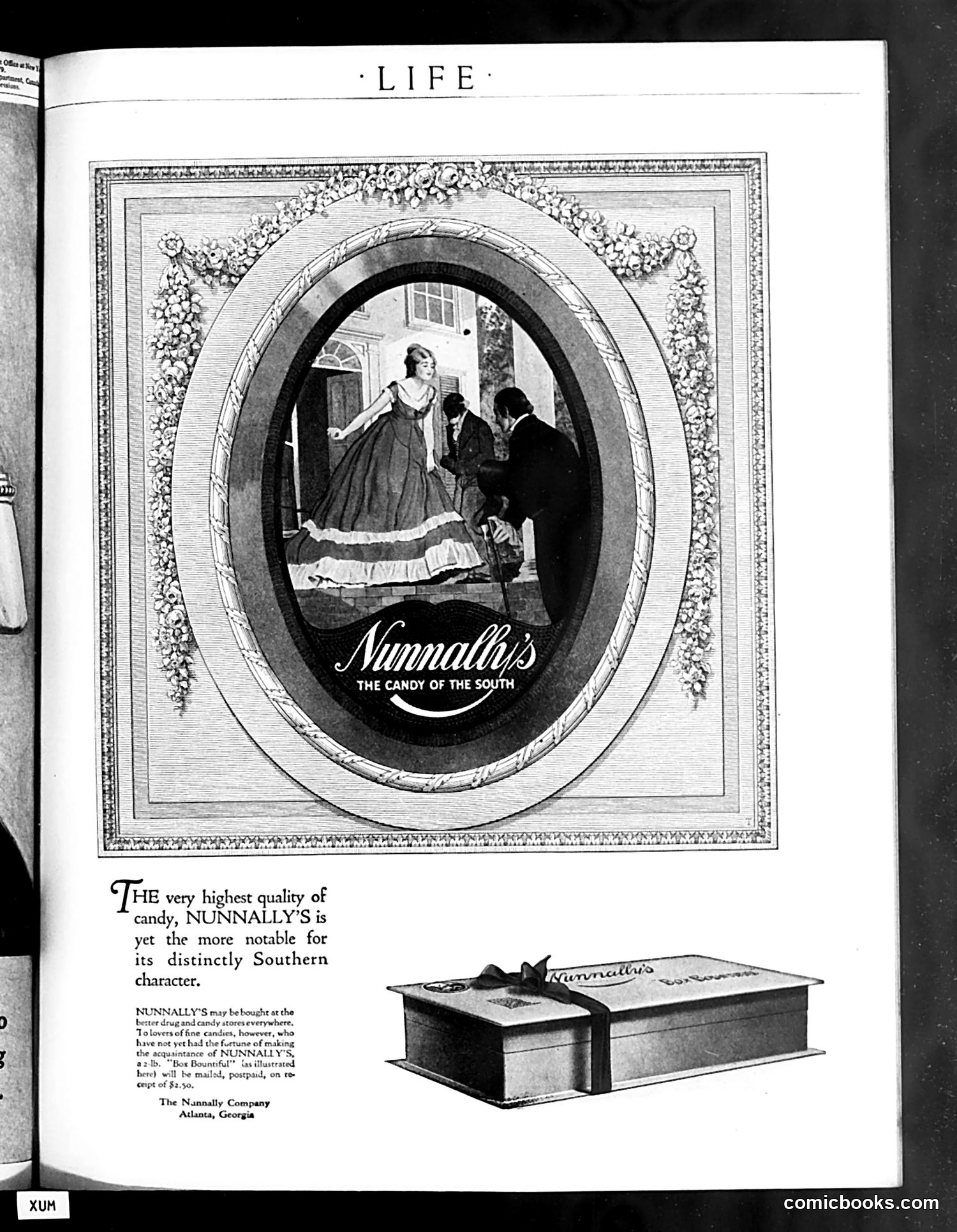
This page is primarily a **advertisement for Nunnally's candy**, not political satire. The "LIFE" masthead indicates it appeared in the satirical magazine, but the content is commercial. The ad shows an elegant Southern woman in a formal dress receiving male visitors in what appears to be an antebellum-era interior setting. The imagery romanticizes the Old South through period costume and décor. The text emphasizes Nunnally's "distinctly Southern character," marketing the candy by associating it with Southern gentility and tradition. The product box appears at bottom right. The ad appears designed to appeal to nostalgic perceptions of Southern refinement, positioning Nunnally's as an authentically Southern luxury product manufactured in Atlanta, Georgia.
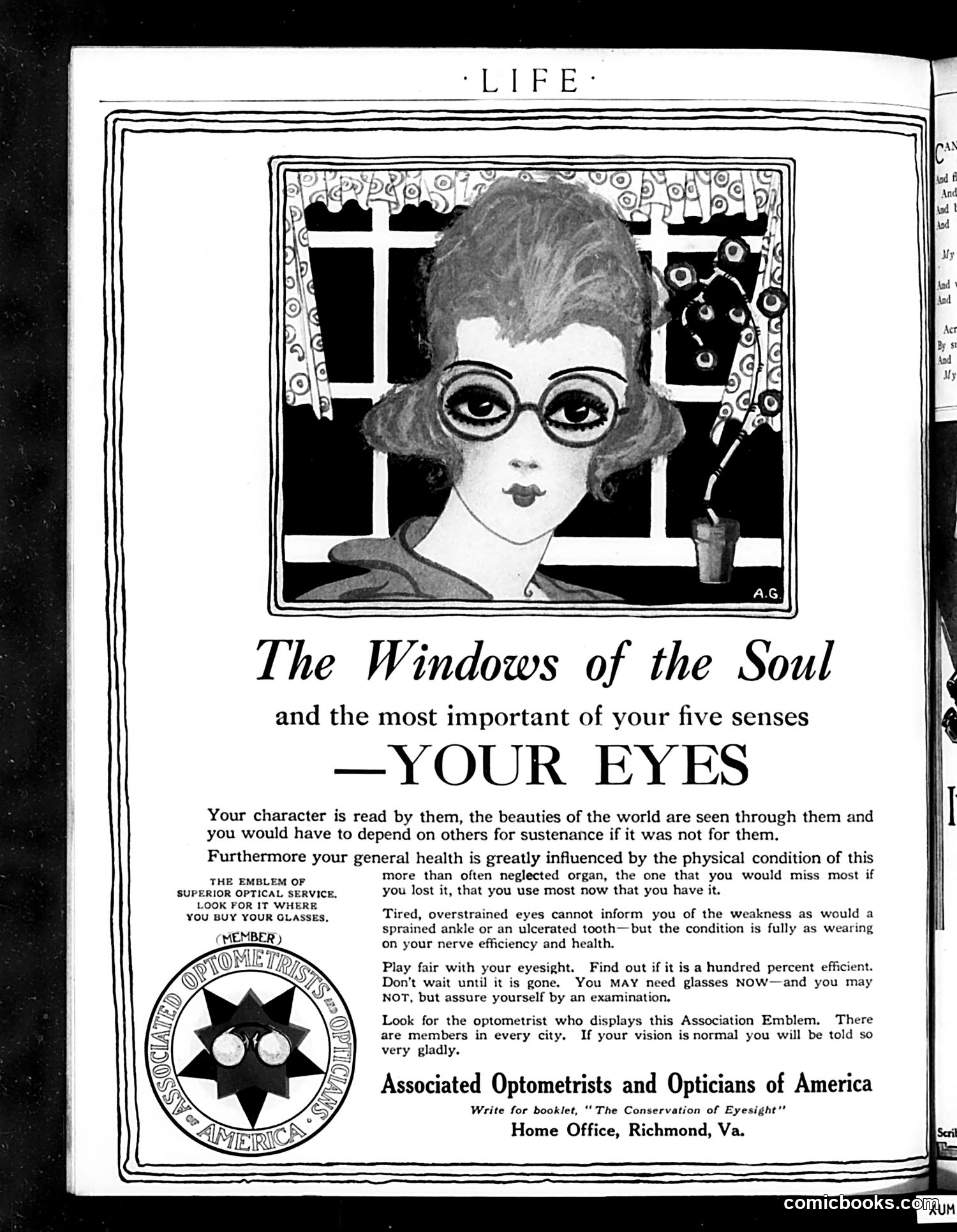
This is **not a political cartoon but an advertisement** from Life magazine. The page promotes eye care through the Associated Optometrists and Opticians of America. The illustration shows a stylized woman wearing round glasses, captioned "The Windows of the Soul"—a period phrase referring to eyes. The ad's message is straightforward health advocacy: eyes are crucial to character perception and physical health, yet often neglected. It encourages readers to get eye examinations, warning that tired or strained eyes signal weakness just as a sprained ankle would. The piece uses persuasive messaging typical of early 20th-century advertising, appealing to vanity (character assessment) and health consciousness to drive optometry visits. The Association Emblem helped readers identify qualified practitioners in their cities.
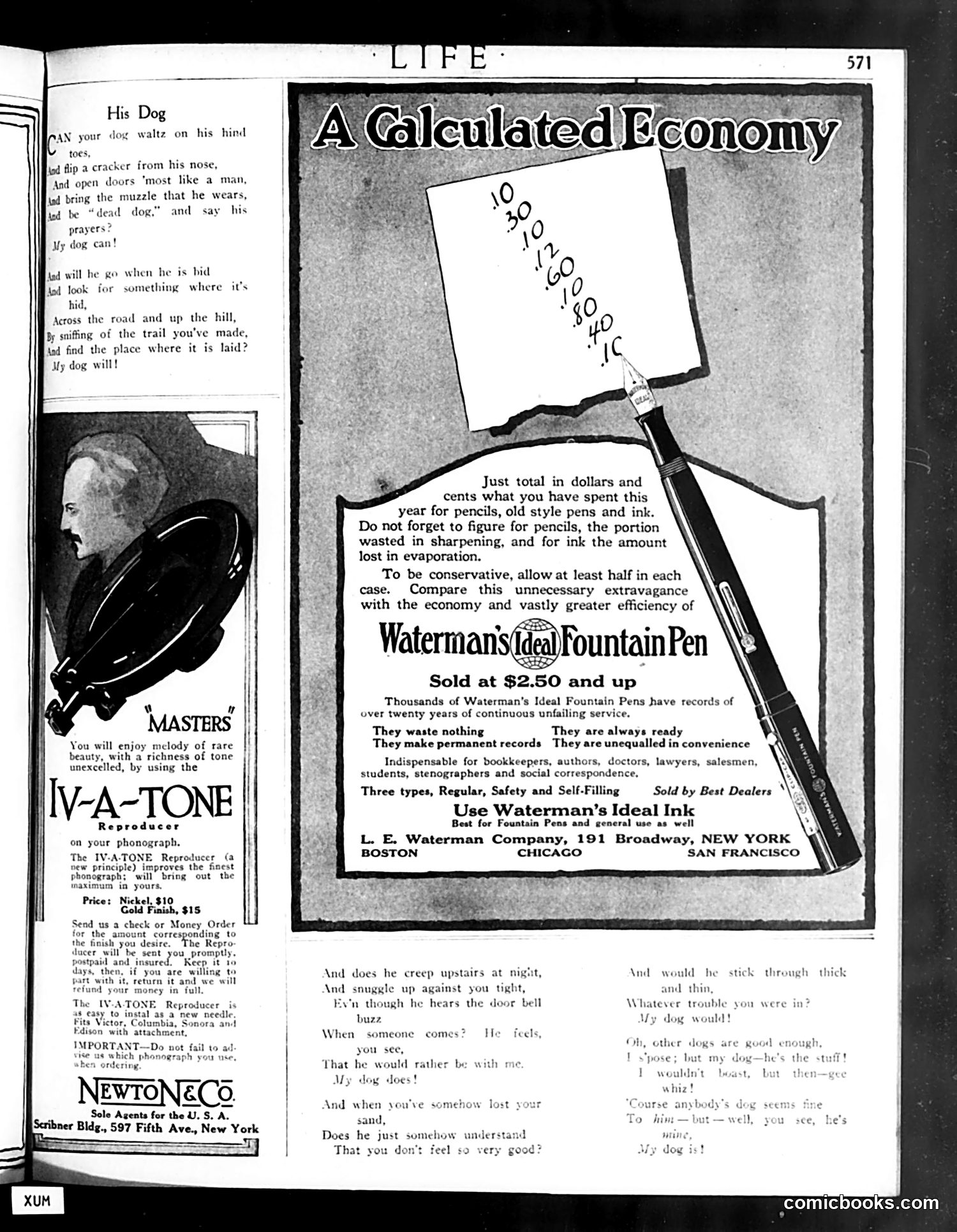
This page is primarily **advertising**, not political satire. The dominant feature is a full-page advertisement for Waterman's Ideal Fountain Pen, centered on the concept of "A Calculated Economy." The ad presents a ledger-style calculation of annual spending on writing supplies (pencils, pens, ink), arguing that waste from sharpening and evaporation makes fountain pens more economical. The visual shows a fountain pen next to a tally sheet. Below the main ad are smaller advertisements: IV-A-TONE Reproducers (a phonograph accessory) on the left, and Newton & Co. (sellers of IV-A-TONE) at bottom left. The page also includes a poem titled "His Dog" in the upper left, unrelated to the advertisements. This reflects early 20th-century consumer marketing emphasizing efficiency and cost-saving.
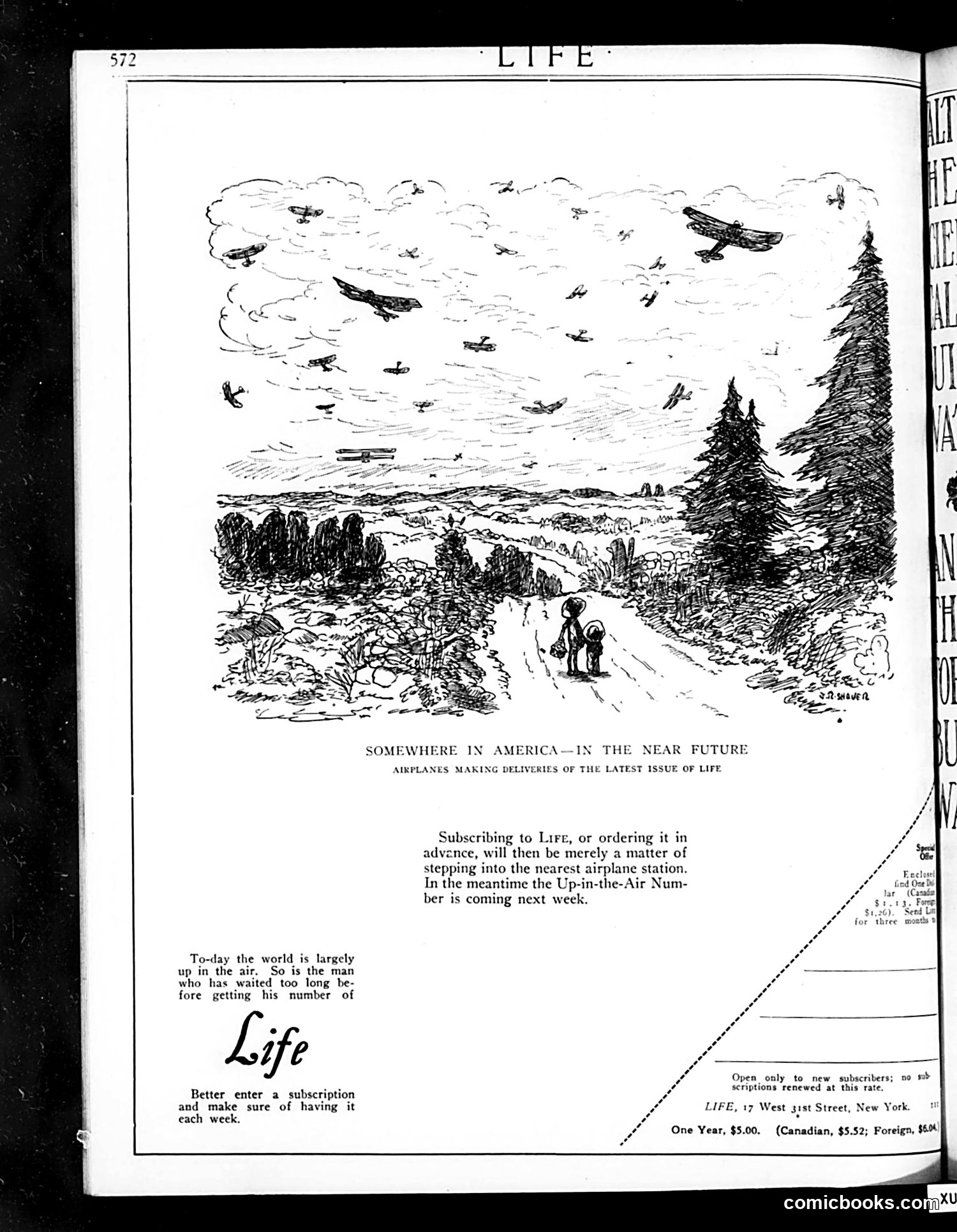
This page is primarily an **advertisement for Life magazine subscriptions**, not a political cartoon. The illustration depicts a futuristic vision titled "Somewhere in America—In the Near Future," showing multiple airplanes delivering copies of Life magazine to a rural landscape. A figure stands on a country road watching aircraft overhead. The satire is gentle: it promotes the idea that Life magazine will become so essential and widespread that delivery by airplane will be necessary to meet demand. The text emphasizes that subscribing is easier than waiting to purchase copies at "airplane stations." This reflects **early-20th-century optimism about aviation technology** and Life's confidence in its own popularity. The advertisement targets readers who don't want to miss issues of the satirical weekly.
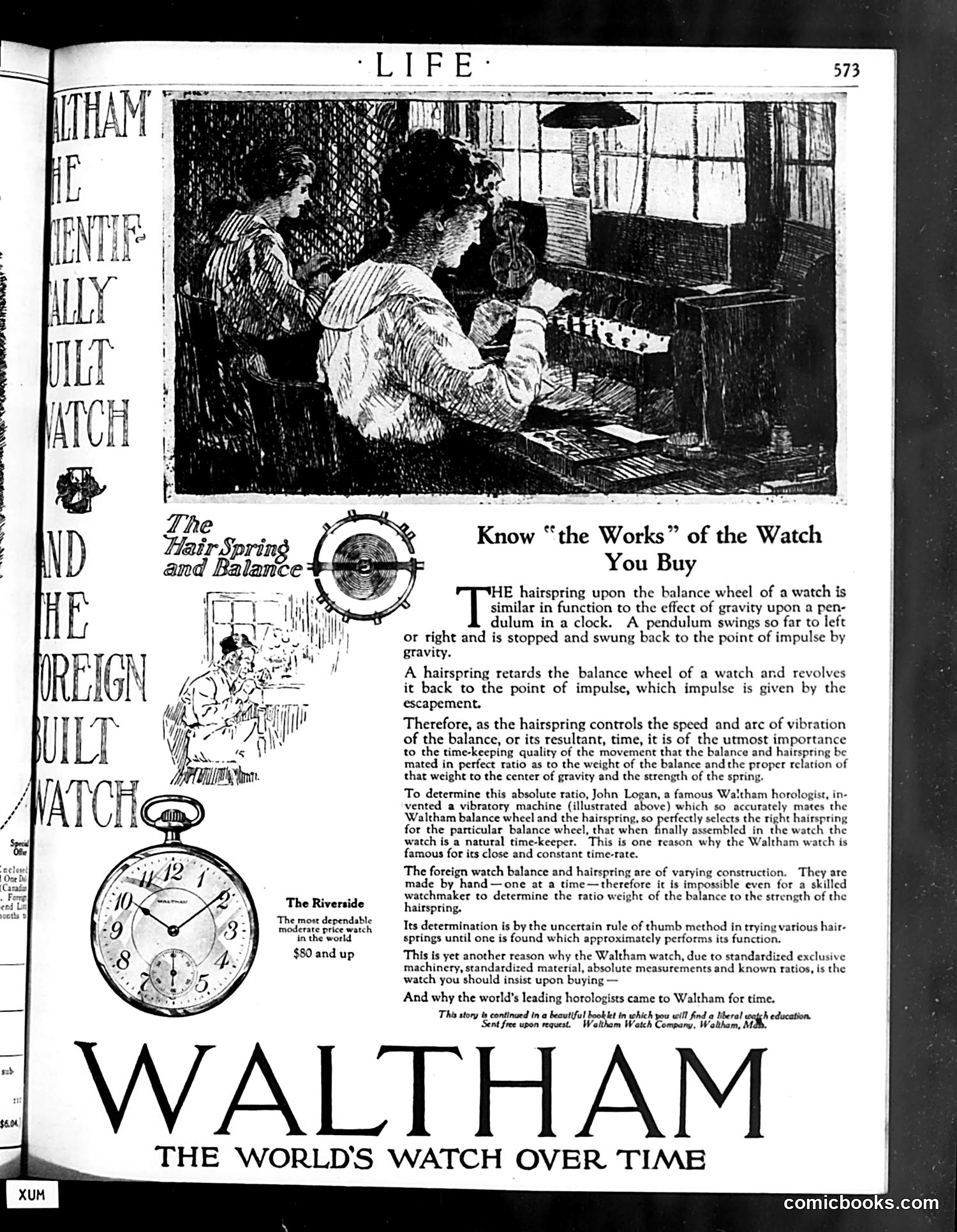
This is primarily a **Waltham Watch advertisement**, not political satire. The page contains: 1. **Top illustration**: Three women at a watch factory workstation, depicting manufacturing/quality control. 2. **Educational content**: Text explaining watch mechanics—specifically how a hairspring and balance wheel function similarly to a pendulum, controlling timekeeping accuracy. 3. **Product positioning**: The ad emphasizes that Waltham watches use standardized machinery and precise measurements, unlike foreign hand-made watches where quality varies unpredictably. This standardization is presented as superior. 4. **The "Riverside" model**: Shown with price "$80 and up," marketed as a reliable, moderately-priced watch. The messaging appeals to American consumer confidence in industrial standardization and manufacturing precision as markers of quality—a common early 20th-century advertising strategy contrasting American mass production favorably against European craftsmanship.
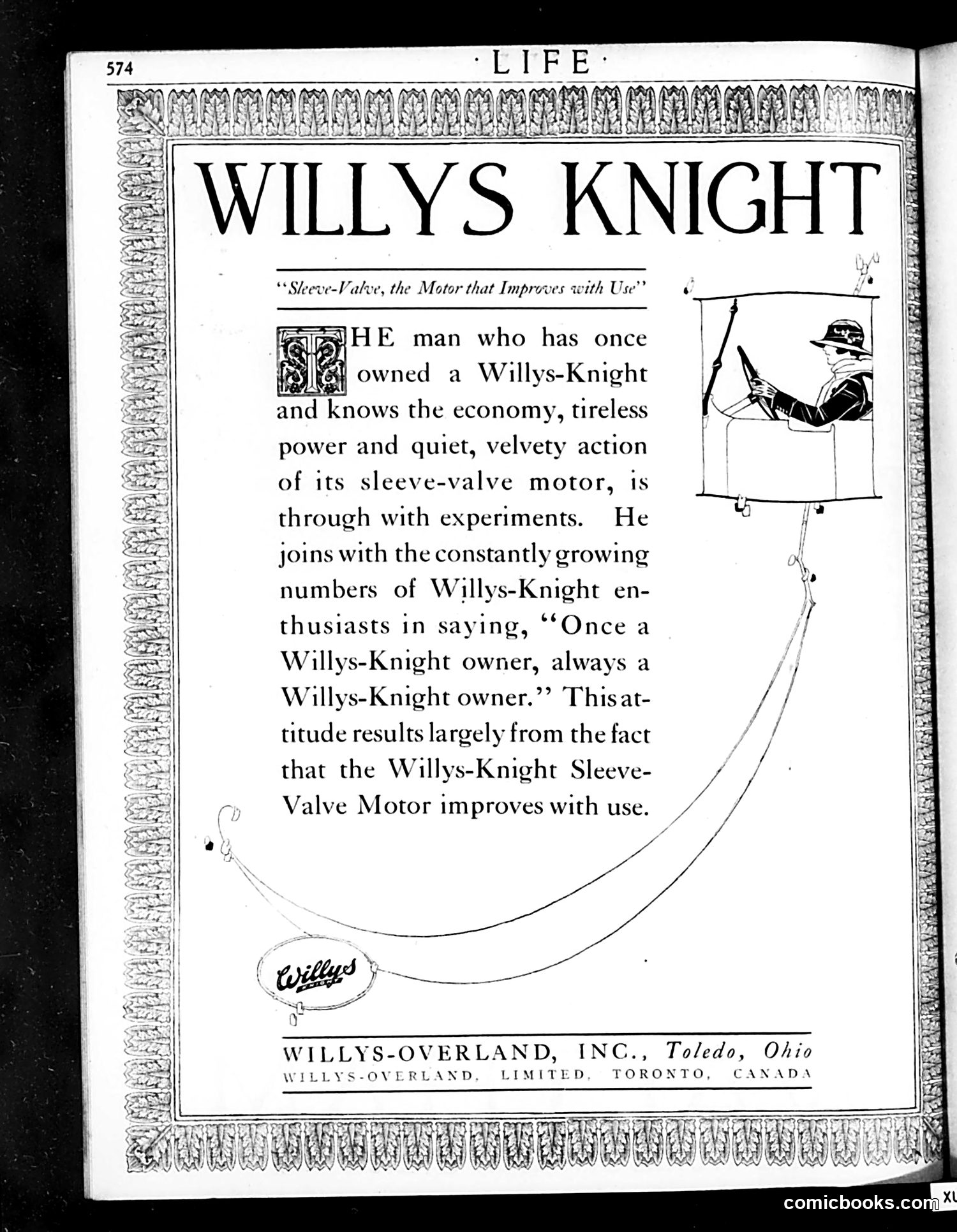
This is an automobile advertisement for the Willys-Knight, not a political cartoon. The page promotes the car's "Sleeve-Valve" motor technology, emphasizing that the engine improves with use and becomes more economical and quieter over time—an unusual selling point that suggests earlier cars often degraded in performance. The accompanying illustration shows a satisfied male driver in a car, representing the typical Willys-Knight owner. The ad's central argument is brand loyalty: "Once a Willys-Knight owner, always a Willys-Knight owner," positioning the car as reliable and worth keeping long-term. The company (Willys-Overland, Inc.) was based in Toledo, Ohio, with a Canadian affiliate in Toronto.
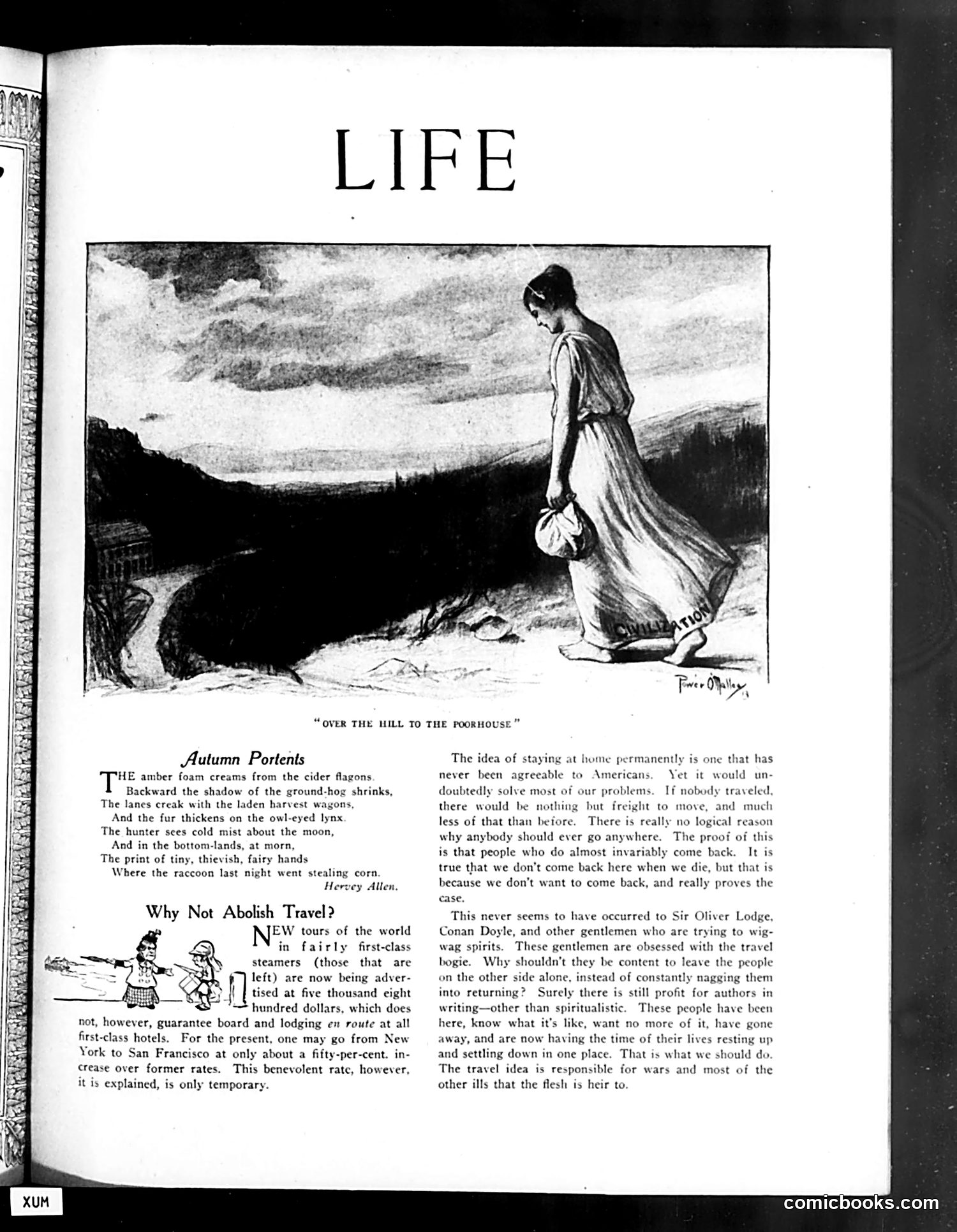
This page from *Life* magazine contains two distinct pieces: **Top illustration** ("Over the Hill to the Poorhouse"): A sketch of a woman in classical dress walking toward a distant poorhouse, carrying a bundle. This accompanies "Autumn Portents," a poem by Harvey Allen about aging and hardship—a sentimental piece, not satire. **Bottom section** ("Why Not Abolish Travel?"): A satirical article mocking spiritualist claims about travel. It references "Sir Oliver Lodge" and "Conan Doyle"—prominent spiritualists of the early 20th century—who allegedly claimed spirits could provide the benefits of world travel without leaving home. The satire ridicules this notion, suggesting spiritualists promote immobility while claiming transcendent experiences. The accompanying illustration shows two figures, likely representing these spiritualist advocates. The satire targets pseudo-scientific spiritualism popular in that era.
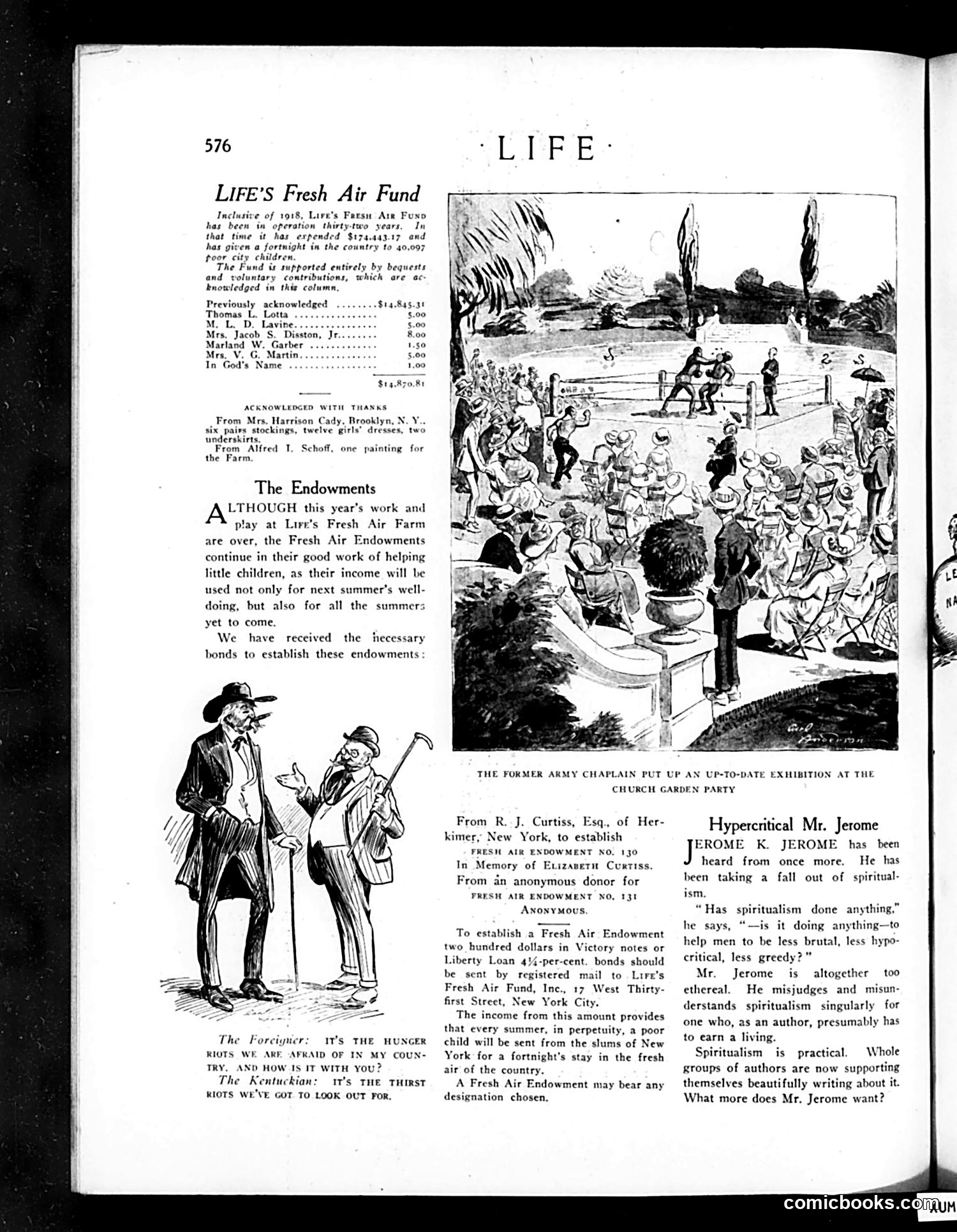
This page documents LIFE's Fresh Air Fund, a charitable program sending poor urban children to the countryside for summer stays. The large illustration shows a crowded recreational gathering at what appears to be a church garden party, depicting the fund's beneficiaries enjoying outdoor activities. The cartoon below features two figures labeled "The Foreigner" and "The Kentickyian," discussing hunger and thirst. The dialogue ("It's the hunger riots we are afraid of in my country / And how is it with you? / It's the thirst riots we've got to look out for") appears to satirize regional American social problems—implying urban (foreign/immigrant) concerns versus rural (Kentucky) concerns differ markedly. The satire critiques American inequality and regional disparities in living conditions during the Progressive Era.
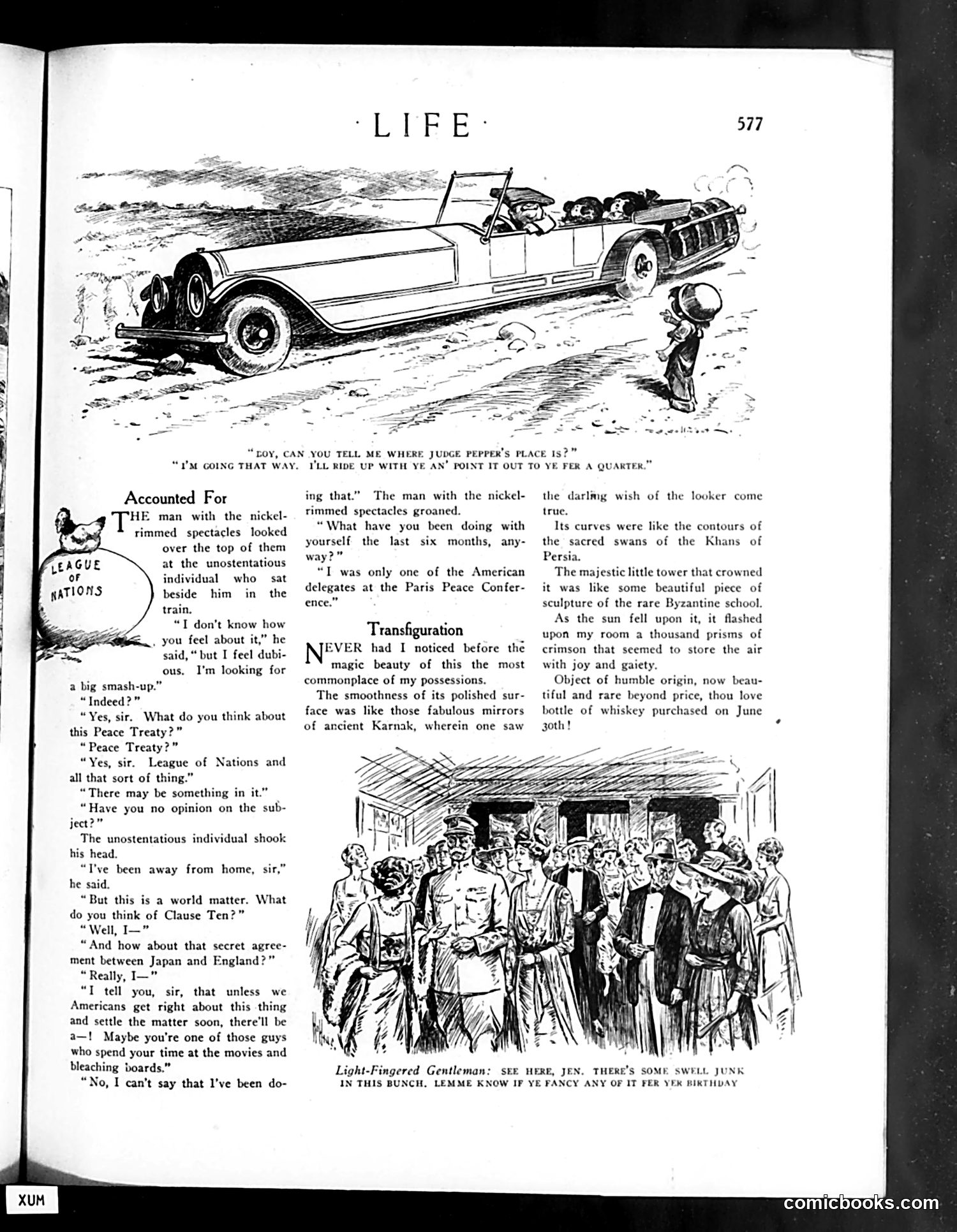
The top cartoon depicts a long automobile stopping to ask directions to "Judge Pepper's place," with the caption suggesting someone will be "rode up with ye an' point it out to ye fer a quarter" — satirizing rural poverty and the commercialization of even basic hospitality. The main story, "Accounted For," features a man with nickel-rimmed spectacles discussing post-WWI politics. He's a common citizen expressing skepticism about the League of Nations and peace treaties, particularly regarding secret agreements between Japan and England. This reflects 1920s American isolationism and public distrust of international entanglements following World War I. The lower illustration shows a formal social gathering, captioned as "Light-Fingered Gentleman," likely satirizing theft or moral corruption among the wealthy elite.
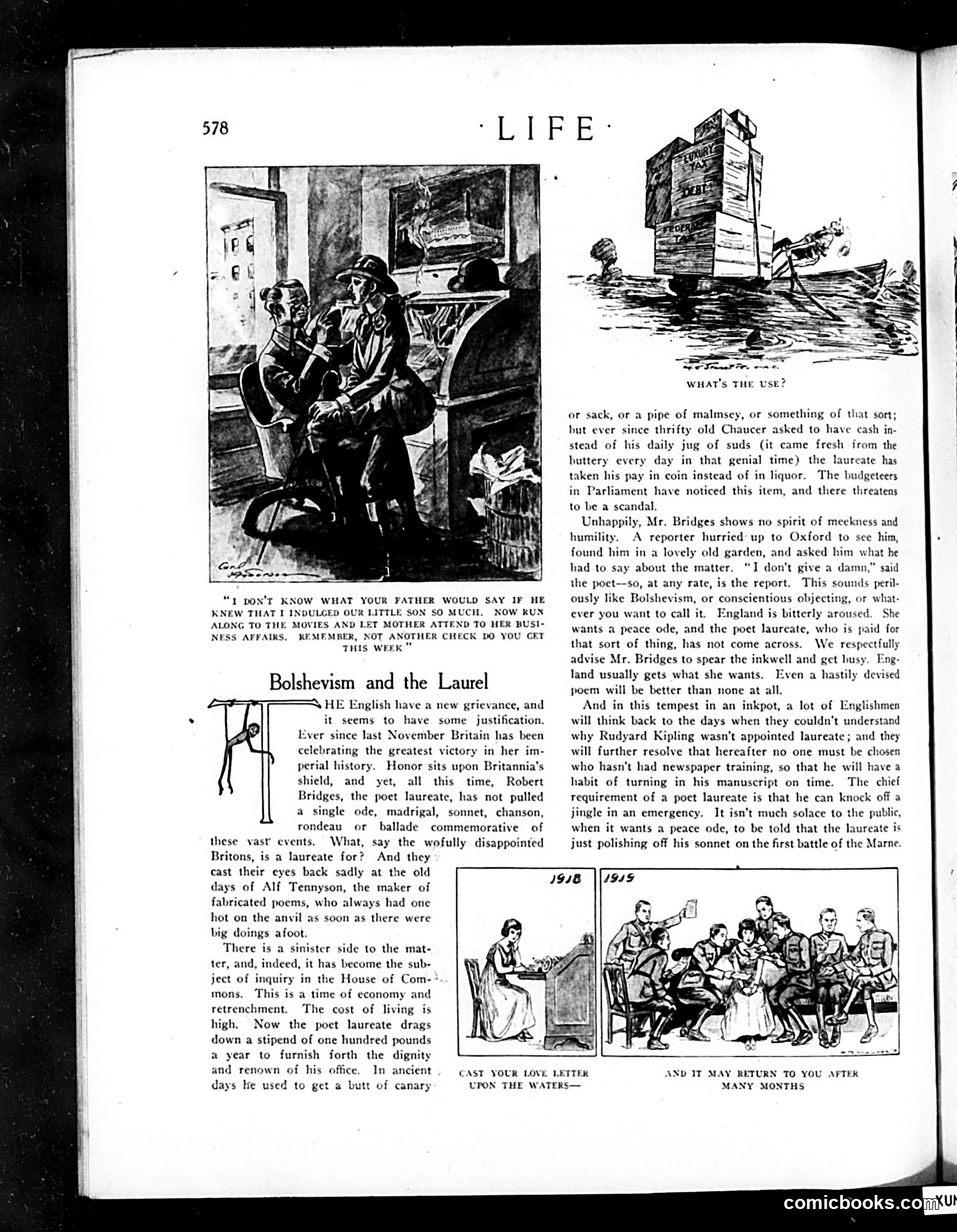
This page satirizes the debate over whether Robert Bridges, Britain's Poet Laureate, should have been appointed. The article criticizes those disappointed by his selection, arguing that England "wants a peace ode" and that Bridges is suitable despite lacking newspaper training. The cartoon mocks the outcry by depicting poets casting love letters on water, hoping they return "after many months"—suggesting laureate aspirants' hopes are equally futile and sentimental. The larger cartoon shows figures indoors, apparently representing the complaint that Bridges hasn't produced patriotic verse during wartime. The satire defends his quiet dignity against demands for immediate propagandistic poetry, positioning literary merit against populist expectations for a poet laureate.
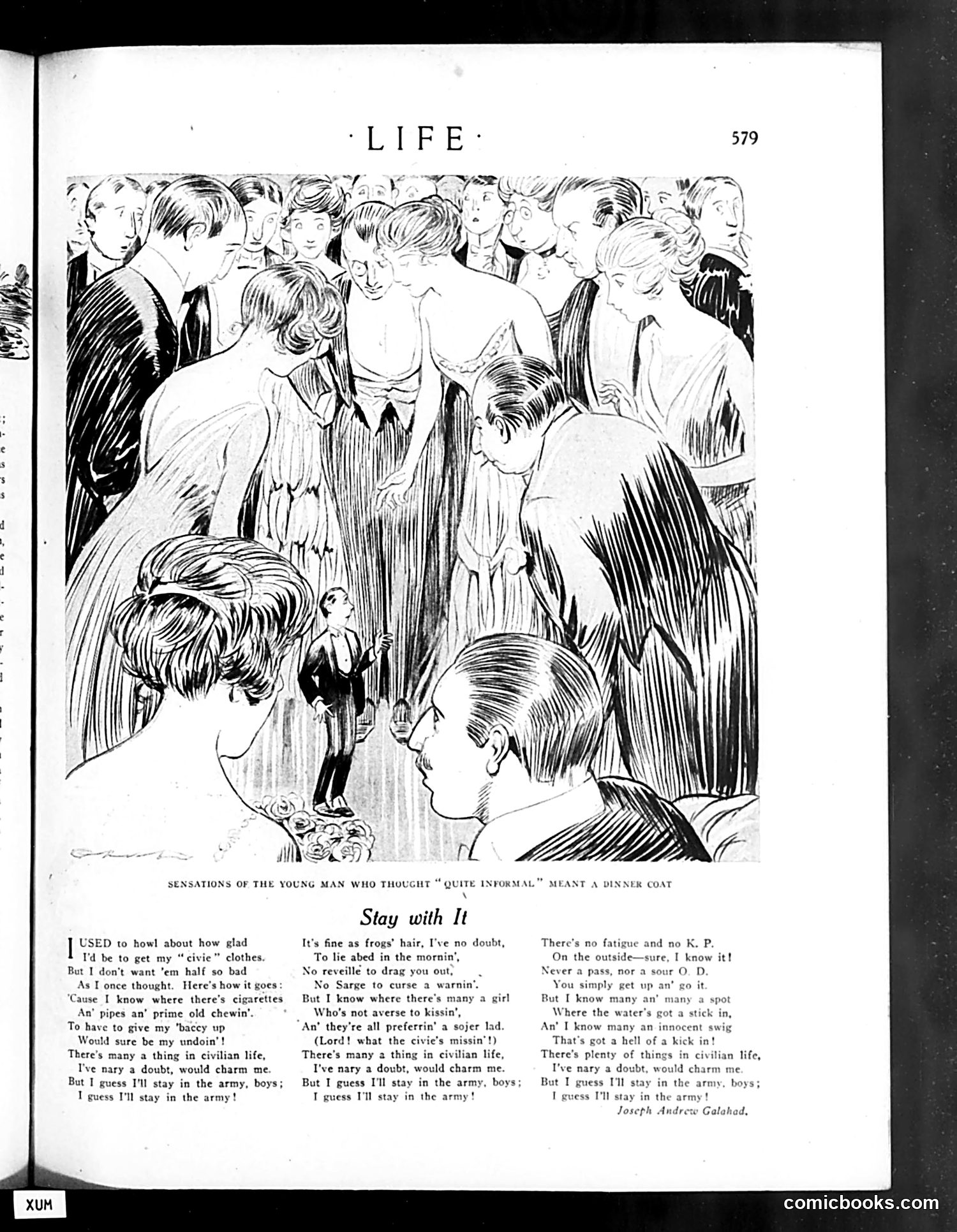
This page from *Life* magazine features an illustration titled "Sensations of the Young Man Who Thought 'Quite Informal' Meant a Dinner Coat," accompanying a poem called "Stay with It" by Joseph Andrew Galahad. The cartoon satirizes a social misunderstanding: a young man (shown in profile at bottom right) attended what he believed was a casual gathering but wore only a dinner jacket instead of formal evening wear. The crowded scene depicts his discomfort amid well-dressed guests in more elaborate attire. The poem's refrain—"I guess I'll stay in the army, boys"—suggests military service as preferable to navigating confusing civilian social conventions. The satire targets upper-class dress codes and the anxiety they provoked in young men uncertain of proper etiquette during the early 20th century.
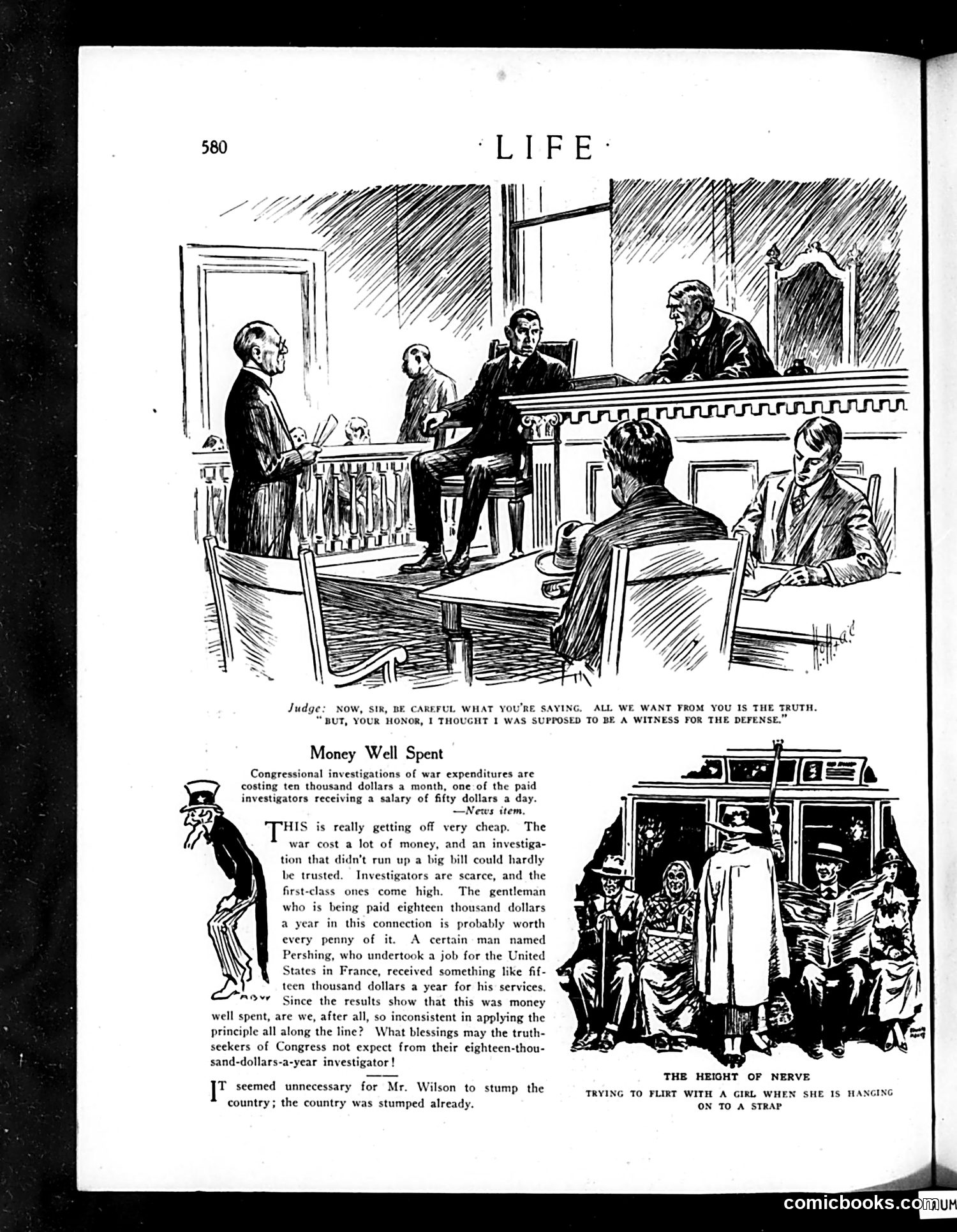
**Top Cartoon:** A courtroom scene where a judge instructs a witness to "be careful what you're saying. All we want from you is the truth. But, your honor, I thought I was supposed to be a witness for the defense." This satirizes the gap between legal ideals (seeking truth) and courtroom reality (witnesses chosen to support one side). **"Money Well Spent" Article:** Criticizes Congressional investigations into war expenditures costing $10,000 monthly. The text sarcastically notes that investigators like someone named Pershing receiving $15,000 yearly represent "money well spent," implying such investigations are wasteful and unnecessary—the country was already "stumped" by war costs. **Bottom Illustration:** Shows crowded transit, captioned "The Height of Nerve"—apparently satirizing someone attempting to flirt while passengers hang on straps.
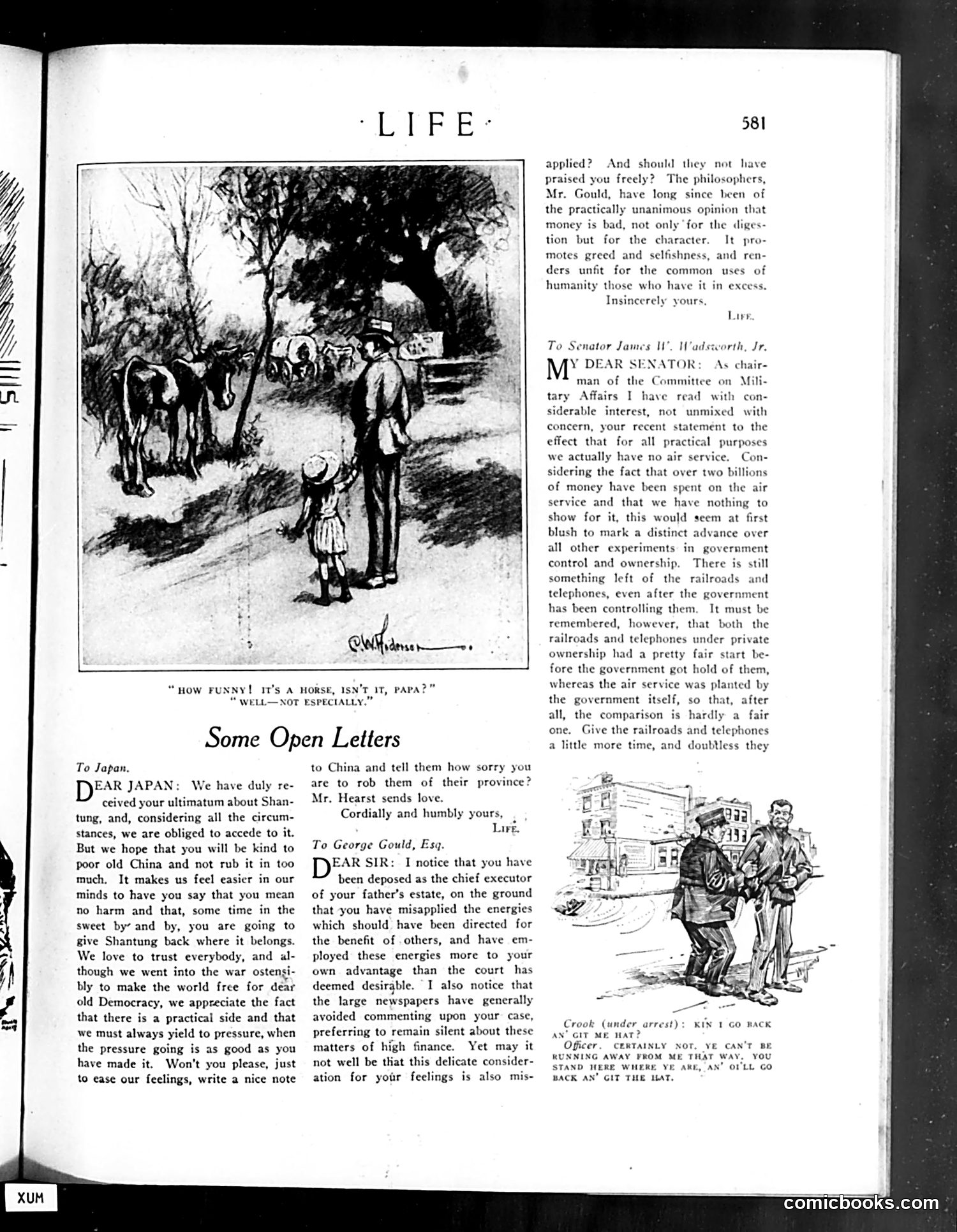
**Main Cartoon ("How Funny! It's a Horse, Isn't It, Papa?"):** A rural scene shows a man gesturing toward a horse while speaking to a child. The joke appears to be a simple, innocent visual pun—the child is confused about whether the animal is actually a horse, suggesting either the horse's unusual appearance or the child's naïveté. **"Some Open Letters" Section:** This page features satirical correspondence addressing contemporary issues: Japan's conduct in China, government management of railroads and telephones versus private enterprise, and an executor's mismanagement of an estate. The tone is gently critical of government inefficiency and individual misconduct, typical of *Life*'s satirical commentary on politics and social affairs of the era.
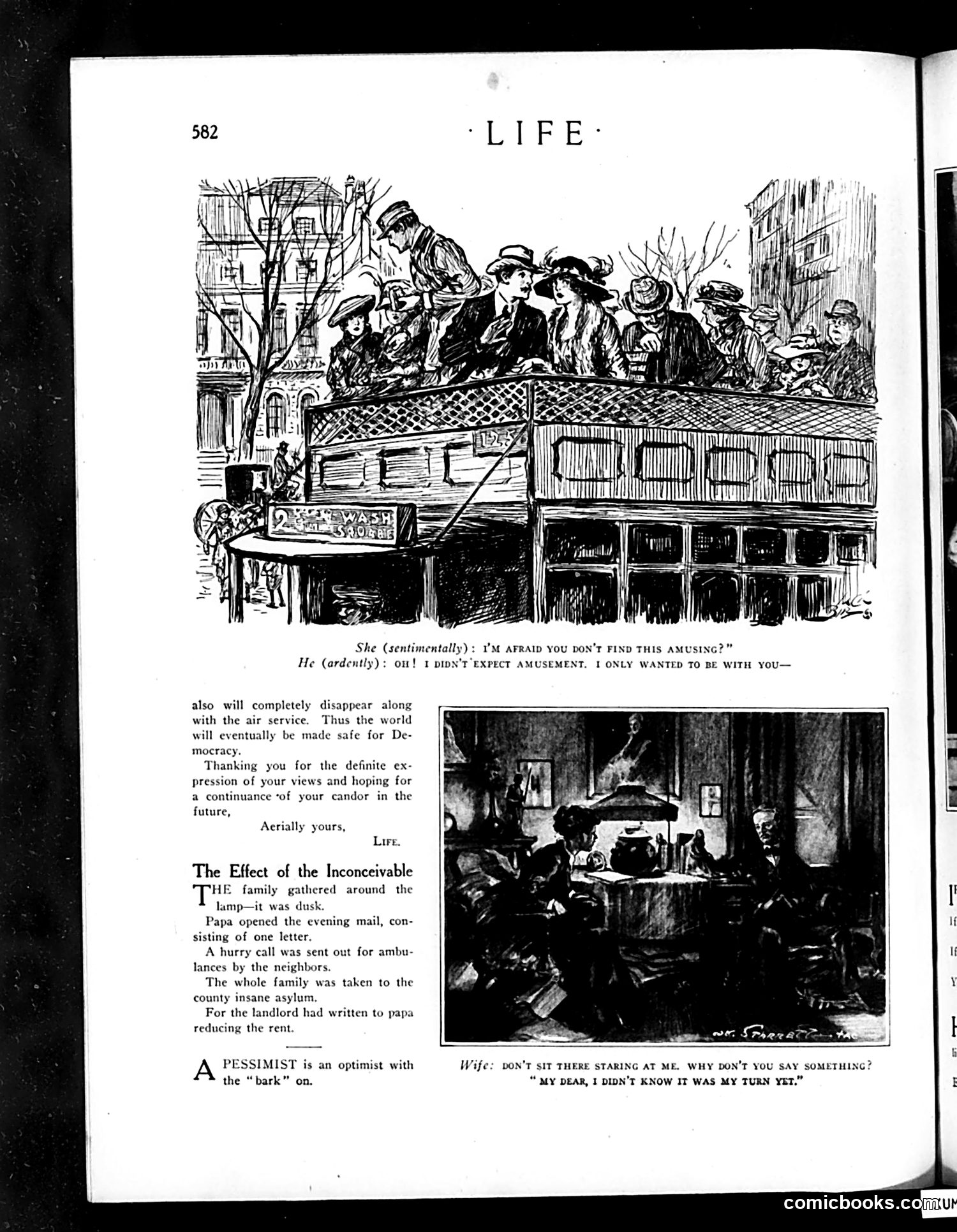
This page contains three distinct satirical pieces mocking early 20th-century American social conventions and anxieties: **Top cartoon:** A couple at an amusement park. She's disappointed the outing isn't entertaining; he claims he only wanted her company. The satire targets romantic posturing—his earnest declaration seems calculated rather than genuine. **Middle story, "The Effect of the Inconceivable":** A family is institutionalized after receiving a letter from their landlord *reducing* their rent. The absurdist humor satirizes economic anxiety—the unexpected good news triggers such shock that rationality breaks down. This reflects period anxieties about housing costs and financial instability. **Bottom cartoon/definition:** A husband silently reads while his wife demands conversation. She complains he never speaks; he notes it's her turn to talk. The satire targets marital miscommunication and gender dynamics—both partners feel unheard despite cohabitation. The overall tone mocks modern domesticity, romance, and economic life through exaggeration and irony.
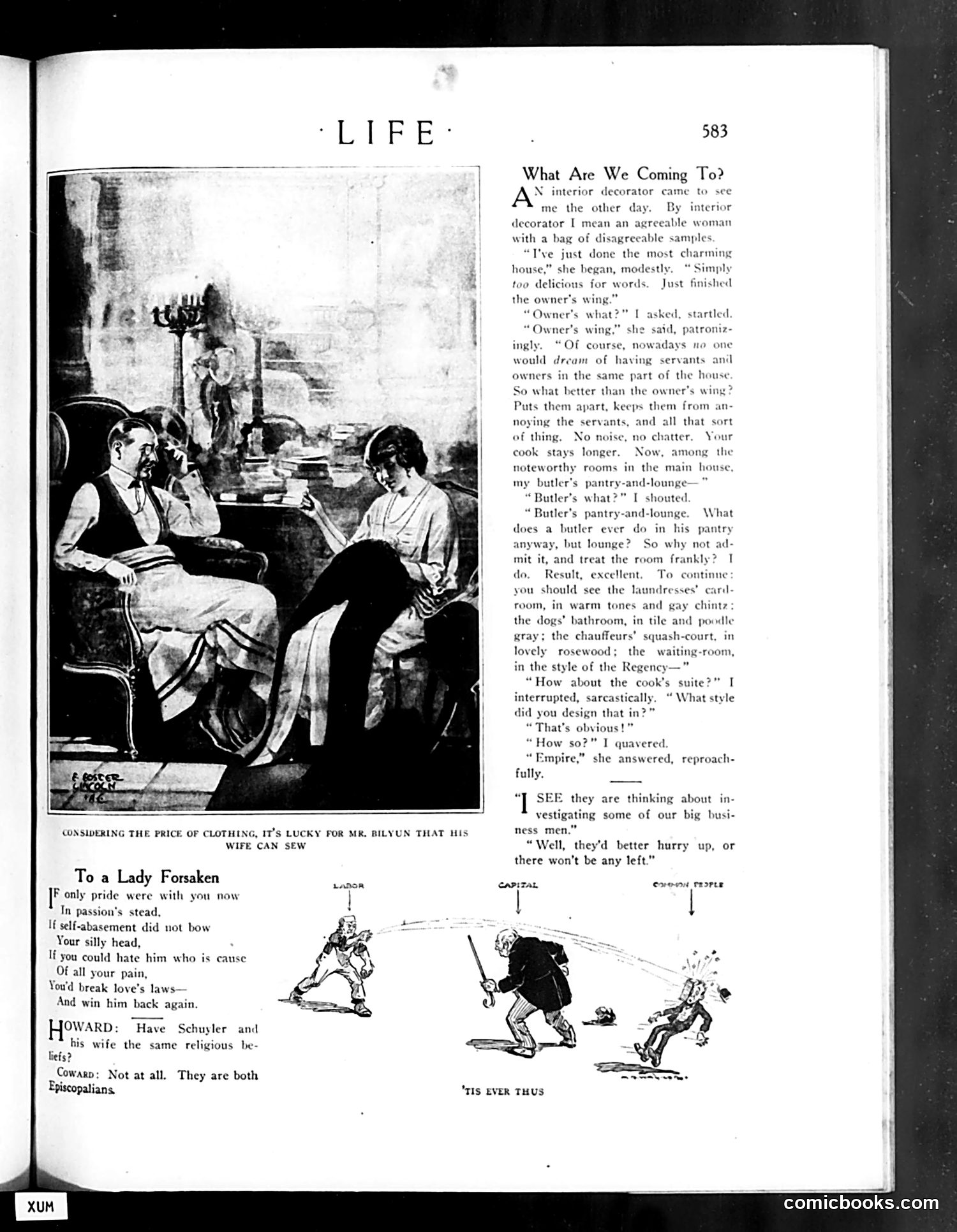
This page contains three distinct satirical pieces: **"To a Lady Forsaken"** is a sentimental poem about romantic pride and reconciliation—typical of early 20th-century magazine verse. **The Schuyler/Coward dialogue** is a brief, cutting joke about hypocrisy: when asked if a couple shares religious beliefs, the response "Not at all. They are both Episcopalians" mocks how nominal faith had become among the wealthy elite. **"What Are We Coming To?"** is the main satire, attacking the pretentiousness of interior design and the absurd class anxieties of the wealthy. An interior decorator justifies segregating servants' quarters and then absurdly applies pseudo-sophisticated naming to rooms (a "butler's pantry-and-lounge," a "dogs' bathroom"). The punchline—that the cook's kitchen is designed in "Empire" style (cheap and mass-produced)—deflates the decorator's snobbery. The humor targets both nouveau-riche affectation and the era's rigid servant hierarchies. The cartoons at bottom appear to show a tug-of-war labeled "Labor," "Capital," and "Everyday People," illustrating class conflict—a recurring Life magazine theme.
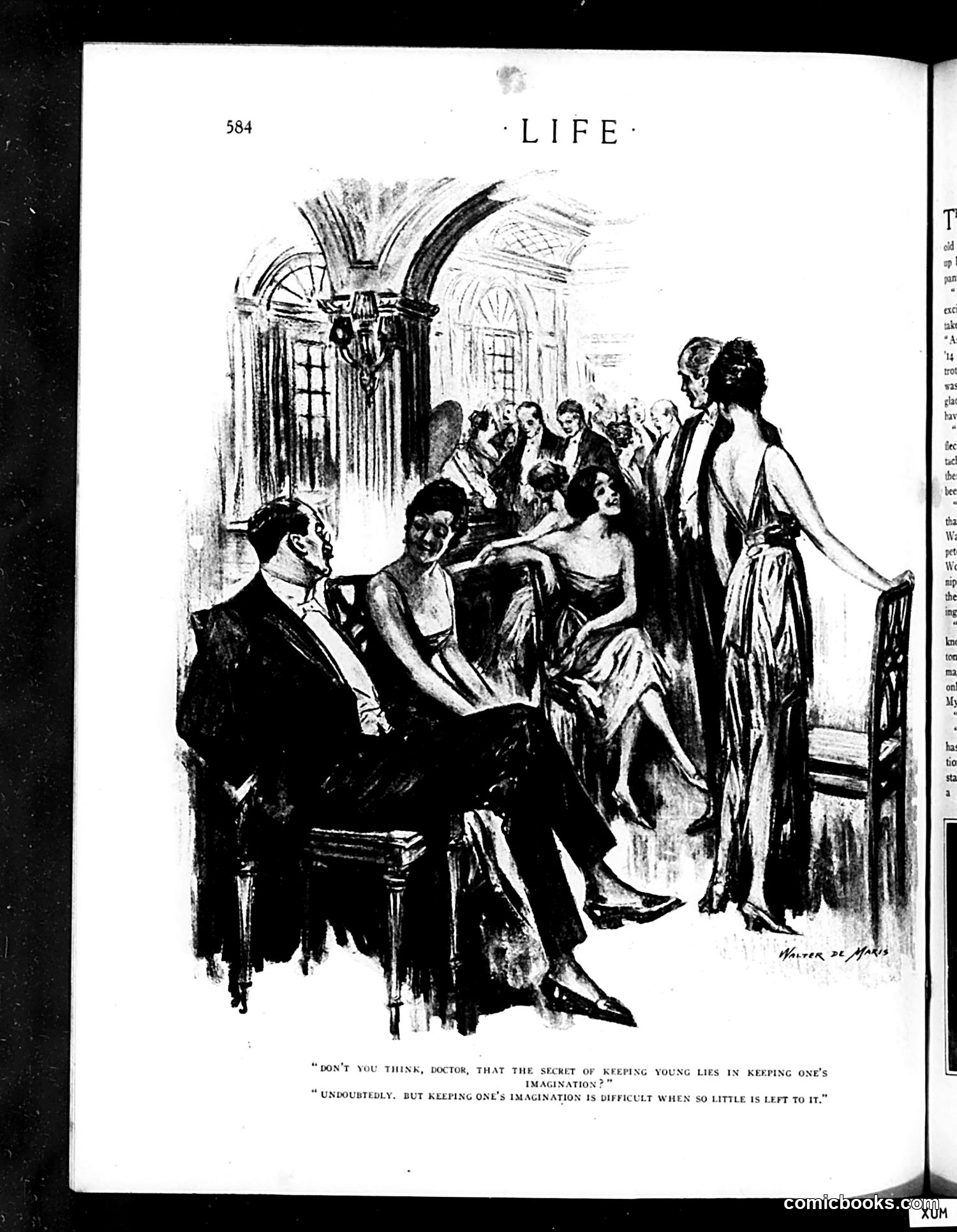
This satirical cartoon, signed by Warren de Marés, depicts an elegant social gathering where a woman poses a philosophical question to a doctor about maintaining youth through imagination. His response delivers the joke: keeping imagination alive is hard "when so little is left to it"—a sarcastic comment on the woman's revealing dress and exposed body. The satire targets 1920s social changes, specifically the "modern woman" with her fashionably scanty clothing and liberated social behavior. The cartoon mocks both the woman's vanity about youth and the era's loosening dress codes and social mores. The doctor's quip suggests that when there's little clothing left to imagine, the mystery and youthful allure are diminished—a commentary on how changing fashion standards affected traditional notions of feminine mystique and propriety.
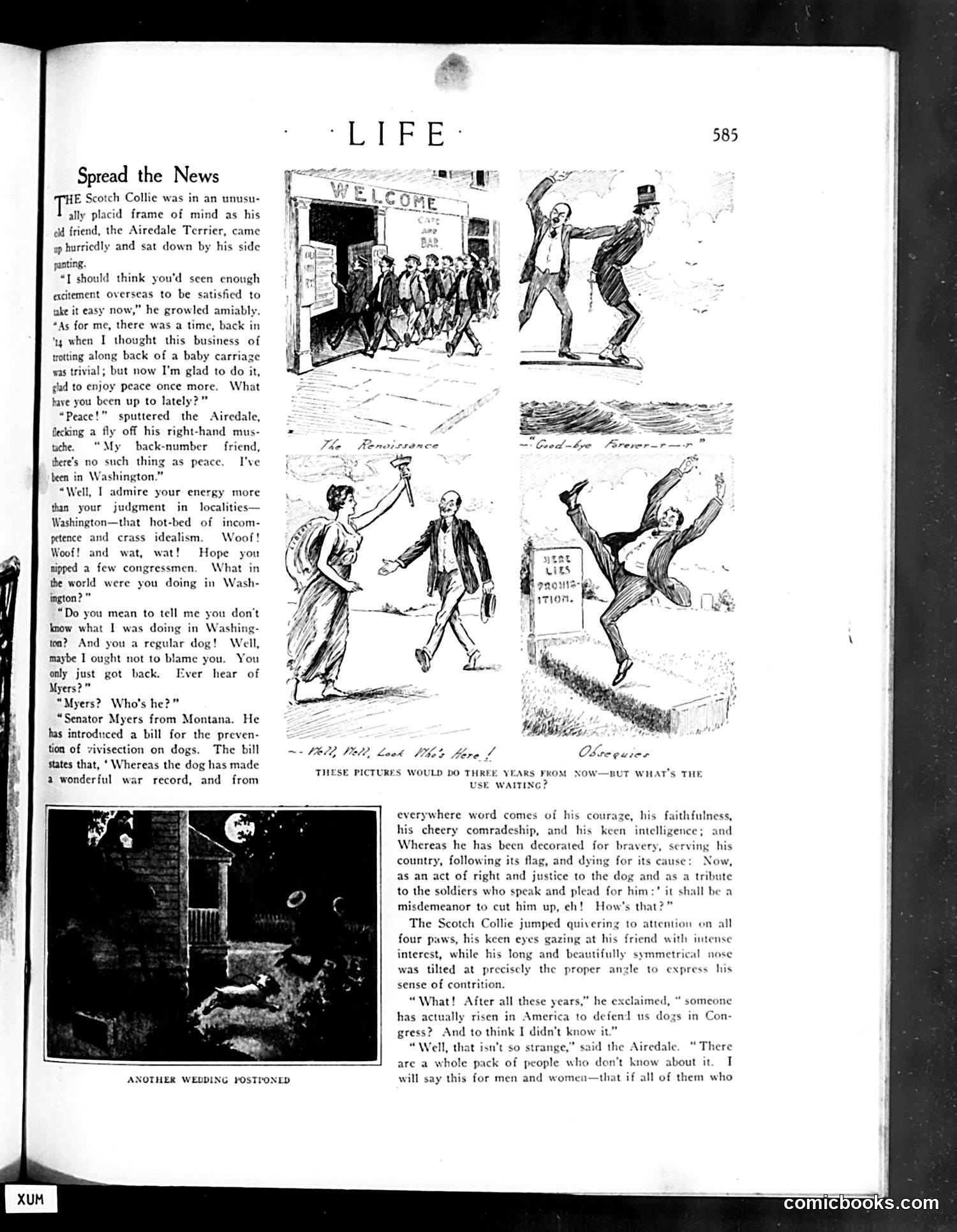
This 1919 *Life* magazine page satirizes post-WWI American politics through a dialogue between two dogs. A Scotch Collie and Airedale Terrier discuss Senator Myers of Montana's bill to protect dogs from vivisection (animal testing). The satire operates on multiple levels: The dogs debate whether dogs deserve legal protection after their war service, while the real target is American politicians and public indifference. The Airedale criticizes Washington as a "hot-bed of incompetence and crass idealism," reflecting post-war disillusionment with government. The cartoon sketches above show dogs' imagined futures—suggesting civilians should consider animal welfare *now* rather than waiting. The humor relies on dogs speaking about human politics, while the underlying message critiques Congress's general ineffectiveness and citizens' apathy toward reform legislation, even when seemingly just causes (animal protection) are proposed. The "Another Wedding Postponed" photo below appears unrelated social commentary on delayed plans due to wartime disruptions.
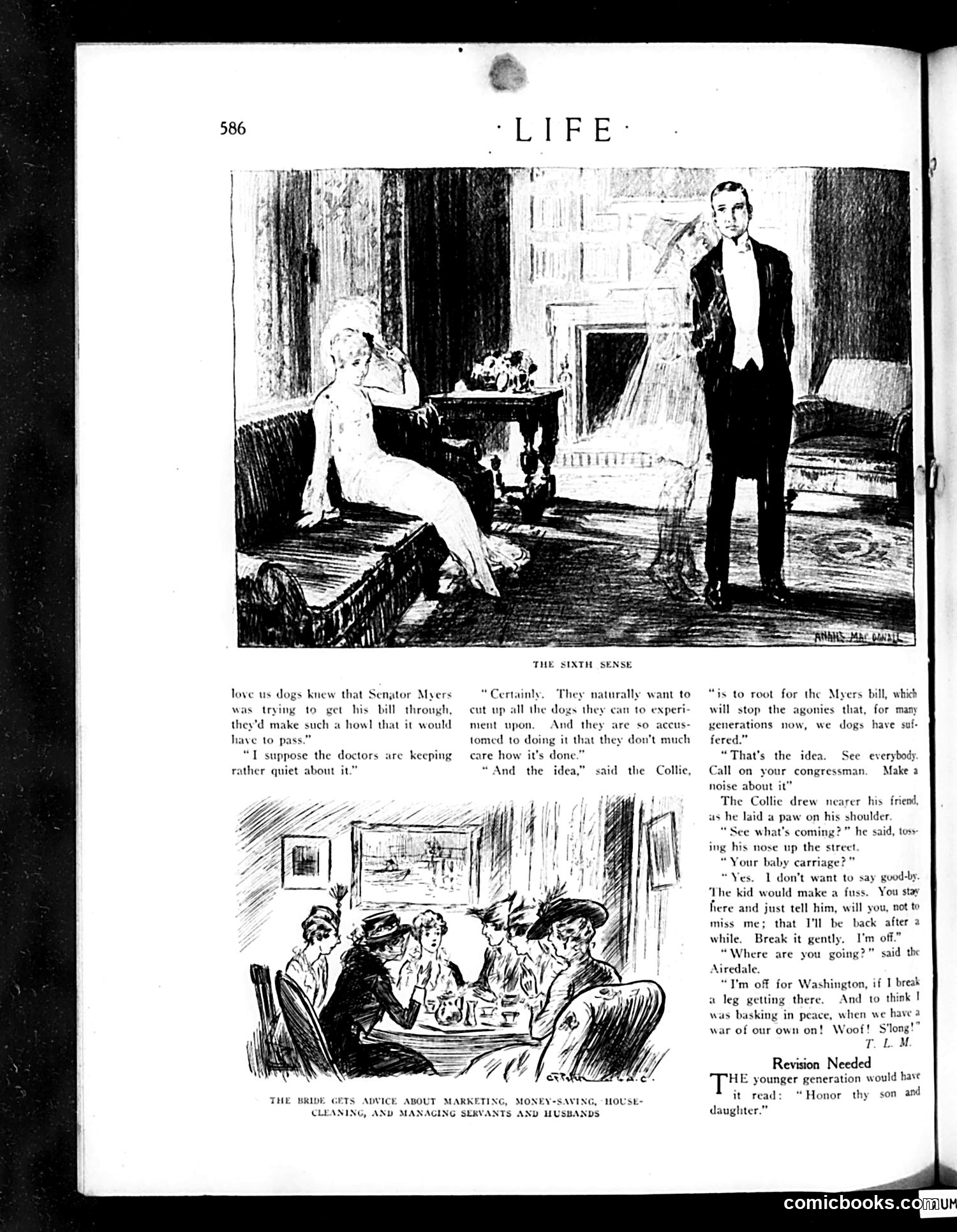
This page contains two satirical pieces about early 20th-century social issues. **Top cartoon ("The Sixth Sense"):** Dogs discuss Senator Myers's bill to protect animals from medical experimentation. The satire targets vivisection—the practice of operating on live animals for research. Dogs worry that without the bill, doctors will continue cutting up animals for experiments. The joke is that dogs possess a "sixth sense" alerting them to legislative threats to their welfare, presenting animal advocacy through anthropomorphized canine characters. **Bottom cartoon ("The Bride Gets Advice"):** Shows women discussing household management, marketing, money-saving, and "managing servants and husbands"—typical domestic advice for newlyweds of the era. The final item, "Revision Needed," satirizes outdated biblical values, suggesting the younger generation should revise "Honor thy father and mother" to include daughters equally. Both pieces mock contemporary attitudes—toward animal research and gender equality—through humor.
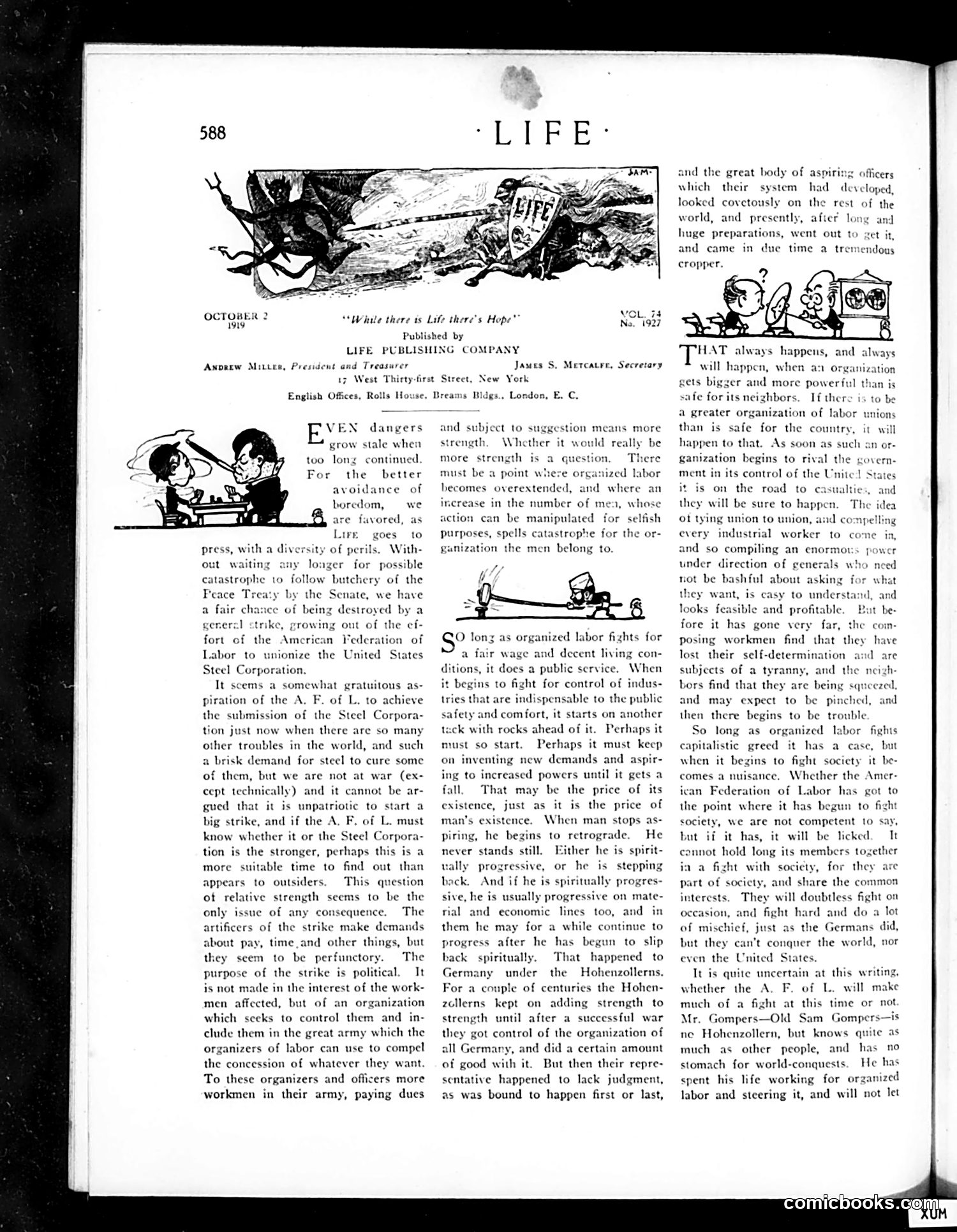
This page contains editorial commentary on labor organizing, specifically the American Federation of Labor's (A.F. of L.) effort to unionize the United States Steel Corporation. The text argues that while labor's fight for fair wages and decent conditions serves the public, expanding union power to control entire industries crosses a dangerous line. The editor warns against organizations becoming "overextended" through aggressive expansion of membership and control. The piece uses Germany under the Hohenzollerns as a cautionary historical parallel—a power that kept expanding until it overreached, ultimately failing due to poor leadership judgment. The cartoons (depicting labor struggles) illustrate the ongoing conflict. The editorial's core message: organizations that grow too powerful relative to society risk catastrophic collapse, much like empires that push expansion beyond sustainable limits. This reflects early 20th-century anxieties about labor's rising power and its potential social consequences.
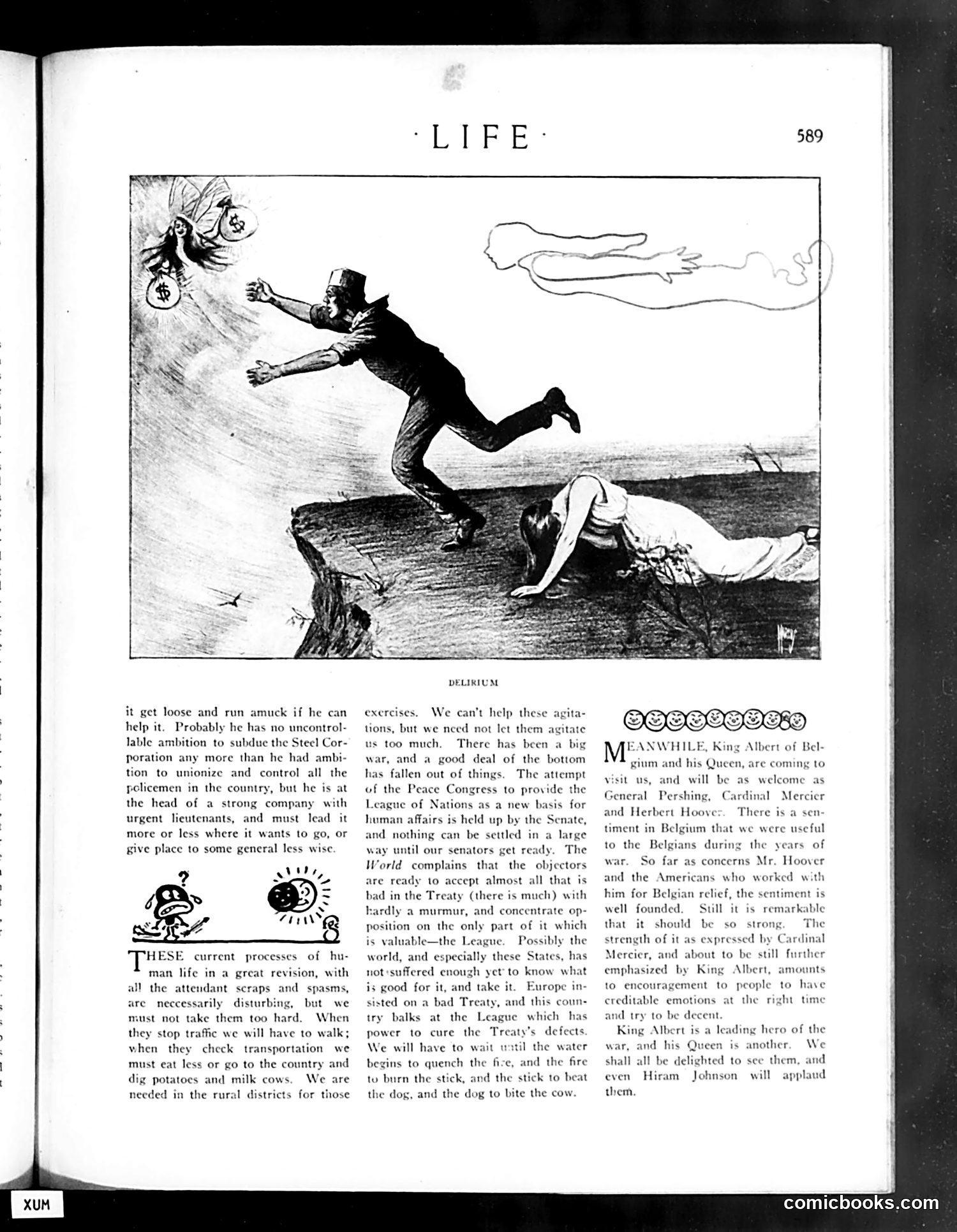
The illustrated cartoon depicts a man in formal dress reaching desperately toward floating dollar signs while a woman lies unconscious or collapsed below him. The title "DELIRIUM" suggests mental disturbance or frenzy. **Context:** The accompanying text discusses post-WWI social upheaval—labor unrest, the failed League of Nations ratification by the Senate, and the Treaty of Versailles disputes. The passage explicitly mentions the Steel Corporation and labor agitation, suggesting the cartoon satirizes capitalist anxiety during this period of industrial turmoil. **The Point:** The cartoon likely critiques wealthy industrialists' frantic, irrational behavior during labor disputes and economic uncertainty. The man's desperate grasping at money while disorder surrounds him represents how capitalists lose perspective when their profits and control are threatened. The "delirium" is their panicked, self-interested response to genuine social change and workers' demands—portrayed as unseemly and disconnected from reality. The satire targets the wealthy and powerful as the truly unhinged actors in post-war America's turbulent reorganization.
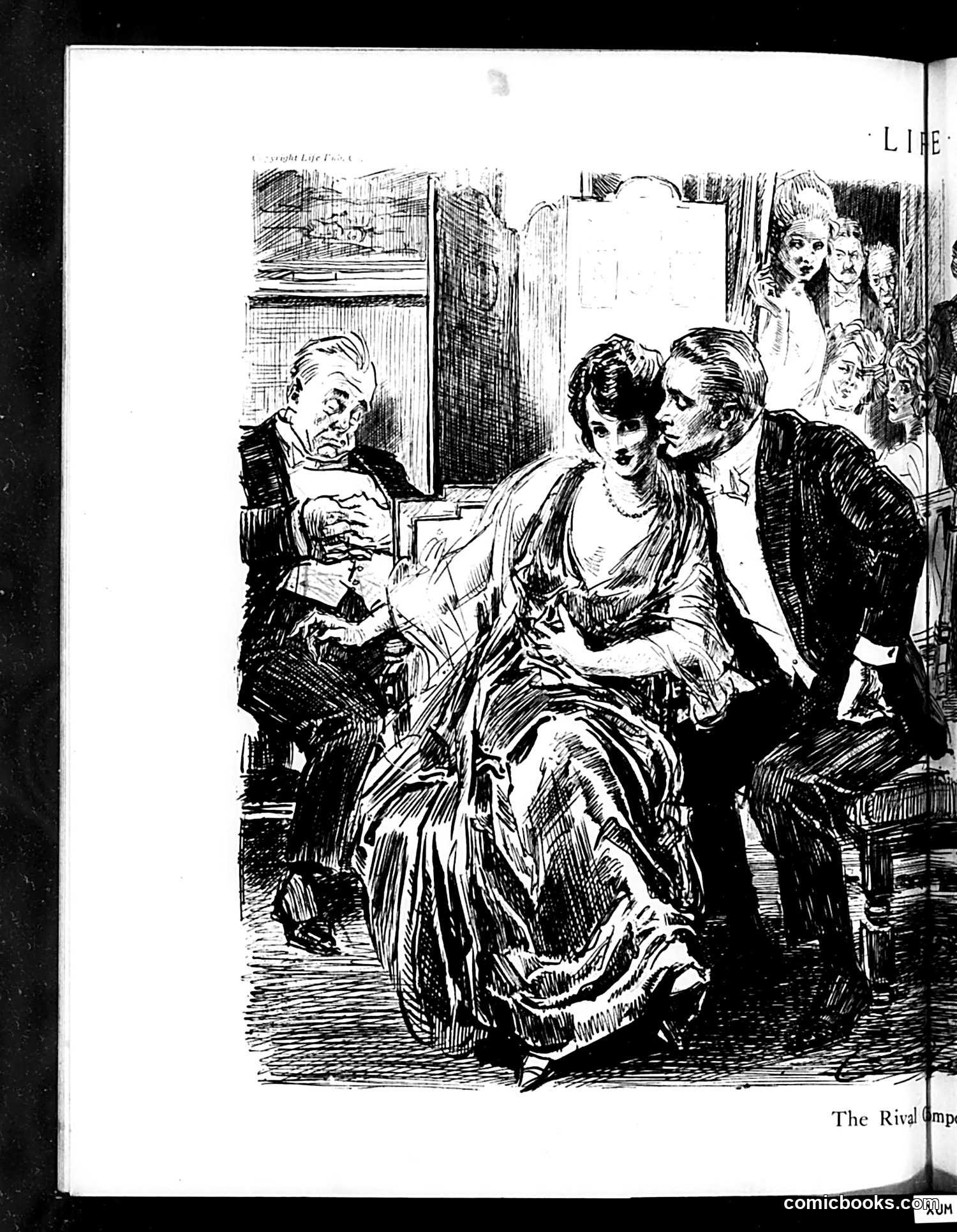
This appears to be a satirical sketch titled "The Rival Comps" [likely "Competitors"]. The scene depicts a social gathering where a woman in an elegant dress sits centrally, surrounded by male admirers. A man on the left appears agitated or distressed, while two men flank her closely—one whispering to her ear. Additional figures observe from the background. The satire likely comments on romantic rivalry or courtship competition among gentlemen vying for a woman's attention. The woman's composed demeanor contrasts with the men's visible anxiety, suggesting she controls the social dynamic. The title and setup mock the competitive, performative nature of Victorian-era courtship and social hierarchies, where men competed for female affection while women wielded social power through desirability.
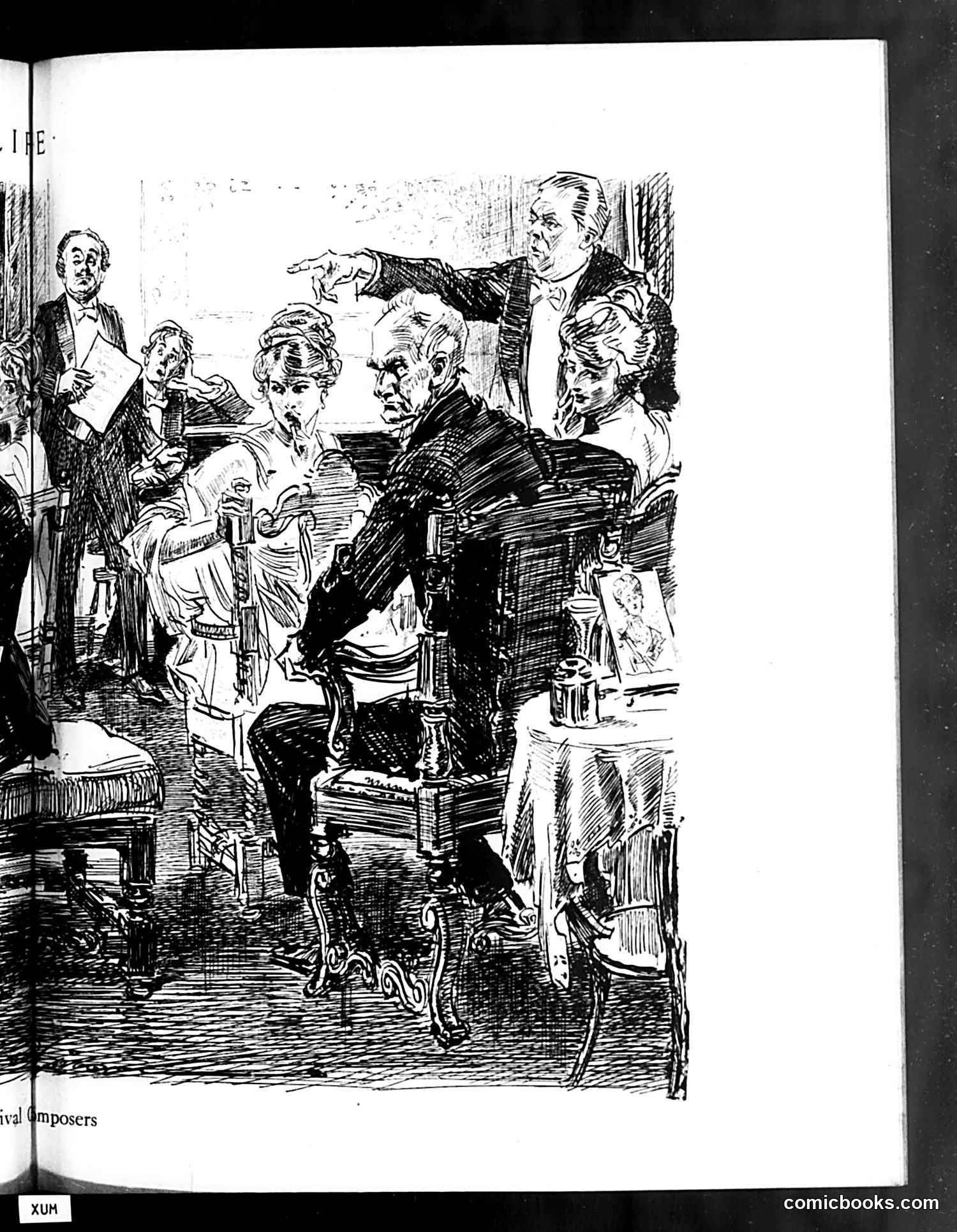
This appears to be a satirical sketch depicting a formal social or political gathering, likely from the late 19th or early 20th century based on the artistic style and clothing. The scene shows several well-dressed men in formal attire (suits, military dress) in what appears to be an interior setting. One central figure stands prominently while others surround him in apparent conversation or debate. The positioning and gestures suggest tension or disagreement among the group. However, the OCR text is largely illegible, providing only scattered letters that don't form coherent words. Without readable caption text identifying the specific figures, political figures, or events being satirized, I cannot definitively explain the cartoon's meaning or identify who these caricatures represent. The partial text "ival imposers" at the bottom may be part of a title, but it's incomplete.
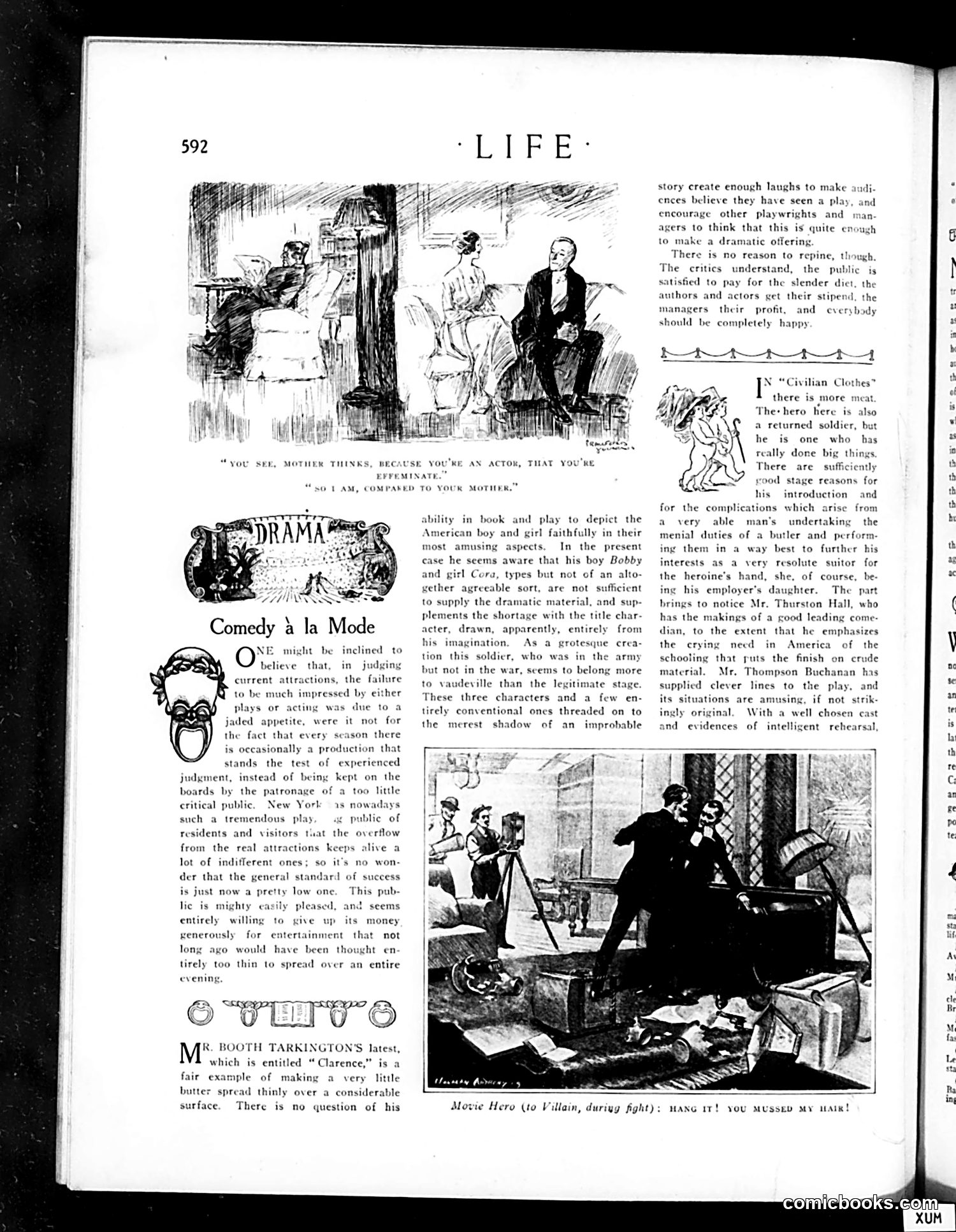
This page reviews theatrical productions, primarily Booth Tarkington's play "Clarence." The top cartoon depicts a conversation about an actor's effeminacy—a mother claims her son is unmanly because he's an actor; he retorts that compared to her, he's quite masculine. This reflects early 20th-century anxieties about theater as an "unmanly" profession. The main text critiques contemporary American theater as creatively thin—"butter spread thinly over considerable surface." Tarkington's play succeeds despite weak material through comedic timing and a grotesque soldier character drawn from imagination rather than authentic observation. The lower illustration shows a film scene where a villain's poorly executed hair-grab prompts the hero to quip "Hang it! You mussed my hair!"—likely mocking silent film melodrama's overwrought physicality. The underlying critique: Broadway succeeds by entertaining easily-pleased audiences, rewarding mediocre writers and encouraging low standards.
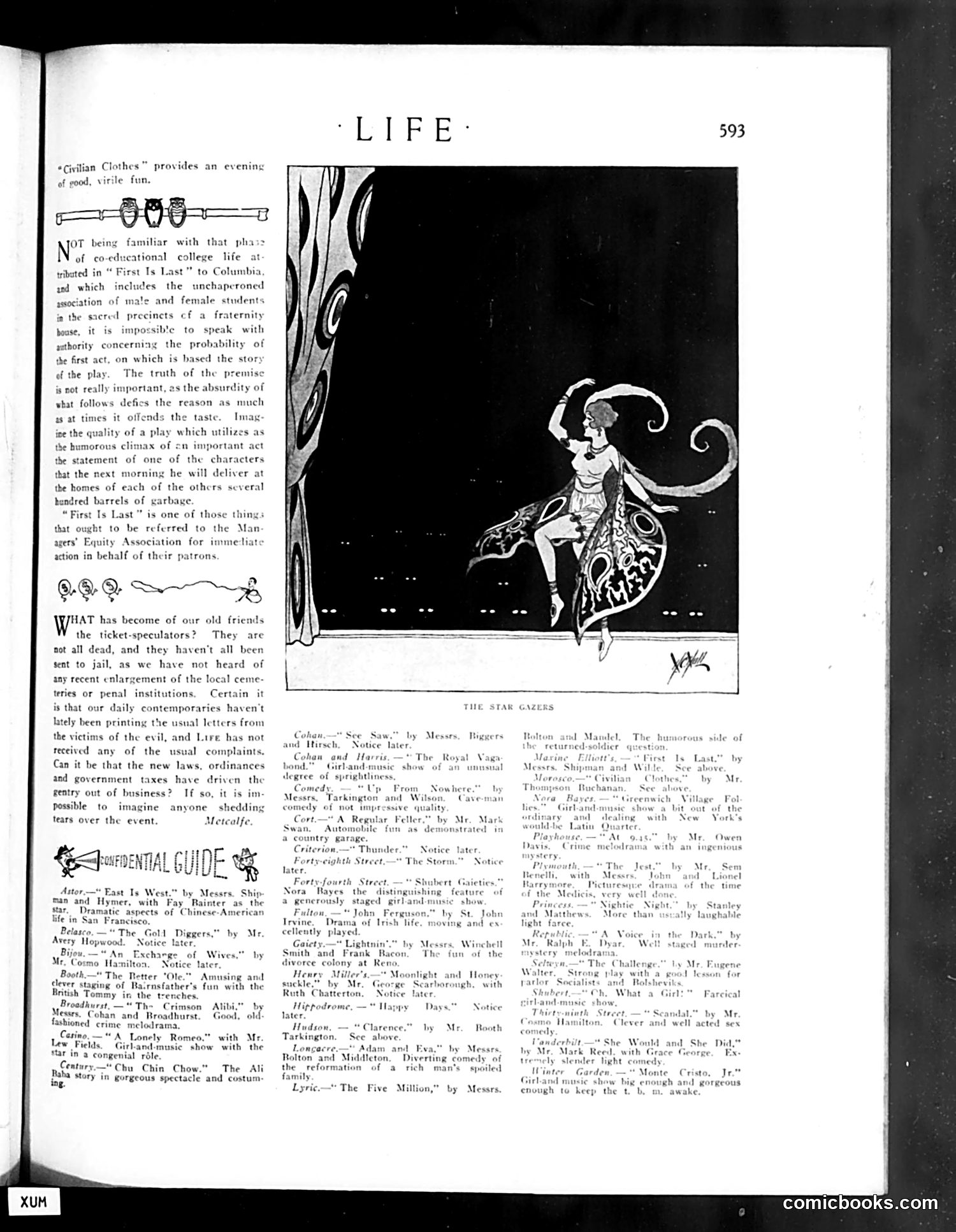
This page combines theater reviews with social satire typical of Life magazine's format. The main illustration shows "The Star Gazer"—an Art Deco-style drawing of a woman in an elaborate costume gazing upward, likely representing theatrical escapism or entertainment. The text discusses a play called "First Is Last," set at Columbia University's co-educational college life, which apparently depicts unchaperoned male-female student interactions in fraternity settings. The reviewer critiques the play's absurd premise—that a character would deliver "several hundred barrels of garbage" to his peers the morning after. Below this is commentary on ticket scalpers, noting that the new laws against scalping appear to have worked, since there are no longer complaints in newspapers or to Life from victims of price-gouging. The page concludes with capsule reviews of current Broadway productions, using the standard theatrical review format of the era.
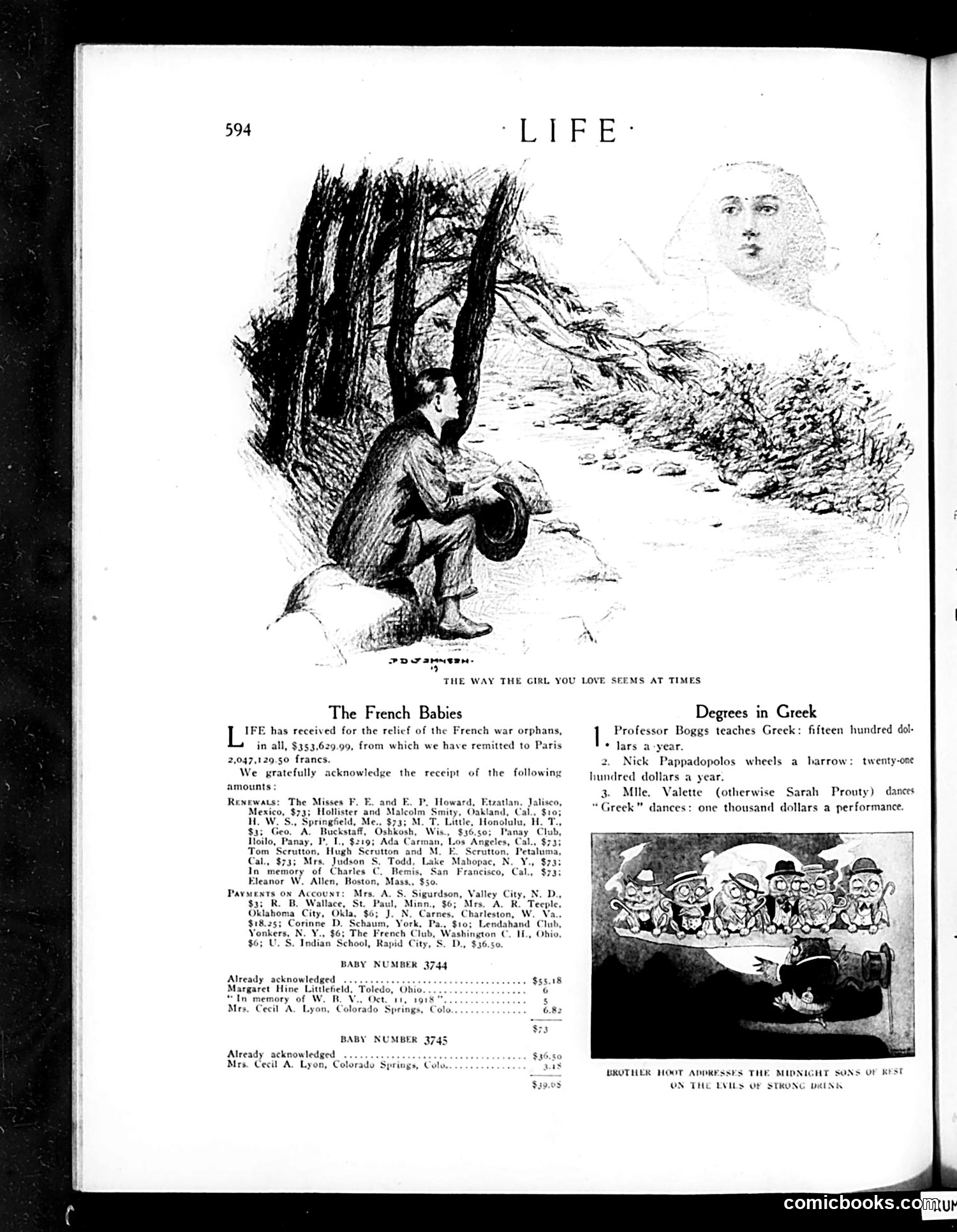
The top illustration shows a sentimental sketch of a young soldier gazing at a ghostly female apparition, captioned "The Way the Girl You Love Seems at Times"—likely reflecting wartime longing and the emotional toll of WWI separation. The bulk of the page documents **"The French Babies"** relief fund, listing donors and amounts contributed to aid French war orphans. This was a genuine charitable campaign Life magazine ran during/after WWI, with detailed accounting of $353,629.99 raised and remitted to Paris. Below that, "**Degrees in Greek**" presents economic satire comparing academic salaries: a Greek professor earns $1,500/year while a laborer (Pappadopolos) pushing a harrow makes $2,100, and a dancer (Mlle. Valette) earns $1,000 per performance. The joke critiques the disparity between intellectual and manual labor compensation. The bottom image and caption about "Brother Hoot" addressing "The Midnight Sons of Rest" on drinking evils appears to be a separate illustrated feature (unclear without more context).
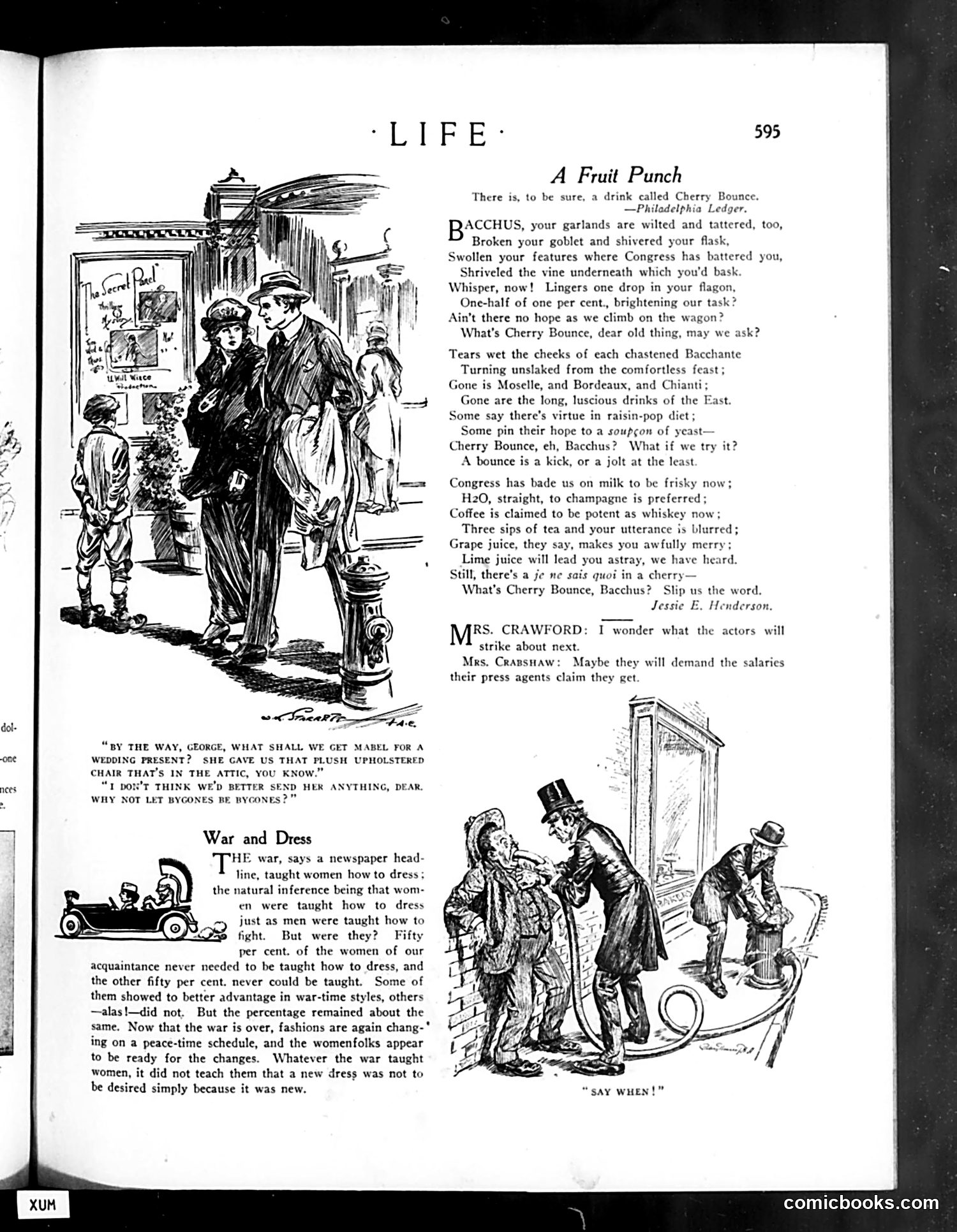
**"A Fruit Punch"** satirizes Prohibition's impact. The poem addresses Bacchus (god of wine), mourning the loss of fine wines (Moselle, Bordeaux, Chianti) under Congressional alcohol bans. It mocks the forced substitution of weak alternatives—milk, water, coffee, grape juice—while asking whether "Cherry Bounce" (a homemade fermented drink) offers any hope. The satire targets both Prohibition's severity and drinkers' desperate search for loopholes. **The dialogue** between Mrs. Crawford and Mrs. Crabshaw jokes about actors' strikes, suggesting press agents inflate salaries beyond reality. **"War and Dress"** critiques a newspaper claim that WWI taught women fashion sense. The author argues women's dress habits remained unchanged—half never needed instruction, half couldn't be taught regardless. The satire suggests the war didn't fundamentally alter women's desire for fashionable clothing, contradicting claims of war-induced behavioral reform.
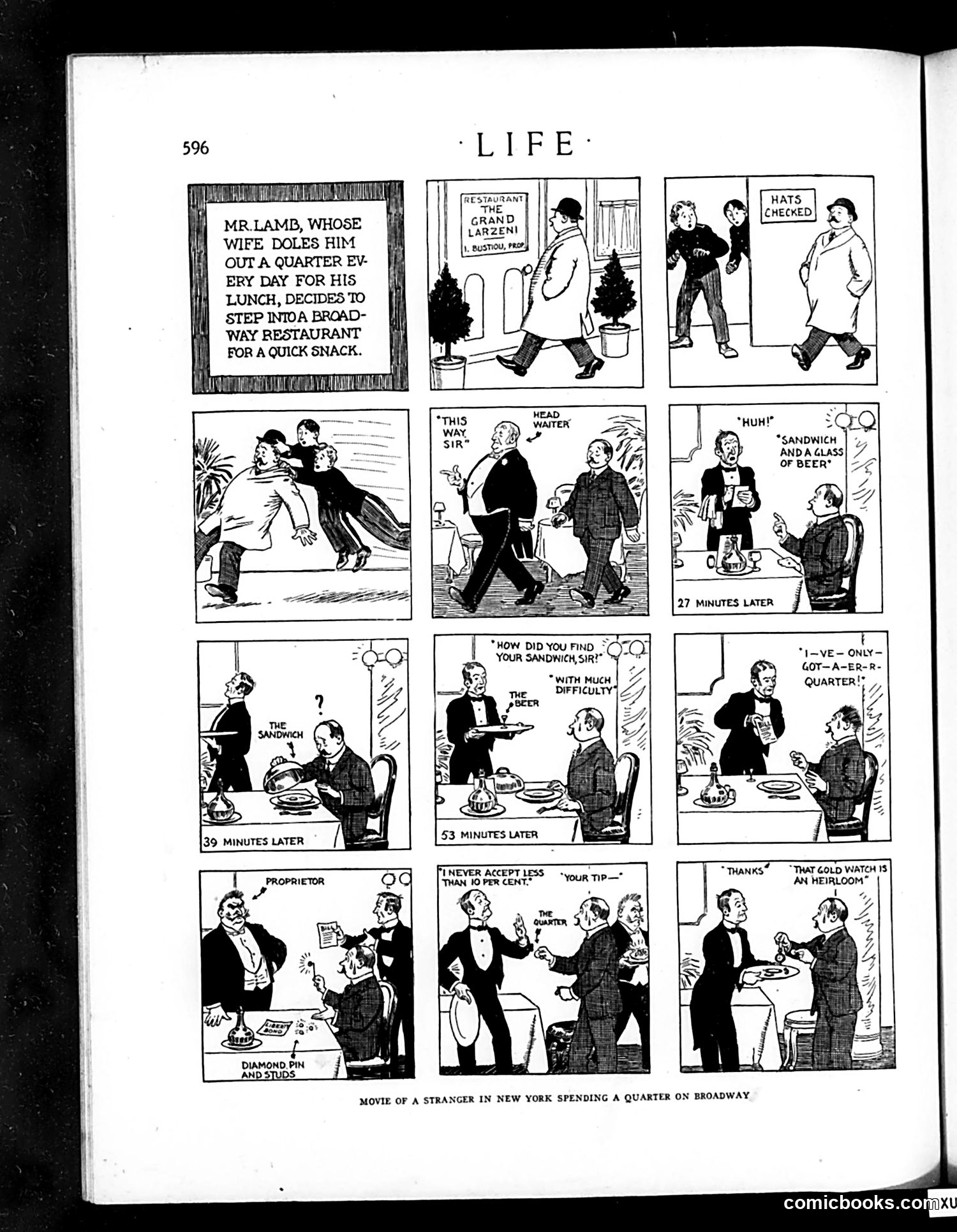
This comic satirizes early 20th-century class economics and inflation. Mr. Lamb—a working man given a meager daily quarter by his wife—enters a fancy Broadway restaurant expecting a modest meal. The humor unfolds through successive panels showing his escalating expenses: a sandwich and beer costs the quarter, yet the waiter's service expectations (tipping) progressively drain his resources. He's charged for hat-checking, questioned about finding the sandwich, and pressured to tip the proprietor and waiter. By the final panel, his quarter is entirely consumed by what should have been simple items plus various fees and gratuities. The satire critiques how hidden costs and tipping culture trap working-class men, turning a modest purchase into an expensive ordeal. The "heirloom" gold watch he surrenders as final payment emphasizes the economic squeeze—forced to literally give up valuables to cover Broadway establishments' nickel-and-diming practices.
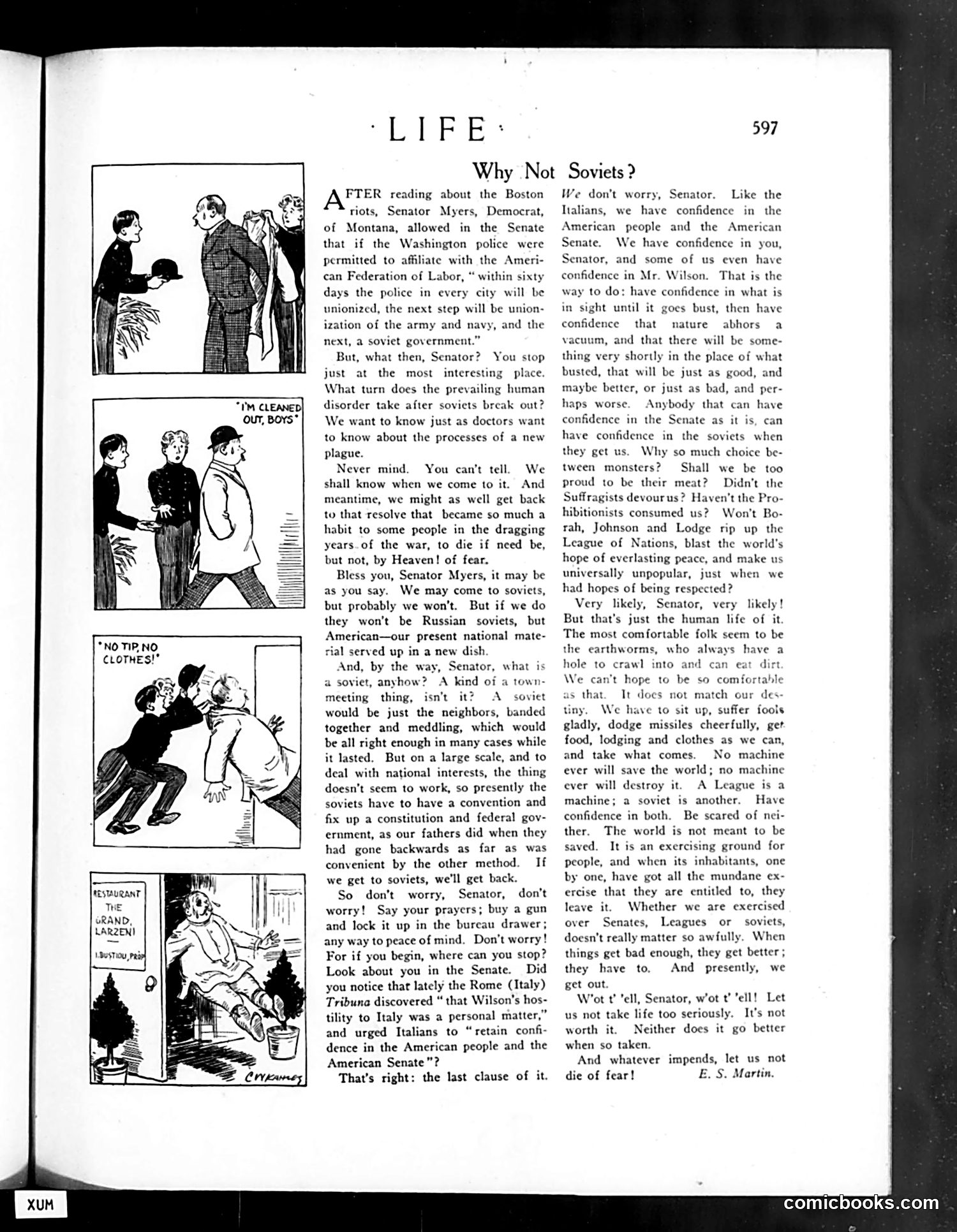
This article satirizes Senator Myers of Montana, who warned that unionizing police would inevitably lead to Soviet government. The cartoons show working-class figures in various states of undress or complaint ("I'm cleaned out, boys," "No tip, no clothes"), mocking the senator's apocalyptic fears. The essay's author responds with tongue-in-cheek reassurance: yes, maybe America will become Soviet—but probably not, and if it does, Americans will just recreate constitutional government anyway, as they always do. The deeper satire targets both the senator's red-scare hysteria and American complacency generally. The final passages mock contemporary political figures (Wilson, Borah, Johnson, Lodge, Suffragists, Prohibitionists) as threats equal to or worse than soviets, suggesting that Americans already endure various "monsters" without catastrophe. The conclusion: worry accomplishes nothing; just accept life's inevitable discomforts. The tone is sardonic political commentary on post-WWI American anxieties.
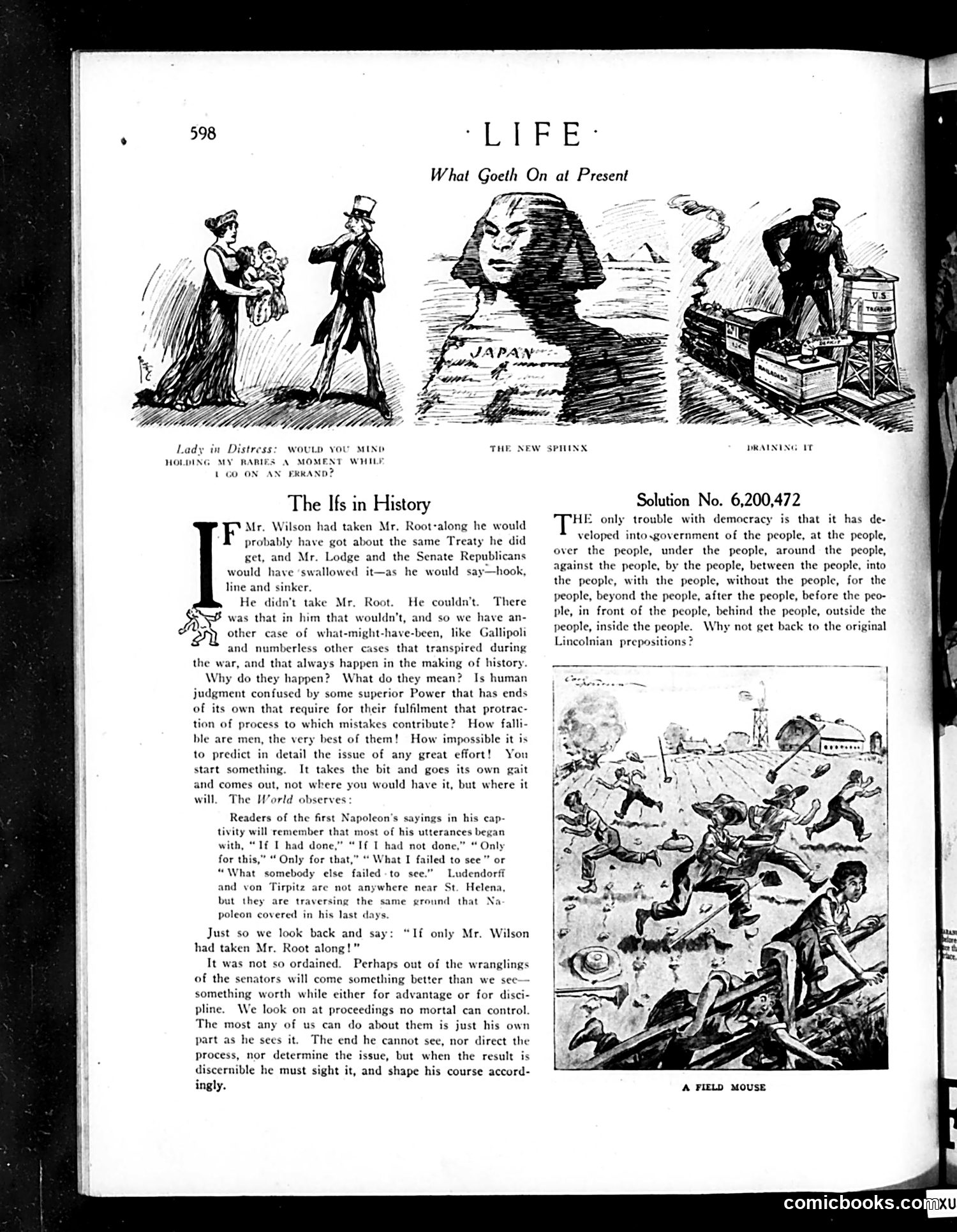
**"The Ifs in History"** criticizes President Wilson's treaty negotiations, likely regarding post-WWI peace terms. The article argues that Wilson should have brought Elihu Root (a prominent Republican statesman) to treaty discussions. Root's absence meant Senate Republicans, led by Henry Cabot Lodge, rejected the treaty—a reference to the failed League of Nations ratification. The satire questions whether history is shaped by human decision or fate, using Napoleon's regretful "if only" statements as parallel. **"The New Sphinx" cartoon** depicts the Great Sphinx with "Japan" labeled, suggesting Japanese imperial expansion concerns post-WWI. **"Solution No. 6,200,472"** mocks democratic rhetoric through absurdist wordplay, parodying Lincoln's famous "government of the people, by the people, for the people" by adding contradictory prepositions ("against," "inside," "outside" the people). It satirizes how democracy's stated ideals had become distorted or hollow by this period.
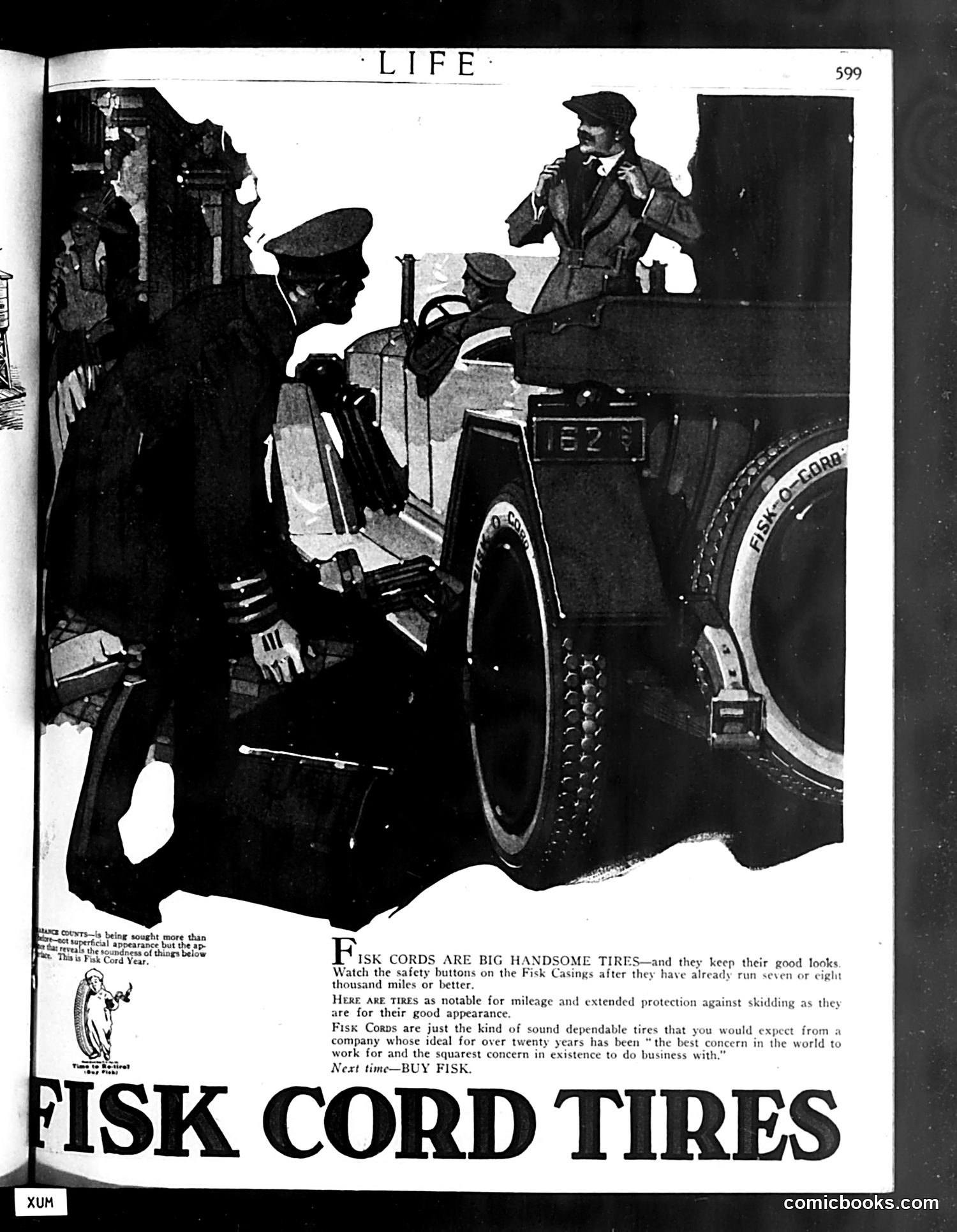
This is a **tire advertisement**, not political satire. The page shows what appears to be a police officer or authority figure inspecting a vehicle equipped with Fisk Cord Tires. The ad's pitch centers on **durability and safety**: Fisk tires allegedly maintain their appearance and performance after thousands of miles, feature safety buttons for skidding prevention, and represent good value. The tagline emphasizes the company's reputation as "the best concern in the world to work for and the squarest concern in existence to do business with." The uniformed inspector figure suggests **trustworthiness and official approval**—a common advertising tactic of the era. The "safety buttons" reference was a selling point for tires of this period. This is straightforward commercial messaging, not social commentary or satire.
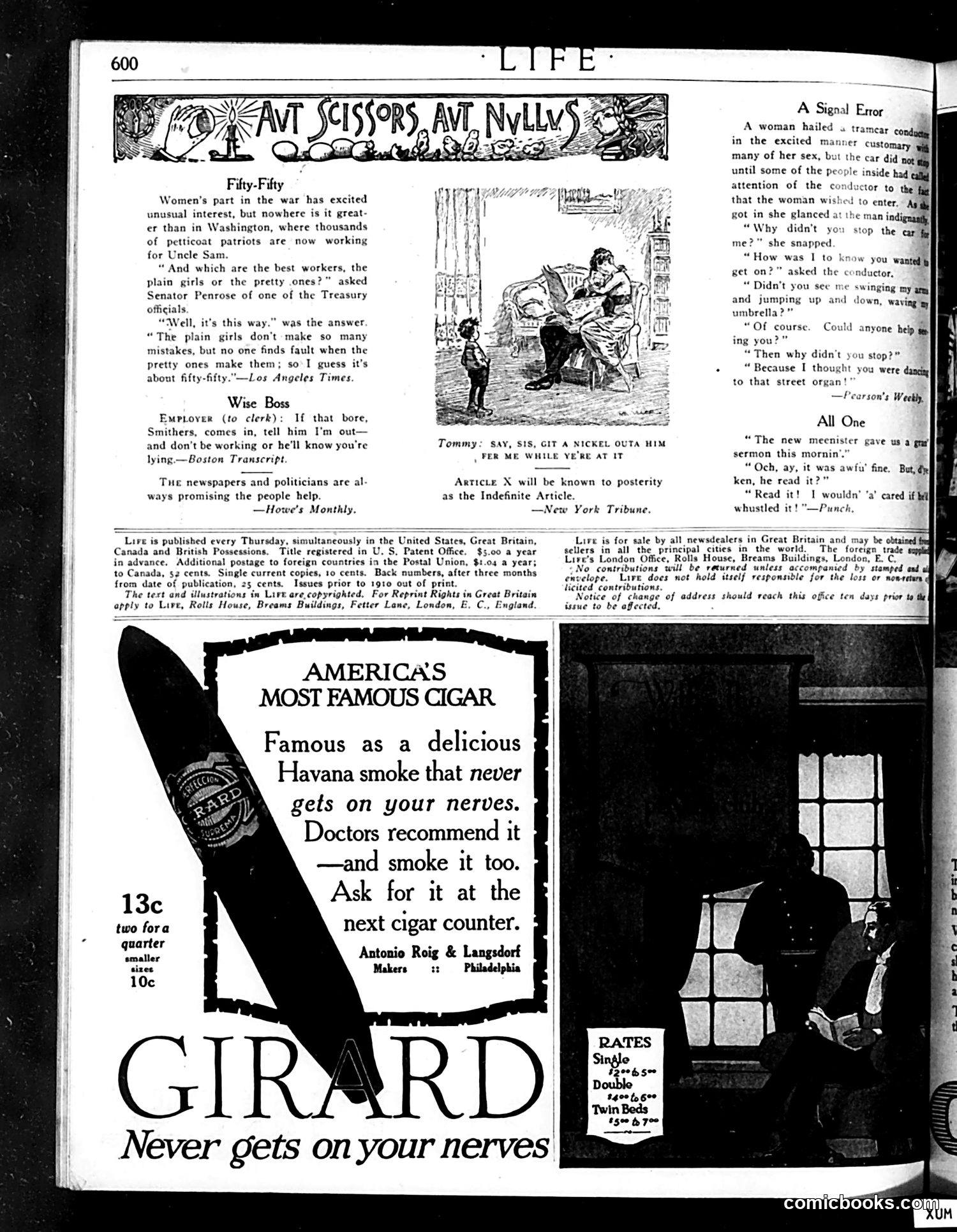
This page contains three short satirical pieces typical of Life's humor: **"Fifty-Fifty"** jokes about female war workers in Washington during WWI. A Treasury official tells Senator Penrose that plain women workers make fewer mistakes, but pretty women aren't criticized when they do—hence "fifty-fifty" quality overall. The satire targets both gender stereotypes and workplace dynamics of the era. **"Wise Boss"** is a brief quip about an employer instructing his clerk to lie about his availability, warning the clerk not to actually work or the ruse will be obvious. **"Tommy"** (with illustration) appears to be a children's scene, likely satirizing how politicians and newspapers constantly promise public assistance without delivering. The page is primarily **advertising** for Girard cigars, claiming doctors recommend them and they "never get on your nerves"—a health claim typical of early 20th-century tobacco marketing before regulation. The remaining text snippets ("Signal Error," "All One") are brief humorous anecdotes from other publications.
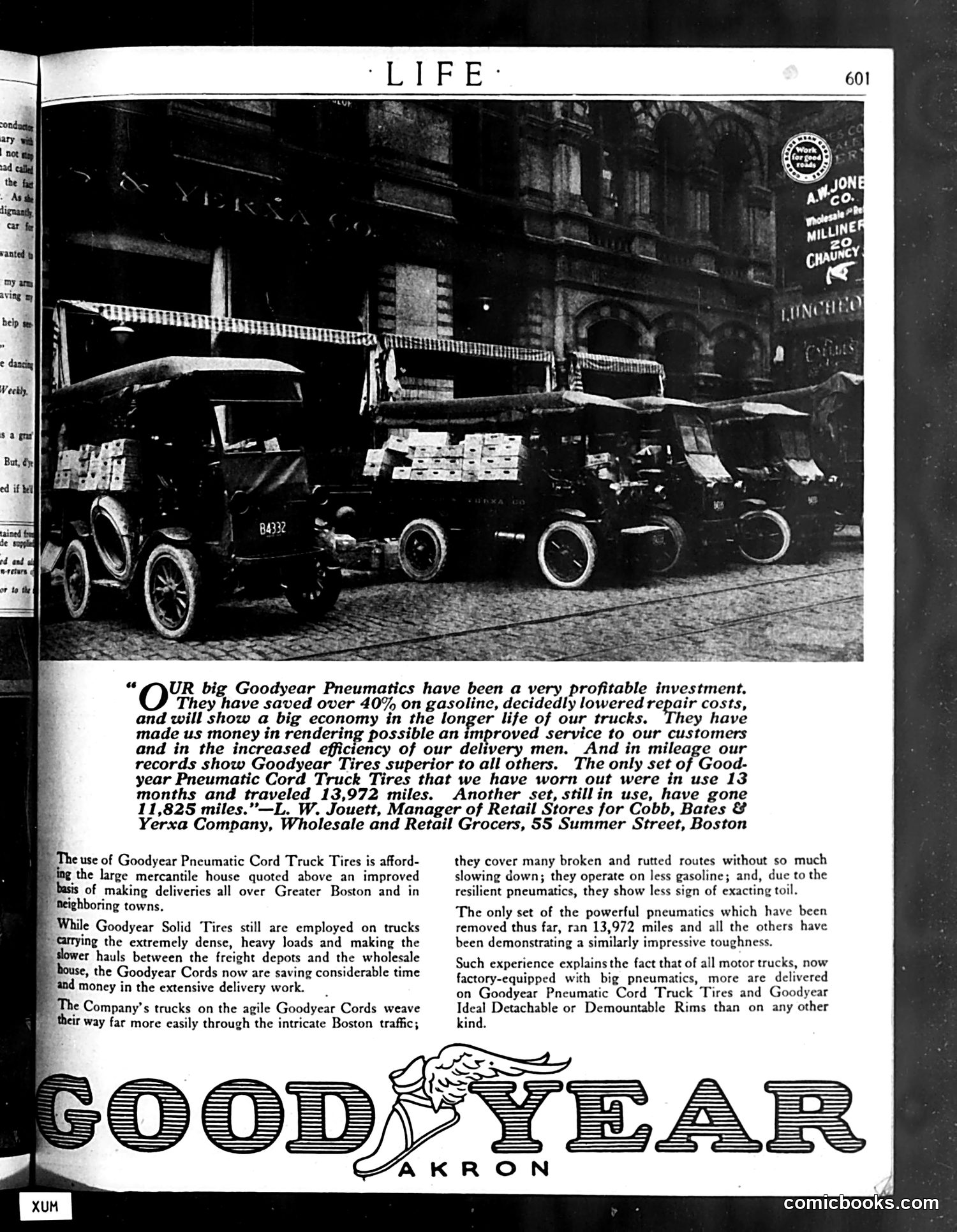
This is **not a cartoon or satire**—it's a straightforward **product advertisement** for Goodyear pneumatic (air-filled) truck tires, circa early 20th century. The page features a photograph of delivery trucks lined up on a Boston street, paired with a testimonial quote from L.W. Jouett, a manager at a major grocery wholesaler. The advertiser uses his endorsement to claim Goodyear tires deliver measurable business benefits: 40% gasoline savings, lower repair costs, extended tire life, and improved delivery efficiency through Boston's traffic. The ad contrasts pneumatic (air) tires with older solid rubber tires, arguing pneumatics are superior for faster delivery routes while solids remain useful for heavy freight hauls. The text emphasizes durability (citing 13,972 miles on one set) and widespread adoption by truck manufacturers. This represents early commercial advertising relying on real-world business testimonials rather than satire or humor.
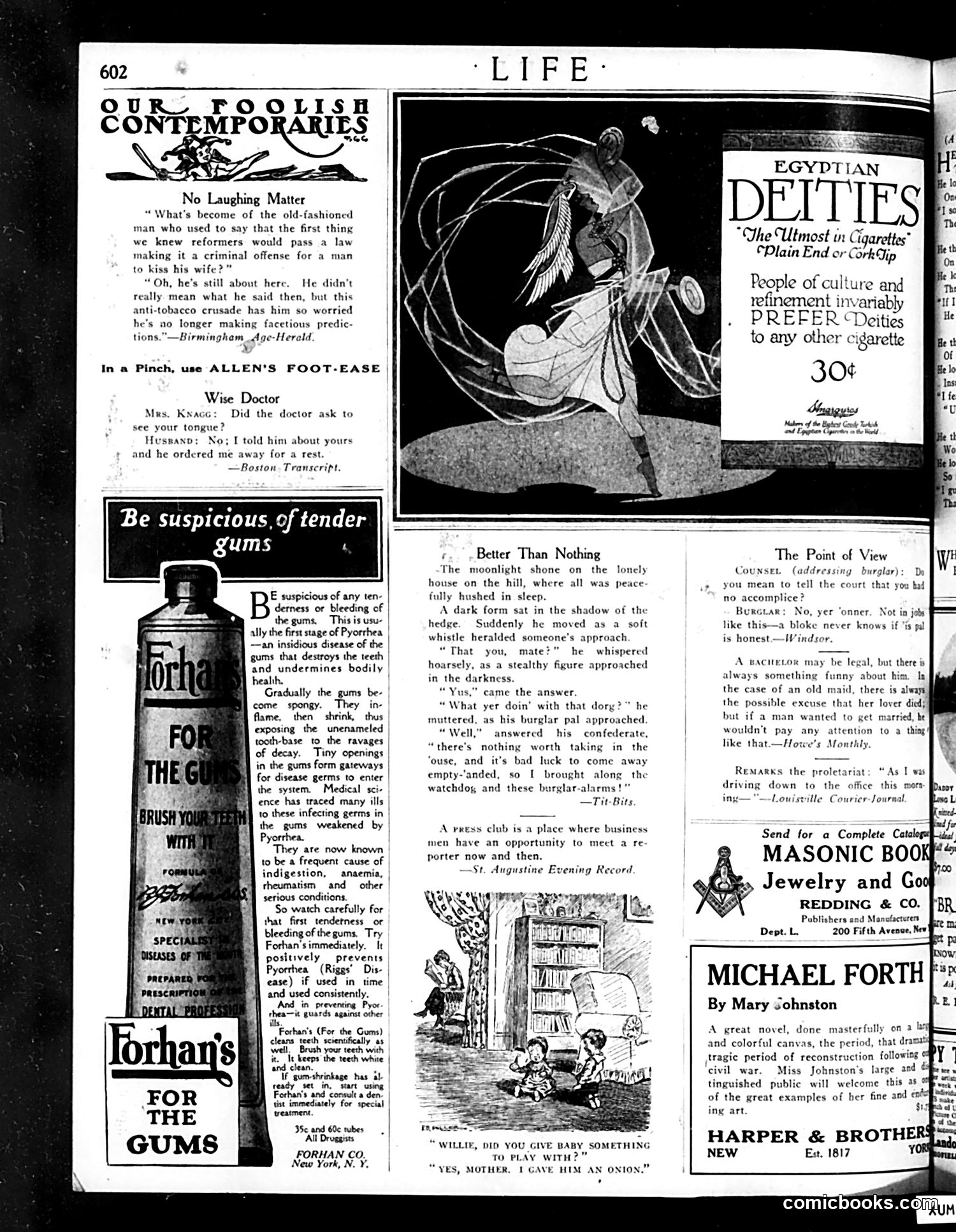
This page contains several satirical pieces typical of early 20th-century Life magazine's humor: **"No Laughing Matter"** jokes about reformers' anti-tobacco crusades replacing older moral panics. An old-fashioned man who once joked about laws forbidding wife-kissing now worries seriously about tobacco restrictions—satirizing shifting social anxieties. **"Wise Doctor"** is a brief joke-exchange mocking marital discord: a husband tells his doctor about *his wife's* tongue problems; the doctor orders the husband away for rest instead. **"Better Than Nothing"** depicts two burglars discussing a failed robbery. One brought a watchdog and burglar-alarms to steal, treating theft like a game—absurdist humor about criminals' desperation. **"The Point of View"** jokes that burglars work alone because partners are untrustworthy, while an old maid's spinsterhood is excusable (dead lover) but a man's reluctance to marry deserves ridicule—crude gender satire. The page is primarily advertising (Forhan's toothpaste, Egyptian Deities cigarettes, Masonic books, Harper & Brothers books), typical of Life's mixed content format.
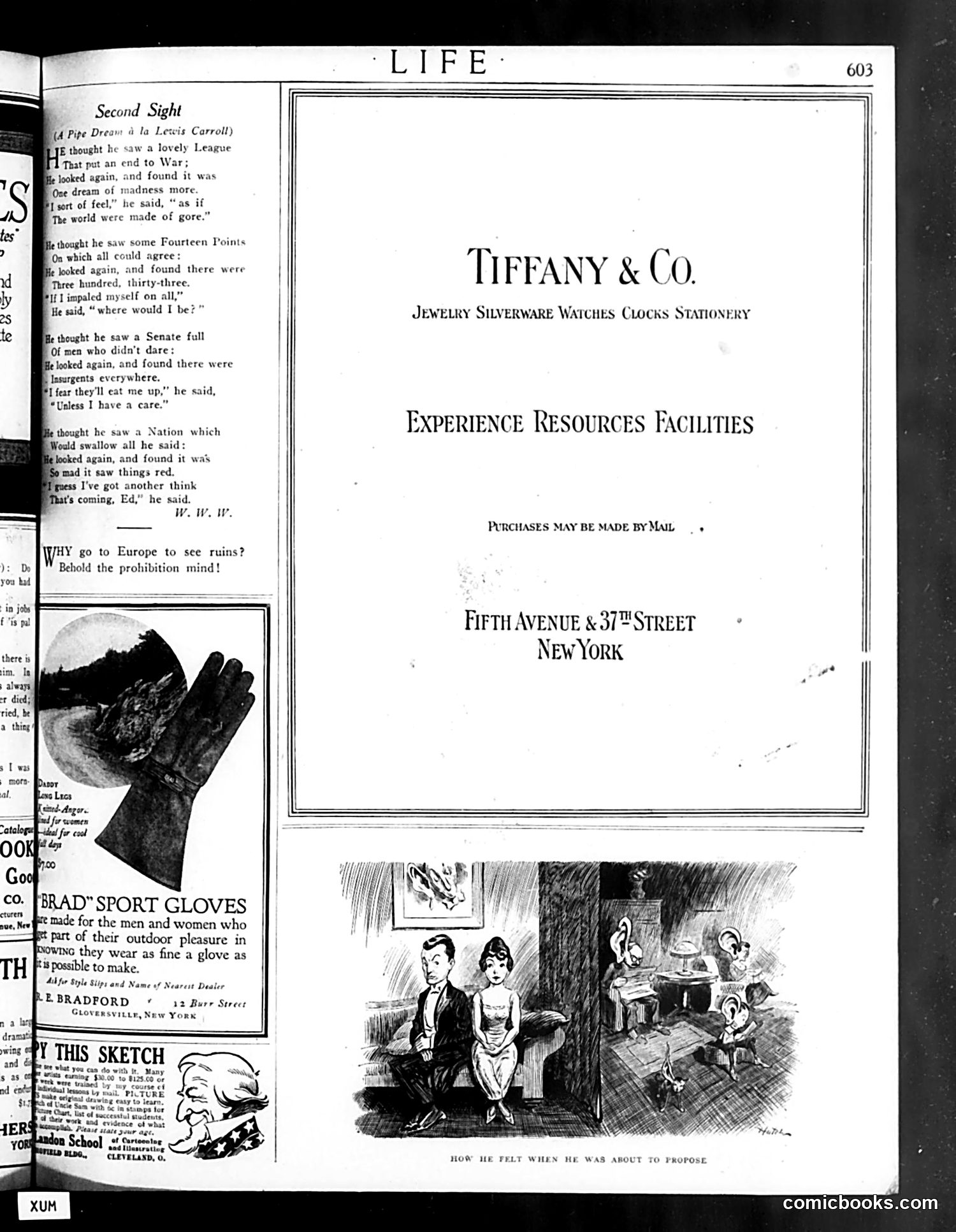
This is a political satire mimicking Lewis Carroll's absurdist style, depicting post-WWI disillusionment. The unnamed protagonist represents idealistic observers of the peace process—likely Wilson administration supporters or League of Nations advocates. The poem catalogs failed post-war hopes: the League of Nations (meant to end war, but proving ineffectual); Wilson's Fourteen Points (supposedly agreed upon, but multiplied into contradictions); and a Senate "full of men who didn't dare" (likely referencing Republican isolationist opposition to the League). The final image—a nation seeing "things red"—suggests communist fear or general societal rage. The Carroll reference amplifies the satire: just as Carroll's characters encounter logical impossibilities, the peace-builder encounters political absurdities. The poem mocks naive idealism confronting messy political reality, particularly Senate opposition to League ratification and the treaty's actual complexity versus its promised simplicity. The bottom illustration, "How He Felt When He Was About to Propose," provides a lighter romantic subplot, contrasting personal uncertainty with geopolitical failure.
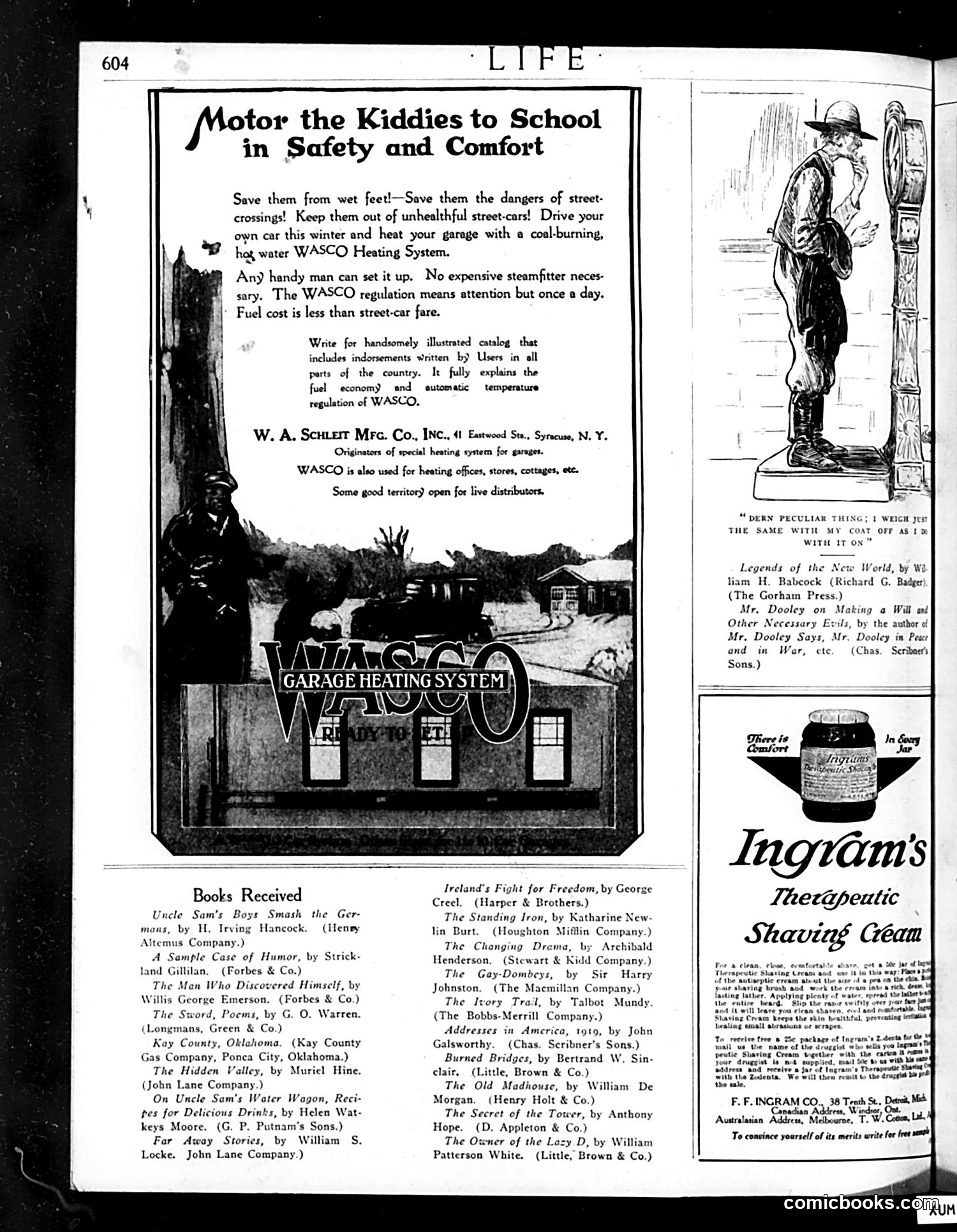
This page is primarily **advertising and book listings**, not political satire. The main advertisement (left) promotes WASCO heating systems for home garages, targeting middle-class car owners. The pitch emphasizes safety—keeping children out of dangerous streetcars and away from wet feet—and economy, claiming fuel costs less than street-car fares. This reflects early 1920s attitudes favoring private automobiles over public transit. The small cartoon (right) shows a man weighing himself in a coat, making a joke about weight distribution rather than addressing political or social issues. The bulk of the page lists newly published books, including war-related titles ("Uncle Sam's Boys Smash the Germans," "Ireland's Fight for Freedom") reflecting post-WWI publication trends, alongside general fiction and humor collections. The Ingram's Shaving Cream ad at bottom right is standard product advertising. **This is essentially a magazine filler page combining ads and book notices.**
This page is entirely an **advertisement**, not a cartoon or satirical content. It's a full-page ad for W. & J. Sloane, a furniture and interior design company operating in the early-to-mid 20th century. The ad promotes seamless rugs and floor coverings, emphasizing that their products are designed with "art knowledge" to complete room furnishings. The decorative border frames the message professionally. The company positions itself as offering expert interior design advice to solve customers' furnishing problems. There is no political or social satire here—it's straightforward commercial messaging typical of *Life* magazine's advertising revenue model. The ornamental border design and typography reflect the aesthetic standards of the era when this appeared.
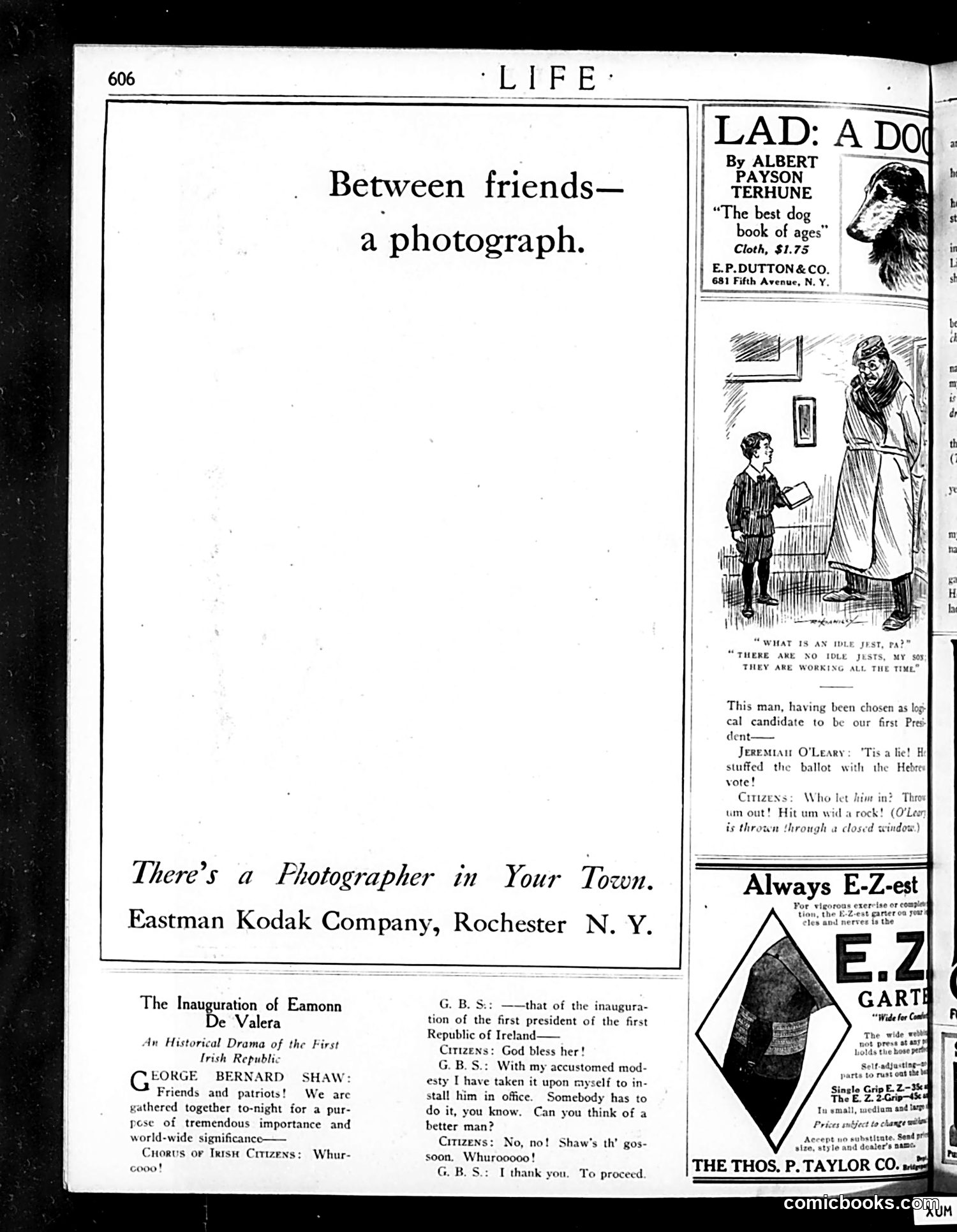
This page satirizes the Irish independence movement and the establishment of the Irish Free State. The main sketch depicts George Bernard Shaw (the famous Irish playwright, identified as "G. B. S.") presiding over the inauguration of Éamonn de Valera as president of the first Irish Republic. **The satire's point**: Shaw humorously claims credit for "installing" de Valera in office with characteristic arrogance ("with my accustomed modesty"). The sketch mocks both Shaw's ego and the chaotic nature of Irish political factions—Jeremiah O'Leary (representing republican hardliners) interrupts to denounce the proceedings, accusing ballot-stuffing, before being thrown through a window by angry citizens. **The joke for contemporary readers**: This satirizes real post-independence tensions in Ireland, where different republican factions disputed legitimacy and methods. Shaw's self-aggrandizing role lampoons intellectuals' pretensions to political importance. The page otherwise contains unrelated advertisements (Eastman Kodak, a dog book, and gardening products).
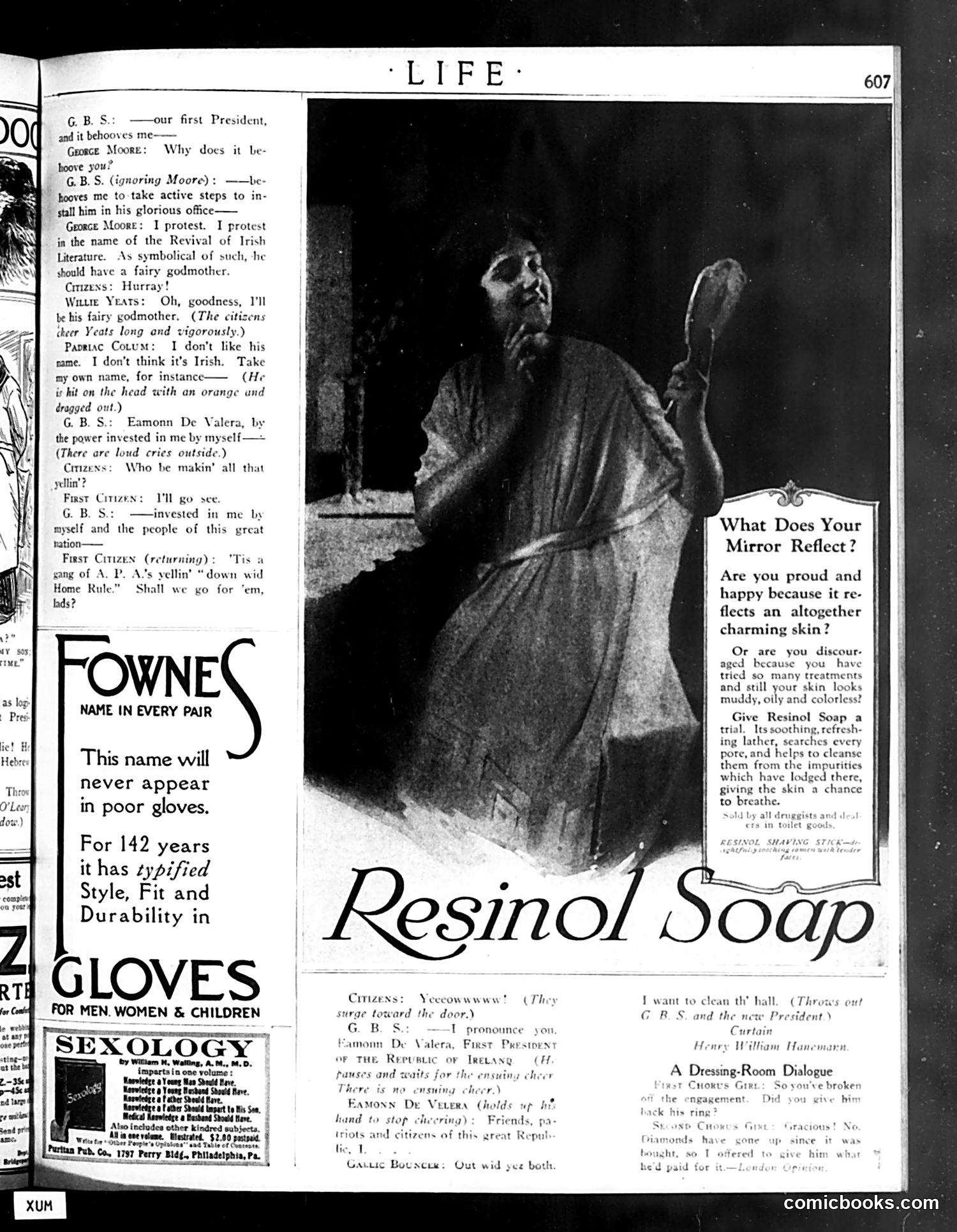
This is a satirical dialogue about Irish independence, likely from the 1920s era of Irish political upheaval. The sketch mocks the process of selecting Ireland's first president. **The figures:** G.B.S. (George Bernard Shaw, the famous Irish playwright), George Moore (Irish writer), W.B. Yeats (Irish poet), and Pádraic Colum (Irish writer) debate installing Eamonn De Valera as president. The satire suggests these literary figures are inappropriately involved in serious state matters. **The joke:** The scene is chaotic—citizens cheer wildly, someone gets hit with an orange and dragged out, there are arguments about Irish names and symbols (fairies, Home Rule). De Valera's appointment happens almost accidentally amid the pandemonium. **The point:** The cartoon satirizes how Ireland's political leadership emerged from literary circles and passionate but disorganized public debate, suggesting the process was more theatrical than rational. The final interruption ("I want to clean th' hall") undercuts the solemnity with mundane reality.
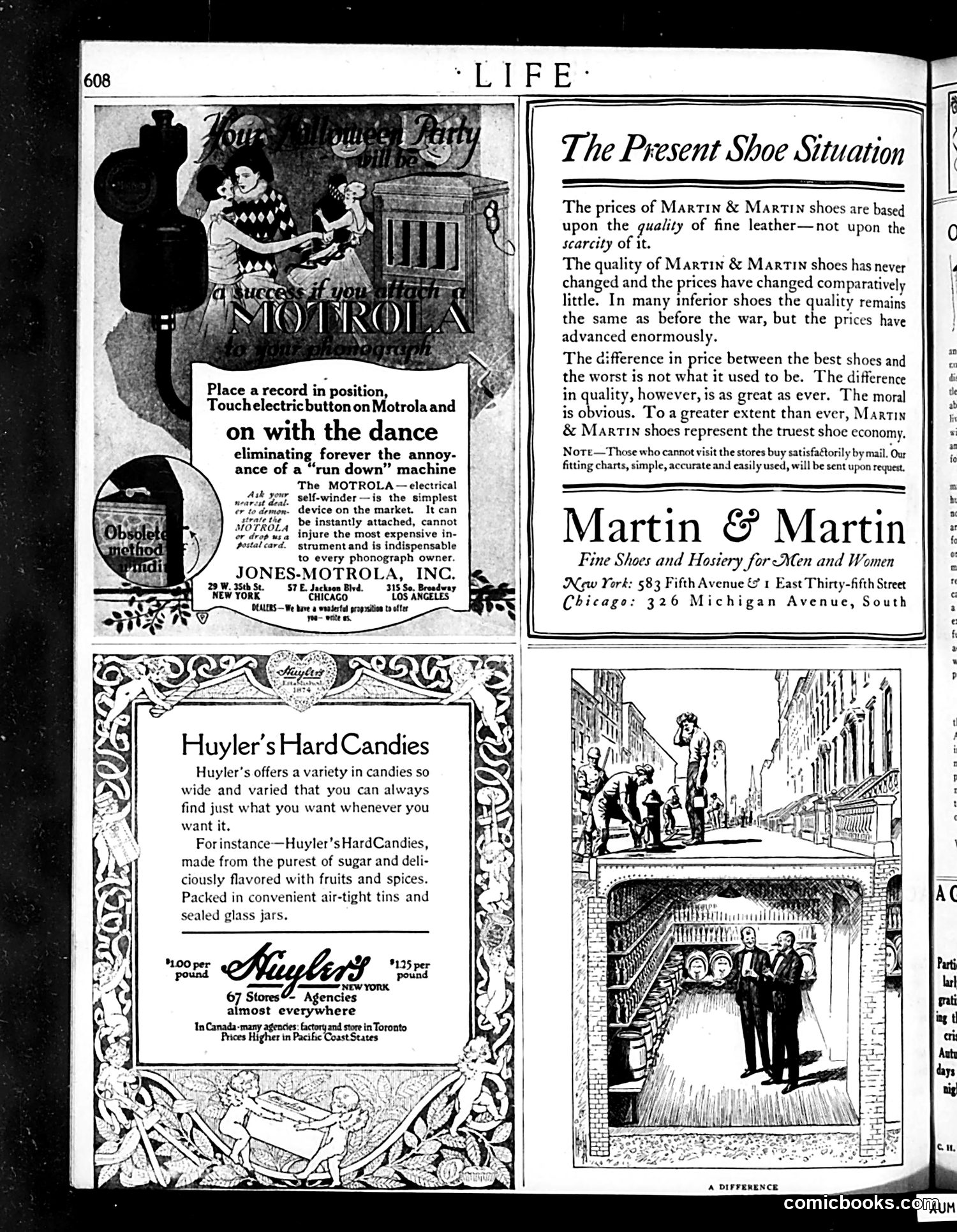
This page contains **three separate advertisements** from what appears to be the post-WWI era (likely early 1920s), with no political cartoons or satire. **The Motrola ad** (top left) advertises an electric record player accessory that eliminates manual winding, positioning it as convenient and safe for phonographs—reflecting the era's novelty of electrical devices in homes. **Huyler's Hard Candies ad** (bottom left) is a straightforward candy advertisement emphasizing variety and quality packaging. **Martin & Martin Shoes ad** (right side) makes an economic argument: the company claims shoe *quality* hasn't changed despite post-war price increases, unlike competitors who raised prices while maintaining inferior quality. This appears to be post-WWI messaging addressing wartime inflation and manufacturing scarcity, positioning Martin & Martin as offering better value than competitors exploiting material shortages. None of these advertisements contain political satire or caricature—they are standard commercial messaging typical of *Life* magazine's advertising content.
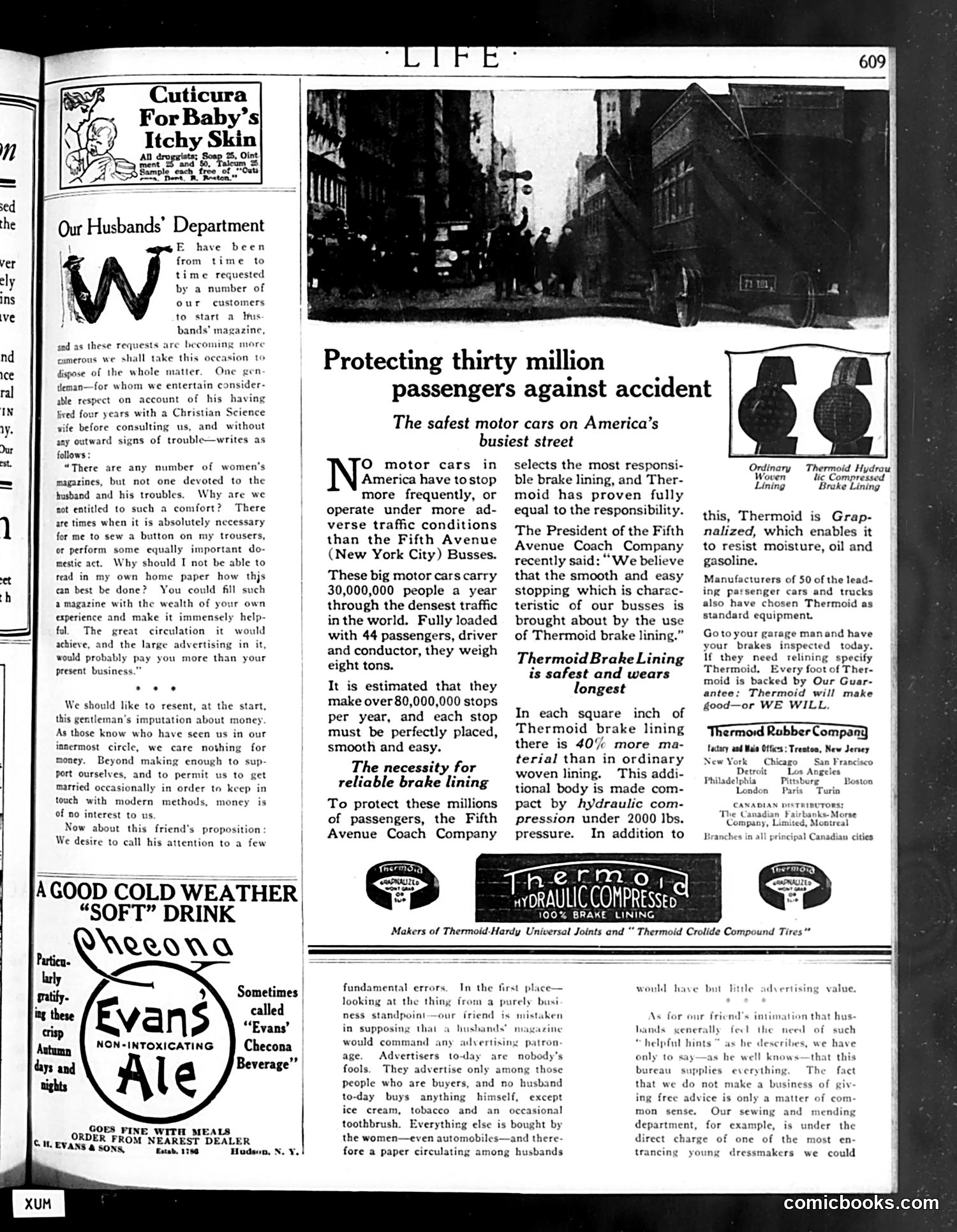
This page contains satirical commentary on gender roles alongside commercial advertising, typical of 1920s Life magazine. **"Our Husbands' Department"** is satirical mockery of a letter proposing a magazine for husbands. The writer complains that men lack a publication addressing their domestic struggles—specifically, how to sew a button. Life's editors respond with feigned sympathy while subtly ridiculing the notion that husbands need guidance on basic household tasks. The satire targets the absurdity of expecting men to need instruction for elementary domestic work, implying this was traditionally women's domain. The editors humorously note they care "nothing for money" except enough to "permit us to get married occasionally"—a jab at divorce rates. **The remaining content is advertising**: Cuticura soap, Evans Ale (a "soft drink"), and Thermoid brake lining for Fifth Avenue buses. The brake lining ad emphasizes safety for NYC's 30 million annual bus passengers, featuring technical specifications and testimonials from the Fifth Avenue Coach Company. The page reflects 1920s attitudes about gender, consumerism, and emerging automobile safety concerns.
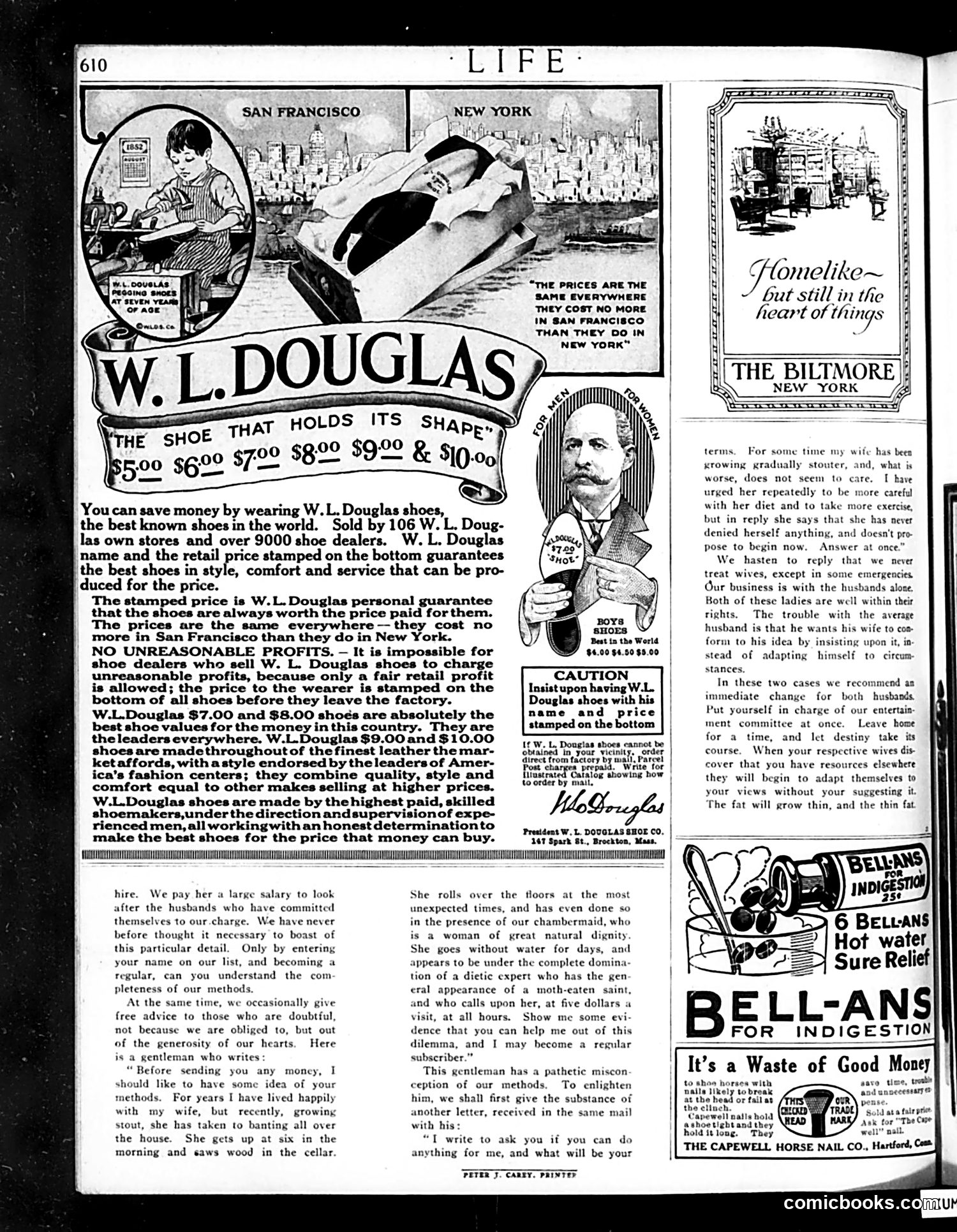
This page is primarily **advertising**, not satire or political commentary. The dominant feature is a large W.L. Douglas shoe advertisement, occupying roughly two-thirds of the left side. **The W.L. Douglas Ad** promotes shoes at prices from $5–$10, emphasizing that prices are identical nationwide and the manufacturer's name/price is stamped on every shoe's bottom as a "personal guarantee" of quality and fair pricing. This reflects early 1900s consumer culture—the stamping of prices addressed contemporary concerns about price gouging and regional markup disparities. **The other content** includes: - A Biltmore Hotel advertisement (right side) - A "Bell-ans for Indigestion" patent medicine ad - An unrelated advice column discussing marital disputes There are no political cartoons on this page. The historical interest lies in the advertising itself: the emphasis on transparent pricing and mass-market consumer goods reflects Progressive Era concerns about fair dealing and standardized commerce.
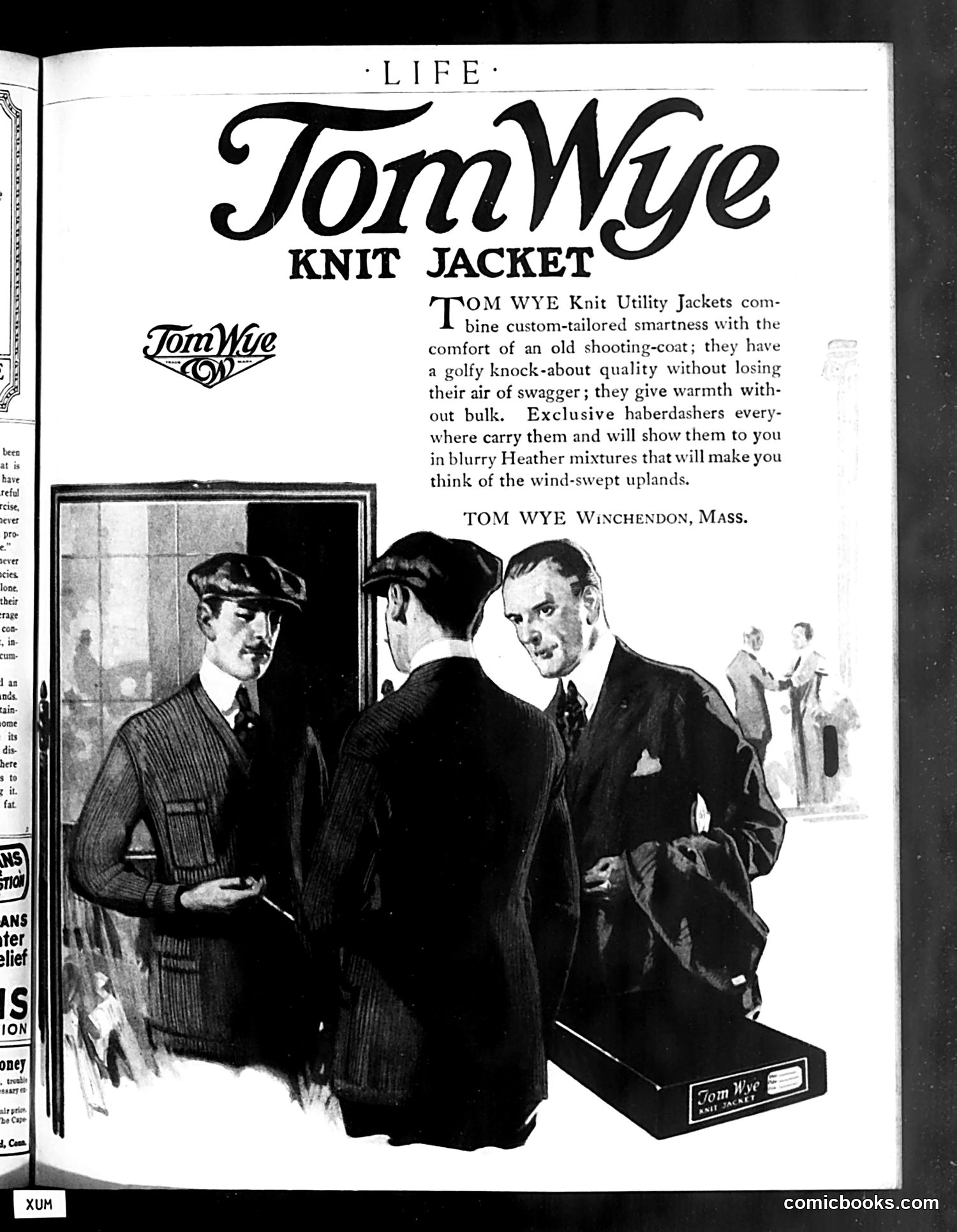
This page is not a political cartoon or satire—it's a straightforward **advertisement for Tom Wye Knit Jackets**, a clothing brand from Winchendon, Massachusetts. The illustration shows three well-dressed men in business attire examining or discussing a knit jacket (displayed in a box at lower right). The ad copy emphasizes the jacket's appeal to affluent male consumers: it combines formal tailoring with casual comfort, suitable for golf or country pursuits. The language—"swagger," "wind-swept uplands," "Heather mixtures"—targets upper-class readers seeking practical yet stylish outerwear. This appears in *Life* magazine's advertising section, typical of early-to-mid 20th century luxury goods marketing to male professionals.
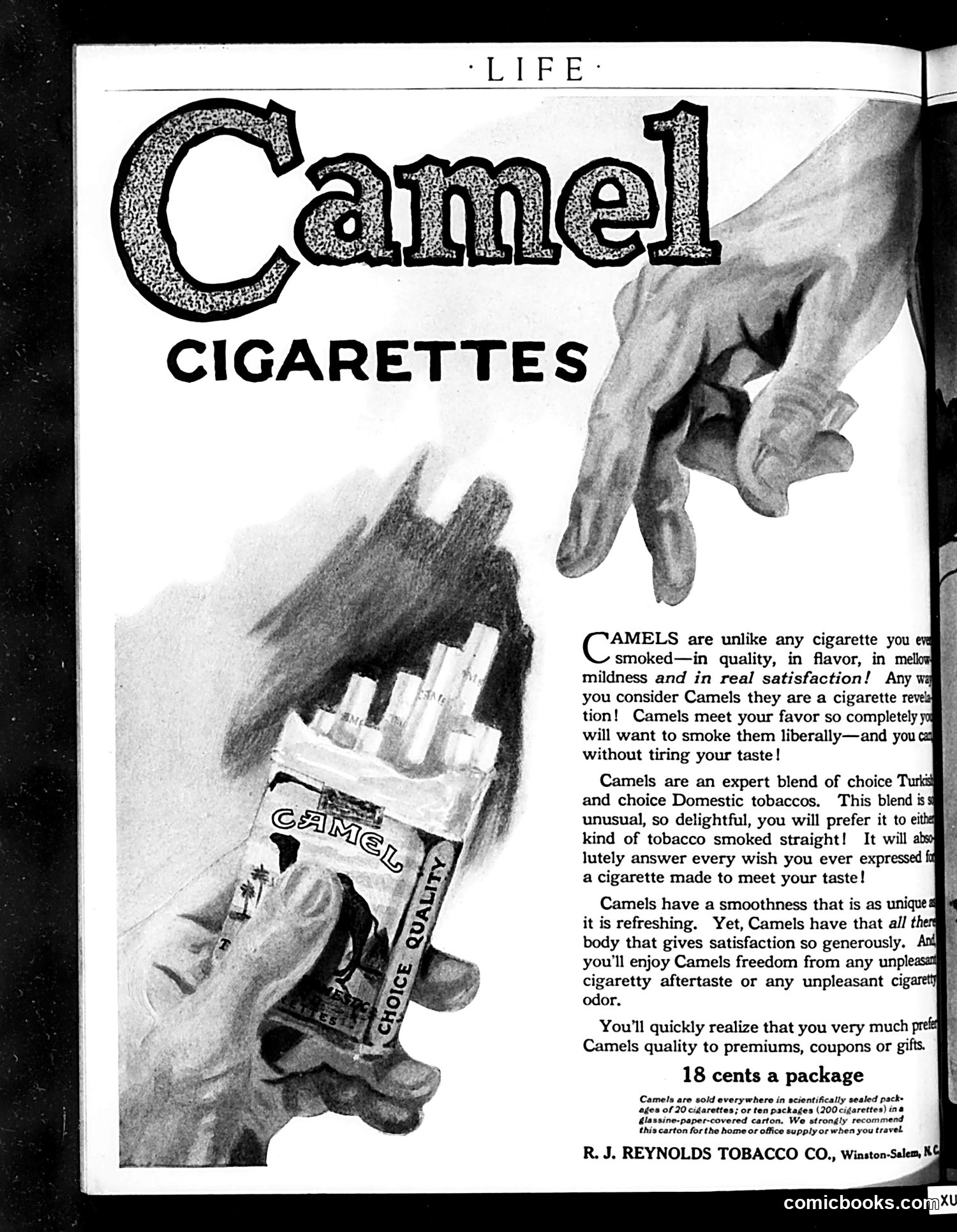
This is a **cigarette advertisement**, not satire or political commentary. It appeared in *Life* magazine during an era (likely 1920s-1930s) when tobacco advertising was legal and widespread in mainstream publications. The image shows a hand holding a Camel cigarette package above a cityscape. The ad makes typical period marketing claims: that Camels are superior in "quality, flavor, mildness and satisfaction," blending Turkish and domestic tobaccos, and free from unpleasant aftertaste. **Key historical context for modern readers:** This represents an era before tobacco's health dangers were widely acknowledged or regulated. Cigarettes were advertised openly in family magazines without health warnings. The "18 cents a package" price and emphasis on scientific packaging reflect early 20th-century consumer marketing tactics. R.J. Reynolds was one of America's dominant tobacco companies.
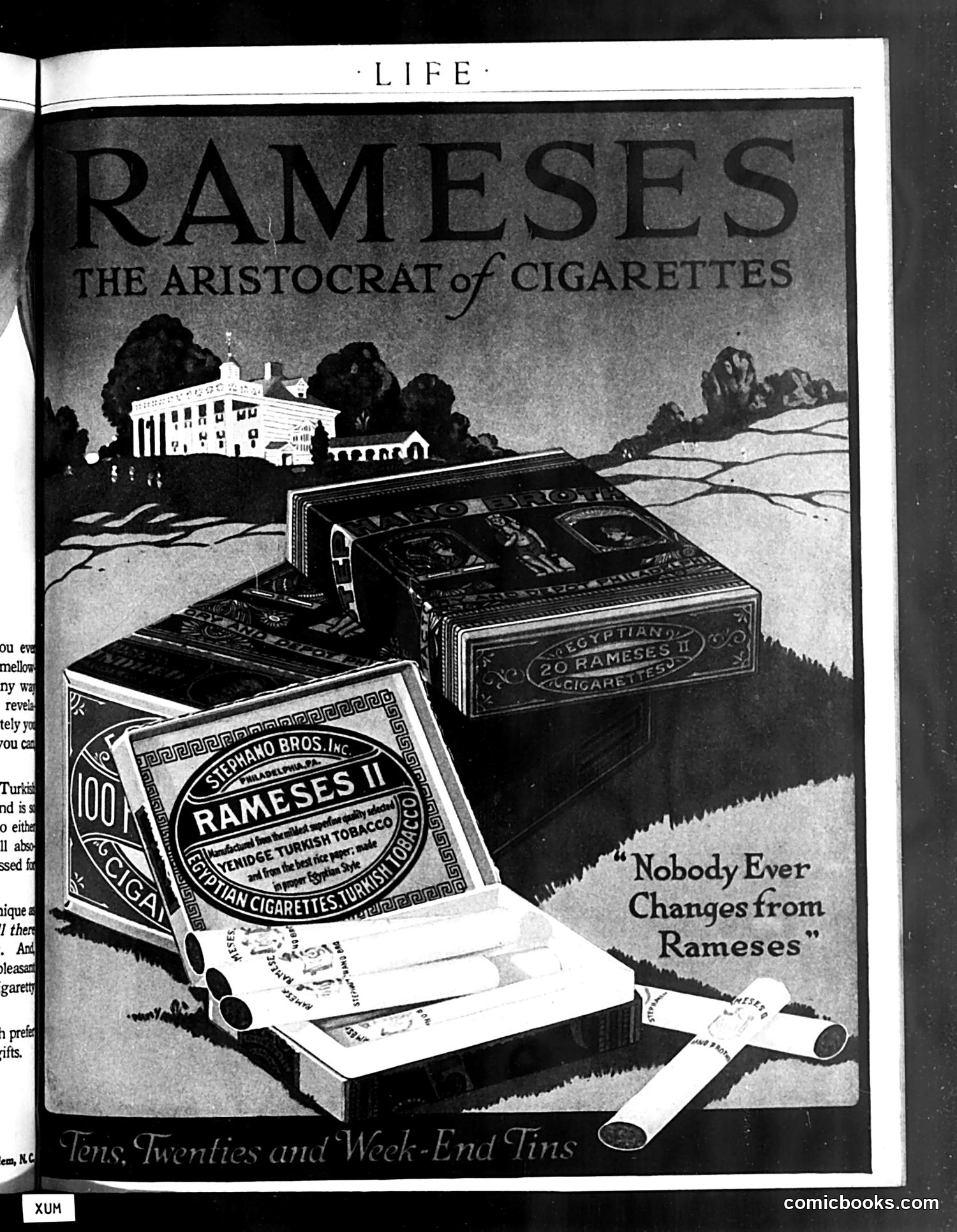
This is a cigarette advertisement, not political satire. The ad promotes "Rameses II" cigarettes, marketed as "The Aristocrat of Cigarettes" and described as Egyptian and Turkish tobacco products made by Stephano Bros., Inc. (Philadelphia). The imagery depicts ornate cigarette boxes arranged in a pastoral landscape with a mansion, emphasizing luxury and sophistication. The tagline "Nobody Ever Changes from Rameses" promises brand loyalty through superior quality. The "Aristocrat" positioning and Egyptian references suggest the cigarettes targeted affluent consumers. The ad represents early 20th-century marketing that associated cigarettes with elegance and status—claims that would be heavily regulated or prohibited in modern advertising due to health concerns cigarettes pose.
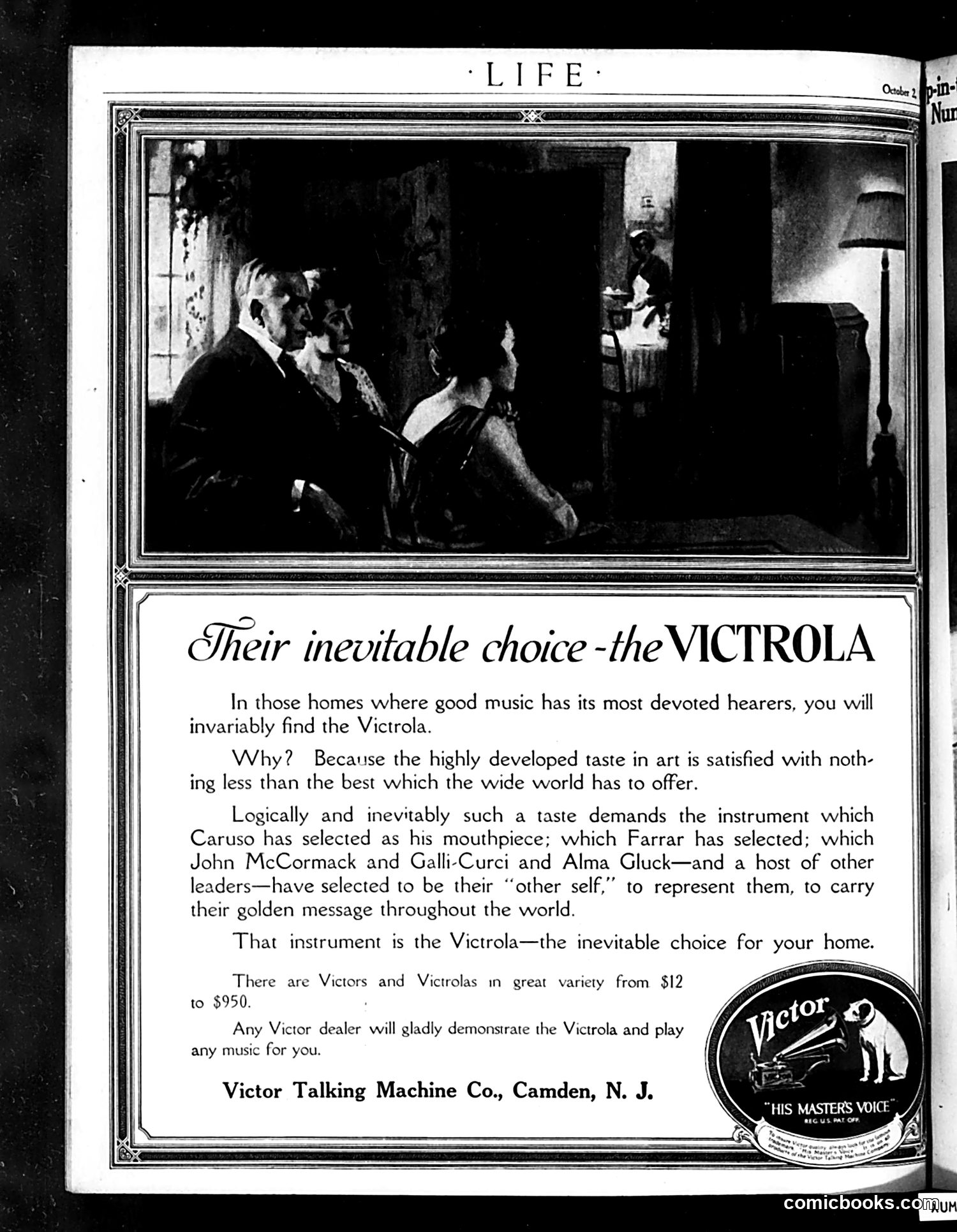
This is **not a cartoon or satire**—it's a straightforward advertisement for the Victrola phonograph, appearing in *Life* magazine. The ad uses aspirational marketing, claiming that distinguished opera singers (Caruso, Farrar, John McCormack, Galli-Curci, Alma Gluck) have chosen the Victrola as their preferred playback device. The image shows an elegant indoor scene of people listening to music together, positioning the machine as a marker of refined taste and cultural sophistication. The argument: households with "highly developed taste in art" inevitably choose Victrolas because the world's greatest musicians endorse them. The ad emphasizes wide price range ($12–$950) to suggest accessibility across class levels while maintaining the product's association with elite cultural authority. This reflects early 20th-century marketing strategy—leveraging celebrity endorsement and aspirational class positioning to sell consumer technology.