
Life, 1919-10-02 · page 22 of 48
Life — October 2, 1919 — page 22: what you’re looking at
What you’re looking at
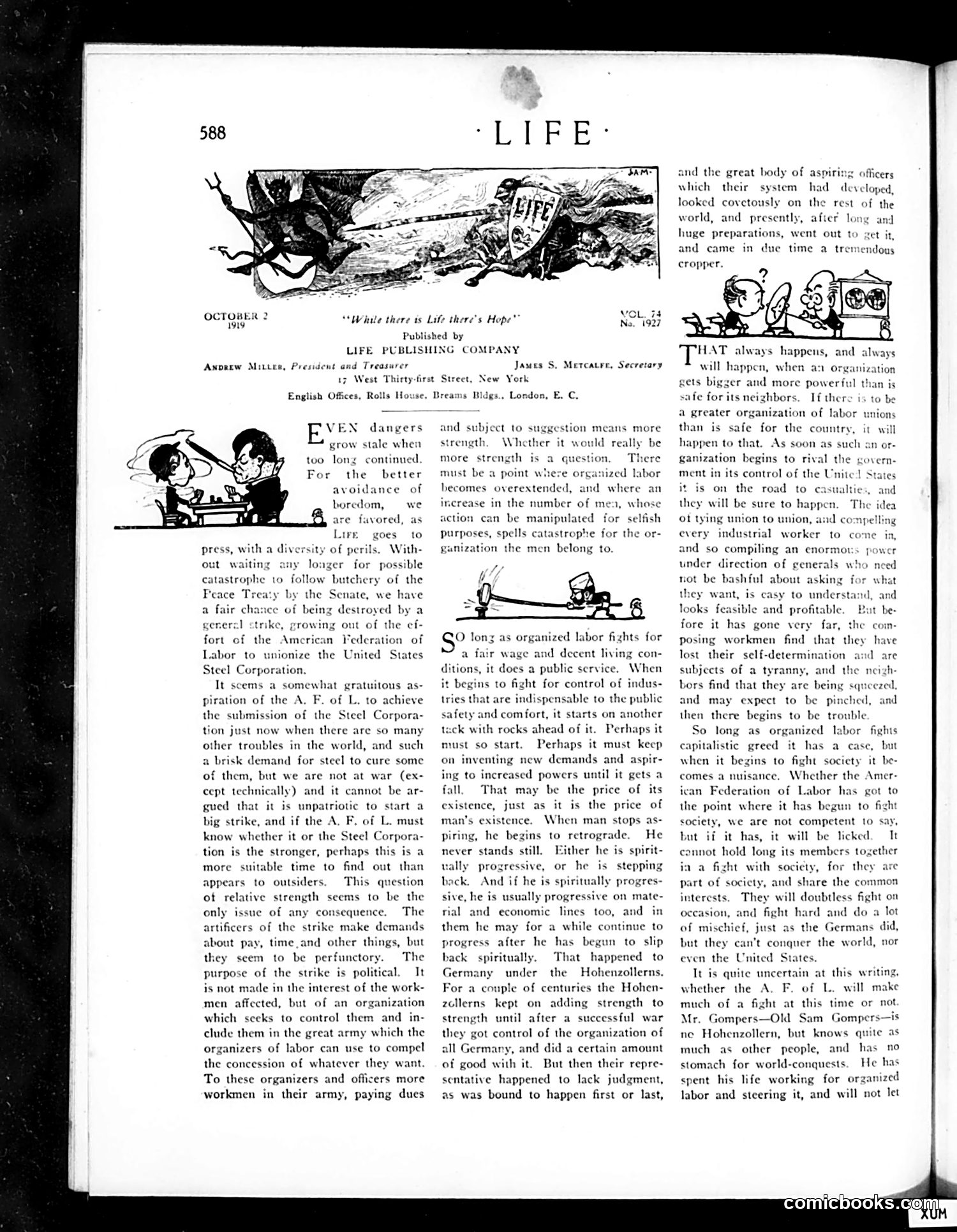
This page contains editorial commentary on labor organizing, specifically the American Federation of Labor's (A.F. of L.) effort to unionize the United States Steel Corporation. The text argues that while labor's fight for fair wages and decent conditions serves the public, expanding union power to control entire industries crosses a dangerous line. The editor warns against organizations becoming "overextended" through aggressive expansion of membership and control. The piece uses Germany under the Hohenzollerns as a cautionary historical parallel—a power that kept expanding until it overreached, ultimately failing due to poor leadership judgment. The cartoons (depicting labor struggles) illustrate the ongoing conflict. The editorial's core message: organizations that grow too powerful relative to society risk catastrophic collapse, much like empires that push expansion beyond sustainable limits. This reflects early 20th-century anxieties about labor's rising power and its potential social consequences.
📄 Transcribed text from this page (OCR, searchable)
Machine-transcribed from the original scan — historical spelling and the odd misread are preserved.
OCTOBER 2 wy “Whale there 1s Life there's Hope” VOL. 74 No. 1927 Published by LIFE Axprew Mittes, President and Treasurer West Thirty-first Street English Offices, Rolls House, Breams Bldgs., EYES dangers grow stale when too long continued For the better avoidance of boredom, — we are favored, as Lire goes to ha diversity of perils, With- ting any catastrophe to follow butchery of the Feace Treaty by the Senate, we have longer for possible a fair cha general ct fort of the American abor to unionize the Steel Corporation, United States It scems a somewhat gratuitous as- piration of the A, F. of L. to achieve the submission of the Steel Corpora- tion just now when there are so many other troubles in the world, and such a brisk demand for steel to cure some of them, but we are not at war (ex- cept technically) and it cannot be ar- gued that it is unpatriotic to start a big strike, and if the A. F, of L. must know whether it or the Steel Corpora- tion is the stronger, perhaps this is a more suitable time to find out than appears to outsiders. This question ot relative strength seems to be the only issue of any consequence. The artificers of the strike make demands about pay, time and other things, but they scem to be perfunctory. The purpose of the strike is political, It is not made in the interest of the work- men affected, but of an organization which seeks to control them and in- clude them in the great army which the organizers of labor can use to compel the concession of whatever they want. To these organizers and officers more workmen in their army, paying duces PUBLISHI COMPANY Jaues S, Mercatre, Secretary New York London, E. C. and subject to suggestion means more trength. Whether it would really be more strength is a question, There st be a point where organized labor becomes overextended, and where an increase in the number of mea, whose action can be manipulated for selfish purposes, spells catastrophe for the or- ization the men belong to. Sse long as organized labor fights for a fair wage and decent living con- ditions, it does a public service. When it begins to fight for control of indus- tries that are indispensable to the public ‘ety and comfort, it starts on another tack with rocks ahead of it. Perhaps it must so start. Perhaps it must keep on inventing new demands and aspir- ing to increased powers until it gets a fall, That may be the price of its existence, just as it is the price of man’s existence. When man stops as- piring, he begins to retrograde. He never stands still. Either he is spirit- ually progressive, or he is stepping back. And if he is spiritually progres- sive, he is usually progressive on mate- rial them he progress after he has begun to slip back spiritually. That happened to Germany under the Hohenzollerns. For a couple of centuries the Hohen- zollerns kept on adding strength to strength until after a successful war they got control of the organization of all Germany, and did a certain amount of good with it. But then their repre- sentative happened to lack judgment, as was bound to happen first or last, and economic lines too, and in may for a while continue to rd thi which great body of aspiring officers their had developed, looked covetously on the rest of the long and huge preparations, went out to get it, and came in due time a treme cropper. system world, and presently, afer HAT always happens, and always will happen, when an organization gets bigger and more powerful than is ife for its neighbors. If ther to be a greater organization of labor unions than is safe for the country, it will happen to that. As soon as such an or- ganization begins to rival the ment in its control of the Unite! States govern: it is on the road to casualties, and they will be sure to happen. The idea ot tying union to union, and compel industrial worker to. cc and so compiling an enormot ver under direction of generals who need not be bashful about asking for they want, is easy to understs looks feasible and profitable. But be- fore it has gone very far, the coi posing workmen find that they have lost every their self-determination and are subjects of a tyranny, and the neigh- bors find that they are being squeezed, and may expect to be pinched, and then there begins to be trouble So long as organized labor fights capitalistic greed it has a when it begins to fight society it be- Whether the Amer- ican Federation of Labor has got to the point where it has begun to fight society, we are not competent to say, but if it has, it licked. It cannot hold long its members together case, but comes a nuisance. will be ia a fight with society, for they are part of socicty, and share the common They will doubtless fight on nd fight hard and do a lot of mischief, just as the Germans did, sterests, occasion, but they can't conquer the world, nor even the United States. It is quite uncertain at this writing, whether the A. F. of L. will make much of a fight at this time or not Mr. Gompers—Okd Sam Gompers—is ne Hohenzollern, but knows quite as people, has no stomach for world-conquests. He has spent his life working for organized labor and steering it, and will not let much as other and