
Life, 1919-10-02 · page 29 of 48
Life — October 2, 1919 — page 29: what you’re looking at
What you’re looking at
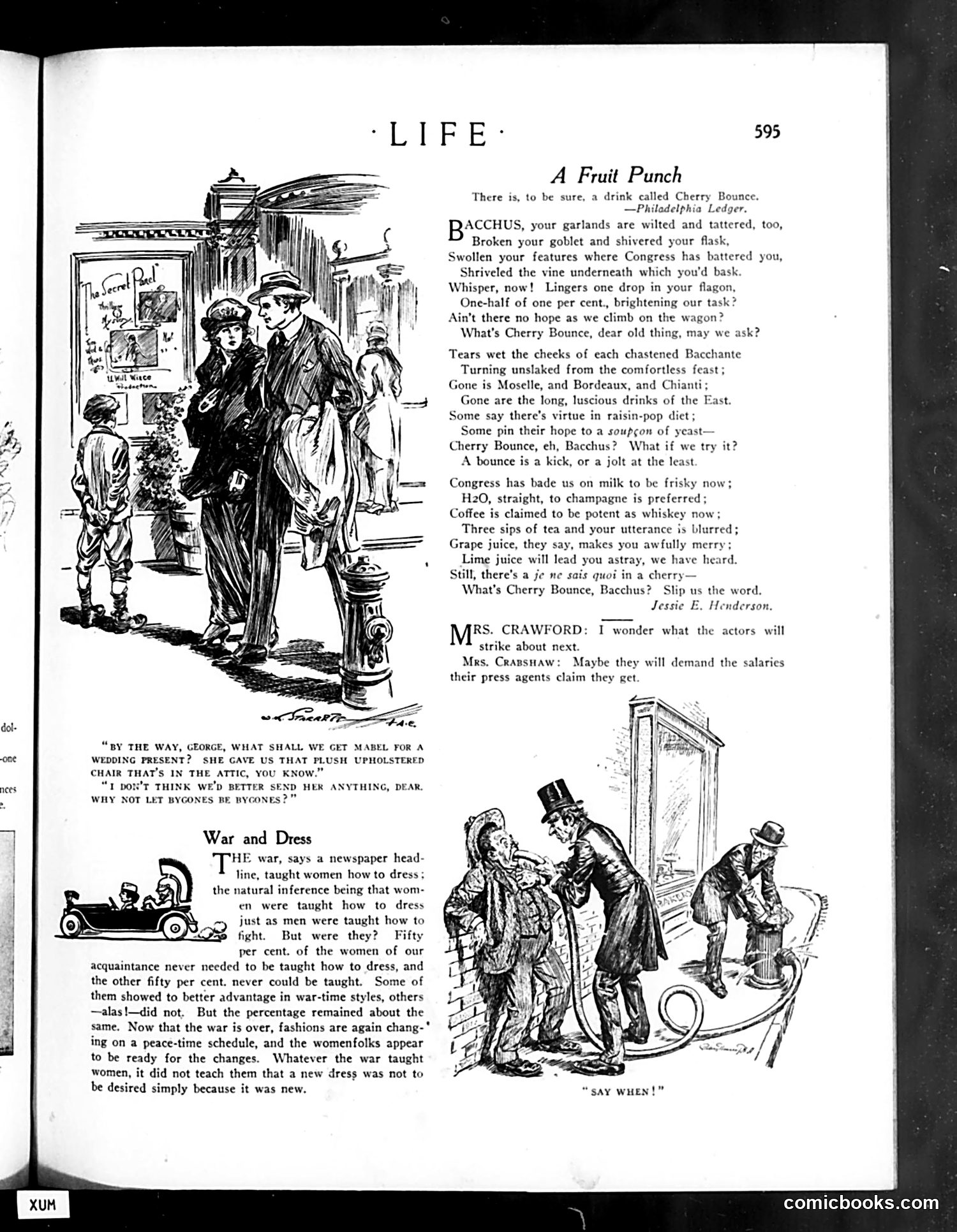
**"A Fruit Punch"** satirizes Prohibition's impact. The poem addresses Bacchus (god of wine), mourning the loss of fine wines (Moselle, Bordeaux, Chianti) under Congressional alcohol bans. It mocks the forced substitution of weak alternatives—milk, water, coffee, grape juice—while asking whether "Cherry Bounce" (a homemade fermented drink) offers any hope. The satire targets both Prohibition's severity and drinkers' desperate search for loopholes. **The dialogue** between Mrs. Crawford and Mrs. Crabshaw jokes about actors' strikes, suggesting press agents inflate salaries beyond reality. **"War and Dress"** critiques a newspaper claim that WWI taught women fashion sense. The author argues women's dress habits remained unchanged—half never needed instruction, half couldn't be taught regardless. The satire suggests the war didn't fundamentally alter women's desire for fashionable clothing, contradicting claims of war-induced behavioral reform.
📄 Transcribed text from this page (OCR, searchable)
Machine-transcribed from the original scan — historical spelling and the odd misread are preserved.
“LIFE: 595 A Fruit Punch There is, to be sure, a drink called Cherry Bounce. —Philadelphia Ledger. ACCHUS, your garlands are wilted and tattered, too, Broken your goblet and shivered your flask, Swollen your features where Congress has battered you, Shriveled the vine underneath which you'd ba Whisper, now! Lingers one drop in your flago: One-half of one per cent., brightening our task Ain’t there no hope as we climb on the wagon? What's Cherry Bounce, dear old thing, may we ask? Tears wet the cheeks of each chastened Bacchante Turning unslaked from the comfortless feast; Gone is Moselle, and Bordeaux, and Chianti; Gone are the long, luscious drinks of the East. Some say there's virtue in raisin-pop diet; Some pin their hope to a soupcon of yeast— Cherry Bounce, eh, Bacchus? What if we try it? A bounce is a kick, or a jolt at the least. Congress has bade us on milk to be frisky now; H20, straight, to champagne is preferred; Coffee is claimed to be potent as whiskey now ; Three sips of tea and your utterance is blurred; Grape juice, they say, makes you awfully merry; Lime juice will lead you astray, we have heard. Still, there’s a je ne sais quoi in a cherry— What's Cherry Bounce, Bacchus? Slip us the word. Jessie E, Henderson. RS. CRAWFORD: I wonder what the actors will strike about next. Mrs. CrapsHaw: Maybe they will demand the salaries their press agents claim they get. eS Pm “BY THE WAY, GEORGE, WHAT SHALL WE GET MABEL FOR A WEDDING PRESENT? SHE GAVE US THAT PLUSH UPHOLSTERED CHAIR THAT'S IN THE ATTIC, YoU KNOW.” “1 DON’T THINK WE'D BETTER SEND HER ANYTHING, DEAR. WHY NOT LET BYGONES BE BYCONES?” War and Dress HE war, says a newspaper head- line, taught women how to dress; the natural inference being that wom- en were taught how to dress just as men were taught how to fight. But were they? Fifty per cent. of the women of our acquaintance never needed to be taught how to dress, and the other fifty per cent. never could be taught. Some of them showed to better advantage in war-time styles, others —alas!—did not. But the percentage remained about the same. Now that the war is over, fashions are again chang-* ing on a peace-time schedule, and the womenfolks appear to be ready for the changes. Whatever the war taught women, it did not teach them that a new dress was not to be desired simply because it was new. “say wen!” comicbooks.com