
Life, 1919-10-02 · page 12 of 48
Life — October 2, 1919 — page 12: what you’re looking at
What you’re looking at
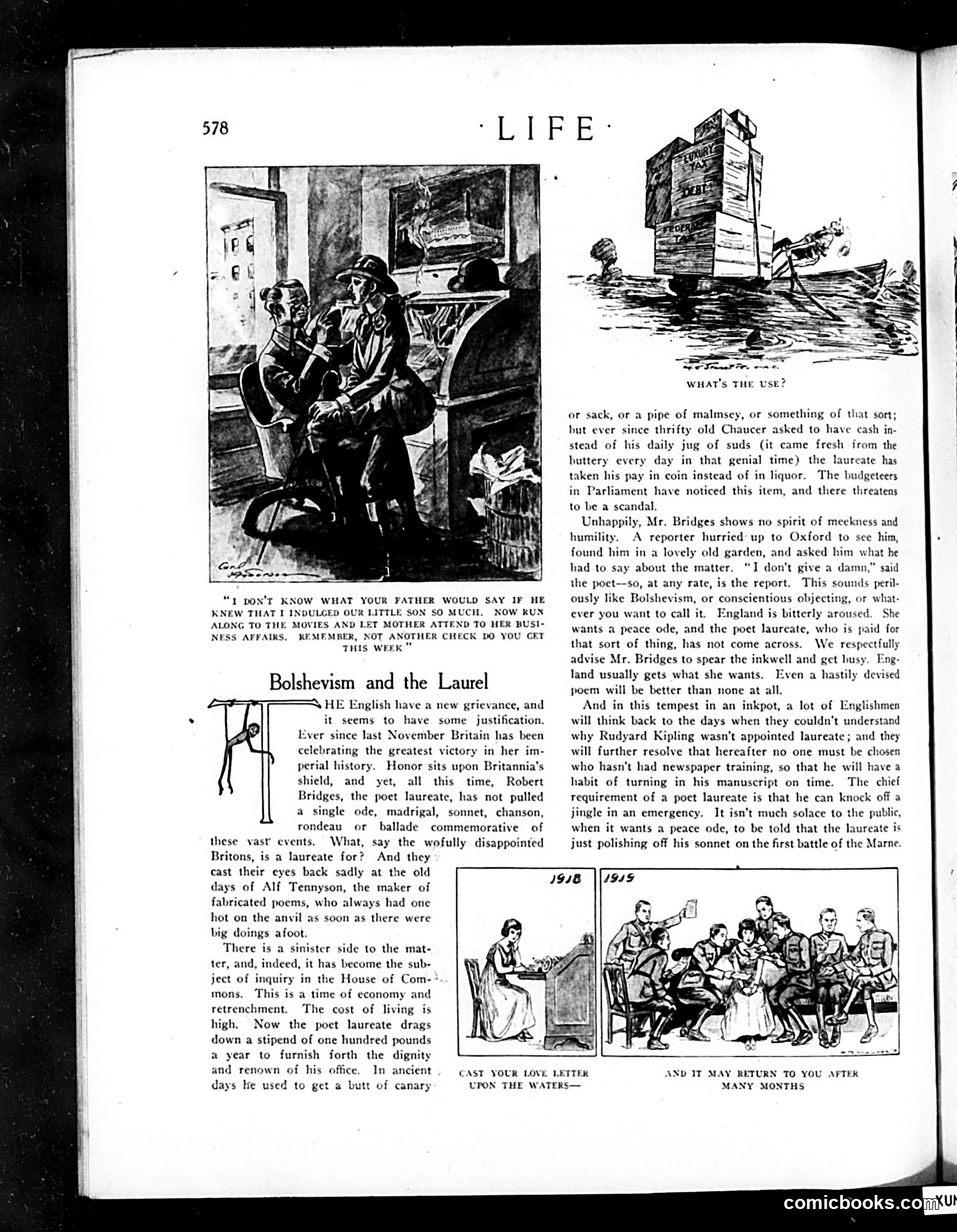
This page satirizes the debate over whether Robert Bridges, Britain's Poet Laureate, should have been appointed. The article criticizes those disappointed by his selection, arguing that England "wants a peace ode" and that Bridges is suitable despite lacking newspaper training. The cartoon mocks the outcry by depicting poets casting love letters on water, hoping they return "after many months"—suggesting laureate aspirants' hopes are equally futile and sentimental. The larger cartoon shows figures indoors, apparently representing the complaint that Bridges hasn't produced patriotic verse during wartime. The satire defends his quiet dignity against demands for immediate propagandistic poetry, positioning literary merit against populist expectations for a poet laureate.
📄 Transcribed text from this page (OCR, searchable)
Machine-transcribed from the original scan — historical spelling and the odd misread are preserved.
“1 DON’T KNOW WHAT YOUR FATHER WOULD SAY IF HE KNEW THAT I INDULGED OUR LITTLE SON SO MUCH. NOW RUN ALONG TO THE MOVIES AND LET MOTHER ATTEND TO HER BUSI- NESS AFFAIRS, REMEMBER, NOT ANOTHER CHECK DO YOU CET THIS WEEK Bolshevism and the Laurel HE English have a new grievance, and it seems to have some justification. Ever since last November Britain has been celebrating the greatest victory in her im- perial history. Honor sits upon Britannia’s shield, and yet, all this time, Robert Bridges, the poet laureate, has not pulled a single ode, madrigal, sonnet, chanson, rondeau or ballade commemorative of these vast’ events. What, say the wofully disappointed Britons, is a laureate for? And they cast their eyes back sadly at the old days of Alf Tennyson, the maker of fabricated poems, who always had one hot on the anvil as soon as there were big doings afoot. There is a sinister side to the mat- ter, and, indeed, it has become the su! ject of inquiry in the House of Com-* mons, This is a time of economy and retrenchment. The cost of living is high. Now the poet laureate drags down a stipend of one hundred pounds a year to furnish forth the dignity WHAT'S THE USE? or sack, or a pipe of malmsey, or something of that sort; but r since thrifty old Chaucer asked to have cash in- stead of his daily jug of suds (it came fresh from the buttery every day in that genial time) the laureate has taken his pay in coin instead of in liquor. The budgeteers in Parliament have noticed this item, and there threatens to be a scandal, Unhappily, Mr. Bridges shows no spirit of meekness and humility. A reporter hurried: up to Oxford to see him, found him in a lovely old garden, and asked him what he had to say about the matter. “I don’t give a damn,” said the poet—so, at any rate, is the report. This ously like Bolshevism, or conscientious objecting, or what- ever you want to call it. England is bitterly aroused. She wants a peace ode, and the poet laureate, who is paid for that sort of thing, has not come across. We respectfully advise Mr. Bridges to spear the inkwell and get busy. Eng- land usually gets what she wants. Even a hastily devised poem will be better than none at all. And in this tempest in an inkpot, a lot of Englishmen will think back to the days when they couldn’t understand why Rudyard Kipling wasn’t appointed laureate; and they will further resolve that hereafter no one must be chosen who hasn't had newspaper training, so that he will have a habit of turning in his manuscript on time. The chief requirement of a poet laureate is that he can knock off a jingle in an emergency. It isn’t much solace to the public, when it wants a peace ode, to be told that the laureate is just polishing off his sonnet on the first battle of the Marne. yunds peril- and renown of his office. In ancient days He used to get a butt of canary CAST YOUR LOVE LETTER UPON THE WATERS— AND 1T MAY RETURN TO YOU AFTEK MANY MONTHS comicbooks.comgy