
Life, 1919-10-02 · page 32 of 48
Life — October 2, 1919 — page 32: what you’re looking at
What you’re looking at
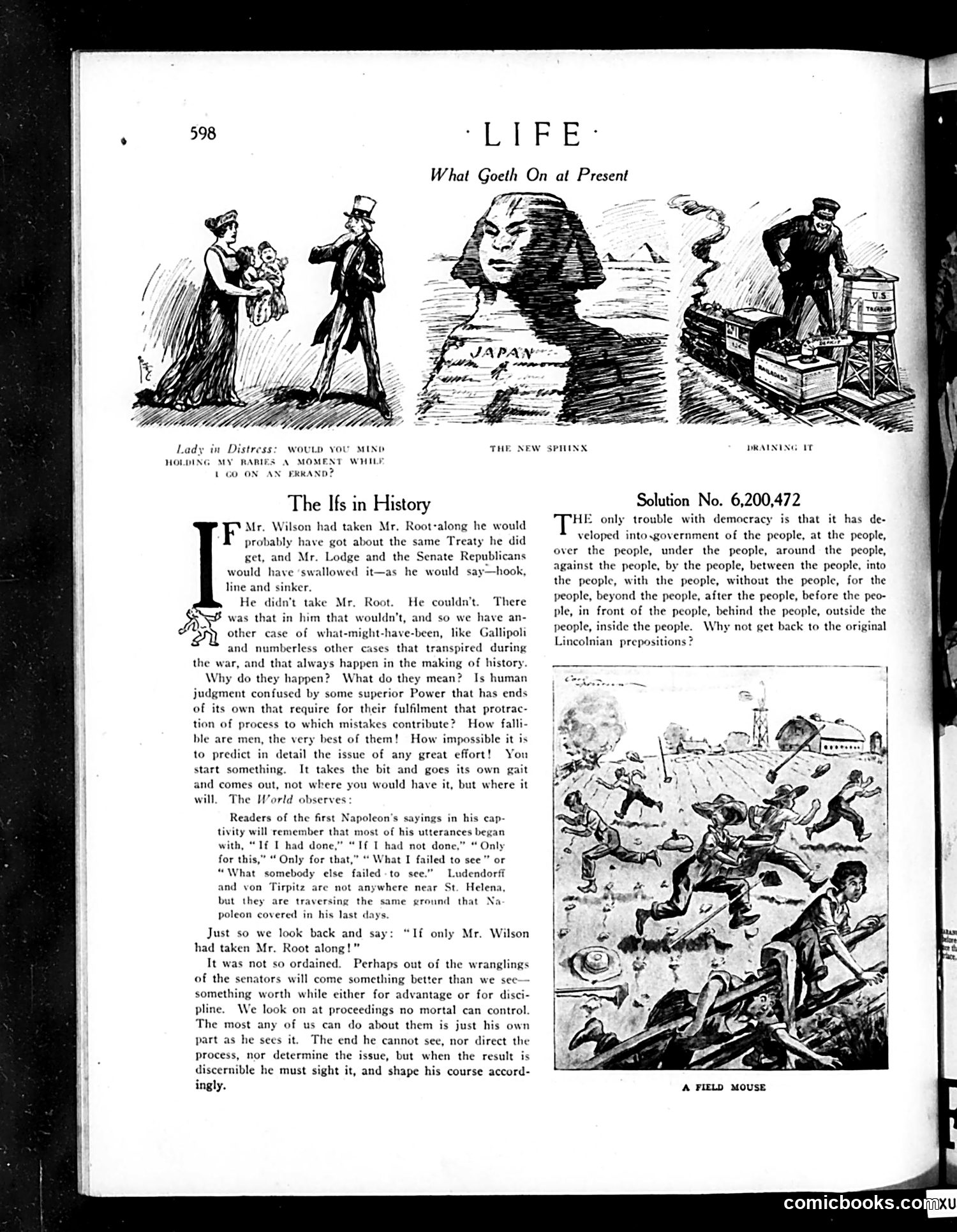
**"The Ifs in History"** criticizes President Wilson's treaty negotiations, likely regarding post-WWI peace terms. The article argues that Wilson should have brought Elihu Root (a prominent Republican statesman) to treaty discussions. Root's absence meant Senate Republicans, led by Henry Cabot Lodge, rejected the treaty—a reference to the failed League of Nations ratification. The satire questions whether history is shaped by human decision or fate, using Napoleon's regretful "if only" statements as parallel. **"The New Sphinx" cartoon** depicts the Great Sphinx with "Japan" labeled, suggesting Japanese imperial expansion concerns post-WWI. **"Solution No. 6,200,472"** mocks democratic rhetoric through absurdist wordplay, parodying Lincoln's famous "government of the people, by the people, for the people" by adding contradictory prepositions ("against," "inside," "outside" the people). It satirizes how democracy's stated ideals had become distorted or hollow by this period.
📄 Transcribed text from this page (OCR, searchable)
Machine-transcribed from the original scan — historical spelling and the odd misread are preserved.
“LIFE: What Goeth On at Present Zs Lady in Distress: wovutn you HOLDING MY RARIES A MOMENT WHILY 1 GO ON AN ERRAND? The Ifs in History Mr. Wilson had taken Mr. Root-along he would probably have got about the same Treaty he did get, and Mr. Lodge and the Senate Republicans would have ‘swallowed it—as he would say—hook, line and sinker. He didn’t take Mr. Root. He couldn't. There was that in him that wouldn't, and so we have an- other case of what-might-have-been, like Gallipoli and numberless other cases that transpired during the war, and that always happen in the making of history. Why do they happen? What do they mean? Is human judgment confused by some superior Power that has ends of its own that require for their fulfilment that protrac- tion of process to which mistakes contribute? How falli- ble are men, the very best of them! How impossible it is to predict in detail the issue of any great effort! You start something. It takes the bit and goes its own gait and comes out, not where you would have it, but where it will, The H’orld observes: Readers of the first Napoleon's sayings in his cap- tivity will remember that most of his utterances began with, “If I had done,” “If 1 had not done,” “ Only for this,” “ Only for that,” “ What I failed to see” or “What somebody else failed to see.” Ludendorff and von Tirpitz are not anywhere near St. Helena, but they are traversing the same ground that Na poleon covered in his last days Just so we look back and say: had taken Mr. Root along!” It was not so ordained. of the sei “If only Mr. Wilson Perhaps out of the wranglings ators will come something better than we see something worth while either for advantage or for disci- pline. We look on at proceedings no mortal can control. The most any of us can do about them is just his own part as he sees it. The end he cannot see, nor direct the Process, nor determine the issue, but when the result is discernible he must sight it, and shape his course accord- ingly. MIND THE NEW SPIINX DRAINING Solution No. 6,200,472 HE only trouble with democracy is that it has de- veloped into,government of the people, at the people, over the people, under the people, around the people, against the people, by the people, between the people, into the people, with the people, without the people, for the people, beyond the people, after the people, before the peo- ple, in front of the people, behind the people, outside the people, inside the people. Why not get back to the original Lincolnian prepositions? A FIELD MOUSE comicbooks.conmmal