
A complete issue · 40 pages · 1918
Life — February 14, 1918
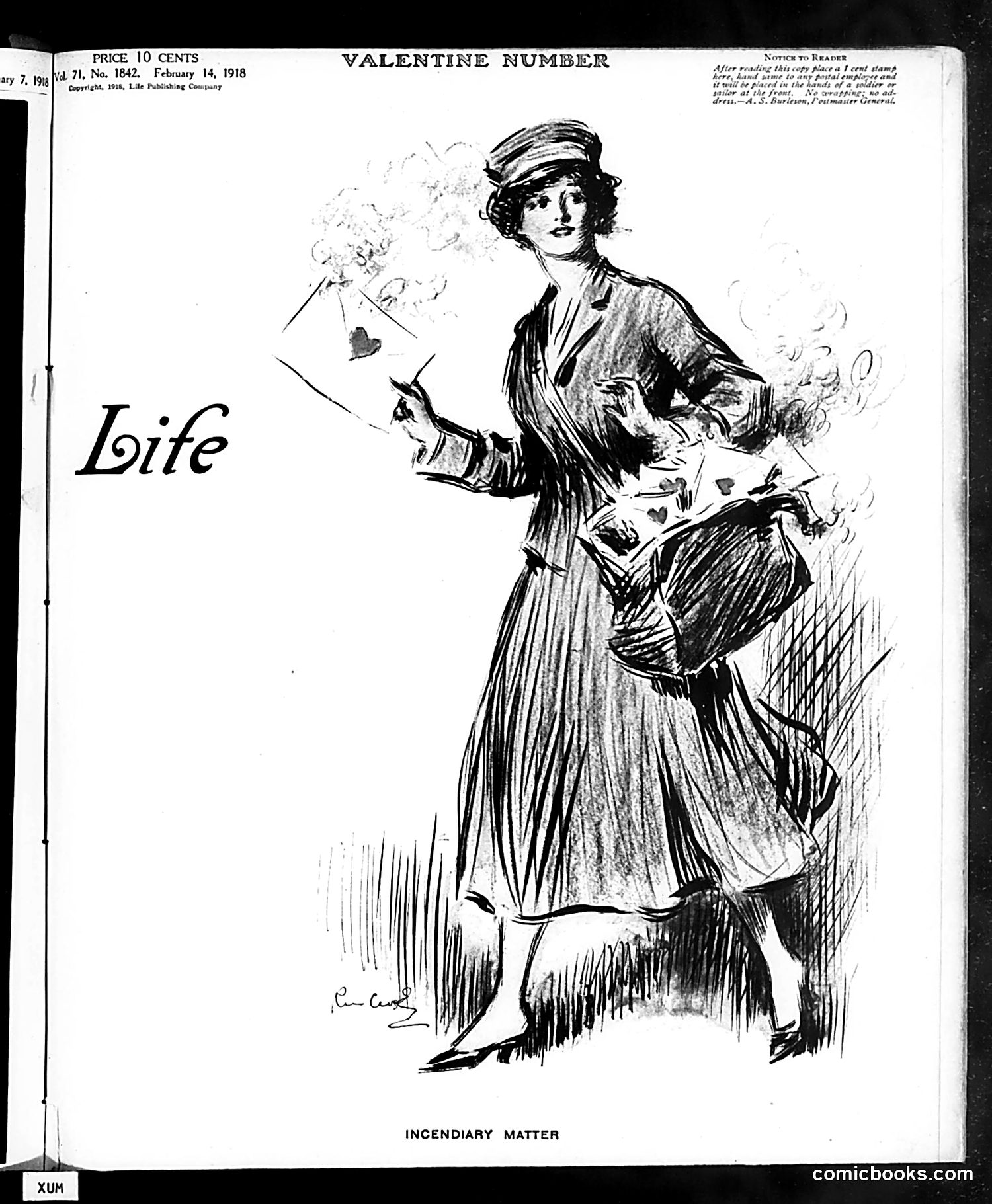
This is the Valentine's Day issue cover of *Life* magazine (February 14, 1918). The illustration shows a fashionable woman in a long coat and hat, playfully tossing love letters or valentines that scatter around her. The title "Life" and caption "INCENDIARY MATTER" create the joke. The satire plays on "incendiary"—literally, material that causes fire—equating the woman's romantic correspondence with something dangerous and inflammatory. This is a visual pun: love letters are "hot" both romantically and, treated as explosive devices, literally. Given the 1918 date (during World War I), the humor likely also references wartime anxiety about explosives and sabotage, making the domestic romance imagery ironically "dangerous." The cartoon exemplifies *Life*'s characteristic blend of social commentary and romantic humor from this era.
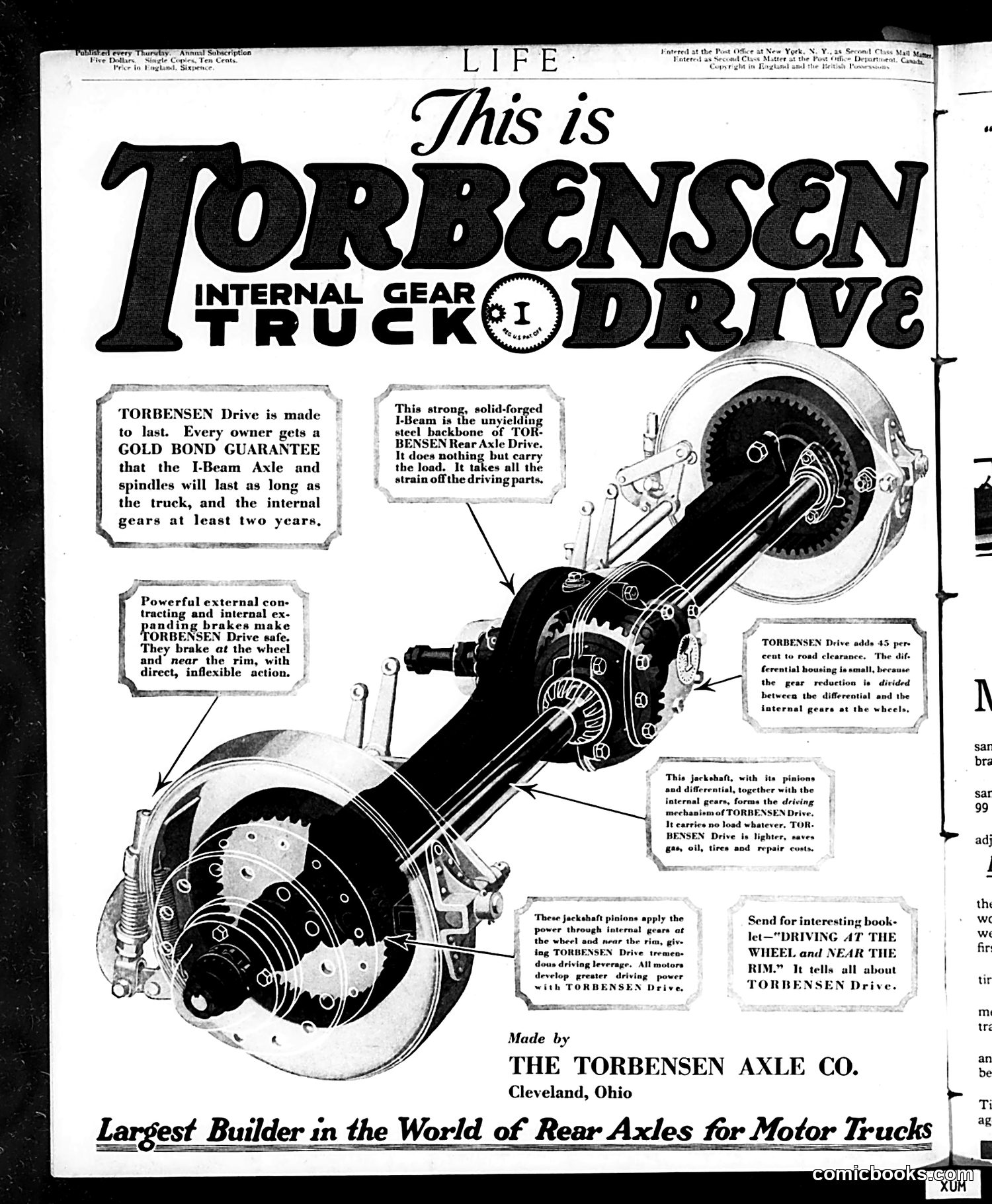
This is **not a cartoon or satire**—it's a straightforward **product advertisement** for the Torbensen Internal Gear Truck Drive, manufactured by the Torbensen Axle Co. of Cleveland, Ohio. The page features a detailed technical illustration of a truck axle assembly with labeled components explaining the mechanics of internal gear drive technology. Multiple text boxes highlight features: the "Gold Bond Guarantee" on the I-beam and spindles, the solid-forged backbone design, powerful braking capabilities, and the jackshaft mechanism that applies power through internal gears. The bottom declares Torbensen as the "Largest Builder in the World of Rear Axles for Motor Trucks." This is vintage industrial advertising aimed at truck manufacturers or fleet operators, emphasizing durability and mechanical advantages.
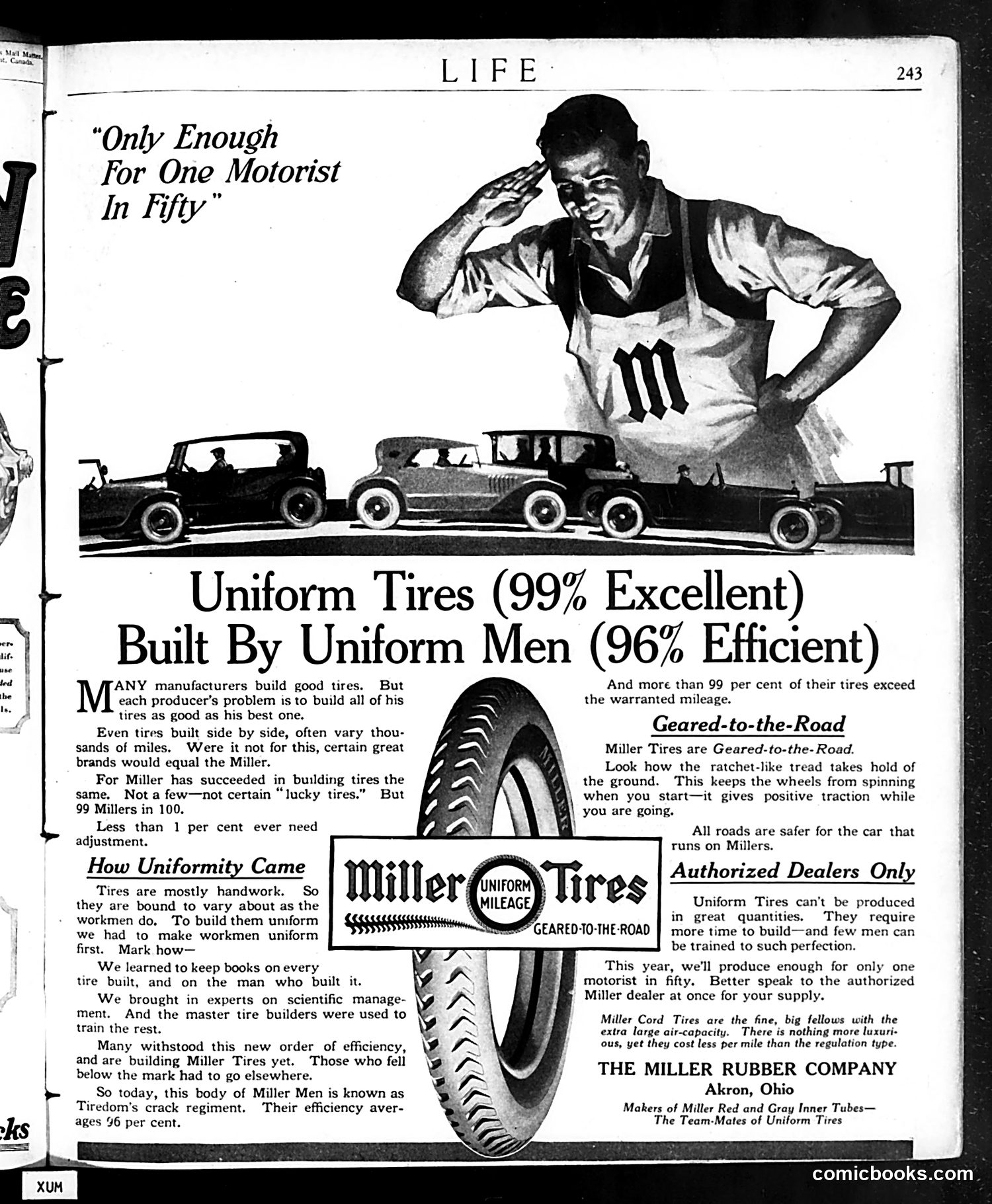
This is a **vintage advertisement**, not political satire. The page promotes Miller Uniform Tires, manufactured by The Miller Rubber Company of Akron, Ohio. The ad's humor relies on a **workplace efficiency angle** popular in 1920s-30s advertising. A cheerful factory worker displays five cars, illustrating Miller's slogan: "Only Enough For One Motorist In Fifty"—meaning their tires are so superior that one person could theoretically use five cars before needing new tires. The text emphasizes **standardization and quality control**: "Uniform Tires (99% Excellent) Built By Uniform Men (96% Efficient)." This appeals to contemporary values celebrating industrial precision and worker reliability. The "Geared-to-the-Road" tire design is highlighted as a technical advantage. This reflects **pre-Depression American optimism** about manufacturing prowess.
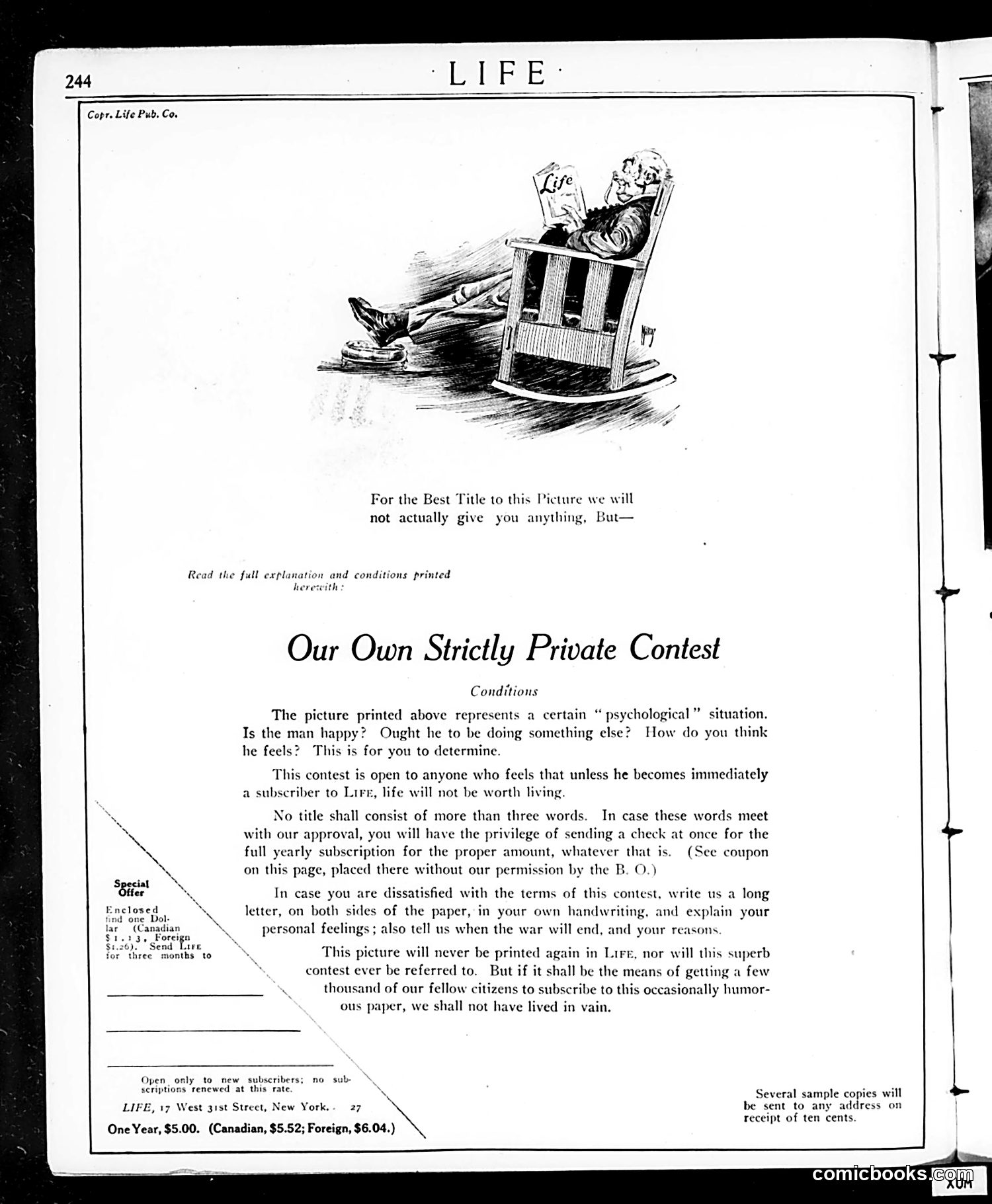
This page from *Life* magazine features a contest rather than a political cartoon. The illustration shows a man relaxing in a rocking chair, reading *Life* magazine, appearing content or perhaps idle. The contest invites readers to interpret the man's psychological state: "Is the man happy? Ought he to be doing something else? How do you think he feels?" Entries are limited to three words. The satire appears gentle—the contest itself is somewhat tongue-in-cheek, jokingly suggesting that only *Life* magazine subscribers can achieve such contentment. The text notes this "occasionally humorous paper" hopes subscriptions will result from the contest. This reflects early 20th-century American magazine culture, where *Life* positioned itself as essential reading for the educated class.
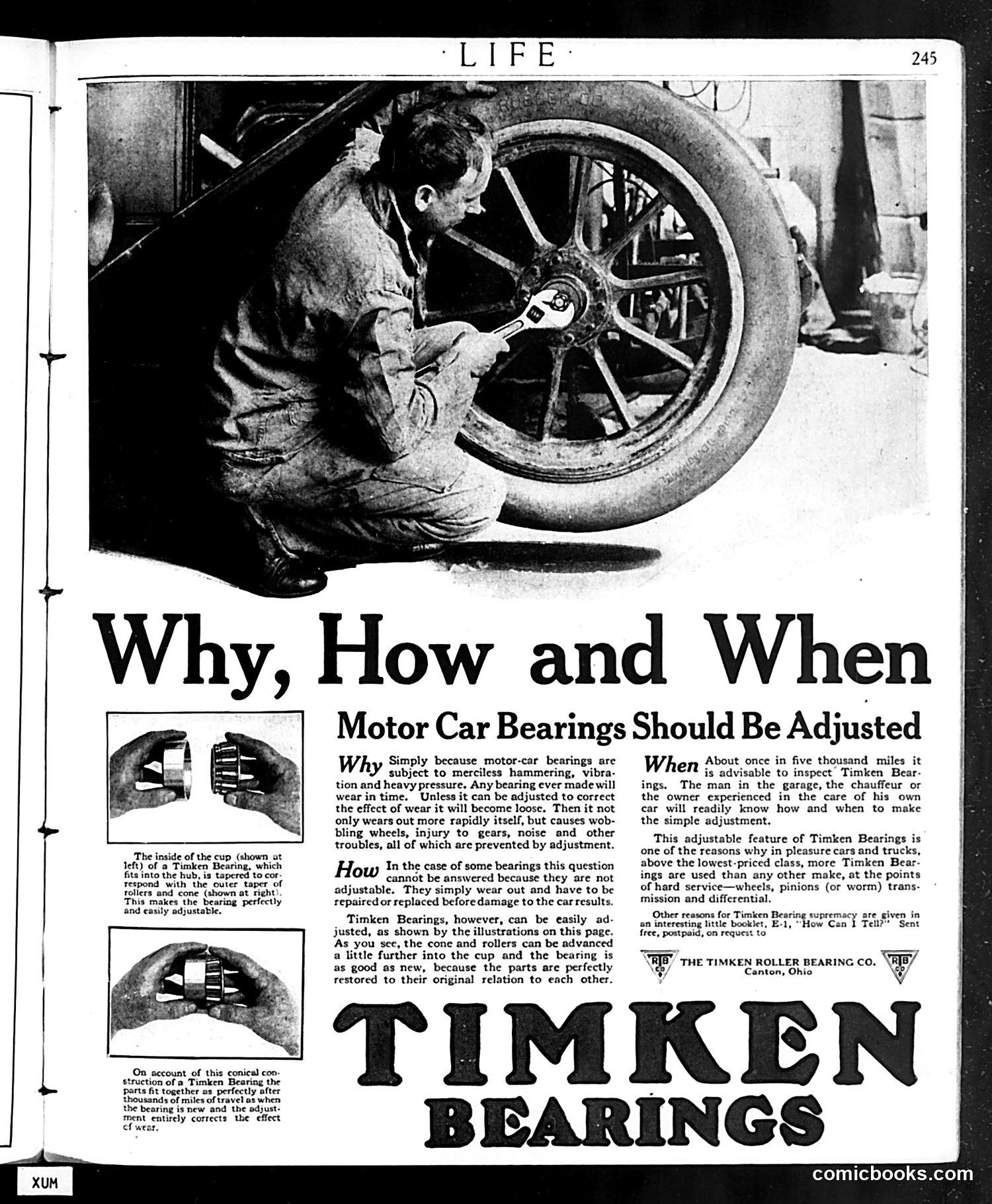
This is **not political satire or a cartoon**—it's a **straightforward advertisement** for Timken Roller Bearings, appearing in Life magazine (page 245). The page features instructional content about motor car bearing maintenance. The main image shows a mechanic adjusting a vehicle wheel bearing. Smaller diagrams demonstrate the bearing's conical construction and proper adjustment technique. The advertisement explains why bearings wear, when they should be inspected (approximately every 5,000 miles), and how Timken's design allows easy adjustment without replacement. The text emphasizes that Timken bearings' superiority in pleasure cars and trucks stems partly from their use in higher-priced vehicles. This represents typical early automotive advertising focused on mechanical education and brand differentiation.
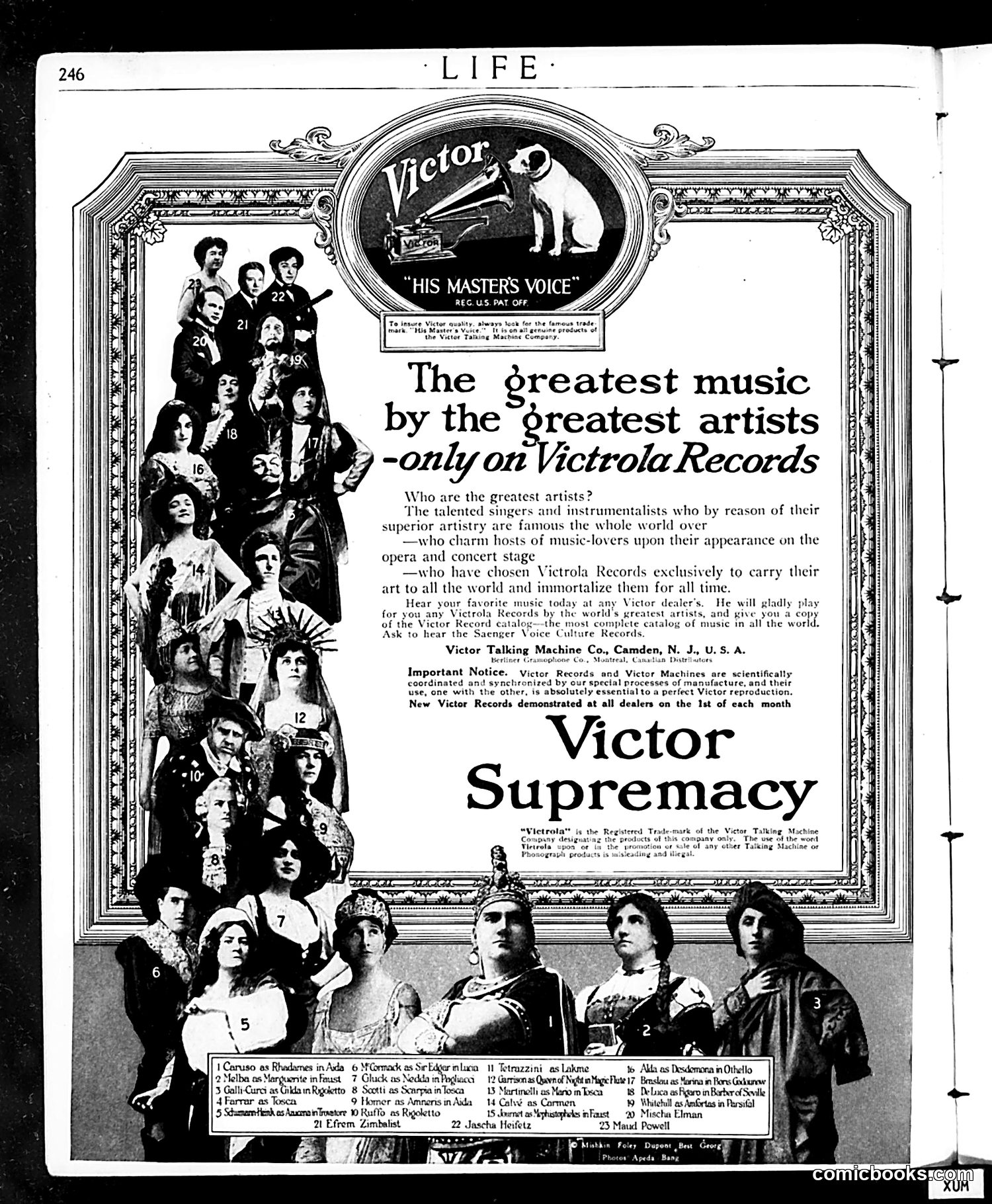
This is primarily a **Victor Talking Machine Company advertisement**, not political satire. The page promotes Victrola Records and phonographs by showcasing famous opera and concert singers of the era. The advertisement emphasizes "Victor Supremacy" in the recorded music market, claiming exclusive contracts with the world's greatest artists. The numbered figures show various internationally renowned performers—including what the caption identifies as opera singers performing roles like "Caruso as Rigoletto" and "Tetrazzini as Lakme." The decorative framing and "His Master's Voice" dog logo (Victor's famous trademark) reinforce brand prestige. This reflects early 20th-century marketing: positioning phonographs as luxury items that brought elite cultural performances into homes. There is no political cartoon or satire present—this is straightforward commercial advertising aimed at affluent consumers.
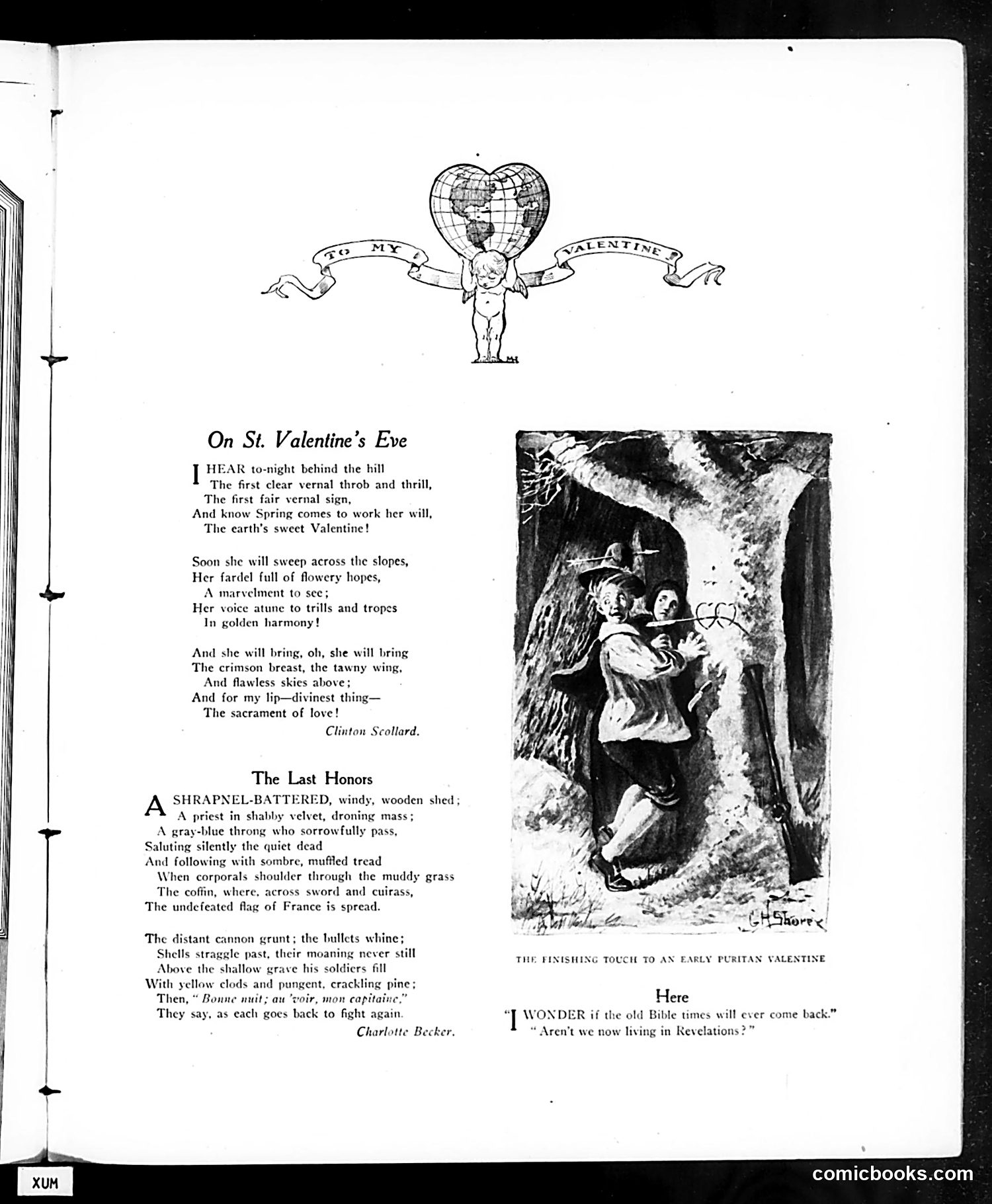
This page contains Valentine's Day poetry and a wartime illustration, likely from World War I era (given references to France and combat). The illustration titled "THE FINISHING TOUCH TO AN EARLY PURITAN VALENTINE" shows what appears to be soldiers or men in a trench or fortification, suggesting romantic sentiment amid military conflict—a pointed irony about Valentine's Day during wartime. The poems "On St. Valentine's Eve" (by Clinton Scollard) and "The Last Honors" (by Charlotte Becker) contrast romantic Spring imagery with brutal war realities: mass, death, mud, cannon fire, and soldiers returning to combat. The final excerpt ("Here") questions whether Biblical times will return, referencing the Book of Revelation—possibly expressing anxiety about civilization's collapse amid the war's devastation. The overall satire juxtaposes love and death, highlighting wartime's darkly ironic timing.
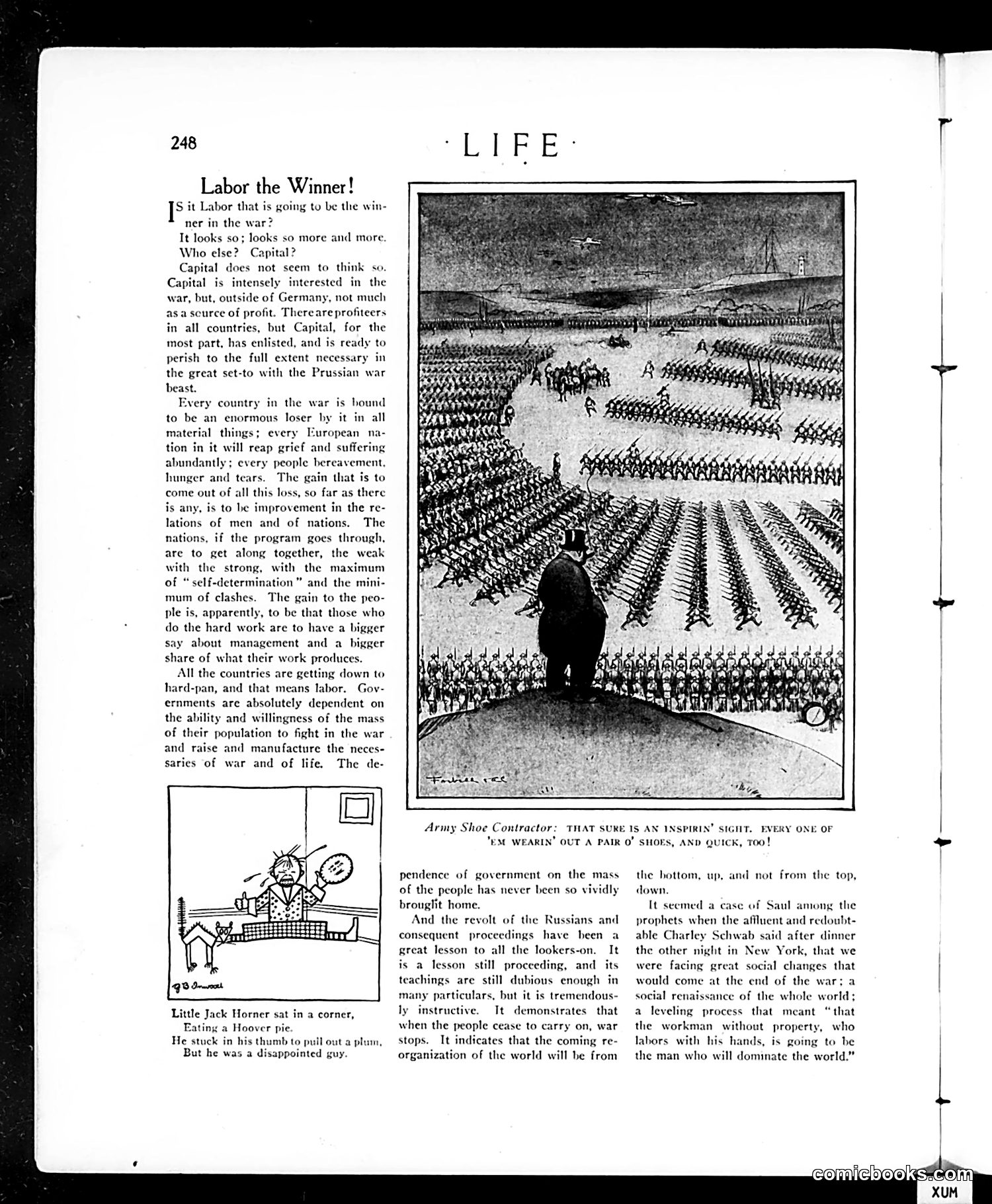
**Main Article: "Labor the Winner!"** This piece argues that labor—not capital—will emerge victorious from World War I. The author contends that governments depend entirely on workers' willingness to fight and manufacture war materials, giving labor unprecedented leverage. The text references "the revolt of the Russians and consequent proceedings" as demonstrating that when people stop supporting war, it ends—a lesson about future world reorganization favoring the working class. **Small Cartoon: "Little Jack Horner"** A crude satirical rhyme shows a figure (unclear which politician) extracting a plum from a pie—likely representing profiteering or corrupt advantage-taking during wartime. **Large Illustration: "Army Shoe Contractor"** Depicts a figure overseeing assembled troops, captioned about soldiers wearing out shoes quickly. This appears to satirize military contractors profiting from war supply contracts.
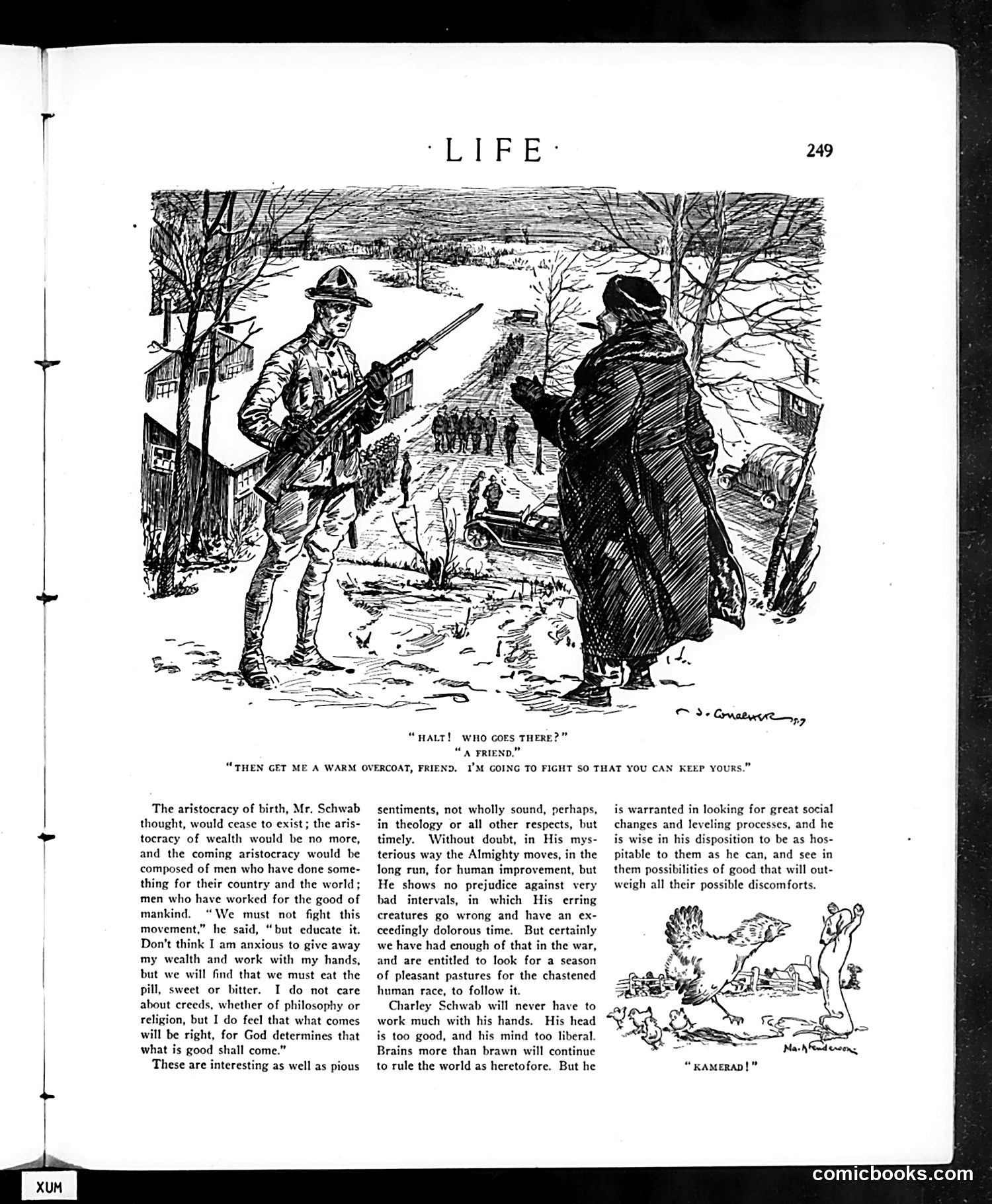
The main illustration depicts a military soldier stopping a civilian in a snowy landscape, with the caption "Halt! Who goes there?" / "A friend." / "Then get me a warm overcoat, friend. I'm going to fight so that you can keep yours." This appears to be **WWI-era satire critiquing class inequality** in military service. The joke suggests that wealthy civilians avoid fighting while poor soldiers freeze, and that the soldier fights partly to protect the civilian's comfort and property. The accompanying text discusses Charley Schwab's philosophy on wealth and social responsibility, positioning the cartoon as social commentary on how the burden of war falls unequally on working-class soldiers versus privileged civilians. The smaller cartoon labeled "Kamerad!" (German surrender term) appears related to this theme.
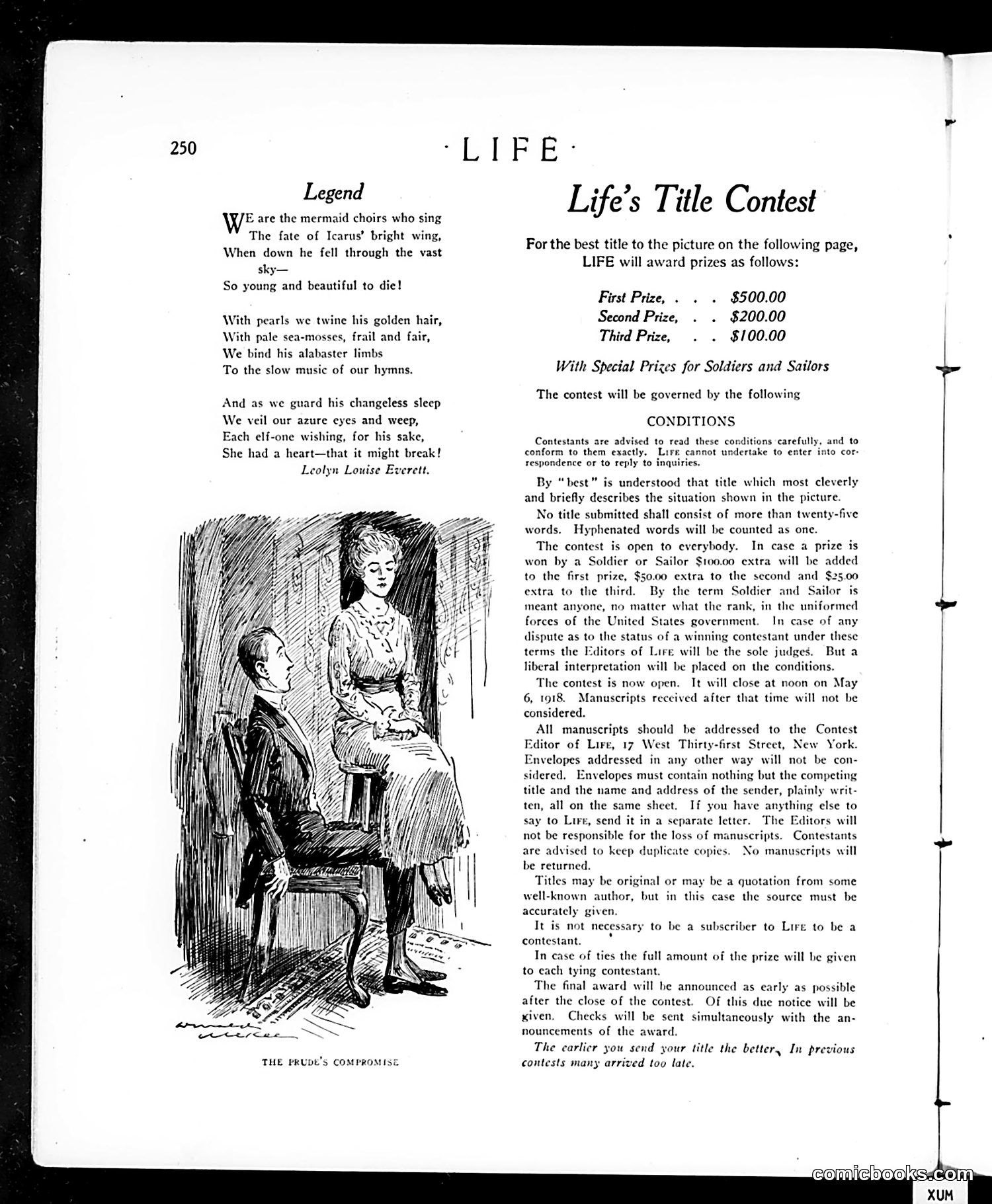
This page contains a poetry excerpt titled "Legend" by Roslyn Louise Everett, followed by a **Life magazine title contest** announcement offering cash prizes ($500, $200, $100) for the best caption to an accompanying picture. The sketch labeled **"The Frog's Compromise"** depicts two figures in an interior setting—one seated, one standing. The title likely references Aesop's fable where a frog agrees to carry a scorpion across water, only to be stung midway. The satirical point appears to concern a risky agreement or dangerous compromise, though without seeing the accompanying picture being captioned, the specific political or social reference remains unclear. The humor likely relies on readers' familiarity with this cautionary tale.
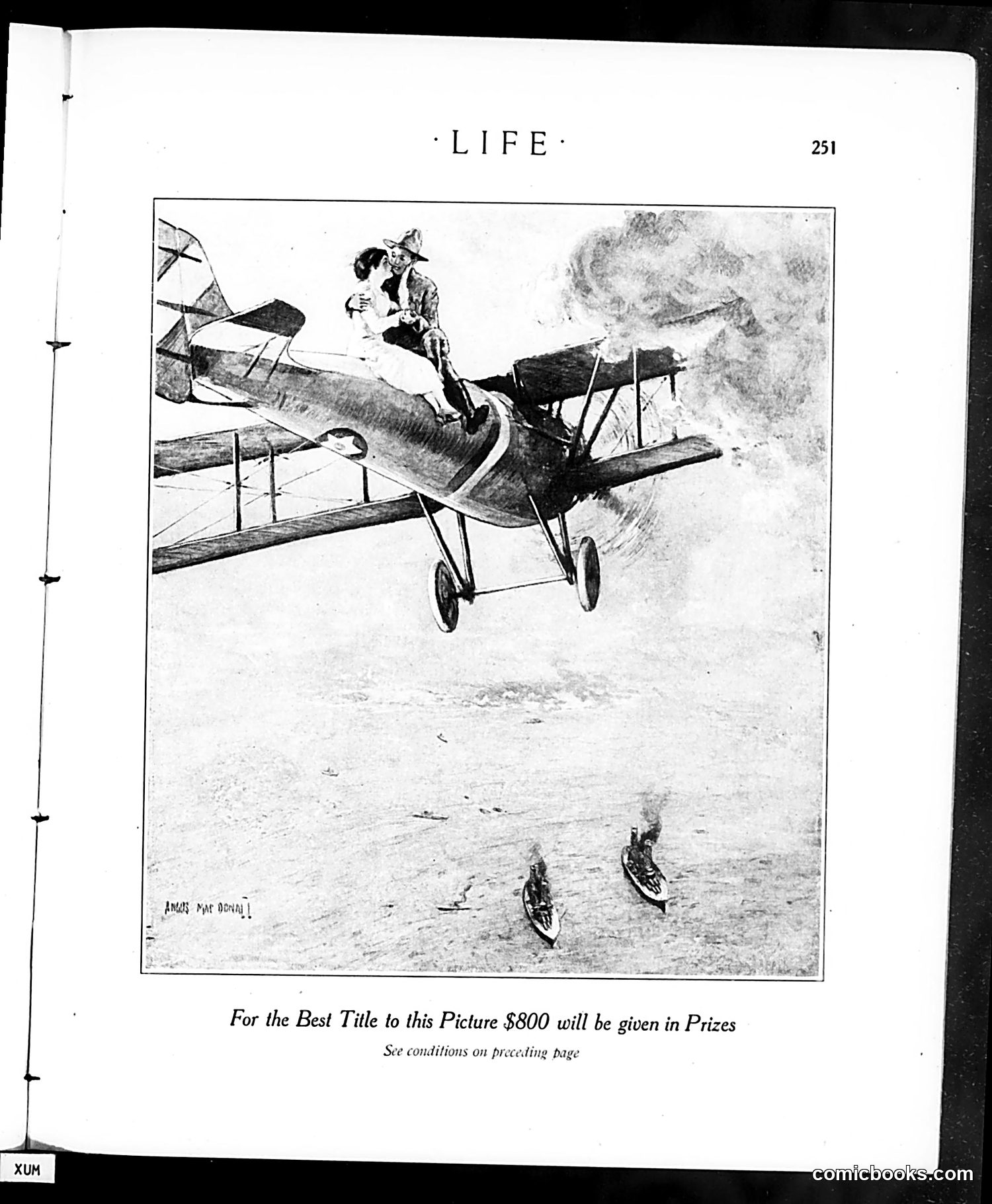
This page from *Life* magazine (page 251) features a humorous illustration of an early biplane in flight with two figures aboard—a man in military attire and a woman. Below, two small boats on water appear to be reacting to the aircraft overhead. The caption announces a contest: "$800 will be given in Prizes" for "the Best Title to this Picture," with conditions referenced on a preceding page. This appears to be a **caption-writing contest**, a common feature in early 20th-century magazines. The image likely plays on contemporary anxieties about aviation technology (still novel and dangerous) and possibly gender dynamics, given the woman's presence in the aircraft. The boats below suggest the airplane's danger to people on the ground—a satirical comment on aviation's unpredictability during this experimental era.
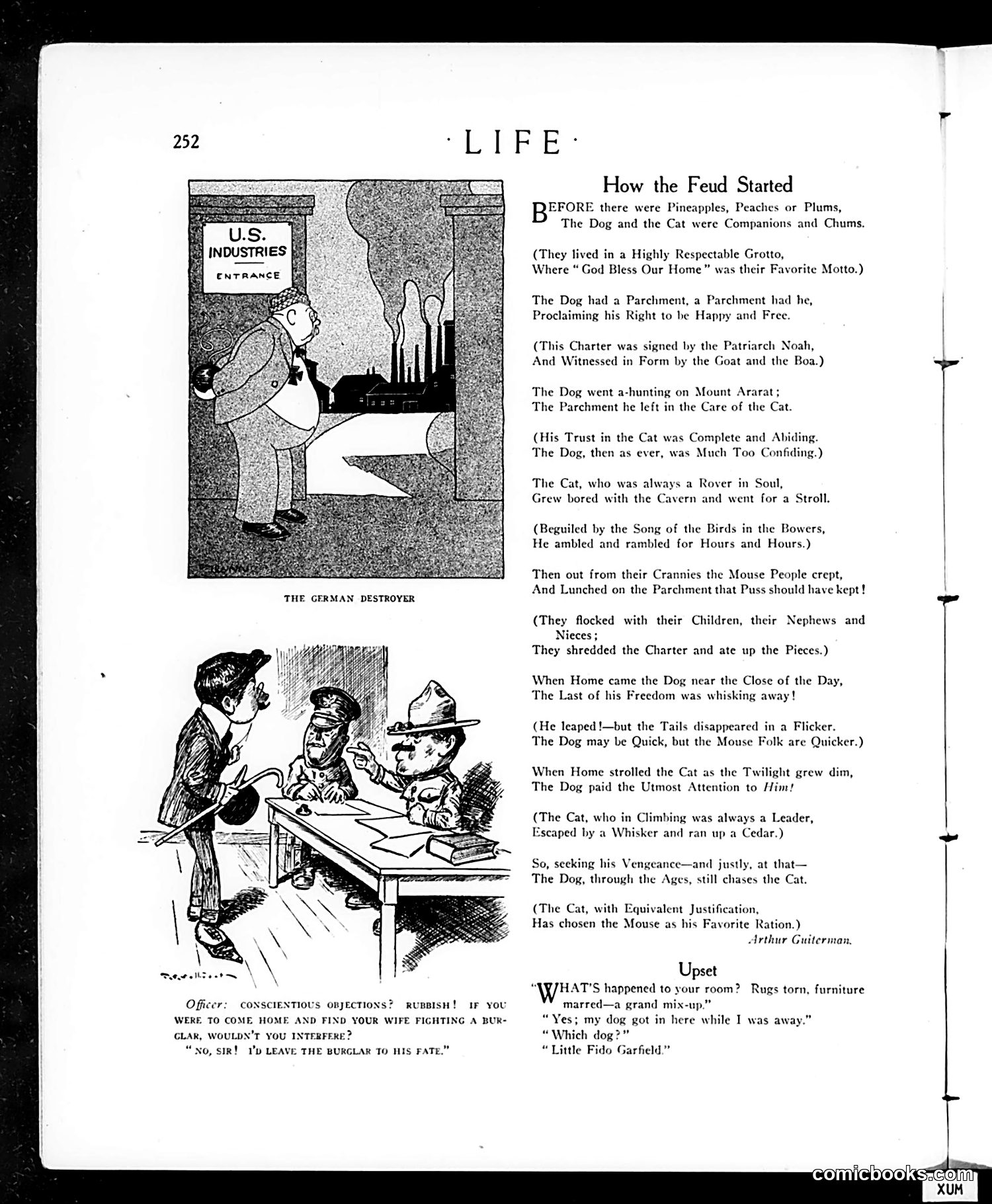
This page from *Life* magazine contains two satirical pieces: **"How the Feud Started"** (right): A mock-epic poem blaming dogs and cats' eternal conflict on a broken "Parchment" granting dogs freedom. Mice breached this ancient charter, causing the dog to eternally chase the cat in revenge. The satire uses animal fable conventions to humorously explain natural animal behavior as if it were serious political/legal history. **"The German Destroyer" (top left)** and **"Upset" (bottom)**: The top cartoon shows a figure labeled "U.S. Industries" being confronted by what appears to be a German military figure. The bottom depicts a domestic dispute where a burglar isn't blamed—the husband blames his dog ("Little Fido Garfield"). These appear to reference World War I–era concerns and domestic humor, respectively.
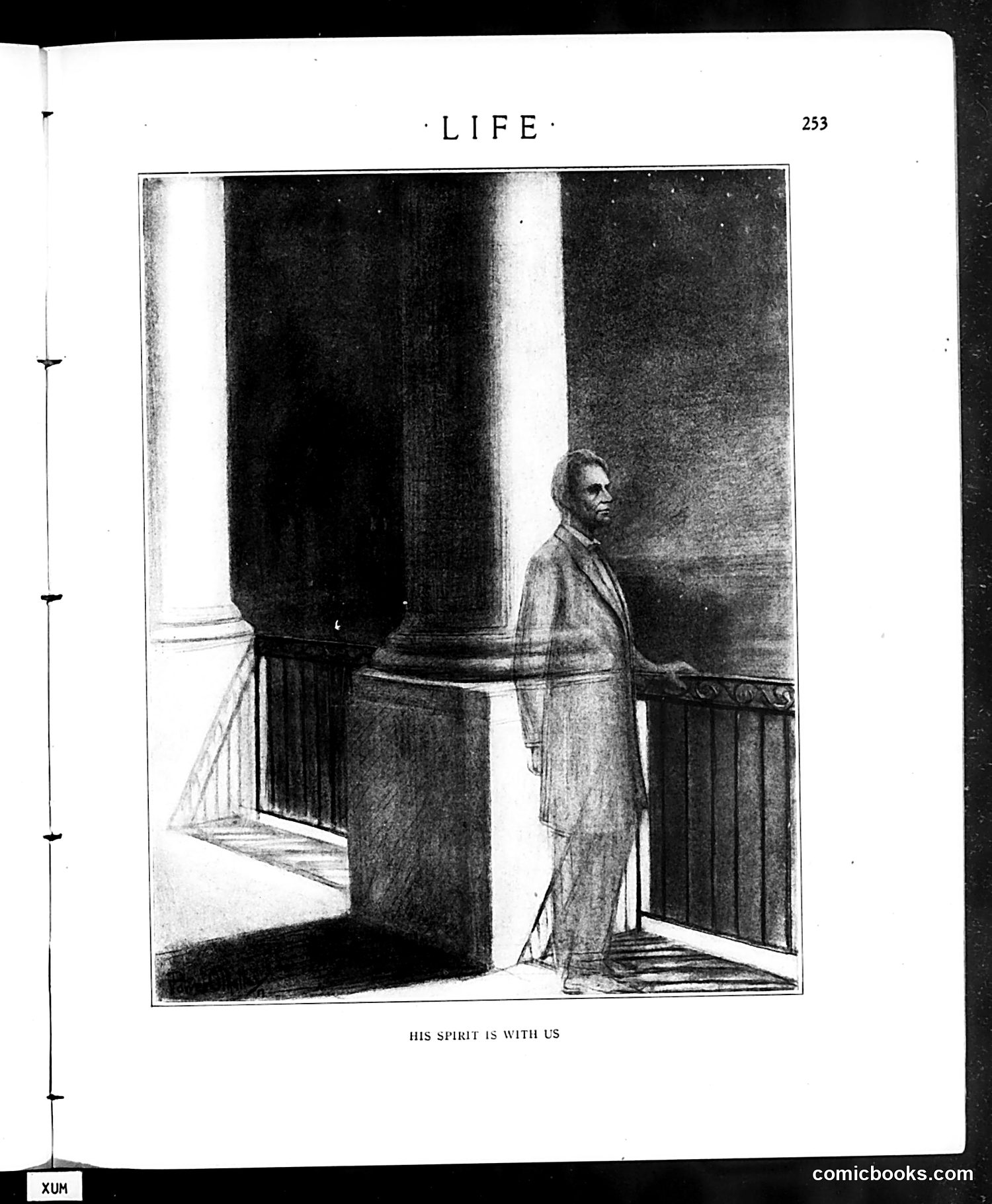
This satirical cartoon from *Life* magazine depicts a solitary figure standing in a grand columned interior, gazing upward toward light streaming through the architecture. The caption "His Spirit Is With Us" suggests a spiritual or political invocation of an absent authority figure. Without additional context (date, publication details visible on the page), the specific identity of the referenced figure remains unclear. However, the imagery—the monumental classical setting, the reverent pose, the emphasis on spiritual presence rather than physical presence—suggests this critiques either religious veneration or the political deification of a leader. The tone appears satirical, possibly mocking uncritical devotion or invoking an idealized memory of someone absent or deceased.
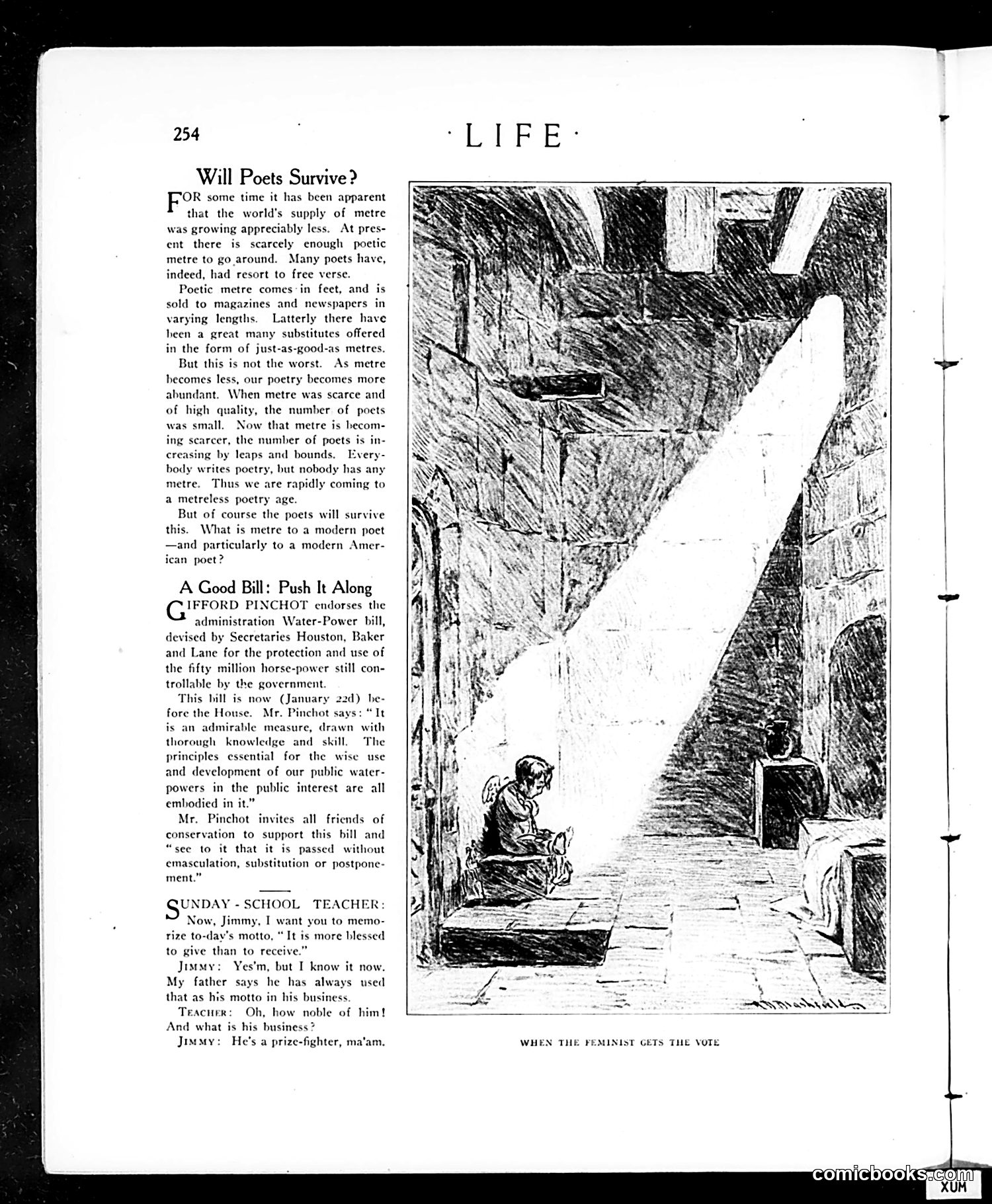
This page contains three separate pieces of commentary and satire: 1. **"Will Poets Survive?"** - An essay arguing that poets will endure despite the decline of poetic meter in modern publishing, as free verse becomes increasingly common. 2. **"A Good Bill: Push It Along"** - Commentary supporting Clifford Pinchot's Water-Power bill before Congress, praising its conservation principles for public water resources. 3. **"Sunday-School Teacher"** - A brief humorous dialogue where a teacher asks Jimmy about his father's business motto ("It is more blessed to give than to receive"), and Jimmy replies his father is a "prize-fighter." The joke mocks the disconnect between moral teachings and actual professions. The accompanying illustration, captioned "When the Feminist Gets the Vote," depicts a woman in what appears to be a dungeon or cellar, satirizing anxieties about women's suffrage and social change.
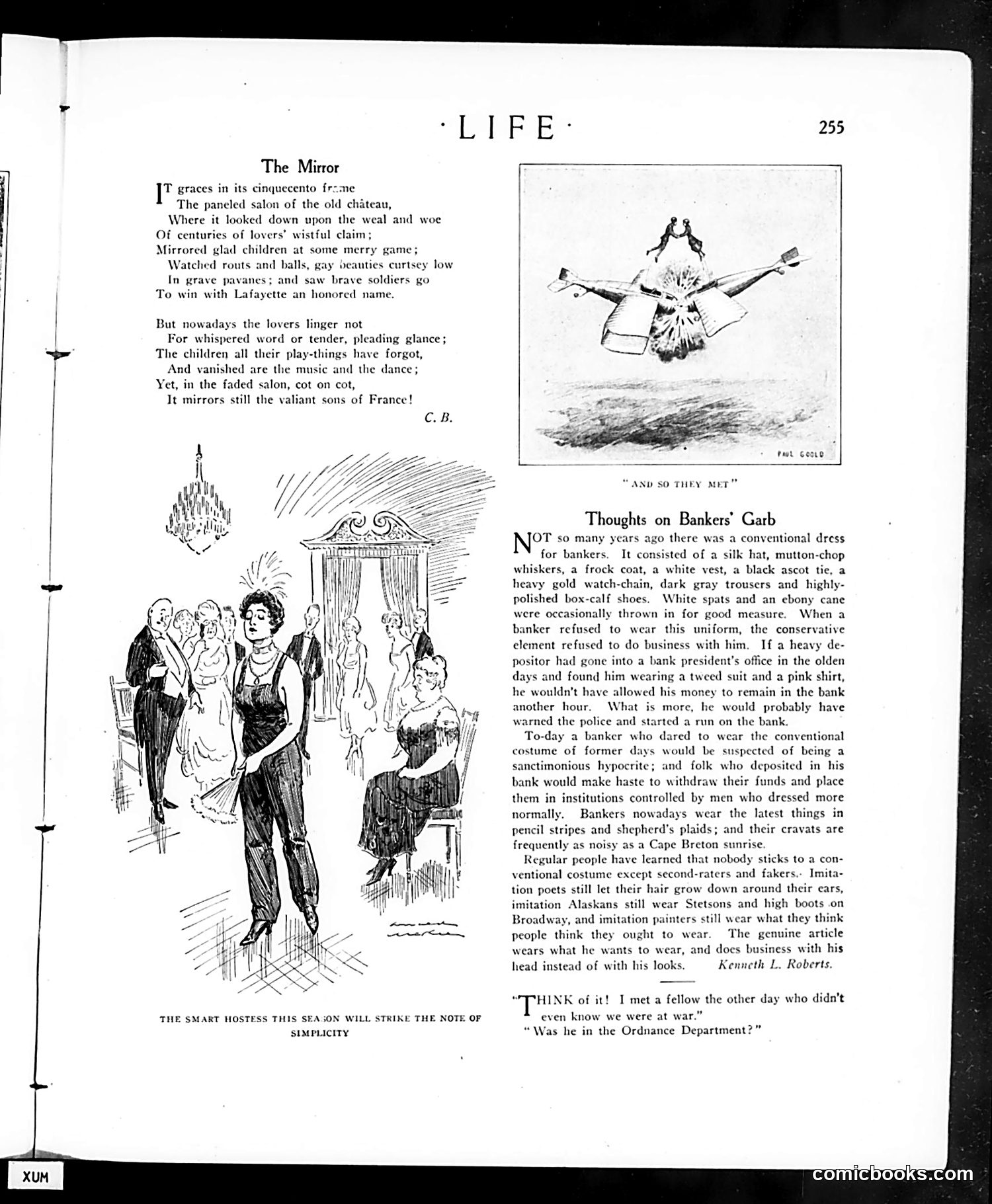
**"The Mirror" Poem** (top left): A nostalgic verse by C.B. mourning how an old French château's mirror once reflected aristocratic romance and military glory, but now reflects nothing—suggesting cultural decay or loss after WWI. **Left Cartoon**: Shows a formal gathering in what appears to be a grand salon. The caption reads "THE SMART HOSTESS THIS SEA SON WILL STRIKE THE NOTE OF SIMPLICITY"—satirizing wealthy society hostesses who claim to embrace wartime austerity while maintaining elaborate, expensive social events. The irony is visual: they're dressed formally in an ornate setting. **Right Section**: "Thoughts on Bankers' Garb" critiques how bankers abandoned formal dress codes, suggesting this represents broader social loosening of conventions and class distinctions.
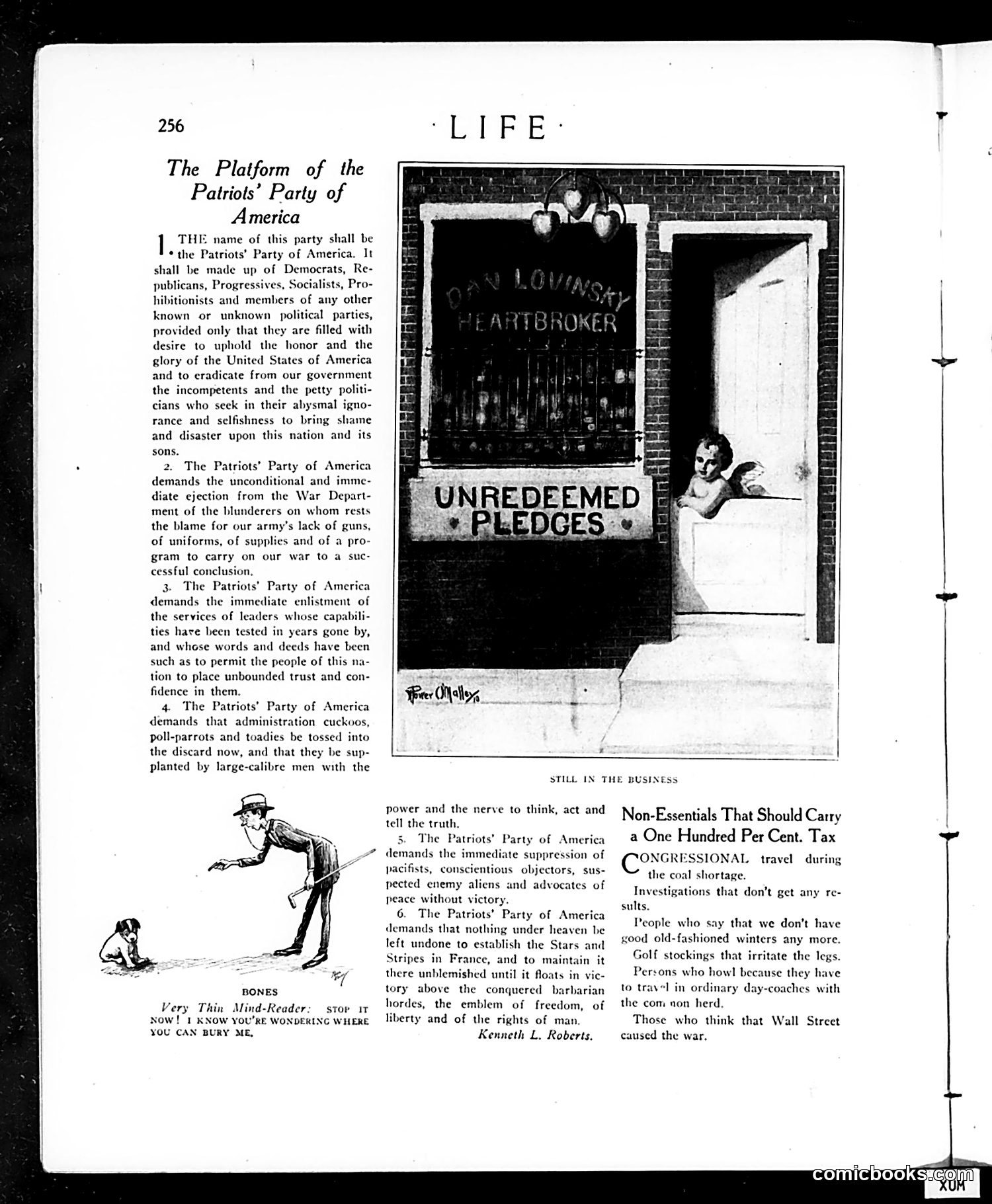
This 1918 *Life* magazine page satirizes American political opportunism during World War I. The main cartoon depicts a storefront window labeled "Unredeemed Pledges" displaying a heartbroken figure—likely representing a woman or civilian—suggesting abandoned war promises or failed commitments. The accompanying text presents a mock "Patriots' Party of America" platform, which Kenneth L. Roberts uses to skewer political grandstanding. The platform demands military competence, strong leadership, suppression of pacifists, and total victory in France—ostensibly patriotic but actually lampooning politicians who claim patriotism while accomplishing little. The bottom section, "Non-Essentials That Should Carry Tax," continues the satire by listing ridiculous complaints (golf stockings, nostalgia for old winters) and unfounded conspiracy theories (Wall Street caused the war), mocking the public's misplaced priorities during wartime. The cartoon and text together critique both self-serving politicians and the gullible citizenry who embrace simplistic patriotic rhetoric.
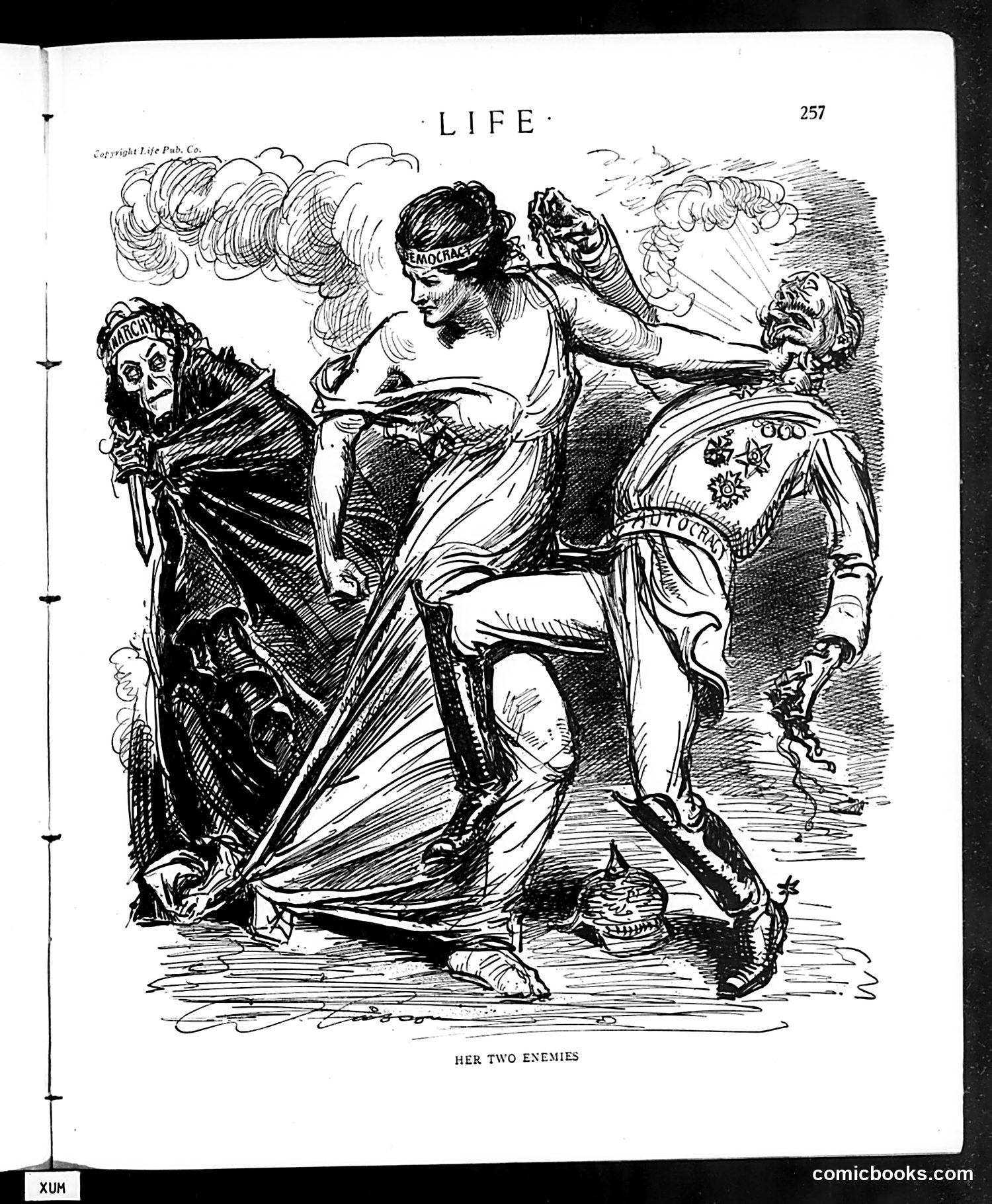
This political cartoon titled "Her Two Enemies" depicts a blindfolded female figure labeled "Democracy" confronting two male adversaries. On the left stands a skeletal, death-like figure in dark robes, likely representing monarchy or autocracy. On the right is a militaristic male figure wearing a decorated uniform with insignia, apparently representing militarism or authoritarian government. The satire suggests that democracy faced two primary threats in the era this was published. The allegorical woman's blindfold emphasizes democracy's vulnerability or inability to see these dangers clearly. The contrasting depictions—one ghostly and archaic, the other militaristic and contemporary—suggest the cartoon addresses both historical tyranny and modern threats to democratic governance, though the specific historical moment remains unclear without additional dating.
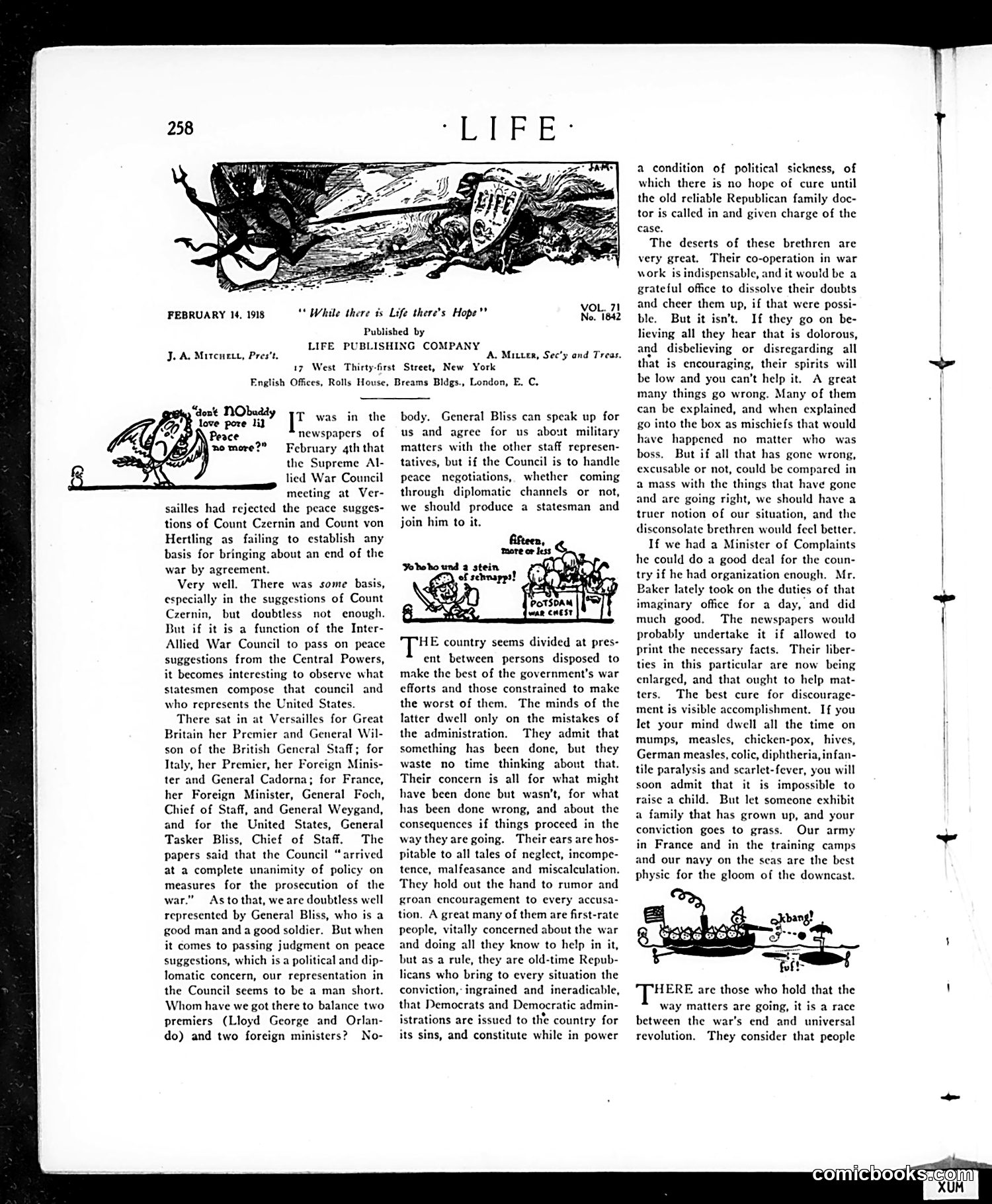
This page contains political commentary on World War I–era governance, not primarily cartoons. The main content criticizes two issues: **First issue:** The Inter-Allied War Council at Versailles rejected peace overtures from Austria-Hungary. The writer argues America's representation—General Tasker Bliss (Chief of Staff)—is inadequate. A military officer cannot properly handle diplomatic peace negotiations; the U.S. needs a statesman at the table alongside British Premier Lloyd George, Italian Premier Orlando, and their foreign ministers. **Second issue:** The writer addresses Republican critics of the Democratic Wilson administration. Though many are patriotic and helpful in war efforts, they're predisposed to assume Democrats are inherently incompetent and await "the old reliable Republican family doctor" to fix things. The author suggests this partisan skepticism undermines morale, regardless of actual accomplishments. The small cartoons appear to illustrate these complaints humorously but aren't central to the argument.
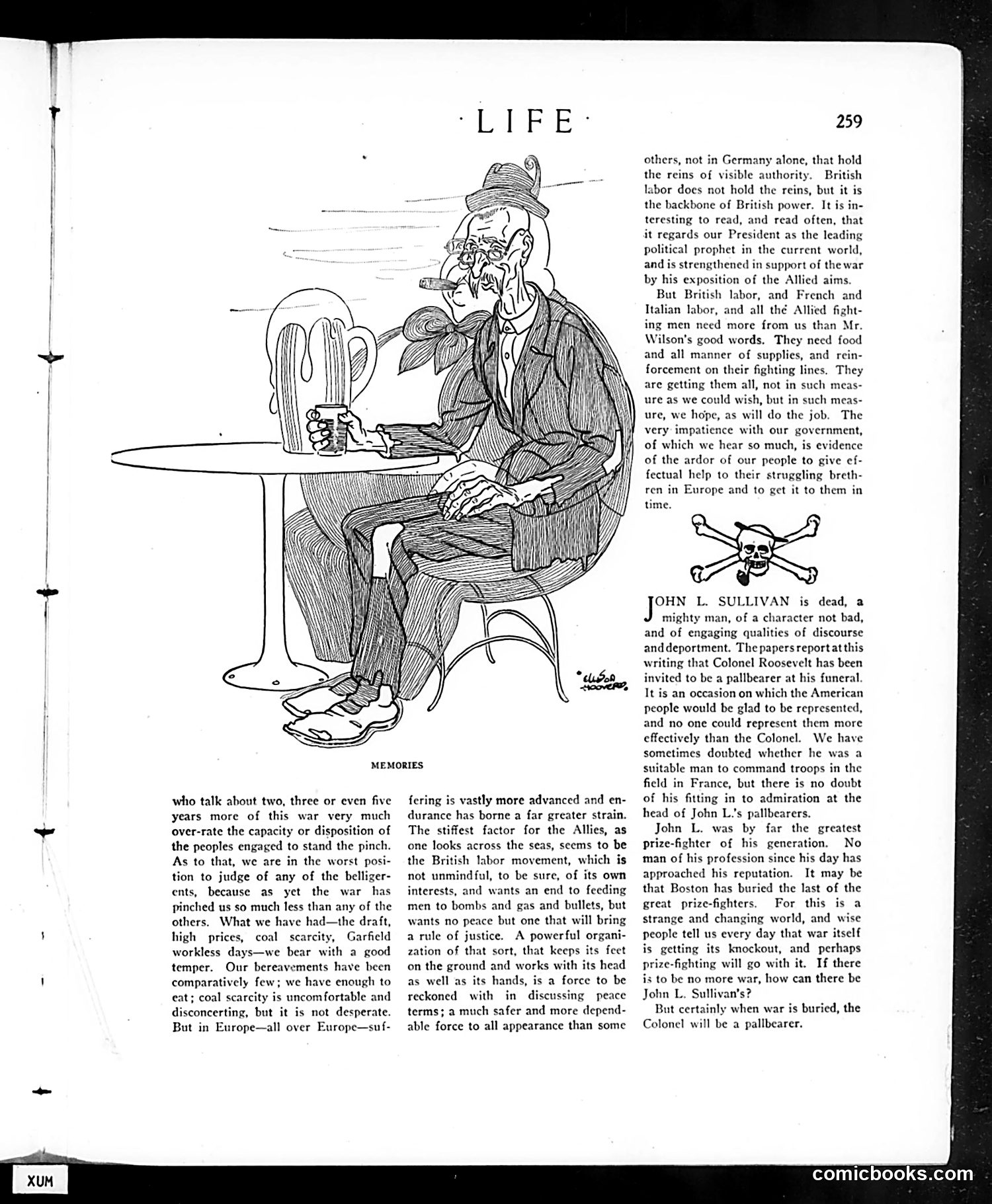
The illustration depicts a caricatured figure (likely representing German authority or leadership) sitting at a table, appearing disheveled and troubled. The cartoon's context, drawn during World War I, satirizes European power structures. The accompanying text discusses British labor movements as the true backbone of Allied strength—more reliable than visible political authority. The author argues that while President Wilson's rhetoric inspires Allied workers, they need material support (food, supplies, reinforcements) rather than words. The secondary piece eulogizes boxer John L. Sullivan, using his death to make a broader point: it sardonically suggests that Colonel Roosevelt (likely Theodore Roosevelt) would be the perfect pallbearer, implying Roosevelt's influence is waning as the world moves beyond both prize-fighting and war itself. The cartoon critiques both wartime leadership and American preparedness, suggesting our government moves too slowly providing aid to struggling European allies.
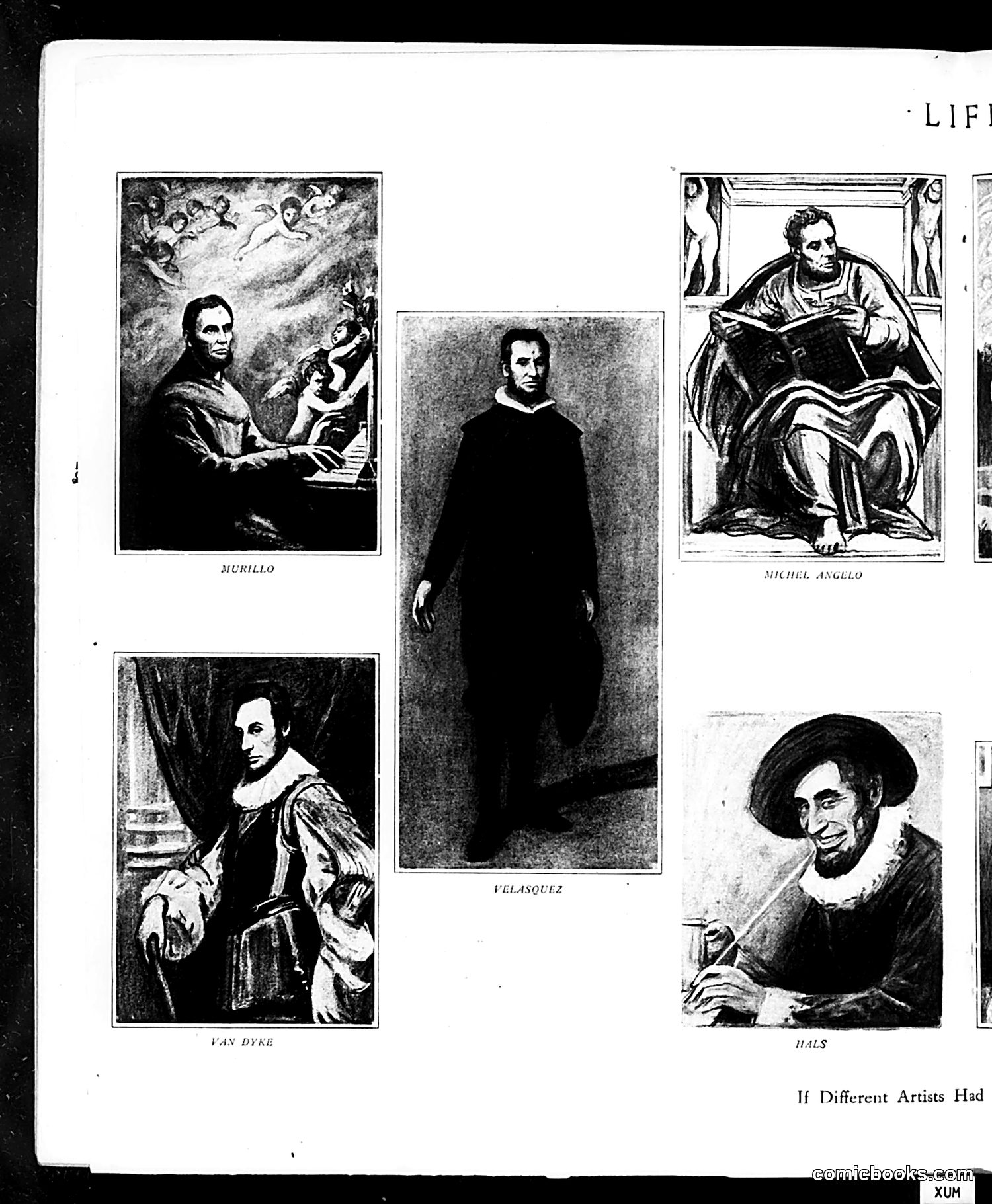
This page appears to be the opening of a satirical feature titled "If Different Artists Had..." showing famous Renaissance and Old Master painters—Murillo, Velásquez, Michelangelo, Van Dyke, and Hals—in portrait form. The incomplete title suggests the feature will humorously reimagine how these celebrated artists would have depicted a particular subject (likely a contemporary figure or scene from the Life magazine era, though we cannot see the complete article). The satire works by invoking the distinctive styles of these masters—their techniques, compositions, and artistic signatures—to contrast with modern subject matter. This was a common Life magazine format: using cultural authority and artistic history to mock contemporary figures or situations through stylistic pastiche.
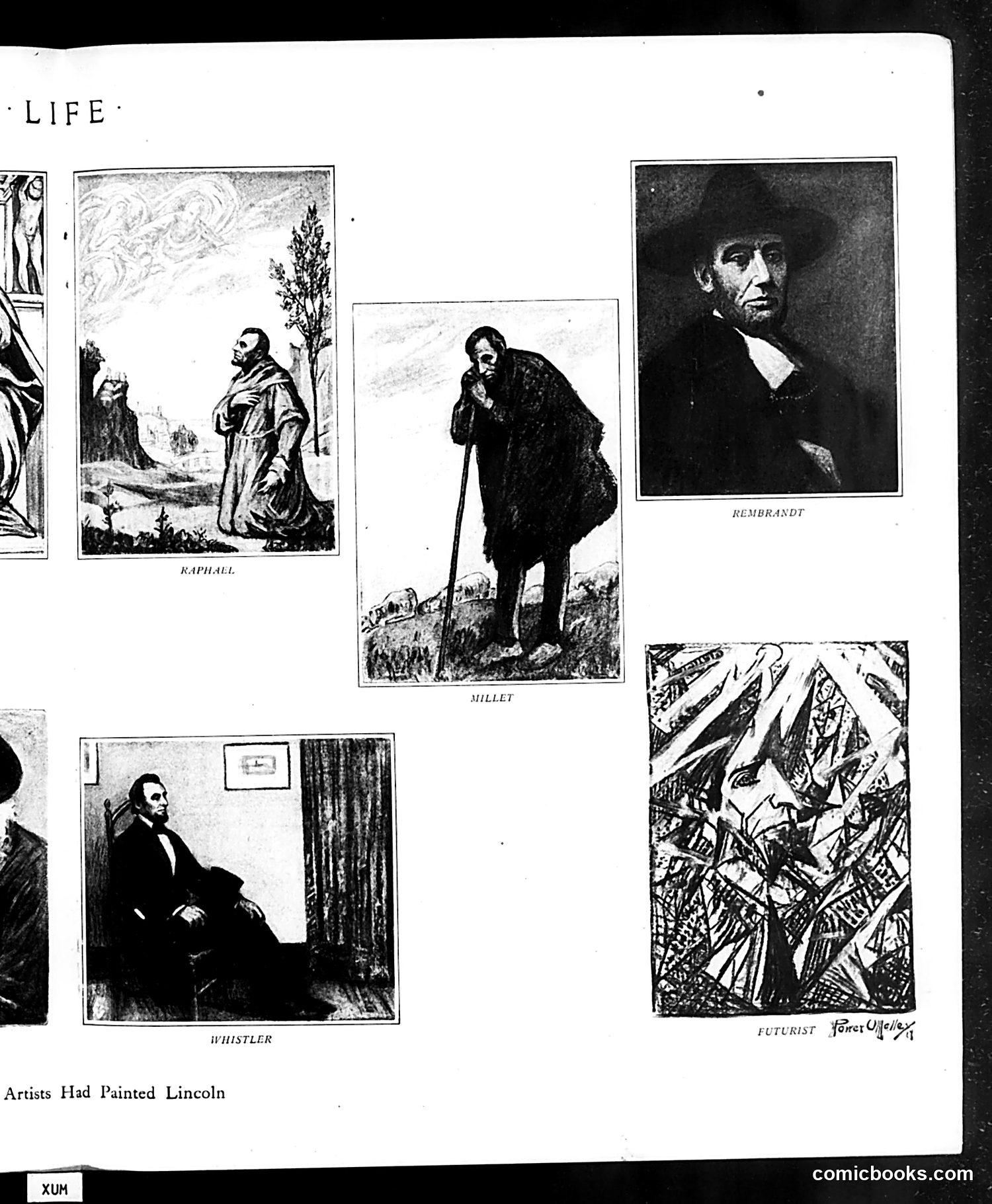
This Life magazine page presents artistic renderings of Abraham Lincoln in different styles. The caption indicates these are examples of how various famous painters might have depicted the 16th president. The page shows: - **Raphael** and **Millet**: Lincoln in religious or pastoral contexts - **Rembrandt**: A dark, portrait-style rendering - **Whistler**: Lincoln seated indoors in contemporary dress - **Futurist** (lower right): An abstract, chaotic composition The satire appears to mock how different artistic movements and famous painters would approach the same subject, each imposing their distinctive style. The "Futurist" example especially parodies modernist abstraction as incomprehensible fragmentation—a common early 20th-century critique of avant-garde art movements.
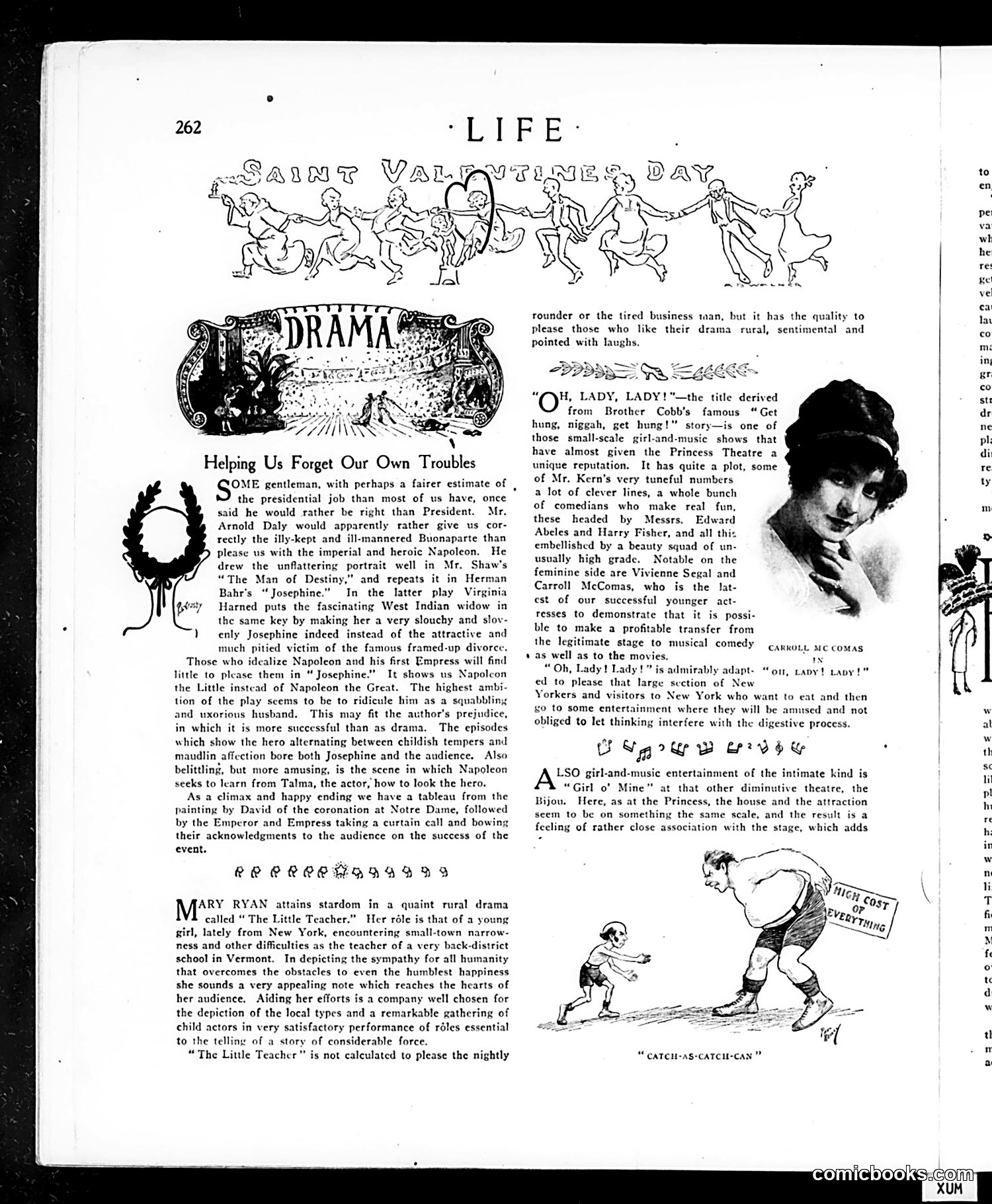
This page reviews theatrical productions, mocking both performers and audiences. The main critiques are: **"Josephine"**: Actor Arnold Daly and actress Virginia Harned are criticized for portraying Napoleon and Josephine as petty, quarrelsome figures rather than the romantic, heroic couple audiences expect. The reviewer suggests this unflattering depiction appeals only to those with anti-Napoleon prejudices. **"The Little Teacher"**: Mary Ryan stars in a sentimental rural drama about a New York teacher in Vermont. It's presented as wholesome entertainment for those wanting emotional appeal and rustic charm. **"Oh, Lady! Lady!"**: This musical comedy at the Princess Theatre features tuneful songs by composer Kern, comedians, and attractive actresses like Vivienne Segal. The reviewer notes it's designed for patrons who want amusement without intellectual engagement—essentially dinner-theater entertainment for people who don't want to think. The overall tone suggests Life's readers were culturally sophisticated enough to recognize when theatrical productions aimed at lower intellectual expectations.
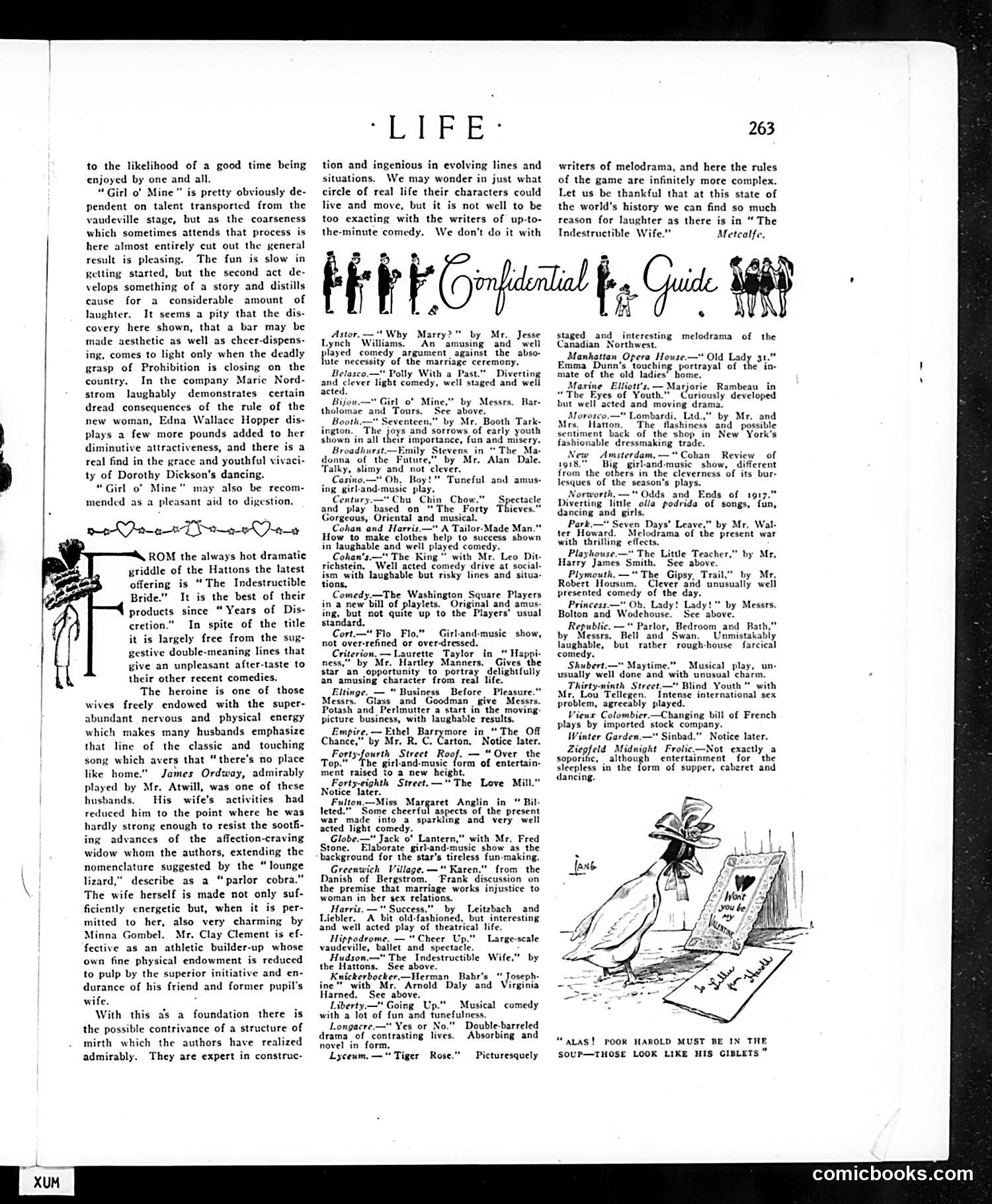
This page reviews Broadway theatrical productions from approximately 1917-1918. The main cartoon (bottom right) depicts a man in formal dress lounging on a beach chair, with the caption: "ALAS! POOR HAROLD MUST BE IN THE SOUP—THOSE LOOK LIKE HIS GIBLETS." The joke references a character named Harold who appears to be in trouble, with the imagery suggesting he's literally "in the soup" (a period idiom meaning "in serious difficulty"). The cartoon's humor relies on visual puns and the exaggerated situations common to vaudeville comedy. The left column discusses theatrical reviews—shows like "The Indestructible Bride" and "Girl o' Mine"—evaluating their quality and noting the upcoming Prohibition's impact on depicting bars as aesthetic spaces. The text emphasizes that these are light comedies dependent on skilled performers, particularly praising actress Dorothy Dickson's dancing ability. The "Confidential Guide" section lists current Broadway productions with brief reviews, a standard feature in Life magazine's drama criticism.
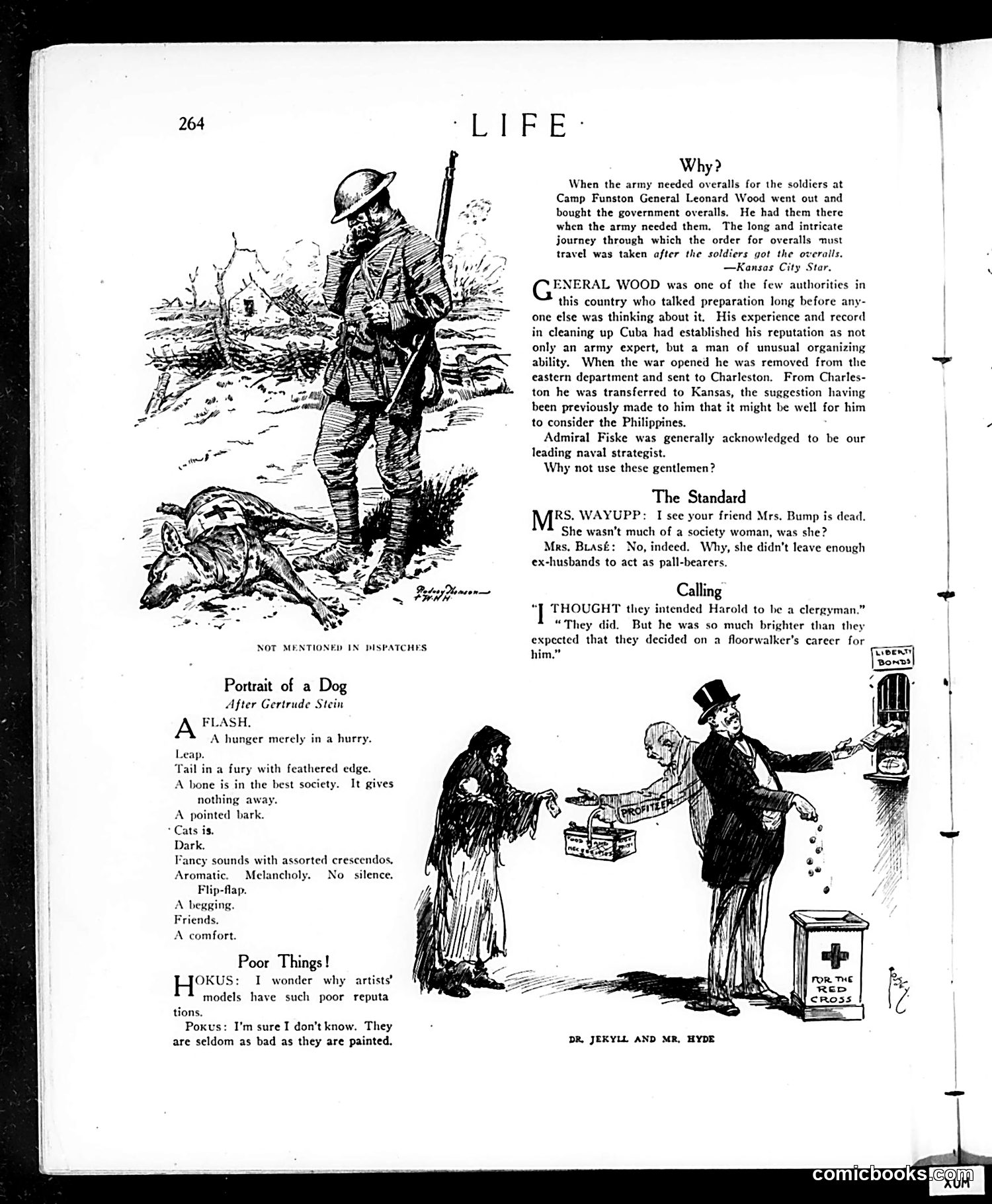
This page contains several satirical pieces reflecting early 20th-century American concerns: **"Why?" Section**: Praises General Leonard Wood for efficiently procuring overalls for Camp Funston soldiers before bureaucratic channels could process orders. The satire critiques government inefficiency—Wood's direct action contrasts with slow military bureaucracy. The piece suggests Wood and Admiral Fiske should hold higher positions given their competence. **"The Standard"**: A brief joke mocking Mrs. Blase for having so many ex-husbands she couldn't find enough to serve as pallbearers at her funeral—satirizing both divorce and loose morality among society women. **"Calling"**: Jokes that Harold was too intelligent for clergy, so became a floorwalker (department store employee) instead—mocking both religious calling and social mobility. **"Portrait of a Dog" (After Gertrude Stein)**: Parodies modernist poet Gertrude Stein's abstract, repetitive style by applying it absurdly to describe a dog. **"Poor Things!"**: Brief joke about artists' models' bad reputations being worse than reality.
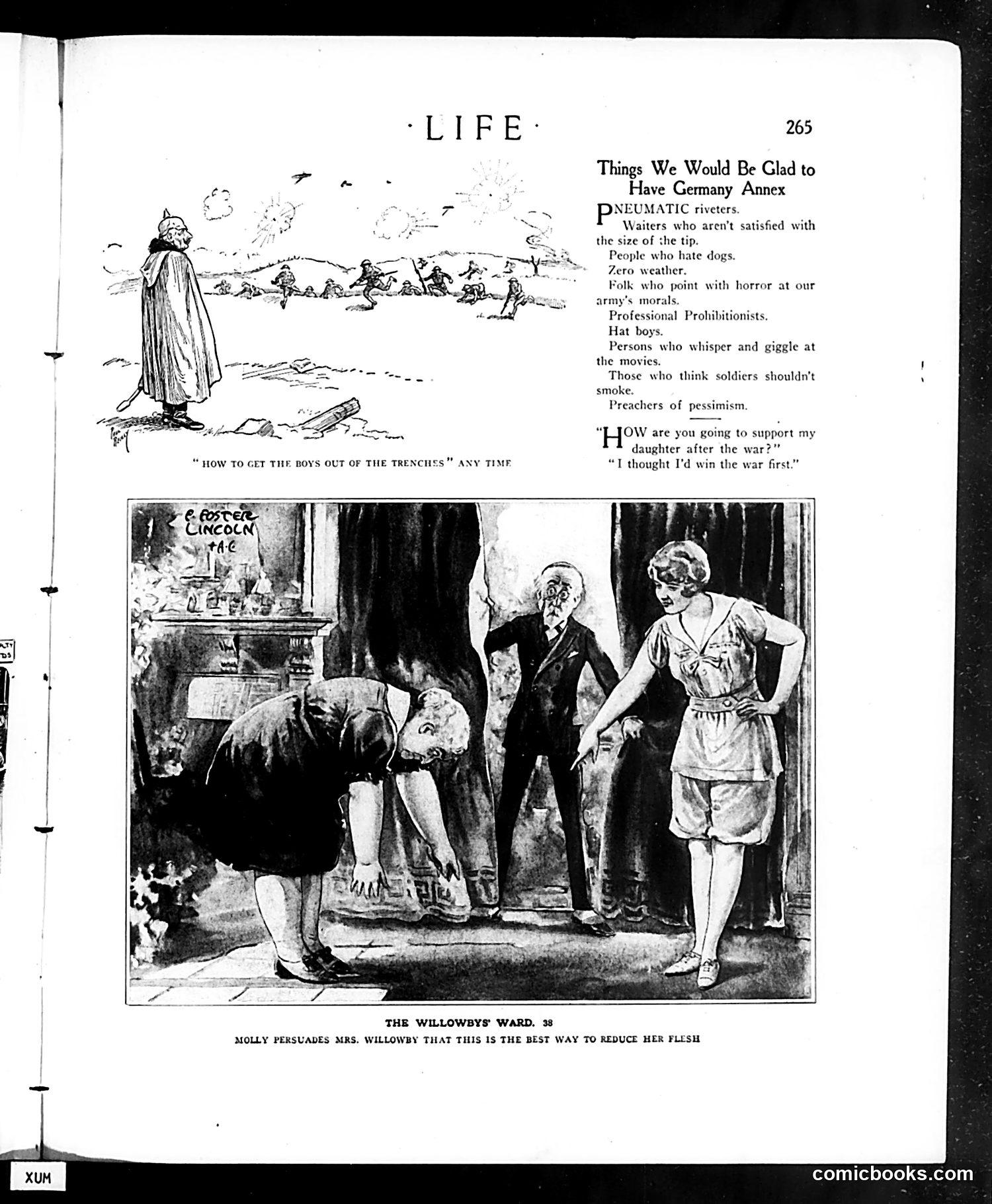
This page contains two distinct satirical pieces from Life magazine, likely from World War I era. **Top section:** A humorous list titled "Things We Would Be Glad to Have Germany Annex" mocks various annoyances in American society—from pneumatic riveters and poor tippers to people who dislike dogs, complain about soldiers smoking, or preach pessimism. The satire suggests these irritants are so bothersome that Americans would happily let Germany have them, a darkly comic way of venting frustrations. **Bottom cartoon ("The Willowbys' Ward"):** Shows a scene where Molly (left, bending over) persuades Mrs. Willowby that physical exercise is "the best way to reduce her flesh" (lose weight). Two other figures observe. The joke plays on period anxieties about women's appearance and the era's exercise fads. Both pieces reflect early 20th-century social attitudes: wartime sentiment, gender expectations, and contemporary preoccupations with health and comportment.
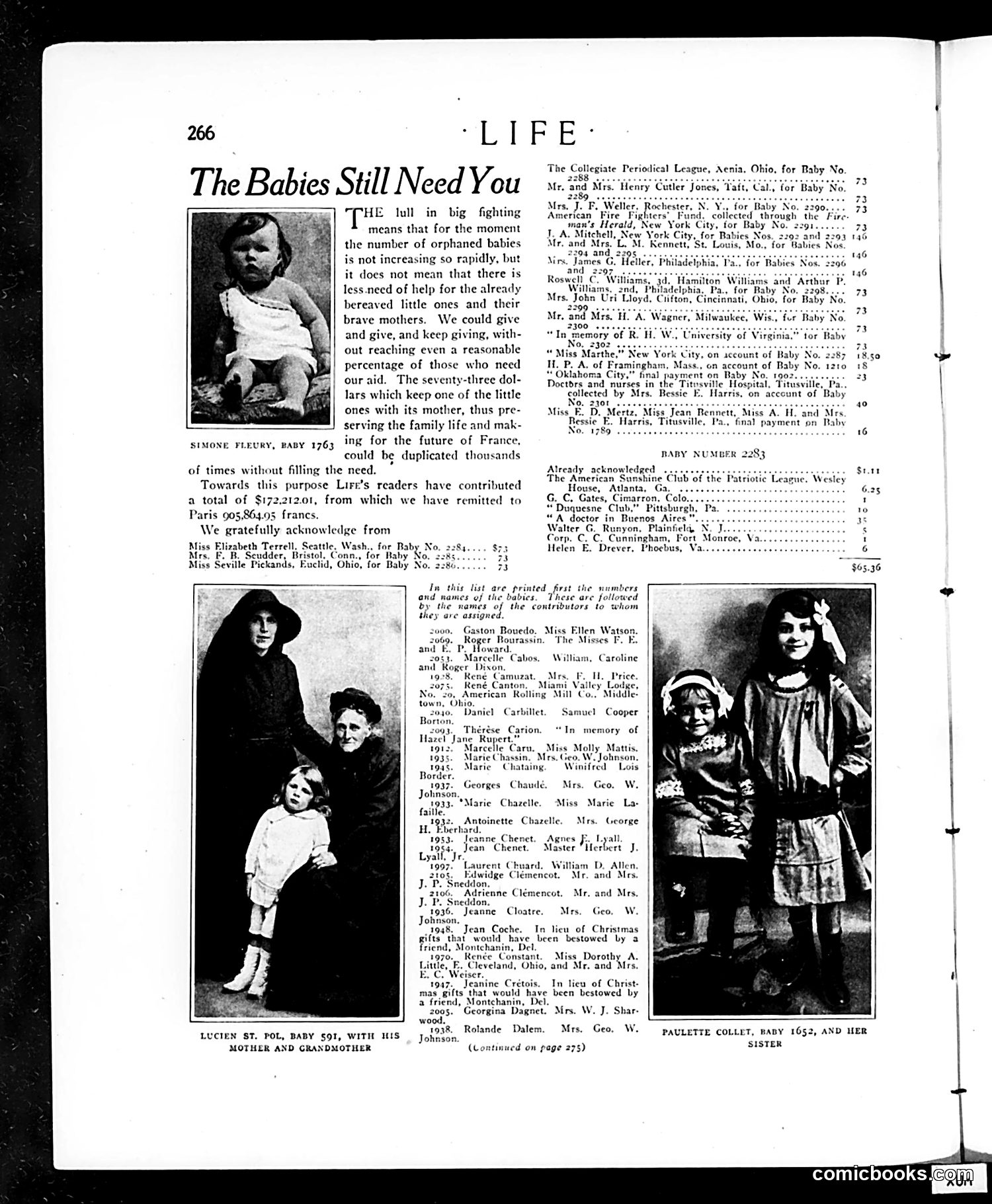
This page presents a fundraising campaign for French orphaned babies during/after World War I. The article argues that despite a "lull in big fighting," thousands of children still need aid. Life's readers have collectively contributed $172,212 (remitted as 905,864 francs to Paris), with $73 keeping one child with its mother. The photographs show real French children sponsored through this program—Simone Fleury (Baby 1763) and Paulette Collet (Baby 1642) with her sister. The bulk of the page lists donor names and the babies they support, creating personal connections between American contributors and specific French children. This reflects post-WWI American philanthropy efforts toward devastated European populations. The "brave mothers" and emphasis on family preservation reflect contemporary rhetoric about women and children as innocents harmed by war, making them worthy targets for charitable donations.
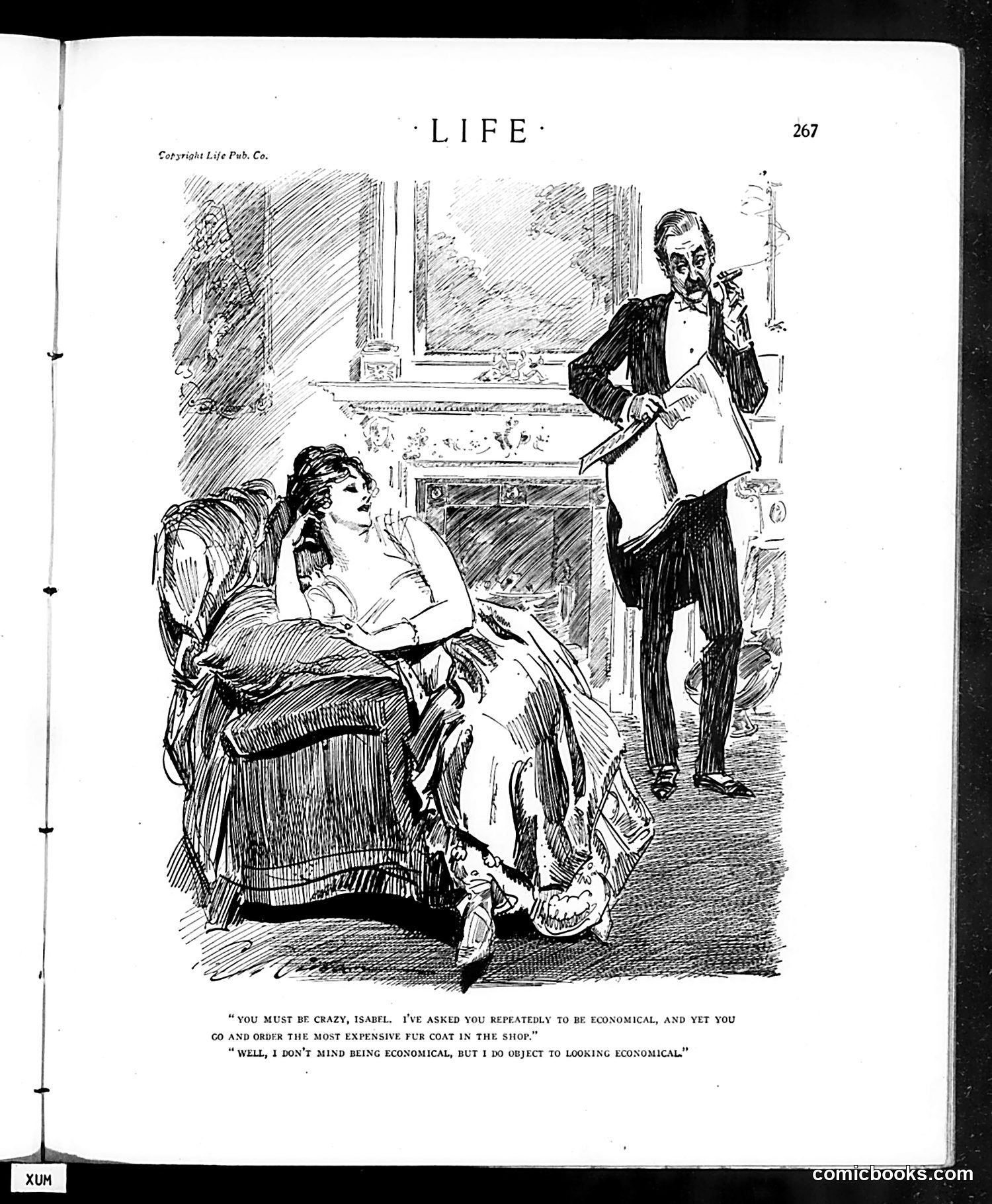
This is a domestic satire about wealth and appearance. A well-dressed man (likely a husband) scolds a woman (Isabel) for purchasing an expensive fur coat despite his repeated requests for financial restraint. Isabel's response—that she'll economize in spending but refuses to *appear* poor—satirizes the vanity and social status-consciousness of upper-class women in the early 20th century. The joke targets the contradiction between professed frugality and the desire to maintain appearances of wealth and fashion. The cartoon mocks both marital conflict over spending and the superficiality of valuing how one looks over actual financial prudence. This reflects contemporary anxieties about consumer culture and women's spending habits.
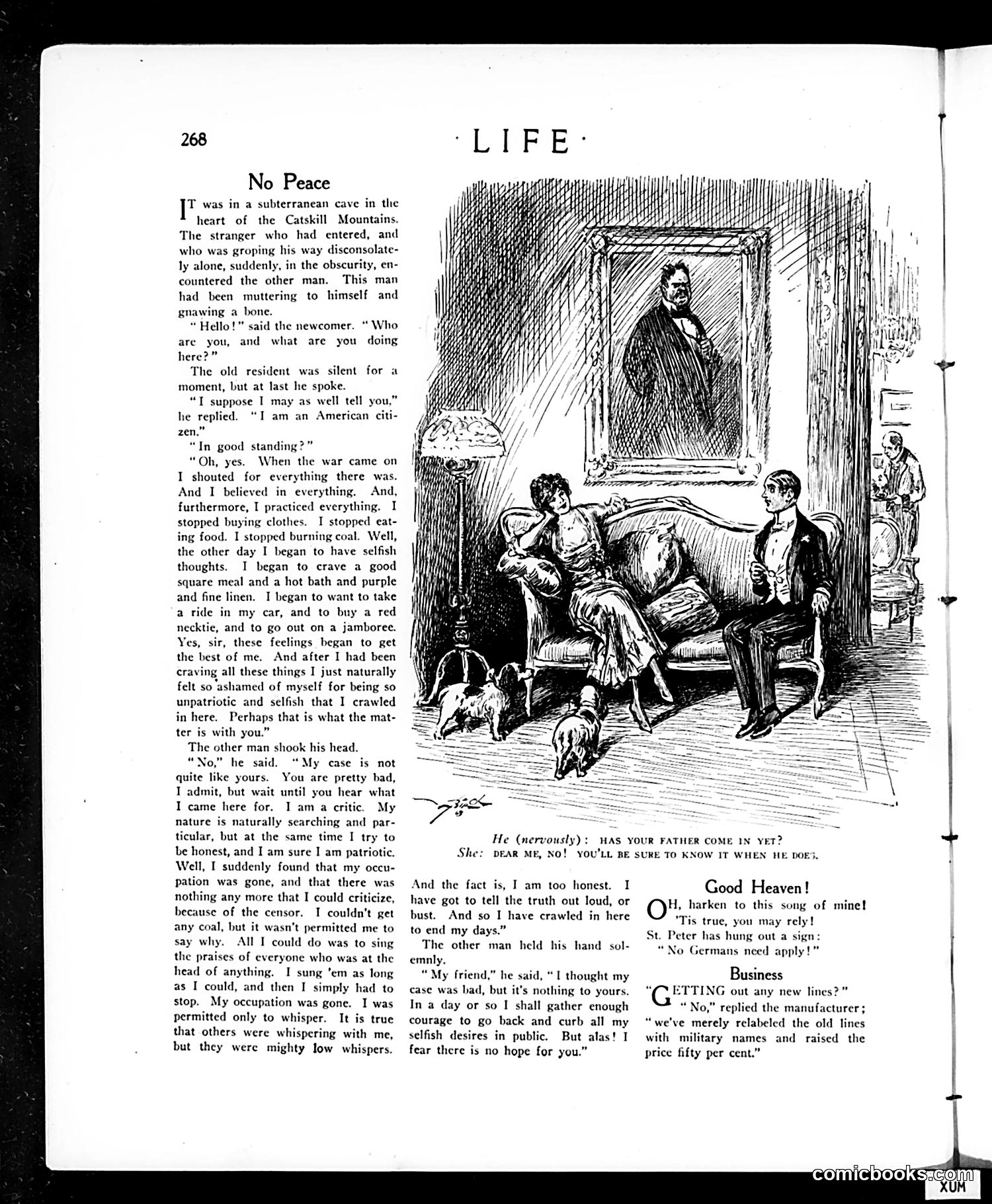
This page contains WWI-era satire mocking American civilian sacrifice and censorship. **"No Peace"** depicts two men hiding in a cave—one ashamed for wanting basic comforts (food, baths, cars) during wartime, the other a *critic* who has lost his profession due to wartime censorship. The critic cannot speak truthfully or criticize authority without state suppression, making his situation hopeless. The satire targets both the *excessive patriotic fervor* demanded of civilians and the *government censorship* that silenced dissent and honest commentary. **"Good Heaven!"** jokes that even German immigrants are unwelcome (a St. Peter sign reads "No Germans need apply"), reflecting anti-German sentiment during WWI. **"Business"** mocks war profiteering: manufacturers simply relabel old products with military names and raise prices 50%. Overall, the page critiques wartime hypocrisy—demanding citizen sacrifice while suppressing free speech and enabling corporate greed.
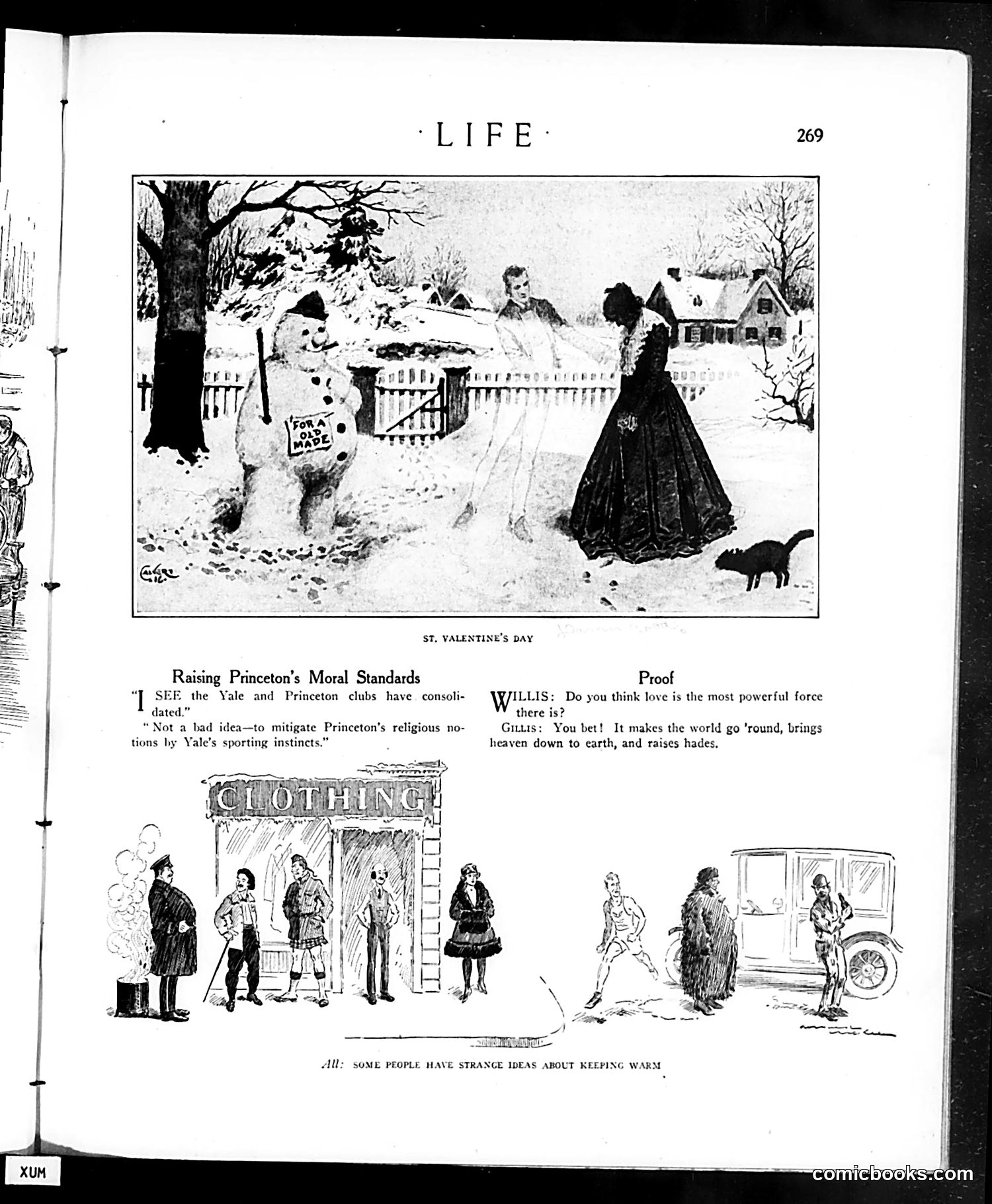
**Top cartoon (St. Valentine's Day):** A woman in a long dark coat encounters a snowman labeled "FOR SALE" in a snowy yard. The joke plays on Valentine's Day romance—she's literally making an offer to the snowman, treating it as a potential romantic interest. This is absurdist humor mocking the desperation of single women on Valentine's Day. **Bottom cartoons:** Two separate satirical pieces. "Raising Princeton's Moral Standards" mocks Ivy League university rivalry, suggesting Yale's "sporting instincts" (athleticism, presumably less morally rigorous) could offset Princeton's strict religious standards—implying Princeton's reputation for moral seriousness is stuffy. "Proof" shows a dialogue between Willis and Gillis debating whether love is the most powerful force, with Gillis's response ("raises hades") using a pun—love causes chaos alongside romance. The "Clothing" scene below satirizes absurd ways people keep warm in winter (unclear specific reference).
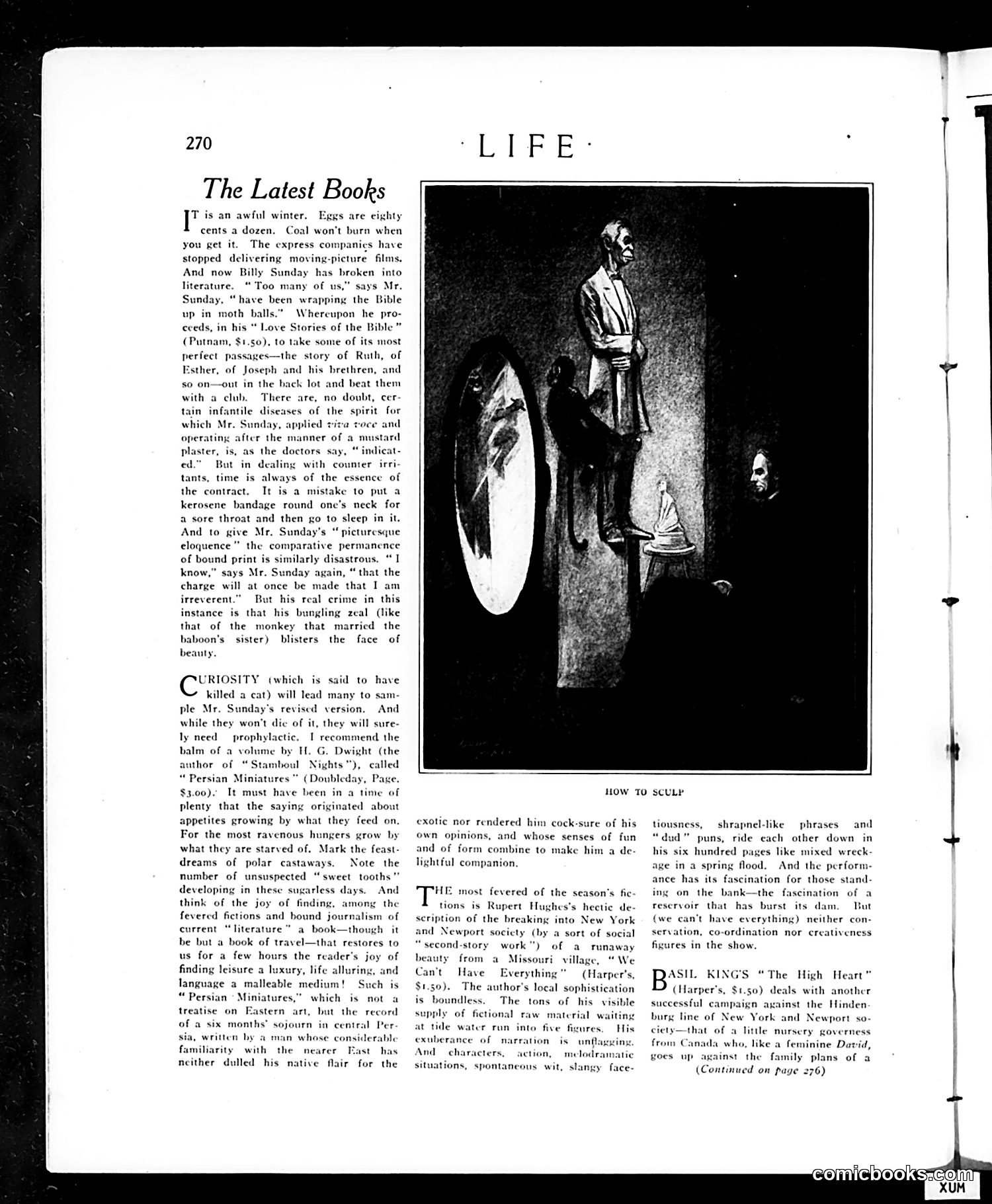
This page reviews Billy Sunday's "Love Stories of the Bible," a collection the critic brutally mocks. Billy Sunday was a famous evangelical preacher known for fiery, colloquial sermons. The reviewer sarcastically compares Sunday's "bungling zeal" to a monkey marrying a baboon's sister—his crude approach to Biblical passages "blisters the face of beauty." The illustration labeled "HOW TO SCULP" appears to satirize Sunday's heavy-handed method: depicting a figure with a hammer and chisel attacking a classical bust, literally smashing refinement into something crude. The metaphor suggests that Sunday's populist, aggressive style ruins the elegant artistry of scripture. The page also reviews other contemporary fiction, including Rupert Hughes's society novel. The overall tone criticizes attempts to make high culture accessible through crude methods—the core satire being that overzealous modernization can destroy what it aims to preserve.
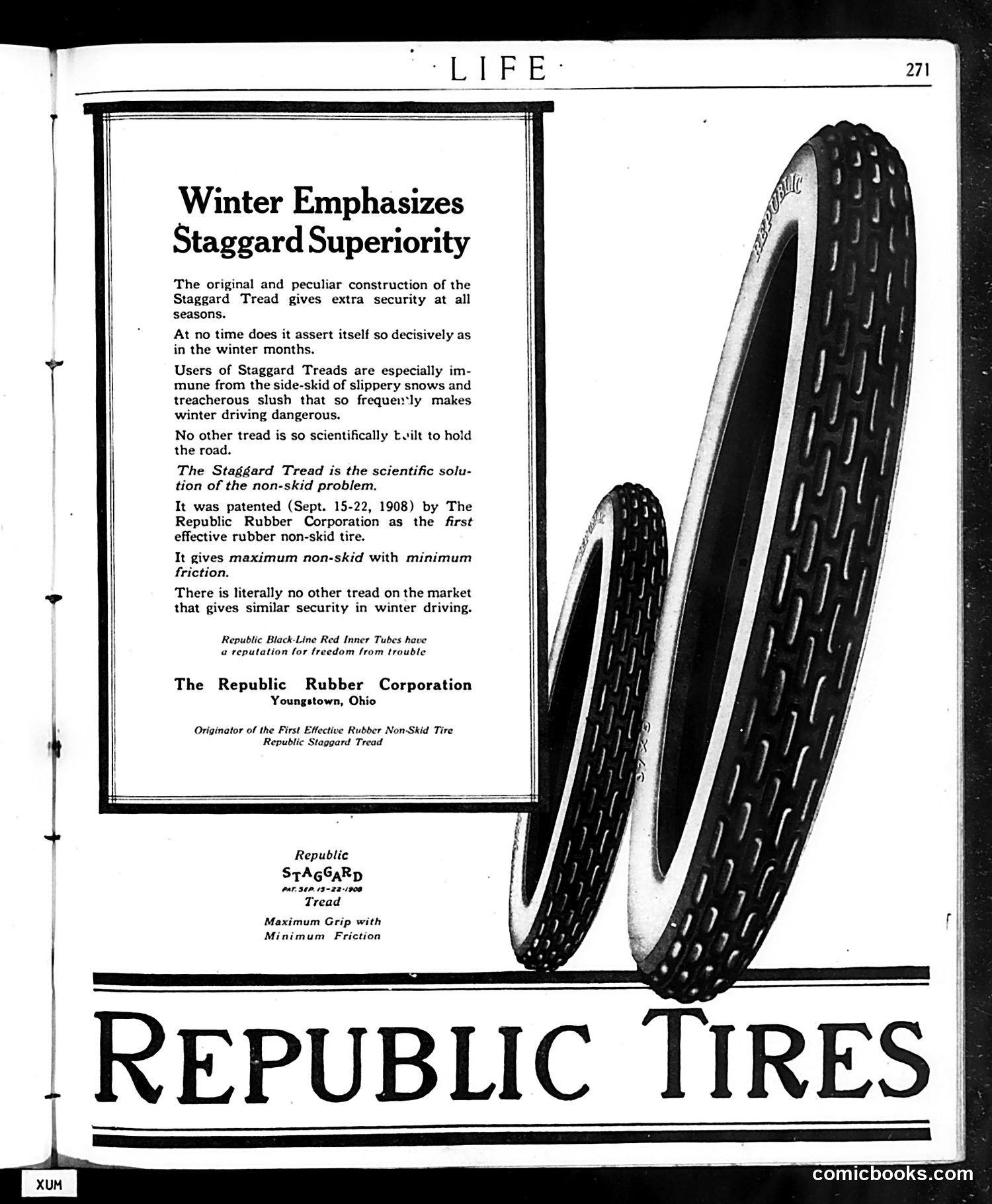
This is a **full-page advertisement**, not a cartoon or satirical content. It promotes Republic Tires' "Staggard Tread" tire, emphasizing its superior winter traction. The ad claims the Staggard Tread was the **first effective non-skid tire**, patented in 1908 by Republic Rubber Corporation of Youngstown, Ohio. It targets winter driving dangers—slippery snow and slush causing side-skids—positioning the tire as a scientific solution offering "maximum grip with minimum friction." The page features two tire illustrations showing the distinctive tread pattern. The messaging repeatedly asserts superiority ("no other tread...gives similar security"), a common early-20th-century advertising strategy. There is **no political satire or joke** here—it's straightforward product promotion typical of Life magazine's advertising content during this period.
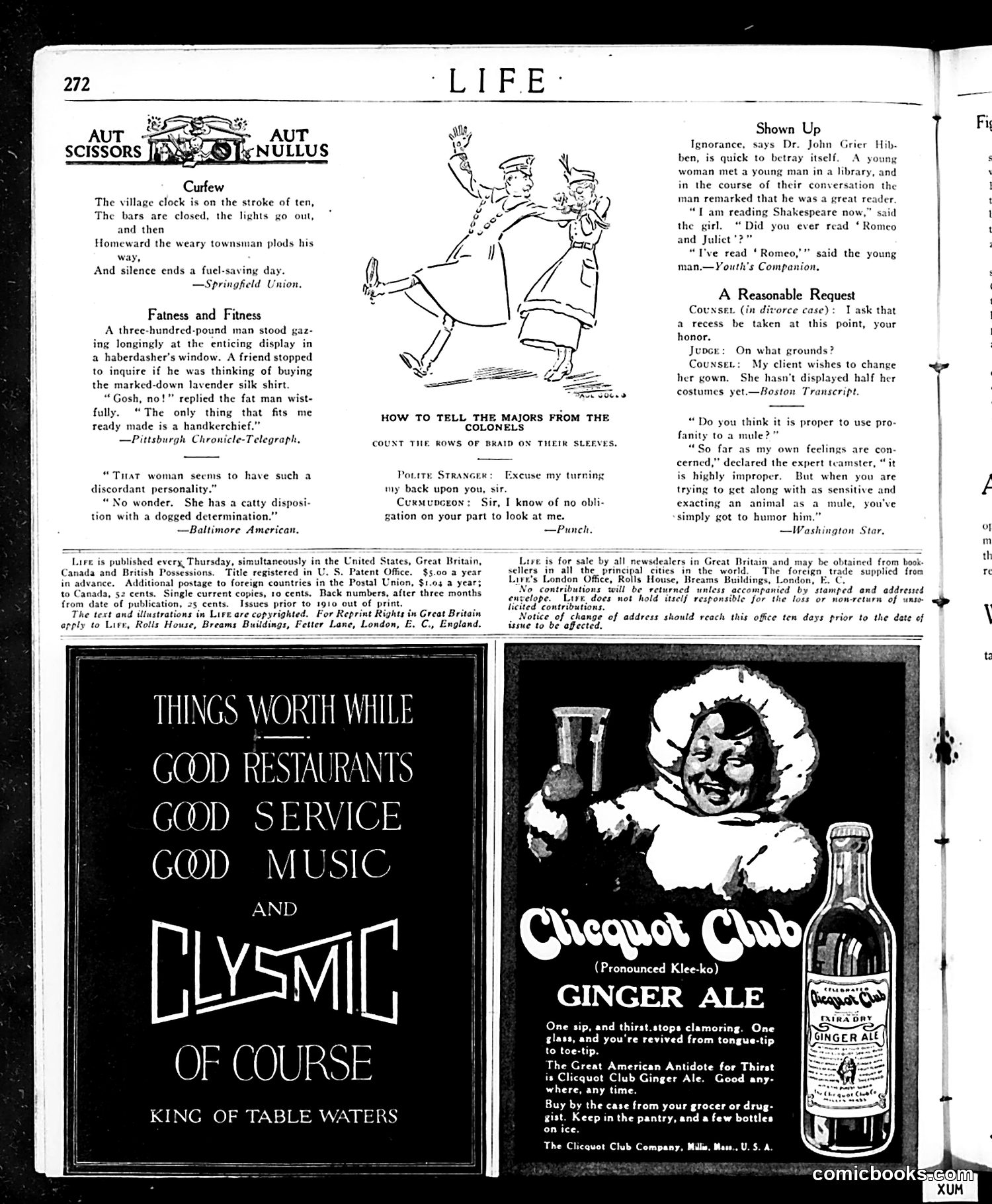
This page from *Life* magazine contains several short humor pieces typical of early 20th-century satirical journalism: **The cartoons/jokes mock:** 1. **Urban wartime rationing** ("Curfew")—the village clock strikes 10 when bars close and lights go out, ending a "fuel-saving day," referencing WWI-era conservation measures. 2. **A fat man's clothing problem**—a 300-pound man can only fit into a handkerchief, satirizing ready-made clothing sizes. 3. **Military rank identification**—a humorous guide to distinguishing majors from colonels by counting "rows of braid on their sleeves." 4. **Ignorance exposed**—a young man claims to have read Shakespeare's "Romeo" but only half the play, revealing he's a pretentious fraud. 5. **Divorce proceedings**—a lawyer requests a recess so his client can change into more costumes to impress the judge, mocking theatrical courtroom behavior. The page also contains period advertisements for Clicquot Club Ginger Ale and Elysian restaurant services.
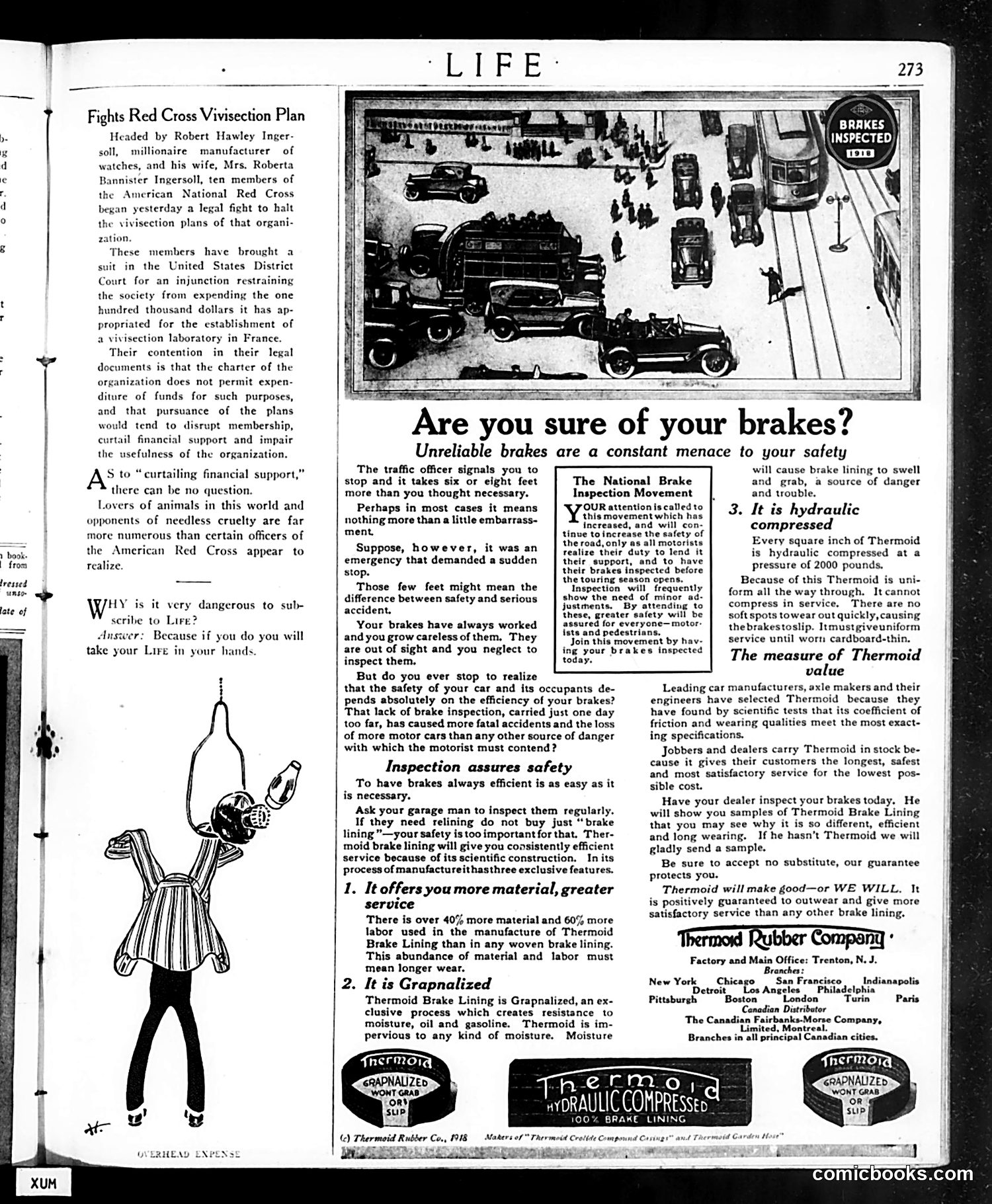
This page contains two distinct items: **Upper Left: Red Cross Vivisection Controversy** A news item reports that Robert Hawley Ingersoll (a wealthy watch manufacturer) and his wife are leading ten American Red Cross members in a lawsuit to block the organization from spending $100,000 to establish a vivisection laboratory in France. They argue the expenditure violates the Red Cross charter and will damage membership and finances. The piece notes that animal lovers far outnumber those supporting such research—a swipe at Red Cross leadership for being out of touch with public sentiment. **Main Content: Thermoid Brake Lining Advertisement** The bulk of the page is a commercial advertisement disguised as public safety advocacy, promoting the "National Brake Inspection Movement." It uses fear-based messaging (unreliable brakes kill more people than any other car hazard) to sell Thermoid brand brake lining, highlighting three features: more material/labor, "Grapnalized" moisture resistance, and hydraulic compression. The sidebar joke "Why is it dangerous to subscribe to Life?" with the punchline about taking your "Lire" (Italian currency) in your hands is a pun unrelated to the main content.
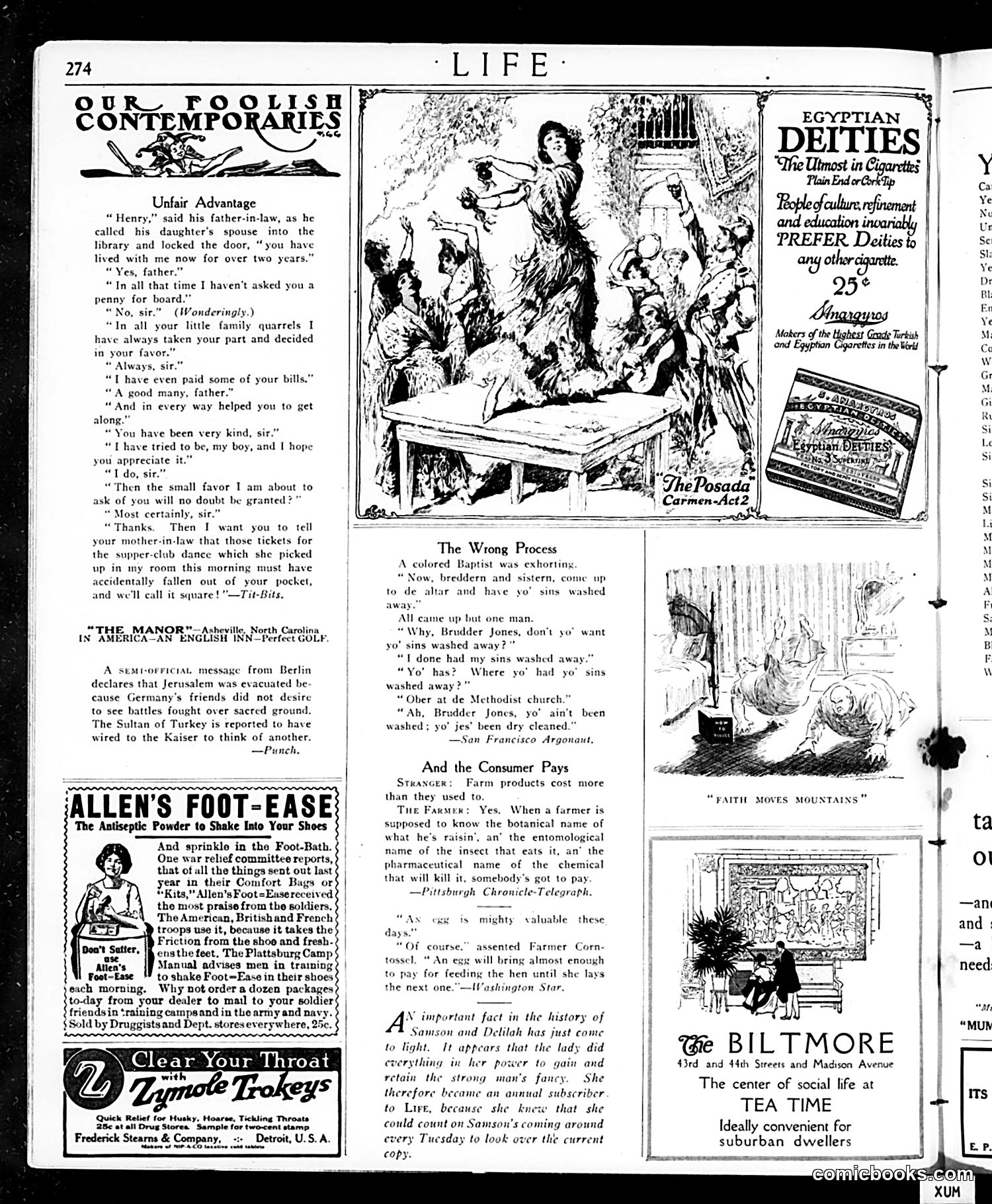
**"Unfair Advantage"** depicts a father-in-law who has generously supported his son-in-law for two years, then demands a favor: falsely claiming the son-in-law left supper-club dance tickets in his room, so the father can deceive his wife. The joke satirizes male marital deception and the leverage of financial dependence—the son-in-law must comply because he owes his father-in-law. **"The Wrong Process"** is a dialect joke about a Black Baptist preacher discovering a congregant had his "sins washed away" at a Methodist church, prompting the punchline that he was merely "dry cleaned" instead. It plays on religious rivalry and the period's common use of ethnic/racial humor. **"And the Consumer Pays"** satirizes farmers facing new agricultural complexity—they must now know botanical names of crops and chemical names of pesticides—meaning someone pays for this increased expertise burden, ultimately the consumer. The page is primarily humor and advertising, typical of Life's format circa 1910s-1920s.
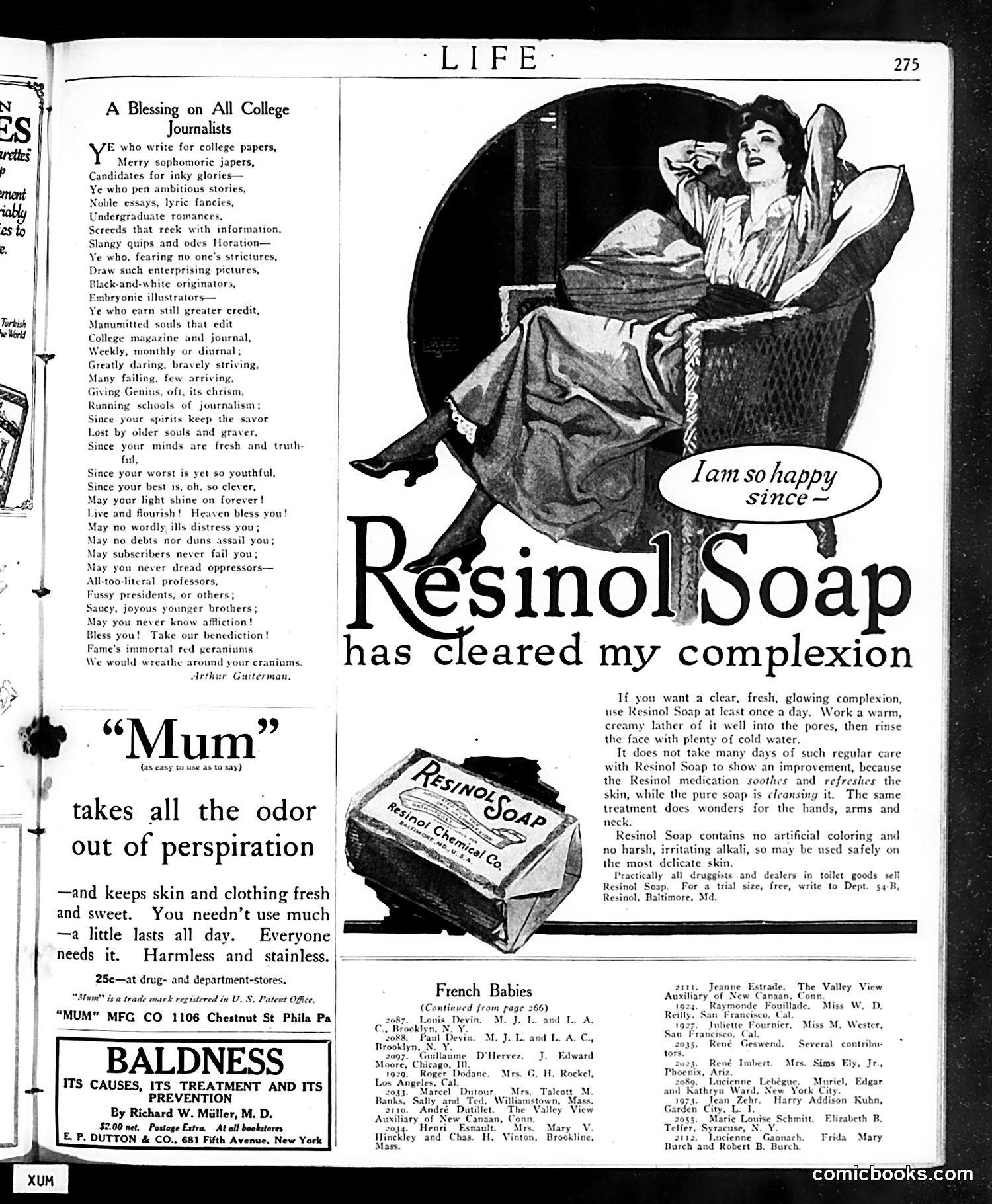
This page is primarily **advertisements and filler content** rather than political satire. The main content includes: 1. **"A Blessing on All College Journalists"** — A celebratory poem by Arthur Guiterman praising college newspaper writers and editors. It's gentle mockery in the tradition of "mock-heroic" verse, treating student journalists as noble figures while poking fun at their youthful earnestness, their struggles with deadlines, and their desire for glory. 2. **Product advertisements** dominating the page: Resinol Soap (complexion care), "Mum" deodorant, and a baldness treatment book. These reflect early 20th-century consumer culture and common anxieties about appearance and hygiene. The page contains no significant political commentary — it's typical magazine filler showcasing both light literary content and commercial advertising, standard for *Life* magazine during this era.
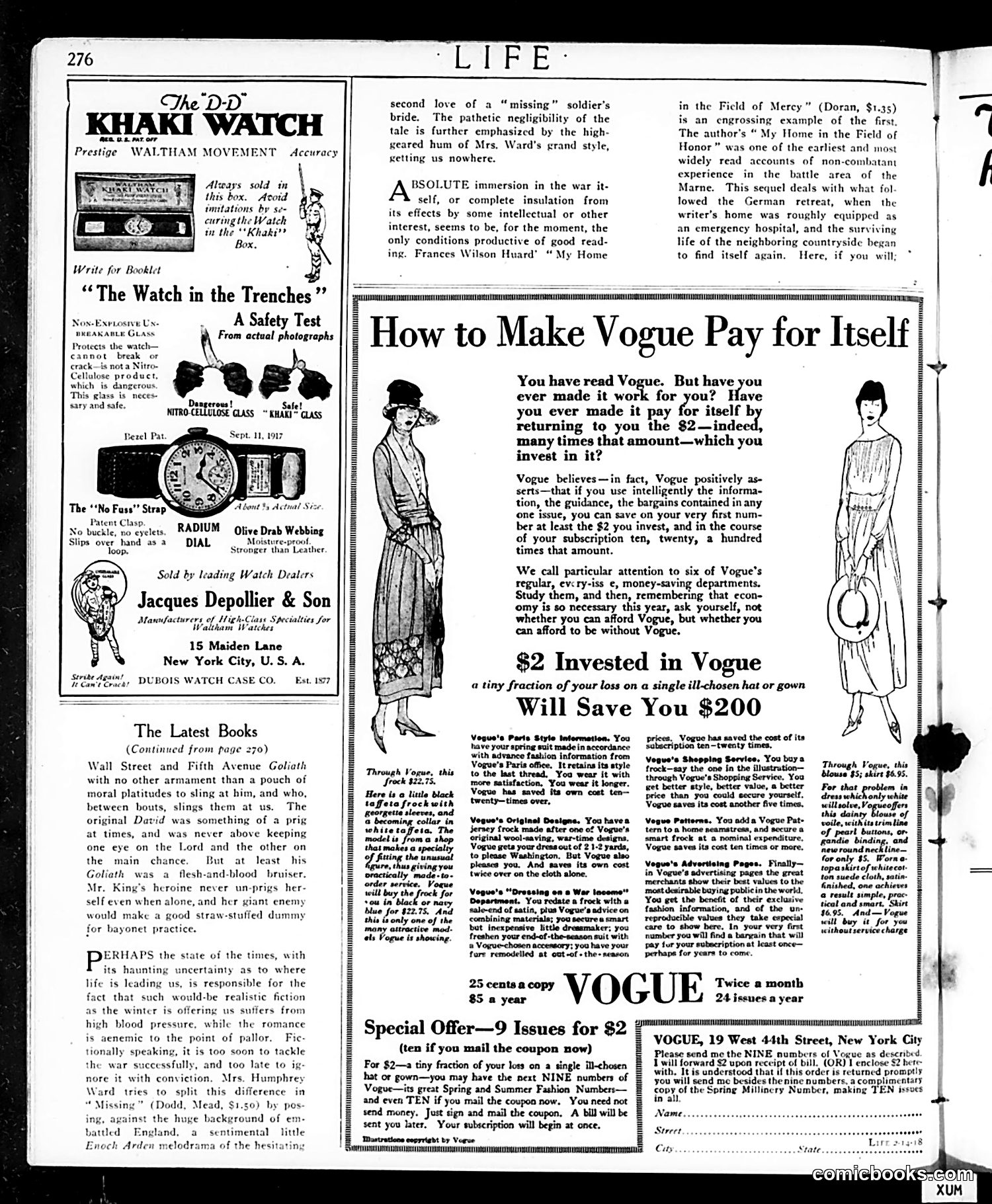
This page combines **wartime advertising with book reviews** reflecting WWI-era concerns. ## Advertisements (Left Side) The "D-D Khaki Watch" ads target soldiers. The marketing emphasizes military practicality—unbreakable glass, radium dials for darkness, and a safety strap—positioning the watch as essential trench equipment. References to "The Watch in the Trenches" and combat conditions reflect the massive American military mobilization of 1917. ## Book Review (Lower Left) The reviewer critiques contemporary fiction's treatment of war, arguing that successful war novels require either complete immersion in combat or total insulation from it. The review of "Missing" (about a soldier's bride) dismisses it as emotionally overwrought and trivial against the war's real scale. ## Vogue Advertisement (Right Side) This occupies roughly half the page, promoting fashion magazine subscriptions by claiming Vogue helps readers save money through smart purchasing and resourceful design—using war-era conservation rhetoric ("wool-saving") to justify fashion consumption as practical patriotism rather than frivolity. The juxtaposition reveals how American commerce adapted messaging to legitimize luxury spending during wartime.
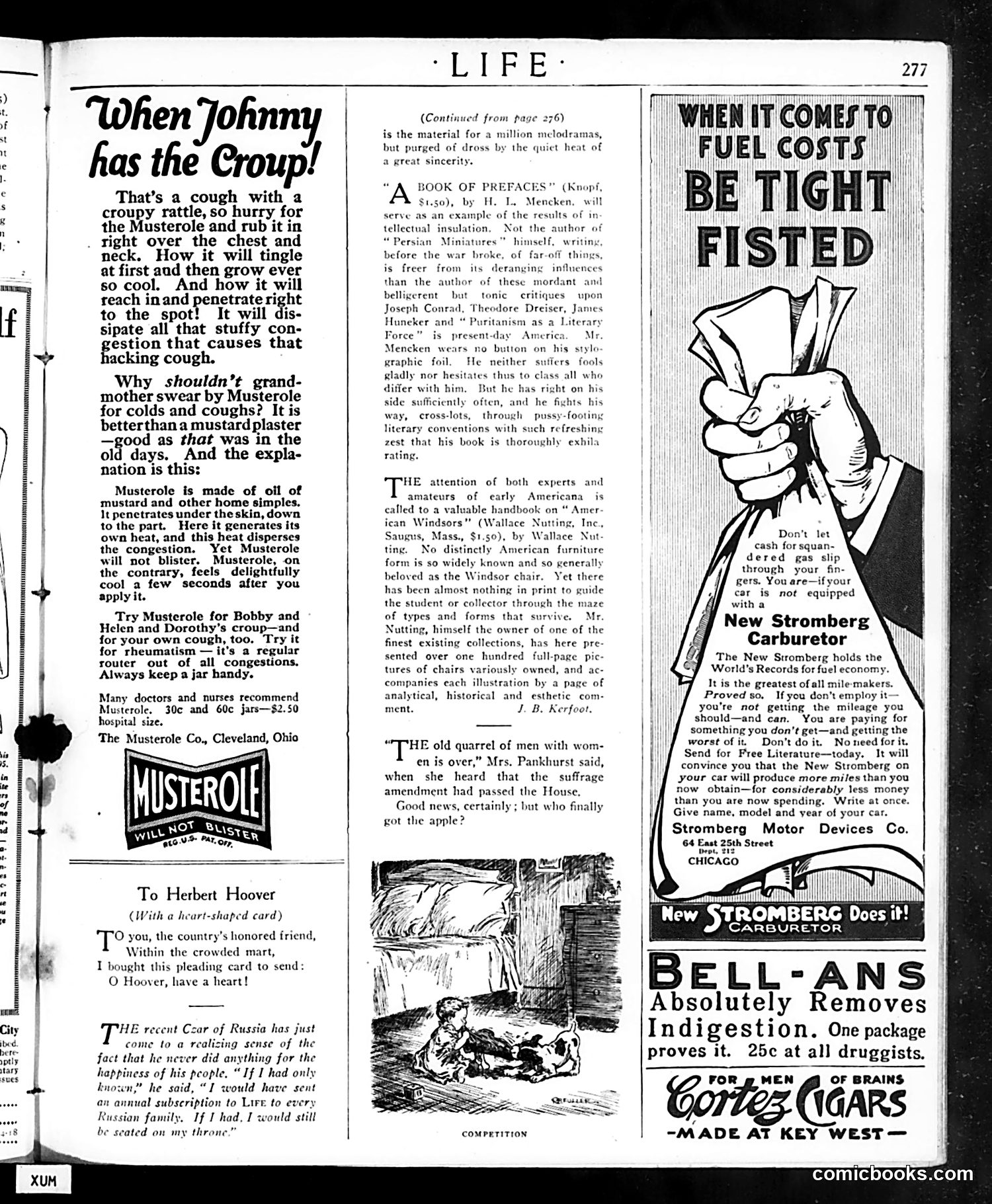
This page contains three distinct elements: **Left side:** Advertisements and a humorous poem to Herbert Hoover (likely written during his Food Administration role in WWI, asking him to "have a heart" regarding rationing/shortages). A Musterole cold remedy ad emphasizes home medical treatment. **Center:** Book reviews, including H.L. Mencken's "Book of Prefaces" and Wallace Nutting's guide to American Windsor chairs—intellectual/cultural content typical of *Life* magazine's editorial voice. **Right side:** Advertisements for fuel-efficient carburetors and cigars, with wartime messaging about conserving gasoline ("Be tight fisted"). This reflects post-WWI fuel scarcity concerns. The page illustrates *Life*'s dual nature: a satirical magazine supporting consumer culture and home remedies while also publishing serious literary criticism. The advertising reflects 1920s concerns about efficiency, thrift, and modern technology solving everyday problems.
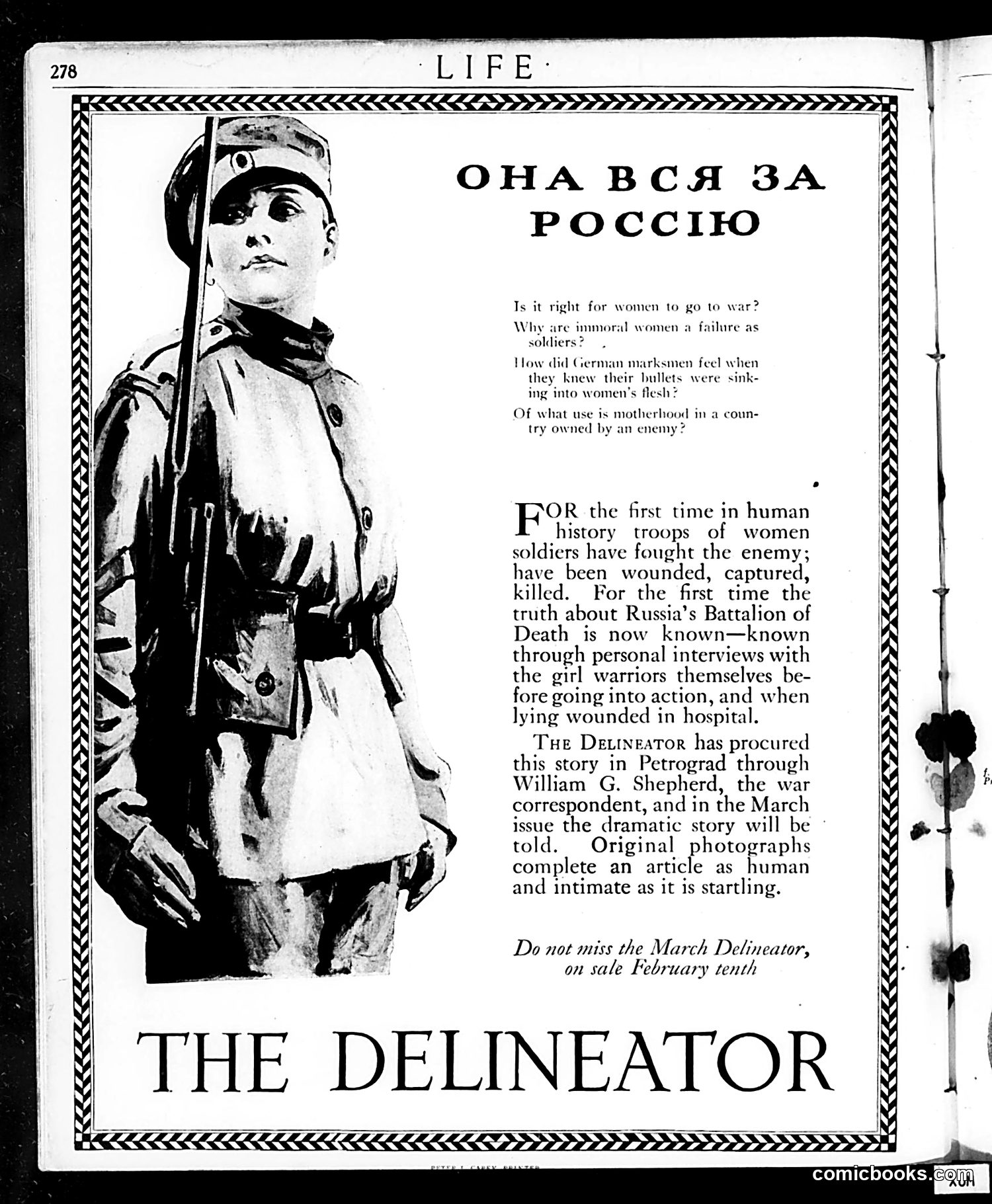
This is primarily **advertising**, not satire. The page promotes "The Delineator" magazine's March issue and a story in "The Delineator" about Russia's "Battalion of Death"—an actual all-female combat unit that fought in World War I. The image shows a **female Russian soldier** in military uniform with rifle and bayonet, representing these women combatants. The accompanying text poses rhetorical questions designed to intrigue readers: "Is it right for women to go to war?" and "How did German marksmen feel when they knew their bullets were sinking into women's flesh?"—emphasizing the novelty and emotional impact of female soldiers. The ad promises "personal interviews with the girl warriors themselves" and "original photographs," positioning the story as groundbreaking journalism by war correspondent William G. Shepherd. The appeal is to readers' curiosity about this historically unprecedented phenomenon rather than to political satire.
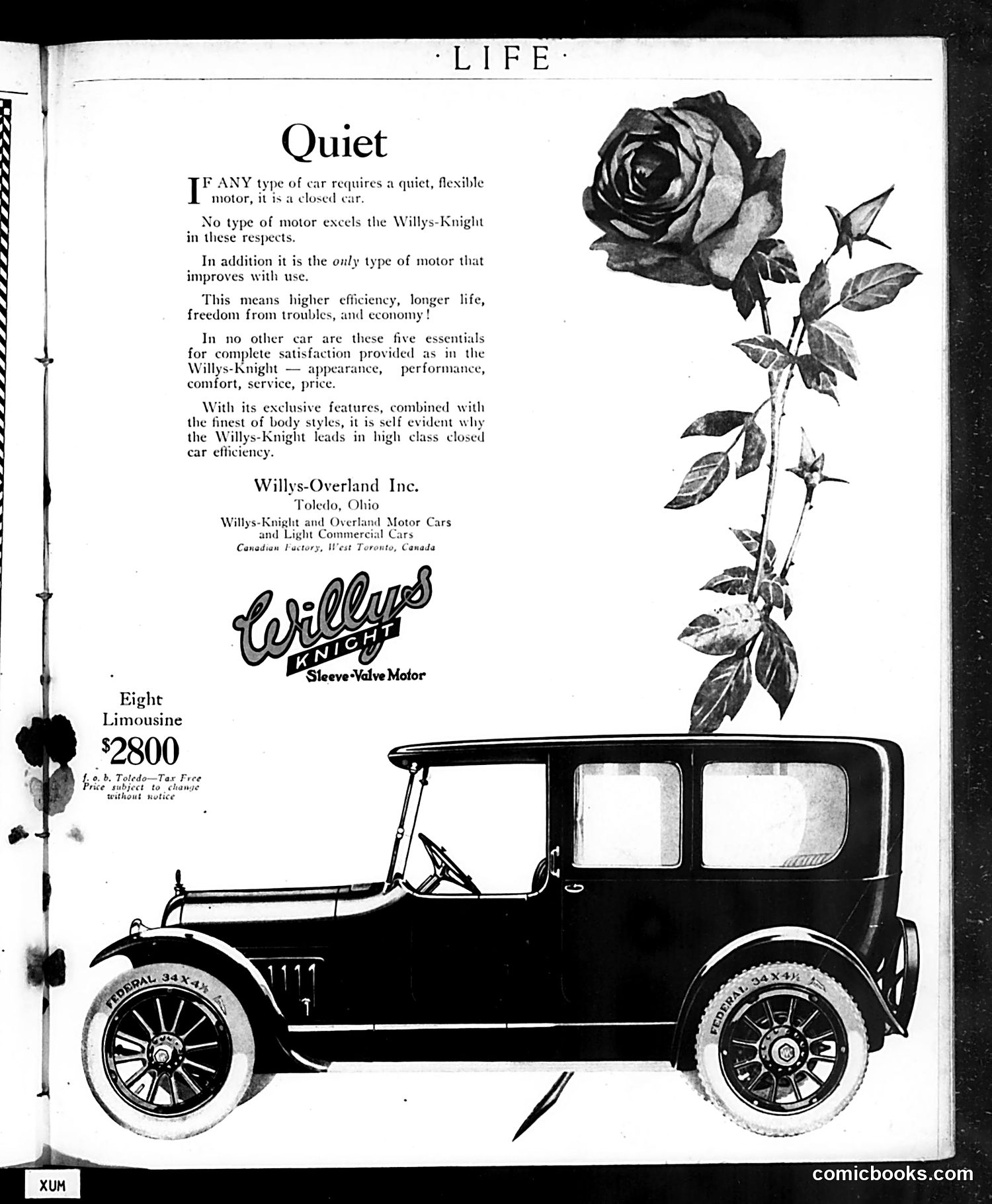
This is not a cartoon or satirical content—it's a straightforward **automobile advertisement** for the Willys-Knight motor car, published in *Life* magazine (which was a general-interest publication, not purely satirical). The page promotes the Willys-Knight's "Quiet" engine, emphasizing its sleeve-valve motor technology. The ad claims the engine "improves with use" and offers "higher efficiency, longer life, freedom from troubles, and economy." It lists five essentials: appearance, performance, comfort, service, and price. The decorative rose illustration is period-typical advertising ornament. The Eight Limousine model is priced at $2,800 (f.o.b. Toledo, Ohio). The Willys-Overland Inc. company, based in Toledo with a Canadian factory, manufactured both Willys-Knight and Overland vehicles. This reflects early 1920s automotive marketing, before mass production made cars ubiquitous.
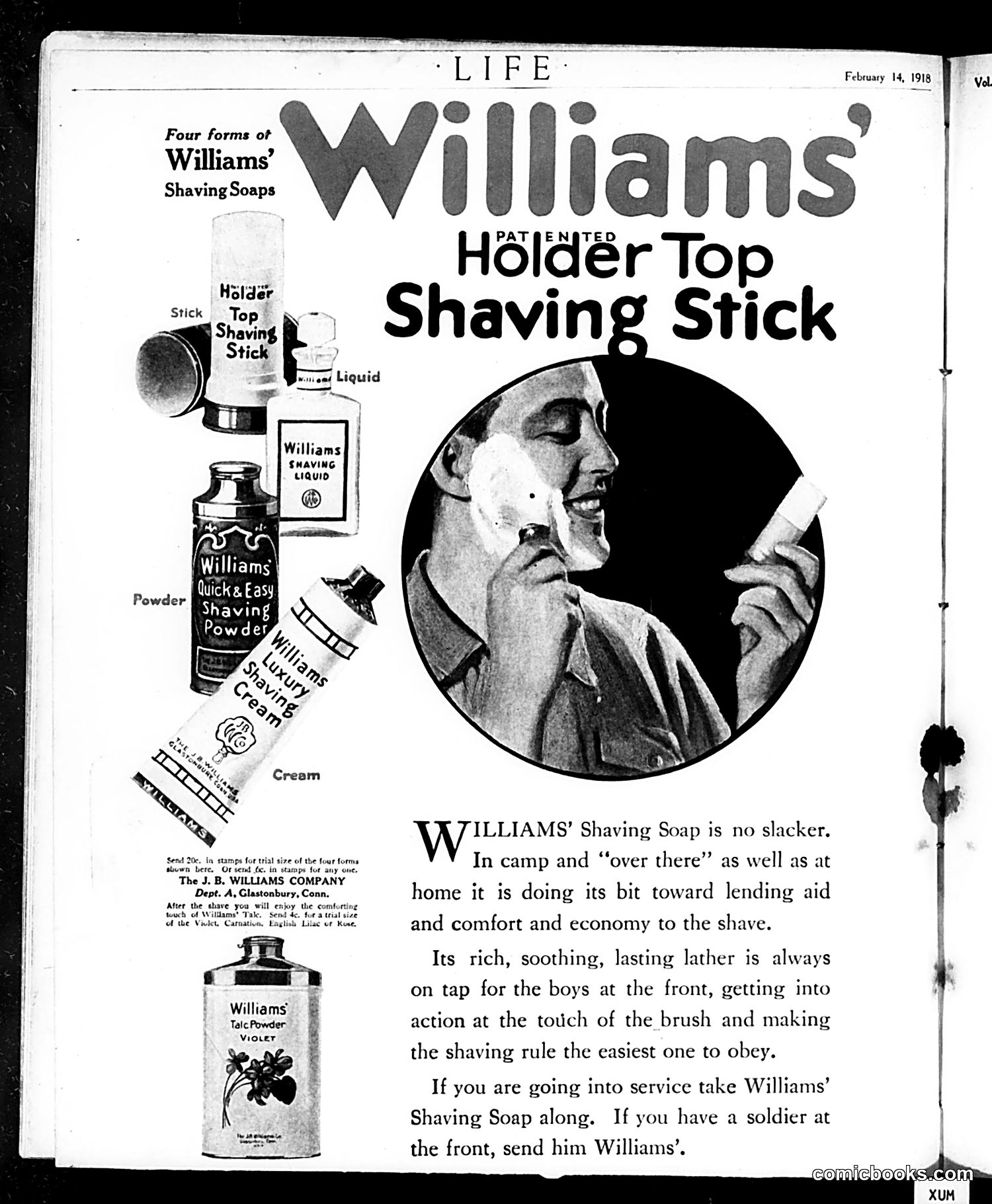
This is a **wartime advertisement**, not political satire. Dated February 14, 1918, it's a Williams' Shaving Soap ad directly targeting American soldiers in World War I. **The "Point":** The ad uses patriotic language to position shaving soap as essential military equipment. It calls Williams' soap "no slacker" (invoking the contempt for draft-dodgers), claiming the product aids soldiers "in camp and 'over there'" (military slang for the European front). The circular photograph shows a soldier shaving—proof of the product's battlefield utility. **The Appeal:** The text directly addresses civilians: those "going into service" should bring Williams' soap; those with soldiers at the front should send it as a care package. This transforms a luxury grooming product into a patriotic gift and necessity. **Historical Context:** In 1918, wartime advertising frequently wrapped commercial products in patriotic duty. "No slacker" explicitly references the moral shame attached to draft resistance, making consumer choice seem like participation in the war effort itself. This reflects how American businesses mobilized marketing around WWI support.