
Life, 1918-02-14 · page 30 of 40
Life — February 14, 1918 — page 30: what you’re looking at
What you’re looking at
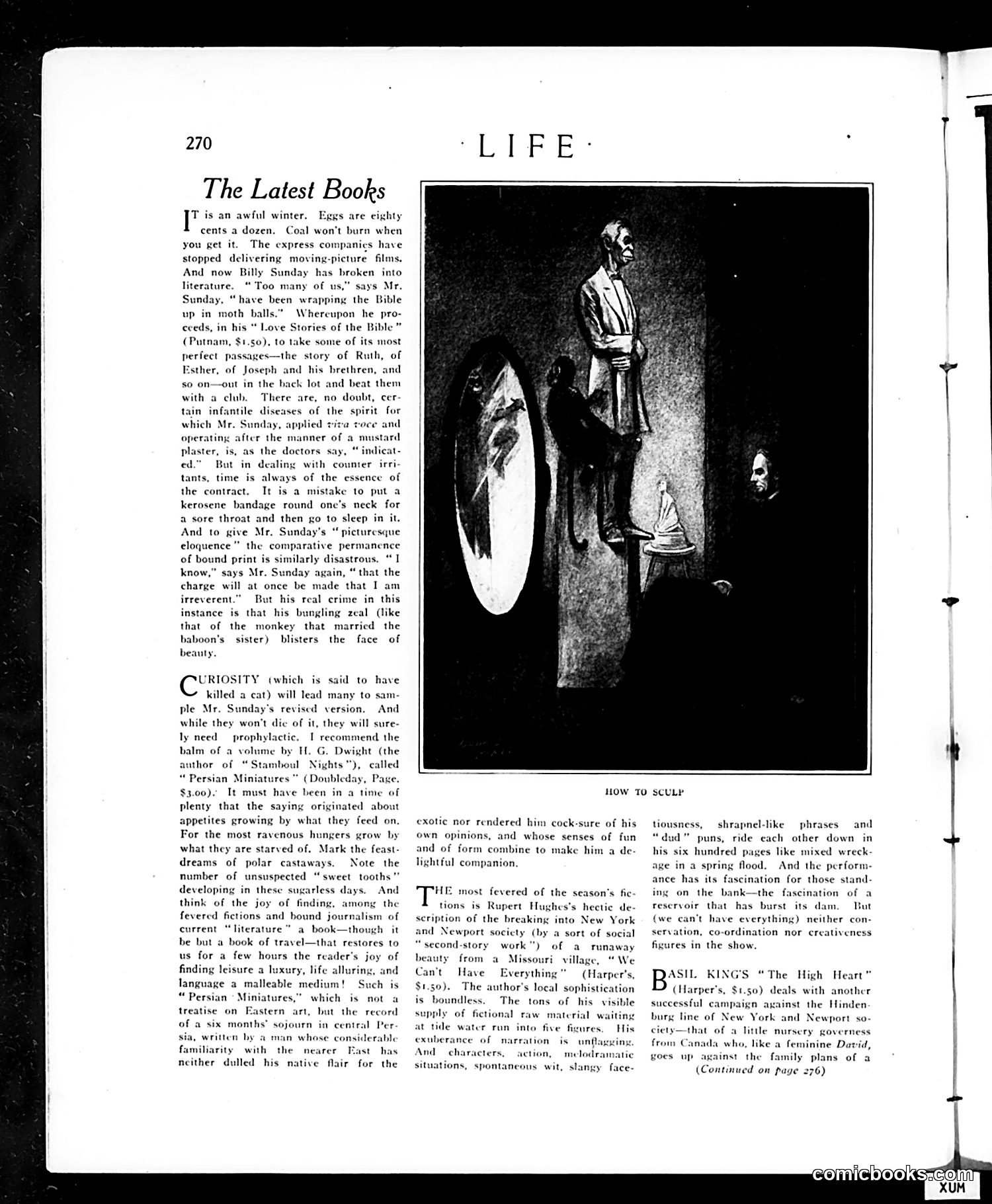
This page reviews Billy Sunday's "Love Stories of the Bible," a collection the critic brutally mocks. Billy Sunday was a famous evangelical preacher known for fiery, colloquial sermons. The reviewer sarcastically compares Sunday's "bungling zeal" to a monkey marrying a baboon's sister—his crude approach to Biblical passages "blisters the face of beauty." The illustration labeled "HOW TO SCULP" appears to satirize Sunday's heavy-handed method: depicting a figure with a hammer and chisel attacking a classical bust, literally smashing refinement into something crude. The metaphor suggests that Sunday's populist, aggressive style ruins the elegant artistry of scripture. The page also reviews other contemporary fiction, including Rupert Hughes's society novel. The overall tone criticizes attempts to make high culture accessible through crude methods—the core satire being that overzealous modernization can destroy what it aims to preserve.
📄 Transcribed text from this page (OCR, searchable)
Machine-transcribed from the original scan — historical spelling and the odd misread are preserved.
270 The Latest Books r is an awful winter. Eggs are eighty cents a dozen. Coal won't burn when you get i stopped delivering moving-picture films. And now Billy Sunday has broken into lite Sunday, “have been wrapping the Bible up in moth balls.” Whereupon he pro- ceeds, in his “ Love Stories of the Bible” (Putnam, $1.50), to take some of its most perfect passages—the story of Ruth, of Esther, of Joseph and his brethren, and so on—out in the back lot and beat them with a club. There are, no doubt, cer- tain infantile diseases of the spirit for h Mr. Sunday, applied after the manner of a mustard The express companies have Too many of us,” says Mr. ure. viva voce and operatin| plaster, is, as the doctors say, “indicat- ed.” But in dealing with counter irri tants, time is always of the essence of the contract. It is a mistake to put a kerosene bandage round one’s neck for a sore throat and then go to sleep in it. And to give Mr. Sunday's “ picturesque eloquence” the comparative permanence of bound print is similarly disastrous. “1 know,” says Mr. Sunday again, “that the charge will at once be made that I am irreverent.” But his real crime in this instance is that his bungling zcal (like that of the monkey that married the baboon's sister) blisters the face of beauty. URIOSITY (which is. sait killed a cat) will lead many to sam- ple Mr. Sunday's revised version. And while they won't dic of it, they will sure- ly need prophylactic. I recommend the balm of a volume by H. author of “ boul Nights"), called to have 3. Dwight (the “ Persian Miniatures ” (Doubleday, Page. plenty that the saying originated about appetites growing by what they feed on, exotic nor rendered him cock-sure of his For the most ravenous hungers grow by own opinions, and whose senses of fun what they are starved of. Mark the feast- and of form combine to 1 dreams of polar castaways. Note the lig number of unsuspected “sweet tooths” developing in these sugarless days. And think of the joy of finding, among the fevered fictions and bound jour current ake him a de htful companion, HIE most fevered of the season's fic tions is Rupert Hughes's hectic de- ism of — scription of the breaking into New York literature” a book—though it and Newport society (by a sort of social be but a book of travel—that restores to“ second-story work” of a runaway us for a few hours the reader's joy of beauty from a Missouri village, “We finding leisure a luxury, life alluring, and Can't. Have Everything” — (Harper's, language a malleable medium! Such is $1.50). The author's local sophistication “ Persian Miniatures,” which is not a is boundless. The tons of his visible treatise on 1, but the record — supply of fictional raw material waiting of a six months’ sojourn in central Per fasten at tide water run into five fi written by a man whose considerable exuberance of nart familiarity with the nearer East ha And ch. neither dulled his native flair for the — situations, spontaneous wit, slangy face: res. His ion is unfla racters, action, melodramatic sia $3.00). It must have been in a time of Mow To SCULP tiousness, shrapnel-like phrases and “dud” puns, ride cach other down in his six hundred pages like mixed wreck- flood. And the perform fascination for those stand- age in a sprit ance has its f bank—the fascination of a reservoir that has burst its dam. I ing on th (we can't have everything) neither con- servation, co-ordination nor crea figures in the show. iveness ASIL KING'S “The High Heart” (Harper's, $1.50) deals with another su ‘cessful campaign against the Hinden burg line o New York and Newport so- ciety—th of a little nursery governess from Canada who, like a feminine David, nst the family plans of a (Continued on page 276) goes up +