
Life, 1918-02-14 · page 22 of 40
Life — February 14, 1918 — page 22: what you’re looking at
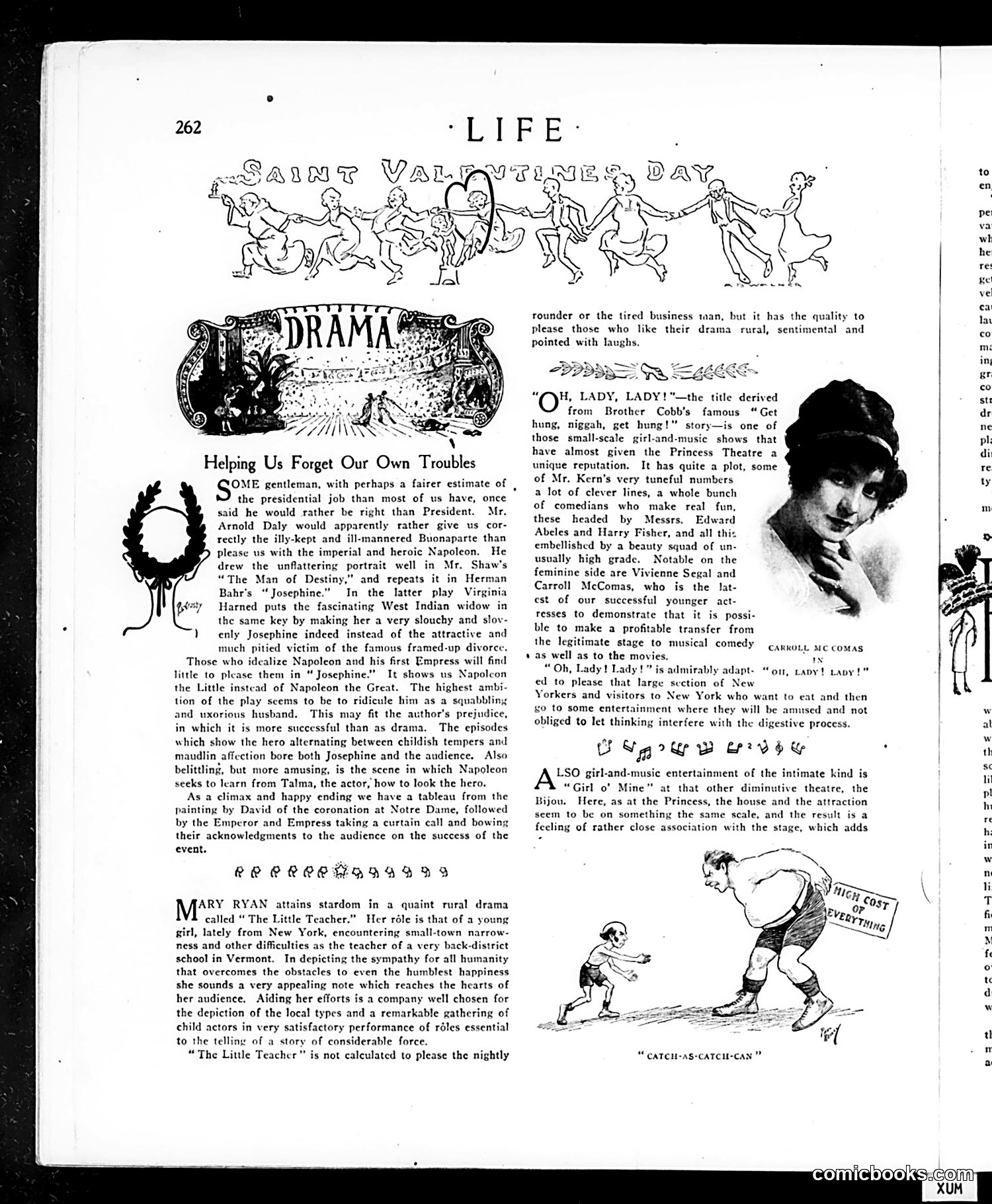
What you’re looking at
This page reviews theatrical productions, mocking both performers and audiences. The main critiques are: **"Josephine"**: Actor Arnold Daly and actress Virginia Harned are criticized for portraying Napoleon and Josephine as petty, quarrelsome figures rather than the romantic, heroic couple audiences expect. The reviewer suggests this unflattering depiction appeals only to those with anti-Napoleon prejudices. **"The Little Teacher"**: Mary Ryan stars in a sentimental rural drama about a New York teacher in Vermont. It's presented as wholesome entertainment for those wanting emotional appeal and rustic charm. **"Oh, Lady! Lady!"**: This musical comedy at the Princess Theatre features tuneful songs by composer Kern, comedians, and attractive actresses like Vivienne Segal. The reviewer notes it's designed for patrons who want amusement without intellectual engagement—essentially dinner-theater entertainment for people who don't want to think. The overall tone suggests Life's readers were culturally sophisticated enough to recognize when theatrical productions aimed at lower intellectual expectations.
📄 Transcribed text from this page (OCR, searchable)
Machine-transcribed from the original scan — historical spelling and the odd misread are preserved.
262 PPE, * pe aine VAL RY 3 \ Helping Us Forget Our Own Troubles the presidential job than most of us have, once said he would rather be right than President. Mr. Arnold Daly would apparently rather give us cor- rectly the illy-kept and ill-mannered Buonaparte than please us with the imperial and heroic Napoleon. He drew the unflattering portrait well in Mr. Shaw's “The Man of Destiny,” and repeats it in Herman Bahr's “Josephine.” In the latter play Virgini Harned puts the fascinating West Indian widow in the same key by making her a very slouchy and slov- enly Josephine indeed instead of the attractive and much pitied vietim of the famous framed-up divorce. Those who idealize Napoleon and his first Empress will find little to please them in “ Josephine.” It shows us Napoleon the Little instead of Napoleon the Great. The highest ambi- tion of the play scems to be to ridicule him as a squabbling and uxorious husband. This may fit the author’s prejudice, in which it is more successful than as drama. The episodes which show the hero alternating between childish tempers and maudlin affection bore both Josephine and the audience. Also belittling, but more amusing, is the scene in which Napoleon seeks to learn from Talma, the actor, how to look the hero. As a climax and happy ending we have a tableau from the painting by David of the coronation at Notre Dame, followed by the Emperor and Empress taking a curtain call and bowing their acknowledgments to the audience on the success of the event. RR RCRCOCHEASS3D ARY RYAN attains stardom in a quaint rural drama called “ The Little Teacher.” Her réle is that of a young girl, lately from New York, encountering small-town narrow- ness and other difficulties as the teacher of a very back-district school in Vermont. In depicting the sympathy for all humanity that overcomes the obstacles to even the humblest happiness she sounds a very appealing note which reaches the hearts of her audience. Aiding her efforts is a company well chosen for the depiction of the local types and a remarkable gathering of child actors in very satisfactory performance of réles essential to the telling of a story of considerable force. “The Little Teacher" is not calculated to please the nightly OME gentleman, with perhaps a fairer estimate of | 28 iS RS) DAY. Oe rounder or the tired business tan, but it has the quality to please those who like their drama rural, sentimental and pointed with laughs. “C)H, LADY, LADY! "—the title derived from Brother Cobb’s famous “Get hung, niggah, get hung!" story—is one of those small-scale girl-and-music shows that have almost given the Princess Theatre a unique reputation. It has quite a plot, some of Mr. Kern’s very tuneful numbers a lot of clever lines, a whole bunch of comedians who make real fun, these headed by Messrs, Edward Abeles and Harry Fisher, and all this embellished by a beauty squad of un- usually high grade. Notable on the feminine side are Vivienne Segal and Carroll McComas, who is the Iat- est of our successful younger act- tresses to demonstrate that it is possi- ble to make a profitable transfer from the legitimate stage to musical comedy well as to the movies. "Oh, Lady! Lady!" is admirably adapt- “ou, cavy! apy!" ed to please that large section of New Yorkers and visitors to New York who want to eat and then so to some entertainment where they will be amused and not obliged to let thinking interfere with the digestive process. Vg w ee LSO girl-and-music entertainment of the intimate kind is “Girl o' Mine” at that other diminutive theatre, the Bijou. Here, as at the Princess, the house and the attraction seem to be on something the same scale, and the result is a feeling of rather close association with the stage, which adds CARKOLL MCCOMAS a IN “ CATCH-AS-CATCH-CAN m: