
Life, 1918-02-14 · page 19 of 40
Life — February 14, 1918 — page 19: what you’re looking at
What you’re looking at
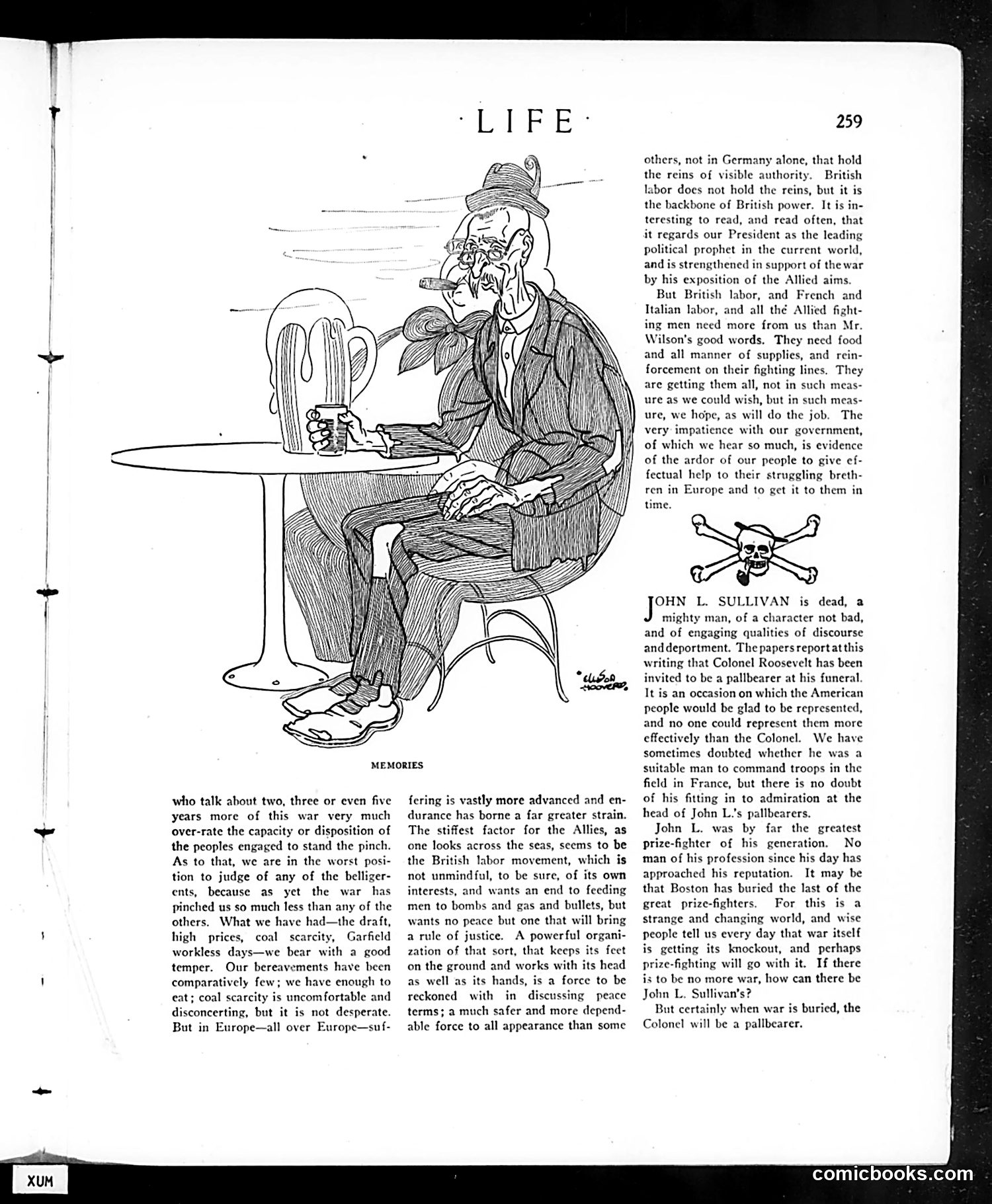
The illustration depicts a caricatured figure (likely representing German authority or leadership) sitting at a table, appearing disheveled and troubled. The cartoon's context, drawn during World War I, satirizes European power structures. The accompanying text discusses British labor movements as the true backbone of Allied strength—more reliable than visible political authority. The author argues that while President Wilson's rhetoric inspires Allied workers, they need material support (food, supplies, reinforcements) rather than words. The secondary piece eulogizes boxer John L. Sullivan, using his death to make a broader point: it sardonically suggests that Colonel Roosevelt (likely Theodore Roosevelt) would be the perfect pallbearer, implying Roosevelt's influence is waning as the world moves beyond both prize-fighting and war itself. The cartoon critiques both wartime leadership and American preparedness, suggesting our government moves too slowly providing aid to struggling European allies.
📄 Transcribed text from this page (OCR, searchable)
Machine-transcribed from the original scan — historical spelling and the odd misread are preserved.
MEMORIES who talk about two, three or even five years more of this war very much over-rate the capacity or disposition of the peoples engaged to stand the pinch. As to that, we are in the worst posi- tion to judge of any of the belliger- ents, because as yet the war has pinched us so much less than any of the others. What we have had—the draft, high prices, coal scarcity, Garfield workless days—we bear with a good temper. Our bereavements have been comparatively few; we have enough to eat; coal scarcity is uncomfortable and disconcerting, but it is not desperate. But in Europe—all over Europe—suf- fering is vastly more advanced and en- durance has borne a far greater strain. The stiffest factor for the Allies, as one looks across the seas, scems to be the British labor movement, which is not unmindful, to be sure, of its own interests, and wants an end to feeding men to bombs and gas and bullets, but wants no peace but one that will bring a rule of justice. A powerful organi- zation of that sort, that keeps its feet on the ground and works with its head as well as its hands, is a force to be reckoned with in discussing peace terms; a much safer and more depend- able force to all appearance than some 259 others, not in Germany alone, that hold the reins of visible authority. British labor does not hold the reins, but it is the backbone of British power. It is in- teresting to read, and read often, that it regards our President as the leading political prophet in the current world, and is strengthened in support of the war by his exposition of the Allied aims. But British labor, and French and Italian labor, and all thé Allied fight- ing men need more from us than Mr. Wilson's good words. They need food and all manner of supplies, and rein- forcement on their fighting lines, They are getting them all, not in such meas- ure as we could wish, but in such meas- ure, we hope, as will do the job. The very impatience with our government, of which we hear so much, is evidence of the ardor of our people to give ef- fectual help to their struggling breth- ren in Europe and to get it to them in time. OHN L. SULLIVAN is dead, a mighty man, of a character not bad, and of engaging qualities of discourse anddeportment. The papers report at this writing that Colonel Roosevelt has been invited to be a pallbearer at his funeral. It is an occasion on which the American people would be glad to be represented, and no one could represent them more effectively than the Colonel. We have sometimes doubted whether he was a suitable man to command troops in the field in France, but there is no doubt of his fitting in to admiration at the head of John L.'s pallbearers. John L. was by far the greatest prize-fighter of his generation. No man of his profession since his day has approached his reputation. It may be that Boston has buried the last of the great prize-fighters. For this is a strange and changing world, and wise people tell us every day that war itself is getting its knockout, and perhaps prize-fighting will go with it. If there is to be no more war, how can there be John L. Sullivan's? But certainly when war is buried, the Colonel will be a pallbearer. comicbooks.com