
Life, 1918-02-14 · page 8 of 40
Life — February 14, 1918 — page 8: what you’re looking at
What you’re looking at
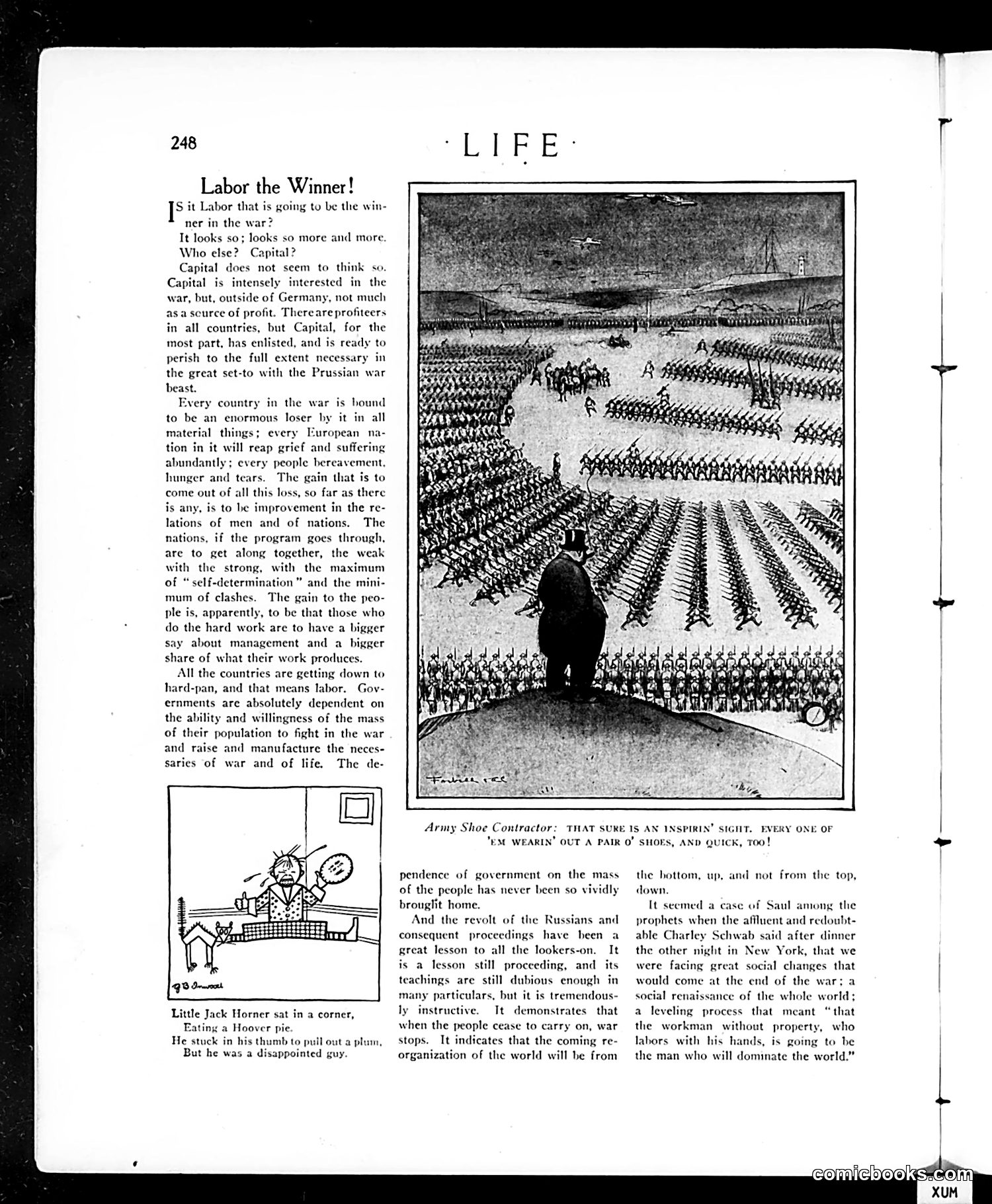
**Main Article: "Labor the Winner!"** This piece argues that labor—not capital—will emerge victorious from World War I. The author contends that governments depend entirely on workers' willingness to fight and manufacture war materials, giving labor unprecedented leverage. The text references "the revolt of the Russians and consequent proceedings" as demonstrating that when people stop supporting war, it ends—a lesson about future world reorganization favoring the working class. **Small Cartoon: "Little Jack Horner"** A crude satirical rhyme shows a figure (unclear which politician) extracting a plum from a pie—likely representing profiteering or corrupt advantage-taking during wartime. **Large Illustration: "Army Shoe Contractor"** Depicts a figure overseeing assembled troops, captioned about soldiers wearing out shoes quickly. This appears to satirize military contractors profiting from war supply contracts.
📄 Transcribed text from this page (OCR, searchable)
Machine-transcribed from the original scan — historical spelling and the odd misread are preserved.
248 Labor the Winner! S it Labor that is going to be the win- ner in the war? It looks so; looks so more and more. Who else? Capital? Capital does not seem to think so. Capital is intensely interested in the war, but, outside of Germany, not much asa scurce of profit. There are profiteers in all countries, but Capi for the most part, has enlisted, and is ready to perish to the full extent necessary in the great set-to with the Prussian war beast. ery country in the war is bound to be an enormous loser by it in all al things; every European na- tion in it will reap grief and suffering abundantly ; every people bereavement, hunger and tears. The gain that is to come out of all this loss, so far as there is any, is to be improvement in the re- lations of men and of nations. The nations, if the program goes through, are to get along together, the weak with the strong, with the maximum of “self-determination” and the mini- mum of clashes. The gain to the peo- ple is, apparently, to be that those who do the hard work are to have a bigger say about management and a bigger share of what their work produces. All the countries are getting down to hard-pan, and that means labor. Gov- ernments are absolutely dependent on the ability and willingness of the mass of their population to fight in the war and raise and manufacture the neces- saries of war and of life. The de- Army Shoe Contracto: "EM WEARID pendence of government on the mass of the people has never been so vividly brouglit home. And the revolt of the Russians and consequent proceedings have heen a great lesson to all the lookers-on. It is a lesson still proceeding, and its teachings are still dubious enough in many particulars, but it is tremendous- ly instructive. It demonstrates that when the people cease to carry on, war stops. It indicates that the coming re- organization of the world will be from ting a Hoover pie He stuck in his thumb to pull out a plum, But he was a disappointed guy. THAT SURE IS AN INSPIRIN’ SIGHT. OUT A PAIR 0’ SHOES, AND QUICK, Too! EVERY ONE OF the hottom, up, and not from the top, down. It seemed a case Saul among the prophets when the affluent and redoubt- able Charley Schwab said after dinner the other night in New York, that we were facing great social changes that would come at the end of the war; a social renaissance of the whole world; a leveling process that meant “that the workman without property, who labors with his hands, is going to be the man who will dominate the world.”