
Life, 1918-02-14 · page 28 of 40
Life — February 14, 1918 — page 28: what you’re looking at
What you’re looking at
This page contains WWI-era satire mocking American civilian sacrifice and censorship. **"No Peace"** depicts two men hiding in a cave—one ashamed for wanting basic comforts (food, baths, cars) during wartime, the other a *critic* who has lost his profession due to wartime censorship. The critic cannot speak truthfully or criticize authority without state suppression, making his situation hopeless. The satire targets both the *excessive patriotic fervor* demanded of civilians and the *government censorship* that silenced dissent and honest commentary. **"Good Heaven!"** jokes that even German immigrants are unwelcome (a St. Peter sign reads "No Germans need apply"), reflecting anti-German sentiment during WWI. **"Business"** mocks war profiteering: manufacturers simply relabel old products with military names and raise prices 50%. Overall, the page critiques wartime hypocrisy—demanding citizen sacrifice while suppressing free speech and enabling corporate greed.
📄 Transcribed text from this page (OCR, searchable)
Machine-transcribed from the original scan — historical spelling and the odd misread are preserved.
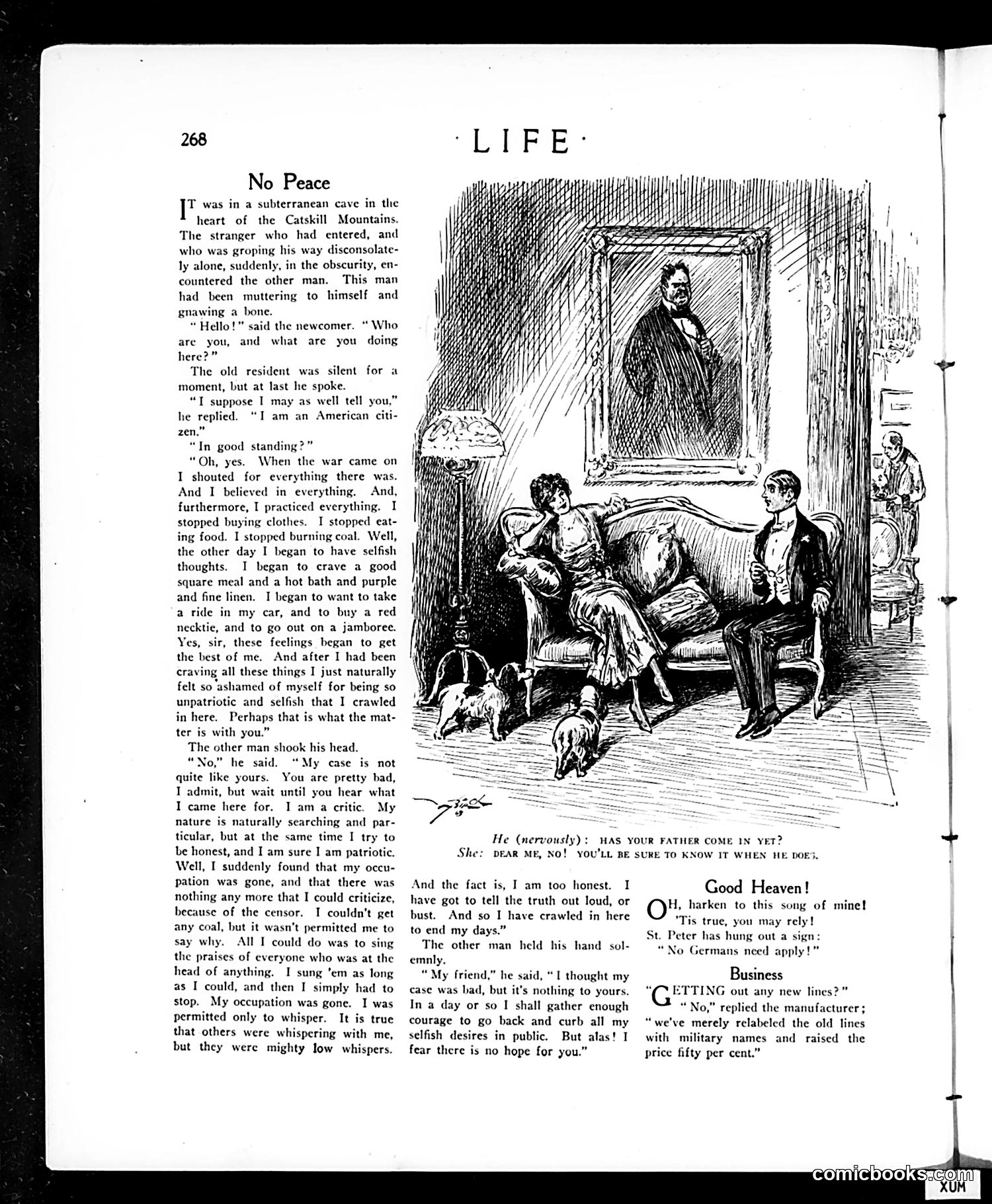
268 No Peace T was in a subterranean cave in the heart of the Catskill Mountains. The stranger who had entered, and who was groping his way disconsolate- ly alone, suddenly, in the obscurity, en- countered the other man. This man had been muttering to himself and gnawing a bone. “Hello!” said the newcomer. “ Who are you, and what are you doing here?” The old resident was silent for a moment, but at last he spoke. “T suppose I may as well tell you,” he replied. “I am an American citi- zen.” “In good standing?” “Oh, yes. When the war came on I shouted for everything there was. And I believed in everything. And, furthermore, I practiced everything. I stopped buying clothes. I stopped eat- ing food. I stopped burning coal. Well, the other day I began to have selfish thoughts. I began to crave a good square meal and a hot bath and purple and fine linen. I began to want to take a ride in my car, and to buy a red necktie, and to go out on a jamboree. Yes, sir, these feelings began to get the best of me. And after I had been craving all these things I just naturally felt so ashamed of myself for being so unpatriotic and selfish that I crawled in here. Perhaps that is what the mat- ter is with you.” The other man shook his head. “No,” he said. “My case is not quite like yours. You are pretty bad, I admit, but wait until you hear what I came here for. I am a critic. My nature is naturally searching and par- ticular, but at the same time I try to be honest, and I am sure I am patriotic. Well, I suddenly found that my occu- pation was gone, and that there was nothing any more that I could criticize, because of the censor. I couldn't get any coal, but it wasn’t permitted me to say why. All I could do was to sing the praises of everyone who was at the head of anything. I sung ’em as long as I could, and then I simply had to stop. My occupation was gone. I was permitted only to whisper. It is true that others were whispering with me, but they were mighty low whispers. SS SS Ws He (nervously) : HAS YOUR FATHER COME IN YET? She: DEAR ME, NO! YOU'LL BE SURE TO KNOW IT WHEN HE DOES. And the fact is, I am too honest. I have got to tell the truth out loud, or bust. And so I have crawled in here to end my days.” The other man held his hand sol- emnly, “My friend,” he said, “I thought my case was bad, but it’s nothing to yours. In a day or so I shall gather enough courage to go back and curb all my selfish desires in public. But alas! I fear there is no hope for you.” Good Heaven! harken to this song of minel is true, you may rely! St. Peter has hung out a sign: “No Germans need apply!” O#.. Business “CC ETTING out any new lines? No,” replied the manufacturer ; “we've merely relabeled the old lines with military names and raised the price fifty per cent.”